Easy-to-read Ganita Prakash Class 6 Notes and Chapter 8 Playing with Constructions Class 6 Notes save valuable study time during exam season.
Class 6 Maths Chapter 8 Playing with Constructions Notes
Class 6 Playing with Constructions Notes
Circle
A circle is a set of all points in a plane that are at a constant distance from a fixed point. The fixed point is known as the centre of the circle, and the constant distance is known as the radius of the circle.
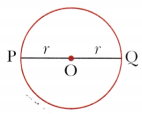
Here, O is the centre and OA = OB = r is the radius.

A line segment passing through the centre of a circle, and having its end points on the circle, is known as a diameter of the circle.
Here, PQ (diameter) = PO + OQ = r + r = 2r
Therefore the diameter of a circle with a radius ‘r’ is 2r.
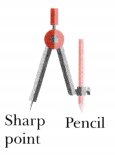
A compass is a tool used to draw circles or arcs. It has two legs — one leg has a sharp point that is placed on the centre of the circle, and the other leg holds a pencil that is used to draw the circle or the arc.
Construction of Circle
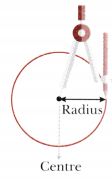
Step 1: Adjust the compass to the required radius using a ruler.
Step 2: Place the pointed leg firmly on the paper to mark the circle’s centre
Step 3: Rotate the compass to draw the circle without lifting the pencil.
Construction of Squares and Rectangles
Construction of a square of side length 5 cm:
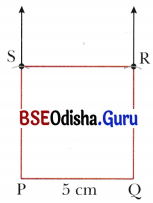
Step 1: Draw a line segment PQ = 5 cm.
Step 2: Draw a perpendicular to PQ through P.
Step 3: Using a ruler, mark S on the perpendicular such that PS = 5 cm.
Step 4: Draw a perpendicular to PQ through Q and mark R on the perpendicular such that QR = 5 cm.
Step 5: Join R and S to get square PQRS of side length 5 cm.

Construction of a rectangle of side lengths 6 cm and 4 cm:
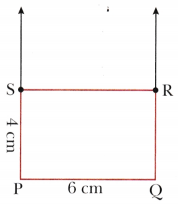
Step 1: Draw a line segment PQ = 6 cm.
Step 2: Draw a perpendicular to PQ through P.
Step 3: Using a ruler, mark S on the perpendicular such that PS = 4 cm.
Step 4: Draw a perpendicular to PQ through Q and mark R on the perpendicular such that QR = 4 cm.
Step 5: Join R and S to get rectangle PQRS of side lengths 6 cm and 4 cm.
Construction of a Rectangle in which one of the Diagonals Divides the Opposite Angles into Two Smaller Angles
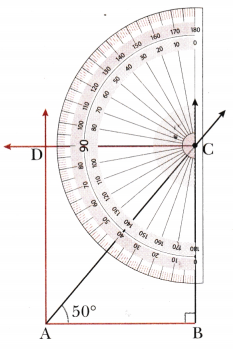
Let’s construct a rectangle in which one of the diagonals divides the opposite angles into 50° and 40°. Steps of construction are as follows:
Step 1: Draw AB of any length.
Step 2: Draw a perpendicular to AB through B.
Step 3: Draw a ray making an angle 50° with AB through A. You will get point C as point of intersection of the ray drawn in this step and perpendicular drawn in step 2.
Step 4: Draw a perpendicular to AB through A.
Step 5: Draw a perpendicular to BC through C. (Because all the angles of a rectangle are equal to 90°). Join CD to get the required rectangle ABCD.
Construction of a Rectangle in which a Side and a Diagonal are Given
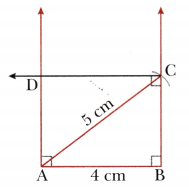
Let’s construct a rectangle where one of its sides is 4 cm and the length of a diagonal is 5 cm.
Steps of construction are as follows:
Step 1: Draw a line segment AB = 4 cm.
Step 2: Draw a perpendicular to AB through B.
Step 3: TakeT as centre and mark an arc of radius 5 cm on perpendicular to AB through B. The arc and perpendicular intersect at point C.
Step 4: Draw perpendiculars to AB and BC passing through A and C respectively. Then, the point where these perpendiculars intersect is the point D. ABCD is the required rectangle.
Points Equidistant from Two Given Points
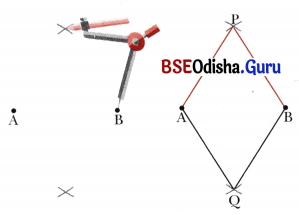
Suppose A and B are two given points. Our task is to find points that are 5 cm away from both A and B. Steps of construction are as follows:
Step 1: Take A as centre and mark two arcs of radius 5 cm such that one arc is above AB and another is A below AB.
Step 2: Take B as centre and mark two arcs of radius 5 cm such that one arc is above AB and another is below AB.
Let P and Q, be the points of intersection of arcs above and below /IB respectively. Then, AP = BP = 5 cm and AQ = BQ = 5 cm.
If you join the points P and Q with a straight line, then that line is called the perpendicular bisector of the line segment AB.
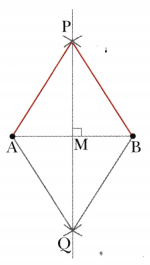
The perpendicular bisector cuts the line segment AB in two equal parts such that AM = BM.
All the points on line PQ are equidistant from points A and B. Therefore, there are infinite number of points which are equidistant from points A and B.
Construction of Circle
Steps:
Adjust the compass to the required radius using a ruler.
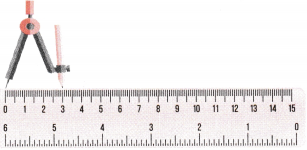
Place the pointed leg firmly on the paper to mark the circle’s centre.
Rotate the compass to draw the circle without lifting the pencil.
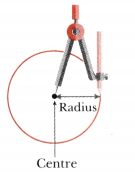
Construction of Squares and Rectangles
In a rectangle:
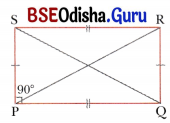
Opposite sides are parallel and equal.
All angles are 90°.
Diagonals are equal and bisect each other.
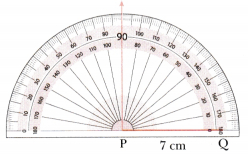
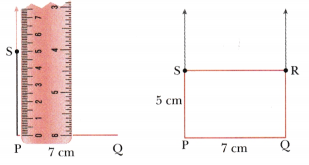
Construction of a rectangle of side lengths 7 cm and 5 cm:
Draw a line segment PQ = 7 cm.
Draw a perpendicular to PQ through P.
Using a ruler, mark S on the perpendicular such that PS = 5 cm.
Draw a perpendicular to PQ through (land mark R on the perpendicular such that QR = 5 cm.
Join R and S to get rectangle PQRS of side lengths 7 cm and 5 cm.
In a square:
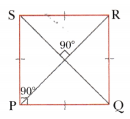
All four sides are equal.
Opposite sides are parallel,
All angles are 90°.
Diagonals are equal and bisect each p other at 90°.
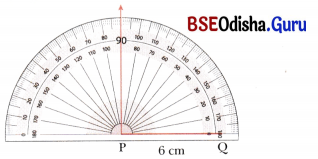
Construction of a square of side length 6 cm:
Draw a line segment PQ = 6 cm.
Draw a perpendicular to PQ through P.
Using a ruler, mark S on the perpendicular such that PS = 6 cm.
Draw a perpendicular to PQ through Q and mark R on the perpendicular such that QR = 6 cm.
Join R and S to get square PQRS of side length 6 Cm.
Instruments for Construction
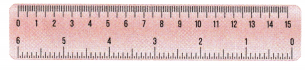
Ruler
For drawing and measuring straight lines.
It has two long straight edges. One edge is graduated into centimetres and millimetres and the other is usually graduated into inches.
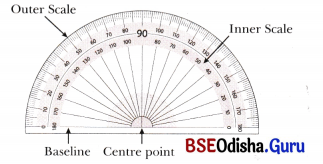
Protractor
Semi circular tool used to construct and measure angles.
Compass
For drawing circles and arcs.
It has two legs, one with a sharp needle and the other with a screw arrangement to hold a pencil. The two legs are hinged together which gives a provision to increase or decrease the distance between them.
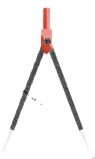
Divider
It has two legs with sharp needle at their end.
It is used to compare the lengths.
Construction of a Rectangle with Diagonals dividing the opposite angles
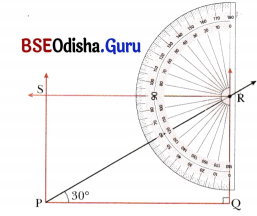
Construction of a rectangle in which one of the diagonals divides the opposite angles in 30° and 60°:
Draw PQ of any length.
Draw a perpendicular to PQ through Q.
Draw a ray making an angle 30° with PQ through P. Mark R as point of intersection of ray and perpendicular.
Draw perpendiculars to PQ and QR passing through P and R respectively. Mark .S as point of intersection of both the perpendiculars.
Join R and S to get rectangle PQRS in which one of the diagonals divides the opposite angles in 30° and 60°.
Construction of a Rectangle in which a Side and a Diagonal are given
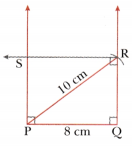
Construction of a rectangle in which one of the sides is 8 cm and length of diagonal is 10 cm:
Draw a line segment PQ = 8 cm.
Draw a perpendicular to PQ through Q.
Take P as centre and mark an arc of radius 10 cm on perpendicular to PQ through £). The arc and perpendicular intersect at point R.
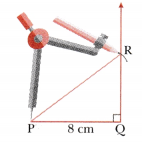
Draw perpendiculars to PQ and QR passing through P and R respectively. Then, the point where these perpendiculars intersect is the point S.
PQRS is the required rectangle.