
Easy-to-read Ganita Prakash Class 6 Notes and Chapter 7 Fractions Class 6 Notes save valuable study time during exam season.
Class 6 Maths Chapter 7 Fractions Notes
Class 6 Fractions Notes
A fraction is a number representing a part of a whole. The whole has to be divided into equal parts.
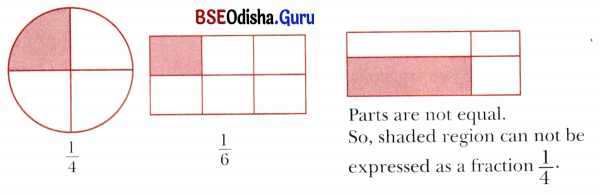
A fraction lias two parts:
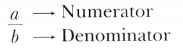
Numerator (top number): Tells how many parts we have
Denominator (bottom number): Tells how many equal parts the whole is divided into.
 |
 |
|
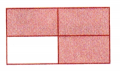
| Fraction that is shaded | \(\frac{1}{8}\) | \(\frac{3}{4}\) |
| Meaning | 1 part out of 8 equal parts | 3 part out of 4 equal parts |
| Numerator (N) | 1 | 3 |
| Denominator (D) | 8 | 4 |
Any whole number can be written as a fraction by placing it over 1 i.e., 5 can be written as \(\frac{5}{1}\).
Proper fractions: A fraction whose numerator is less than the denominator is called a proper fraction. For example, \(\frac{1}{3}, \frac{3}{7}, \frac{2}{5}\) etc. are proper fractions.
Note: The values of these fractions are always less than 1. So, proper fractions lie to the left of 1 on the number line.

Unit fractions: A fraction which has 1 as the numerator is called a unit fraction.
For example, \(\frac{1}{1}, \frac{1}{2}, \frac{1}{6}, \frac{1}{9}\) etc.
Improper fractions: A fraction with the numerator either equal to or greater than the denominator is called an improper fraction. For example, \(\frac{3}{2}, \frac{7}{4}, \frac{10}{3}, \frac{5}{5}\) etc. are improper fractions.
Note: The values of these fractions are always equal to or more than 1. Therefore, improper fractions lie on the right of 1, including 1, on the number line.
Mixed fractions: A mixed fraction is a combination of a whole number and a proper fraction. Mixed fractions are used when a quantity is more than a whole, but not a complete next whole number.
Like and Unlike fractions
Two or more fractions with the same denominators are called like fractions.
For example, \(\frac{7}{20}, \frac{13}{20}, \frac{11}{20}\) are like tractions.
Fractions with different denominators are called unlike fractions.
For example, \(\frac{7}{9}, \frac{13}{15}, \frac{11}{13}\) are unlike tractions.
When numerators of two fractions are the same, the fraction with smaller denominator is greater than the fraction with larger denominator. For example, \(\frac{9}{4}\) is greater than \(\frac{9}{5}\).
When denominators of two fractions are the same, the fraction with smaller numerator is smaller than the fraction with larger numerator. For example, \(\frac{5}{8}\) is smaller than \(\frac{7}{8}\).
The reciprocal of a fraction \(\frac{a}{b}\) is obtained by interchanging its numerator and denominator, resulting in \(\frac{b}{a}\).
Simplest form: A fraction is said to be in its simplest form (or lowest terms) when the numerator and the denominator have no common factor other than 1.
For example, \(\frac{3}{5}\) is the simplest form of \(\frac{18}{30}\).
Equivalent fractions: Fractions having the same value are called equivalent fractions.
For example, \(\frac{1}{2}, \frac{2}{4}, \frac{3}{6}\) are equivalent lractions because \(\frac{1}{2}=\frac{2}{4}=\frac{3}{6}\).
Conversion of Fractions
Mixed fraction into improper fraction:
Improper fraction = \(\frac{\text { Whole number } \text { × } \text { Denominator }+ \text { Numerator }}{\text { Denominator }}\)
For example, \(2 \frac{3}{5}=\frac{(\text { Whole number } \times \mathrm{D})+\mathrm{N}}{\mathrm{D}}=\frac{(2 \times 5)+3}{5}=\frac{10+3}{5}=\frac{13}{5}\)
Improper fraction into mixed fraction:
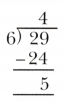
Mixed fraction = Quotient (Q) \(\frac{\text { Remainder (R) }}{\text { Denominator (D) }} \text {. For example, } \frac{29}{6}=4+\frac{5}{6}=4 \frac{5}{6}\)
Comparison of Fractions
To compare unlike fractions, follow these steps:
Step 1: Obtain LCM of the denominators of the fractions.
Step 2: Convert each fraction to its equivalent fraction with the denominator equal to the LCM obtained in step 1.
Step 3: Compare the numerators of the obtained fractions having equal denominators.
Step 4: Fraction with the smaller numerator is smaller than the other fractions.
For example, to compare \(\frac{2}{3}, \frac{3}{4} \text { and } \frac{5}{6}\), we take the LCM of 3, 4, and 6, which is 12,
and convert the fractions:
\(\frac{2}{3}=\frac{8}{12}, \frac{3}{4}=\frac{9}{12}, \frac{5}{6}=\frac{10}{12}, \text { so } \frac{8}{12}<\frac{9}{12}<\frac{10}{12} \Rightarrow \frac{2}{3}<\frac{3}{4}<\frac{5}{6}\)
Addition of Like Fractions
To add two or more like fractions, follow the steps given below:
Step 1: Obtain the fractions and common denominator.
Step 2: Add the numerators of all fractions.
Step 3 : Write the fraction as 
Subtraction of Like Fractions
To subtract two like fractions, follow the steps given below:
Step 1: Obtain the fractions and common denominator
Step 2: Subtract the numerator of the fraction which is to be subtracted from the numerator of the other fraction (from which it is to be subtracted).
Step 3 : Write the fraction as 
Addition of Unlike Fractions (Brahmagupta’s Method)
Step 1: Obtain the fractions and their denominators.
Step 2: Find the LCM of the denominators.
Step 3: Convert each fraction to its equivalent fraction with denominator equal to the LCM obtained in step 2.
Step 4: Add the numerators of all equivalent fractions obtained in step 3.
Step 5 : Write the fraction as 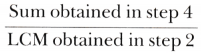
For example, \(\frac{4}{5}+\frac{2}{3}=\frac{12}{15}+\frac{10}{15}=\frac{12+10}{15}=\frac{22}{15}\)
Subtraction of Unlike Fractions (Brahmagupta’s Method)
Step 1: Obtain the fractions and their denominators.
Step 2: Find the LCM of the denominators.
Step 3: Convert each fraction to its equivalent fraction with denominator equal to the LCM obtained in step 2.
Step 4: Subtract the numerator of fraction which is to be subtracted from the numerator of the other fraction (of equivalent fractions obtained in step 3).
Step 5: Write the fraction as 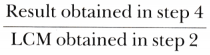
For Example, \(\frac{7}{3}-\frac{2}{5}=\frac{35}{15}-\frac{6}{15}=\frac{35-6}{15}=\frac{29}{15}\)
Types of Fractions
- A fraction is a number representing a part of a whole. The whole has to be divided into equal parts.
- A fraction whose numerator is less than the denominator is called a proper fraction.
- A fraction which has 1 as the numerator is called a unit fraction.
- A fraction with the numerator either equal to or greater than the denominator is called an improper fraction.
- A mixed fraction is a combination of a whole number and a proper fraction.
- Two or more fractions with the same denominators are called like fractions.
- Fractions with different denominators are called unlike fractions.
- Fractions having the same value are called equivalent fractions.
Conversion of Fractions
Mixed fraction into improper fraction:
Improper traction = \(\frac{\text { Whole number × Denominator }+ \text { Numerator }}{\text { Denominator }}\)
Improper fraction into mixed fraction:
Mixed Fraction = Quotient (Q) \(\frac{\text { Remainder (R) }}{\text { Denominator (D) }}\)
Comparison of Fractions
To compare unlike fractions, follow these steps:
Step 1: Obtain LCM of the denominators of the fractions.
Step 2: Convert each fraction to its equivalent fraction with the denominator equal to the LCM obtained in step 1.
Step 3: Compare the numerators of the obtained fractions having equal denominators.
Step 4: Fraction with the smaller numerator is smaller than the other fractions.
Addition and Subtraction of Fractions
Addition of Unlike Fractions
Step 1: Obtain the fractions and their denominators.
Step 2: Find the LCM of the denominators.
Step 3: Convert each fraction to its equivalent fraction with denominator equal to the LCM obtained in step 2.
Step 4: Add the numerators of all equivalent fractions obtained in step 3.
Step 5: Write the fraction as
Subtraction of Unlike Fractions
Step 1: Obtain the fractions and their denominators.
Step 2: Find the LCM of the denominators.
Step 3: Convert each fraction to its equivalent fraction with denominator equal to the LCM obtained in step 2.
Step 4: Subtract the numerator of fraction which is to be subtracted from the numerator of the other fraction (of equivalent fractions obtained in step 3).
Step 5: Write the fraction as