
Go through BSE Odisha Class 7 Science Solutions and Class 7 Science Chapter 7 Heat Transfer in Nature Question Answer to understand textbook questions more clearly.
Class 7 Science Curiosity Chapter 7 Question Answer
Science Curiosity Class 7 Chapter 7 Question Answer
Heat Transfer in Nature Class 7 Questions and Answers
Let Us Enhance Our Learning
Question 1.
Choose the correct option in each case.
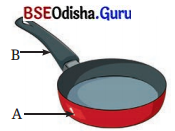
(i) Your father bought a saucepan made of two different materials, A and B, as shown in figure. The materials A and B have the following properties
(a) Both A and B are good conductors of heat.
(b) Both A and B are poor conductors of heat.
(c) A is a good conductor and B is a poor conductor of heat.
(d) A is a poor conductor and B is a good conductor of heat.
Answer:
(c) The body of the saucepan (A) is made of metal, which is a good conductor of heat The handle (B) is made of plastic which is a poor conductor of heat.

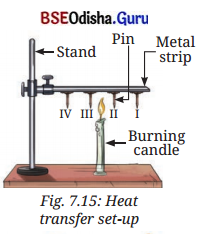
(ii) Pins are stuck to a metal strip with wax and a burning candle is kept below the rod, as shown in figure. Which of the following will happen?
(a) All the pins will fall almost at the same time
(b) Pins I and II will fall earlier than pins III and IV
(c) Pins I and II will fall later than pins III and IV
(d) Pins II and III will fall almost at the same time
Answer:
(d) The portion of the metal strip just above the candle flame (between Pins II and III) gets heated first. Heat will be conducted equally in both directions, causing Pins II and III to fall almost together.
(iii) A smoke detector is a device that detects smoke and sounds an alarm. Suppose you are fitting a smoke detector in your room. The most suitable place for this device will be:(a) Near the floor
(b) In the middle of a wall
(c) On the ceiling
(d) Anywhere in the room
Answer:
(c) Hot smoke rises due to convection, so it accumulates on the ceiling, allowing the detector to sense it at the earliest.
Question 2.
A shopkeeper serves you cold lassi in a tumbler. By chance, the tumbler had a small leak. You were given another tumbler by the shopkeeper to put the leaky tumbler in it. Will this arrangement help to keep the lassi cold for a longer time? Explain.
Answer:
Yes, this arrangement will help keep the lassi cold for a longer time. When the tumbler with a small leak is placed inside another tumbler, a layer of air gets trapped between the two tumblers. Since air is a poor conductor of heat (insulator), so it reduces the flow of heat from the warm surroundings into the cold lassi. Additionally, the two layers of tumblers further helps in insulation. Thus, the lassi remains cold for a longer time because heat transfer is minimised.
Question 3.
State with reason(s) whether the following statements are True [T] or False [F].
(i) Heat transfer takes place in solids through convection.
Answer:
False In solids, heat cannot be transferred by convection, because the particles cannot move freely from one place to another.
(ii) Heat transfer through convection takes place by the actual movement of particles.
Answer:
True
(iii) Areas with clay materials allow more seepage of water than those with sandy materials.
Answer:
False Clay particles are very fine and tightly packed, with very small pores, so water seeps through them very slowly. Sandy soils have larger pores that allow faster seepage.
(iv) The movement of cooler air from land to sea is called a land breeze.
Answer:
True
Question 4.
Some ice cubes placed in a dish melt into water after some time. Where do the ice cubes get heat for this transformation?
Answer:
The ice cubes get heat from their warmer surroundings. The ice absorbs heat from the air, the dish, and nearby objects at higher temperatures, causing it to melt into water.
Question 5.
A burning incense stick is fixed, pointing downwards. In which direction would the smoke from the incense stick move? Show the movement of smoke with a diagram.
Answer:
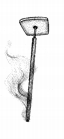
The smoke from the burning incense stick fixed pointing downwards will move upward. Smoke is a mixture of hot gases and tiny solid particles that are released during burning. As it is warmer than the surrounding air, it rises up. This upward movement of smoke happens due to convection. The movement of smoke can be represented as shown in the figure above.
Question 6.
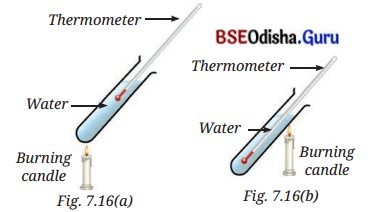
Two test tubes with water are heated by a candle flame as shown in figure. Which thermometers (figure (A) or figure (B)) will record a higher temperature? Explain.
Answer:
The thermometer in figure (A) will record a higher temperature. The flame heats the water at the bottom directly, causing convection currents that spread heat evenly through the water. In figure (B), the heated water at the top becomes less dense but cannot rise further as it is already on top, so convection currents are not properly established. As a result, heat does not spread. efficiently through the water, and the thermometer records a lower temperature.
Question 7.
Why are hollow bricks used to construct the outer walls of houses in hot regions?
Answer:
Hollow bricks are used to construct the outer walls of houses in hot regions because the air trapped inside the holes acts as an insulator. Air is a poor conductor of heat, so it reduces the transfer of heat from the outside to the inside of the house. This helps keep the interiors cooler even in hot weather.
Question 8.
Explain how large water bodies prevent extreme temperatures in area around them.
Answer:
Water heats up and cools down more slowly than land. During the day, the land becomes hot faster, while the water remains relatively cooler. The cool air from above the water moves towards the land (sea breeze) and lowers the temperature in surrounding area.
At night, the land cools down faster, while the water remains warmer. The warmer air over the water rises, and the cooler air from the land moves toward the sea (Land Breeze). This circulation helps keep the coastal area from becoming too cold. Thus, due to the different rates of heating/cooling of land and water, areas near large water bodies experience moderate temperatures and do not face extreme temperatures.
Question 9.
Explain how water seeps through the surface of the Earth and gets stored as groundwater.
Answer:
When rain falls on the Earth’s surface, some of the water flows over the ground, while a part of it seeps down through the soil and rocks. The spaces between soil and rock particles allow water to pass through. This downward movement of water into the ground is called infiltration. The water then collects in the pore spaces of rocks and sediments beneath the surface, forming underground water reserves known as aquifers. This stored water is called groundwater, which can be obtained through wells and bore wells.
Question 10.
The water cycle helps in the redistribution and replenishment of water on the Earth. Justify the statement.
Answer:
The water cycle is a continuous process through which water moves between the atmosphere, land, and water bodies, thereby helping in the redistribution and replenishment of water on the Earth. Heat from the Sun causes water in oceans, rivers, and lakes to evaporate, and plants also release water vapour through transpiration.
This water vapour rises, cools, and condenses to form clouds. The clouds bring rain, snow, or hail through precipitation. The rainwater that falls on the Earth’s surface flows into ponds, rivers, and oceans or seeps into the ground to become groundwater.
Class 7 Curiosity Chapter 7 Question Answer
InText Questions
Question 1.
Why we generally use metal utensils for cooking, whereas we prefer clay and porcelain cups for drinking tea or coffee? [Page 91]
Answer:
Generally, metal utensils are used for cooking because metals are good conductors of heat. On the other hand, clay and porcelain are poor conductors of heat. Tea and coffee kept in these cups stays hot for a longer time.
Question 2.
Using scientific reasoning, explain why two thin blankets provide more warmth than one thick blanket. [Page 92]
Answer:
Air trapped between the layers of two thin blankets acts as a poor conductor of heat. It does not allow body heat to escape quickly. This insulation makes two thin blankets warmer than one thick blanket.
Question 3.
Is it possible to construct houses that are not affected much by the outside heat and cold? [Page 92]
Answer:
Yes, it is possible to construct houses that are not affected much by outside heat and cold by utilising the concept of heat transfer. This can be done by using insulating materials, thick walls, air gaps, and reflective surfaces, which reduce heat transfer by conduction, convection, and radiation, keeping the inside temperature more comfortable.
Question 4.
Why does smoke rise up when an incense stick (agarbatti) is burnt? [Page 93]
Answer:
Smoke is a mixture of hot gases and tiny solid particles that are released when something burns. As it is warmer than the surrounding air, it rises up.
Question 5.
How does heat transfer take place in liquids? Do liquids also rise up when heated like air? [Page 94]
Answer:
Heat transfer takes place in liquids by the process of convection. In convection, heat transfer takes place by the actual movement of particles of liquids from one place to another. Yes, liquids also rise up when heated like air. When a liquid is heated, it expands, become lighter, and rises.
Question 6.
Why are windows of the houses in coastal areas placed facing the sea? [Page 95]
Answer:
As the land gets heated faster than water during the day, it causes warm air above the land to rise. In coastal areas, this causes cooler air to move from the sea towards the land. This movement of cooler air from the sea to the land is called sea breeze. Hence, in hot places, sea breeze relieves people from the heat. That is why, windows of the houses in coastal areas are placed facing the sea.
Question 7.
Why do we feel warm sitting around a fire? [Page 96]
Answer:
We feel warm because heat is transferred directly from the fire (hot object) to us by radiation.
Question 8.
Identify the various heat transfer processes when heating water in a pan. [Page 97]
Answer:
Heat is transferred from the flame to the utensil by conduction. Subsequently, water in the utensil gets heated up by convection. The warmth that we feel around the flame and the hot utensil is due to radiation.
Question 9.
What is water cycle? List the processes that make up the water cycle. [Page 98]
Answer:
The continuous movement of water upward as water vapour and downward through precipitation, passing through soil, rocks, and plants, and finally returning to water bodies, is called water cycle. The processes that make up the water cycle are: evaporation, transpiration, condensation, precipitation.
Question 10.
How does water seep through the surface of the Earth? [Page 99]
Answer:
Water seeps through the surface of the Earth by the process of infiltration. When it rains, water falls on the ground and enters the soil through tiny pores and spaces present between soil particles.
Question 11.
Why does water seep fastest through gravel, slower through sand, and slowest through clay? [Page 100]
Answer:
Water seeps fastest through gravel, slower through sand, and slowest through clay due to differences in the size of soil particles and the spaces between them. Gravel has large particles with big gaps, allowing water to pass through quickly. Sand has smaller particles and narrower spaces, so water seeps more slowly. Clay has very fine particles with extremely small pores, which restrict the movement of water and cause it to seep very slowly.