
Combining textbook study with BSE Odisha Class 7 Science Notes and Class 7 Science Curiosity Chapter 5 Changes Around Us: Physical and Chemical Notes can make exam preparation more effective.
Changes Around Us: Physical and Chemical Notes Class 7
Class 7 Science Curiosity Chapter 5 Notes
A change is said to take place when the state, appearance or properties of a substance become different from what they were before or are altered.
These changes can be observed through our senses of sight, smell, touch, hearing, and taste.
Physical Change
- A change in which only physical properties such as size, appearance, shape, volume, and state of a substance change is called a physical change.
- In a physical change, the chemical properties of a substance remain the same and no new substance is formed.
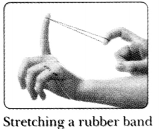
- Examples: Melting of ice cubes, cutting a piece of wood, drying of wet clothes, stretching a rubber band, boiling of water, etc.

Chemical Change
- A change in which one or more new substances are formed is called a chemical change.
- The properties of the new substances formed are different from those of the original substances.
- Examples: Cooking of food, burning of wood, making popcorn from corn, etc.
- A chemical reaction is a process in which one or more substances react to form one or more new substances with different properties.
- The chemical reaction involved in a chemical change is represented in short form as a chemical equation.
Turning Lime Water Milky: Test For Carbon Dioxide
- On blowing air into lime water, bubble formation occurs, and the lime water turns milky (or cloudy). This is due to the formation of an insoluble white substance, i.e., calcium carbonate, along with water.
- The word equation for the chemical reaction that takes place is as follows:
Calcium hydroxide (Lime water) + Carbon dioxide → Calcium carbonate (Insoluble white substance) + Water
Reaction of Vinegar with Baking Soda
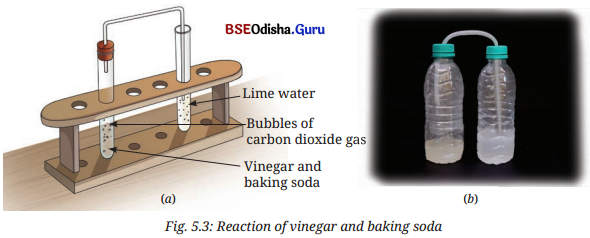
- When vinegar is mixed with baking soda, a fizzing, bubbling sound is produced along with the formation of bubbles.
- The released gas, when passed through lime water, turns it milky.
- This indicates that the gas released is carbon dioxide.
Vinegar + Baking soda → Carbon dioxide + Other substances
Rusting
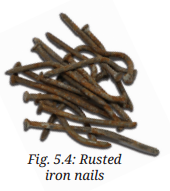
- Rusting is a process that involves the formation of a brown-coloured substance called rust on an iron surface, when it is exposed to both air and water.
- Since a new substance, i.e., rust (iron oxide), is forme’? in this process, it is a chemical change.
Combustion
- A chemical reaction in which a substance reacts with oxygen and produces heat and/or light is known as combustion.
- Substances that undergo combustion reactions are called combustible substances.
- The burning of a combustible substance also involves the formation of a new substance.
- For example, when magnesium ribbon is burnt in air (oxygen), it involves the formation of a new substance, magnesium oxide, along with the evolution of heat and light.
Magnesium (Ribbon) + Oxygen (Air) → Magnesium oxide (White powder) + Heat + Fight - Some other examples of combustible substances include wood, paper, cotton, coal, kerosene, etc.
- The minimum temperature at which a substance catches fire is called its ignition temperature.
- The component of the air that supports combustion is oxygen. Thus, combustion cannot take place without a continuous supply of oxygen. This is why the flame of a candle gets extinguished if it is covered with a glass tumbler.
Requirements for combustion:
- A combustible substance or fuel
- Air (Oxygen)
- Heat that allows the combustible substance or fuel to reach its ignition temperature.
Physical And Chemical Changes Occurring Together The burning of a candle
- Physical changes: The melting of wax from solid to liquid, its solidification on cooling, and its evaporation.
- Chemical change: The burning of wax vapour in the flame, as it produces new substances such as carbon dioxide and water vapour, which are released as smoke.
Reversible And Irreversible Changes
- Reversible changes are those in which the original substance can be obtained again. For example, melting of ice cubes, drying wet clothes, making small balls of dough, mixing salt in water, etc.
- Irreversible changes are those in which the original substance cannot be obtained again. For example, chopping vegetables, cutting a piece of paper, breaking a glass, rusting of iron, etc.
Desirable And Undesirable Changes
- Changes that are helpful in our daily lives are desirable changes. For example, the cutting of vegetables and fruits, the ripening of fruits, and cooking food.
- Changes that are harmful or unwanted are called undesirable changes. For example, rusting of iron, decay of food, etc.
Slow Changes In Nature
Weathering
- Weathering is the process by which large rocks are gradually broken down into smaller pieces due to natural physical and chemical changes.
- It involves physical changes such as changes in temperature, growth of plant roots, and freezing of water in rock cracks.
- It involves chemical changes like reaction of water and oxygen with minerals in rocks that causes changes in their chemical composition (for example, iron in basalt forming iron oxide).
- Weathering takes place over a long period of time and ultimately leads to the formation of soil.
Erosion:
Erosion is defined as the process by which soil, rocks, or other substances are worn away and carried from one place to another by wind, or water, or other agents. Since no new substance is formed, erosion is a physical change.
Physical Changes:
Changes which only affect the shape, size, or state of a substance without forming a new substance. For example, inflation of a balloon, melting of ice, etc.
Simultaneous Physical and Chemical Changes
A single process may involve simultaneous physical and chemical changes. For example, burning of a candle.
- Physical change: Melting of wax
- Chemical change: Burning of wax vapour to form new substances
Reversible and Irreversible Changes
Reversible Change: The original substance can be brought back again, e.g., folding of paper.
Irreversible Change: The original substance cannot be brought back again, e.g., making of popcorn from corn.
Desirable and Undesirable Changes
Desirable Change: These changes are considered useful and good.
For example, cooking food, setting of curd are some desirable changes.
Undesirable Change: These changes are considered unw anted or harmful.
For example, rusting of iron, decay of food, and rotting of fruits are some undesirable changes.
Note: A change that is undesirable in a given situation may be desirable in some other situation.
Chemical Changes
- Changes in which new substance(s) is/are formed through a process called chemical reaction.
- For example, formation of an insoluble substance on passing carbon dioxide through lime water.
- Calcium hydroxide (Lime water) + Carbon dioxide → Calcium Carbonate (Insoluble substance) + Water
Rusting:
The exposure of iron to air and water results in the formation of rust (new substance) via a process called rusting.
Combustion
- A chemical reaction in which a substance reacts with oxygen to produce heat and/or light. For example, burning of magnesium ribbon.
Magnesium + Oxygen → Magnesium oxide + Heat + Light - The substances that undergo combustion are known as combustible substances, e.g., wood, paper, cotton, kerosene etc
Requirements for Combustion
- A combustible substance, also called ‘fuel’
- Air (Oxygen)
- Heat that allows the fuel to reach its ignition temperature
Some Slow Natural Changes
Weathering
- Weathering is the gradual breaking down of rocks into smaller pieces or sediments.
- It involves both physical and chemical changes.
Erosion
- Erosion is the process of removing, transporting, and depositing rocks, soil, and sediments by natural forces like wind, water, or landslides.
- It involves only physical change.