
Combining textbook study with BSE Odisha Class 7 Science Notes and Class 7 Science Curiosity Chapter 2 Exploring Substances: Acidic, Basic, and Neutral Notes can make exam preparation more effective.
Exploring Substances: Acidic, Basic, and Neutral Notes Class 7
Class 7 Science Curiosity Chapter 2 Notes
Classification of Substances
Based on their physical properties, substances around us are classified into the following categories:
| Nature of the substance | Taste/Feel | Examples |
| Acidic | Sour taste | Lemon juice, Avila juice |
| Basic | Bitter taste and soapy or slippery to the touch | Detergent solution, Baking soda |
| Neutral | No particular taste or smell | Sugar solution, salt solution |

Some Common Acids and their Natural Sources
| Acid | Natural source | Acid | Natural source |
| Citric acid | Citrus fruits like lemon, orange, etc. | Malic acid | Apple |
| Acetic acid | Vinegar | Oxalic acid | Spinach |
| Ascorbic acid | Amla juice | Tartaric acid | Tamarind and grapes |
| Lactic acid | Curd, sour milk | Formic acid | Ant sting |
Indicators
- The substances whose colour or odour changes when they come in contact with acidic or basic substances are known as indicators.
Indicators can be natural or synthetic depending on their origin. - Natural: Obtained from natural sources
- Synthetic: Made in laboratories
Indicators can be visual or olfactory depending on their mode of action.
- Visual: Show colour change in different media
- Olfactory: Show odour change in different media
Visual Indicators
(a) Litmus
- Natural substance obtained from lichens
- Available in both solution form and in the form of paper strips
- Litmus paper is available in two colours – red and blue.
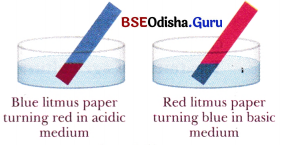
- Changes in the colour of litmus papers in different solutions are represented as follows:

- Since litmus shows different colours in acidic and basic solutions, it is known as a visual acid-base indicator.
(b) Red Rose extract
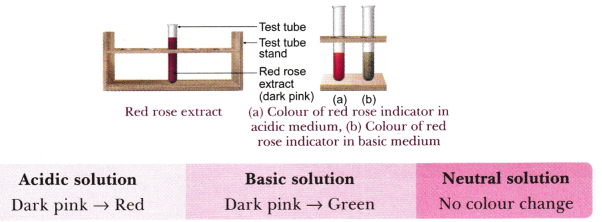
- Natural, visual acid-base indicator o It is obtained as a filtrate by soaking fresh and crushed red rose petals in hot water.
- Changes in the colour of red rose extract in different solutions are represented as follows:
(c) Turmeric
- Natural, visual acid-base indicator
- Can be used in the form of turmeric paper strips
- Changes in the colour of turmeric paper in different solutions are represented as follows:
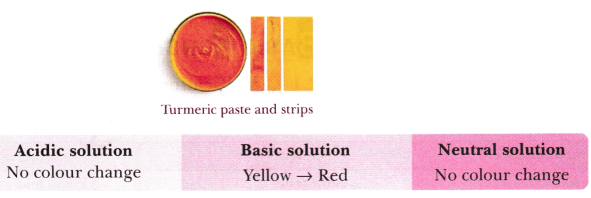
- Can only be used to identify basic substances
- Cannot distinguish between acidic and neutral substances
NOTE: The colour of hydrangea flowers depends on the acidic or basic nature of the soil in which they grow.
In acidic soil, hydrangea flowers turn blue, whereas in basic soil, they become pink or red.
By adjusting the acidic or basic nature of the soil, gardeners can change the flower colour, making hydrangea an example of a natural acid-base indicator.
Olfactory indicator: Onion extract
- Onion extract can be used as an olfactory indicator as it shows change in odour in different media as follows:
- Basic solutions: Odour vanished
- Acidic and neutral solutions: Odour retained
Neutralisation Reaction
The reaction in which sufficient quantities of an acid and a base react with each other to form a corresponding salt and water, with the release of heat, is called a neutralisation reaction.
Acid + Base → Salt + Water + Heat
Real-life Applications of Neutralisation Reactions
Treatment of an ant bite: Formic acid injected from the ant bite can be neutralised by applying moist baking soda (basic).
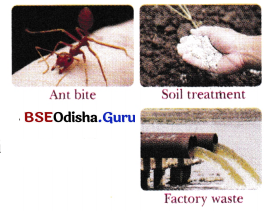
- Treatment of agricultural soil:
- Acidic soil can be treated with a base like quick lime or slaked lime
- Basic soil can be treated with acidic substances such as organic matter, like manure or composted leaves
- Management of factory wastes :
- Factory wastes are acidic, and hence, when released into water bodies, they become dangerous for aquatic life. Therefore, these are treated with basic substances to neutralise before they are released into the water bodies.
Substances Around Us
Grouping of Substances
Acids
- Acids generally taste sour.
- Acids turn blue litmus paper red.
- Examples: lemon juice, amla juice, tamarind water, vinegar etc.
Bases
- Bases generally taste bitter and often feel soapy or slippery to the touch.
- Bases turn red litmus paper blue.
- Examples: soap solution, baking soda solution, washing powder solution, etc.
Neutral Substances
- Neutral substances do not possess the sour or bitter taste associated with acids and bases.
- Neutral substances do not affect either of the two litmus papers.
- Examples: distilled water, sugar solution, salt solution etc.
Neutralisation: Reaction between an acid and a base to produce salt and water with the evolution of heat.
Acid + Base → Salt + Water + Heat
Neutralisation in Daily life
- An ant bite injects formic acid, which can be neutralised by applying moist baking soda, a base.
- Farmers neutralise acidic soil by adding lime water and neutralise basic soil by adding organic matter like manure or compost.
- Factory waste (if acidic) can be neutralised by adding basic substances before releasing it into the lake.
Indicators: Substances that help us identify whether a substance is acidic, basic, or neutral.
Natural Indicators: These are obtained from natural sources like plants.
Examples: turmeric, litmus, red rose extract, etc.
Synthetic Indicators: These are made in laboratories.
Examples: phenolphthalein and methyl orange.
Visual Indicators: These are the substances that change colour in acidic and basic media.
Litmus Solution/paper
- Acidic solution: Blue litmus → Red
- Basic solution: Red litmus → Blue
- Neutral solution: No colour change
Red Rose Extract
- Acidic solution: Dark pink → Red
- Basic solution: Dark pink → Green
- Neutral solution: No colour change
Turmeric Paper
- Basic solution: Yellow → Red
- Acidic and neutral solutions:
- No colour change
Olfactory Indicator: Olfactory indicators change their smell when mixed with acids or bases. Example: cloth strips with onion smell.
- Smell vanishes → Basic solution
- Smell retains → Acidic or neutral solution