
Students can include Class 7 Curiosity Extra Questions and Class 7 Science Chapter 9 Life Processes in Animals Extra Question Answer in their daily self-study routine.
Class 7 Science Chapter 9 Life Processes in Animals Extra Questions
Class 7 Science Chapter 9 Extra Questions on Life Processes in Animals
Life Processes in Animals Class 7 Very Short Question Answer
Question 1.
Name the parts of the alimentary canal where
(i) water gets absorbed from undigested food.
(ii) digested food gets absorbed.
(iii) taste of the food is perceived.
(iv) bile juice is produced.
Answer:
(i) Large intestine
(ii) Small intestine
(iii) Tongue
(iv) Liver

Question 2.
If breathing is a part of respiration, then what is the difference between them? Give your answer in a tabular form.
Answer:
| Breathing | Respiration |
| It is the process of inhaling and exhaling air. | It is the process of breaking down food to release energy in the presence of oxygen. |
| It is a physical process. | It is a chemical process. |
Question 3.
As Ajay climbed higher up the mountain, he realised that his breathing had become faster and his chest was moving rapidly. This made him wonder how inhalation and exhalation occurs during breathing, and if the diaphragm plays any role during inhalation. Provide an answer for the same.
Answer:
- Inhalation is taking in oxygen-rich air, and exhalation is breathing out air rich in carbon dioxide.
- During inhalation, the diaphragm contracts and moves downwards.
Question 4.
During a class discussion, Prerna said that respiration and breathing are interdependent. To which, Manav countered that respiration and breathing are different processes and can occur independently of each other. Based on your understanding, whose claim is correct and why?
Answer:
Prerna’s claim is right. Breathing supplies oxygen needed for respiration, and respiration releases energy that helps in breathing. Thus, although they are different processes, respiration and breathing are interdependent.
Question 5.
After the doctor advised Harsh’s uncle to avoid eating food rich in fats due to a liver infection, Harsh asked his teacher the following questions:
(i) Why did the doctor recommend avoiding food rich in fats?
Answer:
The doctor told Harsh’s uncle to avoid eating food rich in fats because the liver helps with fat digestion. When the liver is affected, it cannot function properly, thereby affecting the digestion of fats.
(ii) What does the liver secrete that helps in the digestion of fats?
Answer:
Liver secretes bile which breaks down fats into small droplets making it easier to digest and also neutralises acid present in the food (coming from stomach) in the small intestine.
Question 6.
Following a football match in his school, Anish noticed that he was breathing heavily. His teacher explained that it is because his body requires more energy. What is this energy-releasing process called? Give its word equation.
Answer:
Glucose + Oxygen → Carbon dioxide + Water + Energy
Question 7.
While visiting a dairy farm, Preeti noticed that cows and buffalo swallow grass quickly without chewing much. Later, she saw them sitting calmly and chewing the same food again. Can you explain why ruminants show this type of feeding behaviour?
Answer:
Ruminants like cows and buffalo first swallow their food quickly and store it in a specialised structure called the rumen. Later, this partially digested food is brought back to the mouth and chewed again through a process called rumination. This helps them digest tough plant materials like grass properly.
Question 8.
Name the main components of the circulatory system. What is its primary function in the human body?
Answer:
- Circulatory system includes the heart, blood, and blood vessels.
- It helps in the transport of nutrients, oxygen, and other substances throughout the body.
Question 9.
As Aarav was eating bread, it felt soft and sweet after chewing. Curious, he asked his mother why this happened. She explained that it is due to a substance found in the mouth. What is this substance called, and what is its function in the mouth?
Answer:
Saliva is the watery fluid produced in the mouth. It contains a digestive juice that helps break down starch into sugar.
Question 10.
Give the pathway of air flow in the human respiratory system. How are lungs protected?
Answer:
Nostrils → Nasal passages → Windpipe → Bronchi → Smaller and finer branches of bronchi → Alveoli (balloon-like sacs)
– Lungs are protected by the rib cage.
Life Processes in Animals Class 7 Short Question Answer
Question 1.
Write down the function of the following parts:
(i) Oesophagus
(ii) Anus
(iii) Liver
Answer:
(i) Oesophagus: It is a long, flexible tube that contracts and relaxes in a wave-like motion to push the food down into the stomach.
(ii) Anus: It is the opening at the end of the digestive tract that expels the solid waste (stool) out of the body.
(iii) Liver: It secretes bile, which helps in the breakdown of fats.
Question 2.
During a biology field trip, Ved came across the following animals:
(i) Tadpole
(ii) Snake
(iii) Fish
(iv) Lizard
(v) Earthworm
(vi) Goat
Can you help Ved name the respiratory organs of the given animals?
Answer:
(i) Gills
(ii) Lungs
(iii) Gills
(iv) Lungs
(v) Moist skin
(vi) Lungs
Question 3.
Apart from digestive and respiratory systems, what other systems are present in the human body? Write down their functions.
Answer:
The other two systems that work in coordination with digestive and respiratory systems are circulatory and excretory systems.
- Circulatory system: It helps in the transport of nutrients, oxygen, carbon dioxide, and other substances via blood.
- Excretory system: It removes waste products such as excess water and salts from the body.
Question 4.
During a science class, Mr. Joshi displayed an image of a balloon-shaped structure, essential in the process of respiration and asked the students to identify it and explain its function. What is the name of this structure, and what does it do?
Answer:
The balloon-like structures are called alveoli. These are small air sacs in the lungs where exchange of oxygen and carbon dioxide takes place. They have thin walls surrounded by fine tubes containing blood.
As blood flows through these fine tubes, it carries carbon dioxide from all parts of the body. which passes into the alveoli and is removed from the body when we breathe out. At the same time, oxygen from the air inside the alveoli enters the blood and is then carried to different parts of the body. These structures provide a larger surface area for the exchange of gases during respiration.
Question 5.
On an average, an adult human being at rest breathes 15-18 times per minute. The breathing rate, however, may differ under different conditions. Arrange the following activities given in the box in order of increasing breathing rates and give reason for your answer.
Sleeping, Cycling, Brisk walk, Watching T.V.
Answer:
- Order of increasing breathing rate: Sleeping < Watching TV < Brisk walk < Cycling
- Breathing rate increases with the energy demand of the body. While sleeping, the body’s energy requirement is lowest, so breathing is slowest. Watching TV requires slightly more energy, so breathing is comparatively faster. Brisk walking is a physical activity that requires more oxygen, increasing the breathing rate, and cycling is the most physically demanding among these activities, so the breathing rate is highest.
Question 6.
‘Different animals have different mechanism for the digestion of food’. Comment on this statement taking into consideration the digestion in ruminants and birds.
Answer:
The differences in the mechanism of digestion in ruminants and birds are listed below:
| Feature | Ruminants (cows and buffalo) |
Birds |
| Type of food | Plant material (grass) | Grains, seeds, insects, etc. |
| Chewing | Chew partially digested food | Do not chew; swallow food as a whole |
| Grinding food | Mouth (chewing); teeth present | Teeth absent, food is broken down in a chamber called the gizzard |
Life Processes in Animals Class 7 Long Question Answer
Question 1.
Shweta was studying the human digestive system and learnt that the pancreas is a vital organ located in the abdomen. It produces a secretion ‘X’ that is released into the small intestine, which is crucial for breaking down the food we eat into simpler substances that can be absorbed by the body.
Based on this information, answer the following questions.
(i) Name the secretion X .
(ii) What is the nature of X ?
(iii) What are the functions of X ?
(iv) Can digestion occur properly without X? Give reason for your answer.
Answer:
(i) Pancreatic juice
(ii) Basic in nature
(iii)
- Neutralises acid present in the food.
- Helps in the breakdown of carbohydrates, proteins, and fats.
(iv) No, digestion cannot occur properly without pancreatic juice because it breaks down carbohydrates, proteins, and fats. Without it, these nutrients cannot be digested and absorbed efficiently by the body.
Question 2.
(i) How do fishes and earthworms breathe?
(ii) What are the different adaptations for respiration used by amphibians like frogs during their life cycle? How is it helpful for them?
Answer:
(i) Fishes have specialised structures called gills for breathing, which are richly supplied with blood vessels. The exchange of oxygen and carbon dioxide between the blood and the gases dissolved in surrounding water takes place across them. Whereas, earthworms use their moist skin for the exchange of gases from the environment.
(ii) Amphibians, like frogs, use different body parts for breathing during different stages of their life:
- Tadpoles breathe through gills, similar to fish.
- Adult frogs breathe using lungs when on land and through their moist skin when underwater.
These adaptations help them to survive both in water and on land.
Question 3.
(i) Rahul was learning about how humans breathe and wanted to know what respiration means and which parts of the body help us breathe.
How would you explain the human respiratory system to Rahul?
Answer:
The process of breaking down food to release energy is called respiration.
Main parts of the human respiratory system are:
- Nostrils
- Nasal passages
- Windpipe
- Lungs
- Alveoli
- Diaphragm
(ii) Give the word equation for respiration.
Answer:
Glucose + Oxygen → Carbon + Water + Energy dioxide
(iii) Write down the function(s) of:
(a) Nasal passages
(b) Alveoli
Answer:
(a) Nasal passages: It filters dust particles and moistens the air we breathe in.
(b) Alveoli: Alveoli are small balloon-like air sacs where the exchange of gases (oxygen and carbon dioxide) takes place.
Question 4.
One afternoon, while having lunch with her mother, Isha wondered how the food she eats is broken down inside the body. As she chewed her food, she started asking her mother a few questions about digestion. Based on their conversation, answer the following questions:
(i) Where does digestion begins in the body, and what is the role of saliva in digestion?
(ii) What does the stomach secrete to aid the process of digestion?
(iii) Define: (a) Mechanical digestion (b) Egestion
Answer:
(i) Digestion of food starts in the mouth. Saliva plays an important role in digestion by moistening the food, making it easier to chew and swallow. It contains a digestive juice that helps break down starch into sugar.
(ii) Stomach secretes digestive juice, acid, and mucus that aids in the process of digestion.
(iii)
(a) Mechanical digestion: The process of initial breakdown of food into fine pieces is called mechanical digestion. This process begins in the mouth as the teeth break down the food we eat into smaller pieces through crushing and chewing.
(b) Egestion: The process of removing undigested and unabsorbed food materials from the body in the form of stool, through the anus, is called egestion.
Life Processes in Animals Class 7 Case Based Questions
Read the following passages and answer the questions that follow:
Question 1.
Mohan was fascinated while watching his pet parrot, Peeku, eat grains quickly. He wondered how birds eat and digest food since they do not have teeth. Suddenly, he remembered his science class, where Mrs. Rita explained about a special structure, that helps birds in the process of digestion.
(i) Name the structure.
Answer:
Gizzard
(ii) Do ruminants also have this structure?
Answer:
No, ruminants such as cows and buffalo do not have a gizzard. Instead, they have a rumen, which helps in the digestion of food.
(iii) How does this structure help in the digestion of food?
Answer:
The gizzard has muscular walls and often contains small stones (grit) swallowed by the bird. The contraction and relaxation of the walls help to grind and crush the food into smaller pieces, making digestion easier.
OR
(iii) Is the process of digestion in birds different from that in humans? Give reason.
Answer:
Birds do not have teeth and they use a gizzard for grinding food, whereas humans chew food with their teeth before swallowing. This special structure called gizzard is absent in humans.
Question 2.
During the annual sports day at school, Rohan and Ravi participated in the 100 metre sprint.
After finishing the race, Rohan was gasping for breath. His face turned red, and his heart was beating rapidly. They counted their breaths per minute and observed that Rohan was breathing faster than Ravi. [Critical Thinking and Observation Skills]
(i) Why was Rohan breathing faster than Ravi after the race?
Answer:
Rohan might not be physically fit and healthy, or he might have run faster than Ravi, which required a higher oxygen supply to his muscles and resulted in faster breathing.
(ii) What are the end products formed during respiration in our body?
Answer:
Carbon dioxide, water, and energy.
(iii) What happens during respiration? Name the primary respiratory organ in humans.
Answer:
- During respiration, food in the form of glucose is broken down to release energy.
- Lungs are the primary respiratory organs in humans.
OR
(iii) Does blood play any role during the process of respiration?
Answer:
Yes, blood has a vital role in respiration. It functions as a transport medium for oxygen and carbon dioxide, facilitating gaseous exchange between the lungs and the body parts.
Life Processes in Animals Class 7 Picture Based Questions
Observe the given picture and answer the questions that follow:

1. (i) Where are these structures found?
Answer:
Inner lining of the small intestine
(ii) Mention a structural characteristic of these structures.
Answer:
These are finger-like projections surrounded by tiny blood vessels.
(iii) What are their functions?
Answer:
These finger-like projections increase the surface area for absorption and allow digested nutrients to pass into the blood, which is carried to different parts of the body to provide energy.
OR
(iii) Mention any two other roles of the location where these structures are found.
Answer:
- The small intestine receives bile from the liver to break down fats into tiny droplets.
- It also receives pancreatic juice to neutralise the acid in food.
- Its inner lining secretes digestive juices that further break down fats, proteins, and carbohydrates.
Life Processes in Animals Class 7 Activity Based Questions
Read the following activity and answer the questions that follow:
Question 1.
Objective: To demonstrate the mechanism of breathing using a simple lung model.
Materials required: A transparent plastic bottle, two small balloons, one large rubber sheet, Y-shaped hollow tube, rubber bands and tape
Procedure:
- Take a clean transparent plastic bottle and cut off its bottom.
- Attach two small balloons to the ends of a Y-shaped tube using rubber bands.
- Insert the tube into the mouth of the bottle and seal with tape to make it airtight.
- Stretch the rubber sheet tightly over the open bottom of the bottle.
- Pull the rubber sheet downward and then push it upward gently, while observing the balloons.
Observation: When the rubber sheet is pulled downwards, the balloons inside the bottle inflate.
When the rubber sheet is pushed upwards, the balloons deflate.
(i) Which process of breathing is represented when the balloons inflate?
(ii) What changes occur inside the bottle when the rubber sheet is pulled downwards?
(iii) What does the deflation of balloons indicate about the movement of air during exhalation?
Answer:
(i) Inhalation
(ii) The space inside the bottle increases, allowing air to enter into the balloons and they inflate.
(iii) Deflation of balloons indicates that air moves out of the lungs during exhalation due to reduced volume of the chest cavity.
OR
(iii) What should be kept the same in this activity for a fair demonstration? Mention ‘Yes’ or ‘No’ for each and give reason.
| S. No. | Should this be kept the same? | Yes or No? | Reason |
| (a) | Size of the bottle | ||
| (b) | Number of balloons | ||
| (c) | Airtight sealing of the bottle |
Answer:
(a) Yes; the bottle represents the chest cavity, changing its size affects the space for air.
(b) Yes; the balloons represent the lungs; changing their number is not possible, since humans have two lungs.
(c) Yes; air leakage will disturb air pressure and affect inflation and deflation of balloons.
Life Processes in Animals Extra Questions for Practice
Question 1.
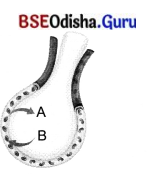
As part of a revision test, Mohan was asked to identify ‘A’ and ‘B’ in the diagram given alongside. Which among the following options should he choose?
(a) A – Carbon dioxide, B – Oxygen
(b) A – Oxygen, B – Carbon dioxide
(c) A – Carbon dioxide, B – Hydrogen
(d) A – Hydrogen, B – Oxygen
Answer:
(a) During respiration carbon dioxide is removed from the body when we breathe out. At the same time, oxygen from the air inside the alveoli enters the blood and is then carried to different parts of the body.
Question 2.
While on a walk through the neighbourhood park, Ananya noticed some tadpoles swimming together in a pond. She wondered how these organisms breathe underwater. Which of the following structures help tadpoles in gaseous exchange?
(a) Gills
(b) Lungs
(c) Alveoli
(d) Moist skin
Answer:
(a) Gills
Question 3.
The image alongside shows a child who is blowing foggy air out of his mouth. Which terminology would be most appropriate for defining the act of blowing air out?

(a) Breathing
(b) Exhalation
(c) Inhalation
(d) Respiration
Answer:
(b) Exhalation
Question 4.
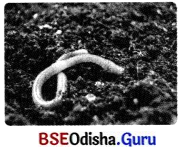
While helping his father plant sunflower seedlings, Mihir noticed an earthworm with moist skin, as given alongside. Curious, he asked his father why earthworms have such skin. What could be the most appropriate explanation Mihir’s father can give?
(a) It helps them escape from a predator’s grip.
(b) It helps them reflect sunlight during summer.
(c) It helps them absorb oxygen from the surroundings.
(d) It helps them absorb nutrients from the soil.
Answer:
(c) Earthworms breathe through their moist skin, which allows gaseous exchange.
Questions 5 and 6 consist of two statements – Assertion (A) and Reason (R). Answer these questions by selecting the correct option:
(a) Both A and R are true and R is the correct explanation of A.
(b) Both A and R are true but R is not the correct explanation of A.
(c) A is true but R is false.
(d) A is false but R is true.
Question 5
Assertion (A): Breathing is the process through which fresh air from outside enters the lungs and fills the alveoli.
Reason (R): Alveoli are balloon-like structures that help in increasing the surface area for exchange of gases.
Answer:
(b) Both A and R are true but R is not the correct explanation of A.
Question 6.
Assertion (A): The large intestine absorbs water and some salts from the undigested food, thus making the waste semi-solid, and it is called stool.
Reason (R): The stool is stored in the upper part of the large intestine, called the rectum.
Answer:
(c) Stool is stored in the lower part of the large intestine, called the rectum.
Question 7.
While teaching her younger brother, Arna explained that the small intestine is in fact the longest part of the digestive system and plays a major role in digestion of food. Her brother, Arsh wondered what exactly it does to help the body obtain energy. What functions are performed by the small intestine?
Answer:
- The small intestine secretes digestive juice that further breaks down fats, proteins, and carbohydrates.
- It has multiple finger-like projections that help in the absorption of nutrients into the blood.
Question 8.
Do different organisms have different breathing organs? Explain.
Answer:
Yes, different organisms have different breathing organs, as this enables them to adapt better to their environment.
For example, most aquatic organisms like fish breathe through gills. On the other hand, terrestrial animals such as birds, elephants, cows, and humans breathe through their lungs.
Question 9.
Ms. Rekha gave her Class 7 students an assignment to make a poster on alveoli. The poster should highlight their function and specific characteristics. What points should the students include in their posters?
Answer:
- Function: Alveoli increase the surface area for efficient exchange of oxygen and carbon dioxide.
- Characteristics: Alveoli are tiny, balloon-like air sacs in the lungs where exchange of gases take place. They have thin walls and are surrounded by blood vessels. They allow oxygen to enter the blood and carbon dioxide to exit the body.
Question 10.
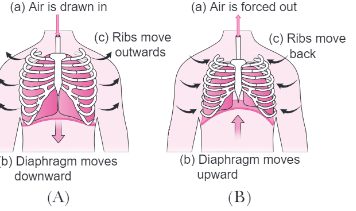
Observe the given figures and answer the following questions.
(i) Name the processes depicted by figures A and B.
Answer:
Figure A indicates the process of inhalation and figure B indicates the process of exhalation.
(ii) In the given figures indicate the direction of
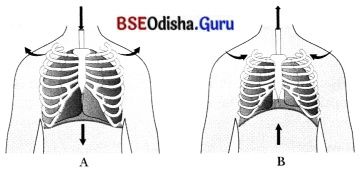
(a) movement of air
(b) movement of diaphragm
(c) movement of ribs
Answer:
Question 11.
Sana, a Class 7 student, was very curious to learn about nutrients present in food. One day at school, her teacher conducted an experiment by adding a few drops of iodine solution to some boiled rice. To her surprise, the rice turned blue-black. Sana later repeated the experiment at her home, with slices of potato and chapati and saw similar results.
(i) What is starch?
Answer:
Starch is a type of complex carbohydrate present in our food.
(ii) Why did the food items show a blue-black colour when iodine was added?
Answer:
Rice, potatoes, and chapati turn blue-black when iodine solution is added to them because these food items contain starch.
(iii) In which part of the digestive system is starch first acted upon, and into which simpler substance is it converted?
Answer:
Digestion of starch begins in the mouth by the action of saliva which contains a digestive juice that helps break down starch into simple sugars.
OR
(iii) Can you think of any two food items that do not contain starch? How can you prove this using the iodine test?
Answer:
Examples of food items that do not have starch include lemon, cucumber, etc. These food items will not turn blue-black when tested with iodine solution.
Question 12.
During a school field trip to a science museum, Aisha saw a model of the human digestive system and was curious about how it works. She asked her teacher to explain the different parts involved in digestion and how they function. How would the teacher explain the different parts of the digestive system to Aisha?
Answer:
Digestion in humans is a step-by-step process that takes place in the alimentary canal. The main organs and their respective roles are:
- Mouth: Site where the food is chewed (mechanical digestion, aided by teeth), and mixed with saliva. Saliva contains digestive juice that begin the digestion of starch.
- Oesophagus: Pushes food to the stomach using muscular movements (contraction and relaxation in a wave-like motion).
- Stomach: Secretes acid and digestive juice that helps in the breakdown of protein, and the mucus secreted protects the stomach lining from the acid.
- Small Intestine: Receives digestive secretions from three sources – the inner lining of the small intestine itself, liver (bile) and pancreas (pancreatic juice) that aids in the complete digestion of food. The nutrients are absorbed into the blood through finger-like projections present on their inner walls.
- Large Intestine: Absorbs water and salts, and then forms solid waste (stool) from the undigested food that is temporarily stored in the rectum before expulsion.
- Anus: Removes undigested waste from the body through the process of egestion.