
For better exam readiness, students can include Class 7 Science MCQ and Curiosity Chapter 5 Changes Around Us: Physical and Chemical MCQ in their daily study routine.
Class 7 Science Chapter 5 Changes Around Us: Physical and Chemical MCQ
Changes Around Us: Physical and Chemical Class 7
MCQ On Changes Around Us: Physical and Chemical Class 7
Question 1.
Which of the following is a physical change?
(a) Rusting of iron
(b) Combustion of magnesium ribbon
(c) Burning of candle
(d) Melting of wax
Answer:
(d) Melting of wax is a physical change, as no new substance is formed.

Question 2.
A cube of ice, 2 cm in length, is left out in a bowl, and it turns to water. The bowl is then kept in the freezer. The ice formed has the diameter of the bowl. What kind of change occurs in this case?
(a) A physical change with a change in shape and state.
(b) A chemical change with a change in state.
(c) A physical change where solid ice directly changes from a cube to a thick circle.
(d) A chemical change with the formation of a new substance.
Answer:
(a) A physical change with a change in shape and state.
Question 3.
What type of changes occur in the wax and the wick of a burning candle?
(a) Physical change in the wick; chemical change in the wax
(b) Chemical change in the wick, physical change in the wax
(c) Chemical change in both the wax and wick; physical change in some wax
(d) Physical change in both the wick and the wax; chemical change in the wick
Answer:
(c) Burning of wax near the wick involves a chemical change because combustion of both wick and wax vapour takes place, while melting, solidification and evaporation of wax involve physical changes.
Question 4.
In an experiment, Ravina, a class 7 science teacher, demonstrated the burning of magnesium ribbon. During the experiment, a white-coloured substance, X, was formed, accompanied by the evolution of heat and light. Which of the following statements is correct based on this experiment?
(a) The substance X is magnesium carbonate, and there occurs only a change in the state of magnesium.
(b) The substance X is magnesium hydroxide, and there occurs no change in the chemical composition of magnesium.
(c) The substance X is magnesium oxide, and the reaction involved is combustion.
(d) The substance X is magnesium carbonate, and a chemical reaction is involved in this process.
Answer:
(c) When a magnesium ribbon is burnt in air, the following chemical reaction takes place:

Hence, the white-coloured substance X formed on burning magnesium ribbon is magnesium oxide. This reaction is classified as a combustion reaction.
Question 5.
Nitin, Rashmi, Sunil and Rohit were discussing the topic ‘Physical and Chemical changes around Us’. During their discussion, they made the following statements:
Nitin: No new substance is formed during the rusting of iron.
Rashmi: Wood and kerosene are combustible substances.
Sunil: Burning of a candle involves only a physical change.
Rohit: Curdling of milk and ripening of fruits are chemical changes.
(a) Nitin and Sunil are correct
(b) Nitin and Rashmi are correct
(c) Rohit and Sunil are correct
(d) Rashmi and Rohit are correct
Answer:
(d) A new substance called iron oxide is formed during the rusting of iron. Burning of a candle involves both physical and chemical changes.
Question 6.
Which of the following statements is incorrect for a chemical reaction?
(a) Heat may be given out but never absorbed.
(b) Sound may be produced.
(c) A colour change may take place.
(d) A gas may be evolved.
Answer:
(a) Heat may be given out but never absorbed.
Question 7.
In a bowl a few fresh fruits were placed. The next day it was observed that the fresh fruits had ripened. What kind of change occurred within the fresh fruits?
(a) Chemical change as new substances are formed during ripening.
(b) Physical change as the colour of fruit changes.
(c) Chemical change as the shape of the fruit changes.
(d) Physical change as the state of the fruit alone changes.
Answer:
(a) Ripening of fruits is an irreversible chemical change.
Question 8.
Read the following passage carefully and fill in the blanks by selecting the correct option.
A black-coloured rock called basalt, containing (i) chemically changes to form a red coloured layer of (ii), in a process called (iii). (i), (ii) and (iii) are respectively,
(a) Magnesium, magnesium oxide and erosion
(b) Iron, iron oxide and weathering
(c) Magnesium, magnesium oxide and combustion
(d) Iron, iron oxide and erosion
Answer:
(b) Iron, iron oxide and weathering
Question 9.
A student collects wax from a burning candle. He melts it and then adds a new wick to it and leaves it to cool. Can a new and functional candle be created by this process? Why or why not?
(a) Yes; it is a reversible physical change in state of wax.
(b) No; it is a physical change that cannot be reversed.
(c) No; it is an irreversible chemical change with the formation of a new substance.
(d) Yes; it a chemical change causing the wax to change from one state to another.
Answer:
(a) Yes, a new functional candle can be made by melting the wax of an old candle. This is because the melting of wax is a reversible physical change.
Question 10.
A woman mixes flour, milk, eggs and water to create a batter, for baking a cake. The steps in the process are:
Step 1: Mix flour, water, eggs, sugar and milk in a bowl.
Step 2: Place the batter in a baking tray and bake a cake in the oven.
Which types of changes do each of these steps represent?
(a) 1: Physical change, 2: Chemical change
(b) 1: Physical change, 2: Physical change
(c) 1: Chemical change, 2: Chemical change
(d) 1: Chemical change, 2: Physical change
Answer:
(a) Since no new substance is formed in step 1, it is a physical change. Step 2 involves baking the cake, hence it is a chemical change as a new substance, i.e., cake is formed, that has different properties from those of the original batter.
Question 11.
Given below are the pictures of certain processes/ events that you may observe in your daily lives:
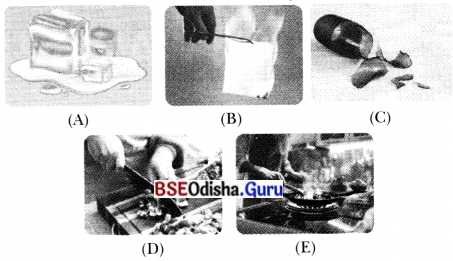
Based on your observation, select the correct statements from the following:
(a) Processes A and E are reversible, while B, C and D are irreversible.
(b) Only process A is reversible, while the rest are irreversible.
(c) Only process C is reversible, while the rest are irreversible.
(d) Processes A and D are reversible, while B, C and E are irreversible.
Answer:
(b) Only process A is reversible, while the rest are irreversible.
Question 12.
Pooja prepared a birthday card for her mother and the process involved the following steps:
(i) Folding of the paper
(ii) Cutting of the paper
(iii) Pasting stickers on the paper
Which of the following options correctly identifies the types of changes taking place?
| (i) | (ii) | (iii) | |
| (a) | Reversible physical |
Irreversible chemical |
Irreversible physical |
| (b) | Irreversible chemical |
Reversible physical |
Reversible physical |
| (c) | Reversible physical |
Irreversible physical |
Reversible physical |
| (d) | Reversible physical |
Reversible physical |
Irreversible physical |
Answer:
(c)
Question 13.
Which of the following is/are true when milk changes into curd?
(i) Its state is changed from liquid to semi-solid.
(ii) It changes colour.
(iii) It changes taste.
(iv) The change cannot be reversed.
Choose the correct option from below.
(a) (i) and (ii) are correct.
(b) (ii) and (iii) are correct.
(c) (i), (iii) and (iv) are correct.
(d) (i) and (iv) are correct
Answer:
(c) (i), (iii) and (iv) are correct.
Question 14.
The given experimental setup shows that lime water turns milky in the presence of a gas X. Which of the following statements are incorrect regarding this experiment?
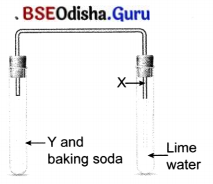
(i) The lime water turns milky due to the formation of calcium hydrogen carbonate.
(ii) Y must be an acid like acetic acid.
(iii) The process involves an irreversible physical change, as there occurs only a change in the colour of the original mixture.
(iv) The gas X is hydrogen, which turns lime water milky.
(a) (i) and (ii) only
(b) (ii), (iii), and (iv)
(c) (iii) and (iv) only
(d) (i), (iii), and (iv)
Answer:
(d) The lime water turns milky due to the formation of calcium carbonate, which is insoluble in water. The process involves a chemical change as a new substance (calcium carbonate) is formed. The gas X is carbon dioxide, which turns lime water milky.
Question 15.
Which of the following statements are correct about combustion?
(i) In this reaction, a substance reacts with carbon dioxide and produces heat and light.
(ii) In this reaction, a substance reacts with oxygen and produces heat and/or light.
(iii) Combustion can only take place if the heat supplied is sufficient to reach the ignition temperature of the combustible substance.
(iv) All substances undergo combustion at all temperatures.
(a) (ii) and (iv)
(b) (i) and (iii)
(c) (ii) and (iii)
(d) (i) and (iv)
Answer:
(c) In a combustion reaction, a given substance reacts with oxygen present in the air and produces heat and light. Only combustible substances undergo combustion, and that too at a certain minimum temperature. A given combustible substance cannot burn if the heat supplied is not sufficient enough to reach its ignition temperature.
Question 16.
Divya, a student of class 7, placed two identical candles on two separate Petri dishes and lit them. She covered one of these with a glass tumbler as shown in the given experimental setup:
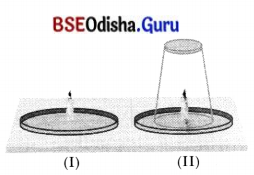
Based on the experiment, select the correct statements from the following:
(i) The candle in case (I) will get extinguished earlier in comparison to the candle in case (II).
(ii) The candle in case (II) will get extinguished earlier in comparison to the candle in case (I).
(iii) The component of air that supports combustion is oxygen.
(iv) The component of air that supports combustion is carbon dioxide.
(a) (i) and (iii)
(b) (ii) and (iv)
(c) (i) and (iv)
(d) (ii) and (iii)
Answer:
(d) The candle in case (I) has a continuous supply of air (oxygen), while the supply of air gets discontinued in case (II) as the candle gets covered with a glass tumbler. Hence, the candle in case (II) will get extinguished earlier in comparison to the candle in case (I). Also, the component of air that supports combustion is oxygen.
Question 17.
In a class discussion on physical and chemical changes, the teacher asked the students to determine whether the burning of a candle is a physical or a chemical change.
The students had the following discussion:
Student X: It involves only a physical change as only melting and solidification of the wax occur in this process.
Student Y: It involves only a chemical change as the wax burns to produce heat.
Student Z: It involves both physical and chemical changes as the wax melts, evaporates, and solidifies (physical changes), and the vapour of wax burns to produce a flame (chemical change).
The correct statement is provided by which of the above students?
(a) Students X and Y
(b) Student Y only
(c) Students Y and Z
(d) Student Z only
Answer:
(d) On burning a candle, the wax of the candle melts and the melted wax is carried up the wick, which then evaporates due to the heat of the flame. The wax vapour burns to produce a flame. Here, the melting of wax, its solidification, and evaporation are classified as physical changes. The burning of wax vapour in the flame represents a chemical change. Thus, burning a candle involves both physical and chemical changes.
Question 18.
In which of the following processes is a chemical change taking place?
(i) Heating water in a pan on a Bunsen burner
(ii) Folding a paper to make a boat
(iii) Cooking food
(iv) Folding a bed sheet
(a) (i) and (ii) only
(b) (iii) only
(c) (iii) and (iv) only
(d) (i), (ii) and (iii)
Answer:
(c) (iii) and (iv) only
Changes Around Us: Physical and Chemical Class 7 Assertion and Reason Questions
The following questions consist of two statements – Assertion (A) and Reason (R). Answer these questions by selecting the correct option:
(a) Both A and R are true and R is the correct explanation of A.
(b) Both A and R are true but R is not the correct explanation of A.
(c) A is true but R is false.
(d) A is false but R is true.
1. (A): Melting of wax is an irreversible physical change.
(R): Only the state of matter changes during this process.
Answer:
(d) Melting of wax is a reversible physical change.
2. (A): After dissolving salt in water, it cannot be recovered by any physical method.
(R): Dissolving salt in water is a physical change.
Answer:
(d) After dissolving salt in water, it can be recovered by evaporation, which is a physical method.
3. (A): A physical change is always reversible.
(R): A physical change is accompanied by a change in physical properties of the original substance.
Answer:
(d) A physical change may be reversible as well as irreversible. For example, breaking a glass tumbler into smaller pieces is a physical, irreversible change.
4. (A): If a burning candle is covered with a glass tumbler, it stops burning after some time.
(R): Oxygen is required for combustion.
Answer:
(a) Both A and R are true and R is the correct explanation of A.
5. (A): Ripening of fruits is a chemical change.
(R): During ripening, a new substance is formed.
Answer:
(a) Both A and R are true and R is the correct explanation of A.
6. (A): Turning of lime water milky is a chemical change.
(R): Lime water turns milky in the presence of carbon dioxide due to the formation of a new substance, i.e., calcium carbonate.
Answer:
(a) Both A and R are true and R is the correct explanation of A.
Changes Around Us: Physical and Chemical Class 7 Fill in the Blanks
1. Souring of milk is an example of a ………… change.
Answer: chemical
2. Iron benches kept in lawns and gardens acquire …………. This process involves a ………..change because a new substance is formed.
Answer: rust, chemical
3. Grinding of wheat grain changes its size. It is a…………(physical/chemical) change.
Answer: physical
4. The process that results in the formation of new substances during a …………change is known as a …………reaction.
Answer: chemical, chemical
5. Cooking of food is a …………(desirable/undesirable) change.
Answer: desirable
6. ………… gas when passed through lime water turns it milky due to the formation of …………………
Answer: Carbon dioxide, calcium carbonate
Changes Around Us: Physical and Chemical Class 7 True or False
1. When a candle burns, both physical and chemical changes take place.
Answer: True
2. The component of air that supports combustion is carbon dioxide.
Answer: False: The component of air that supports combustion is oxygen.
3. Stretching of a rubber band is not a physical change.
Answer: False: Stretching of a rubber band is a physical change.
4. A physical change does not involve the formation of a new substance.
Answer: True
5. Rusting of iron is an undesirable chemical change.
Answer: True
6. The movement of rock pebbles, soil, and sediments (after breaking down) from one place to another by wind or flowing water to form sand is called erosion.
Answer: True
Changes Around Us: Physical and Chemical Class 7 Match the Following
Question 1.
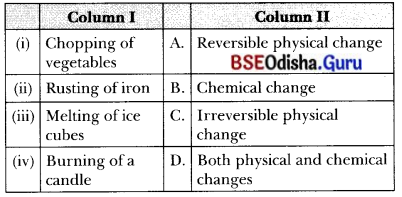
Answer:
| Column I | Column II | ||
| (i) | Chopping of vegetables | C. | Irreversible physical change |
| (ii) | Rusting of iron | B. | Chemical change |
| (iii) | Melting of ice cubes | A. | Reversible physical change |
| (iv) | Burning of a candle | D. | Both physical and chemical changes |
Question 2.
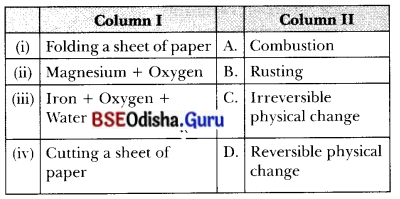
Answer:
| Column I | Column II | ||
| (i) | Folding a sheet of paper | D. | Reversible physical change |
| (ii) | Magnesium + Oxygen | A. | Combustion |
| (iii) | Iron + Oxygen + Water | B. | Rusting |
| (iv) | Cutting a sheet of paper | C. | Irreversible physical change |