
Students can refer to BSE Odisha Class 7 Math Solution and Ganita Prakash Chapter 2 Arithmetic Expressions Class 7 Question Answer to understand textbook questions step by step.
Class 7 Maths Chapter 2 Arithmetic Expressions Solutions
Ganita Prakash Class 7 Chapter 2 Solutions
Class 7 Maths Ganita Prakash Chapter 2 Solutions Arithmetic Expressions
Question 1.
Fill in the blanks to make the expressions equal on both sides of the ‘=’ sign:
(i) 13 + 4 = _____ + 6
(ii) 22 + = 6 × 5
(iii) 8 × = 64 4 2
(iv) 34 – _____ = 25
Solution:
(i) 13 + 4 = 11 + 6 [∵ 13 + 4 = 17 and 11 + 6 = 17]
(ii) 22 + 8 = 6 × 5 [∵ 6 × 5 = 30 and 22 + 8 = 30]
(iii) 8 × 4 = 64 ÷ 2 [∵ 64 ÷ 2 = 32 and 8 × 4 = 32]
(iv) 34 – 9 = 25
Question 2.
Arrange the following expressions in ascending (increasing) order of their values.
(i) 67 – 19
(ii) 67 – 20
(iii) 35 × 25
(iv) 5 × 11
(v) 120 ÷ 3
Solution:
(i) 67 – 19 = 48
(ii) 67 – 20 = 47
(iii) 35 + 25 = 60
(iv) 5 × 11 = 55
(v) 120 ÷ 3 = 40
Clearly, 40 < 47 < 48 < 55 < 60
∴ 120 ÷ 3 < 67 – 20 < 67 – 19 < 5 × 11 < 35 4 25
Hence, (v) < (ii) < (i) < (iv) < (iii).

Question 3.
For each of the following situations, write the expression describing the situation, identify its terms and find the value of the expression.
(i) Queen Alia gave 100 gold coins to Princess Elsa and 100 gold coins to Princess Anna last year. Princess Elsa used the coins to start a business and doubled her coins. Princess Anna bought jewellery and has only half of the coins left. Write an expression describing how many gold coins Princess Elsa and Princess Anna together have.
(ii) A metro train ticket between two stations is ₹40 for an adult and ₹20 for a child. What is the total cost of tickets:
(a) for four adults and three children?
(b) for two groups having three adults each?
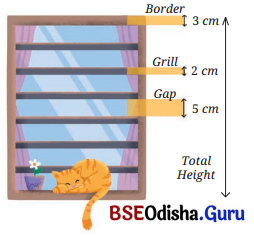
(iii) Find the total height of the window by writing an expression describing the relationship among the measurements shown in the picture.
Solution:
(i) Number of gold coins Princess Elsa got = 100
Number of gold coins Princess Anna got = 100
Princess Elsa used the coins to start the business and double her coins.
So, the number of coins Princess Elsa has = 2 × 100
Princess Anna bought jewellery and has only half of the coins left.
So, the total number of coins Princess Anna has = \(\frac{100}{2}\)
Therefore, the total number of gold coins Princess Elsa and Princess Anna have together
= 2 × 100 + \(\frac{100}{2}\) = 200 + 50 = 250
Thus, the expression describing the above situation is, 2 × 100 + \(\frac{100}{2}\).
Terms: 2 × 100, \(\frac{100}{2}\)
(ii) (a) Fare of metro train ticket for an adult = ₹40
So, the fare of metro train ticket for four adults (in ₹) = 4 × 40
Fare of metro train ticket for a child = ₹20
So, the fare of metro train ticket for three children (in ₹) = 3 × 20
Therefore, the expression describing the total cost of tickets (in ₹) for four adults and three children is 4 × 40 + 3 × 20.
Total fare = 4 × ₹40 + 3 × ₹20 = ₹ 160 + ₹60 = ₹220
Terms: 4 × 40, 3 × 20
(b) Fare of metro train ticket for an adult = ₹40
So, the fare of metro train ticket for a group of three adults (in ₹) = 3 × 40
Therefore, the expression describing the total cost of tickets (in ₹) for the two groups having three adults each is 2 × (3 × 40).
Total fare = 2 × (3 × ₹ 40) = 2 × ₹120 = ₹240
Terms: 2 × (3 × 40)
(iii) By observing the given picture, the total height of the window
= Number of gaps × 5 cm + Number of grills × 2 cm + Number of borders × 3 cm
Here, total number of gaps = 7; Total number of grills = 6; Total number of borders = 2
∴ Total height of window (in cm) = 7 × 5 + 6 × 2 + 2 × 3 = 35 + 12 + 6 = 47 + 6 = 53
Terms: 7 × 5, 6 × 2, 2 ×3
Question 4.
Remove the brackets and write the expression having the same value.
(i) 14 + (12 + 10)
(ii) 14 – (12 + 10)
(iii) 14 + (12 – 10)
(iv) 14 – (12 – 10)
(v) -14 + 12 – 10
(vi) 14 – (-12 – 10)
Solution:
(i) 14 + (12 + 10) = 14 + 12 + 10 = 14 + 22 = 36
(ii) 14 – (12 + 10) = 14 – 12 – 10 = 14 – 22 = -8
(iii) 14 + (12 – 10) = 14 + 12 – 10 = 14 + 2 = 16
(iv) 14 – (12 – 10) = 14 – 12 + 10 = 14 – 2 = 12
(v) – 14 + 12 – 10 = – 14 + 2 = – 12
(vi) 14 – (-12 – 10) = 14 + 12 + 10 = 14 + 22 = 36
Here, expressions given in (i) and (vi) have same value.
Question 5.
Find the values of the following expressions. For each pair, first try to guess whether they have the same value. When are the two expressions equal?
(i) (6 + 10) – 2 and 6 + (10 – 2)
(ii) 16 – (8 – 3) and (16 – 8) – 3
(iii) 27 – (18 + 4) and 27 + (-18 – 4)
Solution:
(i) (6 + 10) – 2 = 16 – 2 = 14 and 6 + (10 – 2) = 6 + 8 = 14
Clearly, (6 + 10) – 2 = 6 + (10 – 2)
Hence, both the expressions have the same value.
(ii) 16 – (8 – 3) = 16 – 5 = 11 and (16 – 8) – 3 = 8 – 3 = 5
Clearly, 16 – (8 – 3) ≠ (16 – 8) – 3
Hence, both the expressions do not have the same value.
(iii) 27 – (18 + 4) = 27 – 22 = 5 and 27 + (-18 – 4) = 27 + (- 22) = 27 – 22 = 5
Clearly, 27 – (18 + 4) = 27 + (-18 – 4)
Hence, both the expressions have the same value.
Question 6.
Add brackets at appropriate places in the expressions such that they lead to the values indicated.
(i) 34 – 9 + 12 = 13
(ii) 56 – 14 – 8 = 34
(iii) – 22 – 12 + 10 + 22 = – 22
Solution:
(i) 34 – (9 + 12) = 34 – 21 = 13
(ii) (56 – 14) – 8 = 42 – 8 = 34
(iii) – 22 – (12 + 10) + 22 = – 22 – 22 + 22 = – 22
Question 7.
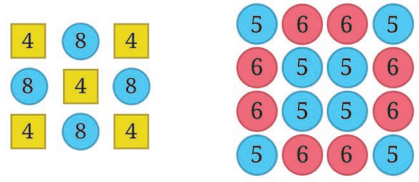
Find out the sum of the numbers given in each picture below in at least two different ways. Describe how you solved it through expressions.
Solution:
For I : 5 × 4 + 4 × 8 = 20 + 32 = 52 or 4 × (4 + 8) + 4 = 4 × 12 + 4 = 52
For II : 8 × (5 + 6) = 8 × 11 = 88 or 8 × 5 + 8 × 6 = 40 + 48 = 88
Question 8.
Read the situations given below. Write appropriate expressions for each of them and find their values.
(i) The district market in Begur operates on all seven days of a week. Rahim supplies 9 kg of mangoes each day from his orchard and Shyam supplies 11 kg of mangoes each day from his orchard to this market. Find the amount of mangoes supplied by them in a week to the local district market.
(ii) Binu earns ₹20,000 per month. She spends ₹5,000 on rent, ₹5,000 on food and ₹2,000 on other expenses every month. What is the amount Binu will save by the end of a year?
(iii) During the daytime a snail climbs 3 cm up a post, and during the night while asleep, accidentally slips down by 2 cm. The post is 10 cm high, and a delicious treat is on its top. In how many days will the snail get the treat?
Solution:
(i) Amount of mangoes supplied by Rahim each day = 9 kg
Amount of mangoes supplied by Shyam each day = 11 kg
Total supplies of mangoes in the market on each day = (9 + 11) kg
∴ Total supplies of mangoes in the market in a week (7 days) = 7 × (9 + 11) = 7 × 20 = 140 kg
(ii) Binu’s per month earning = ₹20,000
Binu’s total monthly expenditures
= ₹5,000 on rent + ₹5,000 on food + ₹ 2,000 on other expenses
= ₹(5,000 + 5,000 + 2,000)
Therefore, Binu’s monthly savings = ₹20,000 – ₹(5,000 + 5,000 + 2,000) = ₹20,000 – ₹12,000 = ₹8,000
Thus, Binu’s total yearly savings = 12 × 8000 = ₹96000
Hence, Binu will save ₹96000 by the end of the year.
(iii) Since the snail climbs 3 cm up the post in daytime and slips down by 2 cm at night.
The distance climbed by the snail in a day = 3 – 2 = 1 cm
∴ The distance climbed in 7 days = 7 cm
The height of the post is 10 cm.
The distance climbed on the 8th day before slipping = 7 + 3=10 cm
So, the snail will take 8 days to reach the top of the post and get the delicious treat.
Question 9.
Find different ways of evaluating the following expressions:
(i) 1 – 2 + 3 – 4 + 5 – 6 + 7 – 8 + 9 – 10
(ii) 1 – 1 + 1 – 1 + 1 – 1 + 1 – 1 + 1 – 1
Solution:
(i) 1 – 2 + 3 – 4 + 5 – 6 + 7 – 8 + 9 – 10 = (1 + 3 + 5 + 7 + 9) + (-2 – 4 – 6 – 8 – 10) = 25 + (- 30) = – 5
OR
1 – 2 + 3 – 4 + 5 – 6 + 7 – 8 + 9 – 10 = (1 – 2) + (3 – 4) + (5 – 6) + (7 – 8) + (9 – 10)
= (-1) + (-1) + (-1) + (-1) + (-1) = -5
(ii) 1 – 1 + 1 – 1 + 1 – 1 + 1 – 1 + 1 – 1 = (1 – 1) + (1 – 1) + (1 – 1) + (1 – 1) + (1 – 1)
= 0 + 0 + 0 + 0 + 0 = 0
OR
1 – 1 + 1 – 1 + 1 – 1 + 1 – 1 + 1 – 1= (1 + 1 + 1 + 1 + 1) + (- 1 – 1 – 1 – 1 – 1)
= 5 + (- 5) = 0
Question 10.
Identify which of the following expressions are equal to the given expression without computation. You may rewrite the expressions using terms or removing brackets. There can be more than one expression which is equal to the given expression.
(i) 83 – 37 – 12
(a) 84 – 38 – 12
(b) 84 – (37 + 12)
(c) 83 – 38 – 13
(d) -37 + 83 – 12
(ii) 93 + 37 × 44 + 76
(a) 37 + 93 × 44 + 76
(b) 93 + 37 x× 76 + 44
(c) (93 + 37) × (44 + 76)
(d) 37 × 44 + 93 + 76
Solution:
(i) 83 – 37 – 12 = 83 – 37 – 12 + (1 – 1) = (83 + 1) – 37 – 1 – 12 = 84 – 38 – 12
Also, 83 – 37 – 12 = – 37 + 83 – 12
Hence, (a) and (d) are equal to the given expression 83 – 37 – 12.
(ii) 93 + 37 × 44 + 76
Rearranging the terms, we get 37 × 44 + 93 + 76, which is equal to the given expression in option (d). Hence, (d) is equal to the given expression 93 + 37 × 44 + 76.
InText Questions
Question 1.
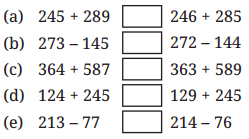
Use ‘>’ or ‘<’ or ‘=’ in each of the following expressions to compare them. Can you do it without complicated calculations? Explain your thinking in each case.
Solution:
(i) 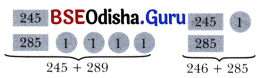
∴ 245 + 289 > 246 + 285
(ii) 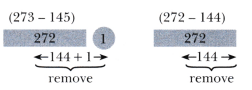
∴ 273 – 145 = 272 – 144
(iii) 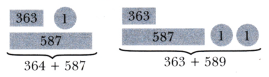
∴ 364 + 587 < 363 + 589
(iv) 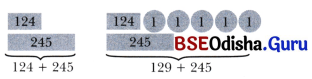
∴ 142 + 245 < 129 + 245
(v) 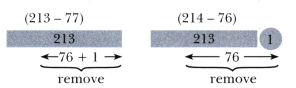
∴ 213 – 77 < 214 – 76
Question 2.
Can you explain why subtracting a number is the same as adding its inverse, using the Token Model of integers that we saw in the Class 6 textbook of mathematics?
Solution:
In the token model:
Subtracting a positive number (e.g. subtracting 3) means removing 3 positive tokens.
Adding a negative number (e.g. adding- 3) meaning adding 3 negative tokens. These 3 negative tokens cancel out 3 existing positive tokens (by forming zero pairs), which is equivalent to removing 3 positive tokens.
Since both actions result in removing the same number of positive tokens, the final value is the same.
Question 3.
Does adding the terms of an expression in any order give the same value? Take some expressions and check. Consider expressions with more than 3 terms also.
Solution:
Yes
(-2) + (-3) + (-4) + (-5)
= (-2) + (-3) + (-4) + (-5)
= (- 5) + (-4) + (-5)
= (-9) + (-5) = -14
(-2) + (-3) + (-4) + (-5)
= (-2) + (-3) + (-4) + (-5)
= (-2) + (-7) + (-5)
= (-2) + (-12) = -14
(-2) + (-3) + (-4) + (-5)
= (-2) + (-3) + (-4) + (-5)
= (-2) + (-3) + (-9)
= (-5) + (- 9) = -14
Note: Students can do on their own by taking different numbers.
Question 4.
5 × 4 + 3 ≠ 5 × (4 + 3). Can you explain why?
Is 5 × (4 + 3) = 5 × (3 + 4) = (3 + 4) × 5?
Solution:
Expression 5 × 4 + 3 means 3 more than 5 × 4, which is equal to 23, but 5 × (4 + 3) means 5 times the sum of 3 and 4 which is equal to 35.
Hence, 5 × 4 + 3 + 5 ×(4 + 3)
Now, 5 × (4 + 3), 5 × (3 + 4), and (3 + 4) × 5 have the same meaning, which is 5 times the sum of 3 and 4 and give the same value.
Hence, 5 × (4 + 3) = 5 × (3 + 4) = (3 + 4) × 5
Question 5.
Use distributive property to find the following products:
(i) 95 × 8
(ii) 104 × 15
(iii) 49 × 50
Is this quicker than the multiplication procedure you use generally?
Solution:
(i) 95 × 8
= (100 – 5) × 8
= (100 × 8) – (5 × 8)
= 800 – 40 = 760
(ii) 104 × 15
= (100 + 4) × 15
= (100 × 15) + (4 × 15)
= 1500 + 60 = 1560
(iii) 49 × 50
= (50 – 1) × 50
= (50 × 50) – (50 × 1)
= 2500 – 50 = 2450
Yes, this procedure is quicker than the general multiplication procedure.
Arithmetic Expressions Class 7 Extra Questions
Arithmetic Expressions Class 7 Very Short Question Answer
Question 1.
Riya buys 5 notebooks per day for 4 days and 7 notebooks per day for the remaining 3 days of a week. Form an expression to represent the total number of notebooks she buys in that week.
Solution:
For 4 days: Riya buys 5 notebooks per day
For 3 days: Riya buys 7 notebooks per day
Thus, expression for total number of notebooks
= 4 × 5 + 3 × 7
Question 2.
Compare which is greater: 79 – 96 or 117 – 130.
Solution:
The value of 79 – 96 is – 17.
The value of 117 – 130 is – 13.
Clearly, – 17 < -13
Hence, 117 – 130 is greater than 79 – 96.
Question 3.
Anaya is preparing for a temple festival. She decorates 5 pillars, placing 7 marigold garlands on each. However, 2 garlands fall and cannot be used. Find the total number of garlands finally used.
Solution:
Total garlands before any fall = 5 × 7 = 35
Garlands that cannot be used = 2
Now, total garlands finally used = 35 – 2 = 33
Question 4.
Priya buys 2 packs of biscuits for ₹15 each and a juice for ₹20. What is the total cost that Priya needs to pay?
Solution:
Given, Priya buys 2 packs of biscuits for ₹15 each and a juice for ₹20.
Cost of biscuits = 2 × ₹15
Cost of juice = ₹ 20
Now, total cost = 2 × ₹ 15 + ₹20 = ₹30 + ₹20
= ₹50
Question 5.
Add brackets at appropriate places in the expressions such that they lead to the values indicated.
(i) 25 – 7 + 12 = 6
(ii) 42 – 15 – 7-9 = 29
(iii) – 32 – 18 + 14 + 32 = – 32
(iv) 35 – 18 – 5 + 10 = 32
Solution:
(i) 25 – (7 + 12) = 6
(ii) 42 – 15 – (7 – 9) = 29
(iii) – 32 – (18 + 14) + 32 = – 32
(iv) 35 – (18 – 5) + 10 = 32
Arithmetic Expressions Class 7 Short Question Answer
Question 1.
Ankit is planning a birthday party. He buys:
- 5 party hats, each costing ₹ 60
- 2 big balloons, each costing ₹90
- If the total cost exceeds ₹400, he receives a discount of ₹50.
Write the expression that shows the amount (in ₹) Ankit has to pay.
Solution:
Given, cost of five party hats = 5 × ₹ 60
Cost of two big balloons = 2 × ₹90
Discount = ₹50 [If total cost > ₹400]
Now, total cost (in ₹) = 5 × 60 + 2 × 90 = 300 + 180 = 480
As 480 > 400, Ankit gets a discount of ₹50.
So, the expression that shows the amount (in ₹) Ankit has to pay (after applying the discount) is
5 × 60 + 2 × 90 – 50.
Question 2.
Simplify:
(i) (-40) × (-1) + 28 ÷ 7
(ii) 7 – [13 – 2{4 × (- 4)}]
(iii) 81 × [59 – {7 × 8 + (13 – 2 × 5)}]
Solution:
(i) (-40) × (- 1) + 28 ÷ 7
= (40 × 1) + 28 ÷ 7
= 40 + 4 = 44 [∵ (-) × (-) = ( + )]
(ii) 7 – [13 – 2{4 × (- 4)}]
= 7 – [13 – 2 × {-16}] [∵ (+) × (-) = (-)]
= 7 – [13 + 32] = 7 – 45 = -38
(iii) 81 × [59 – {7 × 8 + (13 – 2 × 5)}]
= 81 × [59 – {7 × 8 + (13 – 10)}]
= 81 × [59 – {56 + 3}]
= 81 × [59 – 59] = 81 × 0 = 0
Question 3.
Find the following products using the distributive property.
(i) 107 × 12
(ii) 98 × 14
Solution:
(i) Let’s break 107 as 100 + 7.
Now, 107 × 12 = (100 + 7) × 12
= 100 × 12 + 7 × 12 [Using distributive property]
= 1200 + 84 = 1284
Hence, 107 × 12 = 1284
(ii) Let’s break 98 as 100 – 2.
Now, 98 × 14 = (100 – 2) × 14
= 100 × 14 – 2 × 14
= 1400 – 28 = 1372
Hence, 98 × 14 = 1372
Question 4.
Simplify: 659 – [219 – (750 — 255 ÷ 5 × 9)]
Solution:
We know, on removing the brackets preceded by a minus sign, the signs of all the terms inside the brackets change.
Thus, 659 – [219 – (750 – 255 ÷ 5 × 9)]
= 659 – 219 + (750 – 255 ÷ 5 × 9)
= 659 – 219 + (750 – 51 × 9) [As 255 ÷ 5 = 51]
= 659 – 219 + (750 – 459) [As 51 × 9 = 459]
= 1409-678
[As 659 + 750 = 1409 and – 219 – 459 = – 678]
= 731
Hence, 659 – [219 – (750 – 255 ÷ 5 × 9)] = 731
Question 5.
Simplify:
63 – (- 3){- 2 – 8 – 3} ÷ {5 + (- 2)(- 1)}
Solution:
63 – (-3){-2 – 8 – 3} ÷ {5 + (-2)(-1)}
= 63 – (- 3){-2 – 5} ÷ {5 + (- 2)(- 1)}
[Removal of bar]
= 63 + 3{-2 – 5} ÷ {5 + 2}
[As – (-3) = 3 and (-2) (-1) = 2]
= 63 + 3{-7} ÷ 7
= 63 – 21 ÷ 7[As 3(-7) = -21]
= 63 – 3 = 60[As 21 ÷ 7 = 3]
Question 6.
Ravi took part in a painting competition and got scores 34, 37 and 31 from three judges. Later, it was found that second judge had mistakenly given 37 instead of the correct score 35. What are Ravi’s initial and updated total scores?
Solution:
Given, Ravi got scores 34, 37 and 31 from three judges.
So, the initial total score = 34 + 37 + 31 = 102
Later, the second judge’s score was corrected from 37 to 35, which is 2 less than the initial score.
Since only the second score changed, the updated total score = 102 – 2 = 100
Hence, Ravi’s updated total score is 100.
Question 7.
Remove the brackets and write the expression having the same value.
(i) 18 + (12 + 6)
(ii) 18 + (12 – 6)
(iii) 18 – (12 + 6)
(iv) 18 – (12 – 6)
(v) 18 – (-12 – 6)
(vi) 18 – (-12 + 6)
Solution:
On removing the brackets preceded by a plus sign, the signs of all the terms inside the brackets remain same.
(i) 18 + (12 + 6) = 18 + 12 + 6
(ii) 18 + (12 – 6) = 18 + 12 – 6
On removing the brackets preceded by a minus sign, the signs of all the terms inside the brackets change.
(iii) 18 – (12 + 6) = 18 – 12 – 6
(iv) 18 – (12 – 6) = 18 – 12 + 6
(v) 18 – (-12 – 6) = 18 + 12 + 6
(vi) 18 – (-12 + 6) = 18 + 12 – 6
Question 8.
Leela is organizing candles for a festival. She places 36 candles in one box and 27 in another. She gives away 8 candles from the second box to her neighbour.
Write an expression for the number of candles Leela is left with.
Solution:
Candles in the first box = 36
Candles in the second box = 27
Candles given to neighbour = 8
Now, the number of candles left with Leela
= Candles in the first box + Candles in the second box – Candles given to neighbour
= 36 + 27 – 8, which is the required expression.
Question 9.
In three sections of a school library, 64, 93 and 81 books were recorded respectively.
Later, the librarian found that there were mistakes in two sections:
- The first section actually had 84 books, not 64.
- The second section actually had 73 books, not 93.
What is the difference between total number of books initially and after correcting the record?
Solution:
The error in the number of books in the first section was + 20 (i.e., 84 – 64 = +20).
The error in the second section was -20
(i.e., 73 – 93 = – 20).
Since these two errors cancel each other out, the overall total remains unchanged.
Therefore, there is no difference in the total number of books.
Arithmetic Expressions Class 7 Long Question Answer
Question 1.
Find the following products using the distributive property.
(i) 125 × 16
(ii) 87 × 13
(iii) 106 × 104
(iv) 107 × 91
Solution:
(i) Let’s break 125 as 100 + 25.
Now, 125 × 16 = (100 + 25) × 16
= 100 × 16 + 25 × 16 = 1600 + 400 = 2000
Hence, 125 × 16 = 2000
(ii) Let’s break 87 as 100 -13.
Now, 87 × 13 = (100 – 13) × 13
= 100 × 13 – 13 × 13 = 1300 – 169 = 1131
Hence, 87 × 13 = 1131
(iii) Let’s break 106 as 100 + 6.
Now, 106 × 104 = (100 + 6) × 104
= 100 × 104 + 6 × 104 = 10400 + 6 × (100 + 4)
[As 104 = 100 + 4]
= 10400 + 6 × 100 + 6 × 4
= 10400 + 600 + 24 = 11024
Hence, 106 × 104 = 11024
(iv) Let’s break 107 as 100 + 7.
Now, 107 × 91 = (100 + 7) × 91
= 100 × 91 + 7 × 91 = 9100 + 7 × (100 – 9)
[As 91 = 100 – 9]
= 9100 + 7 × 100 – 7 × 9
= 9100 + 700 – 63
= 9800 – 63 = 9737
Hence, 107 × 91 = 9737.
Question 2.
Simplify:
(i) 121 ÷ [17 – {15 – 3(7 – 4)}]
(ii) 32 ÷ [32 + {32 – (32 + 32 – 32 )}]
(iii) 15 – (-3) × [{4- 7 – 3} + 3 × {5 + (-3) × (-6)}]
Solution:
(i) 121 ÷ [17 – {15 – 3(7 – 4)}]
= 121 ÷ [17 – {15 – 3 × 3}]
= 121 ÷ [17 – {15 – 9}]
= 121 ÷ [17 – 6]
= 121 ÷ 11 = 11
(ii) 32 ÷ [32 + {32 – (32 + 32 – 32 )}]
= 32 ÷ [32 + {32 – (32 + 0)}]
= 32 ÷ [32 + {32 – 32}]
= 32 ÷ [32 + 0] = 32 + 32 = 1
(iii) 15 – (-3) × [{4 – 7 – 3 } ÷ 3 × {5 + (-3) × (-6)}]
= 15 + 3 × [{4 – 4} ÷ 3 × {5 + 18}]
= 15 + 3 × [0 ÷ 3 × 23]
= 15 + 3 × [0 × 23] [As 0 ÷ 3 = 0]
= 15 + 3 × 0 = 15
Arithmetic Expressions Class 7 Case Based Questions
Question 1.
At Surya Vidya Mandir, the annual Art Festival is being celebrated. Ishan is participating in the event and earning performance points based on his art scenes.
Here’s how the points are awarded:
- In the 1st scene, he puts in a solid effort and earns 22 points.
- In the 2nd scene, he gets more confident and scores 8 more points than in the 1st scene.
- In the 3rd scene, he is slightly exhausted and earns half the points he got in the 2nd scene.
Based on the above information, answer the following questions:
(i) Write arithmetic expressions to represent the number of points earned in the 2nd and 3rd scenes respectively.
(ii) What is the total number of points earned in all three scenes?
(iii) If each point is worth ₹50, how much money can Ishan claim?
Solution:
Points earned in 1st scene = 22
Points earned in 2nd scene
= 8 more points than in the 1st scene
= 22 + 8 = 30
Points earned in 3rd scene
= \(\frac{1}{2}\) × (Points earned in 2nd scene)
= \(\frac{1}{2}\) × 30 = 15
(i) Arithmetic expression to represent the number of points earned in 2nd scene = 22 + 8
Arithmetic expression to represent the number of points earned in 3rd scene = \(\frac{1}{2}\) × 30
(ii) Total number of points earned in all three scenes = 22 + 30 + 15 = 67
(iii) Given, 1 point = ₹50
Total money that Ishan can claim
= ₹50 × 67 = ₹3,350
Question 2.
Ria buys 5 packs of pencils for her art class.
Each pack has 6 coloured pencils and 4 graphite pencils. But she loses 3 coloured pencils on the way.
Based on the above information, answer the following questions

(i) How many coloured pencils does Ria have?
(ii) How many graphite pencils does she have?
(iii) What is the total number of pencils Ria finally has?
Solution:
(i) In 1 pack, there are 6 coloured pencils.
So, number of coloured pencils in 5 packs
= 5 × 6 = 30
Given, Ria lost 3 coloured pencils on the way.
Now, number of remaining coloured pencils
= 30 – 3 = 27
(ii) In 1 pack, there are 4 graphite pencils.
So, number of graphite pencils in 5 packs
= 4 × 5 = 20
(iii) Total number of pencils with Ria
= Number of coloured pencils + Number of graphite pencils
= 27 + 20 = 47