
Go through BSE Odisha Class 8 Science Solutions Chapter 7 Particulate Nature of Matter Question Answer to understand textbook questions more clearly.
Class 8 Science Curiosity Chapter 7 Question Answer
Class 8 Science Ch 7 Particulate Nature of Matter Question Answer
Class 8 Science Chapter 7 Particulate Nature of Matter Question Answer
Probe and Ponder Questions
Question 1.
Why is it possible to pile up stones or sand, but not a liquid like water?
Answer:
Stones and sand are solids. In solids, particles are tightly packed and held together by relatively strong interparticle attractions. This fixed arrangement gives solids a definite shape and allows them to rest on one another, so they can be piled up. Water is a liquid; its partcles have weaker attractions and can move past one another, so liquid flows and cannot keep a free-standing pile of its own shape.
Question 2.
Why does water take the shape of folded hands but lose that shape when released?
Answer:
Water is a liquid. Its particles can move around and rearrange themselves to fit the shape of the container (in this case, folded hands). When the hands are opened, gravity and the ability of the particles to move cause the water to flow and change shape again, because liquids have a definite volume but no fixed shape.

Question 3.
We cannot see air, so how does it add weight to an inflated balloon?
Answer:
Air is a mixture of gases made of tiny partcles (molecules) that cannot be seen individually. When a balloon is inflated, these gas particles occupy space inside the balloon and add mass to it. Because mass is present. the balloon becomes heavier – that is, air inside the balloon contributes to its weight.
Question 4.
Is the air we breathe today the same that existed thousands of years ago?
Answer:
Yes. Matter, including air, is continuously recycled in nature through processes such as respiration, photosynthesis and weather cycles. The atoms and molecules in the air today have existed for a very long time and keep circulating through the envvironment.
Question 5.
Share your questions?
Answer:
- How small are the tiniest particles of matter and can we ever see them?
- Why do some solids melt easily while others need very high temperatures?
- If gases have no fixed volume, how do they stay contained in the atmosphere?
- What happens to the partcles when a substance changes from solid to liquid?
- Why don’t all solids dissolve in water like sugar does?
InText Questions
Question 1.
Is every speck of this fine chalk powder still composed of the same substance, or has it changed into something else on breaking or grinding? (Page 99)
Answer:
Yes, even after breaking or grinding, each speck of chalk powder (fine-grinded) is the same as the previous state because this change is a physical change in which only the size of chalk changes, not any chemical change occurred.
Question 2.
Are the units of chalk obtained in this manner considered the smallest units of chalk? (Page 100)
Answer:
No, the obtained units of chalk in the process of grinding are not the smallest unit. Every unit of chalk is even consists of constituent particles, which are the basic units of chalk.
Question 3.
Chalk and sugar can both be broken down into their constituent particles. But how are the constituent particles held together to form the solid pieces we see? (Pages 101)
Answer:
The constituent particles in solids are held together by interparticles forces of attraction. These forces keep the particles closely packed and fixed in position, giving solids a definite shape and volume.
Question 4.
In the solid state, is there any way to move these particle apart? (Page 102)
Answer:
In a solid, particles can only vibrate about fixed positions because they are very close together and strongly attracted to one another. To move them further apart, we must supply energy (for example by heating) so that the solid melts into a liquid, where particles can move more freely.
Question 5.
Solids have a definite volume; what about liquids and gases? (Page 103)
Answer:
Liquids: Liquids have a definite volume but no definite shape; they take the shape of the container that holds them.
Gases: Gases have neither definite shape nor definite volume; they expand to fill the entire contain or space available to them.
Question 6.
Do gases also have a fixed volume? (Page 105)
Answer:
No, gases don’t have a fixed shape or volume. The volume of gas changes with the amount of closeness of particles or the interparticle attraction between particles.
Question 7.
Sugar and sand are both solids. Why does sugar dissolve in water, but sand does not? (Pages 108)
Answer:
Sugar particles are solid, but they dissolve in water and occupy some space between the water molecules. Because water can break down sugar particles, which reduces the total volume of the mixture. Whereas sand particles have a rigid crystal structure, which cannot be broken down by water molecules, and hence settle down in water and increasing the total volume.
Question 8.
How can we demonstrate the movement of gas particles that cannot be seen with the naked eye? (Page 110)
Answer:
We can use visible tracers such as smoke or coloured vapours to show gas motion. For example. Smoke from incense spreads through the air and its movement shows that gases particles move randomly and can carry other particles with them.
Particulate Nature of Matter Class 8 Questions and Answers
Keep the Curiosity Alive (Pages 113-114)
Question 1.
The primary difference between solids and liquids is that the constituent particles are :
(i) closely packed in solids, while they are stationary in liquids.
(ii) far apart in solids and have fixed positions in liquids.
(iii) always moving in solids and have a fixed position in liquids.
(iv) closely packed in solids and move past each other in liquids.
Answer:
(iv) closely packed in solids and move past each other in liquids.
Explanation: In solids, particles are closely packed and fixed in position due to strong interparticle attractions. In liquids, particles are still close but can move or slide past each other, allowing the liquid to flow and take the shape of its container.
Question 2.
Which of the following statements are true? Correct the false statements.
(i) Melting ice into water is an example of the transformation of a solid into a liquid.
Answer:
True: Melting ice into water is an example of the transformation of a solid into a liquid.
(ii) The melting process involves a decrease in interparticle attractions during the transformation.
Answer:
True: The Melting process involves a decrease in interparticle attraction during the transformation.
(iii) Solids have a fixed shape and a fixed volume.
Answer:
True: Solids have a fixed shape and a fixed volume.
(iv) The interparticle interactions in solids are very strong, and the interparticle spaces are very small.
Answer:
True: The interparticle interactions in solids are very strong, and the interparticle spaces are very small.
(v) When we heat camphor in one corner of a room, the fragrance reaches all corners of the room.
Answer:
True: When we heat camphor in one corner of a room, the fragrance reaches all corners of the room.
(vi) On heating, we are adding energy to the camphor, and the energy is released as a smell.
Answer:
False: The correct statement is: On heating, energy is added to camphor, causing it to undergo sublimation. The camphor directly converts into gas, and the vapour carries its characteristic smell.
Question 3.
Choose the correct answer with justification. If we could remove all the constituent particles from a chair, what would happen?
(i) Nothing will change.
(ii) The chair will weigh less due to lost particles.
(iii) Nothing of the chair will remain.
Answer:
Correct option is (iii) Nothing of the chair will remain.
Justification: A chair is made up of constituent particles (atoms and molecules). If you remove all the particles from the chair, there is nothing left to form the structure, shape, weight, or existence of the chair.
Question 4.
Why do gases mix easily, while solids do not?
Answer:
Gas particles are far apart from each other, and that’s why they move very fast in all directions. Gases have weak intermolecular forces, so they don’t attach. Due to this reason, gas particles spread easily around other particles.
Question 5.
When spilled on the table, milk in a glass tumbler flows and spreads out, but the glass tumbler stays in the same shape. Justify this statement.
Answer:
In this case, milk is spilled on the table, and it spreads around the table because its state is liquid. Liquids can take the shape of their surrounding because their molecules are free to move. This is the reason the milk flows around the table. Whereas the glass tumbler’s shape does not change because it is a solid. In solids, the molecules are closely packed.
Question 6.
Represent diagrammatically the changes in the arrangement of particles as ice melts and transforms into water vapour.
Answer:
As ice melts into water and then vaporizes into steam, the arrangement of water particles changes significantly. Initially, in ice (a solid), water molecules are tightly packed in a fixed, crystalline structure with limited movement (vibrations). As ice melts, the particles gain kinetic energy, breaking free from their fixed positions and becoming able to slide past each other, forming liquid water.
Further heating increases the kinetic energy, causing the particles to move more rapidly and spread out, eventually breaking free from the liquid and becoming water vapour, a gas with particles moving randomly and freely.
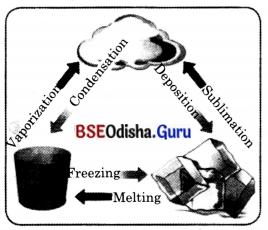
Ice (Solid)
- Arrangement: Water molecules are tightly packed in a regular, crystalline structure.
- Movement: Molecules vibrate in fixed positions.
Liquid Water
- Arrangement: Molecules are closer together than in a gas, but not in a regular structure. They can move around and slide past each other.
- Movement: Molecules can move around and slide past each other.
Water Vapor (Gas)
- Arrangement: Molecules are far apart and move randomly and freely in all directions.
- Movement: Molecules move rapidly and randomly, colliding with each other and the container walls.
Question 7.
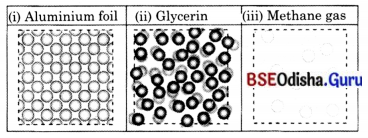
Draw a picture representing particles present in the following :
(i) Aluminium foil
(ii) Glycerin
(iii) Methane gas
Answer:
Pictorial representation of particles of Aluminium foil, Glycerin, and Methane gas.
Question 8.
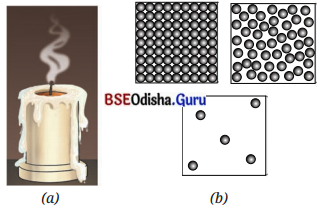
Observe figure (a), which shows the image of a candle that was just extinguished after burning for some time. Identify the different states of wax in the figure and match them with figure (b), showing the arrangement of particles.
Answer:
Different states of wax
Question 9.
Why does the water in the ocean taste salty, even though the salt is not visible? Explain.
Answer:
Ocean water tastes salty because it contains a high concentration of dissolved salts, primarily sodium chloride (common table salt). These salts are not visible because they are dissolved at a molecular level, meaning the individual salt molecules are dispersed throughout the water, making it appear clear.
Question 10.
Grains of rice and rice flour take the shape of the container when placed in different jars. Are they solids or liquids? Explain.
Answer:
Grains of rice and rice flour are considered solids, despite appearing to take the shape of their container. This is because each grain retains its shape and volume, even when mixed. The “flowing” behavior is due to the ability of these small, irregularly shaped particles to move past each other with minimal friction.
Class 8 Science Chapter 7 Question Answer
Activity 1
Aim: To show that matter is made of tiny units which is called constituent particles or building blocks.
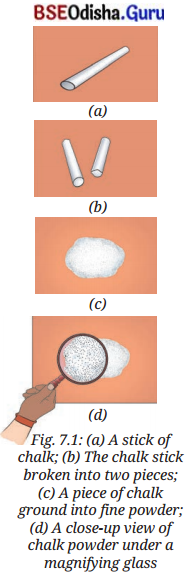
Materials Required: A stick of chalk, magnifying glass.
Procedure:
- Break a piece of chalk into two pieces see figure (a) and figure (b).
- Then break the chalk till it becomes difficult to break it further by hand.
- Finally grind the small pieces of chalk thus obtained [Fig. (c) using a mortar and pestle.
- Look at the fine powder of chalk with a magnifying glass and note down your observations. [Fig. (d)
Observations:
- Even finest chalk powder you can make still looks like chalk under a magnifying glass.
- By breaking or grinding the chalk no new substance is formed. Grinding is a physical change in which only the size of each speck of chalk has reduced further.
Inferences:
- If you could keep breaking the chalk smaller and smaller you would eventually reach the constituent particles that can’t be broken down further by normal means.
- The constituent particle is the basic unit that makes up a substance.What happen to sugar when dissolve in water?
Activity 2.
Let us perform
Aim: To show that particles have a lots of space between them and each tiny particle is made up of millions of constituent particles.
Materials Required: A glass tumbler, sugar.
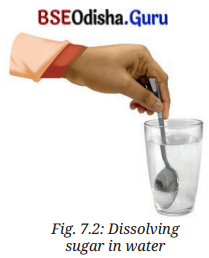
Procedure:
- First of all we will take a glass tumbler and fill it with drinking water.
- Now, add two or three teaspoons of sugar into it.
- Do not stir the water. Taste a small spoonful of water from the top layer of the glass.
- When you taste without stirring, the top layer does not taste sweet.
- Now, dissolve the sugar with the help of a spoon by stiring the Fig.: Dissolving sugar in water solution.
- Again taste a spoonful of water from the top layer.
Observations:
- After stirring the whole solution tastes sweet.
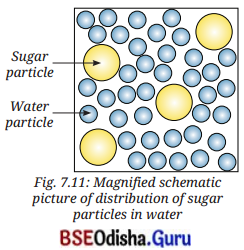
- Sugar particles dissolves completely and no longer can be seen.
Inference:
- The sugar has separated into its constituent particles, which spread out among the water particles and occupy the space called interparticle spaces.
- Constituent particles or basic particles are so small that they are invisible to the naked eye or even ordinary microscope.
Conclusion: Both chalk and sugar can be broken down to pieces made of their basic particles, and these are so small they are invisible to the naked eye or even ordinary microscopes.
Activity 3.
Let us find out
Aim: To show that solids are hard and keep their shape.
Materials Required: Some solid objects like stone, iron nail, etc. hammer.
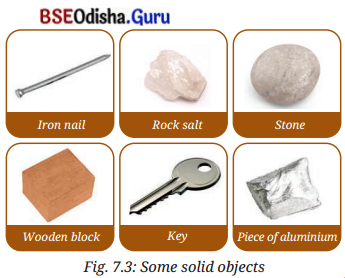
Procedure:
- First of all we will collect a few solid objects, like a piece of iron or an iron nail, a piece of rock salt, a stone, a piece of wood, a key, and a piece of aluminium (See figure).
- Now look at their shapes and sizes.
- Take one by one and try hammering them.
- Tabulate your observation and note down that which of the above six objects particles are strongly held together?
Observations:
| Objects | After hammering | Particles are strongly held together (Yes/No) |
| 1. Iron nail 2. Rock salt 3. Stone 4. Wooden block 5. Key 6. Piece of aluminium |
Shape can change May break May break No change Shape can change May convert into sheet |
Yes Yes Yes Yes Yes Yes |
Inference:
- They have definite shape and volume.
- They are tightly packed.
- This is due to strong interparticle attraction.
- The particles can only move to and fro about their positions (vibrate or oscillate) but cannot move past each other.
Activity 4.
Let us try and find out
Aim: To show that liquid have no fixed shape but have a fixed volume.
Materials Required: Containers of different shapes, marker, strip of paper.
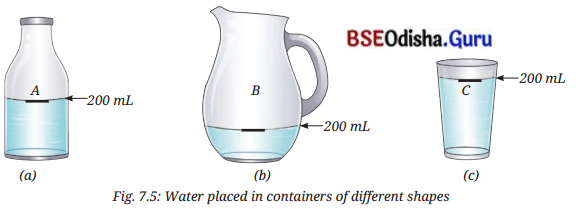
Procedure:
- First of all we will take three clean and dry containers of different shapes.
- Label them as X, Y and Z as in figure.
- Now, mark the 250 mL level in each container with the help of a marker or by pasting a thin strip of paper.
- Then, fill the water in X up to the marked level.
- Be careful when you are transfering water from container ‘X’ to container ‘Y’. Water should not be spill out.
- Observe the shapes and level of the water.
- Similarly, transfer the same water from Container Y to Container Z, carefully, and once again observe the shape and level of the water.
Observations:
- The volume stays the same.
- Liquids have no fixed shape it takes the shape of the container into which it is poured.
Inference:
- Liquids have no fixed shape but have a fixed volume.
- This happes because the particles of liquids are free to move.
Activity 5.
Let us investigate
Aim: To show that gases do not have fixed shape or volume and particles of gases move freely in all directions.
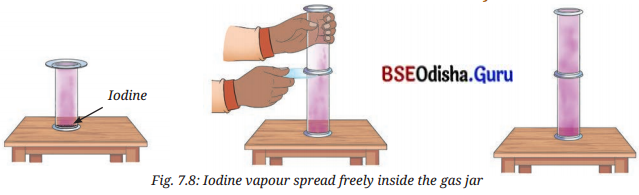
Materials Required: Two transparent gas jar or glass tumblers, incense stick.
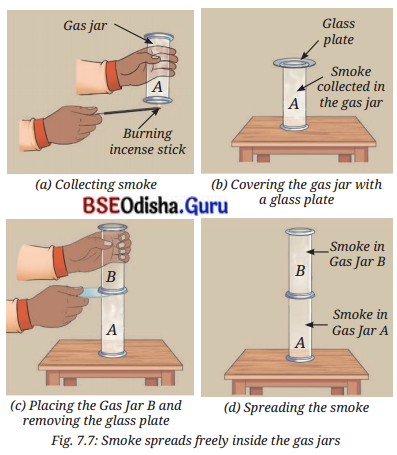
Procedure:
- First of all we will take two transparent gas jars or glass tumblers and mark them A and
- Now, burn an incense stick to create some smoke.
- Collect the smoke by holding the Gas Jar A upside down. [See figure (a)]
- We can see that the gas jar is filled with smoke.
- Now, turn it over and cover it with a glass plate. [See figure (b)]
- Then, take another Gas Jar B and turn it upside down and gently place it over the glass plate covering the Gas Jar A.
- Now, we will remove the glass plate slowly.
- We should take precaution that both gas jars are close and there is no gap for smoke to escape out. [See figure (c)]
- This experiment can be demonstrated by using an Iodine Vapour also.
- Note down your observations.
Observations:
- The smoke fills the entire space in the Gas Jar B, see figure (d).
- Particles in gases move freely in all directions.
Inference:
- Gases do not have a fixed shape or fixed volume.
- They acquire the shape of the vessel in which they are kept.
- Particles of gases are always in rapid, random motion.
Activity 6.
Let us experiment
Aim: To understand the compressibility of fluid (Gas and liquid) using a syringe.
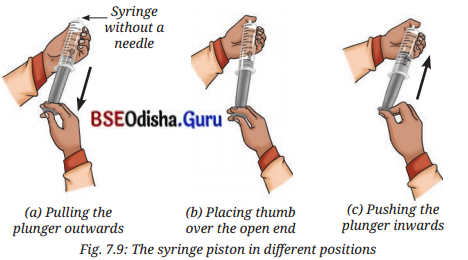
Materials Required: A syringe without needle.
Procedure:
- First of all we will take a syringe without a needle.
- Pull the plunger of the syringe in the outwards direction in a fully extended position (See figure (a)].
- Now, place our thumb on the open end of the syringe so that the air present inside the syringe may not escape.
- Try to push the plunger slowly and steadily inward [See figure (c)].
- Note down your observation.
- Repeat the activity using water and once again note down your observations.
Observations :
- Volume of air inside the syringe decreases because after compressing the air by pushing the plunger, the particles are forced to come closer.
- The plunger cannot move much when we do the same experiment with water.
Inference:
- Gas particles have large gaps between them, so gases are easily compressible.
- Liquids have much smaller gaps between particles, so they are almost incompressible.
Activity 7.
Let us observe
Aim: To show that liquids have enough interparticle spaces.
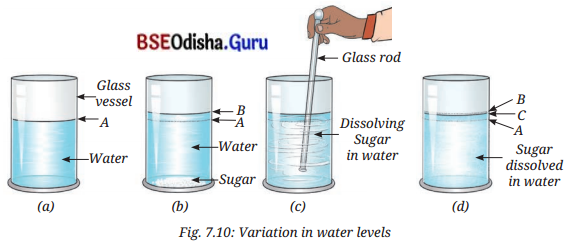
Materials Required: A glass vessel, a marker, glass rod.
Procedure:
- First of all we have to take a glass vessel, fill it about half with water and mark the level of water as A with the help of a marker. [See figure (a)]
- Now, add two teaspoons of sugar into it.
- Obviously the water level will rise. So, mark the new water level on the glass vessel as B. (See figure (b)]
- Take a glass rod and stir the water so that the sugar can be dissolved. [See figure (c)]
- Guess whether the water level will increase or decrease with respect to the mark B.
- Now, mark this water level again as C. [See figure (d)]
- Repeat the above activity with some other soluble solids, such as common salt or glucose, and insoluble solids, like sand and stone pieces.
Observations :
- Water level first rises (as sugar is added).
- After stirring, sugar dissolves, the final liquid level (C) is less than the expected sum of water plus sugar (i.e., level B).
Inference:
- There are some empty spaces between water particles (inter particle spaces). The particles of the dissolved substance occupy these spaces.
- In case of insoluble substances like sand water level stays high or rises because sand does not dissolve or fill the interparticle spaces.
Activity 8.
Let us experiment
Aim: To show that particles of matter are continuously moving.
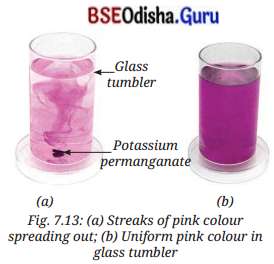
Materials Required: A glass tumbler, a few grains of potassium permanganate.
Procedure:
- Take a few grains of potassium permanganate and dissolve it in a glass tumbler filled with water.
- What did you observed?
Observations:
- At first, you will see pink coloured streaks spreading out. [See figure (a)]
- Very soon, the entire glass of water will acquire a uniform pink colour. [See figure (b)]
Inference:
- Water particles are in motion constantly.
- First they pull out the particles of potassium permanganate from its grain and then hit these particles so that they get spread throughout the liquid.
- Key concept: Particles of liquids are always moving, pulling apart and mixing other particles this is why substances can dissolve and diffuse in water.
Activity 9.
Let us find out
Aim: Particles of air are moving constantly.
Materials Required: Incense stick match stick.
Procedure:
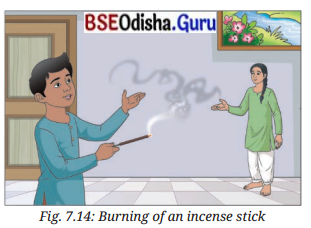
- Put an incense stick in a corner of your room. You have to go near it to get its smell
- Now light the stick with a match stick.
Observations: The fragrance spread immediately and can be felt even from a distance.
Inference: This shows that the particles of air are moving constantly. The air particles hit the particles of the fragrance i.e., got mixed and help them spread throughout the room.
Particulate Nature of Matter Class 8 Extra Questions and Answers
Short Answer Type Questions
Question 1.
Define ‘particulate nature of matter’.
Answer:
The particulate nature of matter means that all matter is made up of tiny particles. These particles are constantly moving and have space between them.
Question 2.
How does temperature affect the state of matter ?
Answer:
Increasing temperature give particles more energy. Which can change solids to liquids and liquids to gases.
Question 3.
What is the significance of interparticle spacing in matter ?
Answer:
Interparticle spacing affects properties like shape, volume and compressibility of a substance.
Question 4.
Give reasons :
(a) A gas fills completely the vessel in which it is kept.
(b) A wooden table should be called a solid.
Answer:
(a) A gas fills completely the vessel in which it is kept because the force of attraction between the particles of gas is very-very less and particles are free to move in all directions.
(b) A wooden table is called a solid because particles of the wood are tightly packed and it has definite shape and volume. It cannot be compressed easily.
Question 5.
A rubber band can change its shape on stretching. Will you classify it as solid or not? Justify your answer.
Answer:
Rubber band changes shape under force and regains the shape when the force is removed. So, it is classified as a solid.
Question 6.
How does particle of soap help in cleaning clothes?
Answer:
When we wash clothes stained with oil using soap, there are many soap particles which surround the oil particles on the fabric. One end of the soap particle attaches to the oil, and the other mixes with water, thus helping lift the oil off and wash it away (See figure).
Question 7.
How does particles behave when they are heated ?
Answer:
(a) Particles move more vigorously and separate from each other.
(b) This separation results in a decrease in interparticle forces of attraction allowing particles to escape the liquid and form vapour.
(c) The overall transformation : The liquid converts into its gaseous state (vapor), with boiling being rapid. At the boiling point, the formation of vapour is very fast and occurs not only at the surface but also within the liquid.
Long Answer Type Questions
Question 1.
Give reasons :
(a) A gas exerts pressure on the walls of the container.
(b) We can easily move our hand in air but to do the same through a solid block of wood we need a karate expert.
Answer:
(a) The molecules of a gas are free to inove randomly in all directions. During their motion, they collide with one another and also with the walls of the container. The constant bombardment of the molecules on the walls of the container exerts a steady force. The force acting per unit area on the walls of the container is called pressure. Thus, gases exert pressure.
(b) In air there is a lot of empty space between the molecules and the forces between the particles are almost negligible. Hence we can move our hand in air. Through a solid block of wood only a karate expert can do this because there are strong forces of attraction between particles in a solid block of wood and there is no empty space between them.
Question 2.
Give reasons for the following :
(a) A gas does not have a fixed shape.
(b) A gas does not have a fixed volume.
(c) A gas can be compressed easily.
Answer:
(a) A gas does not have a fixed shape because the positions of its particles (molecules) are not fixed and particles move freely.
(b) A gas does not have a fixed volume because the spaces between its particles (molecules) are not fixed. Since the particles (molecules) of a gas are free to move anywhere, it takes the shape and volume of its container.
(c) A gas can be compressed easily because its molecules are far apart and there are large spaces between them which can be reduced by compression.
Case-Study Based Questions
1. Read the following passage carefully and answer the questions that follow : The force of attraction between the particles are maximum in solids, intermediate in liquids and minimum in gasses. The space in between the constituent particles and kinetic energy of the particles are minimum in the case of solids, intermedicate in liquids and maximum in gases.
(i) Which one of the following represents a correct arrangement of increasing order of forces of attraction between their particles?
(a) Water, air, wind
(b) Air, sugar, oil
(c) Oxygen, water, sugar
(d) Salt, juice, air
Answer:
(c) Oxygen, water, sugar
(ii) Which one of the following represents a correct arrangement of increasing order of forces of attraction between the particles?
(a) Water, common salt, carbondioxide
(b) Carbondioxide, water, common salt
(c) Carbondioxide, common salt, water
(d) Common salt, water, carbondioxide
Answer:
(b) Carbondioxide, water, common salt
(iii) The space in between the constituent particles is :
(a) Least of solids, intermediate in liquids and maximum in gases
(b) Least in liquids, intermediate in solids and maximum in gases
(c) Least in gases, intermediate in liquids and maximum in solids
(d) Least in solids, intermediate in gases and minimum in liquids
Answer:
(a) Least of solids, intermediate in liquids and maximum in gases
(iv) In which of the following conditions, the distance between the molecules of hydrogen gas could increase?
A. Increased pressure in hydrogen contained in a closed container
B. Some hydrogen gas leaking out of the container.
C. Increasing the volume of the container of hydrogen gases.
D. Adding more hydrogen gas to the container without increasing the volume of the container.
(a) A and C
(b) A and D
(c) B and C
(d) B and D
Answer:
(c) B and C
Picture Based Questions
I. Look at the picture and answer the following questions :
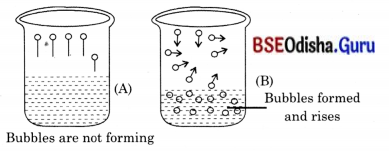
(a) Which phenomenon is displayed by figure (A) and figure (B).
Answer:
A → Evaporation
B → Boiling
(b) How did you identified it ?
Answer:
Evaporation is slower process of vapour formation and occur at all temperature. Also, bubbles do not forms. But, boiling is the fast process of vapour formation and bubbles are formed.
(c) Do boiling take place at all temperature?
Answer:
No, it occur at boiling point only.
Particulate Nature of Matter Class 8 MCQ
Multiple Choice Questions (Mcqs)
Question 1.
Which of the following is the basic unit of matter?
(a) Molecule
(b) Atom
(c) Element
(d) Compound
Answer:
(b) Atom
Question 2.
Which of these is not a form of matter?
(a) Solid
(b) Liquid
(c) Gas
(d) Energy
Answer:
(d) Energy
Question 3.
Which of the following is true about matter?
(a) It occupies space
(b) It has mass
(c) It is made up of particles
(d) All of the above
Answer:
(d) All of the above
Question 4.
The particles of matter are:
(a) stationary
(b) invisible and always moving
(c) not attracted to each other
(d) fixed in space
Answer:
(b) invisible and always moving
Question 5.
When sugar dissolves in water, it shows:
(a) sugar disappears
(b) particles are stationary
(c) matter is continuous
(d) matter is made up of particles
Answer:
(d) matter is made up of particles
Assertion and Reasoning
These questions consist of two statements, each printed as Assertion (A) and Reason (R). While answering these questions, you are required to choose any one of the following four responses.
(a) Assertion (A) and Reason (R) both are correct and reason is correct explanation for assertion.
(b) Assertion (A) and Reason (R) both are correct and reason is not correct explanation for assertion.
(c) Assertion (A) is correct but the Reason (R) is wrong.
(d) Assertion (A) is wrong but the Reason (R) is correct.
1. Assertion (A): Oxygen is called a gas. Reason (R): Oxygen has neither fixed shape nor fixed volume.
Answer:
(a) Assertion (A) and Reason (R) both are correct and reason is correct explanation for assertion.
2. Assertion (A): Solids are incompressible. Reason (R): The forces of attraction between the particles are maximum and spaces in between the constituent particles are least in the case of solids.
Answer:
(a) Assertion (A) and Reason (R) both are correct and reason is correct explanation for assertion.
Fill in the blanks
1. In gaseous state interparticle spacing is ………….
Answer:
maximum
2. The ………… energy is used to overcome the attractive forces between particles.
Answer:
thermal
3. Movement of particles are ………… in solids.
Answer:
negligible
4. Evaporation is a ………… phenomenon.
Answer:
surface
5. Matter is made up of very tiny ………….
Answer:
particles
True or False
1. All matter is made up of tiny particles.
Answer:
True
2. Particles of matter are visible to the naked eye.
Answer:
False
3. The spaces between particles are the same in all states of matter.
Answer:
False
4. Matter is anything that has mass and occupies space.
Answer:
True
5. Water is not considered matter because it flows.
Answer:
False