
Students can refer to BSE Odisha Class 7 Math Solution and Ganita Prakash Chapter 1 Large Numbers Around Us Class 7 Question Answer to understand textbook questions step by step.
Class 7 Maths Chapter 1 Large Numbers Around Us Solutions
Ganita Prakash Class 7 Chapter 1 Solutions
Class 7 Maths Ganita Prakash Chapter 1 Solutions Large Numbers Around Us
Question 1.
Read the following numbers in Indian place value notation and write their number names in both the Indian and American systems:
(i) 4050678
(ii) 48121620
(iii) 20022002
(iv) 246813579
Solution:
(i) 4050678
Indian System: 40,50,678
Number name: Forty lakh fifty thousand six hundred seventy eight American system: 4,050,678
Number name: Four million fifty thousand six hundred seventy eight
(ii) 48121620
Indian System: 4,81,21,620
Number name: Four crore eighty one lakh twenty one thousand six hundred twenty American System: 48,121,620
Number name: Forty eight million one hundred twenty one thousand six hundred twenty
(iii) 20022002
Indian System: 2,00,22,002
Number name: Two crore twenty two thousand two American System: 20,022,002
Number name: Twenty million twenty two thousand two
(iv) 246813579
Indian System: 24,68,13,579
Number name: Twenty four crore sixty eight lakh thirteen thousand five hundred seventy nine American System: 246,813,579
Number name: Two hundred forty six million eight hundred thirteen thousand five hundred seventy nine
Question 2.
Write the following numbers in Indian place value notation:
(i) One crore one lakh one thousand ten
(ii) One billion one million one thousand one
(iii) Ten crore twenty lakh thirty thousand forty
(iv) Nine billion eighty million seven hundred thousand six hundred
Solution:
(i) 1,01,01,010
(ii) 1,001,001,001
In Indian place value notation: 1,00,10,01,001
(iii) 10,20,30,040
(iv) 9,080,700,600
In Indian place value notation: 9,08,07,00,600

Question 3.
Compare and write ‘<‘ ‘>’ or ‘ = ’:
(i) 30 thousand _________ 3 lakh
(ii) 500 lakh _______ 5 million
(iii) 800 thousand ______ 8 million
(iv) 640 crore _______ 60 billion
Solution:
(i) As 30,000 < 3,00,000
⇒ 30 thousand < 3 lakh (ii) Since 1 million = 10 lakh, 5 million = 50 lakh Clearly, 500 lakh > 50 lakh ⇒ 500 lakh > 5 million
(iii) 800 thousand = 800 × 1000 = 800,000
8 million = 8,000,000
As 800,000 < 8,000,000
⇒ 800 thousand < 8 million
(iv) Since 1 billion = 100 crore, 60 billion = 60 × 100 crores = 6,000 crores
Clearly, 640 crore < 6,000 crore
⇒ 640 crore < 60 billion
Question 4.
Find quick ways to calculate these products:
(i) 2 × 1768 × 50
(ii) 72 × 125
(iii) 125 × 40 × 8 × 25
Solution:
(i) 2 × 1768 × 50 = 2 × 1768 × \(\frac{100}{2}\) = 1768 × 100 = 1,76,800
(ii) 72 × 125 = 72 × \(\frac{1000}{8}\) = 9 × 1000 = 9,000
(iii) 125 × 40 × 8 × 25 = \(\frac{1000}{8}\) × 40 × 8 × \(\frac{100}{4}\) = 1000 × 5 × 2 × 100 = 10,00,000
Question 5.
Using all digits from 0-9 exactly once (the first cannot be 0) to create a 10-digit number, write the —
(i) Largest multiple of 5
(ii) Smallest even number
Solution:
(i) Arranging digits in descending order, we get 9, 8, 7, 6, 5, 4, 3, 2, 1, 0.
All multiple of 5 can end only in 5 or 0.
Hence, the largest multiple of 5 is 9876543210.
(ii) Arranging digits in ascending order, we get 0, 1, 2, 3, 4, 5, 6, 7, 8, 9.
Since the number cannot start with 0, the smallest number = 1023456789
We know that an even number has either 2, 4, 6 or 8 at its ones place.
Thus, swapping the last two digits, we get the smallest even number = 1023456798
Question 6.
The number 10,30,285 in words is “Ten lakh thirty thousand two hundred eighty five”, which has 41 letters. Give a 7-digit number which has the maximum number of letters.
Solution:
We use 7 (seven) and 8 (eight) to make such a number since both numbers contain five letters when written in words.
One such 7-digit number is 77,77,777 (Seventy seven lakh seventy seven thousand seven hundred seventy seven).
This has 60 letters, making it one of the 7-digit numbers having maximum number of letters.
Question 7.
Write a 9-digit number where exchanging any two digits results in a bigger number. How many such numbers exist?
Solution:
To ensure that on exchanging any two digits increases the value of a 9-digit number, the digits must increase from left to right. So, the arrangement would be: 123456789.
There is only 1 number that satisfies the given condition.
Question 8.
Strike out 10 digits from the number 12345123451234512345 so that the remaining number is as large as possible.
Solution:
Given, 12345123451234512345
We have 20 digits and need to remove 10 digits, leaving us with 10 digits.
To maximise the resulting number we want the leftmost digit to be as large as possible. Looking at the original number 12345123451234512345, the first few digits are small. We can strike out the initial T234’ to get the larger digit in the first position, i.e. 5.
Now, our numbers starts with 5 as we have struck out 4 digits so far and we need to strike out 6 more.
The remaining number is 5123451234512345. We want the next digit to be as large as possible. So, we strike out ‘1234’ following the 5, leaving us with 551234512345.
We have now struck out 4 + 4 = 8 digits.
We need to strike out 2 metre digits from 551234512345.
To keep the number as large as possible we should strike out ‘ I ’ and ‘2’.
Therefore, by striking out the digits 1234, then 1234, then 1 and 2, the number is 5534512345, which is the largest possible number.
Question 9.
The words ‘zero’ and ‘one’ share letters ‘e’ and ‘o’. The words ‘one’ and ‘two’ share a letter ‘o’, and the words ‘two’ and ‘three’ also share a letter ‘t’. How far do you have to count to find two consecutive numbers which do not share an English letter in common?
Solution:
The problem involves finding two consecutive numbers whose English names share no common letters.
Here, words zero and one share e and o. Words one (1) and two (2) share o.
Words two (2) and three (3) share t. Words three (3) and four (4) share r.
Words four (4) and five (5) share/. Words five (5) and six (6) share i.
Words six (6) and seven (7) share s. Words seven (7) and eight (8) share e.
Words eight (8) and nine (9) share i and e.
Words nine (9) and ten (10) share n and e.
.
.
.
.
Words nineteen (19) and twenty (20) share t, e, n and so on.
It shows that all consecutive numbers have atleast one common letter. Hence, their is no such pair of consecutive numbers that do not share an English letter in common.
Question 10.
A calculator has only ‘+ 10,000’ and ‘+ 100’ buttons. Write an expression describing the number of button clicks to be made for the following numbers:
(i) 20,800
(ii) 92,100
(iii) 1,20,500
(iv) 65,30,000
(v) 70,25,700
Solution:
(i) 20,800 = (2 × 10,000) + (8 × 100)
Number of clicks = 2 + 8 = 10 clicks
(ii) 92,100 = (9 × 10,000) + (21 × 100)
Number of clicks = 9 + 21 =30 clicks
(iii) 1,20,500 = (12 × 10,000) + (5 × 100)
Number of clicks = 12 + 5 = 17 clicks
(iv) 65,30,000 = (653 × 10,000) + (0 × 100)
Number of clicks = 653 + 0 = 653 clicks
(v) 70,25,700 = (702 × 10,000) + (57 × 100)
Number of clicks = 702 + 57 = 759 clicks
Question 11.
You are given two sets of number cards numbered from 1-9. Place a number card in each box below to get the (i) largest possible sum (ii) smallest possible difference of the two resulting numbers.

Solution:
(i) Since each card numbered 1 – 9 is to be placed in the boxes such that no box is empty, the cards cannot be repeated.
To get the largest possible sum, both the 7-digit and 5-digit numbers need to be the largest.
Largest 7-digit number = 98,76,543; Largest 5-digit number = 98,765
Largest possible sum = 98,76,543 + 98,765 = 99,75,308
(ii) To get the smallest possible difference, the 7-digit number needs to be the smallest, and the 5-digit number needs to be the largest.
Smallest 7-digit number = 12,34,567
Largest 5-digit number = 98,765
Smallest possible difference = 12,34,567 – 98,765 = 11,35,802
Question 12.
A bar-tailed godwit holds the record for the longest recorded non-stop flight. It travelled 13,560 km from Alaska to Australia without stopping. Its journey started on 13 October 2022 and continued for about 11 days. Find out the approximate distance it covered every day. Find out the approximate distance it covered every hour.
Solution:
Given, total distance = 13,560 km and duration = 11 days
Distance covered everyday = 13,560 ÷ 11 = 1,232.72 km
Thus, the godwit covers approximately 1,233 km per day.
We know that one day has 24 hours.
Thus, distance covered every hour = 1,233 ÷ 24 = 51.375 km
Hence, the godwit covers approximately 51 km per
InText Questions
Question 1.
Observe the pattern and fill in the boxes given below.
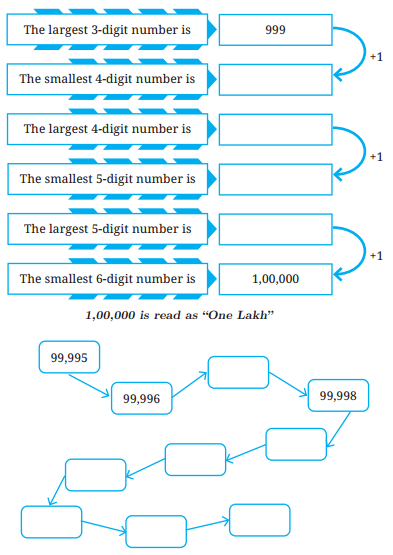
Solution:
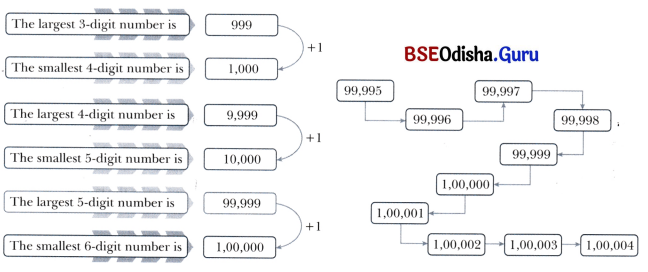
Question 2.
What if a person ate 3 varieties of rice every day, will he be able to taste all the lakh varieties in a 100 year lifetime? Find out.
Solution:
With 3 varieties of rice every day, he can taste 365 × 3 = 1095 varieties in a year.
To taste 1 lakh varieties, he would need 1,0,000 ÷ 1095 ≈ 91 years.
Hence, he would be able to eat all 1 lakh varieties of rice in 100 years.
Question 3.
Two of the many different ways to get 5072 are shown below:
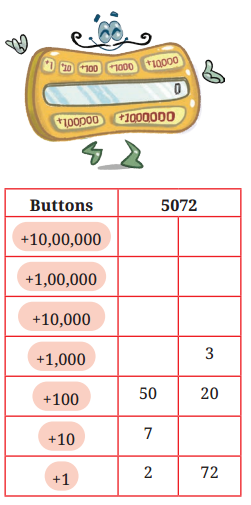
These two ways can be expressed as:
(a) (50 × 100) + (7 × 10) + (2 × 1) = 5072
(b) (3 × 1000) + (20 × 100) + (72 × 1) = 5072
Find a different way to get 5072 and write an expression for the same.
Solution:
| Buttons | 5072 |
| + 10,00,000 | |
| + 1,00,000 | |
| + 10,000 | |
| + 1,000 | 5 |
| + 100 | 0 |
| + 10 | 7 |
| + 1 | 2 |
Expression: (5 × 1000) + (0 × 100) + (7 × 10) + (2 × 1) = 5000 + 70 + 2 = 50724.
Question 4.
The estimated population of Chintamani in the year 2024 is 1,06,000. How much more than one lakh is 1,06,000?
Solution:
Given, the estimated population of Chintamani in the year 2024 is 1,06,000.
∴ Required difference = 1,06,000 – 1,00,000
= 6,000
Thus, the population of Chintamani in 2024 is 6,000 more than one lakh.
Question 5.
The Thoughtful Thousands only has a + 1000 button. How many times should it be pressed to show:

(i) Three thousand? 3 times
(ii) 10,000? ______
(iii) Fifty-three thousand? _________
(iv) 90,000? __________
(v) One Lakh? ________
(vi) ________? 153 times
(vii) How many thousands are required to make one lakh?
Solution:
(i) \(\frac{3000}{1000}\) = 3 ⇒ 3 times
(ii) \(\frac{10000}{1000}\) = 10 ⇒ 10 times
(iii) \(\frac{53000}{1000}\) = 53 ⇒ 53 times
(iv) \(\frac{90000}{1000}\) = 90 ⇒ 90 times
(v) \(\frac{100000}{1000}\) = 100 ⇒ 100 times
(vi) 153 × 1000 = 1,53,000
(vii) 100000 ÷ 1000 = 100. Thus, 100 thousands make 1 lakh.
Question 6.
How many zeros does a hundred thousand have?
Solution:
100 thousand = 100 × 1000 = 1,00,000
Clearly it has 5 zeros.
Question 7.
With large numbers it is useful to know the nearest thousand, lakh or crore. For example, the nearest neighbours of the number 6,72,85,183 are shown in the table below.
| Nearest thousand | 6,72,85,000 |
| Nearest ten thousand | 6,72,90,000 |
| Nearest lakh | 6,73,00,000 |
| Nearest ten lakh | 6,70,00,000 |
| Nearest crore | 7,00,00,000 |
Write the five nearest neighbours for these numbers:
(i) 3,87,69,957
(ii) 29,05,32,481
Solution:
| Nearest Neighbours | For 3,87,69,957 | For 29,05,32,481 |
| Nearest thousands | 3,87,70,000 | 29,05,32,000 |
| Nearest ten thousands | 3,87,70,000 | 29,05,30,000 |
| Nearest lakhs | 3,88,00,000 | 29,05,00,000 |
| Nearest ten lakhs | 3,90,00,000 | 29,10,00,000 |
| Nearest crores | 4,00,00,000 | 29,00,00,000 |
Question 8.
Using the meaning of multiplication and division, can you explain why multiplying by 5 is the same as dividing by 2 and multiplying by 10?
Solution:
We know that 5 × 2= 10 (multiplication fact) gives
two division facts: 10 ÷ 2 = 5 and 10 ÷ 5 = 2.
So, we can use \(\frac{10}{2}\) in place of 5 . Either we multiply a number by 5 or by \(\frac{10}{2}\), we will get the same answer.
Question 9.
Can multiplying a 3-digit number with another 3-digit number give a 4-digit number?
Solution:
The product of smallest 3-digit numbers
= 100 × 100 = 10,000 (5-digit number)
And, the product of largest 3-digit numbers
= 999 × 999 = 9,98,001 (6-digit number)
So, the product of two 3-digit numbers will have either 5 or 6 digits.
Hence, a 4-digit number cannot be obtained by multiplying two 3-digit numbers.
Question 10.
Can multiplying a 4-digit number with a 2-digit number give a 5-digit number?
Solution:
The product of smallest 4-digit number and smallest 2-digit number
= 1000 × 10 = 10,000 (5-digit number)
And, the product of largest 4-digit number and largest 2-digit number
= 9999 × 99 = 9,89,901 (6-digit number)
So, the product of 4-digit number and 2-digit number will have either 5 or 6 digits.
Hence, multiplying a 4-digit number with a 2-digit number can give a 5-digit number.
Question 11.
Roxie wondered, “If I could travel 100 kilometers every day, could I reach the Moon in 10 years?” (The distance between the Earth and the Moon is 3,84,400 km.)
(i) How far would she have travelled in a year?
(ii) How far would she have travelled in 10 years?
Solution:
(i) Distance travelled by Roxie in a day = 100 km
Thus, distance travelled by Roxie in a year = 365 × 100 = 36500 km (As 1 year = 365 days)
(ii) Distance travelled by Roxie in 10 years =100 × 365 x 10 = 36500 × 10 = 365000 km
Since 365000 < 384400, Roxie cannot reach the moon in 10 years.
Large Numbers Around Us Class 7 Extra Questions
Large Numbers Around Us Class 7 Very Short Question Answer
Question 1.
How many thousands are there in 1 million?
Solution:
Place value chart in International Number System is given below:
| Periods | Millions | Thousands | Ones | ||||||
| Place Name | HM | TM | M | HTh | TTh | Th | H | T | o |
| 1 million | 1 | 0 | 0 | 0 | 0 | 0 | 0 | ||
| 1 thousand | 1 | 0 | 0 | 0 | |||||
1 million is three places to the left of 1 thousand.
Thus, 1 million = 1,000 thousand
Hence, 1,000 thousands are there in one million.
Question 2.
How many hundreds are there in 10 lakhs?
Solution:
Place value chart in Indian Number System is given below:
| Periods | Crores | Lakhs | Thousands | Ones | |||||
| Place
Name |
TC | C | TL | L | TTh | Th | H | T | o |
| 10 lakh | 1 | 0 | 0 | 0 | 0 | 0 | 0 | ||
| 1 hundred | 1 | 0 | 0 | ||||||
10 lakh is four places to the left of 1 hundred.
Thus, 10 lakh = 10,000 hundred
Hence. 10,000 hundreds are there in 10 lakhs.
Question 3.
The annual wheat production in a region is 673400000 kilograms. Place the commas according to the International Number System format.
Solution:
In the International Number System, commas are placed in a 3-3-3-3… pattern, starting from the right. This helps to separate the digits into hundreds, thousands, millions, billions, and so on.
Number: 673,400,000
Number Name: Six hundred seventy three million four hundred thousand
Question 4.
Without multiplying, predict the number of digits in the product 113 × 98.
Solution:
Rounding 113 to nearest tens we get 110 and rounding 98 to nearest tens, we get 100.
Thus, estimated product = 110 × 100 = 11000, which is a 5-digit number.
Hence, the actual product will have 5 digits.
Verification: 113 × 98 = 11,074, which is a 5-digit number
Question 5.
Compare and write ‘>’, ‘<‘ or ‘=’’:
(i) 80 thousand ______ 8 lakh
(ii) 200 lakh ______ 2 million
Solution:
(i) 80 thousand = 80 × 1,000 = 80,000 and 8 lakh = 8 × 1,00,000 = 8,00,000
As 80,000 < 8,00,000
Thus, 80 thousand < 8 lakh
(ii) We know, 1 million = 10 lakh
So, 2 million = 20 lakh < 200 lakh Thus, 200 lakh > 2 million
Question 6.
How many ten thousands are there in the smallest 6-digit number?
Solution:
The smallest 6-digit number is 1,00,000 i.e. 1 lakh.
| Place Name | TL | L | TTh | Th | H | T | o |
| 1 Lakh | 1 | 0 | 0 | 0 | 0 | 0 | |
| 10 thousand | 1 | 0 | 0 | 0 | 0 |
1 lakh is one place to the left often thousands.
Thus, 1 lakh =10 ten thousands
Question 7.
How many thousands are there in 1 lakh?
Solution:
| Place Name | L | TTh | Th | H | T | b |
| 1 Lakh | 1 | 0 | 0 | 0 | 0 | 0 |
| 1 thousand | 1 | 0 | 0 | 0 |
1 lakh is 2 places to the left of thousand.
Hence, 1 lakh = 100 thousands.
Large Numbers Around Us Class 7 Short Question Answer
Question 1.
Write the number names of the following numerals in the Indian and International Numbers Systems.
(i) 437065
(ii) 42181602
(iii) 636547150
(iv) 4050607080
Solution:
| Sr. No. | Indian System | International System |
| (0 | 4,37,065: Four lakh thirty seven thousand sixty five | 437,065: Four hundred thirty seven thousand sixty five |
| (ii) | 4,21,81,602: Four crore twenty one lakh eighty one thousand six hundred two | 42,181,602: Forty two million one hundred eighty one thousand six hundred two |
| (iii) | 63,65,47,150: Sixty three crore sixty five lakh forty seven thousand one hundred fifty | 636,547,150: Six hundred thirty six million five hundred forty seven thousand one hundred fifty |
| (iv) | 4,05,06,07,080: Four arab five crore six lakh seven thousand eighty | 4,050,607,080: Four billion fifty million six hundred seven thousand eighty |
Question 2.
Find the place value of underlined digits in International Number System.
(i) 3241767
(ii) 98443810
Solution:
(i)
| Place Name | M | HTh | TTh | Th | H | T | O |
| 3,241,767 | 3 | 2 | 4 | I | 7 | 6 | 7 |
From the table, the digit 1 is at thousands place.
Thus, the place value of 1 is 1 × 1,000 = 1,000.
(ii)
| Place Name | TM | M | HTh | TTh | Th | H | T | O |
| 98,443,810 | 9 | 8 | 4 | 4 | 3 | 8 | 1 | 0 |
From the table, the digit 8 is at thousands place.
Thus, the place value of 8 is 8 × 1,000 = 1,000.
= 8,000,000.
Question 3.
Calculate the following products:
(i) 4 × 1522 × 50
(ii) 48 × 125
(iii) 125 × 20 × 16 × 25
Solution:
(i) 4 × 1522 × 50 = 4 × 1522 × \(\frac{100}{2}\)
= 2 × 1522 × 100 = 3044 × 100 = 304400
(ii) 48 × 125 = 48 × \(\frac{1000}{8}\) = 6 × 1000 = 6000
(iii) 125 × 20 × 16 × 25 = \(\frac{1000}{8}\) × 20 ×16 × \(\frac{100}{4}\)
= 1000 × 5 × 2 × 100 = 1000 × 10 × 100 = 1000000
Question 4.
A city’s population grew from 5,67,000 to 7.42.0 in five years. Estimate the increase using appropriate rounding.
Solution:
Given, in five years the population of a city grew from 5,67,000 to 7,42,000.
Rounding off both the numbers to nearest ten thousands, we get 5,70,000 and 7,40,000 respectively.
Thus, estimated increase in population
= 7,40,000 – 5,70,000 = 1,70,000
Question 5.
A stadium had 4,73,000 visitors in 2022 and 5.85.0 in 2023. Estimate the increase in visitors by rounding to the nearest ten thousands.
Solution:
Number of visitors in 2022 = 4,73,000
Number of visitors in 2023 = 5,85,000
Rounding both the numbers to nearest ten thousands, we get
4.73.0 → 4,70,000 and 5,85,000 → 5,90,000
Thus, estimated increase in visitors
= 5,90,000 – 4,70,000 = 1,20,000.
Large Numbers Around Us Class 7 Long Question Answer
Question 1.
Round off the following to the given nearest place.
(i) 7,065; hundreds
(ii) 55,777; thousands
(iii) 46,439; ten thousands
(iv) 30,89,732; lakhs
(v) 34,75,68,328; ten crores
Solution:
(i) In 7,065, the digit at the hundreds place is 0.
As the digit at the tens place, 6 > 5, we increase 0 by 1 and we replace the remaining digits to the right of the hundreds place by 0.
Thus, on rounding off 7065 to the nearest hundreds, we get 7100.
(ii) In 55,777, the digit at the thousands place is 5.
As the digit at the hundreds place, 7 > 5, we increase 5 by 1 and we replace the remaining digits to the right of the thousands place by 0.
Thus, on rounding off 55,777 to the nearest thousands, we get 56,000.
(iii) In 46,439, the digit at the ten thousands place is 4.
As the digit at the thousands place, 6 > 5, we increase 4 by 1 and we replace the remaining digits to the right of the ten thousands place by 0.
Thus, on rounding off 46,439 to the nearest ten thousands, we get 50,000.
(iv) In 30,89,732, the digit at the lakhs place is 0.
As the digit at the ten thousands place, 8 > 5, we increase 0 by 1 and we replace the remaining digits to the right of the lakhs place by 0.
Thus, on rounding off 30,89,732 to the nearest lakhs, we get 31,00,000.
(v) In 34,75,68,328, the digit at the ten crores place is 3.
As the digit at the crore place, 4 < 5, 3 remains unchanged and we replace the remaining digits to the right of the ten crores place by 0.
Thus, on rounding off 34,75,68,328 to the nearest ten crores, we get 30,00,00,000.
Question 2.
A clothing store earned ₹6,58,900 in January and ₹ 7,21,600 in February. Estimate the total revenue by rounding each figure to the nearest lakhs. Is your estimated total greater or smaller than the exact total?
Solution:
Revenue earned by clothing store in January = ₹6,58,900
Revenue earned by clothing store in February = ₹ 7,21,600
Rounding the numbers to nearest lakhs, we get
6,58,900 → 7,00,000
[∵ At ten thousands place, 5 = 5]
7,21,600 → 7,00,000
[∵ At ten thousands place, 2 < 5]
Now, estimated total revenue over the two months = ₹ 7,00,000 + ₹ 7,00,000 = ₹ 14,00,000
Actual total revenue = ₹6,58,900 + ₹7,21,600
= ₹ 13,80,500
Thus, the estimated total revenue for the given two months is greater than the actual revenue.
Question 3.
Say True or False.
(i) 6,78,456 is rounded off as 6,80,000 to the nearest ten thousands.
(ii) 52,25,067 is rounded off as 52,00,000 to the nearest thousands.
(iii) 2,31,48,765 is rounded off as 2,40,00,000 to the nearest ten lakhs.
Solution:
We know that, while rounding the number nearest to given place,
If the digit on the right of the given place is 5 or greater than 5, we increase the digit at that place by 1.
If the digit on the right of the given place is less than 5, we keep the digit at that place same.
(i) True
In 6,78,456, the digit at the ten thousands place is 7.
The digit to the right of 7, i.e. the digit at the thousands place is 8 and 8 > 5.
Thus, 6,78,456 is rounded off as 6,80,000 to the nearest ten thousands.
(ii) False
In 52,25,067, the digit at the thousands place is 5.
The digit to the right of 5, i.e. the digit at the hundreds place is 0 and 0 < 5.
So, 5 remains unchanged.
Thus, 52,25,067 is rounded off as 52,25,000 to the nearest thousands.
(iii) False
In 2,31,48,765, the digit at the ten lakhs place is 3.
The digit to the right of 3, i.e. the digit at the lakhs place is 1 and 1 < 5. So, 3 remains unchanged.
Thus, 2,31,48,765 is rounded off as 2,30,00,000 to the nearest ten lakhs.
Large Numbers Around Us Class 7 Case Based Questions
Question 1.
The population details of a town were published in a report.
| Population of children | 12,35,678 |
| Population of adults | 34,78,915 |
| Population of senior citizens | 5,60,328 |
The report is also translated for international agencies.
Based on the above information, answer the
following questions:
(i) Create the report for the international agencies using the International Number System.
(ii) What is the face value and place value of digit 3 in the population of children?
(iii) Write the number name for the population of senior citizens in the International Number System.
Solution:
i) The report in International Number System will be:
| Population of children | 1,235,678 |
| Population of adults | 3,478,915 |
| Population of senior citizens | 560,328 |
(ii) Given, the population of children = 12,35,678, which is represented in Indian Number System.
| Place Name | 12,35,678 |
| C | |
| TL | 1 |
| L | 2 |
| TTh | 3 |
| Th | 5 |
| H | 6 |
| T | 7 |
| O | 8 |
The face value of 3 is 3.
Clearly, digit 3 is at the ten-thousands place.
∴ The place value of 3 is 3 × 10,000 = 30,000.
(iii) In International Number System, population of senior citizens = 560,328
Number name: Five hundred sixty thousand three hundred twenty eight
Question 2.
The principal of Sunrise Public School is preparing a budget for renovating the school. She has received the cost from various departments:
Painting classrooms: ₹4,83,760
Replacing furniture: ₹3,27,450
Electrical work: ₹ 1,65,890
Bathroom renovations: ₹2,49,300
To present a simplified version in a meeting, she rounds off all values to the nearest lakhs.
Based on the above information, answer the following questions:
(i) What is the rounded cost of each item to the nearest lakhs?
(ii) What is the total estimated cost using the rounded values?
(iii) How much is the difference between the estimated and the total actual cost?
Solution:
(i) Rounding off all the costs to the nearest lakhs, we get
| Items | Actual Cost | Estimated Cost (to nearest lakh) |
| Painting classrooms | ₹4,83,760 | ₹5,00,000 |
| Replacing furniture | ₹3,27,450 | ₹ 3,00,000 |
| Electrical work | ₹ 1,65,890 | ₹ 2,00,000 |
| Bathroom renovations | ₹2,49,300 | ₹2,00,000 |
(ii) The total estimated cost is the sum of the estimated cost of each item.
Thus, total estimated cost = ₹5,00,000 + ₹ 3,00,000 + ₹ 2,00,000 + ₹ 2,00,000
= ₹ 12,00,000
(iii) The total estimated cost = ₹ 12,00,000
Now, total actual cost
= ₹4,83,760 + ₹3,27,450 + ₹ 1,65,890 + ₹2,49,300
= ₹ 12,26,400
Thus, difference between total actual cost and total estimated cost
= ₹ 12,26,400 – 12,00,000 = ₹26,400