
Combining textbook study with BSE Odisha Class 7 Science Notes and Class 7 Science Curiosity Chapter 9 Life Processes in Animals Notes can make exam preparation more effective.
Life Processes in Animals Notes Class 7
Class 7 Science Curiosity Chapter 9 Notes
Life Processes
Certain essential functions that all living beings perform to survive are called life processes. Some examples of life processes include nutrition, respiration, excretion, etc.
Nutrition
- All living beings require energy to perform life processes. This energy comes from the food they eat, which contains complex substances (nutrients) like carbohydrates, proteins, and fats that the body cannot use directly.
- The process of breaking down complex food components into simpler forms that the body can absorb and use is called digestion.

(i) Digestion in Human Beings
Digestion in humans occurs inside a long tube called the alimentary canal, which extends from the mouth to the anus. Each component of the alimentary canal has its specific function(s).
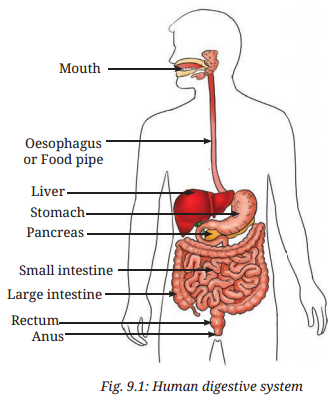
Mouth
- Teeth help break the food into smaller pieces by crushing and chewing it. This process of initial breakdown of food into fine pieces is called mechanical digestion.
- Saliva present in the mouth contains a digestive juice that helps break down starch (complex carbohydrate) into simple sugars.
- The chewed food, moistened with saliva, is then gently pushed to the back of the mouth with the help of the tongue, which helps in mixing the chewed food thoroughly with saliva.
Food pipe (Oesophagus)
- Food then enters the food pipe (a muscular structure) whose walls contract and relax in a wave-like motion to push the food down into the stomach.
- This wave-like motion continues all along the alimentary canal, helping to move food forward at every stage of digestion.
Stomach
- Once the food reaches the stomach, the walls of the stomach begin to contract and relax, churning the food and mixing it well with the secretions released by the inner lining of the stomach that contains digestive juice, acid, and mucus.
| Secretion | Function(s) |
| Digestive juice | Helps break down proteins into simpler substances |
| Add |
|
| Mucus | Protects the inner lining of the stomach from being damaged by the acid |
Small Intestine
- From the stomach, the partially digested food enters the small intestine.
- It is about 6 metres long (longest part of the alimentary canal) and receives digestive secretions from its own inner lining, as well as from the liver and pancreas.
| Component | Secretion | Function(s) |
| Liver | Bile (Basic in nature) |
|
| Pancreas | Pancreatic juice (Basic in nature) |
|
| Inner lining | Digestive juice | Further breaks down fats, proteins, and carbohydrates into simpler forms |
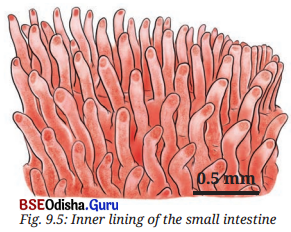
- The inner wall of the small intestine is thin and covered with thousands of tiny, finger-like projections called villi, which increase the surface area for absorption of nutrients.
- The blood vessels inside these finger-like projections absorb the digested nutrients and carry them to different parts of the bodv.
Large Intestine
- It is about 1.5 metres in length and absorbs water and salts from the undigested food, turning the waste into a semi-solid form known as stool.
- The stool is stored in the rectum (lower part of the large intestine). When the body is ready to get rid of waste, it is removed through the anus by a process called egestion.
- Eating foods that are rich in dietary fibre (like fruits, vegetables, and whole grains) helps the large intestine function properly, by making the stool easier to pass.
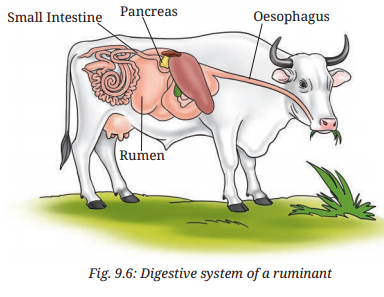
(ii) Digestion in Ruminants a Grass-eating animals like cows and buffalo, partially chew the grass and swallow it into their stomachs, where the initial digestion takes place.
Later, this partially digested food is brought back to the mouth for thorough chewing.
This process is called rumination, and animals that follow this method of digestion are called ruminants.
After this, the well-chewed food passes down the alimentary canal for complete digestion.
(iii) Digestion in Birds
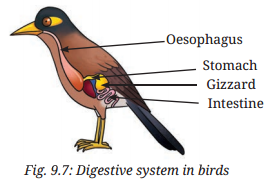
Birds cannot chew their food as they do not have teeth. Instead, they have a special muscular chamber called gizzard that helps to break down food through the contraction and relaxation of its / walls.
Birds often swallow grit (small stones or sand) that collects in the gizzard and helps to grind the food mechanically.
Respiration
- The process by which nutrients in the consumed food are converted into usable energy is called respiration (a chemical process).
- It involves breathing (a physical process), which is a process of inhaling air rich in oxygen and exhaling air rich in carbon dioxide.
(i) Respiration in Human Beings
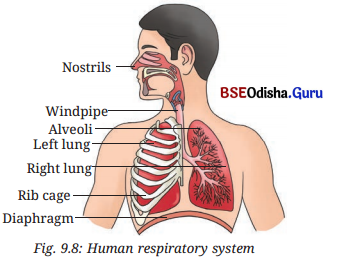
a Respiratory System: The respiratory system in humans includes the following components:
| Component | Feature and Function |
| Nostrils | Nasal openings through which air enters our body |
| Nasal
Passages |
Small passages, lined with tiny hair an4mucus through which air passes, trapping dust and dirt |
| Windpipe | Tubular structure through which air reaches the lungs |
| Bronchi | Two branches of the windpipe each entering into lungs |
| Lungs | Primary breathing organ |
| Alveoli | Small balloon-like sacs, richly supplied with blood vessels, present inside the lungs, where the exchange of gases takes place |
Mechanism of Breathing
Inhaling (Breathing in)
- Ribs move up and outwards
- Diaphragm contracts and moves downwards
- Volume of the chest cavity increases
- Air enters the lungs
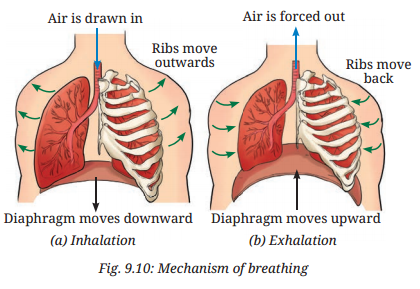
Exhalation (Breathing out)
- Ribs move down and inwards
- Diaphragm relaxes and moves upwards
- Volume of the chest cavity decreases
- Air is pushed out of the lungs
Exchange of Gases During Respiration
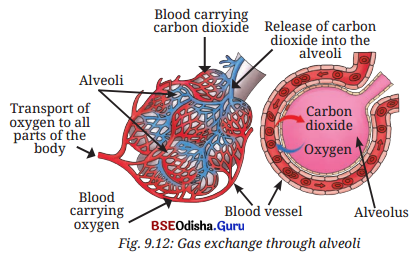
- Exchange of gases occurs at alveoli (sing, alveolus).
- As blood flows through these fine tubes, it carries carbon dioxide from all parts of the body into the alveoli and is removed when we breathe out.
- At the same time, oxygen from the air inside the alveoli enters the blood. This oxygen-rich blood is then carried (transported) to different parts of the body.
- Using the oxygen inhaled during breathing, the food is broken down to release energy (respiration).
Word equation: Glucose + Oxygen → Carbon dioxide + Water + Energy - Oxygen travels from the lungs to our entire body with the help of the circulatory system, which includes the heart (pumps blood), blood, and blood vessels (carries blood throughout the body).
(ii) Respiration in Other Organisms
- Animals like birds, elephants, lions, cows, goats, lizards, and snakes breathe through lungs.
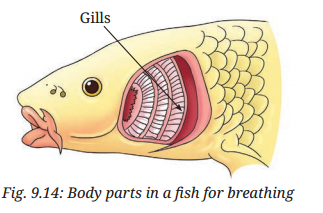
- On the other hand, aquatic organisms like fish have special breathing organs called gills, which are packed with tiny blood vessels and are designed to utilise dissolved oxygen from the water.
- Amphibians, like frogs, use different body parts to breathe during different stages of their life.
- Tadpoles use gills to breathe underwater. Breathing body parts in a fish
- Adult frogs use lungs when they are on land and moist skin when they are underwater,
- Earthworms also breathe through their moist skin.
Digestion:
The process of breaking down complex food components into simpler forms.
Humans: Components and Mechanism
Mouth
- Initiates mechanical digestion (breakdown of food into fine pieces, aided by teeth)
- Releases saliva that breaks down starch into sugar, and moistens the food (aided by tongue)
Oesophagus (Food pipe)
- Transports food from mouth to stomach through a wave-like motion
Stomach
- Produces digestive juice (breaks down proteins), acid (kills harmful bacteria and aids in protein digestion), and mucus (protects the stomach lining from acid)
Small Intestine
- Absorbs nutrients into the bloodstream with the help of numerous finger-like projections
- Receives secretions from liver (bile – breaks down fats) and pancreas (produces pancreatic juice to neutralise acids and break down carbohydrates, proteins, and fats)
- Inner lining secretes digestive juice for further break down of food
Large Intestine
- Absorbs water and minerals (like salts)
- Turns Undigested, semi-solid food into stool that is stored in the rectum
Anus
- Expels stool from the body (egestion)
Other Animals
Ruminants
- Food is partially chewed and stored in rumen.
- Partially digested food, is brought back to the mouth and chewed again (rumination).
Birds
- Lack teeth; food is broken down through contraction and relaxation of the walls of gizzard.
- Gizzard grinds food using muscular actions of its walls and grit (small stones or sand).
Respiration
The chemical process of breaking down food to release energy utilising oxygen. It involves breathing (a physical process of
inhaling and exhaling air).
Glucose + Oxygen → Carbon dioxide + Water + Energy
Humans Components of Respiratory System
- Nostrils: Nasal openings through which air enters our body
- Nasal Passages: Small passages, lined with tiny hair and mucus through which air passes; traps dust and dirt
- Windpipe: Tubular structure through which air reaches lungs
- Bronchi: Iwo branches of the windpipe, each entering into lungs
- Lungs: Primary breathing organs
- Alveoli: Small balloon-like sacs surrounded by fine blood vessels, presen t inside lungs where the exchange of gases takes place.
Other Animals
- Fish: Through gills
- Tadpole: Through gills
- Frog: Through lungs (on land) and moist skin (underwater)
- Earthworm: Through moist skin
- Bird, elephant, lion, cow, goat, lizard, snake: Lungs
Mechanism of Breathing
Inhaling (Breathing in)
- Ribs move up and outwards
- Diaphragm contracts and moves downwards
- Volume of the chest cavity increases
- Air (oxygen-rich) enters the lungs
Exhalation (Breathing Out)
- Ribs move down and inwards
- Diaphragm relaxes and moves upwards
- Volume of the chest cavity decreases
- Air (carbon dioxide-rich) is pushed out of the lungs
Circulatory System: Specialised system for the transport of nutrients, oxygen, and waste substances. It includes the heart, blood, and blood vessels.