
Go through BSE Odisha Class 8 Science Solutions Chapter 8 Nature of Matter: Elements, Compounds, and Mixtures Question Answer to understand textbook questions more clearly.
Class 8 Science Curiosity Chapter 8 Question Answer
Class 8 Science Ch 8 Nature of Matter: Elements, Compounds, and Mixtures Question Answer
Class 8 Science Chapter 8 Nature of Matter: Elements, Compounds, and Mixtures Question Answer
Probe and Ponder Questions
Question 1.
Which of the entities in the picture consist of matter and which of them do not?

Answer:
- Entities consisting of matter include physical objects like staircases, air, water, food, clothes, shoes, books, trees, balls and sticks as these have mass and occupy space.
- They are made of tiny particles. Entities that do not consist of matter include light, heat, electricity, thoughts and emotions as they lack mass and do not occupy space.
Question 2.
How can elements be combined to form a compound?
Answer:
- Elements combine chemically in fixed ratios to form compounds.
- For example, hydrogen and oxygen combine in a 2:1 ratio to form water, where the atoms bond tightly, creating a new substance with properties different from the original elements.
- This requires a chemical reaction, not just physical mixing.

Question 3.
How could the discovery of a compound that absorb carbon dioxide from the air contribute to solving environmental challenges?
Answer:
- Such a compound could reduce atmospheric carbon dioxide levels, mitigating global warming and climate change.
- For instance, it might be used in technologies to capture emissions from industries or vehicles, similar to how calcium hydroxide reacts with carbon dioxide to form calcium carbonate.
- This could help address air pollution and support environmental cleanup efforts.
Question 4.
Share your questions …………………….
Answer:
Based on the chapter, questions could include:
- What happens when elements like iron and sulfur are heated together?
- Why does water extinguish fire while its components (hydrogen and oxygen) support combustion?
- How do alloys like stainless steel improve everyday material?
InText Questions
Question 1.
According to science, how would you classify milk, packed fruit juice, baking soda, sugar, and soil as mixtures or pure substances? (Page 121)
Answer:
- Milk: Mixture (contains water, fats, proteins, etc.)
- Packaged fruit juice: Mixture (water sugars, flavors, vitamins, etc.)
- Baking soda: Pure substance (if chemically pure-only sodium bicarbonate)
- Sugar: Pure substance (if only sucrose)
- Soil: Mixture (sand, clay, minerals, organic matter, water, air)
In science, “pure” means that the substance consists of the same kind of particle everywhere in the sample.
Question 2.
Electrolysis of water produces two different gases. Can these collected gases be water vapour ? (Page 122)
Answer:
These gases are Hydrogen and oxygen not water vapour otherwise they would have condensed back to form water.
Question 3.
When electric current is passed through water, it breaks down into hydrogen and oxygen. Is this a chemical change or a physical change? (Page 123)
Answer:
This is a chemical change because the properties of hydrogen and oxygen are different from original substance water and it is irreversible by simple physical method.
Question 4.
After heating sugar in a boiling tube what is left behind? Also, we observe a small droplets of water inside the boiling tube. Where did this water come from?
Answer:
Charcoal (carbon) is left behind in the boiling tube. Water must have come from the dry sugar and not from the air.
Nature of Matter: Elements, Compounds, and Mixtures Class 8 Questions and Answers
Keep the Curiosity Alive (Pages 131-132)
Question 1.
Consider the following reaction where two substances, A and B, combine to form a product C :
A+B →C
Assume that A and B cannot be broken down into simpler substances by chemical reactions. Based on this information, which of the following statements is correct?
(i) A, B, and C are all compounds, and only C has a fixed composition.
(ii) C is a compound, and A and B have a fixed composition.
(iii) A and B are compounds, and C has a fixed composition.
(iv) A and B are elements, C is a compound, and has a fixed composition.
Answer:
(iv) A and B are elements, C is a compound, and has a fixed composition.
A and B are elements, because elements are pure substances made of only one kind of atom and cannot be broken down chemically. When A and B combine chemically to form C, the result is a compound. A compound is formed when two or more elements combine in a fixed ratio through a chemical reaction. Therefore, A and B are elements, and C is a compound with a fixed composition.
Question 2.
Assertion: Air is a mixture.
Reason: A mixture is formed when two or more substances are mixed, without undergoing any chemical change.
(i) Both Assertion and Reason are true and Reason is the correct explanation for Assertion.
(ii) Both Assertion and Reason are true, but Reason is not the correct explanation for Assertion.
(iii) Assertion is true, but Reason is false.
(iv) Assertion is false, but Reason is true.
Answer:
(i) Both Assertion and Reason are true and Reason is the correct explanation for assertion.
Air is indeed a mixture because it is composed of various gases like nitrogen. oxygen, and carbon dioxide, which are mixed without any chemical reaction between them. The properties of these individual gases are retained within the air.
Question 3.
Water, a compound, has different properties compared to those of the elements oxygen and hydrogen from which it is formed. Justify this statement.
Answer:
Water has properties which is completely different from hydrogen and oxygen. Like water is liquid in form, whereas hydrogen (H) and oxygen (O) are gases. This is because a compound’s properties depends on its molecular structure.
Question 4.
In which of the following cases are all the examples correctly matched? Give reasons in support of your answers.
(i) Elements – water, nitrogen, iron, air.
(ii) Uniform mixtures – minerals, seawater. bronze, air.
(iii) Pure substances – carbon dioxide, iron, oxygen, sugar.
(iv) Non-uniform mixtures – air, sand, brass, muddy water.
Answer:
(iii) Pure substances – Carbon dioxide, iron, oxygen, and sugar are all pure substances. (Correctly matched).
A pure substance is composed of only one type of particle. Carbon dioxide, iron, and oxygen are all elements, meaning they are made up of only one type of atom. Sugar is a compound. but it is still considered a pure substance because it consists of only one type of molecule.
Question 5.
Iron reacts with moist air to form iron oxide, and magnesium burns in oxygen to form magnesium oxide. Classify all the substances involved in the above reactions as elements, compounds, or mixtures, with justification.
Answer:
- Iron: Element (pure metal, cannot be broken down).
- Moist air: Mixture (air gases plus water vapor, components retain properties).
- Iron oxide: Compound (iron and oxygen combined chemically).
- Magnesium: Element (pure metal).
- Oxygen: Element (pure gas).
- Magnesium oxide: Compound (magnesium and oxygen in fixed ratio).
- Justification: Elements are simplest substance; compounds form from elements via chemical reactions with new properties; mixtures do not involve chemical bonding.
Question 6.
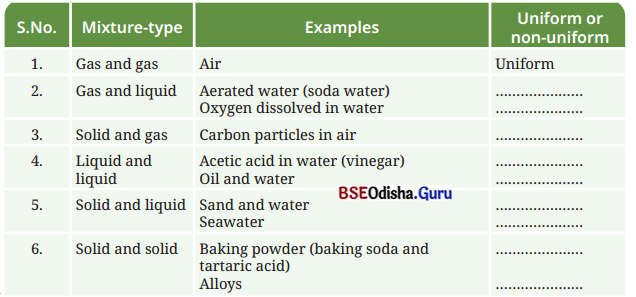
Classify the following as elements, compounds, or mixtures in the Table.
Carbon dioxide, sand, seawater, magnesium oxide, muddy water, aluminum, gold, oxygen, rust, iron sulfide, glucose, air, water, fruit juice, nitrogen, sodium chloride, sulfur, hydrogen, and baking soda.
| Elements | Compounds | Mixtures |
Identify pure substances amongst these and list them below.
| pure substances |
Answer:
Pure Substances: Aluminium, gold, oxygen, nitrogen, sulfur, hydrogen, carbon dioxide, magnesium oxide, iron sulfide, glucose, water, sodium chloride, baking soda.
| Elements | Compounds | Mixtures |
| Aluminium | Carbon Dioxide CO2 | Sand |
| Gold | Magnesium Oxide (MgO) | Seawater |
| Oxygen | Rust (Fe2O3) | Muddy Water |
| Nitrogen | Iron Sulfide (FeS) | Air |
| Sulfur | Glucose (C6 H12O6 ) | Fruit Juice |
| Hydrogen | Water (H2O) | |
| Sodium Chloride(NaCl) | ||
| Baking Soda NaHCO3 |
Question 7.
What new substance is formed when a mixture of iron filings and sulfur powder is heated, and how is it different from the original mixture? Also, write the word equation for the reaction.
Answer:
When iron filings and sulfur powder are heated, they react to form a new substance called ferrous sulfide (FeS), also known as iron sulfide. This is a chemical change, and the resulting compound has different properties from the original iron and sulfur.
The word equation for the reaction is :
Iron + Sulfur → Ferrous Sulfide.
Question 8.
Is it possible for a substance to be classified as both an element and a compound? Explain why or why not.
Answer:
No, a substance cannot be classified as both an element and a compound. Elements are pure substances that cannot be broken down into simpler substances by chemical means, while compounds are formed when two or more different elements are chemically bonded together. The defining characteristic of a compound is that it is composed of multiple elements, whereas an element is a single type of atom. Therefore, a substance cannot be both a single type of atom and a combination of different types of atoms simultaneously.
Question 9.
How would our daily lives be changed if water were not a compound but a mixture of hydrogen and oxygen?
Answer:
Water’s role in life and nature depends on it being a compound with stable properties. If it were a mixture, it would be dangerous and unusable, making life as we know it impossible.
Impact on Daily Life
- No safe drinking water → Life would not be possible.
- No water for agriculture →Crops would not grow.
- No water for cleaning or cooking → Daily tasks would be unsafe.
- No aquatic life → Fish and underwater plants would die.
- Increased fire hazards → Hydrogen and oxygen together are explosive.
Question 10.
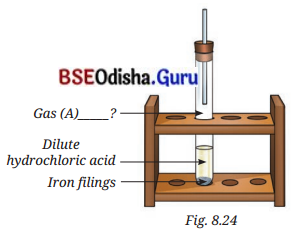
Analyse the figure. Identify Gas A. Also, write the word equation of the chemical reaction.
Answer:
By analysing the figure, it is found that there will be a chemical reaction inside the test tube between dilute HCl and Fe.
2HCl+Fe →FeCl2+H2 ↑
So the reaction forms Iron Chloride (FeCl2) and the gas above will be Hydrogen (H2).
Hydrochloric Acid + Iron filing → Iron Chloride + Hydrogen (g)
Thus, Gas A = Hydorgen
Question 11.
Write the names of any two compounds made only from non-metals, and also mention two uses of each of them.
Answer:
1. Carbon Dioxide (CO2)
Made of: Carbon and Oxygen (both nonmetals)
Uses:
- Used in fire extinguishers to put out flames.
- Used by plants during photosynthesis to make food.
2. Sulfur Dioxide (SO2)
Made of: Sulfur and Oxygen (both nonmetals)
Uses:
- Used as a preservative in dried fruits and wines.
- Used in the manufacture of sulfuric acid, an important industrial chemical.
Question 12.
How can gold be classified as both a mineral and a metal?
Answer:
A mineral is a naturally occurring substance with a definite chemical composition.
Gold is found in nature in its native form, often embedded in rocks or alluvial deposits. It is extracted through mining, making it a metallic mineral. Minerals like gold are formed by natural geological processes.
Gold as a Metal
After extraction, gold is refined and used as a metal. It is a pure element (symbol: Au ) with typical metallic properties :
- Lustrous (shiny)
- Malleable (can be beaten into sheet)
- Ductile (can be drawn into wires)
- Good conductor of electricity
- Used in jewelry, electronics, and currency.
Class 8 Science Chapter 8 Question Answer
Activity 1.
Let us experiment
Aim: To demonstrate the presence of carbon dioxide in the air.
Materials Required: Calcium oxide (Quick lime), a petri dish a glass tumbler, a glass rod.
Procedure:
- For this activity we need a glass tumbler which is half filled with water.
- Now, add a small amount of calcium oxide (quick lime) slowly to it.
- Note down your observation.
- Calcium oxide reacts vigorously with water to form calcium hydroxide and releases heat.
- Now, stir the mixture with a glass rod to make a solution of calcium hydroxide. This solution is called lime water.
- Filter it using a filter paper and observe its colour.
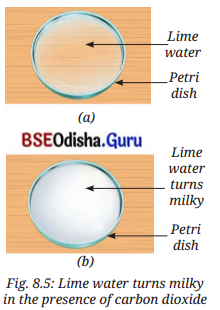
- Leave this colourless solution in a petri dish for a few hours [Figure (a)].
- We should stirr the solution at regular intervals.
- Note down your observation. [Figure (b)]
Observations:
- Glass tumbler becomes hot when calcium oxide is added to it.
- After sometime, the clear solution of lime water turns milky.
Inferences:
- Lime water turns milky because carbon dioxide in the air reacts with calcium hydroxide to produce insoluble calcium carbonate (which looks milky).
Calcium hydroxide + Carbon dioxide → Calcium carbonate + Water - It shows the presence of carbon dioxide in the air.
Activity 2.
Let us explore
Aim: To show that air contains dust particles.
Materials Required: A black sheet of paper, a magnifying glass.
Procedure:
- Take a black sheet of paper. Remember that it should be free from any visible dust particles.
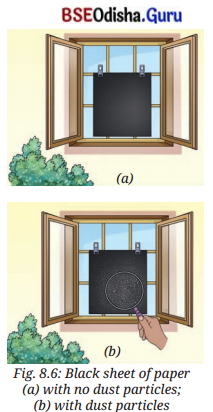
- Fix the black sheet of paper on an open window [Figure (a)], or in the near by garden, for a few hours.
- Note down your observation.
- You may use a magnifying glass to see the particles.
Observations: We observed that tiny particles settled on its surface.
Inference:
- This shows that dust particles are suspended in the air.
- Since they are not an integral part of the air therefore are considered as pollutants. The nature and the amount of dust particles in the air may vary from time to time and from place to place.
Activity 3.
Let us experiment (Demonstration activity)
Aim: To demonstrate that water is composed of two different constituents by passing electricity through it.
Materials Required: 9 V battery, a beaker or a glass tumbler, dilute sulphuric acid.
Procedure:
- First of all we will take two small test tubes, a beaker or a glass tumbler, and a 9 V battery.
- Now, fill about 2/3rd of the beaker with water and add a few drops of dilute sulfuric acid to it.
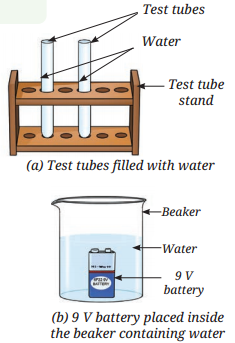
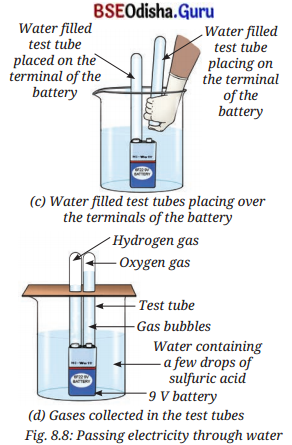
- Fill both the small test tubes completely with water taken from the beaker [Figure (a)].
- Now, keep a 9V battery inside the beaker [Figure (b)].
- We should take precaution that water cannot be spilled out.
- Now, carefully place the water-filled test tubes on each of the terminals of the battery [Fig (c)].
- Now, we will wait for a few minutes.
- Are you observing the formation of any gas bubbles at both the terminals inside the test tubes?
- Now, you will continue it for 10-15 minutes.
- Observe the volume of gas collected in each test tube [Figure (d)].
- Is the volume of the gas collected the same in both the test tubes?
- Remove these test tubes one-by-one carefully.
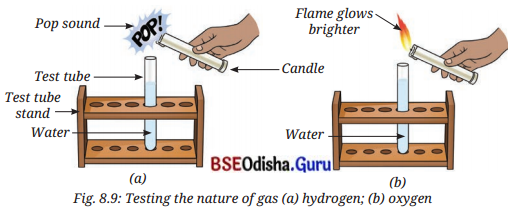
- Test these gases one-by-one by bringing a burning candle close to the mouth of the test tubes.
Observations:
- Bubbles at both the terminals inside the test tube are formed.
- Volume of gas collected in each test tube in 2:1.
- Electrolysis of water produces two different gases (not water vapor): one that makes a “pop” sound with a flame (hydrogen), the other that makes a flame glow brighter (oxygen).
Inference:
- Water breaks down (chemically) into hydrogen and oxygen, proving it is a compound made of two elements.
- Water is composed of two different constituents-hydrogen and oxygen.

Precaution:
- This activity must be performed under the supervision of the teacher.
- Be careful while handling sulfuric acid. Do not use a lithium-ion battery.
- Perform gas testing with care. Maintain a safe distance from the set-up.
Activity 4.
Let us experiment
Aim: To show that sugar is a chemical compound and after heating it gives carbon (charcoal) and water.
Materials Required: A test tube, a test tube holder, a teaspoon of sugar.
Procedure:
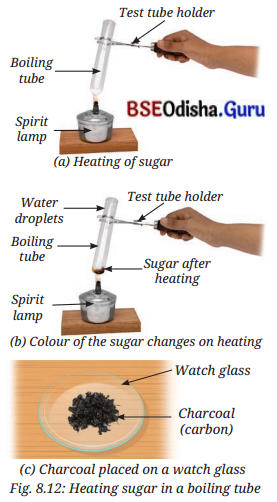
- Take a teaspoon of sugar and put in a boiling tube.
- Now, start heating gently see figure (a).
- Note your observation.
Observations:
- After heating the sugar, it turns into brown [see figure (b)]. After sometime, it begins to char, i.e., it turns blackish [see figure (c)].
- We can observe a small droplets of water inside the boiling tube near its open end.
Inference:
- Since we are heating the tube, the water must have come from the dry sugar and not from the air.
- Charcoal (carbon) is left behind in the boiling tube. We can scoop it out in a watch glass [see figure (c)] and explore if it burns like coal.
- Sugar decomposes on heating and gives carbon and water.
- We may conclude that sugar is a chemical compound consisting of the elements carbon, hydrogen, and oxygen.
Precaution: This activity must be performed in the presence of a teacher.
Activity 5.
Let us experiment (Demonstration activity)
Aim: To differentiate between mixture and compound.
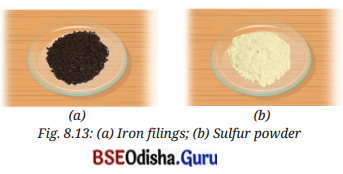
Materials Required: A tripod stand, wire gauze, iron filings, sulfur powder.
Procedure:
- In this experiment, we explore how iron and sulfur behave as a mixture before heating and form a compound after heating.
- This highlights key differences between mixtures (where substances stay separate) and compounds (where they combine chemically into something new). Let’s break it down step by step, starting with the initial mixture.
Demonstration:
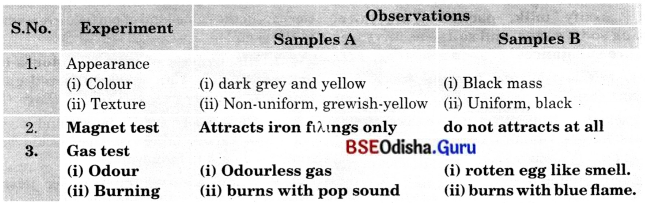
Before Heating: Forming Sample A (The Mixture)
To begin, mix iron filings and sulfur powder together to create Sample A. This is a classic example of a mixture, where two substances are simply combined without any chemical change.
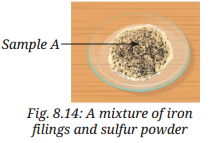
Observations:
Step 1 Appearance
- You can clearly see both components as separate substances-dark grey (or greyish-black) iron filings and yellow sulfur powder-making it look non-uniform.
Step 2 Magnet test
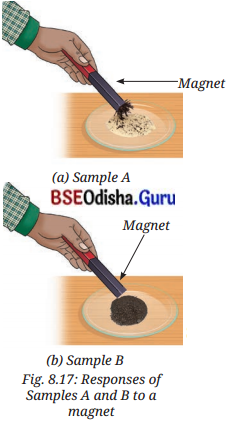
- When you bring a magnet near Sample A, it attracts only the iron filings, leaving the sulfur behind. This shows the components retain their individual properties.
Step 3 Acid test
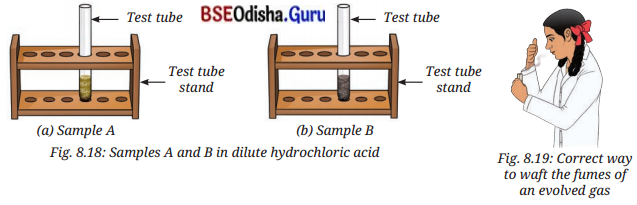
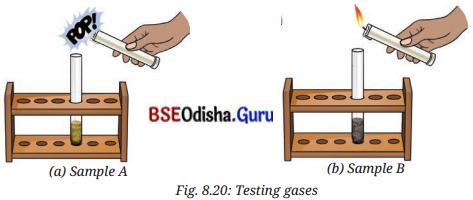
- Add dilute hydrochloric acid to Sample A. The iron reacts to produce hydrogen gas (which makes a pop sound when ignited); but the sulfur does not react and remains as a yellow solid.
Inference:
- The above three tests confirm that in a mixture, substances can be separated easily and keep their original traits or properties.
- The reaction can be represented as – Iron + Dilute Hydrochloric acid → Iron chloride + Hydrogen gas
After Heating: Forming Sample B (The Compound)
- Take half of Sample ‘A’ in a China dish and heat it gently with continuous stirring. This causes a chemical reaction, resulting in a new black mass called iron sulfide (Sample ‘B’). The transformation shows how elements combine to form a compound with entirely new properties.
- Let the content of the China dish cool.
- Place this black mass in a mortar and grind it with the help of a pestle.
- Observe the appearance, result of magnetic test and acid test.
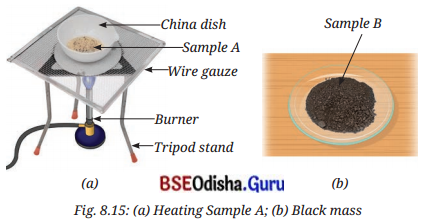
Observations:
- Step 1 – Appearance
The black mass looks uniform throughout. No separate iron or sulfur visible anywhere. - Step 2 – Magnet test
Unlike Sample A, a magnet has no effect on Sample B. The iron is now chemically bounded and doesn’t lost their magnetic property. - Step 3 Acid test
Add dilute hydrochloric acid to Sample B. It produces hydrogen sulfide gas, which has a distinct rotten egg smell-completely different from the odourless hydrogen.
Inference:
- The above three tests confirms that Sample B is a compound, the properties of its constituents do not retain.
- At this point, iron and sulfur can no longer be separated by physical methods like magnets or simple filtering. A compound has formed, with fixed ratios and unique characteristics that differ from the original elements.
The reaction can be represented as –
Iron sulfide Dilute Hydrochloric acid → Iron chloride + Hydrogen sulfide
Answer:
Precautions:
- Be careful while handling hydrochloric acid.
- Never smell anything directly.
- This activity may be demonstrated under the supervision of the teacher. It may be performed in a fume hood or a well-ventilated area. Do not inhale the gases.
Nature of Matter: Elements, Compounds, and Mixtures Class 8 Extra Questions and Answers
Short Answer Type Questions
Question 1.
What are metals and non-metals?
Answer:
Metals are elements that are shiny, good conductors of heat and electricity. Whereas. non-metals are dull in appearance and poor conductors of heat and electricity.
Question 2.
What is the main difference between physical and chemical change ?
Answer:
When physical change happens, no new substance forms and it is reversible whereas in a chemical change, new substance is formed and it is irreversible.
Question 3.
What do you mean by metalloids ?
Answer:
Metalloids are elements that have properties of both metals and non-metals. They are known as semimetals. For example; Silicon, Germ.anium.
Question 4.
What do you mean by adulteration ?
Answer:
Adulteration is the illegal act of mixing lower-quality or harmful substances into foods or products that increase quantity or cut costs, but this reduces quality and can be dangerous to health.
Question 5.
How do metals form compounds ?
Answer:
Metals form compounds by donating electrons to non-metals during chemical reactions. This results in ionic bonding, creating substances like metal oxides and metal chlorides.
Question 6.
What is a mineral and how is it different from rock?
Answer:
A mineral is a naturally occurring, inorganic substance with a definite chemical composition and a crystalline structure. In contrast, a rock is a solid material made up of one or more minerals.
Question 7.
What are pure substances ?
Answer:
A pure substance is a type of matter that has a uniform and definite composition. It contains only one kind of particle, either a single element (like oxygen or gold) or a single compound (water or salt) and cannot be separated into other substances by physical means.
Long Answer Type Questions
Question 1.
Discuss the importance and applications of elements, compounds and mixtures in our daily lives.
Answer:
Elements, compounds and mixtures are the basic building blocks of all matter. They play key roles in daily life and various industries.
Elements Importance: Elements are the simplest form of matter and cannot be further broken down, making them the foundation of all other substances.
Applications:
- Metals like iron, copper and aluminium are used in construction, wiring and packaging due to their strength, conductivity and malleability.
- Non-metals like oxygen are essential for respiration and combustion.
- Silicon is vital for electronics and computer technology.
- Gold and silver are valued for jewelry and in some electronic components.
Compounds
Importance: Compounds are formed by the chemical combination of elements, resulting in substances with unique properties necessary for life and various technological advancements.
Applications:
- Water (H2O) is indispensable for life, used for drinking, cooking and industrial processes.
- Table salt (NaCl) is a fundamental seasoning and food preservative.
- Sugar (C12H22 O11) is a crucial energy source.
- Many medicines and pharmaceuticals are pure compounds designed to interact with the body in specific ways.
Carbon dioxide (CO2) is involved in respiration and photosynthesis.
Mixtures
Importance: Most of the matter encountered daily exists as mixtures. Understanding mixtures is essential for various applications.
Applications:
- Air, a mixture of gases like Nitrogen and Oxygen, is vital for breathing and weather phenomena.
- Alloys, like steel and bronze, are mixtures of metals that possess enhanced properties like strength or corrosion resistance, used in construction and various manufactured goods.
- Food products like milk, juice and granola are mixtures, combining different components for taste, nutrition or texture.
- Soil is a complex mixture of minerals, organic matter and living organisms, crucial for plant growth.
- Many everyday products like paints, cleaning solutions and cosmetics are mixtures designed for specific purposes.
Question 2.
Why are compounds considered pure substances, while mixtures are not?
Answer:
Compounds are pure substances because they are made up of only one type of molecule and have a uniform and definite composition throughout. For example, every molecule of water (H2O) is identical, consisting of two hydrogen atoms and one oxygen atom chemically bonded together. This fixed composition results in consistent physical and chemical properties, like a specific boiling point and density.
Mixtures are not pure substances because they consist of two or more substances that are physically blended, not chemically bonded. The components of a mixture retain their individual properties and can be present in varying proportions. For example, air is a mixture of Nitrogen, Oxygen and other gases and amount of each gas can vary.
Case-Study Based Questions
Question 1.
Read the following passage carefully and answer the questions that follow: A mixture contains more than one susbtance (element and/or compound) mixed in any proportion. Mixtures can be separated into pure substances using appropriate separation techniques. Pure substances can be elements or compounds.
An elements is a form of matter that cannot be broken down by chemical reactions into simpler substances. A compound is a substance composed of two or more different types of elements, chemically combined in a fixed proportion. Properties of a compound are different from its constituent elements where as a mixture shows the properties of its constituting elements or compounds.
(i) Which of the following are homogeneous in nature ?
A. Ice
B. Wood
C. Soil
D. Air
(a) A and C
(b) B and D
(c) A and D
(d) C and D
Answer:
(c) A and D
(ii) Two chemical species X and Y combine together to form a product P which contains both X and Y.
X+Y → P
X and Y cannot be broken down into simpler substances by simple chemical reactions. Which of the following concerning the species X, Y and P are correct?
A. P is a compound
B. X and Y are compounds
C. X and Y are elements
D. P has a fixed composition
(a) A, B and C
(b) A, B and D
(c) B, C and D
(d) A, C and D
Answer:
(d) A, C and D
(iii) Give two points of differences between an element and a compound.
Answer:
| Element | Compound |
| 1. An element is made up of same kind of atoms. | 1. A compound is obtained from different kinds of atoms. |
| 2. An element cannot be split by physical or chemical methods. | 2. A compound can be split into new substances by chemical methods. |
(iv) Which of the following are not compounds?
(a) Chlorine gas
(b) Potassium chloride
(c) Iron
(d) Iron sulphide
(e) Aluminium
(f) Iodine
(g) Carbon
(h) Carbon monoxide
(i) Sulphur powder
Answer:
Chlorine gas, iron, aluminium, iodine, carbon, sulphur powder.
Picture Based Questions
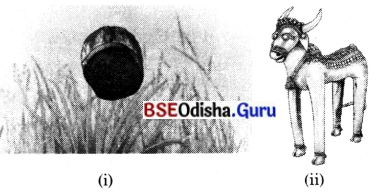
I. Look at the pictures and answer the following questions :
(a) Identify the pictures (i) and (ii).
Answer:
(i) Graphene aerogel
(ii) Dhokra art
(b) Write the use of figure (i).
Answer:
(i) It is used as an environment cleaner
(ii) It is useful in fabricating energy saving devices and special coating for buildings.
(c) In which states this craft is popular [see figure (ii)] ?
(a) Bihar
(b) Odisha
(c) both (a) and (b)
(d) None of these
Answer:
(c) both (a) and (b)
Nature of Matter: Elements, Compounds, and Mixtures Class 8 MCQ
Multiple Choice Questions (Mcqs)
Question 1.
What is a mixture?
(a) A substance formed by chemical reaction
(b) A single pure substance
(c) A combination of substances without chemical reaction
(d) A new element
Answer:
(c) A combination of substances without chemical reaction
Question 2.
What is a component in a mixture ?
(a) A new element
(b) An individual substance in the mixture
(c) A type of atom
(d) A compound
Answer:
(b) An individual substance in the mixture
Question 3.
Which of the following is a compound ?
(a) Brass
(b) Salt (NaCl)
(c) Air
(d) Lemonade
Answer:
(b) Salt (NaCl)
Question 4.
What is a pure substance ?
(a) Any liquid
(b) Substance with only one type of particle
(c) Mixture of water and sugar
(d) A combination of many substances
Answer:
(b) Substance with only one type of particle
Question 5.
Which of the following statements are true for pure substances?
(i) Pure substances contain only one kind of particles.
(ii) Pure substances may be compounds or mixtures.
(iii) Pure substances have the same composition throughout.
(iv) Pure substances can be exemplified by all elements other than nickel.
(a) (i) and (ii)
(b) (i) and (iii)
(c) (iii) and (iv)
(d) (ii) and (iii)
Answer:
(b) (i) and (iii)
Assertion and Reasoning
These questions consist of two statements, each printed as Assertion (A) and Reason (R). While answering these questions, you are required to choose any one of the following four responses.
(a) Assertion (A) and Reason (R) both are correct and reason is correct explanation for assertion.
(b) Assertion (A) and Reason (R) both are correct and reason is not correct explanation for assertion.
(c) Assertion (A) is correct but the Reason (R) is wrong.
(d) Assertion (A) is wrong but the Reason (R) is correct.
1. Assertion (A): Copper is called an element.
Reason (R): Copper cannot be broken down to simpler substances by chemical reactions.
Answer:
(a) Assertion (A) and Reason (R) both are correct and reason is correct explanation for assertion.
2. Assertion (A): Elements combine and react to form a compound.
Reason (R): The constituents of a compound can be separated easily by physical methods.
Answer:
(c) Assertion (A) is correct but the Reason (R) is wrong.
Fill in the blanks
1. The atoms of most of the elements cannot exist ………….
Answer:
independently
2. Two or more atoms combine and form a stable particle of that element called a ………….
Answer:
molecule
3. Baking powder is a mixture of baking soda and …………acid.
Answer:
tartaric
4. In ancient Indian Texts, Bronze is also known as ………….
Answer:
Kamsya
5. Bronze is an alloy made of copper and ………….
Answer:
tin
True or False
1. The properties of a mixture depend upon the properties of its components and no new substances is formed.
Answer:
True
2. The composition of a compound is always fixed.
Answer:
True
3. Brass is a compound of copper and zinc.
Answer:
False
4. Air is not a mixture.
Answer:
False
5. Lime water turns milky in the presence of carbon dioxide.
Answer:
True