
Students can refer to BSE Odisha Class 7 Math Solution and Ganita Prakash Chapter 4 Expressions using Letter Numbers Class 7 Question Answer to understand textbook questions step by step.
Class 7 Maths Chapter 4 Expressions using Letter Numbers Solutions
Ganita Prakash Class 7 Chapter 4 Solutions
Class 7 Maths Ganita Prakash Chapter 4 Solutions Expressions using Letter Numbers
Question 1.
One plate of Jowar roti costs ₹30 and one plate of Pulao costs ₹20. If x plates of Jowar roti and y plates of pulao were ordered in a day, which expressions(s) describe the total amount in rupees earned that day?
(a) 30x + 20y
(b) (30 + 20) × (x + y)
(c) 20x + 30)
(d) (20 + 30) × (x + y)
(e) 30x – 20y
Solution:
Cost of one plate of Jowar roti = ₹30
Cost of x plates of Jowar roti = ₹30x
Cost of one plate of Pulao = ₹20
Cost of y plate of Pulao = y
So, the expression for the total amount earned that day = 30x + 20y
Hence, the correct answer is option (a).
Question 2.
Write formulas for the perimeter of:
(i) triangle with all sides equal.
(ii) a regular pentagon.
(iii) a regular hexagon.
Solution:
(i) Let side length of triangle be a. Then,
Perimeter of triangle with all sides equal = a + a + a = 3a = 3 × side
(ii) Let side length of a regular pentagon be a. Then,
Perimeter of the regular pentagon = a + a + a + a + a = 5a = 5 × side
(iii) Let side length of a regular hexagon be a. Then,
Perimeter of the regular hexagon = a + a + a + a + a + a = 6a = 6 × side

Question 3.
Munirathna has a 20 m long pipe. However, he wants a longer watering pipe for his garden. He joins another pipe of some length to this one. Give the expression for the combined length of the pipe. Use the letter- number to denote the length in metres of the other pipe.
Solution:
Length of pipe Munirathna has = 20 m
Length of another pipe Munirathna wants to join = k m
∴ Combined length of the pipe = (20 + k) m
Question 4.
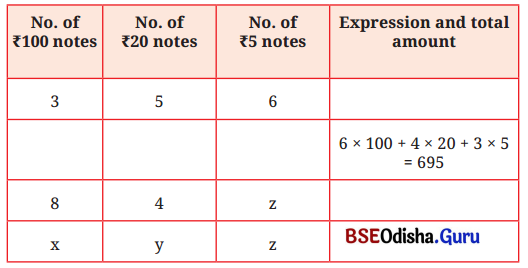
What is the total amount Krithika has, if she has the following numbers of notes of ₹100, ₹20 and ₹5?
Complete the following table:
Solution:
| Number of ₹100 notes | Number of ₹20 notes | Number of ₹5 notes | Expression and Total amount (in ₹) |
| 3 | 5 | 6 | 3 × 100 + 5 × 20 + 6 × 5 = 430 |
| 6 | 4 | 3 | 6 × 100 + 4 × 20 + 3 × 5 = 695 |
| 8 | 4 | z | 8 × 100 + 4 × 20 + z × 5 = 880 + 5z |
| x | y | z | x × 100 + y × 20 + z × 5 = 100x + 20y + 5z |
Question 5.
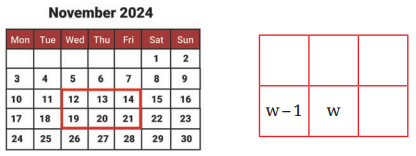
In a calendar month, if any 2 × 3 grid full of dates is chosen as shown in the picture, write expressions for the dates in the blank cells if the bottom middle cell has date ‘w’.
Solution:
Date to the left to w will be 1 less than w.
Date to the right to w will be 1 more than w.
Since there are 7 clays in a week,
Date above w will be 7 less than w.
Date in the diagonally left cell to w will be 8 less than w.
Date in the diagonally right will to w will be 6 less than w.
Thus, the expressions in other five blank cells of the grid are as shown:
|
w – 1 |
w – 7 |
w – 6 |
|
w – 1 |
w |
w + 1 |
Question 6.
A snail is trying to climb along the wall of a deep well. During the day it climbs up ‘u’ cm and during the night it slowly slips down ‘d’ cm. This happens for 10 days and 10 nights.
(1) Write an expression describing how far away the snail is from its starting position.
(ii) What can we say about the snail’s movement if d > u?
Solution:
(i) During the day the snail climbs up ‘u’ cm.
During the night the snail slips down ‘d’ cm.
So, the net distance covered in one day is (u – d) cm.
So, in 10 days and 10 nights the net distance covered by the snail = 10(u – d) cm.
Hence, the expression describing how far away the snail is from it starting position is 10(u – d).
(ii) If d > u, snail slips down more than it climbs.
It means the snail will never reach the top.
Question 7.
Radha is preparing for a cycling race and practices daily. The first week she cycles 5 km every day. Every week she increases the daily distance cycled by ‘z’ km. How many kilometres would Radha have cycled after 3 weeks?
Solution:
In first week, Radha cycles 5 km every day.
So, she cycled 5 × 7 = 35 km in first week.
In second week, Radha cycles (5 + z) km every day.
In third week, she cycles 5 + z + z = (5 + 2z) km every day.
So, she cycled (5 + 2z) × 7 = (35 + 14z) km in third week.
Thus, number of kilometres Radha cycled in 3 weeks
= 35 + (35 + 7z) + (35 + 14z)
= (35 + 35 + 35) + (7z + 14z) = (105 + 21z)km
Question 8.
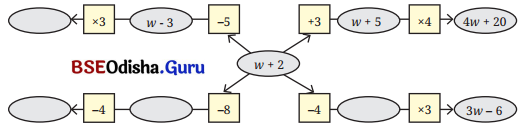
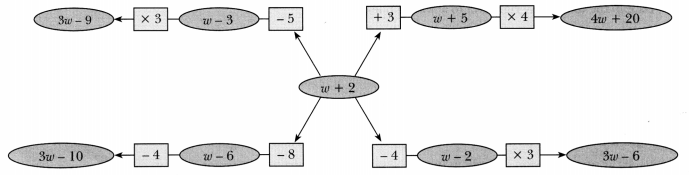
In the following figure, observe how the expression it w + 2 becomes 4w + 20 along one path. Fill in the missing blanks on the remaining paths. The ovals contain expressions and the boxes contain operations.
Solution:
[(w + 2) – 5] × 3 = [w – 3] × 3 = 3w – 9
[(w + 2) – 8] – 4 = [w – 6] – 4 = w – 10
[(w + 2) – 4] × 3 = [w – 2] × 3 = 3w – 6
Question 9.
A local train from Yahapur to Vahapur stops at three stations at equal distances along the way. The time taken in minutes to travel from one station to the next station is the same and is denoted by t. The train stops for 2 minutes at each of the three stations.
(i) What is the algebraic expression for the time taken to travel from Yahapur to Yahapur?
(ii) If t = 4, what is the time taken to travel from Yahapur to Vahapur?
Solution:
(i) 
Let the time taken to travel from one station to another station = t
So, time taken to travel from Yahanpur to Vahapur = 4t
As there are three stoppages between these two stations and the train stops for 2 minutes at each stoppage, total time taken during stoppages = 2 × 3 = 6 minutes.
So, the algebraic expression for total time taken (in minutes) is (4t + 6).
(ii) From (i), the algebraic expression for total time (in minutes) taken from Yahanpur to Vahapur is (4t + 6). So, the time taken to travel from Yahapur to Vahapur = 4 × 4 + 6 = 16 + 6 = 22 minutes.
Question 10.
Simplify the following expressions:
(i) 3a + 9b – 6 + 8a – 4b – 7a + 16
(ii) 3(3a – 3b) – 8a – 4b – 16
(iii) 2(2x – 3) + 8x + 12
(iv) 8x – (2x – 3) + 12
(v) 8h – (5 + 7h) + 9
(vi) 23 + 4(6m – 3n) – 8n – 3m – 18
Solution:
(i) 3a + 9b – 6 + 8a – 4b – 7a + 16 = (3a + 8a – 7a) + (9b – 4b) + (- 6 + 16) = 4a + 5b + 10
(ii) 3(3a – 3b) – 8a – 4b – 16 = 9a – 9b – 8a – 4b – 16 = (9a – 8a) + (-9b – 4b) – 16 = a – 13b – 16
(iii) 2(2x – 3) + 8x + 12 = 4x – 6 + 8x + 12 = (4x + 8x) + (-6 + 12) = 12x + 6
(iv) 8x – (2x – 3) + 12 = 8x – 2x + 3 + 12 = 6x + 15
(v) 8h – (5 + 7h) + 9 = 8h – 5 – 7h + 9 = 8h – 7h – 5 + 9 = h + 4
(vi) 23 + 4(6m – 3n) – 8n – 3m – 18 = 23 + 24m – 12n – 8n – 3m – 18
= 24m – 3m – 12w – 8n + 23 – 18 = 21m – 20n + 5
Question 11.
Add the expressions given below:
(i) 4d – 7c + 9 and 8c – 11 +9d
(ii) – 6f + 19 – 8s and – 23 + 13f + 12s
(iii) 8d – 14c + 9 and 16c – (11 + 9d)
(iv) 6f – 20 + 8s and 23 – 13f – 12s
(v) 13m – 12n and 12n – 13m
(vi) – 26m + 24n and 26m – 24n
Solution:
(i) (4d – 7c + 9) + (8c – 11 + 9d) = (4d + 9d) + (- 7c + 8c) + (9 – 11) = 13d + c – 2
(ii) (-6f + 19 – 8s) + (-23 + 13f + 12s) = (-6f + 13f) + (-8s + 12s) + (19 – 23) = 7f + 4s – 4
(iii) (8d – 14c + 9) + [16c – (11 + 9d)] = (8d – 14c + 9) + (16c – 11 – 9d)
= (8d – 9d) + (-14c + 16c) + (9 – 11) = -d + 2c – 2
(iv) (6f – 20 + 8s) + (23 – 13f – 12s) = (6f – 13f) + (8s – 12s) + (-20 + 23) = -7f – 4s + 3
(v) (13m – 12n) + (12n – 13m) = (13m – 13m) + (- 12n + 12n) = 0
(vi) (-26m + 24n) + (26m – 24n) = (-26m + 26m) + (24n – 24n) = 0
Question 12.
Imagine a straight rope. If it is cut once as shown in the picture, we get 2 pieces. If the rope is folded once and then cut as shown, we get 3 pieces. Observe the pattern and find the number of pieces if the rope is folded 10 times and cut. What is the expression for the number of pieces when the rope is folded r times and cut?
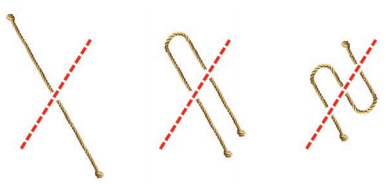
Solution:
Step 1 (0 fold): We get 0 + 2 = 2 pieces
Step 2 (1 fold): We get 1 + 2 = 3 pieces
Step 3 (2 folds): We get 2 + 2 = 4 pieces
In the same way, if rope is folded 10 times and cut, we get 10 + 2 = 12 pieces.
In the same way, when the rope is folded r times and cut, we get r + 2 pieces.
Question 13.
Look at the matchstick pattern below. Observe and identify the pattern. How many matchsticks are required to make 10 such squares. How many are required to make w squares?
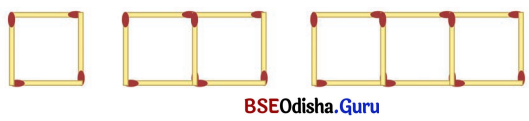
Solution:
Step 1: To make 1 square, we need 4 matchsticks.
Step 2: To make 2 squares, we need 4 + 3 = 7 matchsticks.
Step 3: To make 3 squares, we need 4 + 3 + 3 = 10 matchsticks.
So, to make w squares, we need —
4 + (w – 1) × 3 = 4 + 3 (w – 1) = 4 + 3w – 3 = (3w + 1) matchsticks.
To make 10 squares, substituting w = 10, we get
Number of required matchsticks = 3(10) + 1 = 30 + 1 = 31
Question 14.
Observe the pattern below. How many squares will be there in Step 4, Step 10, Step 50? Write a general formula. How would the formula change if we want to count the number of vertices of all the squares?

Solution:
Number of squares in step 1 = 5
Number of squares in step 2 = 5 + 4 = 9
Number of squares in step 3 = 5 + 4 + 4 = 5 + 2 × 4 = 5 + 8 = 13
Thus, number of squares in step 4 = 5 + 3 × 4 = 5 + 12 = 17
Number of squares in step 10 = 5 + 9 × 4 = 5 + 36 = 41
And, number of squares in step 50 = 5 + 49 × 4 = 5 + 196 = 201
So, the general formula for number of squares in step n = 5 + (n – 1) × 4 = 5 + 4 (n – 1) = 5 + 4n – 4 = 4n + 1
Number of vertices in step 1 = 16
Number of vertices in step 2 = 16 + 12 = 28
Number of vertices in step 3 = 16 + 12 + 12 = 16 + 2 × 12 = 16 + 24 = 40
Number of vertices in step n = 16 + (n – 1) × 12 = 16 + 12n – 12 = 12n + 4
InText Questions
Question 1.
Shabnam is 3 years older than Aftab. When Aftab’s age is 10 years, Shabnam’s age will be 13 years. Now, Aftab’s age is 18 years, what will Shabnam’s age be?
Solution:
Shabnam’s age = Aftab’s age + 3
When .Aftab’s age = 18 years,
Shabnam’s age = 18 + 3 = 21 years
Question 2.
Find the values of the following arithmetic expressions:
(i) 23 – 10 × 2
(ii) 83 + 28 – 13 + 32
(iii) 34 – 14 + 20
(iv) 42 + 15 – (8 – 7)
(v) 68 – (18 + 13)
(vi) 7 × 4 + 9 × 6
(vii) 20 + 8 × (16 – 6)
Solution:
(i) 23 – 10 × 2 = 23 – 20 = 3
(ii) 83 + 28 – 13 + 32
= (83 – 13) + (28 + 32)
= 70 + 60 = 130
(iii) 34 – 14 + 20 = (34 – 14) + 20 = 20 + 20 = 40
(vi) 42 + 15 – (8 – 7) = 42 + 15 – 1
= 42 + 14 = 56
(v) 68 – (18 + 13) = 68 – 31 = 37
(vi) 7 × 4 + 9 × 6 = 28 + 54 = 82
(vii) 20 + 8 × (16 – 6) = 20 + 8 × 10
= 20 + 80 = 100
Question 3.
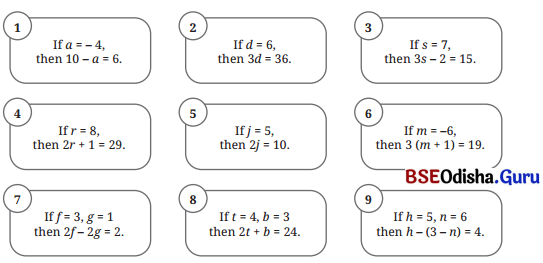
Some simplifications are shown below where the letter-numbers are replaced by numbers and the value of the expression is obtained.
1. Observe each of them and identify if there is a mistake.
2. If you think there is a mistake, try to explain what might have gone wrong.
3. Then, correct it and give the value of the expression.
Solution:
(1) If a = – 4, then 10 – a = 6 is wrong.
(2) If d = 6, then 3d = 36 is wrong.
As 10 – a = 10 – (-4) = 10 + 4 = 14
As 3d = 3 × d = 3 × 6 = 18
So, if a = -4, then 10 – a = 14 is correct.
So, if d = 6, then 3d = 18 is correct.
(3) Ifs = 7, then 3s – 2 = 15 is wrong.
(4) If r = 8, then 2r + 1 = 29 is wrong.
As 3s – 2 = 3 × 7 – 2 = 21 – 2 = 19
As 2r + 1 = 2 × 8 + 1 = 16 + 1 = 17
So, if s = 7, then 3s – 2 = 19 is correct.
So, if r = 8, then 2r + 1 = 17 is correct.
(5) If j = 5, then 2j = 10 is correct.
(6) If m = – 6, then 3(m + 1) = 19 is wrong.
As 2j = 2 × 5 = 10
As 3(m + 1) = 3 × (- 6 + 1) = 3 × (- 5) = – 15
So, if m = – 6, then 3(m + 1) = – 15 is correct.
(7) If f = 3, g = 1, then 2f – 2g = 2 is wrong.
(8) If t = 4, b = 3, then 2t + b = 24 is wrong.
As 2f – 2g = 2 × 3 – 2 × 1 = 6 – 2 = 4
As 2t + b = 2 × 4 + 3 = 8 + 3 = 11
So, if f = 3, g = 1, then 2f – 2g = 4 is correct.
So, if t = 4, b = 3, then 2t + b = 11 is correct,
(9) If h = 5, n = 6, then h – (3 – n) = 4 is wrong.
As h – (3 – n) = 5 – (3 – 6) = 5 – (- 3) = 5 + 3 = 8
So, if h = 5, n = 6, then h – (3 – n) = 8 is correct.
Question 4.
Here is a table showing the number of pencils and erasers sold in a shop. The price per pencil is c, and the price per eraser is d. Find the total money earned by the shopkeeper during these three days.
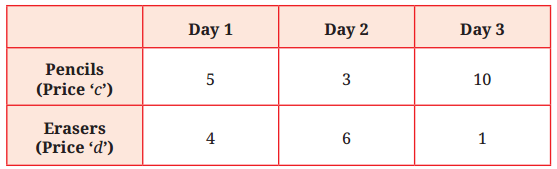
(i) If c = ₹50, find the total amount earned by the sale of pencils.
(ii) Write the expression for the total money earned by selling erasers. Then, simplify the expression.
Solution:
Total money earned by the shopkeeper
= Money earned on day 1 + Money earned on day 2 + Money earned on day 3
= 5c + 4 d + 3c + 6d + 10c + d = 18c + 11d
(i) Total amount earned by the sale of pencils
= 5c + 3c + 10c = 18c
= 18 × ₹50 = ₹900
(ii) Given, the price per eraser is d.
Total money earned by selling erasers
= 4d + 6d + d = 11 d
Question 5.
Fill in the blanks below by replacing the letter- numbers by numbers; an example is shown. Then compare the values that 5u and 5 + u take.
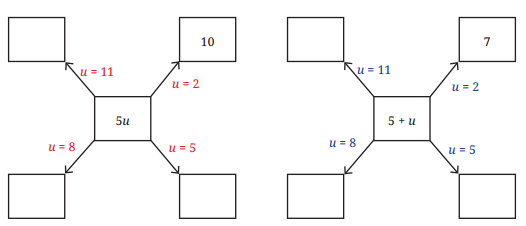
Solution:
| u | 5u | 5 + u |
| 11 | 5 × 11 = 55 | 5 + 11 = 16 |
| 8 | 5 × 8 = 40 | 5 + 8 = 13 |
| 5 | 5 × 5 = 25 | 5 + 5 = 10 |
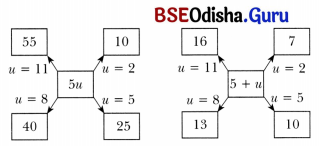
We see that the values of 5u and 5 + u are not equal for different values of u. So, the expressions 5w and 5 + u are not equal.
Question 6.
Are the expressions 10y – 3 and 10(y – 3) equal?
After filling in the two diagrams (given below), do you think the two expressions are equal?
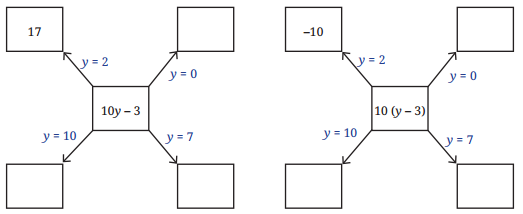
Solution:
| u | 10y – 3 | 10(y – 3) |
| 0 | 10 × 0 – 3 = -3 | 10(0 – 3) = -30 |
| 7 | 10 × 7 – 3 = 67 | 10(7 – 3) = 40 |
| 10 | 10 × 10 – 3 = 97 | 10(10 – 3) = 70 |
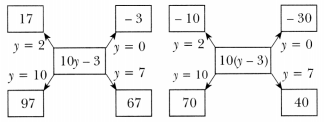
Since the values of 10v – 3 and 10(y – 3) are not equal for different values of y, the expressions 10y – 3 and 10(y – 3) are not equal.
Question 7.
Find the formulas of the number machines below and write the expression for each set of inputs.
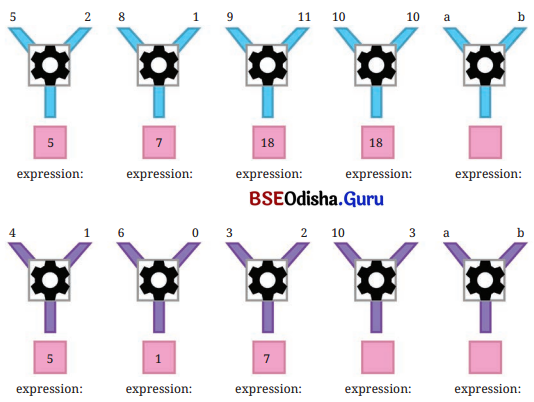
Solution:
(i) The formula for the number machine is “sum of first number and second number minus two” and the expression is a + b – 2.
The expression for each set of inputs are:
5 + 2 – 2 = 5, 8 + 1 – 2 = 7,
9 + 11 – 2 = 18, 10 + 10 – 2 = 18
and a + b – 2
(ii) The formula for the number machine is “product of first number and second number plus one” and the expression is a × b + 1.
The expression for each set of inputs are:
4 × 1 + 1= 5, 6 × 0 + 1 = 1,
3 × 2 + 1 = 7, 10 × 3 + 1 = 31
and a × b + 1 = ab + 1
Question 8.
Somjit noticed a repeating pattern along the border of a saree.
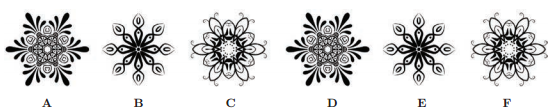
Use this to find what design appears at positions 99, 122 and 148.
Solution:
We can see the design A, B and C appear at the positions 3n – 2, 3n – 1 and 3n, respectively.
For 99, the remainder on division by 3 is 0,’i.e. it is a multiple of 3.
So, at position 99, design C will appear.
For 122, the remainder on division by 3 is 2, i.e. it is 1 less than a multiple of 3, i.e. 3n – 1.
So, at position 122, design B will appear.
For 148 , the remainder on division by 3 is 1, i.e. it is 2 less than a multiple of 3, i.e. 3n – 2.
So, at position 148, design A will appear.
Expressions using Letter Numbers Class 7 Extra Questions
Expressions using Letter Numbers Class 7 Very Short Question Answer
Question 1.
Simplify the expression 7(u – 2v) + 2v.
Solution:
Using the distributive property, this expression can be simplified as
7(u – 2v) + 2v = 7u – 7 × 2v + 2v
= 7u – 14v + 2v = 7u – 12v
[Adding like terms together]
Question 2.
What is the sum of the numbers in the given picture (unknown values are denoted by letter- numbers)?
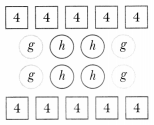
Solution:
Adding row wise, we get Sum of numbers
= (5 × 4) + (2g + 2h) + (2g + 2h) + (5 × 4)
= 20 + 2g + 2 h + 2g + 2h + 20
= (20 + 20) + (2g + 2g) + (2h + 2 h)
= 40 + 4g + 4 h
Expressions using Letter Numbers Class 7 Short Question Answer
Question 1.
Add the numbers in each picture below. Write their corresponding expressions and simplify them.
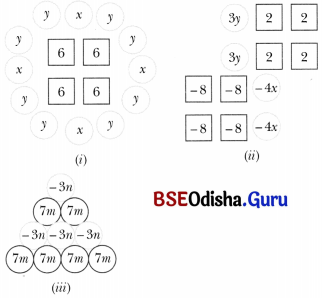
Solution:
(i) (x + y + y + x + y + y + x + y + y + x + y + y) + (4 × 6)
= 4x + 8y + 24
(ii) 2 × 3y + 4 × 2 + 2 × (-4x) + 4 × (-8)
= 6y + 8 – 8x – 32
= 6y – 8x – 24
(iii) 4 × (- 3n) + 6 × 7m
= -12m + 42m
= 42m – 12n
Question 2.
Simplify each of the following expressions:
(i) e + e + e + f + f
(ii) m + m – (m – n) – n – n
(iii) l – 7m + l – (m – 1)
(iv) 2x – x – (x + x)
(v) (3u – 2v) – (2u – 3v)
Solution:
(i) e + e + e + f + f = 3e + 2f
(ii) m + m – (m – n) – n – n = 2m – (m – n) – 2n
= 2m – m + n – 2n
= m – n
(iii) l – m + l – (m – l) = l + l – m – (m – l)
= 2l – m – m + l
= 3l – 2m
(iv) 2x – x – (x + x) = 2x – x – 2x = -x
(v) (3u – 2v) – (2u – 3v) = 3u – 2v – 2u + 3v
= 3u – 2v – 2v + 3u
= u + v
Expressions using Letter Numbers Class 7 Long Question Answer
Question 1.
Simplify the following expressions:
(i) 2x – 3y + 7x + y – 12
(ii) 4(x – 2y) + 3x – 5y + 1
(iii) 7 + 3h – 2g – (5h – 4g)
(iv) 3g + 9h – (5 + 6h – 2g)
(v) 5(2u + 7v – 2) – 3(8u – 10v + 4)
(vi) 17 – 13a + 19b – 2(9 + 7a – 3b)
Solution:
(i) 2x – 3y + 7x + y – 12
= 9x – 2y – 12
(ii) 4(x – 2y) + 3x – 5y + 1
= 4x – 8y + 3x – 5y + 1
= 7x – 13y + 1
(iii) 7 + 3h – 2g – (5h – 4g)
= 7 + 3h – 2g – 5h + 4g
= 7 – 2h + 2g
(iv) 3g + 9h – (5 + 6h – 2g)
= 3g + 9h – 5 – 6h + 2g
= 5g + 3h – 5
(v) 5(2u + 7v – 2) – 3(8u – 10v + 4)
= 10u + 35v – 10 – 24u + 30v – 12
= – 14u + 65v – 22
(vi) 17 – 13a + 19b – 2(9 + 7a – 3b)
= 17 – 13a + 19b – 18 – 14a + 6b
= – 27a + 25b – 1
Question 2.
Add the expressions given below:
(i) 3d+ 6c – 7 and 3c – 4d + 2
(ii) -8g + 3h + 2 and 6g – 4h – 12
(iii) 11k + l + 10 and k – (11l – 10)
(iv) 21m – 7n and -17m + 10n + 13
(v) 5(x + 7y) – 3 and 2x + 3y – 2
(vi) 7a + 2b + 9 and 3a + 8b + 1
Solution:
(i) (3d + 6c – 7) + (3c – 4d + 2)
= 6c + 3c + 3d – 4d – 7 + 2 = 9c – d – 5
(ii) (-8g + 3h + 2) + (6g – 4h – 12)
= -8g + 6g + 3h – 4h + 2 – 12
= – 2g – h – 10
(iii) (11k + l + 10) + {k – (11l – 10)}
= 11k + l + 10 + k = 11l + 10
= 11k + k + l – 11l + 10 + 10
= 12k – 10l + 20
(iv) (21m – 7n) + (-17m + 10n + 13)
= 21m – 17m – 7n + 10n + 13
= 4m + 3n + 13
(v) 5(x + 7y) – 3 + (2x + 3y – 2)
= 5x + 35y – 3 + 2x + 3y – 2
= 5x + 2x + 35y + 3y – 3 – 2
= 7x + 38y – 5
(vi) (7a + 2b + 9) + (3a + 8b + 1)
= 7a + 3a + 2b + 8b + 9 + 1
= 10a + 10b + 10
Expressions using Letter Numbers Class 7 Case Based Questions
Question 1.
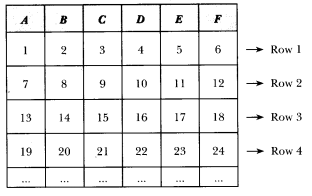
A movie theatre has 6 columns of seats (labelled A to F) and the seats are arranged in endless rows, starting from the front. Each seat is numbered sequentially row wise, beginning with Seat 1 in Column A of Row 1, moving left to right.
Based on the above information, answer the following questions:
(i) In the seating layout, imagine selecting any 2 × 3 block of seats (2 rows and 3 columns), like the one shown in the picture.
| x | ||
If the seat in the top middle of selected block is numbered ‘x’ write expressions to represent the seat numbers in the other five blank positions of the block.
(ii) Look at the group of seats arranged in the shape.
| 4 | 6 | |
| 11 | ||
| 16 | 18 |
Find the sum of all the seat numbers in this shape. Then compare this total with the number
at the centre i.e. 11.
Try this again with a different set of numbers arranged in the same shape and write your observation.
Solution:
(i) Number to the left of Y will be 1 less than x.
Number to the right of V will be 1 more than x.
Since there are 6 seats in one row,
Number below x will be 6 more than x.
Number in the diagonally left cell to ‘x’ will be 5 more than x for one less than x + 6).
Number in the diagonally right cell to ‘x’ will be 7 more thain x (or one more than x + 6).
Thus, the expressions in other five blank s positions of the block are as shown:
|
x – 1 |
x |
x + 1 |
|
x + 5 |
x + 6 |
x + 7 |
(ii) Sum of all numbers
= 4 + 6 + 11 + 16 + 18 = 55 = 5 × 11
The sum is 5 times the number in the centre.
Now, let the number at the centre be 14, then the shape is given below:
| 7 | 9 | |
| 17 | ||
| 19 | 21 |
Sum of all the numbers
= 7 + 9 + 14 + 19 + 21
= 70 = 5 × 14
Again, the sum is 5 times the number in the centre.
Now, let the number at the centre be 9, then the shape is given below:
|
2 |
4 |
|
|
9 |
||
|
14 |
16 |
Sum of all the numbers
= 2 + 4 + 9 + 14 + 16 = 45 = 5 × 9
Again, the sum is 5 times the number in the centre.
Question 2.
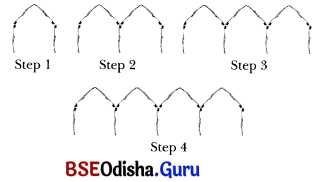
Observe the picture below. It shows a growing pattern of huts made using toothbrushes.
In Step 1, there is 1 hut.
In Step 2, there are 2 huts.
In Step 3, there are 3 huts and this pattern continues.
Based on the above information, answer the following questions:
(i) What is the general rule to find the number of toothbrushes in step n?
(ii) How many toothbrushes will be there in step 9, step 37 and step 54?
Solution:
(i) We can see that the number of toothbrushes increases by 3 at each step.
| Step No. | Number of Toothbrushes |
| 1 | 4 = 4 + 0 × 3 = 4 + (4 – 1) × 3 |
| 2 | 4 + 3 = 4 + 1 × 3 = 4 + (2 – 1) × 3 |
| 3 | 4 + 3 + 3 = 4 + 2 × 3 = 4 + (3- 1) × 3 |
| 4 | 4 + 3 + 3 + 3 = 4 + 3 × 3 = 4 + (4 – 1) × 3 |
We can write general rule to find the number of toothbrushes in step n as:
4 + (n – 1) × 3 = 4 + 3n – 3 = 3n + 1,
where n = 1, 2, 3, …
(ii) Number of toothbrushes in step 9
= 3 × 9 + 1 = 27 + 1 = 28
Number of toothbrushes in step 37
= 3 × 37 + 1 = 111 + 1 = 112
Number of toothbrushes in step 54
= 3 × 54 + 1 = 162 + 1 = 163