
Students can refer to BSE Odisha Class 7 Math Solution and Ganita Prakash Chapter 6 Number Play Class 7 Question Answer to understand textbook questions step by step.
Class 7 Maths Chapter 6 Number Play Solutions
Ganita Prakash Class 7 Chapter 6 Solutions
Class 7 Maths Ganita Prakash Chapter 6 Solutions Number Play
Question 1.
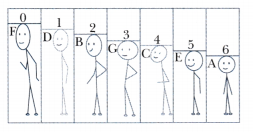
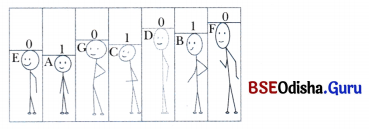
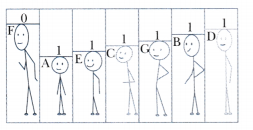
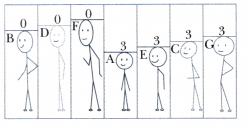
Arrange the stick figure cutouts in order of their heights, ensuring that each child (from left to right) states the number of children standing ahead who are taller than them.
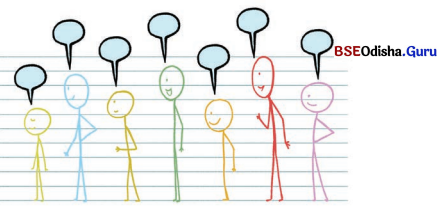
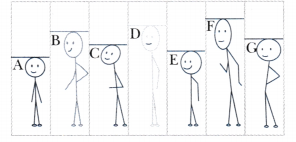
(i) 0, 1 , 1 , 2, 4, 1 , 5
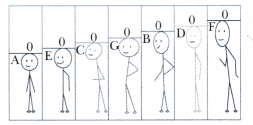
(ii) 0, 0, 0, 0, 0, 0, 0
(iii) 0, 1, 2, 3, 4, 5, 6
(iv) 0, 1,0, 1, 0, 1, 0
(v) 0, 1, 1, 1, 1, 1, 1
(vi) 0,0,0,3,3,3,3
Solution:
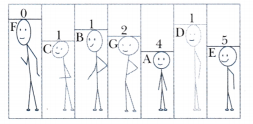
(i) The required arrangement is FCBGADF:

(ii) The required arrangement is AECGBDF.
(iii) The required arrangement is FDBGCEA
(iv) The required arrangement is EAGCDBF
(v) The required arrangement is FAECGBD
(vi) The required arrangement is BDFAECG
Question 2.
We know that:
(i) even + even = even
(ii) 0dd + 0dd = 0dd
(iii) even + odd = odd
Similarly, find out the parity for the below scenarios:
(iv) even – even = ___________
(v) 0dd – 0dd = _______
(vi) even – odd = ________
(vii) odd – even = ________
Solution:
(iv) even – even
Example: 6 – 2 = 4 → even
8 – 4 = 4 → even
Parity of result = even
∴ even – even = even
(v) odd – odd
Example: 7 – 3 = 4 → even
9 – 5 = 4 = 4 → even
Parity of result = even
∴ old – old = even
Question 3.
How many different magic squares can be made using numbers 1-9?
Solution:
Using the numbers 1-9, there is exactly one unique magic square (excluding rotations and reflections).
| 8 | 1 | 6 |
| 3 | 5 | 7 |
| 4 | 9 | 2 |
If transformations like rotations are allowed, then there are 8 variations of this magic square.
Question 4.
Create a magic square using numbers 2-10. What strategy would you use for this? Compare it with the magic squares made using 1-9.
Solution:
The numbers 2-10 are 9 consecutive numbers, just like 1-9, but increased up by 1.
Strategy: Start with the classic 1-9 magic square, and add 1 to each number.
| 8 | 1 | 6 |
| 3 | 5 | 7 |
| 4 | 9 | 2 |
Original: After adding 1 to each.
The magic square for numbers 2-10 would have a different magic sum (18) compared to numbers 1-9 (15). The structure remains similar, but the values are shifted up to 1.
| 9 | 2 | 7 |
| 4 | 6 | 8 |
| 5 | 10 | 3 |
Question 5.
Take a magic square, and
(i) increase each number by 1
(ii) double each number
In each case, is the resulting grid also a magic square?
How do the magic sums change in each case?
Solution:
Original:
| 8 | 1 | 6 |
| 3 | 5 | 7 |
| 4 | 9 | 2 |
(i) After increasing each number by 1:
| 9 | 2 | 7 |
| 4 | 6 | 8 |
| 5 | 10 | 3 |
This is still a magic square.
New magic sum = 15 + 3 × 1 = 18
(ii) After doubling each number
| 16 | 2 | 12 |
| 6 | 10 | 14 |
| 8 | 18 | 4 |
Still a magic square
New magic sum = 15 × 2 = 30
In case (i), adding a constant to every number → magic sum (for 3×3 grid) is increased by three times of that constant.
In case (ii), multiplying all by a constant → magic sum multiplied by that constant.
Question 6.
Using the generalised form, find a magic square if the centre number is 25.
Solution:
The generalised form of a magic square is given below.
| m + 3 | m – 4 | m + 1 |
| m – 2 | m | m + 2 |
| m – 1 | m + 4 | m – 3 |
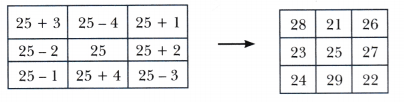
If the centre number is 25, then m = 25.
Substituting m = 25 in generalised form of a magic square, we get
Question 7.
Write the result obtained by—
(i) adding 1 to every term in the generalised form.
(ii) doubling every term in the generalised form.
Solution:
The generalised form of a magic square is given below.
| m + 3 | m – 4 | m + 1 |
| m – 2 | m | m + 2 |
| m – 1 | m + 4 | m – 3 |
(i) Adding one to every term:
| m + 4 | m – 3 | m + 2 |
| m – 1 | m + 1 | m + 3 |
| m | m + 5 | m – 2 |
(ii) Doubling every term:
| 2m + 6 | 2m – 8 | 2m + 2 |
| 2m – 4 | 2m | 2m + 4 |
| 2m – 2 | 2m + 8 | 2m – 6 |
Question 8.
Create a magic square whose magic sum is 60.
Solution:
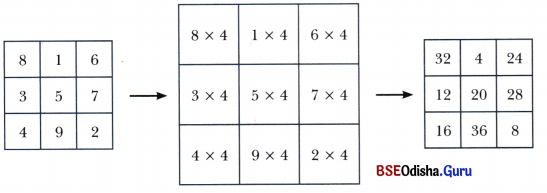
A 3 × 3 magic square’s sum is 3 × middle element.
So, for a sum is 60, the middle element should be \(\frac{60}{3}\) = 20 .
To get a magic sum of 60, we will multiply the original magic square by 4 i.e.
Question 9.
Is it possible to get a magic square by filling nine non-consecutive numbers?
Solution:
Yes, it is possible.
Justification: Let us consider the two magic squares with magic sum 45.
| 18 | 11 | 16 |
| 13 | 15 | 17 |
| 14 | 19 | 12 |
9 consecutive numbers
and
| 24 | 3 | 18 |
| 9 | 15 | 21 |
| 12 | 27 | 6 |
9 non-consecutive numbers
Question 10.
A light bulb is ON. Dorjee toggles its switch 77 times. Will the bulb be on or off? Why?
Solution:
Dorjee toggles the switch 77 times.
Each toggle changes the state of the bulb (ON to OFF or OFF to ON). Starting from ON.
An odd number of toggles will leaves the bulb OFF and an even number of toggles will leave the bulb ON. Since 77 is odd, after 77 toggles, the bulb will be OFF.
Question 11.
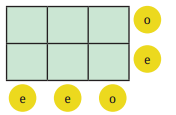
Here is a 2 × 3 grid. For each row and column, the parity of the sum is written in the circle; ‘e’ for even and ‘o’ for odd. Fill the 6 boxes with 3 odd numbers (‘o’) and 3 even numbers (‘e’) to satisfy the parity of the row and column sums.
Solution:
Let’s label the cells as:
| A | B | C |
| D | E | F |
So the constraints are:
- Row 1 (A, B, C): sum is odd
- Row 2 (D, E, F): sum is even
- Column 1 (A, D): sum is even
- Column 2 (B, E): sum is even
- Column 3 (C, F): sum is odd
We’ll track parities only (o or e), not actual numbers.
Row 1: A = o, B = e, C = e, then o + e + e = odd
Column 1 (A, D) – e means A must be paired with D as odd to get the sum as even.
So, if A = o, D = o, then o + o = even
Similarly, if B = e, E = e, then e + e = even
Again, if C = e, F = o, then e + o = odd
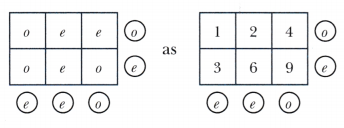
So, the 6 boxes with 3 odd numbers and 3 even numbers can be filled as follows:
Question 12.
Make a 3 × 3 magic square with 0 as the magic sum. All numbers can not be zero. Use negative numbers, as needed.
Solution:
It is given that
- The magic square is 3 × 3.
- The magic sum is 0.
- All numbers in the square cannot be zero, we can use negative numbers as needed.
So, we will use the numbers (- 4) to 4 to create a magic square whose magic sum is 0.
The required magic square is given below.
| -3 | 2 | 1 |
| 4 | 0 | -4 |
| -1 | -2 | 3 |
Question 13.
Two consecutive numbers in the Virahanka sequence are 987 and 1597. What are the next 2 numbers in the sequence? What are the previous 2 numbers in the sequence?
Solution:
Given numbers are 987 and 1597.
In the Virahanka sequence, each number is the sum of the two preceding numbers.
The next two numbers are:
987 + 1597 = 2584 and 1597 + 2584 = 4181
The previous two numbers are:
1597 – 987 = 610 and 987 – 610 = 377
The sequence is …, 377, 610, 987, 1597, 2584, 4181,…
Question 14.
What is the parity of the 20th term of the Virahanka sequence.
Solution:
Consider the Virahanka sequence given below:
1,2, 3, 5, 8, 13, 21,34, 55, 89, 144, 233, 377, 610, 987, …
Let us observe the pattern of odd/even in Virahanka sequence.
Here 1 → odd;
2 → even;
3 → odd
5 → odd;
8 → even;
13 → odd
21 → odd;
34 → even;
55 → odd
So parity cycle: odd, even, odd, (repeats every 3 terms)
So the parity of 20th term in Virahanka sequence is even.
Question 15.
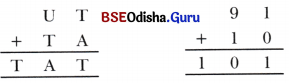
Solve the following cryptarithm:

Solution:
Here, in TAT, letter T is a hundreds place.
So, T = 1.
⇒ A = 0 and U = 9.
So, we have U = 9, T = 1 and A = 0.
InText Questions
Question 1.
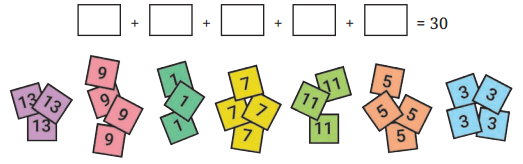
Kishor has a set of number cards and 5 boxes. If each box must contain exactly one number card, suggest an arrangement to help him distribute the cards, so that 5 cards add to 30? Is it possible?
Solution:
No, it is not possible, as the sum of 5 odd numbers is always odd and 30 is an even number.
Question 2.
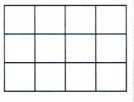
In a 3 × 3 grid, there are 9 small squares, which is an odd number. Meanwhile, in a 3 × 4 grid, there are 12 small squares, which is an even number.
Given the dimensions of a grid, can you tell the parity of the number of small squares without calculating the product?
Solution:
Yes, we can determine the parity of the number of small squares in a grid without directly calculating the full product, simply by observing the parity of the dimensions.
Rule: The product of two numbers is:
- Even if at least one of the numbers is even.
- Odd if both numbers are odd.
Question 3.
We can describe how the numbers within the magic square are related to each other, i.e. the structure of the magic square.
Choose any magic square that you have made so far using consecutive numbers. If m is the letter- number of the number in the centre, express how other numbers are related to m, how much more or less than m.
Solution:
Consider the magic square
| 8 | 1 | 6 |
| 3 | 5 | 7 |
| 4 | 9 | 2 |
We can express it using the letter- number m for the number in the centre as:
| m + 3 | m – 4 | m + 1 |
| m – 2 | m | m + 2 |
| m – 1 | m + 4 | m – 3 |
Question 4.
Write the next 3 numbers in the sequence:
1, 2, 3, 5, 8, 13, 21, 34, 55, 89, , , , …
If you have to write one more number in the Sequence above, can you tell whether it will be an odd number or an even number (without adding the two previous numbers)?
Solution:
The next 3 terms in the sequence are:
55 + 89 = 144; 89 + 144 = 233; 144 + 233 = 377
Yes, we can determine the parity without adding the two previous number.
Since odd + odd = even
Hence, parity of next number in sequence is even.
Question 5.
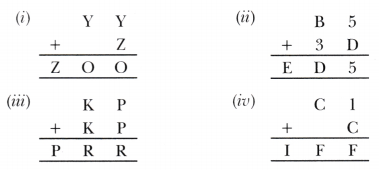
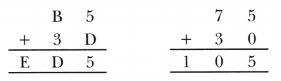
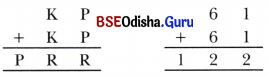
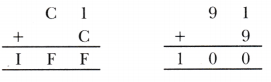
Find out what each letter stands for.
Solution:
(i) YY is a two-digit number where both digits are the same. So it can be 99, 88, …
But Z is a 1-digit number and ZOO is a 3-digit number.
So, Y = 9, Z = 1 and O = 0.
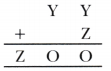
\(\begin{array}{r}
99 \\
+\quad 1 \\
\hline 1 \quad 00 \\
\hline
\end{array}\)
(ii)
(iii) Here, KP is a 2-digit number and PRR is a 3-digit number. Basically, 2 × (KP) = PRR.
If P = 1, then R = 2.
Hence, K = 6, P = 1 and R = 2.
Here, C + 1 is a two-digit number i.e. 10.
Number Play Class 7 Extra Questions
Number Play Class 7 Very Short Question Answer
Question 1.
A bag holds 100 balls, each marked with an odd number. If two balls are picked at random and their numbers are added, what will be the parity of the result?
Solution:
We know that odd number + odd number = even number.
Since each ball is marked with an odd number. If two balls are picked at random and their numbers are added, the parity of the sum will be even.
Question 2.
A number has odd parity. What will be the parity of:
(i) Number + 7
(ii) Number – 2
(iii) Number + Number
Solution:
Given, a number has odd parity.
(i) Since the parity of the sum of two odd numbers is even, the parity of (Number + 7) will be even.
(ii) Since the parity of the difference of an even and an odd number is odd, parity of (N umber – 2) will be odd.
(iii) Since the parity of the sum of two odd numbers is even, the parity of (Number + Number) will be even.
Question 3.
Neha wants to climb a staircase with 7 steps. She has a simple rule: She can take either 1 step or 2 steps at a time. For example, one possible way to climb is: 2, 1, 2, 2.
In how many different ways can Neha climb to the top of the 7-step staircase?
Solution:
The number of different ways in which Neha can climb to the top of the 7-step staircase taking either 1 step or 2 steps at a time, is the 7th element of Virahanka sequence.
Virahanka sequence: 1, 2, 3, 5, 8, 13, 21, …
7th element of Virahanka sequence = 21
∴ Neha can climb to the top of the 7-step staircase in 21 different ways.
Number Play Class 7 Short Question Answer
Question 1.
During a maths quiz, a student says, “Two consecutive numbers add up to 98.” Is this claim correct? Justify your answer with reasoning.
Solution:
(i) The claim is not correct.
(ii) The counting numbers 1, 2, 3, 4, 5, … alternate between even and odd numbers.
In any two consecutive numbers, one will always be even and the other will always be odd.
We know that the parity of the sum of an even number and an odd number is odd.
Since 98 is an even number, his claim is incorrect.
Question 2.
Form two expressions, one that always gives odd parity and another that always gives even parity.
Solution:
We know that the parity of the product is even if at least one of them is even.
Also, in any two consecutive numbers, one is alwavs even and the other is always odd.
∴ For any number n, the expression n(n + 1) = n2 + n always has even parity.
Since even number + odd number = odd number.
∴ The expression n2 + n + 1 always has odd parity.
Question 3.
Solve the following cryptarithms:
(i)
\(\begin{array}{r}
\mathrm{B} 2 \\
+6 \mathrm{C} \\
\hline \mathrm{EC} 6
\end{array}\)
(ii)
\(\begin{array}{r}
\mathrm{PQ} \\
+\mathrm{QR} \\
\hline \mathrm{QRQ}
\end{array}\)
Solution:
We know that in cryptarithms:
- Each letter stands for unique digit and different letters represent different digits.
- The same letter always means the same digit.
(i) Here, 2 + C = 6 ⇒ C = 4
Now, B + 6 = EC = E4 [Since C = 4]
⇒ B = 8 and E = 1
(ii) Here, Q + R = Q ⇒ R = 0
Now, P + Q = QR
⇒ P + Q = Q0
⇒ P = 9 and Q = 1
Number Play Class 7 Long Question Answer
Question 1.
Aarav stores his stamp collection in small boxes. He has:
- an odd number of boxes with 5 stamps each,
- an odd number of boxes with 7 stamps each, and
- an even number of boxes with 10 stamps each. He counts all his stamps and says the total is 175.
Did Aarav make a mistake? Explain your reasoning.
Solution:
We know that the parity of the product of two odd numbers is odd and the parity of the product of two even numbers is even. Thus,
- An odd number of boxes with 5(odd) stamps each gives an odd number of stamps.
- An odd number of boxes with 7(odd) stamps each also gives an odd number of stamps.
- An even number of boxes with 10(even) stamps each gives an even number of stamps.
Since, odd number + odd number = even number And even number + even number = even number, the final total must be even number. But Aarav claims the total is 175, which is odd. Therefore, he must have made a mistake in his counting.
Question 2.
Two consecutive numbers in the Virahanka sequence are 377 and 610. What are the previous 2 numbers in the sequence?
Solution:
We know that in Virahanka sequence, a number is the sum of previous two numbers.
Let the previous two numbers be x and y respectively.
The sequence will be as: …, x,y, 377, 610, …
Then, y + 377 = 610
⇒ v = 610-377 = 233
Now, x + v = 377 ,
⇒ x + 233 = 377
⇒ x = 377 – 233 = 144
Thus, the previous two numbers in the Virahanka sequence are 144 and 233.
Question 3.
Solve the following cryptarithms:
(i)
\(\begin{array}{r}
\mathrm{Tl} \\
+1 \mathrm{~T} \\
\hline 66
\end{array}\)
(ii)
\(\begin{array}{r}
\mathrm{D} 3 \\
+3 \mathrm{D} \\
\hline \mathrm{PPQ}
\end{array}\)
Solution:
(i) T + 1 = 6 ⇒ T = 5
Thus,
\(\begin{array}{r}
51 \\
+\quad 15 \\
\hline 66
\end{array}\)
(ii) A three-digit number abc can be written as 100a + 10b + c.
D3 = 10D + 3, 3D = 3 × 10 + D = 30 + D and PPQ = 100P + 10P + Q = 110P + Q
Now, D3 + 3D = (10D + 3) + (30 + D)
= 11 D + 33
When D ranges from 1 to 6, the expression 11 D + 33, gives a two-digit number.
At D = 7, 11 × 7 + 33 = 77 + 33 = 110
Putting P = 1 and Q = 0, we get
110P + Q = 110 × 1 + 0 = 110
∴ P = 1, Q = 0 and D = 7