
Easy-to-read Ganita Prakash Class 6 Notes and Chapter 1 Patterns in Mathematics Class 6 Notes save valuable study time during exam season.
Class 6 Maths Chapter 1 Patterns in Mathematics Notes
Class 6 Patterns in Mathematics Notes
A pattern means a repeated arrangement of numbers, shapes, colours, or even ideas. Patterns help us predict what comes next and understand how things are connected.
Patterns in Numbers
- If the numbers in a list are related to each other by a clear rule, the arrangement is called a number pattern or a number sequence.
- Some number sequences are finite (having a fixed number of terms), while others are infinite (going on forever).
For example, 2, 4, 6, 8, 10 is a finite sequence having 5 terms, while 1, 2, 3, 4, …, is an infinite sequence.
Some important number sequences
| Name of Sequence | Sequence | Pattern / Rule |
| All Is | 1, 1, 1, 1, 1, 1, … | Every number is 1 |
| Counting Numbers | 1,2, 3, 4, 5, 6, 7, 8, … | Add 1 each time |
| Even Numbers | 2,4,6, 8, 10, 12, 14, 16, 18, … | Add 2 each time, starting from 2 |
| Odd Numbers | 1,3, 5, 7, 9, 11, 13, 15, 17, 19, … | Add 2 each time, starting from 1 |
| Square Numbers | 1,4, 9, 16, 25, 36, 49, … | Multiply a number by itself (w × n) |
| Cube Numbers | 1, 8, 27, 64, 125, 216, … | Multiply a number by itself twice (n × n × n) |
| Powers of 2 | 1,2, 4, 8, 16, 32,64, 128,256,… | Multiply previous number by 2 each time |
| Powers of 3 | 1,3, 9, 27, 81,243, 729, … | Multiply previous number by 3 each time |
| Virahanka Numbers | 1, 2, 3, 5, 8, 13, 21, … | Sum of the previous two numbers |
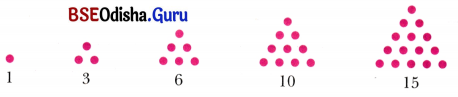
Triangular numbers: 1, 3, 6, 10, 15, 21, 28, …
The nth triangular number is the sum of the first n natural numbers.
Pattern Rule: nth number = \(\frac{n(n+1)}{2}\); n = 1, 2, 3, …
i.e. 1st number = 1; 2nd number = \(\frac{2(2+1)}{2}=\frac{2 \times 3}{2}\) = 3;
3rd number = \(\frac{3(3+1)}{2}=\frac{3 \times 4}{2}\) = 6; 4th number = \(\frac{4(4+1)}{2}=\frac{4 \times 5}{2}\) = 10 and so on.
Triangular numbers can be arranged as dots forming an equilateral triangle.

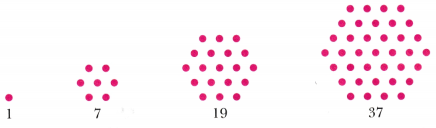
Hexagonal numbers: 1, 7, 19, 37, 61, …
The nth hexagonal number (except the first number) is obtained by adding the preceding number with 6 × (n – 1).
Pattern Rule: 1st term = 1, nth number (term) = Preceding term + 6 × (n- 1); n = 2, 3, 4, …
i.e. 1st term = 1; 2nd term = 1 + 6 × (2 – 1) = 7
3rd term = 7 + 6 × (3 – 1) = 19; 4th term = 19 + 6 × (4 – 1) = 37 and so on.
Hexagonal numbers can be arranged as dots forming a regular hexagon.
Relations among Number Sequences
The sum of the first n odd numbers is equal to n2.
| Addition of Odd Numbers | Result | Square Number |
| 1 | 1 | l2 |
| 1 + 3 | 4 | 22 |
| 1+ 3 + 5 | 9 | 32 |
| 1 + 3 + 5 + 7 | 16 | 42 |
| 1 + 3 + 5 + 7 + 9 | 25 | 52 |
| 1 + 3 + 5 + 7 + 9 +11 | 36 | 62 |
Adding numbers up from 1 to a number, and then back down again to 1, also gives square numbers.
| Addition of Counting Numbers Up and Down | Result | Square Number |
| 1 | 1 | l2 |
| 1+2+1 | 4 | 22 |
| 1+2+3+2+1 | 9 | 32 |
| 1+2+3+4+3+2+1 | 16 | 42 |
| 1+2+3+4+5+4+3+2+1 | 25 | 52 |
| 1+2+3+4+5+6+5+4+3+2+1 | 36 | 62 |
Patterns in Shapes
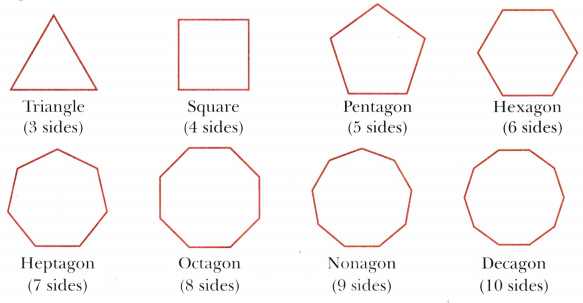
Regular Polygons Sequence
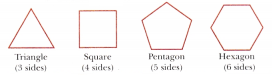
A regular polygon is a flat (two dimensional) shape with equal sides and equal angles.
| Regular Polygon | Number of Sides | Measure of Each Angle |
| Triangle (Equilateral) | 3 | 60° |
| Quadrilateral (Square) | 4 | 90° |
| Pentagon (Regular) | 5 | 108° |
| Hexagon (Regular) | 6 | 120° |
| Heptagon (Regular) | 7 | 128.57° |
| Octagon (Regular) | 8 | 135° |
| Nonagon (Regular) | 9 | 140° |
| Decagon (Regular) | 10 | 144° . |
Triangle → Square → Pentagon → Hexagon → Heptagon → Octagon → Nonagon → Decagon → ….
Complete Graphs Sequence
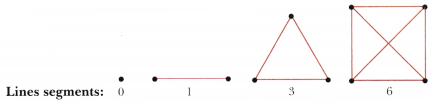
In complete graph, every pair of distinct vertices is connected by a unique line segment.
The number of unique line segments in a sequence of complete graphs with n vertices is calculated as \(\frac{n(n-1)}{2}\), where n = 1,2, 3, ….
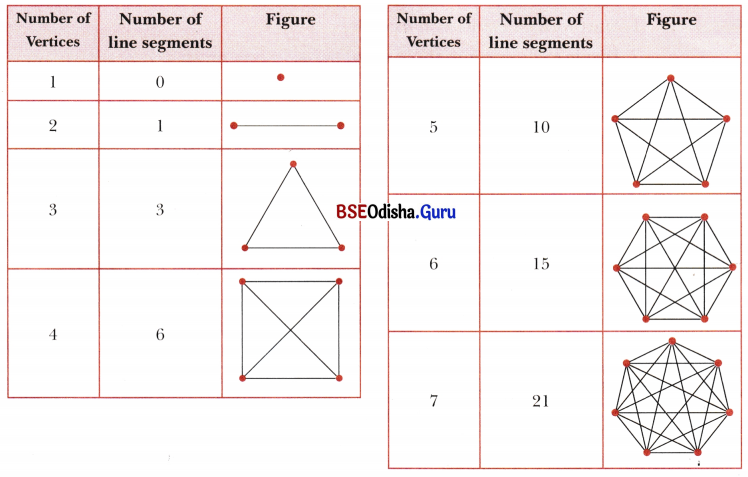
We represent a complete graph with the symbol Kn, where n is the number of vertices.
Note: This sequence follows the pattern of Triangular Numbers starting with 1, 3, 6, 10, … .
Stacked Squares Sequence
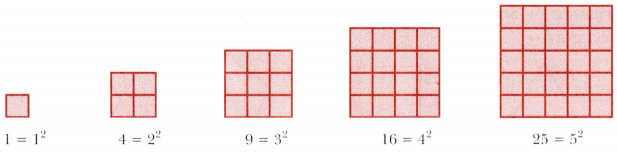
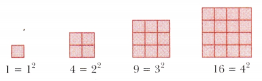
In the stacked squares sequence, we arrange small squares to form larger squares.
It follows the pattern of square numbers: 1,4, 9, 16, 25, …
Stacked Triangles Sequence
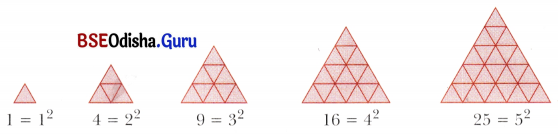
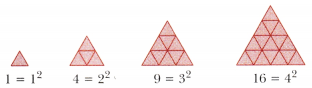
In the stacked triangles sequence, we stack small triangles to form larger triangles.
This sequence also follows the square numbers pattern: 1,4, 9, 16, 25, …
Koch Snowflake Sequence
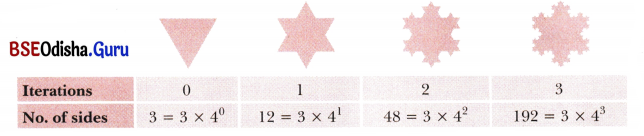
The Koch Snowflake is a special pattern where we start with an equilateral triangle and
build a snowflake shape  by repeating a simple rule.
Steps to Form a Koch Snowflake:
- Start with an equilateral triangle.
- Divide each side into three equal parts.

- Replace the middle part with a new outward-facing equilateral triangle.
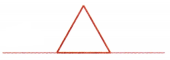
- Remove the original middle line segment.
- Repeat the process on every straight line segment (side).
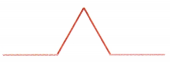
Number of line segments = 3 × 4n, where n is the number of iterations.

| Iterations | 0 | 1 | 2 | 3 | 4 |
| No. of sides | 3 × 4° = 3 | 3 × 41 = 12 | 3 × 42 = 48 | 3 × 43 = 192 | 3× 44 = 768 |
Relation of Shapes to Number Sequences
- The regular polygons sequence is related to counting numbers sequence starting from 3, i.e. 3, 4, 5, 6, 7 and so on.
- Complete graphs sequence is related to triangular number sequence, i.e. 1,3, 6, 10, 15 … .
- The stacked squares sequence is related to square numbers sequence i.e. 1, 4, 9, 16, 25 … .
- Stacked triangles sequence is related to square numbers sequence i.e. 1,4, 9, 16, 25 … .
- Koch Snowflakes sequence is related to a numbers sequence and the number sequence is
given as 3, 12, 48, 192 … .
Regular Polygon
A Regular Polygon is a flat (two dimensional) shape with equal sides and equal angles.
Add 1 side each time to get the next polygon.
Triangle → Square → Pentagon → Hexagon….
Stacked Triangles
In the stacked triangles sequence, we stack small triangles to form larger triangles.
This sequence follows the square numbers pattern: 1, 4, 9, 16, 25, …
Stacked Squares
In the stacked squares sequence, we arrange small squares to form larger squares.
It follows the pattern of square numbers: 1,4, 9, 16, 25, …
Complete Graphs
In complete graphs, every pair of distinct vertices is connected by a unique line segment.
The number of unique line segments in a sequence of complete graph with n vertices is calculated as \(\frac{n(n-1)}{2}\), where = 1, 2, 3,……….
Koch Snowflake
The Koch Snowflake is a special pattern where we start with an equilateral triangle and build a snowflake shape by replacing each line segment by a speed bump .
Number of line segments = 3 x 4″, where n is the number of iterations.
In the Koch Snowflake, the number of line segments increases by 4 times at every step: 3. 12, 48, 192, …
Important points
- Adding up odd numbers gives square numbers.
- Adding the counting numbers up and then down gives square numbers.
- Adding pairs of consecutive triangular numbers gives square numbers.
- Multiplying triangular numbers by 6 and adding 1 gives hexagonal numbers.
- Adding up hexagonal numbers gives cube numbers.
- The number of sides in the shape sequence of regular polygons is given by the counting numbers starting with 3.
- In a complete graph, the number of unique line segments sequence is related to triangular number pattern: 1, 3, 6, 10, 15,……