
Go through BSE Odisha Class 8 Science Solutions Chapter 2 The Invisible Living World: Beyond Our Naked Eye Question Answer to understand textbook questions more clearly.
Class 8 Science Curiosity Chapter 2 Question Answer
Class 8 Science Ch 2 The Invisible Living World: Beyond Our Naked Eye Question Answer
Class 8 Science Chapter 2 The Invisible Living World Beyond: Our Naked Eye Question Answer
Probe and Ponder Questions
Question 1.
Have you ever wondered what you might see if the invisible world around you became visible?
Answer:
Yes, it would be fascinating to see the microorganisms like bacteria, fungi, protozoa, and viruses that are constantly interacting with our environment and even inside our bodies. It would change how we perceive cleanliness, health, and the complexity of ecosystems around us
Question 2.
How do you think your observation of this hidden world might change the way you think about size, complexity, or even what counts as ‘living’?
Answer:
Observing this hidden world would reveal that even microscopic organisms exhibit complex behaviors such as movement, reproduction, response to stimuli, and forming colonies. This would deepen our understanding of what qualifies as a living being and show that size does not limit the complexity of life.

Question 3.
Have you thought how these tiny living beings interact with each other?
Answer:
Yes, microorganisms constantly interact; some live symbiotically, while others compete for resources or prey on one another. For example, bacteria can help in digestion or cause diseases, and fungi can decompose organic matter, enriching the soil. These interactions form the foundation of many ecological processes.
Question 4.
Share your questions……
Answer:
Seeing the invisible world and learning about microorganisms sparks so many questions! Here are some questions you might have, and you can add your own:
- What do microorganisms eat to stay alive?
- Can microorganisms see or feel each other, or do they just bump into things?
- Why are some bacteria helpful (like in curd) and others harmful (like causing diseases)?
- How do microorganisms survive in tough places, like hot springs or salty water?
InText Questions
Question 1.
Why do microorganisms not infect the pickles and murabbas?
Answer:
Preservation with Salt and Sugar: Pickles and murabbas are made with high concentrations of salt or sugar. These act as preservatives and prevent the growth of microbes, so the food does not spoil easily.
The Invisible Living World: Beyond Our Naked Eye Class 8 Questions and Answers
Keep the Curiosity Alive (Pages 25-26)
Question 1.
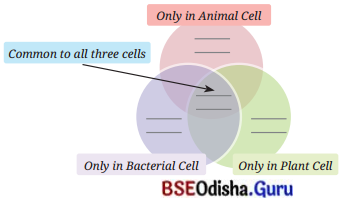
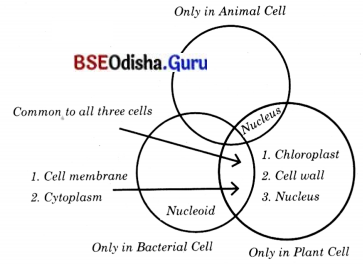
Various parts of a cell are given below. Write them in the appropriate places in the following diagram.
Nucleus , Cytoplasm
Chloroplast , Cell wall
Cell membrane , Nucleoid
Answer:
Question 2.
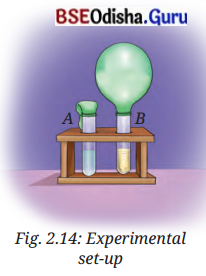
Aanandi took two test tubes and marked them A and B. She put two spoonfuls of sugar solution in each of the test tubes. In test tube B, she added a spoonful of yeast. Then she attached two incompletely inflated balloons to the mouth of each test tube. She kept the set-up in a warm place, away from sunlight.
(i) What do you predict will happen after 3-4 days? She observed that the balloon attached to testtube B was inflated. What can be a possible explanation for this?
(a) Water evaporated in test tube B and filled the balloon with the water vapour.
(b) The warm atmosphere expanded the air inside the test tube B, which inflated the balloon.
(c) Yeast produced a gas inside the test tube B which inflated the balloon.
(d) Sugar reacted with warm air, which produced gas, eventually inflating the balloon.
Answer:
(c) Yeast produced a gas inside test tube B which inflated the balloon. The yeast fermented the sugar, releasing carbon dioxide gas (CO2), which inflated the balloon.
(ii) She took another test tube, 1/4 filled with lime water. She removed the balloon from test tube B in such a manner that the gas inside the balloon did not escape. She attached the balloon to the test tube with lime water and shook it well. What do you think she wants to find out?
Answer:
She wants to test whether the gas produced is carbon dioxide CO2). If the lime water turns milky, it confirms the presence of CO2, because CO2 reacts with lime water to form calcium carbonate.
Question 3.
A farmer was planting wheat crops in his field. He added nitrogen-rich fertiliser to the soil to get a good yield of crops. In the neighbouring field, another farmer was growing bean crops, but she preferred not to add nitrogen fertiliser to get healthy crops. Can you think of the reasons?
Answer:
Beans are leguminous crops that form a symbiotic relationship with Rhizobium bacteria present in their root nodules. These bacteria fix nitrogen from the atmosphere into the soil, providing a natural source of nitrogen. Therefore, the second farmer does not need to add nitrogen-rich fertiliser.
Question 4.
Snehal dug two pits, A and B, in her garden. In pit A, she put fruit and vegetable peels and mixed it with dried leaves. In pit B , she dumped the same kind of waste without mixing it with dried leaves. She covered both the pits with soil and observed after 3 weeks. What is she trying to test?
Answer:
She is trying to test the effectiveness of composting.
- In Pit A, the mixture of green waste (fruit/vegetable peels) and dry leaves provides the correct carbon-nitrogen balance needed for decomposition.
- Pit B lacks this balance and will decompose more slowly and may smell. This experiment shows that decomposing agents like microorganisms work better when both carbonrich and nitrogen-rich materials are present.
Question 5.
Identify the following microorganisms
(i) I live in every kind of environment, and inside your gut.
(ii) I make bread and cakes soft and fluffy.
(iii) I live in the roots of pulse crops and provide nutrients for their growth.
Answer:
(i) Bacteria
(ii) Yeast
(iii) Rhizobium.
Question 6.
Devise an experiment to test that microorganisms need optimal temperature, air, and moisture for their growth.
Answer:
Set up 3 bread slices:
Slice A: Warm, moist environment (near sink). Slice B: Dry environment (sealed container).
Slice C: Cold environment (refrigerator).
After 3 days, observe: Slice A will have maximum microbial (fungal) growth.
Conclusion: Microorganisms grow best when temperature, moisture, and air are optimal.
Question 7.
Take 2 slices of bread. Place one slice in a plate near the sink. Place the other slice in the refrigerator. Compare after three days. Note your observations. Give reasons for your observations.
Answer:
- Take two slices of bread.
- Place one slice of bread in a plate near the sink. Name it as ‘A’.
- Now, take another slice of bread in a plate and place in the refrigerator. (Say B).
Observations :
- Bread in plate ‘A’ shows fungal/mould growth due to air, warmth and moisture.
- Bread in plate ‘ B ‘ which is kept in refrigerator shows less or no growth as cold inhibits the growth of fungi.
Reason : Warm and moist conditions near the sink promote microbial growth, while cold temperatures in the refrigerator inhibit it.
Question 8.
A student observes that when curd is left out for a day, it becomes more sour. What can be two possible explanations for this observation?
Answer:
Two reasons why curd becomes more sour when left out for a day:
- Microorganisms (lactic acid bacteria) continue to grow and multiply, producing more actic acid, which makes the curd more sour.
- Warmer temperature speeds up bacterial activity, increasing acid production and sourness.
Question 9.
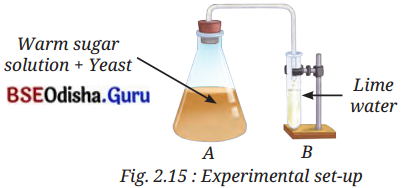
Observe the set-up given in Fig. and answer the following questions.
(i) What happens to the sugar solution in flask A?
(ii) What do you observe in test tube B after four hours? Why do you think this happened?
(iii) What would happen if yeast was not added in flask A?
Answer:
(i) The yeast ferments the sugar in the warm solution, producing carbon dioxide gas and a small amount of alcohol.
(ii) Lime water in test tube B turns milky. This happens because \mathrm{CO}_2 produced in flask A travels through the delivery tube into flask B and reacts with lime water, confirming the presence of carbon dioxide.
(iii) Fermentation would not occur, so no carbon dioxide would be produced. As a result, lime water would remain clear in test tube B.
Class 8 Science Chapter 2 Question Answer
Activity 1
Let us observe
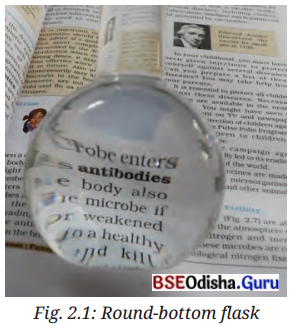
Aim : Let us observe through a round-bottom flask.
Materials Required : A round-bottom flask made of glass, water, a cork, a news paper.
Procedure :
- First of all we will take a round-bottom flask made up of glass as
The Invisible Living World : Beyond Our Naked Eye (Curiosity) shown in figure. Fill it with water. - Now, close the mouth of the flask using a cork.
- Place the flask on an open book and look at the letters through it.
Observations :
- We can observe that the letters appear larger when seen through the flask! This happens because the flask filled with water acts like a magnifying glass.
- If we use a real magnifying glass to look at small organisms, like an ant, we are able to see the details of its body more clearly.
Inference:
- People were curious to know the tiny organisms around them, but they could not see them with their naked eyes.
- With the discovery of microscope we are able to explore tiny world first time.
Activity 2
Let us study a cell (Teacher demonstration activity)
Aim : To prepare a temporary mount of onion peel.
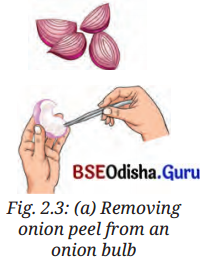
Materials Required : Onion bulb, a forceps, petri dish, safranin glycerin, a needle, coverslip, a microscope.
Procedure :
1. Take an onion bulb from your kitchen or garden and wash it thoroughly with water.
2. Now, cut the onion bulb vertically into pieces.
3. Take one piece of onion and pull out the thin, transparent layer from its inner surface with the help of forceps. This layer is called the onion peel.
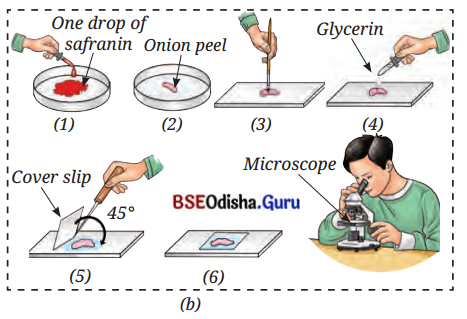
4. Now, put the peel in a petri dish containing a few drops of safranin (red-coloured stain) for about 30 seconds. The stain will give a pinkish colour to the cells and help us see them clearly.
5. Using a thin brush transfer the onion peel to another petri dish containing water to rinse the peel and remove extra stain.
6. Now, we will place the stained onion peel on the glass slide carefully with the help of a thin brush, ensuring it does not break or fold.
7. Put a drop of glycerin over the onion peel on the slide. The glycerin will enable you to
8. Now, slowly place a coverslip over the peel with the help of a needle, such that no air bubbles get trapped.
9. Use blotting paper to gently wipe off any extra glycerin around the edges of the covers’v.
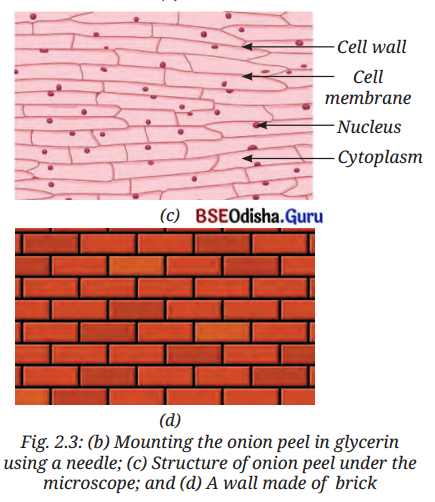
10. Observe the slide under a microscope or a foldscope. Compare it with fig. (c).
Observations :
- There are many rectangular structures under the microscope. These are the cells of the onion peel, which are closely arranged without any space between them.
- The structure of cells are similar to a wall made of bricks.
Inference:
- All plants are made of cells.
- These small microscopic structures that we see in an onion peel are the basic building units of onion bulb. These structures are called cells.
Activity 3
Let us investigate
Aim : To observe the mount of human cheek cell.
Materials Required : Toothpick, glass slide methylene blue (a blue coloured stain), glycerin coverslip, blotting paper, a microscope.
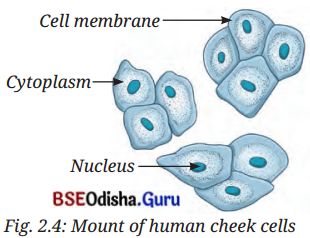
Procedure:
- Rinse your mouth with clean water.
- Now, with the help of the blunt end of a clean toothpick gently scrape the inside of your cheek.
- Put the scraped material in a drop of water on a clean glass slide and spread it evenly.
- Now, mix a drop of methylene blue (a blue-coloured stain) over the material on slide. When you add stain it improves the visibility of the material under the microscope by increasing contrast.
- Wait for one minute, add a drop of glycerin over the material on the slide to prevent the cells from drying.
- Now, carefully place a clean coverslip on the material, and remove the excess glycerin from the edges of the coverslip using blotting paper.
- Observe the slide under a microscope and draw what you see in your notebook.
Observations :
- A polygonshaped structure as shown in Fig. These are cheek cells, which form the inner lining of your mouth.
- We can observe that the cells have three main parts- a thin outer lining, a central region, and a small round structure inside it. The outer layer is called the cell membrane. The round structure in the middle is the nucleus, which is also covered by a thin membrane. The space between the cell membrane and nucleus is filled with cytoplasm.
Inference : Cell membrane, cytoplasm and nucleus are the basic parts of a cell (Both plants and animal cells).
Activity 4
Let us observe pond water/stagnant water
Aim : To observe pond water/stagnant water.
Materials Required : A dropper, a microscope or foldscope slide, cover slip.
Procedure :
- Take a container and collect pond or stagnant water in it. You can take help of your teacher or elder(s).
- Now, by using a dropper place a drop of pond or stagnant water on a microscope or foldscope slide. Put a coverslip and observe it under the microscope or foldscope.
- Look at the tiny organisms found in the pond or stagna t water and note down your observations.
Observations :
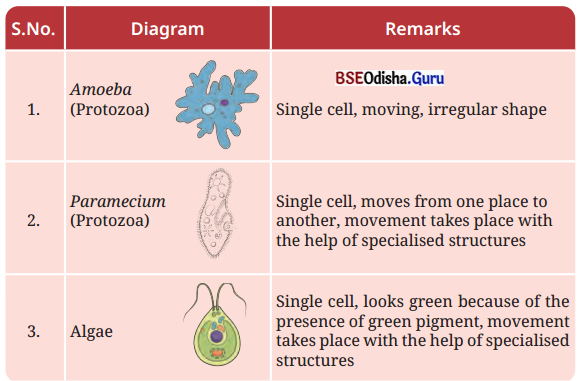
- Microorganisms like bacteria and Amoeba are seen.
- Some multicellular organisms like fungi and algae are also present.
Inference : Microorganisms unicellular and multicellular both are found in stagnant water/ pond water.
Activity 5
Let us observe soil suspension
Aim : To observe soil suspension.
Materials Required : A beaker, moist soil, spoon, gloves, glass rod, a dropper, microscope, coverslip.
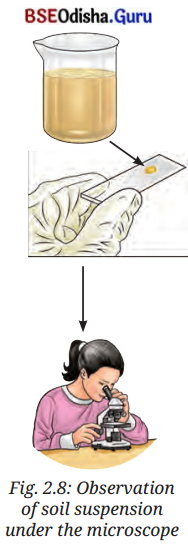
Procedure :
- First of all we will take a beaker and collect some moist soil in it from the nearby farm (field) or garden. Never touch the soil with your bare hands- use a spoon or gloves.
- Now, pour some water into the beaker and stir it with a glass rod. Actually the liquid, which you are looking dirty, has very fine particles of soil, and is called soil suspension. Keep it aside for some time and let the mixture settle.
- With the help of a dropper take out a drop of water from the top layer. Place the drop on a microscope slide.
- Cover it gently with a coverslip and observe it under the microscope (Fig.)
Observations : You may observe small moving organisms similar to those saw in activity 4.
Inference:
- This shows that even soil suspension contains a variety of tiny creatures that cannot be seen with the unaided eye.
- These tiny creatures that cannot be seen with the naked eye are said to be microorganisms (micro means very small; organisms means living beings) or microbes.
Activity 6.
Let us study
Aim : Let us study pond water and soil suspension.
Procedure :
- A group of students studying in Grade 8 performed Activities – 4 and 5 and they collected information from the library and internet.
- They recorded the data obtained in the table given below. They identified the microorganisms as protozoa, algae, fungi and bacteria.
Observations :
1. Table -1. Organisms present in pond water.
2. Table -2 : Organisms present in soil suspension
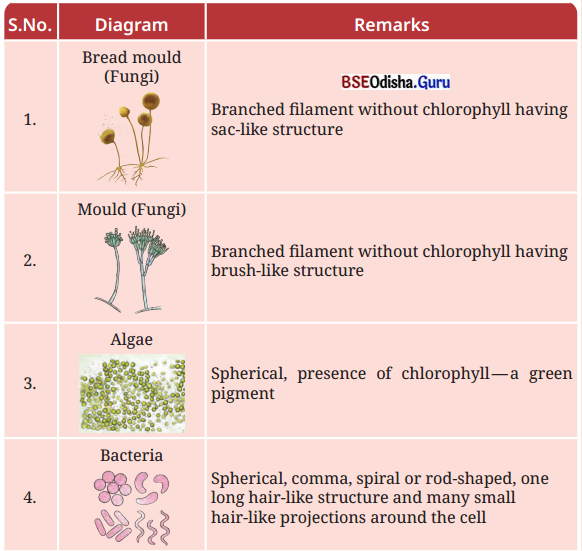
Inference : They are everywhere, and we can only see them with a microscope – a device that magnifies them 100 to 400 times. Though microorganisms are small in size, they play an important role in our lives.
Activity 7.
Let us do
Aim : To make manure from kitchen waste or plant waste.
Materials Required : Fruits and vegetable peels, soil.
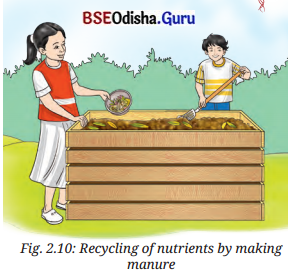
Procedure :
- Take an empty container and fill it halfway with farm soil or garden soil.
- Now, add some kitchen or plant waste like fruit and vegetable peels to the container. Thereafter, put a layer of soil on it and leave it aside.
- Do not disturb it and after 2-3 weeks, observe the changes that have taken place.
Observations :
- You may find that peels of fruits and vegetables have turned into a dark-coloured material.
This is manure, which is rich in nutrients and helps increase the fertility of the soil.
Inference : Soil contains various kinds of microorganisms. Some of these microorganisms, like fungi and bacteria, act on the plant waste and slowly break it down into simpler, nutrient-rich manure.
Activity 8.
Let us perform
Aim : To study the process of fermentation.
Materials Required : Two bowls, 200 g of flour (atta or maida), sugar, yeast powder.
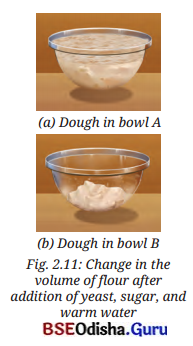
Procedure:
- Take two bowls X and Y.
- Take 200 g of flour (atta or maida) in both the bowls and add a pinch of sugar.
- Now, in bowl X, add a small amount of yeast powder and mix it well with the flour.
- In bowl Y, do not add any yeast, so that we can compare the results of the two bowls.
- Knead the flour of the two bowls by warm water to make soft dough.
- Now, cover the dough with a damp cloth and keep it in a warm place.
- Observe both the bowls after 4-5 hours.
Observations :
- The dough in bowl A, where yeast was added, has risen slightly, become fluffy, and has a different smell compared to the dough kneaded without yeast.
- The volume of dough rises, smell or texture has been changed.
Inference:
- Yeast is a type of microorganism and belongs to fungi.
- Yeast respires and breaksdown food to release energy for their growth.
- During this process carbon dioxide is released which make the dough soft and fluffy.
Activity 9
Let us prepare
Aim : Proper warm condition is necessary for the growth of bacteria.
Materials Required : Two small glass bowls, milk, curd.
Procedure :
- Take two small glass bowls – label them ‘A’ and ‘B’.
- Pour lukewarm milk in bowl A, and cold milk in bowl B.
- Now, add a small spoonful of curd to each bowl and mix well using a spoon.
- Cover both bowls. Keep bowl A in a warm place and bowl B in a cool place (like a refrigerator) for a few hours or overnight.
Observations :
- Table : Testing for curd formation using milk in different conditions
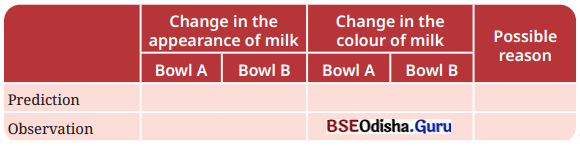
- You will observe that in bowl A, the milk has turned inte curd after a few hours and has become little sour.
- Whereas in bowl B, the milk has not curdled, but it might be a little sour.
Inference:
- The curd contains several types of bacteria, one of them is Lactobacillus which ferments the milk to form curd.
- These bacteria grow well in warm conditions. That is why curd is formed in bowl A but not in bowl B.
The Invisible Living World: Beyond Our Naked Eye Class 8 Extra Questions and Answers
Short Answer Type Questions
Question 1.
How do microorganisms act as a cleaning agent of nature ?
Answer:
The organic wastes like vegetable peels and remains of animals are broken down into harmless and usable substances by the action of microorganisms. In agriculture they are used to increase soil fertility by fixing nitrogen and by making manure.
Question 2.
How is bread formed ?
Answer:
When yeast together with some sugar and warm water is mixed with flour (atta or maida) the dough begins to rise. The presence of sugar and the warmth stimulates rapid growth of the yeast cells. During their reproduction, yeast cells produce carbon dioxide. Bubbles of CO2 fill the dough and make it rise. When baked into a loaf, the bread becomes light and spongy.
Question 3.
Write any three functions of the plant cell wall.
Answer:
The plant cell wall have the following functions :
- It maintains the shape of the cells.
- It protects the cells from mechanical injury and prevents their desiccation.
- It provides mechanical support against gravity. It is due to the rigid cell walls that the aerial parts of the plants are able to keep erect and expose their leaves to sunlight.
Question 4.
Why do plant cells possess large sized vacuole?
Answer:
Plant cells have large distinct vacuoles, They use their vacuoles for transporting and storing nutrients, metabolites and waste products. Plants also accumulate water in their vacuoles as they became larger through turgor driven by cell-wall expansion.
Long Answer Type Questions
Question 1.
Make a sketch of the human nerve cell. What function do nerve cell perform ?
Answer:
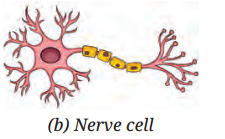
Functions :
(a) Nerve cells help in the transfer of messages from various body parts to brain and brain to various parts of the body.
(b) They help also in the coordination of the functions of the organs of the body.
Question 2.
Write short notes on the following :
(a) Cytoplasm
(b) Nucleus of a cell
Answer:
(a) Cytoplasm : Cytoplasm is a thick jelly-like fluid inside the cell membrane. All the life functions take place in the cytoplasm. There are many small cytoplasmic bodies in cytoplasm. These are called cell organelles. All organelles in cytoplasm play an active role in the functioning of the cell.
(b) Nucleus of a Cell : Nucleus is a large, spherical organelle presents in all the cells. Nucleus controls all the activities of cell. It is surrounded by a thin membrane called nuclear membrane. In animal cells, the nucleus is present at the centre of the cell. However, in the case of plant cells, it is present at the periphery of the cells. The nucleus consists of a nuclear membrane, nucleoplasm, nucleolus and chromosomes.
Case-Study Based Questions
1. Read the following passage carefully and answer the questions that follow :
Every living beings, from tiny bacteria to large animals, is made of cells. These organisms are very much useful in our daily life. During fermentation yeast breakdown sugar and produce carbon dioxide. This gas make idli and dosas soft and spongy. In olden days people knows how to prevent the growth of microbes. They add salt and sugar as a preservatives in pickles and murabbas. Do you know microalgae, plant like microscopic organisms, release oxygen while making food through photosynthesis ? They produce over half of earth’s oxygen. Similarly, ‘spirulina’ a microalga, is labbled as a super food because it is rich in protein and contain vitamin B12.
(i) What property of yeast helps to make idli and dosas soft ?
(a) Releasing oxygen during fermentation.
(b) Releasing carbon dioxide during fermentation.
(c) Formation of Nitrogen gas
(d) None of these
Answer:
(a) Releasing oxygen during fermentation.
(ii) Why does pickles and murabbas not get spoiled easily?
(a) Stored in metal jar
(b) Contains vinegar
(c) High salt and sugar concentration
(d) None of these
Answer:
(c) High salt and sugar concentration
(iii) What do microalgae contribute most to earth?
(a) Oxygen production
(b) Soil Formation
(c) Nitrogen production
(d) Cloud formation
Answer:
(a) Oxygen production
(iv) What makes ‘spirulina’ a super food ?
(a) due to fat content
(b) due to high protein and vitamin B12
(c) due to rich in carbohydrate
(d) due to rich in fibre
Answer:
(b) due to high protein and vitamin B12
Picture Based Questions
I. Study the picture given below carefully and answer the following questions :

(i) Name the microorganism and the group to which it belongs.
(a) bread mould
(b) fungi
(c) bacteria
(d) none of these
Answer:
(a) Bread mould
(ii) Name the food item on which the organism grows.
Answer:
Bread, fruits, starchy food like pasta, potatoes etc.
(iii) Does it grow well in dry or in moist conditions?
Answer:
It grows well in moist condition.
(iv) How can you prevent it from growing?
Answer:
We can prevent it from growing by the following ways:
- store in a cool and dry place.
- keep in a air tight container.
The Invisible Living World: Beyond Our Naked Eye Class 8 MCQ
Multiple Choice Questions (Mcqs)
Question 1.
What tool first helped humans see tiny living organisms?
(a) Spectrometer
(b) Microscope
(c) Thermometer
(d) Telescope
Answer:
(b) Microscope
Question 2.
What term was introduced by Robert Hooke after observing cork ?
(a) Nucleus
(b) Molecules
(c) Microbe
(d) Cell
Answer:
(d) Cell
Question 3.
Who was known as Father of Microbiology ?
(a) Antonie Van Leeuwenhoek
(b) Isaac Newton
(c) Charls Darwin
(d) Robert Hooke
Answer:
(a) Antonie Van Leeuwenhoek
Question 4.
Chloroplast is found in the :
(a) Plant cell only
(b) Animal cell only
(c) Both a and b
(d) None of these
Answer:
(a) Plant cell only
Question 5.
Yeast is used in the production of :
(a) sugar
(b) alcohol
(c) hydrochloric acid
(d) oxygen
Answer:
(b) alcohol
Assertion and Reasoning
These questions consist of two statements, each printed as Assertion (A) and Reason (R). While answering these questions, you are required to choose any one of the following four responses.
(a) Assertion (A) and Reason (R) both are correct and reason is correct explanation for assertion.
(b) Assertion (A) and Reason (R) both are correct and reason is not correct explanation for assertion.
(c) Assertion (A) is correct but the Reason (R) is wrong.
(d) Assertion (A) is wrong but the Reason (R) is correct.
1. Assertion (A): Rhizobium bacteria lives in the root nodules of leguminous plants.
Reason (R): These bacteria trap nitrogen from the air and make it useful for the plants.
Answer:
(a) Assertion (A) and Reason (R) both are correct and reason is correct explanation for assertion.
2. Assertion (A): Spirulina, a microalga called superfood.
Reason (R): Because it is a good source of vitamin B12 and protein.
Answer:
(a) Assertion (A) and Reason (R) both are correct and reason is correct explanation for assertion.
Fill in the blanks
1. Microorganisms can be seen with the help of a ………….
Answer:
microscope
2. Alcohol is produced with the help of …………
Answer:
yeast
3. A muscle cell is shaped like a ………….
Answer:
spindle
4. A herve cell is very ………… and has ………….
Answer:
long, branches
5. The cell wall in the plant cell provides ………… and ………… to plants.
Answer:
rigidity, strength.
True or False
1. We can see microorganisms with our naked eyes.
Answer:
False
2. Mushroom is a fungi.
Answer:
True
3. The yolk (the yellow part of an egg) of an ostrich egg is a single cell.
Answer:
True
4. A group of similar cells forms a type of organ.
Answer:
False
5. Plant cells do not have a vacuole.
Answer:
False