
Students can refer to BSE Odisha Class 8 Math Solution and Ganita Prakash Chapter 1 A Square and A Cube Class 8 Question Answer to understand textbook questions step by step.
Class 8 Maths Chapter 1 A Square and A Cube Solutions
Ganita Prakash Class 8 Chapter 1 Solutions
Class 8 Maths Ganita Prakash Chapter 1 Solutions A Square and A Cube
Page : 1
Question 1.
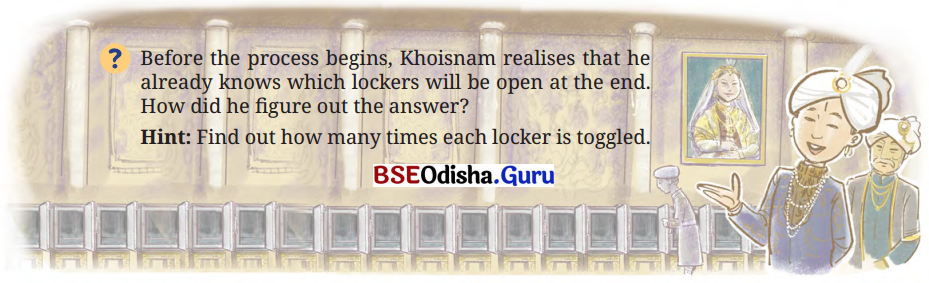
Before the process begins, Khoisnam realises that he already knows which lock¬ers will be open at the end. How did he figure out the answer?
Solution:
Khoisan had figured out on the basis of the following:
(i) If a locker is toggled an odd number of times, it will be open.
(ii) If a locker is toggled an even number of times, it will be closed.
(iii) The number of times a locker is toggled is the same as the number of factors of that locker number.
For example for locker #10, person 1 opens it, person 2 closes it, person 5 opens it and person 10 closes it.
The numbers 1, 2, 5, 10 are factors of 10. If the number of factors is even, the locker will be toggled by an even number of people and it will eventually be closed.
In the same manner if we consider locker #4, it will be closed at the end as 4 has 1, 2 and 4 as its factors, which are odd in number.
Page : 2
Question 1.
Does every number have an even number of factors?
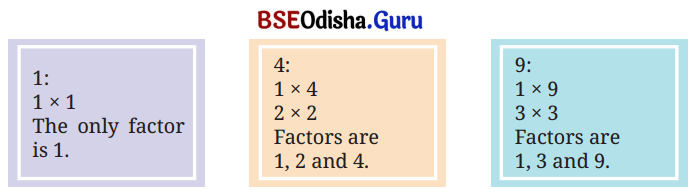
We see in some cases, like 2 × 2, that the numbers in the pair are the same.
Solution:
No! Many numbers do not have an even number of factors, for example – 1 has only 1 factor, 4 has 3 factors: 1, 2 and 4, 9 has 3 factors: 1, 3 and 9, 25 has 3 factors: 1, 5 and 25.
Question 2.
Can you use this insight to find more numbers with an odd number of factors?
For instance, 36 has a factor pair 6 × 6 where both numbers are 6. Does this number have an odd number of factors? If every factor of 36 other than 6 has a different factor as its partner, then we can be sure that 36 has an odd number of factors. Check if this is true.
Hence all the following numbers have an odd number of factors –
1 × 1, 2 × 2, 3 × 3, 4 × 4, …
A number that can be expressed as the product of a number with itself is called a square number, or simpiy a square. The only numbers that have an odd number of factors are the squares, because they each have one factor which, when multiplied by itself, equals the number. Therefore, every locker whose number is a square will remain open.
Solution:
Continuing the given insight we can find more numbers with an odd number of factors:
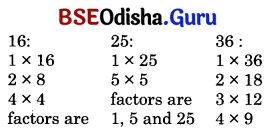
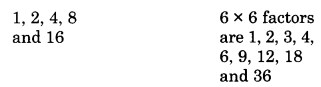
All of the above numbers have odd number of factors.
Note – In the above: 16 : 1 × 16, 2 × 8 and 4 × 4 are called ‘Partner Factors’ and for other numbers as well.

Page : 3
Question 1.
Write the locker numbers that remain open.
Khoisnam immediately collects word clues from these 10 lockers and reads, “The passcode consists of the first five locker numbers that were touched exactly twice.”
Which are these five lockers?
The lockers that are toggled twice are the prime numbers, since each prime number has 1 and the number itself as factors. So, the code is 2 – 3 – 5 – 7 – 11.
Solution:
As we know that each of the square numbers has an odd number of factors. Therefore, the lockers with following numbers will remain open: #1, #4, #9, #16, #25, #36, #49, #64, #81, #100.
Page : 4
1.1 Square Numbers
Question 1.
What patterns do you notice? Share your observations and make conjectures.
Study the squares in the table above. What are the digits in the units places of these numbers? All these numbers end with 0, 1, 4, 5, 6 or 9. None of them end with 2, 3, 7 or 8.
| 12 = 1 | 112 = 121 | 212 = 441 |
| 22 = 4 | 122 = | 222 = |
| 32 = 9 | 132 = | |
| 42 = 16 | 142 = | |
| 52 = 25 | 152 = | |
| 62 = | 162 = | |
| 72 = | 172 = | |
| 82 = | 182 = | |
| 92 = | 192 = | |
| 102 = | 202 = |
Solution:
| 12 = 1 | 112 = 121 | 212 = 441 |
| 22 = 4 | 122 = 144 | 222 = 484 |
| 32 = 9 | 132 = 169 | 232 = 529 |
| 42 = 16 | 142 = 196 | 242 = 576 |
| 52 = 25 | 152 = 225 | 252 = 625 |
| 62 = 36 | 162 = 256 | 262 = 676 |
| 72 = 49 | 172 = 289 | 272 = 729 |
| 82 = 64 | 182 = 324 | 282 = 784 |
| 92 = 81 | 192 = 361 | 292 = 841 |
| 102 = 100 | 202 = 400 | 302 = 900 |
We observe that numbers whose unit’s place digit is 1 or 9, squares of these numbers have unit’s place digit 1. The numbers whose unit’s place digit is 2, 3, 7, or 8, squares of these numbers have 4, 9, 9, 4 as their unit’s place digit, respectively The numbers whose unit’s digit have 3 or 7 have their squares having unit’s place digits 9 while the numbers having unit’s place digits 5, 6, or 0 have 5, 6,0 (even number of zeroes) at their unit’s place digit and ten’s place digit for the case of zeroes.
So, we can conclude that squares of numbers end with 0, 1, 4, 5, 6, or 9. None of them end with 2, 3, 7, or 8.
Question 2.
If a number ends in 0, 1, 4, 5, 6 or 9, is it always a square?
The numbers 16 and 36 are both squares with 6 in the units place. However, 26, whose units digit is also 6, is not a square. Therefore, we cannot determine if a number is a square just by looking at the digit in the units place. But, the units digit can tell us when a number is not a square. If a number ends with 2, 3, 7, or 8, then we can definitely say that it is not a square.
Solution:
No.
If a number ends in ‘0’, then it will not always be a square as numbers 10, 20, 30, 40, 50, 60, etc. are not squares of any number.
If a number ends in ‘0’, it will not always be a square as numbers 11, 21, 31, 41, etc. are not squares.
If a number ends in ‘4’ will not always be a square as numbers 14, 24, 34, 44, etc. are not squares.
If a number ends in ‘5’ will not always be a square as numbers 15, 35, 45, 55, etc. are not squares.
If a number ends in ‘6’ will not always be a square as numbers 26, 46, 56, 66, etc. are not squares.
If a number ends in 9 will not always be a square as numbers 19, 29, 39, 59, 69, etc. are not squares.
So, we can conclude that a number ending at 0, 1, 4, 5, 6, or 9 is not always a square.
Question 3.
Write 5 numbers such that you can determine by looking at their units digit that they are not squares.
The squares, 12, 92, 112, 192, 212, and 292, all have 1 in their units place. Write the next two squares. Notice that if a number has 1 or 9 in the units place, then its square ends in 1.
Solution:
We know that none of square numbers end with 2, 3, 7 or 8.
Based on the above, we can write any number of numbers which can be determined by looking at their units digit that they are not squares.
So, the 5 numbers can be 12, 13, 17, 18, and 28.
Note : We can write any number of numbers which can be determined by looking at their unit’s digits that they are not squares.
Page : 4 – 5
Question 1.
Let us consider square numbers ending in 6 : 16 = 42, 36 = 62, 196 = 142, 256 = 162, 576 = 242, and 676 = 262.
Which of the following numbers have the digit 6 in the units place?
(i) 382
(ii) 342
(iii) 462
(iv) 562
(v) 742
(vi) 822
Solution:
(i) 382 = 1444, No digit 6 in the unit’s place.
(ii) 342 = 1456, Digit 6 in the unit’s place.
(iii) 462 = 2116, Digit 6 in the unit’s place.
(iv) 562 = 3136, Digit 6 in the unit’s place.
(v) 742 = 5476, Digit 6 in the unit’s place.
(vi) 822 = 6724, No, digit 6 in the unit’s place.
Note : The numbers which end at 4 or 6 will have digit 6 in the unit’s place and no other number will have digit 6 in the unit’s place in their squares.
Page : 5
Question 1.
Find more such patterns by observing the numbers and their squares from the table you filled earlier.
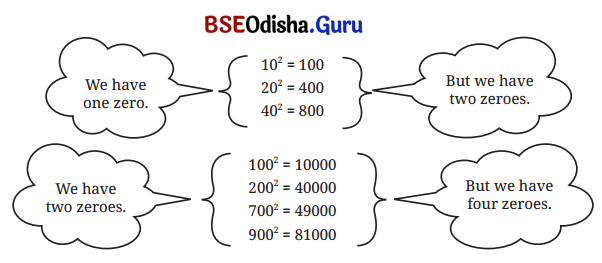
Consider the following numbers and their squares.
Solution:
Some more patterns which we find in the table are :
(i) Numbers ending at 1 or 9 have digit 1 at unit’s place in their squares.
(ii) Numbers ending at 2 or 8 have digit 4 at unit’s place in their squares.
(iii) Numbers ending at 3 or 7 have digit 9 at unit’s place in their squares.
(iv) Numbers ending at 5 will have digit 5 at unit’s digit in their squares.
(v) There will be an even number of zeroes in the squares of a number having a zero at their unit’s place.
(vi) No square number will end at 2, 3, 7, or 8.
Question 2.
If a number contains 3 zeros at the end, how many zeros will its square have at the end?
Solution:
If a number contains 3 zeroes at the end, then there will be 6 zeroes at the end of its square.
Question 3.
What do you notice about the number of zeros at the end of a number and the number of zeros at the end of its square? Will this always happen? Can we say that squares can only have an even number of zeros at the end?
Solution:
The number of zeroes at the end of square of a number is twice the number of zeroes at the end of the number.
For example, if a number has 2 zeroes at the end then its square will have 4 zeroes and if a number has 5 zeroes at the end then its square will have 10 zeroes at its end. This will always happen. Yes, a square number will always have an even number of zeroes at its end.
Question 4.
What can you say about the parity of a number and its square?
Solution:
The square of an even number has an even parity and the square of an odd number has an odd parity.
Page : 6
Question 1.
Using the pattern above, find 362, given that 352 = 1225.
From the question we know that 1225 is the sum of the first 35 odd numbers. To find 362, we need to add the 36th odd number to 1225.
Solution:
It is given that 352 = 1225
∴, to obtain the 362 we add the 36th odd number to 1225.
We add 36th odd number which is 2 × 36 – 1
= 72 – 1 = 71 to 1225 to get
= 1225 + 71 = 1296
So, we have obtained 362 = 1296
Question 2.
How do we find the 36th odd number?
The 1st odd number is 1, 2nd odd number is 3, 3rd number is 5, … , 6th odd number is 11 and so on.
Solution:
We have obtained 36th odd number by 2 × 36 – 1 = 72 – 1 = 71.
Question 3.
What is the nth odd number?
The nth odd number is 2n – 1.
Therefore, the 36th odd number is 71.
By adding 71 to 1225, we get 1296, which is 362.
Consider a number such as 38 that is not a square and subtract consecutive odd numbers starting from 1.

This shows that 38 cannot be expressed as a sum of consecutive odd numbers starting with 1.
Thus, we can say that a natural number is not a perfect square if it cannot be expressed as a sum of successive odd natural numbers starting from 1. We can use this result to find out whether a natural number is a perfect square.
Solution:
nth odd number is given by 2n – 1.
Page : 7
Question 1.
Find how many numbers lie between two consecutive perfect squares. Do you notice a pattern?
Solution:
Let us consider the following :
22 – 12 = 4 – 1 = 3, there are 3 – 1 = 2 numbers in between.
32 – 22 = 9 – 4 = 5, there are 5 – 1 = 4 numbers in between.
42 – 32 = 16 – 9 = 7, there are 7 – 1 = 6 numbers in between.
52 – 42 = 25 – 16 = 9, there are 9 – 1 = 8 numbers in between.
62 – 52 = 36 – 25 = 11, there are 11 – 1 = 10 numbers in between.
So, we notice that in between (n + 1)2 and n2, there are 2n numbers.
Question 2.
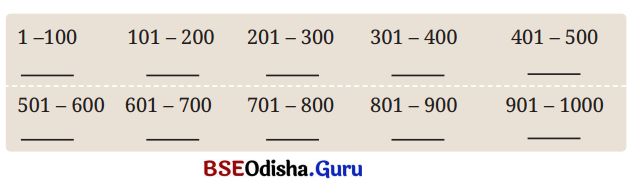
How many square numbers are there between 1 and 100? How many are between 101 and 200? Using the table of squares you filled earlier, enter the values below, tabulating the number of squares in each block of 100. What is the largest square less than 1000?
Solution:
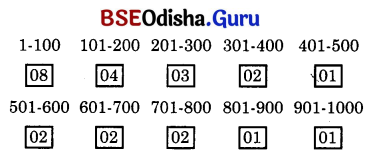
The largest square less than 1000 is 961, which is the square of 31.
Question 3.
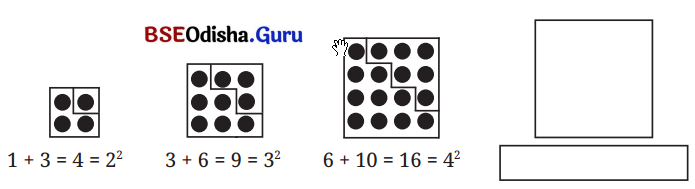
Can you see any relation between triangular numbers and square numbers? Extend the pattern shown and draw the next term.
Solution:
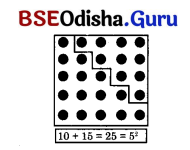
Question 4.
The area of a square is 49 sq. cm. What is the length of its side?
We know that 7 × 7 = 49, or 72 = 49
So, the length of the side of a square with an area of 49 sq. cm is 7 cm.
We call 7 the square root of 49.
In general, if y = x2 then x is the square root of y.
Solution:
Area of a square = (Side)2
⇒ (Side)2 = 49 sq. cm
⇒ (Side)2 = 7 × 7 ⇒ (Side)2 = (7)2
⇒ Side = 7
∴, the length of its side = 7 cm.
Page : 8
Question 1.
What is the square root of 64?
We know that 8 × 8 is 64. So, 8 is the square root of 64. What about -8 × -8? That is 64 too!
82 = 64, and (-8)2 = 64.
So, the square roots of 64 are +8 and -8.
Every perfect square has two integer square roots. One is positive and the other is negative. The square root of a number is denoted by √
Thus, \(\sqrt{64}\) = ±8 and \(\sqrt{100}\) = ±10.
Note that \(\sqrt{8^2}\) = ±8 and \(\sqrt{10^2}\) = ±10. In general, \(\sqrt{n^2}\) = ± n.
In this chapter, we shall only consider the positive square root.
Solution:
To know the square roots of 64, we should try to get all those numbers whose square is 64. We know that 8 × 8 = 64 and also -8 × (-8) – 64
∴, the square roots of 64 are +8 and -8.
Question 2.
Given a number, such as 576 or 327, how do we find out if it is a perfect square? If it is a perfect square, how can we find its square root?
We know that perfect squares end in 1, 4, 9, 6, 5, or an even number of zeros. But, it is not certain that a number that satisfies this condition is a square.
We can clearly say that 327 is not a perfect square. However, we cannot be sure that 576 is a perfect square.
1. We can list all the square numbers in sequence and find out whether 576 occurs among them. We know that 202 = 400, we can find squares of 21, 22, 23, … and so on until we get 576 or a number greater than 576.
202 = 400 212 = 441 222 = 484 232 = 529 242 = 576
However, this process becomes inefficient for larger numbers.
2. Recall that every square can be expressed as a sum of consecutive odd numbers starting from 1.
Consider \(\sqrt{81}\).
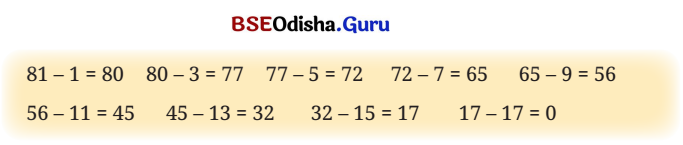
From 81, we successively subtracted consecutive odd numbers starting from 1 until we obtained O at the 9th step. Therefore \(\sqrt{81}\) = 9.
Can we find the square root of 729 using this method? Yes, but it will be time-consuming.
3. We know that a perfect square is obtained by multiplying an integer by itself. Will looking at a number’s prime factorisation help in determining whether it is a perfect square?
Yes, if we can divide the prime factors of a number into two equal groups, then the product of the prime factors in either group combine to form the square root.
Solution:
Given a number, we can decide whether the given number is a perfect square or not by using the following methods:
1. If the given number ends with 2, 3, 7, 8, or an odd number of zeroes, then it can not be a perfect square.
2. We know that every square number can be expressed as a sum of consecutive odd numbers starting from 1.
So, by subtracting consecutive odd numbers, we can check whether the given number is a square or not.
3. We can check whether a given number is a perfect square by prime factorisation. We do the prime factorisation and then group them in pairs. If all prime factors occur in pairs, then it is a perfect square. Otherwise, it is not.
Now we take the given numbers:
Given numbers are 576 and 327.
Clearly 327 cannot be a perfect square as it ends at 7.
For 576, we can do repeated subtraction of consecutive odd numbers starting from 1, or we can find prime factors of 576.
Let us find out prime factors of 576:
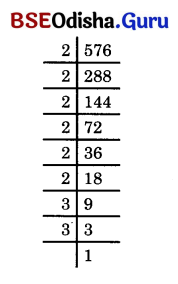
∴, 576 = 2 × 2 × 2 × 2 × 2 × 2 × 3 × 3
Grouping prime factors in pairs, we get:
\(\sqrt{576}\) = 2 × 2 × 2 × 3
= 24
So, 576 is a perfect square and its square roots are 24 and -24.
Page : 9
Question 1.
Is 324 a perfect square?
324 = 2 × 2 × 3 × 3 × 3 × 3.
These can be grouped as
324 = (2 × 3 × 3) × (2 × 3 × 3).
= (2 × 3 × 3)2 = 182.
We can also write the prime factors in pairs. That is,
324 = (2 × 2) × (3 × 3) × (3 × 3),
which shows that 324 is a perfect square. Thus,
324 = (2 × 3 × 3)2 = 182.
Therefore, \(\sqrt{324}\) = 18.
Solution:
Let us find prime factors of 324:
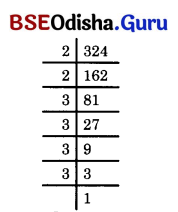
∴, 234 = 2 × 2 × 3 × 3 × 3 × 3
Since, all prime factors of 324 can be grouped in pairs, so 324 is a perfect square.
Hence,
\(\sqrt{324}\) = 2 × 3 × 3 = 18.
Question 2.
Is 156 a perfect square?
The prime factorisation of 156 is 2 × 2 × 3 × 13.
We cannot pair up these factors.
Therefore, 156 is not a perfect square.
Solution:
Let us find prime factors of 156:
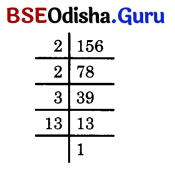
∴, 156 = 2 × 2 × 3 × 13
Here, we can see that all prime factors of 156 cannot be grouped in pairs.
Hence, 156 is not a perfect
Question 3.
Find whether 1156 and 2800 are perfect squares using prime factorisation.
Solution:
Prime factors of:
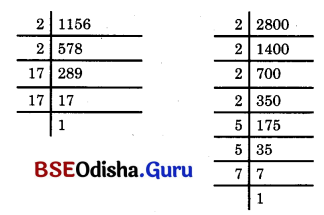
∴, 1156 = 2 × 2 × 17 × 17
All prime factors of 1156 can be grouped in pairs.
Hence, 1156 is a perfect square and \(\sqrt{1156}\) = 34.
Also, 2800 = 2 × 2 × 2 × 2 × 5 × 5 × 7
Here, all prime factors cannot be grouped in pairs.
Hence, 2800 is not a perfect square.
Figure it Out: Page : 10 – 11
Question 1.
Which of the following numbers are not perfect squares?
(i) 2032
(ii) 2048
(iii) 1027
(iv) 1089
Solution:
(i) 2032,
(ii) 2048,
(iii) 1027 are not perfect squares as they end with 2, 8 and 7, respectively. 1089 is a perfect square as it is square of 33.
Question 2.
Which one among 642, 1082, 2922, 362 has last digit 4?
Solution:
Any number whose last digit is 8 will have 4 as last digit in its square.
So, 1082 has the last digit 4.
Also, if the last digit is 2, then its square will have 4 at its units place.
So, 2922 has 4 at its last digit.
Question 3.
Given 1252 = 15625, what is the value of 1262?
(i) 15625 + 126
(ii) 15625 + 262
(iii) 15625 + 253
(iv) 15625 + 251
(v) 15625 + 512
Solution:
To get the value of 1262, we add 126th odd number to 1252 = 15625.
126th odd number is 2 × 126 – 1 = 252 – 1 = 251
So, we get 1262 = 15625 + 251
i.e., (iv) 15625 + 251, is the correct option.
Question 4.
Find the length of the side of a square whose area is 441 m2.
Solution:
Area of the square = 441
So, (side)2 = 441 (∴, area of square = (side)2)
⇒ (side)2 = (3 × 3 × 7 × 7)
⇒ (side)2 = (32 × 72)
⇒ (side)2 = (3 × 7)2
⇒ (side)2 = (21)2
⇒ Side = 21 m,
(∴, length cannot be negative)
∴, The length of the side = 21 m.
Question 5.
Find the smallest square number that is divisible by each of the following numbers: 4, 9, and 10.
Solution:
To get the smallest number that is divisible by 4, 9 and 10, will be the LCM of these numbers.
Now,
4 = 2 × 2 = 22
9 = 3 × 3 = 32
10 = 2 × 5 = 2 × 5
To get the LCM, we collect the factors with highest powers.
So, LCM(4, 9, 10) = 22 × 32 × 5
= 4 × 9 × 5 = 180
Therefore, 180 is the smallest number that is divisible by 4, 9 and 10.
Question 6.
Find the smallest number by which 9408 must be multiplied so that the product is a perfect square. Find the square root of the product.
Solution:
We first of all get the prime factors of 9408:
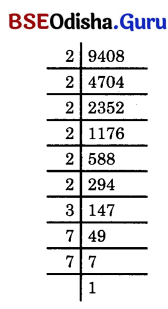
∴, 9408 = 2 × 2 × 2 × 2 × 2 × 2 × 3 × 7 × 7
Here, we can notice that 3 remains unpaired. So, we must multiply 9408 by 3 to get the product, which is a perfect square.
Square root of the new number is:
2 × 2 × 2 × 3 × 7 = 168
Question 7.
How many numbers lie between the squares of the following numbers?
(i) 16 and 17
(ii) 99 and 100
Solution:
(i) There are 32 numbers between 162 and 172
(ii) There are 198 numbers between 992 and 1002
Question 8.
In the following pattern, fill in the missing numbers:
12 + 22 + 22 = 32
22 × 32 × 62 = 72
32 × 42 + 122 = 132
42 + 52 + 202 = (_)2
92 + 102 + (_)2 = (_)2
Solution:
42 + 52 + 202 = (21)2
92 + 102 + (90)2 = (91)2
Question 9.
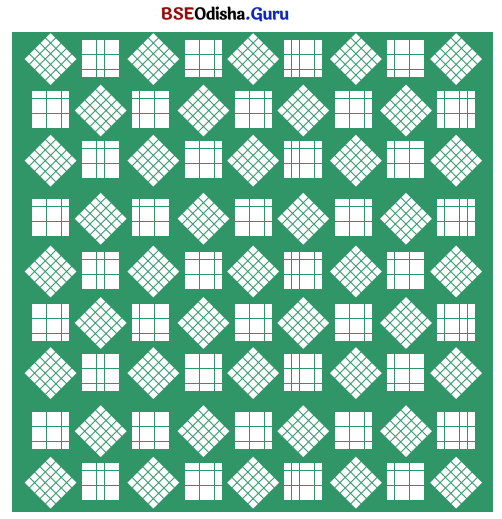
How many tiny squares are there in the following picture? Write the prime factorisation of the number of tiny squares.
Solution:
There are 81 tiny squares.
Prime factorisation of 81 :
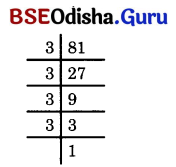
∴, 81 = 3 × 3 × 3 × 3
Page : 11
1.2 Cubic Numbers
Question 1.
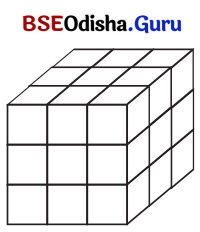
How many cubes of side 1 cm will make a cube of side 3 cm?
Consider the numbers 1, 8, 27, …
These numbers are called perfect cubes. Can you see why they are named so?
Each of them is obtained by multiplying a number by itself three times. We note that
1 = 1 × 1 × 1
8 = 2 × 2 × 2
27 = 3 × 3 × 3
Solution:
27 cubes of 1 cm will make a cube of side 3 cm.
Page : 12
Question 1.
Is 9 a cube?
We see that 2 × 2 × 2 = 8 and 3 × 3 × 3 = 27. This shows that 9 is not a perfect cube. Nor is any number from 10 to 26.
Solution:
No, 9 is not a cube as 9 = 3 × 3. We cannot group the prime factors of 9 as a group of 3.
So, 9 is not a perfect cube.
Question 2.
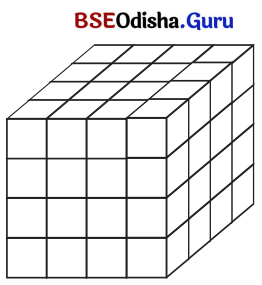
Can you estimate the number of unit cubes in a cube with an edge length of 4 units?
It has 64 unit cubes! If you notice carefully, each layer of this cube has 4 × 4 unit cubes. Each square layer has 16 unit cubes (4 × 4), and there are 4 such layers, so the
total number of unit cubes is 4 × 4 × 4 = 64.
Since 53 = 5 × 5 × 5= 125, 125 is a cube.
In general, for any number n, we write the cube
n × n × n as n3.
Solution:
Total number of unit cubes in a cube with an edge length of 4 units = 4 × 4 × 4 = 64.
Question 3.
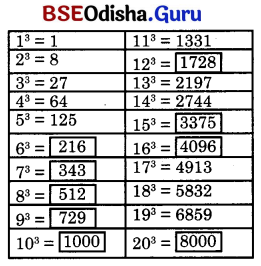
Complete the table below.
| 13 = 1 | 113 = 1331 |
| 23 = 8 | 123 = |
| 33 = 27 | 133 = 2197 |
| 43 = 64 | 143 = 2744 |
| 53 = 125 | 153 = |
| 63 = | 163 = |
| 73 = | 173 = 4913 |
| 83 = | 183 = 5832 |
| 93 = | 193 = 6859 |
| 103 = | 203 = |
Solution:
Question 4.
What patterns do you notice in the table above?
Solution:
We have noticed that cubes of numbers ending at 1, 2, 3, 4, 5, 6, 7, 8, 9, and 0 end at 1, 8, 7, 4, 5, 6, 3, 2, 9, and three zeroes, respectively.
Page : 12 – 13
Question 1.
We know that 0, 1, 4, 5, 6, 9 are the only last digits possible for squares. What are the possible last digits of cubes?
Solution:
The possible last digit of cubes can be any digit from 0 to 9. There is no exception as we have for square numbers.
There can be even or odd number of zeroes in a cube.
Question 2.
Similar to squares, can you find the number of cubes with 1 digit, 2 digits, and 3 digits? What do you observe?
Solution:
Cubes with 1-digit are 1 and 8.
Cubes with 2-digit are 27 and 64.
Cubes with 3-digit are 125, 216, 343, 512, and 729.
We observe that all these cubes are the cubes of 1-digit numbers only.
Clearly, 1 is the cube of 1, and 729 is the cube of 9.
Question 3.
Can a cube end with exactly two zeroes (00)? Explain.
Just as we can take squares of fractions/decimals – (\(\frac{4}{6}\))2 (13.08)2, and
(6)2 – we also can compute cubes of such numbers – (\(\frac{4}{6}\))3, (13.08)3, and (-6)3.
(\(\frac{4}{6}\))3 = (\(\frac{4}{6}\)) × (\(\frac{4}{6}\)) × (\(\frac{4}{6}\)) = ((\(\frac{64}{216}\)))
(13.08)3 = 13.08 × 13.08 × 13.08 = 2237.810112
(-6)3 = -6 × -6 × -6 = -216.
Solution:
No cube can end with exactly two zeroes. If a number ends at 0 (single), then its cube will have three zeroes.
So, no cube number can have two zeroes at the end.
Question 4.
The next two taxicab numbers after 1729 are 4104 and 13832. Find the two ways in which each of these can be expressed as the sum of two positive cubes.
How did Ramanujan know this? Well, he loved numbers. All through his life, he tinkered with numbers. During Ramanujan’s time in Cambridge, his colleagues often marveled at his ability to see deep patterns in numbers that seemed arbitrary to others. His colleague, John Littlewood, once said,
“Every positive integer was one of his [Ramanujan’s] personal friends”.
Solution:
4104 = 23 + 163 and 93 + 153 13832 = 183 + 203 and 33 + 243
Note : 213 = 9261, 223 = 10648, 233 = 12167, 243 = 13824.
Page : 14
Question 1.
Can you tell what this sum is without doing the calculation?
91 + 93 + 95 + 97 + 99 + 101 + 103 + 105 + 107 + 109
Solution:
We see here that starting from the 10 × 9 + 1 = 91, we have 10 odd numbers added in the sequence.
So, the sum will be 103 = 1000.
Question 2.
Let us check if 3375 is a perfect cube.
3375 = 3 × 3 × 3 × 5 × 5 × 5.
Can the factors be split into three identical groups? For 3375, we can
form three groups of (3 × 5). So,
3375 = (3 × 5) × (3 × 5) × (3 × 5)
= (3 × 5)3 = 153.
Another way is to check if the factors can be grouped into triplet(s):
3375 = (3 × 3 × 3) × (5 × 5 × 5) = 33 × 53.
This means \($\sqrt[3]{3375}$\) = 15.
Solution:
Let us find prime factors of 3375 :
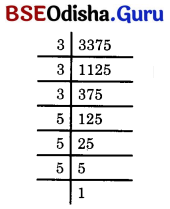
∴, 3375 = 3 × 3 × 3 × 5 × 5 × 5
Since we can group all prime factors in groups of 3,
So, we conclude that 3375 is a perfect cube.
Question 3.
Is 500 a perfect cube?
500 = 2 × 2 × 5 × 5 × 5. We see that the factors cannot be split into three identical groups. Therefore, 500 is not a perfect cube.
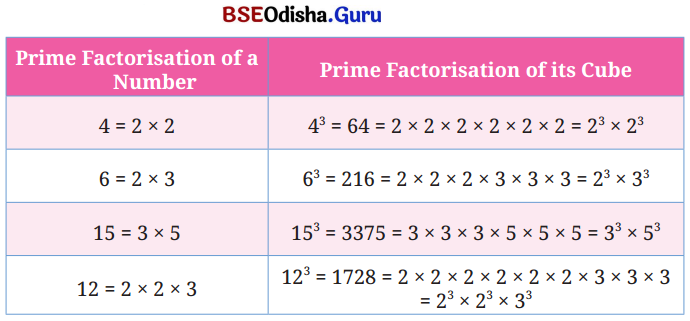
Observe that each prime factor of a number appears three times in the prime factorisation of its cube.
Solution:
Let us find prime factors of 500:
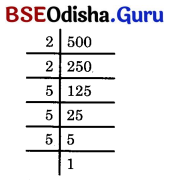
∴, 500 = 2 × 2 × 5 × 5 × 5
Here, we see that all prime factors cannot be grouped in a group of 3.
So, 500 is not a perfect cube.
Page : 15
Question 1.
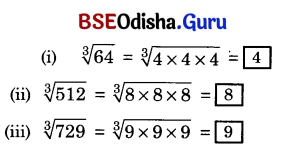
Find the cube roots of these numbers:
(i) \(\sqrt[3]{64}\) =
(ii) \(\sqrt[3]{512}\) =
(iii) \(\sqrt[3]{729}\) =
Solution:
Question 2.
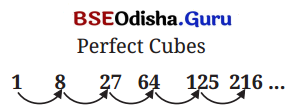
Compute successive differences over levels for perfect cubes until all the differences at a level are the same. What do you notice?
Solution:
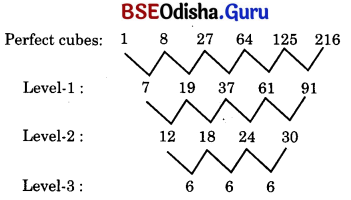
So, at level – 3, we get the differences same as 6.
Figure it Out : Page : 16 – 17
Question 1.
Find the cube roots of 27000 and 10648.
Solution:
Prime factors of 27000 :
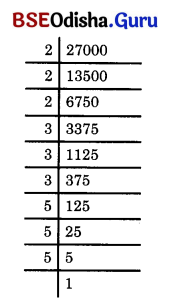
∴, 27000 = 2 × 2 × 2 × 3 × 3 × 3 × 5 × 5 × 5
⇒ \(\sqrt{27000}\) = 2 × 3 × 5
= 2 × 3 × 5 = 30
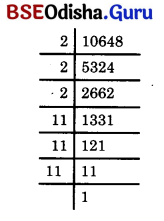
∴, 10648 = 2 × 2 × 2 × 11 × 11 × 11
⇒ \(\sqrt{10648}\) = 2 × 11
= 2 × 11 = 22
Question 2.
What number will you multiply by 1323 to make it a cube number?
Solution:
To get the number by which we should multiply 1323 to make it a cube number.
We first of all find prime factors of 1323.
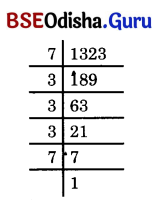
∴, 1323 = 3 × 3 × 3 × 7 × 7
Here, we can see that 7 remains ungrouped in group of three.
So we multiply 1323 by 7 to get a perfect cube. The new number which is a perfect cube is: 9261. Its cube root is : 21.
Question 3.
State true or false. Explain your reasoning.
1. The cube of any odd number is even.
2. There is no perfect cube that ends with 8.
3. The cube of a 2-digit number may be a 3-digit number.
4. The cube of a 2-digit number may have seven or more digits.
5. Cube numbers have an odd number of factors.
Solution:
1. FALSE: The cube of any odd number is odd as 13 = 1, 33 = 27, 53 = 125, 73 = 343, …
2. FALSE : There are perfect cubes that end with 8 as 23 = 8, 123 = 1728, 3 = 10648, …
3. FALSE : The cube of a 2-digit number can never be a 3-digit number.
For example, 103 = 1000
Here, we see that the smallest two-digit number 10 has cube which has 4-digits.
4. FALSE : The cube of a 2-digit number can never be of 7-digit or more digit.
As we can see that 99 is the largest 2-digit number and its cube is 9,70,299, which is a 6-digit number.
5. FALSE : Cube numbers have an odd number of factors is a false statement. We can see that 8, which is a perfect cube, has factors 1, 2, 4, and 8, which are 4 in numbers.
Question 4.
You are told that 1331 is a perfect cube. Can you guess without factorisation what its cube root is? Similarly, guess the cube roots of 4913, 12167, and 32768.
Solution:
1331 is a perfect cube of ‘11’,
4913 is a perfect cube of ‘17’,
12167 is a perfect cube of ‘23’, and
32768 is a perfect cube of ‘32’.
The cubes of numbers ending at 1, 2, 3, and 7, end with 1, 8, 7, and 3, respectively.
Question 5.
Which of the following is the greatest? Explain your reasoning.
(i) 673 – 663
(ii) 433 – 423
(iii) 672 – 662
(iv) 432 – 422
Solution:
(i) 633 – 663 = 13267
(ii) 433 – 423 = 5419
(iii) 672 – 662 = 133
(iv) 432 – 422 = 85
Clearly, 633 – 663 is the greatest and 432 – 422 is the least.
A Square and A Cube Class 8 Extra Questions
Multiple Choice Questions
Question 1.
Which of the following is not a perfect square?
(a) 225
(b) 144
(c) 288
(d) 256
Solution:
Here, 225 = 152, 144 = 122, and 256 = 162.
But 288 cannot be written as a square of any natural number.
(c) 288
Question 2.
Which of the following cannot be a digit at the end of a perfect square?
(a) 1
(b) 2
(c) 4
(d) 6
Solution:
The digit at the end of a perfect square can be 1, 4, 5, 6, 9 or an even number of zeroes.
(b) 2
Question 3.
Total number of factors of a perfect square number is:
(a) Even
(b) Odd
(c) Can be even or odd
(d) None of these
Solution:
This is a fact that the number of factors of a perfect square number is always odd in numbers.
This is a fact that the number of factors of a perfect square number is always odd in numbers.
For example:
12 = 1, factors: 1, number of factors = 1
22 = 4, factors: 1, 2, 4, number of factors = 3
32 = 9, factors: 1, 3, 9, number of factors = 3
42 = 16, factors: 1, 2, 4, 8, 16, number of factors = 5, etc.
(b) Odd
Question 4.
Which of the following is not a perfect square?
(a) 1024
(b) 576
(c) 729
(d) 927
Solution:
1024 = 322, 576 = 242, 729 = 272
But 927 is not a square of any natural number.
(d) 927
Question 5.
Which of the following is a perfect square?
(a) 124632
(b) 207936
(c) 732423
(d) 783228
Solution:
In the given options, we can notice that (a), (c), and (d) end with 2, 3, and 8 respectively. Hence, these numbers cannot be perfect squares.
Answer:
(b) 207936
Assertion and Reasoning
(a) Assertion (A) and Reason (R) both are true and Reason (R) is the correct explanation for the Assertion (A).
(b) Assertion (A) and Reason (R) both are true but Reason (R) is not the correct explanation for the Assertion (A).
(c) Assertion (A) is true but Reason (R) is false.
(d) Assertion (A) is false but Reason (R) is true.
Question 1.
Assertion (A) : The number 102325462 cannot be a square number.
Reason (R) : A square number never ends at 2.
Answer:
(a) Assertion (A) and Reason (R) both are true and Reason (R) is the correct explanation for the Assertion (A).
Question 2.
Assertion (A) : \(\sqrt{2704}\) = 52
Reason (R) : (52)2 = 2704.
Answer:
(a) Assertion (A) and Reason (R) both are true and Reason (R) is the correct explanation for the Assertion (A).
Case Based Questions
Question 1.
During a dance practice in school, 6570 students of different schools are arranged in rows such that the number of students in each row is equal to the number of rows. In doing so, the instructor finds out that few children are left out.

Answer the following questions with proper steps and reasons:
(i) How many students were left out in the arrangement?
(ii) What is the number of students forming a square arrangement?
(iii) Find the number of children in each row of the square arrangement.
Solution:
(i) Total number of students = 6570
Using long division, let us find the square root of 6570:
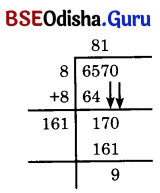
Since, remainder = 9
Hence, (i) 9 students were left out in the arrangement.
(ii) Number of students forming a square arrangement = 6570 – 9 = 6561
(iii) The number of children in each row = \(\sqrt{6561}\) = 81
So, there are 81 children in each row.
Question 2.
Aarya visited her home in a village. She went to her orchard in which she counted the trees and found that there were 52 trees in all. She argued that even trees are arranged in any pattern, but they cannot be arranged in a square arrangement.

Based on the above, answer the following:
(i) Is Aarya right in saying that trees in her orchard cannot be arranged in a square?
(ii) How many trees will be left out if they are to be arranged in a square?
(iii) How many more trees will be required if Aarya wants to arrange them as in a square?
Solution:
(i) Yes. If the orchard has 52 trees then they cannot be arranged in a square arrangement. As there is 2 in its unit’s place, it cannot be a square.
(ii) Three trees will be left out if they are to be arranged in a square.
As 52 – 3 = 49 = (7)2
(iii) Above 52,64 is the square number.
So, 12 more trees will be required to arrange the trees in a square arrangement.