
Students can refer to BSE Odisha Class 7 Math Solution and Ganita Prakash Chapter 8 Working with Fractions Class 7 Question Answer to understand textbook questions step by step.
Class 7 Maths Chapter 8 Working with Fractions Solutions
Ganita Prakash Class 7 Chapter 8 Solutions
Class 7 Maths Ganita Prakash Chapter 8 Solutions Working with Fractions
Question 1.
A team of workers can make 1 km of a water canal in 8 days. So, in one day, the team can make _______ km of the water canal. If they work 5 days a week, they can make _______ km of the water canal in a week.
Solution:
Water canal made by team of workers in 8 days = 1 km
So, water canal made by team of workers in 1 dav = \(\frac{1}{8}\) km
The length of the water canal made by the team of workers in 5 days = 5 × \(\frac{1}{8}\) km = \(\frac{5}{8}\) km
Hence, the team can make \(\frac{5}{8}\) km of the water canal in one week.
Question 2.
Safia saw the Moon setting on Monday at 10 pm. Her mother, who is a scientist, told her that every day the Moon sets \(\frac{5}{6}\) hour later than the previous day. How many hours after 10 pm will the moon set on Thursday?
Solution:
There are 3 days from Monday to Thursday. Since the Moon sets \(\frac{5}{6}\) hours later than previous day, the number of hours the Moon will set later on Thursday than Monday = 3 × \(\frac{5}{6}\) hours = \(\frac{15}{6}\) hours = \(\frac{5}{2}\) hours.
We know that 1 hour = 60 minutes
⇒ \(\frac{5}{2}\) hours = \(\frac{5}{2}\) × 60 minutes = \(\frac{300}{2}\) minutes = 150 minutes
Now, 150 minutes = 120 minutes + 30 minutes = 2 hours 30 minutes
Hence, on Thursday the Moon will set 2 hours 30 minutes after 10 pm.

Question 3.
Find the following products. Use a unit square as a whole for representing the fractions and carrying out the operations.
(i) \(\frac{2}{3}\) × \(\frac{4}{5}\)
(ii) \(\frac{1}{4}\) × \(\frac{2}{3}\)
Solution:
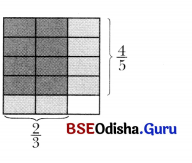
(i) Each row represents \(\frac{1}{5}\) and each column represents \(\frac{1}{3}\). The whole is divided into 5 rows and 3 columns creating 5 x 3 = 15 equal parts and 2 × 4 = 8 of the parts is double-shaded, that is \(\frac{8}{15}\) of the whole is double-shaded.
Therefore, \(\frac{2}{3}\) × \(\frac{4}{5}\) = \(\frac{8}{15}\)
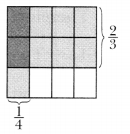
(ii) Each row represents \(\frac{1}{3}\) and each column represents \(\frac{1}{4}\). The whole is divided into 3 rows and 4 columns, creating 3×4=12 equal parts and 2 of the parts are double-shaded, that is \(\frac{2}{12}\) of the whole is double-shaded.
Therefore, \(\frac{1}{4}\) × \(\frac{2}{3}\) = \(\frac{2}{12}\) = \(\frac{1}{6}\)
Question 4.
A water tank is filled from a tap. If the tap is open for 1 hour, \(\frac{7}{10}\) of the tank gets filled. How much of the tank is filled if the tap is open for
(i) \(\frac{1}{3}\) hours
(ii) \(\frac{7}{10}\) hours
Solution:
In 1 hour, part of the tank gets filled = \(\frac{7}{10}\)
(i) In \(\frac{1}{3}\) hours, part oLthe tank gels filled = \(\frac{1}{3}\) × \(\frac{7}{10}\) = \(\frac{1 \times 7}{3 \times 10}\) = \(\frac{7}{30}\)
Therefore, in \(\frac{1}{3}\) hours, \(\frac{7}{30}\) of the tank gets filled.
(ii) In \(\frac{7}{10}\) hours, part of the tank gets filled = \(\frac{7}{10}\) × \(\frac{7}{10}\) = \(\frac{7 \times 7}{10 \times 10}\) = \(\frac{49}{100}\)
Therefore, in \(\frac{7}{10}\) hours, \(\frac{49}{100}\) of the tank gets filled.
Question 5.
Tsewang plants four saplings in a row in his garden. The distance between two saplings is \(\frac{3}{4}\) m. Find the distance between the first and last sapling.
Solution:

The distance between the first and the last sapling = \(\frac{3}{4}\) + \(\frac{3}{4}\) + \(\frac{3}{4}\) = 3 × \(\frac{3}{4}\) = \(\frac{9}{4}\) m
Question 6.
Which is heavier: \(\frac{12}{15}\) of 500 grams or \(\frac{3}{20}\) of 4 kg?
Solution:
We have \(\frac{12}{15}\) of 500 g = \(\frac{12}{15}\) × 500 g = \(\frac{12 \times 500}{15}\) = 400 g
And \(\frac{3}{20}\) × 4000 g = \(\frac{3 \times 4000}{20}\) g = 600 g [∵ 1 kg = 1000 g]
∵ 600 g is heavier than 400 g.
∵ \(\frac{3}{20}\) of 4 kg is heavier than \(\frac{12}{15}\) of 500 grams.
Question 7.
(i) 3 ÷ \(\frac{7}{9}\)
(ii) \(\frac{14}{6}\) \(\frac{7}{3}\)
(iii) \(\frac{1}{6}\) ÷ \(\frac{11}{12}\)
(iv) 3\(\frac{2}{3}\) ÷ 1\(\frac{3}{8}\)
Solution:
(i) 3 ÷ \(\frac{7}{9}\) = 3 × \(\frac{9}{7}\) = \(\frac{9}{7}\) = \(\frac{3 \times 9}{7}\)
= 3\(\frac{6}{7}\)
(ii) \(\frac{14}{6}\) \(\frac{7}{3}\) = \(\frac{14}{6}\) × \(\frac{3}{7}\) = \(\frac{14 \times 3}{6 \times 7}\)
= \(\frac{42}{42}\) = 1
(iii) \(\frac{1}{6}\) ÷ \(\frac{11}{12}\) = \(\frac{1}{6}\) × \(\frac{12}{11}\) = \(\frac{1 \times 12}{6 \times 11}\)
= \(\frac{2}{11}\)
(iv) 3\(\frac{2}{3}\) ÷ 1\(\frac{3}{8}\) = \(\frac{11}{3}\) ÷ \(\frac{11}{8}\) = \(\frac{11}{3}\) × \(\frac{11}{8}\)
= \(\frac{11 \times 8}{3 \times 11}\)
= \(\frac{8}{3}\) = 2\(\frac{2}{3}\)
Question 8.
Patiganita a book written by Sridharacharya in the 9th century CE, mentions this problem: “Friend, after thinking, what sum will be obtained by adding together 1÷ \(\frac{1}{6}\), 1 ÷ \(\frac{1}{10}\), 1 ÷ \(\frac{1}{13}\), 1 ÷ \(\frac{1}{9}\) and 1 ÷ \(\frac{1}{2}\). What should the friend say?
Solution:
1÷ \(\frac{1}{6}\) = 1 × 6 = 6, 1 ÷ \(\frac{1}{10}\) = 1 × 10 = 10, 1 ÷ \(\frac{1}{13}\) = 1 × 13 = 13, 1 ÷ \(\frac{1}{9}\) = 1 × 9 = 9 and 1 ÷ \(\frac{1}{2}\) = 1 × 2 = 2
Therefore, the sum obtained by adding together
1÷ \(\frac{1}{6}\), 1 ÷ \(\frac{1}{10}\), 1 ÷ \(\frac{1}{13}\), 1 ÷ \(\frac{1}{9}\) and 1 ÷ \(\frac{1}{2}\)
= 6 + 10 + 13 + 9 + 2 = 40
Thus, the friend should say the ‘sum’ is 40.
Question 9.
Amritpal decides on a destination for his vacation. If he takes a train, it will take him 5\(\frac{1}{6}\) hours to get there. If he takes a plane, it will take him \(\frac{1}{2}\) hour. How many hours does the plane save?
Solution:
The difference between the two durations = 5\(\frac{1}{6}\) – \(\frac{1}{2}\) = \(\frac{31}{6}\) – \(\frac{1}{2}\) [∵ 5\(\frac{1}{6}\) = \(\frac{31}{6}\)]
= \(\frac{31}{6}\) – \(\frac{3}{6}\) = \(\frac{31-3}{6}\) = \(\frac{28}{6}\)
= \(\frac{14}{3}\) = 4\(\frac{2}{3}\) hours
Hence, the plane saves 4\(\frac{2}{3}\) hours.
Question 10.
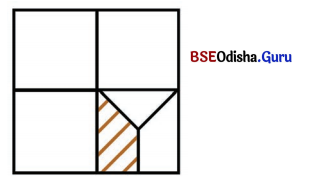
What fraction of the whole square is shaded?
Solution:
In the given figure, the big square is divided into 4 identical squares. So, one small square occupies \(\frac{1}{4}\) of the area of the big square. Now, consider the smaller square.
The small square in the figure is divided into 8 identical triangles in which 3 are shaded.
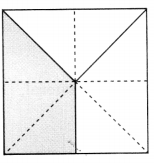
So, the shaded part is \(\frac{3}{8}\) of the small square.
But the small square is \(\frac{3}{8}\) of the big square.
∴ The shaded part is \(\frac{1}{4}\) × \(\frac{3}{8}\) = \(\frac{3}{32}\) of the big square.
Hence, \(\frac{3}{32}\) of the whole square is shaded.
Question 11.
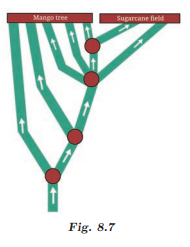
A colony of ants set out in search of food. As they search, they keep splitting equally at each point (as shown in the Fig. 8.7) and reach two food sources, one near a mango tree and another near a sugarcane field. What fraction of the original group reached each food source?
Solution:
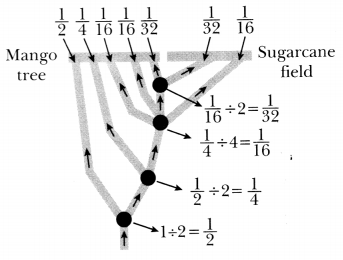
At first point ants split in two ways. So, fraction of ants at each way is 1 ÷ \(\frac{1}{2}\) = \(\frac{1}{2}\).
At the second point. ants split in two ways.
So the fraction of ants at each war \(\frac{1}{2}\) ÷ 2 = \(\frac{1}{2}\) × \(\frac{1}{2}\) = \(\frac{1}{4}\)
At the third point, ants split in four ways.
So, fraction of ants at each way
= \(\frac{1}{4}\) ÷ 4 = \(\frac{1}{4}\) × \(\frac{1}{4}\) = \(\frac{1}{16}\)
At the fourth point, ants split in 2 wars.
So fraction of ants at each way
= \(\frac{1}{16}\) ÷ 2 = \(\frac{1}{16}\) × \(\frac{1}{2}\) = \(\frac{1}{32}\)
Hence, fraction of ants at mango tree = \(\frac{1}{2}\) + \(\frac{1}{4}\) + \(\frac{1}{16}\) + \(\frac{1}{16}\) + \(\frac{1}{32}\)
= \(\frac{16}{32}\) + \(\frac{8}{32}\) + \(\frac{2}{32}\) + \(\frac{2}{32}\) + \(\frac{1}{32}\) = \(\frac{16+8+2+2+1}{32}\)
= \(\frac{29}{32}\)
Fraction of ants near sugarcane field = \(\frac{1}{32}\) + \(\frac{1}{16}\) = \(\frac{1}{32}\) + \(\frac{2}{32}\)
= \(\frac{1+2}{32}\) = \(\frac{3}{32}\)
Question 12.
What is (1 – \(\frac{1}{2}\))?
(1 – \(\frac{1}{2}\)) × (1 – \(\frac{1}{3}\) ?
(1 – \(\frac{1}{2}\)) × (1 – \(\frac{1}{3}\)) × (1 – \(\frac{1}{4}\)) × (1 – \(\frac{1}{5}\)) ?
(1 – \(\frac{1}{2}\)) × (1 – \(\frac{1}{3}\)) × (1 – \(\frac{1}{4}\)) × (1 – \(\frac{1}{5}\)) × (1 – \(\frac{1}{6}\)) × (1 – \(\frac{1}{7}\)) × (1 – \(\frac{1}{8}\)) × (1 – \(\frac{1}{9}\)) × (1 – \(\frac{1}{10}\)) ?
Make a general statement and explain.
Solution:
1 – \(\frac{1}{2}\) = \(\frac{1}{2}\)
(1 – \(\frac{1}{2}\)) × (1 – \(\frac{1}{3}\) = \(\frac{1}{2}\) × \(\frac{2}{3}\) = \(\frac{1}{3}\);
(1 – \(\frac{1}{2}\)) × (1 – \(\frac{1}{3}\)) × (1 – \(\frac{1}{4}\)) × (1 – \(\frac{1}{5}\)) = \(\frac{1}{2}\) × \(\frac{2}{3}\) × \(\frac{3}{4}\) × \(\frac{4}{5}\) = \(\frac{1}{5}\);
(1 – \(\frac{1}{2}\)) × (1 – \(\frac{1}{3}\)) × (1 – \(\frac{1}{4}\)) × (1 – \(\frac{1}{5}\)) × (1 – \(\frac{1}{6}\)) × (1 – \(\frac{1}{7}\)) × (1 – \(\frac{1}{8}\)) × (1 – \(\frac{1}{9}\)) × (1 – \(\frac{1}{10}\))
= \(\frac{1}{2}\) × \(\frac{2}{3}\) × \(\frac{3}{4}\) × \(\frac{4}{5}\) × \(\frac{5}{6}\) × \(\frac{6}{7}\) × \(\frac{7}{8}\) × \(\frac{8}{9}\) × \(\frac{9}{10}\) = \(\frac{1}{10}\)
Here, we observe that in this pattern, denominator of each term cancels the numerator of the next term, and found that the final product has the numerator of the first term and the denominator of the last term.
In general, (1 – \(\frac{1}{2}\)) × (1 – \(\frac{1}{3}\)) × (1 – \(\frac{1}{4}\)) × ………… × (1 – \(\frac{1}{n}\)) = \(\frac{1}{n}\)
InText Questions
Question 1.
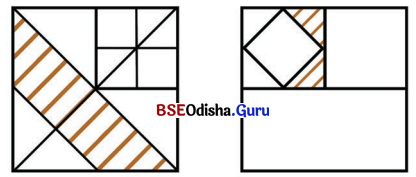
In each of the figures given below, find the fraction of the big square that the shaded region occupies.
Solution:
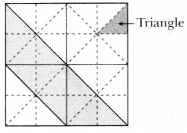
(i) In the figure. the smaller square in the up- right corner is divided into 4 smaller squares and each square within it is further divided into 2 triangles.
∴ Total number of triangles in whole square
= (4 × 2) × 4 = 32
Out of these 32 triangles. 12 triangular regions are shaded.
∴ Fraction of shaded region = \(\frac{12}{32}\) = \(\frac{3}{8}\)
Thus, the shaded region occupies \(\frac{3}{8}\) of the area of the whole square.
(ii) In the figure, the smaller square is divided into 4 triangles and a square, which can be divided into 4 triangles having the same area. Therefore, total triangle in 1 smaller square is 8.
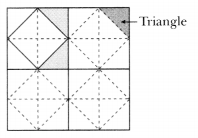
∴ Total number of triangles in whole square = 8 × 4 = 32
Out of these 32 triangles, 2 triangular regions are shaded.
∴ Fraction of shaded region = \(\frac{2}{32}\) = \(\frac{1}{16}\)
Thus, the shaded region occupies \(\frac{1}{16}\) of the area of the whole square.
Working with Fractions Class 7 Extra Questions
Working with Fractions Class 7 Very Short Question Answer
Question 1.
A library has 2400 books, and \(\frac{5}{8}\) of them are placed on the ground floor. The rest are kept on the first floor. How many books are on the first floor?
Solution:
Given, total number of books in library = 2400
Number of books on ground floor
= \(\frac{5}{8}\) of total books = \(\frac{5}{8}\) × 2400 = 5 × 300 = 1500
Hence, number of books on the first floor
= 2400 – 1500 = 900.
Question 2.
A water tank can hold 1250 litres of water. If 2\(\frac{1}{5}\) of such tanks are filled, how much water is used in total?
Solution:
Given, capacity of one tank = 1250 litres
And, 2\(\frac{1}{5}\) of such tanks are filled.
∴ Total water used = 2\(\frac{1}{5}\) × capacitv of one tank
= \(\frac{11}{5}\) × capacity of one tank
= \(\frac{11}{5}\) × 125o = 11 × 250
= 2750 litres
Question 3.
Divide:
(i) 25 by \(\frac{1}{3}\)
(ii) 48 by 3\(\frac{3}{4}\)
Solution:
(i) 25 ÷ \(\frac{1}{3}\) = 25 × \(\frac{3}{1}\)
= \(\frac{25 \times 3}{1}\) = 75
(ii) 48 ÷ 3\(\frac{3}{4}\) = 48 ÷ \(\frac{15}{4}\)
= 48 × \(\frac{4}{15}\) [∵ 3\(\frac{3}{4}\) = \(\frac{15}{4}\)]
= \(\frac{16 \times 4}{5}\) = \(\frac{64}{5}\) = 12\(\frac{4}{5}\)
Question 4.
Solve the following:
(i) \(\frac{3}{4}\) ÷ \(\frac{2}{5}\)
(ii) 2\(\frac{1}{2}\) ÷ \(\frac{5}{8}\)
Solution:
(i) \(\frac{3}{4}\) ÷ \(\frac{2}{5}\) = \(\frac{3}{4}\) ÷ \(\frac{5}{2}\)
= \(\frac{3 \times 5}{4 \times 2}\) = \(\frac{15}{8}\)
(ii) 2\(\frac{1}{2}\) ÷ \(\frac{5}{8}\) = \(\frac{5}{2}\) ÷ \(\frac{5}{8}\)
= \(\frac{5}{2} \times \frac{8}{5}\) = \(\frac{5 \times 8}{2 \times 5}\) = 4
Question 5.
Solve:
(i) \(\frac{5}{6}\) ÷ 3
(ii) 1\(\frac{2}{3}\) ÷ 4
Solution:
(i) \(\frac{5}{6}\) ÷ 3 = \(\frac{5}{6}\) × \(\frac{1}{3}\) = \(\frac{5 \times 1}{6 \times 3}\) = \(\frac{5}{18}\)
(ii) 1\(\frac{2}{3}\) ÷ 4 = \(\frac{5}{3}\) ÷ 4 = \(\frac{5}{3}\) × \(\frac{1}{4}\) = \(\frac{5 \times 1}{3 \times 4}\) = \(\frac{5}{12}\) [∵ 1\(\frac{2}{3}\) = \(\frac{5}{3}\)]
Question 6.
During a community health program, each participant was provided \(\frac{2}{5}\) litres of clean water per day. If 40 litres were distributed on a particular day, calculate the number of participants who received the water.
Solution:
Quantity of water for I participant = \(\frac{2}{5}\) litres
Total quantity oÍ waler = 40 litres
Now, number of participants
= \(\frac{\text { Total quantity of water }}{\text { Quantity of water for } 1 \text { participant }}\)
= 40 ÷ \(\frac{2}{5}\) = 40 × \(\frac{5}{2}\) = 100
Question 7.
What number should be multiplied by 5\(\frac{3}{4}\) to get 3\(\frac{3}{5}\)?
Solution:
Let the required number be x. Then,
x × 5\(\frac{3}{4}\) = 3\(\frac{3}{5}\)
⇒ x = \(\frac{3 \frac{3}{5}}{5 \frac{3}{4}}\)
⇒ x = \(\frac{\frac{18}{5}}{\frac{23}{4}}\) = \(\frac{15}{5}\) × \(\frac{4}{23}\) = \(\frac{18 \times 4}{5 \times 23}\)
= \(\frac{72}{115}\)
Question 8.
Each guest is served 1\(\frac{3}{5}\) litres of juice. If 40 litres of juice is available, how many guests can be served?
Solution:
Given, juice served to each guest.
= 1\(\frac{3}{5}\) litres = \(\frac{8}{5}\)litres
Total quantity of juice available = 40 litres
Now, number of guests that can be served
= \(\frac{\text { Total quantity of juice available }}{\text { Juice served to each guest }}\)
= \(\frac{40}{\frac{8}{5}}\) = 40 × \(\frac{5}{8}\) = 5 × 5 = 25
Working with Fractions Class 7 Short Question Answer
Question 1.
Multiply the following fractions and express as mixed fraction:
(i) 1\(\frac{3}{4}\) × 2\(\frac{2}{5}\)
(ii) 4\(\frac{1}{3}\) × \(\frac{3}{7}\)
(iii) 5\(\frac{2}{9}\) × 1\(\frac{1}{6}\)
(iv) 3\(\frac{4}{5}\) × 2\(\frac{3}{8}\)
Solution:
(i) 1\(\frac{3}{4}\) × 2\(\frac{2}{5}\) = \(\frac{7}{4}\) × \(\frac{12}{5}\)
= \(\frac{7 \times 3}{1 \times 5}\) = \(\frac{21}{5}\)
= 4\(\frac{1}{5}\)
(ii) 4\(\frac{1}{3}\) × \(\frac{3}{7}\) = \(\frac{13}{3}\) × \(\frac{3}{7}\)
= \(\frac{13 \times 1}{1 \times 7}\) = \(\frac{13}{7}\)
= 1\(\frac{6}{7}\)
(iii) 5\(\frac{2}{9}\) × 1\(\frac{1}{6}\) = \(\frac{47}{9}\) × \(\frac{7}{6}\)
= \(\frac{47 \times 7}{9 \times 6}\) = \(\frac{329}{54}\)
= 6\(\frac{5}{54}\)
(iv) 3\(\frac{4}{5}\) × 2\(\frac{3}{8}\) = \(\frac{19}{5}\) × \(\frac{19}{8}\)
= \(\frac{19 \times 19}{5 \times 8}\) = \(\frac{361}{40}\)
= 9\(\frac{1}{4}\)
Question 2.
Meena invited \(\frac{2}{7}\) of her students to a weekend workshop. If \(\frac{3}{5}\) of the invited students were girls, how many boys were present at the workshop if her class has 105 students?
Solution:
Given, total students in the class = 105
∴ Nunber of students invited
= \(\frac{2}{7}\) × Total students =
= \(\frac{2}{7}\) × 105 = 2 × 15 = 30
Now, girls among invited students
= \(\frac{3}{5}\) of the invited students
= \(\frac{3}{5}\) × 30 = 3 × 6 = 18
Hence, number of boys present at the workshop
= 30 – 18 = 12.
Question 3.
A library donated \(\frac{3}{8}\) of its books to a village school. If \(\frac{2}{3}\) of the donated books were story books, how many non-story books were donated to the school if the library originally had 1280 books?
Solution:
Given, total number of books in library = 1280
Number of books donated = \(\frac{3}{8}\) of total books
= \(\frac{3}{8}\) × 1280 = 3 × 160 = 480
Story books among donated books = \(\frac{2}{3}\) × of donated books = \(\frac{2}{3}\) × 480 = 2 × 160 = 320
Hence, number of non-story books among donated books = 480 – 320 = 160
Question 4.
The area of a rectangular field is 63\(\frac{3}{5}\) m2. If its length is 7\(\frac{1}{2}\)m, find its breadth?
Solution:
Given area of rectangular field = 63\(\frac{3}{5}\) = \(\frac{318}{5}\) m2
length of rectangular field = 7\(\frac{1}{2}\) = \(\frac{15}{2}\) m
We know.
Area of rectangle length × Breadth
⇒ Breadth = \(\frac{\text { Area of rectangle }}{\text { Length }}\) = \(\frac{318}{5}\) ÷ \(\frac{15}{2}\)
= \(\frac{318}{5}\) × \(\frac{2}{15}\) = \(\frac{106 \times 2}{5 \times 5}\)
= \(\frac{212}{25}\) = 8\(\frac{12}{25}\) m
Question 5.
Determine the number by which 5\(\frac{4}{7}\) must be multiplied to obtain 4\(\frac{3}{5}\).
Solution:
We have. 5\(\frac{4}{7}\) = \(\frac{39}{7}\) and 4\(\frac{3}{5}\) = \(\frac{23}{5}\)
Let the number to be found b x. Then,
\(\frac{39}{7}\) × x = \(\frac{23}{5}\)
Multiplying by the reciprocal of \(\frac{39}{7}\) on both sides, we get
\(\frac{7}{39}\) × \(\frac{39}{7}\) × x = \(\frac{7}{39}\) × \(\frac{23}{5}\) [∵ Reciprocal of \(\frac{39}{7}\) is \(\frac{7}{39}\)]
⇒ x = \(\frac{7 \times 23}{39 \times 5}\) = \(\frac{161}{195}\)
Question 6.
A bookstore sells journals at ₹ 6\(\frac{1}{2}\) per copy. If the shop’s revenue from journal sales totalled ₹ 975, how many dozens of journals were sold?
Solution:
Given, total revenue from journal sales = ₹ 975
Price of 1 journal = ₹ 6\(\frac{1}{2}\) = ₹ \(\frac{13}{2}\)
Now, number of journals sold
= \(\frac{\text { Total revenue from journal sales }}{\text { Price of } 1 \text { journal }}\)
⇒ Number of journals sold = \(\frac{975}{\frac{13}{2}}\) = 975 × \(\frac{2}{13}\)
= \(\frac{75 \times 2}{1}\) = 150
Now, the number of journals sold (in dozens)
= \(\frac{150}{12}\) = \(\frac{25}{2}\) = 12\(\frac{1}{2}\) [∵ 1 dozen = 12]
Thus, 12\(\frac{1}{2}\) dozens of journals were sold.
Question 7.
Divide:
(i) 36 by \(\frac{3}{8}\)
(ii) 54 by 2\(\frac{2}{5}\)
(iii) 42 by \(\frac{7}{6}\)
Solution:
(i) 36 ÷ \(\frac{3}{8}\) = 36 × \(\frac{8}{3}\) = 12 × 8 = 96
(ii) 54 ÷ 2\(\frac{2}{5}\)
= 54 ÷ \(\frac{12}{5}\) = 54 × \(\frac{5}{12}\)
= \(\frac{9 \times 5}{2}\) = \(\frac{45}{2}\) = 22\(\frac{1}{2}\) [∵ 2\(\frac{2}{5}\) = \(\frac{12}{5}\)]
(iii) 42 ÷ \(\frac{2}{5}\) = 42 × \(\frac{6}{7}\)
= 6 × 6 = 36
Question 8.
How many square tiles with a side length of \(\frac{1}{2}\) m are required to cover an area of 12\(\frac{1}{4}\) m2?
Solution:
Given, the side length of a square tile is \(\frac{1}{2}\) m.
Therefore, area of one tile = Side × Side
= \(\frac{1}{2}\) × \(\frac{1}{2}\) = \(\frac{1}{4}\) m2
Area to be covered by the tiles = 12\(\frac{1}{4}\) m2 = \(\frac{49}{4}\) m2
Now, number of required tiles = Total area that need to be covered ÷ Area of one tile
= \(\frac{49}{4}\) ÷ \(\frac{1}{4}\) = \(\frac{49}{4}\) × \(\frac{4}{1}\) = 49
Thus, the number of required tiles is 49.
Question 9.
A fruit seller earns ₹ 4\(\frac{1}{2}\) per apple. He earns ₹864. How many dozens of apples did he sell?
Solution:
Given, total earnings = ₹864
Amount earned per apple = ₹4\(\frac{1}{2}\) = ₹\(\frac{9}{2}\)
Now, number of apples sold = \(=\frac{\text { Total earnings }}{\text { Amount earned per apple}}\)
= \(\frac{864}{\frac{9}{2}}\) = 864 × \(\frac{2}{9}\) = 96 × 2 = 192
So, number of apples sold (in dozens)
= \(\frac{192}{12}\) = 16 [∵ 1 dozen = 12]
Working with Fractions Class 7 Long Question Answer
Question 1.
Fill in the boxes using <, > or = without actually finding the product:
(i) \(\frac{3}{8}\) × \(\frac{2}{7}\) ☐ \(\frac{2}{7}\)
(ii) \(\frac{5}{9}\) × \(\frac{4}{11}\) ☐ \(\frac{5}{9}\)
(iii) 4\(\frac{1}{2}\) × 3\(\frac{3}{4}\) ☐ 4\(\frac{1}{2}\)
(iv) \(\frac{6}{13}\) × \(\frac{15}{4}\) ☐ \(\frac{15}{4}\)
Solution:
(i) We know, the product of two proper fractions is less than each of them.
Here, \(\frac{3}{8}\) and \(\frac{2}{7}\) are proper tractions.
∴ \(\frac{3}{8}\) × \(\frac{2}{7}\) < \(\frac{2}{7}\)
(ii) We know, the product of two proper fractions is less than each of them.
Here. \(\frac{5}{9}\) and \(\frac{4}{11}\) are proper fractions.
∴ \(\frac{5}{9}\) × \(\frac{4}{11}\) < \(\frac{5}{9}\)
(iii) We know, the product of two improper fractions is greater than both the fractions or equal to either of them.
Here, 4\(\frac{1}{2}\) and 3\(\frac{3}{4}\) are mixed tractions and mixed tractions can he converted into improper fractions.
∴ 4\(\frac{1}{2}\) × 3\(\frac{3}{4}\) > 4\(\frac{1}{2}\)
(iv) We know, the product of a proper fraction and an improper fraction (greater than 1) lies between both the fractions.
Here. \(\frac{6}{13}\) is a proper traction and \(\frac{15}{4}\) is an improper traction (greater than 1).
∴ \(\frac{6}{13}\) × \(\frac{15}{4}\) < \(\frac{15}{4}\)
Question 2.
Solve the following and write the result in simplest form:
(i) 8 × \(\frac{5}{6}\)
(ii) 4 × \(\frac{2}{5}\)
(iii) 7 × \(\frac{3}{8}\)
(iv) 5 × \(\frac{4}{3}\)
(v) \(\frac{11}{4}\) × 3
(vi) 10 × \(\frac{1}{5}\)
Solution:
(i) 8 × \(\frac{5}{6}\) = \(\frac{48 \times 5}{6}\) = \(\frac{4 \times 5}{3}\)
= \(\frac{20}{3}\)
(ii) 4 × \(\frac{2}{5}\) = \(\frac{4 \times 2}{5}\)
= \(\frac{8}{5}\)
(iii) 7 × \(\frac{3}{8}\) = \(\frac{7 \times 3}{8}\)
= \(\frac{21}{8}\)
(iv) 5 × \(\frac{4}{3}\) = \(\frac{5 \times 4}{3}\)
= \(\frac{20}{3}\)
(v) \(\frac{11}{4}\) × 3 = \(\frac{11 \times 3}{4}\)
= \(\frac{33}{4}\)
(vi) 10 × \(\frac{1}{5}\) = 2 × 1 = 2
Question 3.
Solve the following and express as a mixed fraction:
(i) 3\(\frac{5}{8}\) × 2\(\frac{1}{4}\)
(ii) 7\(\frac{2}{3}\) × 4\(\frac{3}{5}\)
(iii) 5\(\frac{3}{10}\) × 3\(\frac{4}{7}\)
(iv) \(\frac{4}{9}\) × 6\(\frac{2}{5}\)
(v) \(\frac{7}{10}\) × 9\(\frac{1}{6}\)
(vi) \(\frac{3}{8}\) × 8\(\frac{5}{9}\)
Solution:
(i) 3\(\frac{5}{8}\) × 2\(\frac{1}{4}\) = \(\frac{29}{8}\) × \(\frac{9}{4}\) = \(\frac{29 \times 9}{8 \times 4}\)
= \(\frac{261}{32}\) = 8\(\frac{5}{32}\)
(ii) 7\(\frac{2}{3}\) × 4\(\frac{3}{5}\) = \(\frac{23}{3}\) × \(\frac{23}{5}\) = \(\frac{23 \times 23}{3 \times 5}\)
= \(\frac{529}{15}\) = 35\(\frac{4}{15}\)
(iii) 5\(\frac{3}{10}\) × 3\(\frac{4}{7}\) = \(\frac{53}{10}\) × \(\frac{25}{7}\)
= \(\frac{265}{14}\) = 18\(\frac{13}{14}\)
(iv) \(\frac{4}{9}\) × 6\(\frac{2}{5}\) = \(\frac{4}{9}\) × \(\frac{32}{5}\) = \(\frac{4 \times 32}{9 \times 5}\)
= \(\frac{128}{45}\) = 2\(\frac{38}{45}\)
(v) \(\frac{7}{10}\) × 9\(\frac{1}{6}\) = \(\frac{7}{10}\) × \(\frac{55}{6}\)
= \(\frac{77}{12}\) = 6\(\frac{5}{12}\)
(vi) \(\frac{3}{8}\) × 8\(\frac{5}{9}\) = \(\frac{3}{8}\) × \(\frac{77}{9}\) = \(\frac{1 \times 77}{8 \times 3}\)
= \(\frac{77}{24}\) = 3\(\frac{5}{24}\)
Question 4.
A car travels 5\(\frac{1}{4}\) km north, then \(\frac{1}{2}\) km west and 4\(\frac{3}{8}\) km north. Find total distance travelled (in km)?
What fraction of the journey was travelled in the north direction?
Solution:
Given: Distance travelled in north direction
d1 = 5\(\frac{1}{4}\) km = \(\frac{21}{4}\) km
Distance travelled in west direction, d2 = \(\frac{1}{2}\) km
Distance travelled in north direction again.
d3 = 4\(\frac{3}{8}\)km = \(\frac{35}{8}\) km
∴ Total distance travelled = d1 + d2 + d3
= \(\frac{21}{4}\) + \(\frac{1}{2}\) + \(\frac{35}{8}\) = \(\frac{42}{8}\) + \(\frac{4}{8}\) + \(\frac{35}{8}\)
= \(\frac{42+4+35}{8}\) = \(\frac{81}{8}\) = 10\(\frac{1}{8}\) km
Total distance travelled in north direction
= d1 + d3 = \(\frac{21}{4}\) + \(\frac{35}{8}\) = \(\frac{42+35}{8}\) = \(\frac{77}{8}\) km
∴ Fraction of the journey travelled in the north direction
= \(\frac{d_1+d_3}{d_1+d_2+d_3}\) = \(\frac{\frac{77}{8}}{\frac{81}{8}}\)
= \(\frac{77}{8}\) × \(\frac{8}{81}\) = \(\frac{77}{81}\)