
Students can refer to BSE Odisha Class 8 Math Solution and Ganita Prakash Chapter 4 Quadrilaterals Class 8 Question Answer to understand textbook questions step by step.
Class 8 Maths Chapter 4 Quadrilaterals Solutions
Ganita Prakash Class 8 Chapter 4 Solutions
Class 8 Maths Ganita Prakash Chapter 4 Solutions Quadrilaterals
1. RECTANGLES AND SQUARES
Figure it Out : Page : 94
Question 1.
Find all the other angles inside the following rectangles.
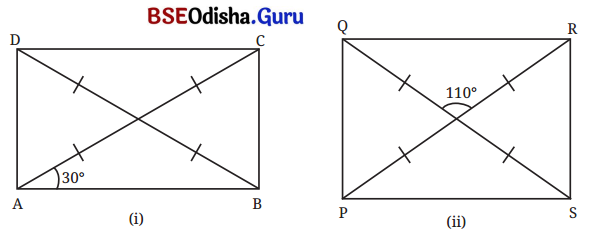
Solution:
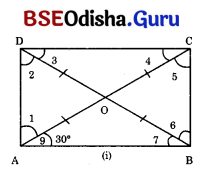
∠1 + ∠9 = 90° …. (All corner angles of a rectangle are 90°)
∠1 + 30° = 90°
∠1 = 90° – 30°
∠1 = 60°
∠1 = ∠5 = 60° … (Alternate interior angles)
∠9 = ∠4 = 30° … (Alternate interior angles)
In ΔAOB, OA = OB, then the angles opposite them are equal
∴ ∠9 = ∠7 = 30°
∠7 = ∠3 = 30° … (Alternate interior angles)
In ΔAOD, OA = OD, then the angles opposite them are equal
∴ ∠2 = ∠1 = 60°
∠2 = ∠6 = 60° … (Alternate interior angles)
In ΔAOB
∠9 + ∠7 + ∠AOB = 180° … (Sum of angles of a triangle)
30° + 30° + ∠AOB = 180°
60° + ∠AOB = 180°
∠AOB = 180° – 60°
∠AOB = 120°
∠AOB = ∠COD = 120° … (Vertically opposite angles)
∠AOB + ∠AOD = 180° … (Linear pair)
120° + ∠AOD = 180°
∠AOD = 180° – 120°
∠AOD = 60°
∠AOD = ∠BOC = 60° … (Vertically opposite angles)
Thus, ∠1 = ∠5 = ∠2 = ∠6= ∠AOD = ∠BOC = 60°.
∠AOB = ∠COD = 120°.
∠9= ∠4 = ∠7 = ∠3 = 30°.
(ii) The given rectangle is PSRQ.
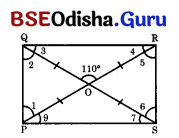
∠POS = ∠ROQ = 110° … (Vertically opposite angles)
∠POS + ∠POQ = 180° … (Linear Pair)
110°+∠POQ = 180°
∠POQ = 180° – 110°
∠POQ = 70°
∠POQ = ∠SOR = 70° … (Vertically opposite angles)
In ΔPOS, OP = OS, then the angles opposite them are equal.
∴ ∠1 = ∠2 = a
In ΔPOS,
∠1 + ∠2 + ∠POS = 180° … (Sum of all angles of a triangle)
a + a + 110° = 180°
2a = 180°- 110°
2a = 70°
a = 35°
∠1 = ∠2 = a = 35°
∠1 = ∠5 = 35° …. (Alternate interior angles)
∠2 = ∠6 = 35° … (Alternate interior angles)
Since ABCD is a rectangle, ∠P = 90°
∠9 = ∠1 + ∠8
90° = 35° + ∠8
∠8 = 90° – 35°
∠8 = 55°
∠8 = ∠4 = 55° …. (Alternate interior angles)
In ΔPOQ, OP = OQ, then the angles opposite to them are equal
i. e. ∠7 = ∠8 = 55°
∠7 = ∠2 = 55° … (Alternate interior angles)
Thus, ∠POS = ∠ROQ = 110°.
∠POQ = ∠SOR = 70°.
∠1 = ∠2 = 5 = ∠6 = 35°.
∠3 = ∠4 = ∠7 = ∠8 = 55°.

Question 2.
Draw a quadrilateral whose diagonals have equal lengths of 8 cm that bisect each other, and intersect at an angle of
(i) 30°
(ii) 40°
(iii) 90°
(iv) 140°
Solution:
(i) Draw a line AB equal to 8 cm.
Take point M on AB such that AM = BM = 4 cm.
Using a protractor, draw an angle of 30° at M on MB. On this line, take points C and D such that MC = MD = 4 cm.
Join AD, DB, BC, and CA.
ABCD is the required quadrilateral.
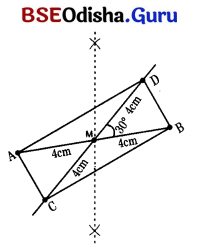
Since diagonals AB and CD are equal and are bisecting each other at M, ACBD is a rectangle.
(ii) Draw a line AB equal to 8 cm.
Take point M on AB such that AM = BM = 4 cm.
Using a protractor, draw an angle of 40° at M on MB.
On this line, take points C and D such that MC = MD = 4 cm.
Join AD, DB, BC, and CA.
ABCD is the required quadrilateral.
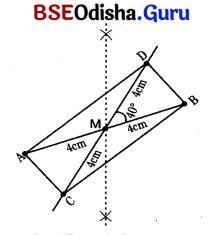
Since diagonals AB and CD are equal and are bisecting each other at M, ACBD is a rectangle.
(iii) Draw a line AB equal to 8 cm.
Take a point M on AB such that AM = BM = 4 cm.
Using a protractor, draw an angle of 90° at M on MB.
On this line, take points C and D such that MC = MD = 4 cm.
Join AD, DB, BC, and CA.
ACBD is the required square.
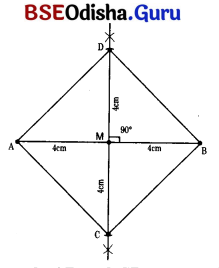
Since diagonals AB and CD are equal and are bisecting each other at M, and also the diagonals are perpendicular to each other, ACBD is a square.
(iv) Draw a line AB equal to 8 cm.
Take a point M on AB such that AM = BM = 4 cm.
Using a protractor, draw an angle of 140° at M on MB.
On this line, take points C and D such that MC = MD = 4 cm.
Join AD, DB, BC, and CA.
ACBD is the required quadrilateral.
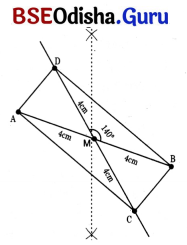
Since diagonals AB and CD are equal and are bisecting each other at M, ACBD is a rectangle.
Question 3.
Consider a circle with centre O. Line segments PL and AM are two perpendicular diameters of the circle. What is the figure APML? Reason and/or experiment to figure this out.
Solution:
In the figure, PL and AM are two perpendicular diameters of the circle. Let r be the radius of the circle.
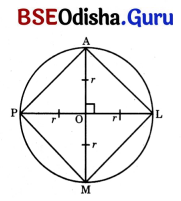
∴ PL = PO + OL
= r + r
= 2 r
and AM = AO + OM
= r + r
= 2 r
∴ PL = AM
∴ In the quadrilateral
APML, diagonals PL and
AM are equal and are perpendicular to each other.
Also, OP = OA = OL = OM = r
∴ Diameters PL and AM bisect each other at 0.
∴ Quadrilateral APML is a square.
Question 4.
We have seen how to get 90° using paper folding. Now, suppose we do not have any paper but two sticks of equal length, and a thread. How do we make an exact 90° using these?
Solution:
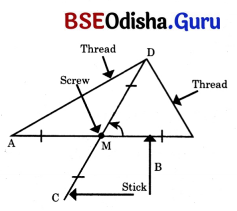
- Let AB and CD be two sticks of equal length, say 6 cm.
- Mark the midpoints of the sticks using a ruler.
- Fix a screw to the sticks at their midpoints.
- Using a thread, measure distances AD and BD.
- Keep on moving the sticks about the screw, so that the distances AD and BD are equal.
- In this position, fix the sticks by tightening the screw.
- The new positions of the sticks are shown in the figure.
- The pieces of thread along AD and BD.
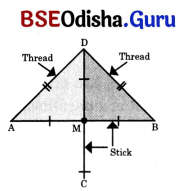
Consider ΔAMD and ΔBMD.
We have AM = BM, AD = BD and MD is common
∴ By the SSS condition,
ΔAMD and ABMD are congruent.
∴ ∠AMD = ∠BMD
Also ∠AMD + ∠BMD = 180° (Linear angles)
∴ ∠AMD + ∠AMD = 180°
⇒ 2 ∠AMD = 180°
⇒ ∠AMD = 90°
∴ ∠AMD = ∠BMD = 90°
∴ Angle between the sticks is 90°.
Question 5.
We saw that one of the properties of a rectangle is that its opposite sides are parallel. Can this be chosen as a definition of a rectangle? In other words, is every quadrilateral that has opposite sides parallel and equal a rectangle?
Solution:
No, this can’t be the definition of a rectangle. A quadrilateral with opposite sides parallel and equal is a parallelogram, but not all parallelograms are rectangles. A rectangle needs all angles to be right angles.
2. QUADRILATERALS WITH EQUAL SIDELENGTHS
Figure it Out: Page : 102
Question 1.
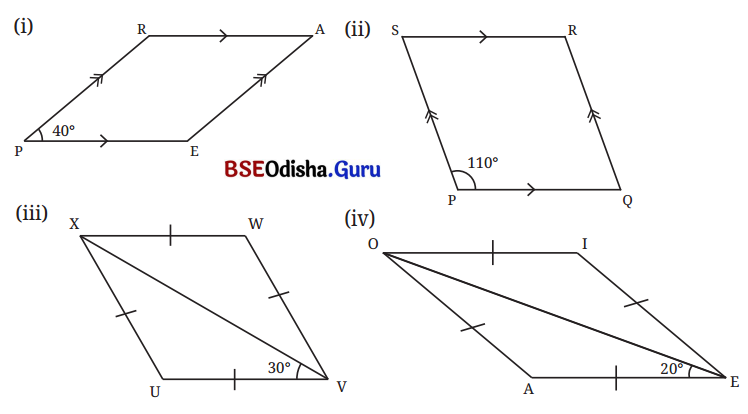
Find the remaining angles in the following quadrilaterals.
Solution:
(i) Here PR || EA, and PE || RA
Therefore, PEAR is a parallelogram.
∠P = ∠A = 40° … (Opposite angles of a parallelogram are equal)
∠ P + ∠R = 180° … (The sum of the adjacent angles of a parallelogram is 180°)
40° + ∠R = 180°
∠R = 180° – 40°
∠R = 140°.
∠R = ∠E = 140°… (Oppositeangles of a parallelogram are equal)
(ii) Here PQ // SR, and PS // QR
∴ PQRS is a parallelogram.
∠P = ∠R = 110° … (Opposite angles of a parallelogram are equal)
∠P + ∠S = 180° … (The sum of the adjacent angles of a parallelogram is 180°)
110° + ∠S = 180°
∠S = 180° – 110°
∠S = 70°.
∠S = ∠Q = 70° … (Opposite angles of a parallelogram are equal)
(iii) Here, XWVU is a rhombus (all sides equal).
In ΔVUX, UV = UX, then the angles opposite them are equal.
∴ ∠UXV = ∠UVX = 30°
∠UXV = ∠WXV = 30° ………….. (The diagonals of a rhombus bisect its angles)
Also, ∠UVX = ∠WVX = 30° ………….. (The diagonals of a rhombus bisect its angles)
∠E = 2 × ∠UVX = 2 × 30° = 60°
∠V = ∠X = 60° ………….. (Opposite angles of a rhombus are equal)
∠V + ∠U = 180° ………….. (The sum of adjacent angles of a rhombus is 180°)
60° + ∠U = 180°
∠U = 180° – 60°
∠U = 120°
∠U = ∠W = 120° ………….. (Opposite angles of a rhombus are equal)
(iv) Here, AEIO is a rhombus (all sides equal).
In ΔEAO, AE = AO, then the angles opposite them are equal.
∴ ∠AOE = ∠AEO = 20°
∠AEO = ∠IEO = 20° ………….. (The diagonals of a rhombus bisect its angles)
Also, ∠AOE = ∠IOE = 20° ………….. (The diagonals of a rhombus bisect its angles)
∠E = 2 × ∠AEO = 2 × 20° = 40°
∠E = ∠O = 40° ………….. (Opposite angles of a rhombus are equal)
∠E + ∠A = 180° ………….. (The sum of adjacent angles of a rhombus is 180°)
40° + ∠A = 180°
∠A = 180° – 40°
∠A = 140°
∠A = ∠I = 140° ………….. (Opposite angles of a rhombus are equal)
Question 2.
Using the diagonal properties, construct a parallelogram whose diagonals are of lengths 7 cm and 5 cm, and intersect at an angle of 140°.
Solution:
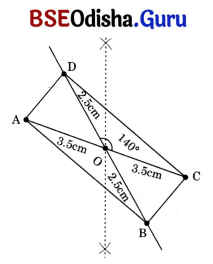
Steps of construction:
(i) Draw a line segment AC of length 7 cm and mark its midpoint as 0.
(ii) At point 0, draw an angle of 140° with respect to diagonal AC.
(iii) At 0, along the 140° angle’s free arms in both directions, mark OD = 2.5 cm and OB = 2.5 cm using a compass.
(iv) Join D to A and C.
Join B to A and C.
So, ABCD is the required parallelogram.
Question 3.
Using the diagonal properties, construct a rhombus whose diagonals are of lengths 4 cm and 5 cm.
Solution:
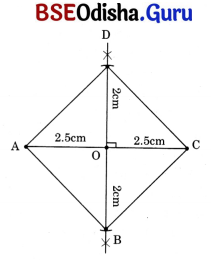
Steps of construction:
(i) Draw a line segment AC of length 5 cm.
(ii) Draw the perpendicular bisector of AC, intersecting it at 0.
(iii) With 0 as centre and radius 2 cm, mark points B (below) and D (above) on the perpendicular bisector.
(iv) Join A with D, D with C, B with A and C with B.
∴ ABCD is the required rhombus.
3. KITE AND TRAPE∠IUM
Figure it Out : Page : 107 – 109
Question 1.
Find all the sides and the angles of the quadrilateral obtained by joining two equilateral triangles with sides 4 cm.
Solution:
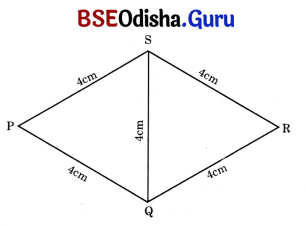
Since all sides of an equilateral triangle are equal.
Thus, the lengths of all sides of the given quadrilateral are equal.
∴ PQ = QR = RS = SP = 4 cm.
Also, the measure of all angles of an equilateral triangle is 60°.
∠P = ∠R = 60°
∠S = ∠PSQ + ∠RSQ = 60° + 60° = 120°.
∠Q = ∠PQS + ∠RQS = 60° + 60° = 120°.
Question 2.
Construct a kite whose diagonals are of lengths 6 cm and 8 cm.
Solution:
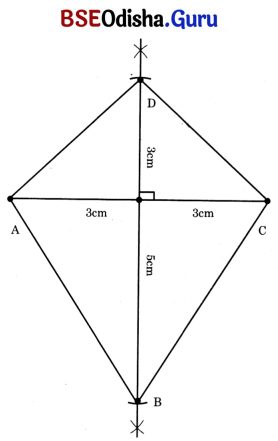
(i) Draw a line segment AC = 6 cm.
(ii) Construct the perpendicular bisector of AC; let it meet AC at 0 (so 0 is the midpoint).
(iii) With centre at 0 and radius 3 cm draw an arc to cut the bisector above AC; label that point D. With centre 0 and radius 5 cm draw an arc to cut the bisector below AC; label that point B.
(iv) Join A with B, B with C, C with D and D with A.
ABCD is the required kite.
Question 3.
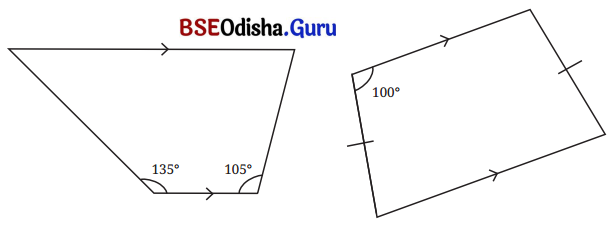
Find the remaining angles in the following trapeziums-
Solution:
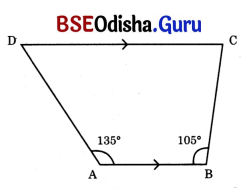
Since AB // DC, and AD is a tranversal, then ∠A + ∠D = 180° … (Sum of angles on the same side of the transversal)
135° + ∠D = 180°
∠D = 180° – 135°
∠D = 45°
Also, since AB // DC, and BC is a tranversal, then So, ∠B + ∠C = 180°
… (Sum of angles on the same side of the transversal)
105° + ∠C = 180°
∠C = 180° – 105°
∠C = 75°
In the second figure :
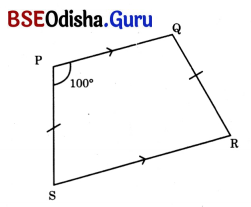
Since PQ // SR, and PS is a tranversal, then ∠P + ∠S = 180° … (Sum of angles on the same side of the transversal)
∠P + 100° = 180°
∠P = 180° – 100° = 80°.
∠S = ∠R = 100° … (In an isosceles trape∠ium base angles are equal)
Also, since PQ // SR, and QR is a tranversal,
So, ∠Q + ∠R = 180° … (Sum of angles on the same side of the transversal)
∠Q + 100° = 180°
∠Q = 180° – 100° = 80°.
Question 4.
Draw a Venn diagram showing the set of parallelograms, kites, rhombuses, rectangles, and squares. Then, answer the following questions –
(i) What is the quadrilateral that is both a kite and a parallelogram?
(ii) Can there be a quadrilateral that is both a kite and a rectangle?
(iii) Is every kite a rhombus? If not, what is the correct relationship between these two types of quadrilaterals?
Solution:
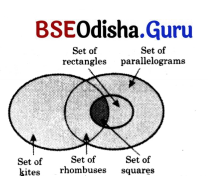
(i) A rhombus is a quadrilateral that is both a kite and a parallelogram.
(ii) A kite is not a rectangle and a rectangle is not a kite.
∴ There can be no quadrilateral that is both a kite and a rectangle.
Also, there is no common portion of the set of kites and the set of rectangle.
(iii) No, every kite is not a rhombus.
Correct relationship:
Every rhombus is a kite, but not every kite is a rhombus.
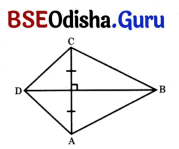
Question 5.
If PAIR and RODS are two rectangles, find ∠IOD.
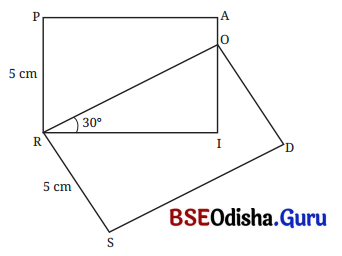
Solution:
Since PAIR and RODS are two triangles.
∠RIO = 90° … (Corner angle of a rectangle)
In ΔRIO,
∠IRO + ∠IOR + ∠RIO = 180° … (Sum of angles of a triangle)
30° + ∠IOR + 90° = 180°
120° + ∠IOR = 180°
∠IOR = 180° – 120° = 60°.
∴ ∠IOD = 90° – ∠IOR
= 90° – 60° = 30°.
Question 6.
Construct a square with diagonal 6 cm without using a protractor.
Solution:
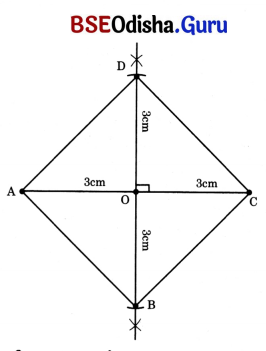
Steps of construction:
(i) Draw a line segment AC = 6 cm and mark its midpoint as O.
(ii) With O as centre and radius greater than half of AC, draw arcs above and below AC from points A and C.
(iii) Join the arcs intersections to get a line perpendicular to AC and passing through 0.
(iv) Again, with 0 as centre and radius equal to 3 cm, mark points B and D on the perpendicular line.
(v) Join (A, B), (C, B), (A, D) and (C, D). Hence, ABCD is the required square with a diagonals of 6 cm.
Question 7.
CASE is a square. The points U, V, W and X are the midpoints of the sides of the square. What type of quadrilateral is UVWX? Find this by using geometric reasoning, as well as by construction and measurement. Find other ways of constructing a square within a square such that the vertices of the inner square lie on the sides of the outer square, as shown in Figure (b).
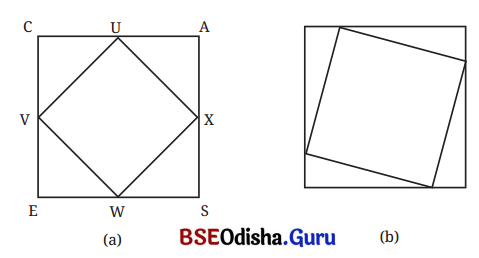
Solution:
(a) U, V, W, and X are the midpoints of the sides of the square.
In ΔVCU and ΔUAX,
we have VC = UA,
∠VCU = ∠UAX = 90°,
and CU = AX.
∴ By the SAS condition, ΔVCU and ΔUAX are congruent.
∴ VU = UX
Similarly, VU = XW, VU = WV.
∴ Sides of the quadrilateral UVWX are equal.
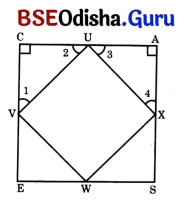
In ΔVCU, VC = CU
⇒ ∠1 = ∠2
Also, ∠1 + ∠C + ∠2 = 180°
⇒ ∠1 + 90° + ∠1 = 180°
⇒ 2∠1 = 90°
⇒ ∠1 = 45°
∴ ∠2 is also 45°.
Similarly, ∠3 = ∠4 = 45°
We have ∠2 + ∠VUX + ∠3 = 180°
⇒ 45° + ∠VUX + 45° = 180°
⇒ ∠VUX = 180° – 90°
⇒ ∠VUX = 90°
Similarly, ∠VXW = 90°,
∠XWV = 90°
and ∠WVU = 90°.
∴ By definition, the quadrilateral UVWX is a square.
(b) Let ABCD be a square.
Take points P, Q, R, and S such that AS = BP = CQ = DR.
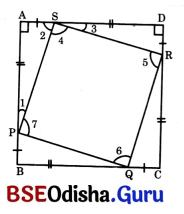
Since the sides of squares are equal,
we have DS = AP = BQ = CR.
In ΔPAS and ΔSDR, we have
PA = SD,
∠PAS = ∠SDR = 90°,
and AS = DR.
∴ By the SAS condition, ΔPAS and ΔSDR are congruent.
∴ PS = SR
Similarly, PS = RQ, PS = QP.
∴ Sides of the quadrilateral PQRS are equal.
In ΔPAS, ∠1 + ∠2 + 90° = 180°
⇒ ∠1 + ∠2 = 90°
⇒ ∠3 + ∠2 = 90° (∵ ∠1 = ∠3)
Also, ∠2 + ∠4 + ∠3 = 180°
⇒ 90° + ∠4 = 180°
⇒ ∠4 = 180° – 90°
⇒ ∠4 = 90°
∴ Similarly, ∠5 = 90°,
∠6 = 90°,
and ∠7 = 90°.
By definition, the quadrilateral PQRS is a square.
Question 8.
If a quadrilateral has four equal sides and one angle of 90°, will it be a square? Find the answer using geometric reasoning as well as by construction and measurement.
Solution:
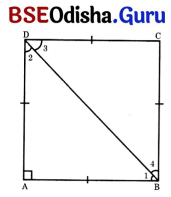
Let ABCD be a quadrilateral such that AB = BC = CD = DA and ∠DAB = 90°.
Join BD.
In ΔADB and ΔCDB, we have AD = CD, AB = CB, and DB is a common side.
∴ ΔADB and ΔCDB are congruent.
∴ ∠C = ∠A = 90°
In ΔDAB, ∠1 = ∠2 (∵ AB = AD)
Also, ∠1 + 90° + ∠2 = 180°
⇒ ∠1 + ∠2 = 90°
⇒ ∠1 = 45°
and ∠2 = 45° (∵ ∠1 = ∠2)
In ΔCDB, ∠3 = ∠4 (∵ CD = CB)
Also, ∠3 + 90° + ∠4 = 180°
⇒ ∠3 + ∠4 = 90°
⇒ ∠3 = ∠4 = 45° (∵ ∠3 = ∠4)
∴ ∠ABC = ∠1 + ∠4 = 45° + 45° = 90°
and ∠ADC = ∠2 + ∠3 = 45° + 45° = 90°.
∴ Each angle of the quadrilateral ABCD is 90°.
∴ ABCD is a square.
Also, by measurement, we find
AB = BC = CD = DA
and ∠A = ∠B = ∠C = ∠D = 90°.
Question 9.
What type of quadrilateral is one in which the opposite sides are equal? Justify your answer.
Hint: Draw a diagonal and check for congruent triangles.
Solution:
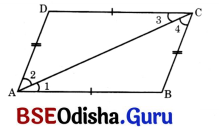
Let ABCD be a quadrilateral in which opposite sides are equal. Join AC.
In ΔADC and ΔCDA,
AD = CB (given)
DC = BA (given)
AC = AC (common side)
By SSS condition, ΔADC ≅ ΔCBA.
∴ ∠1 = ∠3 and ∠2 = ∠4
AC is a transversal of lines AB and DC, and alternate angles ∠1 and ∠3 are equal.
∴ Lines AB and DC are parallel.
AC is a transversal of lines AD and BC, and alternate angles ∠2 and ∠4 are equal.
∴ Lines AD and BC are parallel.
∴ By definition, the quadrilateral ABCD is a parallelogram.
Question 10.
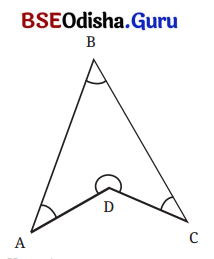
Will the sum of the angles in a quadrilateral such as the following one also be 360°? Find the answer using geometric reasoning as well as by constructing this figure and measuring.
Solution:
In the given quadrilateral, join BD.
In ΔABD, we have
∠A + ∠3 + ∠1 = 180°
In ΔCBD, we have ∠C + ∠4 + ∠2 = 180°
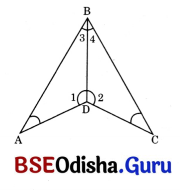
Adding, we get
(∠A + ∠3 + ∠1) + (∠C + ∠4 + ∠2) = 180° + 180°
⇒ ∠A + (∠3 + ∠4) + ∠C + (∠1 + ∠2) = 360°
⇒ ∠A + ∠B + ∠C + ∠D = 360°
∴ The sum of the angles of the quadrilateral ABCD is 360°.
Also, by using a protractor, we find that the sum of all angles is 360°.
Question 11.
State whether the following statements are true or false. Justify your answers.
(i) A quadrilateral whose diagonals are equal and bisect each other must be a square.
Solution:
False.
A quadrilateral whose diagonals are equal and bisect each other is a rectangle. A square is a special case of a rectangle where all sides are also equal.
(ii) A quadrilateral having three right angles must be a rectangle.
Solution:
True.
Three right angles force the fourth to be right angle as well and a quadrilateral with four right angles is a rectangle.
(iii) A quadrilateral whose diagonals bisect each other must be a parallelogram.
Solution:
True.
If the diagonals bisect each other, then the two triangles formed by a diagonal are congruent, which gives pairs of opposite sides parallel. Hence the figure is a parallelogram.
(iv) A quadrilateral whose diagonals are perpendicular to each other must be a rhombus.
Solution:
False.
Squares, kites, and some other quadrilaterals also have perpendicular diagonals. Therefore, having perpendicular diagonals does not necessarily mean the quadrilateral is a rhombus.
(v) A quadrilateral in which the opposite angles are equal must be a parallelogram.
Solution:
True.
If both pairs of opposite angles are equal, then each pair of adjacent angles are supplementary, which implies opposite sides are parallel. Hence the quadrilateral is a parallelogram.
(vi) A quadrilateral in which all the angles are equal is a rectangle.
Solution:
True.
If all four angles are equal, each angle must be 360°/4 = 90°. A quadrilateral with four right angles is a rectangle.
(vii) Isosceles trapeziums are parallelograms.
Solution:
False.
An isosceles trapezium has exactly one pair of parallel sides and equal non-parallel sides. While a parallelogram must have two pairs of parallel sides. So an isosceles trapezium is not a parallelogram.
Quadrilaterals Class 8 Extra Questions
Multiple Choice Questions
Question 1.
The angles in a square are :
(a) 90° each
(b) 70° each
(c) 60° each
(d) 100° each
Solution:
Each angle of a square is 90°.
(a) 90° each
Question 2.
ABCD is a quadrilateral. Sum of angles ∠A + ∠B + ∠C + ∠D is :
(a) 180°
(b) 270°
(c) 360°
(d) 540°
Solution:
Sum of all angles of any quadrilateral is 360°.
(c) 360°
Question 3.
In a square ABCD, AC and BD are its two diagonals. Then which of the following is true?
(a) AC > BD
(b) BD > AC
(c) AC = BD
(d) AC + BD = AB
Solution:
Diagonals of a square are equal.
(c) AC = BD
Question 4.
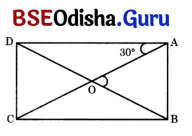
In the following figure, ABCD is a rectangle. ∠AOB =
(a) 90°
(b) 60°
(c) 45°
(d) 35°
Solution:
Here, ABCD is a rectangle.
Hence, ∠DAB = 90°
⇒ ∠DAO + ∠BAO = 90°
⇒ 30° + ∠BAO = 90°
⇒ ∠BAO = 90° – 30° = 60°
Now, if we consider ΔOAB, then .
OA = OB (∵, diagonals are equal and they bisect each other)
∴, ΔOAB is an equilateral Δ as ∠BAO = 60°
So, ∠AOB = 60°
Question 5.
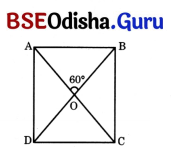
In the following figure, ABCD is a rectangle. ∠OAB =
(a) 60°
(b) 30°
(c) 45°
(d) 90°
Solution:
In ΔOAB, if ∠AOB = 60° then all of its angles are 60° each.
(a) 60°
Assertion and Reasoning
(a) Assertion (A) and Reason (R) both are true and Reason (R) is the correct explanation for the Assertion (A).
(b) Assertion (A) and Reason (R) both are true but Reason (R) is not the correct explanation for the Assertion (A).
(c) Assertion (A) is true but Reason (R) is false.
(d) Assertion (A) is false but Reason (R) is true.
Question 1.
Assertion (A) : In a quadrilateral ABCD, if ∠A = 40°, ∠B = 90° and ∠C = 110°, then ∠D = 120°.
Reason (R) : Sum of all angles of a quadrilateral is 380°.
Solution:
Reason (R) is false as sum of all angles of a quadrilateral is 360°.
Answer:
(c) Assertion (A) is true but Reason (R) is false.
Question 2.
Assertion (A) : If PQRS is a square, then ∠P = 90°.
Reason (R) : Each angle of a square is 90°.
Solution:
In a square PQRS, ∠P = ∠Q = ∠R = ∠S = 90°.
So, ∠P = 90°.
Answer:
(a) Assertion (A) and Reason (R) both are true and Reason (R) is the correct explanation for the Assertion (A).
Case Based Questions
Question 1.
A carpenter needs to put together two thin strips of laminates, as shown in the following figure, So that when a thread is passed through their end points, it forms a rectangle.
She already has one 12 cm long strip.
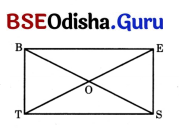
Based on the above, answer the following:
(a) What should be the length of the other strip?
(b) At what point they should be joined?
(c) If thread is passed through B, E, S, T, then what will be the angle between the arms BT and BE?
(d) Will the lengths of BT and ES same? Why?
Answer:
(a) The lengths of both the strips must be same. Hence, the length of the other strip must be 12 cm.
(b) The two strips must be joined at O.
(c) The resultant figure is a rectangle. In a rectangle, the opposite sides are equal. Hence, BT = ES.