
Go through BSE Odisha Class 8 Science Solutions Chapter 5 Exploring Forces Question Answer to understand textbook questions more clearly.
Class 8 Science Curiosity Chapter 5 Question Answer
Class 8 Science Ch 5 Exploring Forces Question Answer
Class 8 Science Chapter 5 Exploring Forces Question Answer
Probe and Ponder Questions
Question 1.
Why does it feel harder to pedal a bicycle when going uphill than on flat ground?
Answer:
When we cycle uphill, we’re constantly fighting against the Earth’s gravitational pull, which tries to pull us back down. This force acts perpendicular to the ground on a flat surface, meaning it doesn’t directly oppose our forward movement. But on a slope, a portion of the gravity acts against our direction of motion, requiring us to exert more force to move forward and upward.
Question 2.
Why is it easier to slip on a wet surface?
Answer:
It is easier to slip on a wet surface due to reduced friction between the foot and the surface. Water acts as a lubricant, minimizing the grip and making it easier to slide.

Question 3.
Why do we feel ‘light’ or like we are ‘floating’ just after our swing reaches its highest point and begins to come down?
Answer:
When the swing reaches its highest point, it momentarily comes to rest before moving downward. A this point, gravity still acts downward, but the support (normal) force exerted by the swing on our body decreases. Because the normal force is reduced, we feel less push from the swing, which makes us feel “light” or as if we are “floating” for a brief moment.
Question 4.
Share your questions
Answer:
- Why does sliding work better on ice than on sand?
- What would happen if friction did not exist at all?
- Why do heavier objects sink more in water than lighter ones of the same size?
- Does air also provide friction to moving objects?
- Why can some birds fly easily for long periods without getting tired?
InText Questions
Question 1.
Does this mean that whenever there is a change in speed or direction, or change in shape, a force is acting on the object? (Page 65)
Answer:
Yes, none of these take place without the action of force.
Question 2.
Suppose an object is at rest. Does it mean that no force is acting on this object? (Page 65)
Answer:
No, the forces are acting on this object. But all these forces acting on them are balancing one another. That is why an object is at rest.
Question 3.
Does this mean that the force of friction will be greater if the surfaces are rough? (Page 68)
Answer:
Yes, more the roughness of a surface, larger is the number of irregularities on its surfaces and hence greater will be the friction.
Question 4.
Is it essential for an object applying force on another object to always be in contact with it? (Page 69)
Answer:
No. Forces can be applied either through direct contact (contact forces) or without direct contact (non-contact forces) such as gravitational or magnetic forces.
Question 5.
Does it mean that there are two kinds of electrical charges?(Page 71)
Answer:
Yes, there are two kinds of electrical charges ‘positive’ and ‘negative’.
Question 6.
Why do all the objects fall towards the Earth? (Page 72)
Answer:
All the objects fall towards the Earth because the Earth attracts (pull) them. This force is called gravitational force.
Question 7.
Is there any force which acts on them. ? What exerts this force ?(Page 72)
Answer:
Yes, there is a force acting on any object in the universe, and it is called gravity. Gravity is a force of attraction that exists between any two objects with mass. The Earth, due to its large mass, exerts a gravitational orce on all objects near it, pulling them towards its center.
Question 8.
Does the Earth pull every object with equal force ? (Page 72)
Answer:
No, the Earth does not pull every object with equal force. The force of gravity is stronger on objects with greater mass. While the Earth exerts a gravitational pull on all objects, the strength of that pull depends on the mass of the object being attracted.
Question 9.
What is the difference between weight and mass ? (Page 75)
Answer:
Mass is the amount of matter in an object and is measured in grams (g) or kilograms (kg). Its value remains the same at every place. Weight, on the other hand, is the gravitational force with which the Earth (or another planet) pulls an object.
Question 10.
If we place some objects on water, some of them float, while others fall to the bottom. The gravitational force of the Earth is acting on all objects, then why don’t all objects fall to the bottom? (Page 76)
Answer:
While the Earth’s gravitational force acts on all objects, whether they sink or float in water depends on the buoyant force and the density of the object relative to water. Objects with a density lower than water experience a stronger buoyant force, causing them to float, while those with a higher density experience a weaker buoyant force and sink.
Exploring Forces Class 8 Questions and Answers
Keep the Curiosity Alive (Pages 25-26)
Question 1.
Match items in Column A with the items in Column B.
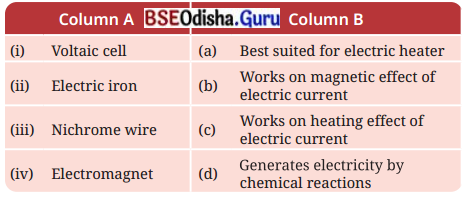
Answer:
| Column A (Type of force) | Column A (Type of force) |
| (i) Muscular force | (b) A child lifting a school bag |
| (ii) Magnetic force | (e) A compass needle pointing North |
| (iii) Frictional force | (a) A cricket ball stopping on its own just before touching the boundary line |
| (iv) Gravitational force | (c) A fruit falling from a tree |
| (v) Electrostatic force | (d) Balloon rubbed on woollen cloth attracting hair strands |
Question 2.
State whether the following statements are True or False.
(i) A force is always required to change the speed of motion of an object.
(ii) Due to friction, the speed of the ball rolling on a flat ground increases.
(iii) There is no force between two charged objects placed at a small distance apart.
Answer:
(i) True: A force is indeed always required to change the speed of motion of an object. If there is no force acting on an object, it will maintain its current speed and direction (unless it’s already at rest, in which case it will stay at rest).
(ii) False: Friction opposes motion, so it will decrease the speed of a rolling ball.
(iii) False: There is a force between charged objects. This force can be attractive or repulsive depending on the charges. But it is always present when charges are close to each other.
Question 3.
Two balloons rubbed with a woollen cloth are brought near each other. What would happen and why?
Answer:
When two balloons are rubbed with a woollen cloth and brought near each other, they will repel each other. This happens because both balloons will acquire a negative charge when rubbed with wool, and like charges repel.
Question 4.
When you drop a coin in a glass of water, it sinks, but when you place a bigger wooden block in water, it floats. Explain.
Answer:
A coin sinks in water because its density (mass per unit volume) is greater than that of water. A wooden block floats because its density is less than that of water, causing it to be buoyed up by the water.
Question 5.
If a ball is thrown upwards, it slows down, stops momentarily, and then falls back to the ground. Name the forces acting on the ball and specify their directions.
(i) During its upward motion
(ii) During its downward motion
(iii) At its topmost position
Answer:
When a ball is thrown upwards, the only force acting on it throughout its entire motion is gravity, which pulls it downwards. However, depending on the motion of the ball, the direction of this force relative to the ball’s velocity changes.
(i) During its upward motion: The force of gravity is downwards, opposing the upward motion of the ball, causing it to slow down.
(ii) During its downward motion: The force of gravity is still downwards, but now it aligns with the ball’s direction of motion, accelerating it downwards.
(iii) At its topmost position: The ball has zero velocity, meaning it’s momentarily stationary. At this point, the force of gravity is still downwards, but since the ball is not moving upwards or downwards, it has no net effect on the ball’s motion.
Question 6.
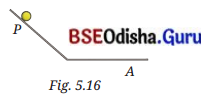
A ball is released from the point P and moves along an inclined plane and then along a horizontal surface as shown in the fig. It comes to stop at the point A on the horizontal surface. Think of a way so that when the ball is released from the same point P, it stops
(i) before the point A
(ii) after crossing the point A.
Answer:
The ball’s motion is governed by the forces of gravity and friction. On the inclined plane, gravity provides the acceleration for the motion. On the horizontal surface, only friction acts on the ball.
- Stopping before A: Increasing friction on the horizontal surface will cause the ball to decelerate more rapidly, meaning it will come to a stop sooner, potentially before reaching point A.
- Stopping after A: Decreasing friction on the horizontal surface will reduce the deceleration, allowing the ball to travel further before losing all its kinetic energy and stopping.
Question 7.
Why do we sometimes slip on smooth surfaces like ice or polished floors? Explain.
Answer:
When we walk on surfaces like ice, we often slip, which means we lose our balance and fall. This happens because the force that helps us stay upright and move forward (friction) is not enough. These surfaces have fewer irregularities. Minimizing the contact area and the force of friction between the surface and our shoes makes it easier to slide instead of grip. A layer of water, even a thin one on ice, can further reduce friction by acting as a lubricant, making the surface even more slippery.
Question 8.
Is any force being applied to an object in a non-uniform motion?
Answer:
Yes, for an object to be in non-uniform motion, a force must be acting upon it. Nonuniform motion, also known as accelerated motion, means the object’s velocity is changing, either in speed or direction, or both. This change in velocity requires a force to be applied.
Question 9.
The weight of an object on the Moon becomes one-sixth of its weight on the Earth. What causes this change? Does the mass of the object also become one-sixth of its mass on the Earth?
Answer:
The change in an object’s weight on the moon compared to Earth is due to the difference in gravitational force. The moon’s gravity is significantly weaker than Earth’s, roughly one-sixth as strong. However, the mass of an object remains the same regardless of location; only weight changes with gravitational pull.
Question 10.
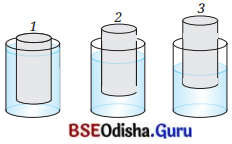
Three objects 1,2 and 3 of the same size and shape but made of different materials are placed in the water. They dip to different depths as shown in fig. If the weights of the three objects 1,2 and 3 are w1, w2, and w3, respectively, then
(i) w1=w2=w3
(ii) w1>w2>w3
(iii) w2>w3>w1
(iv) w3>w1>w2
Answer:
(ii) The relationship between the weights of the objects is w1>w2>w3.
Object 1 is the deepest meaning it displaces the most water.
Object 2 is less deep than object 1 but deeper than object 3.
Object 3 is the least deep, meaning it displaces the least amount of water.
Since the objects have the same size and shape, the greater the depth, the greater the weight of the object (assuming they are all made of the same material).
Hence, the object with the greatest weight will sink the deepest, and the object with the least weight will be the closest to the surface.
Class 8 Science Chapter 5 Question Answer
Activity 1.
Let us explore
Aim: To experience the push or pull.
Materials Required: A large cardboard box, a rope.
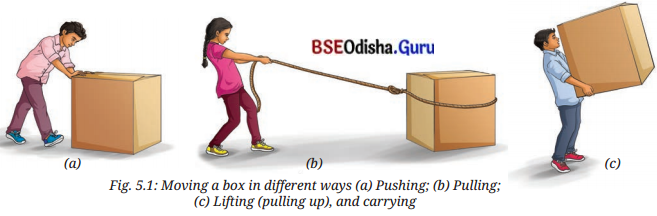
Procedure :
- Take a heavy and large cardboard box.
- Try to push or pull it by yourself.
- Try to move the box in as many different ways as you can do.
- Are you able to move the box in any other way than shown in fig?
Answer:
It is really very difficult to move.
Observations: In every method you are either pushing or pulling the box.
Inferences:
- No matter how you chose to move the box – by dragging, sliding, rolling, lifting etc. Some form of push or pull is always involved.
- Generally, the push or pull applied on an object is called force.
Activity 2.
Let us analyse
Aim: To analyse and study the effect of force.
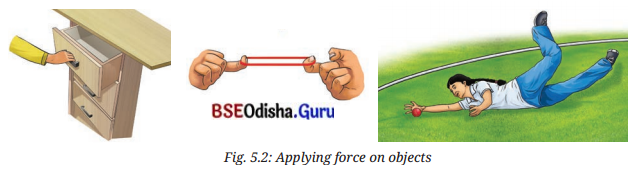
Procedure:
- Think of different examples and situations where a force either push or pull is applied.
- List them in the table given below.
- Write the effect of the force in the table also.
- Some of them are already listed for you.
Observations :
Different actions and their effects
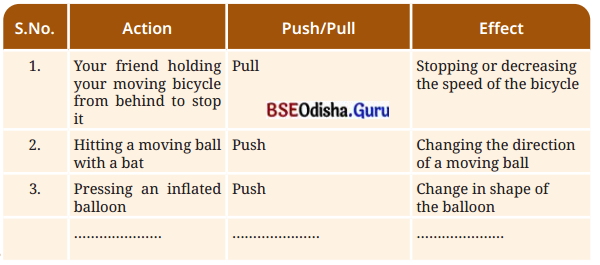
Answer:
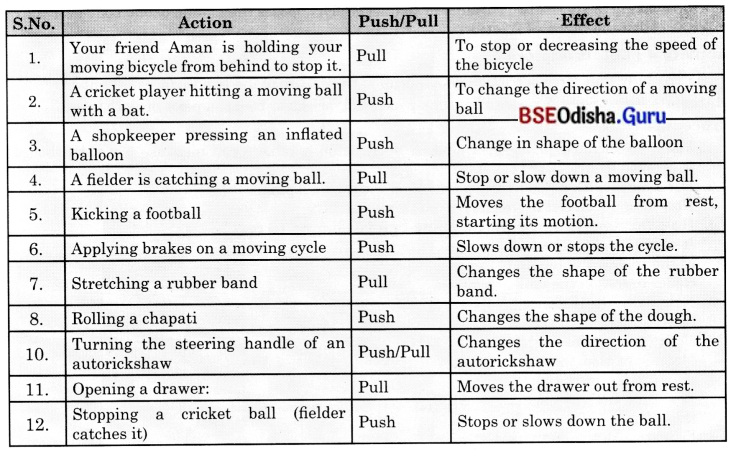
Inferences:
We have noticed that the effect of the force are :
- A force can make an object move from rest.
- A force can change the speed of an object if it is moving. Either increase or decrease.
- A force can change the direction of motion of an object.
- A force can bring about a change in the shape of an object.
- A force can cause some or all of these effects.
Activity 3.
Let us investigate
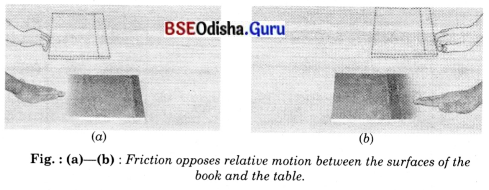
Aim : To show that friction always opposes the relative motion between the two bodies, irrespective of the direction of motion.
Materials Required : A book.
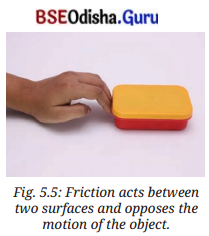
Procedure :
- Gently push a book on a table.
- It stops after moving for some distance.
- Repeat this activity pushing the book from the opposite direction. [Fig. (b).
- Does the book stop this time, too? Yes, the book stop this time too.
- Can you think of an explanation ?
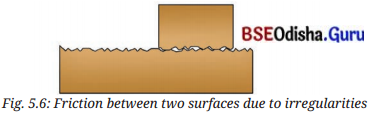
The book slides for some time and then stops. The reason is that
Inference:
The force acting along the two surfaces in contact which opposes the motion of one body over the other, is called the force of friction.
Activity 4.
Let us explore
Aim: To study that force of friction depends upon the nature of the two surfaces in contact.
Materials Required: A wooden board, a pencil cell, bricks or books, a piece of cloth, sand.
Procedure:
- Make an inclined plane on a smooth floor, or on a table. (You may use a wooden board supported by bricks or books).
- Put a mark with a pen at any point ‘A’ on the inclined plane.
- Now let a pencil cell move down from this point.
- How far does it move on the plane before coming to rest ?
It moves up to the end of the inclined plane and comes to rest on the table. - Note down the distance.
- Now spread a piece of cloth over the table. Make sure that there are no wrinkles in the cloth.
Try this activity again [Fig. (b). - Repeat this activity by spreading a thin layer of sand over the table. Maintain the same slope throughout the activity.
Inference: Friction depends upon the nature of surfaces in contact.
Activity 5.
Let us test
Aim : To show that a magnet can exert force on another magnet without being in contact with it.
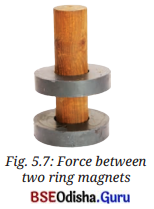
Materials Required : Two ring magnets, a wooden stick.
Procedure :
- First of all we will take two ring magnets and a wooden stick.
- Now, hold the stick in a vertical position on a wooden table.
- Insert one ring magnet into the stick. (See fig.)
- Now, take another ring magnet and insert in such a way that like poles of two magnets face each other.
Observations:
- Second magnet stay floating above the first magnet. It means that they repel each other.
- The second magnet still remains floating after reversing the poles of both magnets.
Inference:
- A magnet can exert force on another magnet without being in contact with it.
- The force exerted by a magnet on another magnet or a magnetic material is called magnetic force. Since a magnet can exert a force from a distance without being in contact it is called a non-contact force.
Activity 6.
Let us experiment
Aim: To show electrostatic force.
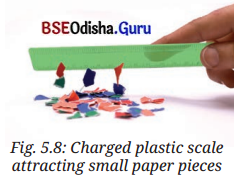
Materials Required : A plastic straw, a plastic scale, a piece of polythene and small piece of paper.
Procedure :
- Take a plastic scale/straw and rub it vigorously with polythene.
- It is advised that never touch the rubbed part with your hand or any other metal object.
- Bring the rubbed straw or scale close to the small pieces of paper which is kept on the table.
- Do not touch the paper.
- Write down your observations.
Observations:
The paper pieces get pulled towards the plastic scale/straw and stick to it when it is brought close to paper pieces.
Inference:
- When two objects are rubbed, electrical charges are build up on their surfaces which is called static charges.
- A charged object attract an uncharged objects like small pieces of paper.
- This is called electrostatic force and comes into play even when the two bodies are not in contact.
Activity 7.
Let us experiment
Aim: To show that like charges repel and unlike charges attract each other.
Materials Required: Two balloons, a length of thread, and a woollen cloth.
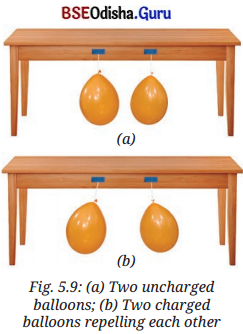
Procedure:
- First of all we will take two balloons, a thread and a woollen cloth.
- Now, inflate the two balloons and hang them.
- We should be careful that the two balloons do not touch each other. (See fig. (a))
- Now, rub both balloons with the woollen cloth and release them. Remember that these two balloons should not be touched with your fingers. Note down your observation.
- Now, bring the woollen cloth used for rubbing the balloons close to one of the rubbed balloons. Note down your observation.
Observations :
- Case-I: The balloons move away from each other i.e., repelling each other.
- Case-II: They attract each other.
Inference:
- The force exerted by a charged body on another charged body or an uncharged body is called electrostatic force. It is a non-contact force.
- We can infer that like or similar charged body repel each other and unlike (opposite) charged bodies attract each other.
- The two kinds of static charges are said to be ‘positive’ and ‘negative’ charges.
Activity 8.
Let us observe
Aim: To demonstrate the gravitational force.
Materials Required: A ball, a stone or any object around you.
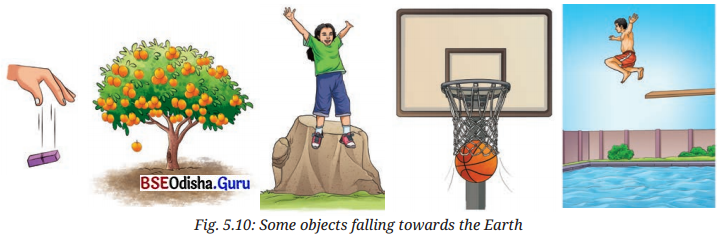
Procedure :
- Take a ball or a stone or your eraser and throw it vertically upwards.
- Now, throw it again, but this time harder than previous.
- Not down your observations in both the cases.
- You may think of different situations around you and can throw any object in any direction.
Observations :
- Case-I: The ball or stone come down.
- Case-II: Even in this case also the ball still fall back down to the ground but takes little more time.
Inference:
- Finally all objects falls or comes back to the ground or floor.
- This shows that some force is acting in downward direction. This is called the gravitational force or force of gravity or simply gravity.
Activity 9.
Let us explore
Aim : To show that the earth pulls different objects with different forces and it depends on their masses.
Materials Required : A spring, a few objects of different masses e.g., a pencil box, a tiffin box, a small stone.
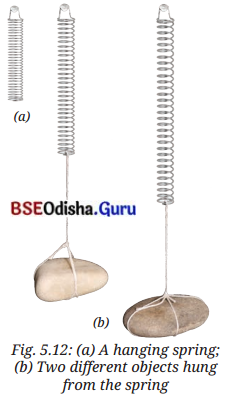
Procedure :
- Hang one end of the spring from a nail and on the other end, hang an object and observe the spring.
- When you suspend an object from a spring, the spring stretches due to the force applied by the earth.
- Now hang the other objects, one by one and notice the stretch in the spring in each cases.
Observations: If you hang objects of different mass one after another, each time causes a different amount of stretching.
Inference: This proves that heavier objects are pulled with more force i.e., the weight of an object depends on its mass; heavier objects have greater weight.
Activity 10.
Let us observe
Aim : To measure maximum weight by a spring balance.
Materials Required : A spring balance.
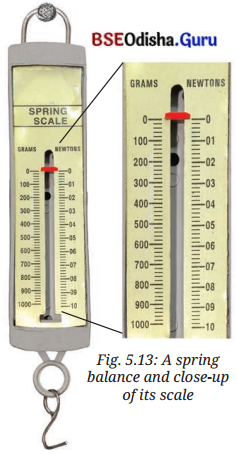
Procedure :
- Take a spring balance and hang it as shown in fig.
- Now, look at the spring balance carefully.
- What is the maximum weight it can measure ?
Observations :
- The maximum weight a spring balance can measure is 10 N.
- Range of spring balance is the maximum weight it can measure.
Inference : If a spring balance shows values from 0 to 10 N , its range is 0.10 N . means that it can measure weight upto 10 N.
Activity 11.
Let us calculate
Aim: To determine the smallest readable value (Least count) of and close-up of its scale a spring balance.
Materials Required: A spring balance.
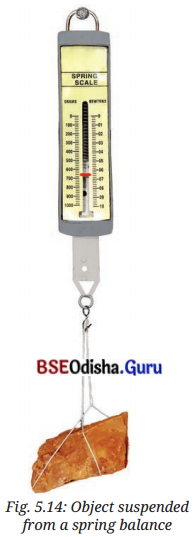
Procedure :
- Note down the weight difference indicated between the two bigger marks.
- The weight difference between 0 and 01 N or between 01 N and 02 N is 1 N.
- Count the number of divisions between these two bigger marks.
Demonstration :
1. Weight different between 0 and 1 N or between 01 N and 2 N =1 N Number of divisions between 0 and 1 or 1 and 2=5
∴ Least count = \(\frac{1}{5}\)=0.2 N
Inference:
- The least count of a spring balance is the smallest difference in weight it can measure.
- So, the least count of a spring balance is 0.2 N.
Activity 12.
Let us measure
Aim: To measure the weight and mass of an object using a spring balance.
Materials Required: Pencil box, water bottle filled with water partially.
Procedure :
- Hang a spring balance from the hook of a spring balance (without exceeding its maximum range).
- The pointer or reading on the scale shows the object’s weight in newtons (N).
- This method can be repeated for many objects and results should be recorded in a table.
- The mass scale (in g/kg) on a spring balance assuming earth’s gravity.
- The mass reading is only correct on earth where gravitational acceleration is standard.
- You can repeat the above Activities-10 to 12 for the mass scale which is shown on the left side on the spring balance (Fig. 13) to measure the mass of an object.
Observations :
Measuring weight using a spring balance
| S.No. | Object | Weight (N) |
| 1. | Pencil Box | |
| 2. | Partially filled water bottle |
Inference: We can measure the weight and mass of an object using a spring balance.
Activity 13.
Let us investigate
Aim: To experience a buoyant force or upthrust by a liquid.
Materials Required: A bucket, an empty plastic bottle.
Procedure:
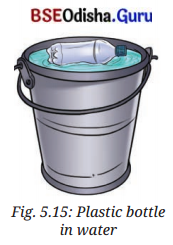
- Take an empty plastic bottle (with its lid closed tightly) and a bucket full of water.
- Now, push the bottle in the water. (See fig.)
- You will feel an upward force or push.
- Does the bottle bounce up and comes on top of water ?
Observation:
- Yes, we feel an upward push on our hand.
- The bottle bounces back up when released.
Inference:
- Gravity (gravitational force acts on downward direction i.e., pulls downward. The buoyant force (upthrust) pushes it upwards.
- If the gravitational force (weight of the object) is greater than buoyant force, the object sinks. i.e. W>U, sink
- If the two forces are equal i.e., W=U, the object floats.
- The density of the liquid affects the buoyant force.
Exploring Forces Class 8 Extra Questions and Answers
Short Answer Type Questions
Question 1.
What is electrostatic force ? Why is it called non-contact force?
Answer:
The force exerted by a charged body on another charged or uncharged body is called electrostatic force. This force comes into play even when the bodies are not in contact, so it is called non-contact force.
Question 2.
What is Muscular Force ? Why is the force called contact force?
Answer:
Muscular Force : The force resulting due to the action of muscles is called Muscular Force. Since muscular force can be applied on an object when muscle is in contact with the object, so it is called a contact force.
Question 3.
What causes friction ?
Answer:
Friction occurs when two bodies move on each other. Each surface has some irregularities on it. When two such objects move on each other their irregularities get interlocked and friction arises.
Question 4.
You might have noticed that when used for a long time, slippers with rubber soles become slippery. Explain the reason.
Answer:
After using a rubber soles for a long time, their surfaces become smooth. Hence, the friction between the sole and the floor decreases. So, the slippers become slippery.
Question 5.
A blacksmith hammers a hot piece of iron while making a tool. How does the force due to hammering affect the piece of iron?
Answer:
The force due to hammering causes the change in the shape of the iron and iron can be moulded in the shape of the required tool.
Question 6.
Iqbal has to push a lighter box and Seema has to push a similar heavier box on the same floor. Who will have to apply a larger force and why ?
Answer:
The heavy object will be pressed hard against the opposite surface and produces more friction. So Seema will have to apply a larger force due to excess friction.
Long Answer Type Questions
Question 1.
In the following situations identify the agent exerting a force and the object on which it acts. State the effect of the force in each case.
(a) Squeezing a piece of lemon between the fingers to extract its juice.
(b) Taking out paste from a toothpaste tube.
(c) A load suspended from a spring while its other end is on a hook fixed to a wall.
(d) An athlete making a high jump to clear the bar at a certain height.
Answer:
(a) Agent are fingers, object is lemon, effect of force can be observable in form of lemon juice being expelled by squeezing.
(b) Agent is hand of the person squeezing the tube, object is toothpaste tube and effect of the force can be observed as the paste coming out of the tube.
(c) Agent is the load suspended, object is the spring and effect can be seen in the form of elongation of spring on suspension of load.
Question 2.
What are the different types of forces ? Give an example of each.
Answer:
Types of forces : The following are the different types of forces :
(a) Muscular force
(b) Magnetic force
(c) Electrostatic force
(d) Gravitational force
(e) Frictional force
(a) Muscular Force : The force applied by a living being with its muscles is known as muscular force e.g., bullocks apply muscular force to draw a cart.
(b) Magnetic Force : The force exerted by a magnet is called magnetic force. Example: A magnet attracts nails and pins made fron iron even from some distance.
(c) Electrostatic Force : The force exerted by an electrified body is called electrostatic force. Example : Pieces of paper get attracted towards a charged comb.
(d) Gravitational Force : The force of attraction between any two objects possessing mass is called force gravitation. An object dropped from a certain height falls on the earth due to the gravitational force.
(e) Frictional Force : The force which always opposes the motion of one body over another body is called frictional force. Example, a marble rolled on the ground stops after some time due to the frictional force.
Question 3.
An archer shoots an arrow in the air horizontally. However, after moving some distance, the arrow falls to the ground. Name the initial force that sets the arrow in motion. Explain why the arrow ultimately falls down.
Answer:
When an archer shoots an arrow he stretches the string of the bow by applying muscular force. In this process the shape of the bow changes. As soon as the string is released, it regains its original position which provides the initial force to set the arrow in motion. The force of gravity that acts on the arrow in the downward direction which finally brings it to the ground.
Case-Study Based Questions
1. Read the following passage carefully and answer the questions that follow :
Generally, to apply a force on an object, your body has to be in contact with the object. The contact may also be with the help of a stick or a piece of rope. This force is caused by the action of muscles in our body. The force resulting due to the action of muscles is known as the muscular force. Animals also make use of muscular force to carry out their physical activities and other tasks. Animals like bullocks, horses, donkeys and camels are used to perform various tasks for us. In per-forming these tasks they use muscular force. Since muscular force can be applied only when it is in contact with an object, it is also called a contact force.
Like Poles of two magnets repel each other and unlike poles attract each other. A straw is said to have acquired electrostatic charge after it has been rubbed with a sheet of paper. Such a straw is an example of a charged body. The force exerted by a charged body on another charged or uncharged body is known as electrostatic force. This force comes into play even when the bodies are not in contact. The electrostatic force, therefore, is another example of a non-contact force.
Similarly, the force exerted by a magnet on a piece of iron is also a noncontact force. Objects or things fall towards the earth because it pulls them. This force is called the force of gravity, or just gravity. This is an attractive force. The force of gravity acts on all objects. The force of gravity acts on all of us all the time without our being aware of it. Water begins to flow towards the ground as soon as we open a tap. Water in rivers flows downward due to the force of gravity.
(i) Gravity is : …………..
(a) Repulsive
(b) Attraction + Repulsive force
(c) Attractive force
(d) Not a force
Answer:
(c) Attractive force
(ii) An example of a non-contact force is :
(a) force exerted by us to lift a bucket
(b) pushing a stationary car
(c) force exerted by magnet
(d) hitting a circket ball for a 6 run
Answer:
(c) force exerted by magnet
(iii) The force exerted by a charged body on another charged body can :
(a) attract each other
(b) both (a) and (c)
(c) repel each other
(d) none of these
Answer:
(b) both (a) and (c)
(iv) Two objects repel each other. This repulsion could be due to charged or uncharged body is :
(a) magnetic force
(b) frictional force
(c) musculer force
(d) electrostatic force
Answer:
(d) electrostatic force
Picture Based Questions
I. Observe the picture and answer the following questions :
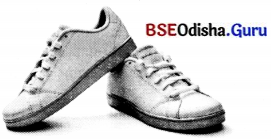
(i) Why do soles of shoes wear out?
(a) Due to friction
(b) Due to
old shoes
(c) Due to bad quality
(d) None of
Answer:
(a) Due to friction
(ii) Can it is possible to reduce friction upto zero ?
(a) Yes
(b) No
(c) Some times
(d) 50-50
Answer:
(b) No
Exploring Forces Class 8 MCQ
Multiple Choice Questions (Mcqs)
Question 1.
What is the SI unit of force ?
(a) Newton
(b) Joule
(c) Watt
(d) Kilogram
Answer:
(a) Newton
Question 2.
What is force described as in science ?
(a) Pressure
(b) Push or pull
(c) Friction
(d) Energy
Answer:
(b) Push or pull
Question 3.
Which of these is a non-contact force ?
(a) Friction
(b) Electrostatic force
(c) Tension
(d) Muscular force
Answer:
(b) Electrostatic force
Question 4.
What causes an object thrown upwards to return to earth ?
(a) Air pressure
(b) Gravity
(c) Electrostatics
(d) Friction
Answer:
(b) Gravity
Question 5.
Which of the following changes can a force cause ?
(a) Director change in
(b) Shape change in
(c) Speed change in
(d) All of these
Answer:
(d) All of these
Assertion and Reasoning
These questions consist of two statements, each printed as Assertion (A) and Reason (R). While answering these questions, you are required to choose any one of the following four responses.
(a) Assertion and reason both are correct and reason is correct explanation for assertion.
(b) Assertion and reason both are correct and reason is not correct explanation for assertion.
(c) Assertion is correct but the reason is wrong.
(d) Assertion is wrong but the reason is correct.
1. Assertion (A): A push or a pull on an object is called a force.
Reason (R): Forces applied on an object in the same direction add to one another.
Answer:
(b) Assertion and reason both are correct and reason is not correct explanation for assertion.
2. Assertion (A): A change in either the speed of an object, or its direction of motion, or both, is described as a change in its state of motion.
Reason (R): A force may bring a change in the state of motion of an object.
Answer:
(a) Assertion and reason both are correct and reason is correct explanation for assertion.
Fill in the blanks
1. To strecth the bow, the archer applies a force that causes a change in its ………….
Answer:
shape
2. The force applied by the archer to stretch the bow is an example of ………… force.
Answer:
muscular
3. The type of force responsible for a change in the state of motion of the arrow is an example of a ………… force.
Answer:
contact
4. While the arrow moves towards its target, the forces acting on it are due to ………… and that due to ………… of air.
Answer:
gravity and friction
5. A force arises due to ………… between two objects.
Answer:
interaction
True or False
1. A cyclist exerts a force of pull on the paddles of bicycle.
Answer:
False
2. Magnetic force is a contact force.
Answer:
False
3. A force can change the direction of motion of a moving object.
Answer:
True
4. The S.I. unit of pressure is newton per square metre.
Answer:
True
5. Pressure due to a liquid contained in a vessel is equal to all the points on its surface.
Answer:
True