Students can refer to BSE Odisha Class 7 Math Solution and Ganita Prakash Chapter 7 A Tale of Three Intersecting Lines Class 7 Question Answer to understand textbook questions step by step.
Class 7 Maths Chapter 7 A Tale of Three Intersecting Lines Solutions
Ganita Prakash Class 7 Chapter 7 Solutions
Class 7 Maths Ganita Prakash Chapter 7 Solutions A Tale of Three Intersecting Lines
Question 1.
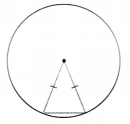
Use the points on the circle and/or the centre to form isosceles triangles.

Solution:
Select any two points on the circle and connect them with the centre of the circle.
Also, join these points to each other. This will form an isosceles triangle as the two radii are equal in length.
Question 2.
Can we say anything about the existence of a triangle for each of the following sets of lengths?
(i) 10 km, 10 km and 25 km
(ii) 5 mm. 10 mm and 20 mm
(iii) 12 cm. 20 cm and 40 cm
Solution:
(i) When we take direct path = 25 km.
Then roundabout path =10 km + 10 km = 20 km.
Since direct path is longer than the roundabout path.
So, existence of a triangle is not possible.
(ii) When we take direct path = 20 mm.
Then roundabout path = 10 mm + 5 mm = 15 mm.
Since direct path is longer than the roundabout path.
So, existence of a triangle is not possible.
(iii) When we take direct path = 40 cm.
Then roundabout path =12 cm + 20 cm = 32 cm.
Since direct path is longer than the roundabout path.
So, existence of a triangle is not possible.

Question 3.
Does there exist an equilateral triangle with sides 50, 50, 50? In general, does there exist an equilateral triangle of any sidelength? Justify your answer.
Solution:
Yes, an equilateral triangle with sides 50, 50, 50 exists because the sum of two sides is greater than the third side. For any positive number say x > 0, x + x > x. So, an equilateral triangle with all side lengths ‘x’ exists.
Question 4.
For each of the following, give at least 5 possible values for the third length so there exists a triangle having these as sidelengths (decimal values can also be chosen): ;
(i) 1, 100
(ii) 5, 5
(iii) 3, 7
Solution:
(i) 5 possible values for the third length would be 99.5. 99.8, 100, 100.5, 100.9
Since, 100 < 1 + 99.5, 100 < 1 + 99.8, 100 < 1 + 100, 100.5 < 1 + 100, and 100.9 < 1 + 100
(ii) 5 possible values for the third length would be 1, 3.5, 5, 7.5, 8.9
Since, 5 < 1 + 5, 5 < 5 + 3.5, 5 < 5 + 5, 7.5 < 5 + 5, and 8.9 < 5 + 5
(iii) 5 possible values for the third length would be 4.5, 5, 6.9, 8, 9.8
Since, 7 < 3 + 4.5, 7 < 5 + 3, 7 < 3 + 6.9, 8 < 3 + 7, 9.8 < 3 + 7
Question 5.
Construct triangles for the measurement, 3 cm, 120°, 8 cm, where the angle is included between the sides.
Solution:
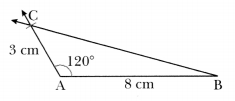
Steps of construction are given below:
Step 1: Construct a side AB of length 8 cm.
Step 2: Construct ∠d = 120° by drawing the other arm of-the angle.
Step 3: Mark the point C on the other arm such that AC, = 3 cm.
Step 4: Join BC to get the required triangle.
Question 6.
Construct triangles for the measurements, 25°, 3 cm, 60° where the side is included between the angles.
Solution:
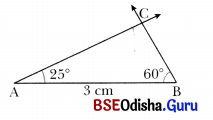
Steps of construction are given below:
Step 1: Draw the base AB of length 3 cm.
Step 2: Draw ∠d and ∠B of measure 25° and 60° respectively.
Step 3: Make the point of intersection of the two new arms of ∠d and ∠B as point C to get the required triangle.
Question 7.
Determine which of the following pairs can be the angles of a triangle and which cannot:
(i) 35°, 150°
(ii) 70°, 30°
Solution:
(i) The sum of the given angles 35° + 150° = 185°.
This is not possible because sum of the angles of the triangle exceeds 180°.
(ii) The sum of the given angles 70° + 30° = 100°.
Possible third angle 180°- 100° = 80°.
Since the possible third angle comes out positive (80°), the given angles can be angles of a triangle.
Question 8.
Find the third angle of a triangle (using a parallel line) when two of the angles are:
(i) 36°, 72°
(ii) 150°, 15°
Solution:
(i) Here ∠B = 36° and ∠C = 72°.
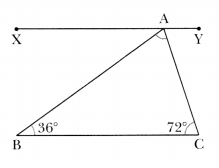
Since the line BC is parallel to AT.
So, ∠XAB = ∠B = 36° [Alternate angles] ………. (i)
and ∠YAC = ∠C = 72 [Alternate angles] ………. (i)
Also, ∠XAB + ∠B AC + ∠YAC = 180° [∠XAY is a straight angle]
⇒ 36° + ∠BAC + 72° = 180° [Using (i) and (ii)]
⇒ ∠BAC = 180°- 108° = 72°.
(ii) Here ∠B = 150° and ∠C = 15°.
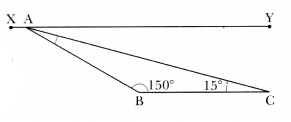
Since the line BC is parallel to AY.
So, ∠XAB = ∠B = 150° [Alternate angles] ………. (i)
and ∠YAC = ∠C = 15° [Alternate angles] ………. (ii)
Also, ∠XAB + ∠BAC + ∠YAC = 180° [∠XAY is a straight angle]
⇒ 150° + ∠BAC + 15° = 180° [Using (i) and (ii)]
⇒ ∠BAC = 180° – 165° = 15°.
Question 9.
Here is a triangle in which we know ∠B = ∠C and ∠A = 50°, Can you find ∠B and ∠C?
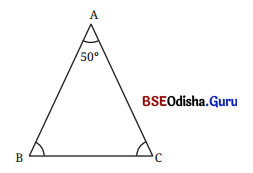
Solution:
Given, ∠A = 50° and ∠B – ∠C.
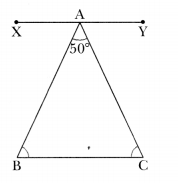
Draw a line Xy which is parallel to BC.
Now, ∠XA B = ∠B and ∠YAC = ∠C [Alternate angles] ………… (i)
Also, ∠XAB + ∠BAC + ∠YAC = 180°
⇒ ∠B + 50° + ∠C = 180° [Using (i)]
⇒ ∠B + ∠C = 180° – 50° = 130°
⇒ 2 ∠B = 130° [∵ ∠B = ∠C]
⇒ ∠B = 65° = ∠C.
Question 10.
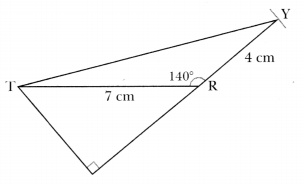
Construct a triangle TRY with RY = 4 cm, TR = 7 cm, ∠R = 140°. Construct an altitude from T to RY.
Solution:
Steps of construction are given below:
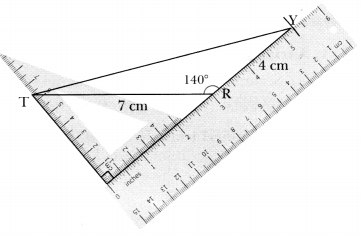
Step 1: Construct a side TR of length 7 cm.
Step 2: Construct ∠R = 140° by drawing the other arm of the angle.
Step 3: Mark the point 1 on the other arm such that RY = 4 cm.
Step 4: Join TY to get the required triangle.
Step 5: Keep the ruler aligned to RY. Place the set square along the ruler such that one of the edges of the right angle touches the ruler.
Step 6: Slide the set square along the ruler till the perpendicular edge of the set square touches the vertex T.
Step 7: Extend the line YR and then draw the altitude through T on extended YR using the perpendicular edge of the set square.
InText Questions
Question 1.
What happens when the three vertices lie on a straight line? Will these points form a triangle?
Solution:
When the three vertices lie on a straight line, they become collinear. This means they no longer form a triangle because the three points do not enclose any area.
Question 2.
Construct a triangle with sidelengths 3 cm, 4 cm, and 8 cm. What is happening? Are you able to construct the triangle?
Solution:
Let the triangle be ABC, where AB = 8 cm.
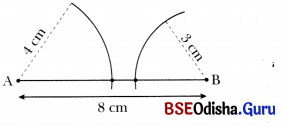
Since, the arcs from the points A and B do not meet. So, we are not able to construct the triangle with side lengths 3 cm, 4 cm, and 8 cm.
A Tale of Three Intersecting Lines Class 7 Extra Questions
A Tale of Three Intersecting Lines Class 7 Very Short Question Answer
Question 1.
In the adjoining figure:
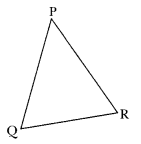
(i) Name the vertex opposite to side PQ.
(ii) Name the side opposite to vertex Q.
(iii) Name the angle opposite to side QR.
(iv) Name the side opposite to ∠R.
Solution:
In the given figure,
(i) The vertex opposite to side PQ is R.
(ii) The side opposite to vertex Q is PR.
(iii) The angle opposite to side QR is ∠P.
(iv) The side opposite to ∠R is PQ.
Question 2.
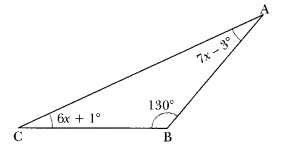
In the given triangle ABC, find the value of x.
Solution:
Given, ∠T = 7x – 3°, ∠B = 130°, ∠C = 6x + 1°
We know that sum of all the angles in a triangle is 180°.
∴ ∠A + ∠B + ∠C = 180°
⇒ 7x – 3° + 130° + 6x + 1° = 180°
⇒ 13x + 128° = 180° ⇒ 13x = 180°- 128° = 52°
⇒ x = \(\frac{52^{\circ}}{13},\) = 4°
Thus, the value of x is 4°.
Question 3.
Can a triangle be formed for the following set of angles?
(i) 80°, 70° and 50°
(ii) 56°, 64° and 60°
Solution:
We know that the sum of all angles in a triangle is 180°.
(i) Given set of angles are 80°, 70° and 50°.
Now, sum of the angles = 80° + 70° + 50° = 200° ≠ 180°
Thus, the given set of angles cannot form a triangle.
(ii) Given set of angles are 56°, 64° and 60°.
Now, sum of the angles = 56° + 64° + 60° = 180°
Thus, the given set of angles can form a triangle.
Question 4.
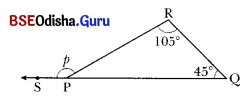
In the following figure, find the value of p.
Solution:
In the given figure, ∠SPR is an exterior angle, and ∠PRQ and ∠PQR are two interior opposite angles to ∠SPR.
∴ ∠SPR = ∠PRQ + ∠PQR [Exterior angle property]
⇒ p = 105° + 45° = 150°
Thus, the value of p is 150°.
Question 5.
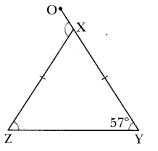
In ∆XYZ, YX is extended to O. If ∠Y = 57° and XY = XZ, then find ∠ZXO.
Solution:
Given, ∠Y = 57° and XY = XZ
We know that in an isosceles triangle, angles opposite to equal sides are equal.
∴ ∠Z = ∠Y = 57° ……… (i)
In the given figure, ∠ZXO is an exterior angle.
And, ∠Y and ∠Z are two interior opposite angle to ∠ZXO.
We know, Exterior angle = Sum of two interior opposite angles
∴ ∠ZXO = ∠Y + ∠Z
⇒ x – 57° + 57° = 114° [Using (i)]
Thus, the value of ∠ZXO is 114°.
A Tale of Three Intersecting Lines Class 7 Short Question Answer
Question 1.
Construct a triangle PQR such that PQ =3.5 cm, QR = 6.5 cm and PR = 4 cm.
Solution:
Given, PQ = 3.5 cm, QR = 6.5 cm and PR = 4 cm
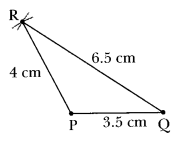
To construct the triangle PQR of given sides, we follow the steps laid down below:
Step 1: Using ruler, draw a line segment PQ, 3.5 cm long.
Step 2: With P as centre, draw an arc with radius equal to 4 cm.
Step 3: With Q as centre, draw an arc with radius equal to 6.5 cm to cut the previous arc at R.
Step 4: Join R to P and Q. Thus, ∆PQR is required triangle.
Question 2.
Construct a triangle PQR such that PQ = 7 cm, QR = 8.5 cm and PR = 9 cm.
Solution:
Given, PQ = 7 cm, QR = 8.5 cm and PR = 9 cm.
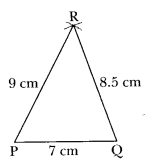
To construct the triangle PQR of given side lengths, follow the steps laid down below:
Step 1: Using ruler, draw a line segment PQ, 7 cm long.
Step 2: With P as centre, draw an arc with radius equal to 9 cm.
Step 3: With Q as centre, draw an arc with radius equal to 8.5 cm to cut the previous arc at R.
Step 4: Join R to P and Q. Thus, ∆PQR is required triangle.
Question 3.
In the given figure, PQ is parallel to RS. Find the value of y.
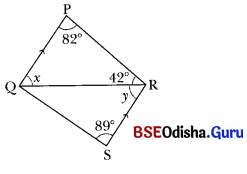
Solution:
In ∆PQR, we have
∠QPR = 82°, ∠PRQ = 42° and ∠PQR = x
We know that the sum of all angles in a triangle is 180°. ‘
∴ ∠QPR + ∠PRQ + ∠PQR = 180°
⇒ 82° + 42° + x = 180°
⇒ 124° + x = 180°
⇒ x = 180°-124° = 56°
Since PQ is parallel to RS and QR is a transversal, ∠PQR and ∠QRS are alternate interior angles, they are equal.
⇒ ∠QRS = ∠PQR
⇒ Y = ,x = 56°
Thus, the value of y is 56°.
Question 4.
In the given figure, find the value of x.
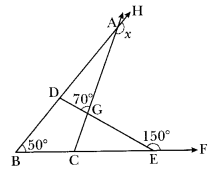
Solution:
In ∆DBE, ∠DEF = 150° is an exterior angle.
We know that the exterior angle of a triangle is equal to the sum of opposite interior angles.
∴ ∠DEF = ∠ERD + ∠EDB
⇒ 150° = 50° + ∠EDB
⇒ ∠EDB = 150° – 50° = 100°
Again, in ADAG, ∠EDB is an exterior angle.
∴ ∠EDB = ∠DAG + ∠AGD
⇒ 100° = ∠DAG + 70°
[∵ ∠EDB = 100°, ∠AGD = 70°]
⇒ ∠DAG = 100° – 70° = 30°
Also, ∠DAG and ∠GAH form a linear pair of angles.
∴ ∠DAG + ∠GAH = 180°
[∵ ∠DAG = 100°, ∠GAH = x]
⇒ 30° + x = 180°
⇒ x = 180°-30° = 150°
Question 5.
In ∆IJK, if IJ = IK, ∠IKJ = 50°, ∠JIK = m, find the value of m.
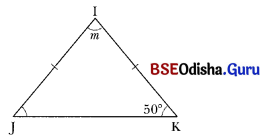
Solution:
Given, IJ = IK, ∠IKJ = 50°, ∠JIK = m
We know that in an isosceles triangle, angles opposite to equal sides are equal.
∴ ∠IKJ = ∠IJK = 50°
Now, sum of all the angles = 180°
⇒ ∠JIK + ∠IKJ + ∠IJK = 180°
⇒ m + 50° + 50° = 180°
⇒ m + 100° = 180°
⇒ m = 180°- 100° = 80°
Thus, the value of m is 80°.
Question 6.
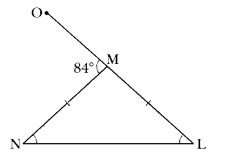
In the given figure, if ∠NMO = 84° and LM = MN, then find the values of ∠N and ∠L.
Solution:
Given, ∠NMO = 84° and LM = MN
We know that in an isosceles triangle, angles opposite to equal sides are equal.
∴ ∠N = ∠L ………. (i)
In the given figure, ∠NMO = 84° is an exterior angle.
And, ∠N and ∠L are two interior opposite angles to ∠NMO.
We know,
Exterior angle = Sum of two interior opposite angles
∴ ∠NMO = ∠N + ∠L
⇒ 84° = ∠N + ∠N [Using (i)]
⇒ 2∠N = 84° ⇒ ∠N = \(\frac{84^{\circ}}{2}\) = 42°
Thus, ∠N = ∠L = 42°
Question 7.
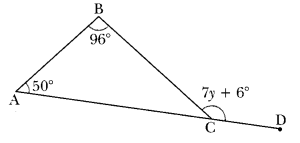
In the given figure, find the value of y.
Solution:
In the given figure, ∠BCD is an exterior angle.
And, ∠BAC and ∠ABC are two interior opposite angles to ∠BCD.
We know, Exterior angle = Sum of two interior opposite angles
∴ ∠BCD = ∠BAC + ∠ABC
⇒ 7y + 6° = 50° + 96°
⇒ 7v + 6° = 146°
⇒ 7y = 146° – 6° = 140°
⇒ y = \(\frac{140^{\circ}}{7}\) = 20°
Thus, the value of y is 20°.
Question 8.
In ∆PQR, ZQ is thrice of ∠P and ∠R is twice of sum of ∠P and ∠Q. Find the angles.
Solution:
Let ∠P be x. Then,
∠Q = 3 x, ∠P = 3x
and ∠R = 2(∠P + ∠Q) = 2(x + 3x) = 2 × 4x = 8x
We know that sum of all the angles in a triangle is 180°.
∴ ∠P + ∠Q + ∠R = 180°
⇒ x + 3x + 8x = 180°
⇒ 12x = 180°
⇒ x = \(\frac{180^{\circ}}{12}\) = 15°
Thus, ∠P = x = 15°, ∠Q = 3x = 3 × 15° = 45° and ∠R = 8x = 8 × 15° = 120°
A Tale of Three Intersecting Lines Class 7 Long Question Answer
Question 1.
Mrs. Roy gave straws of length 21 cm to her students and asked them to cut the straw to get three pieces, which can be used to form each of the three types of triangles. The lengths of the three pieces were supposed to be whole numbers (1, 2, 3, …) only. Based on these criteria, write any one possible combination of straw lengths in Column 3 of the below table.
| Column 1 | Column 2 | Column 3 |
| Type of triangle | Side lengths (cm) | |
| (a) | Scalene triangle | |
| (b) | Isosceles triangle | |
| (c) | Equilateral triangle |
Solution:
We know that if a given set of three lengths satisfies the triangle inequality (each length < sum of the other two lengths), then a triangle exists having those as side lengths.
(a) If all three sides of a triangle are different in length, then it is called a scalene triangle.
Thus, the possible sets of side lengths are:
(i) 2 cm, 9 cm and 10 cm
(ii) 3 cm, 8 cm and 10 cm
(iii) 4 cm, 7 cm and 10 cm
(iv) 4 cm, 8 cm and 9 cm
(v) 5 cm, 6 cm and 10 cm
(vi) 5 cm, 7 cm and 9 cm
(vii) 6 cm, 7 cm and 8 cm
(b) If any two sides of a triangle are equal in length, then it is called an isosceles triangle.
Thus, the possible sets of side lengths are:
(i) 6 cm, 6 cm and 9 cm
(ii) 8 cm, 8 cm and 5 cm
(iii) 9 cm, 9 cm and 3 cm
(iv) 10 cm, 10 cm and 1 cm
(c) If all three sides of a triangle are equal in length, then it is called an equilateral triangle. Thus, the possible set of side lengths is 7 cm, 7 cm, 7 cm.
Question 2.
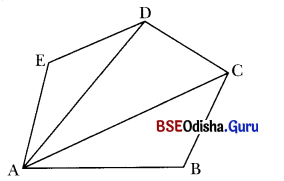
In the given figure, find ∠EAB + ∠ABC + ∠BCD + ∠CDE + ∠DEA.
Solution:
We know that the sum of angles of a triangle is 180°.
∴ In ∆ABC, we have
∠CAB + ∠ABC + ∠BCA = 180° ………… (i)
In ∆ACD, we have
∠ACD + ∠CDA + ∠DAC = 180° ………. (ii)
And in AADE, we have
∠ADE + ∠DEA + ∠EAD = 180° ……….. (iii)
Adding (i), (ii) and (iii), we get
∠CAB + ∠ABC + ∠BCA + ∠ACD + ∠CDA + ∠DAC + ∠ADE + ∠DEA + ∠EAD = 180° + 180° + 180°
⇒ (∠EAD + ∠DAC + ∠CAB) + ∠ABC + (∠BCA + ∠ACD) + (∠CDA + ∠ADE) + ∠DEA = 540°
⇒ ∠EAB + ∠ABC + ∠BCD + ∠CDE + ∠DEA = 540°
[∵ ∠EAD + ∠DAC + ∠CAB = ∠EAB, ∠BCA + ∠ACD = ∠BCD and ∠CDA + ∠ADE = ∠CDE]
Question 3.
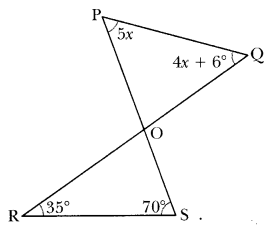
Two line segments PS and QR intersect at O. Joining PQ and SR, we get two triangles, ∆POQ and ∆ROS as shown in the figure. Find the values of ∠P and ∠Q.
Solution:
In ∆ROS, ∠R = 35° and ∠S = 70°
We know that sum of all the angles in a triangle is 180°.
∴ ∠R + ∠ROS + ∠S = 180°
⇒ 35° + ∠ROS + 70° = 180°
⇒ ∠ROS + 105° = 180°
⇒ ∠ROS = 180° – 105° = 75°
Since ∠ROS and ∠POQ are vertically opposite angles, ∠ROS = ∠POQ = 75°.
Now, in ∆POQ, ∠P = 5x, ∠POQ =75° and ∠Q = 4x + 6°
We know that sum of all the angles in a triangle is 180°.
∴ ∠P + ∠POQ + ∠Q = 180°
⇒ 5i + 75° + 4x + 6° = 180°
⇒ 9x + 81° = 180°
⇒ 9x = 180° – 81° = 99°
⇒ x = \(\frac{99^{\circ}}{9}\) = 11°
Thus, ∠P = 5x = 5 × 11° = 55° and ∠Q = 4x + 6° = 4 × 11° + 6° = 44° + 6° = 50°
Question 4.
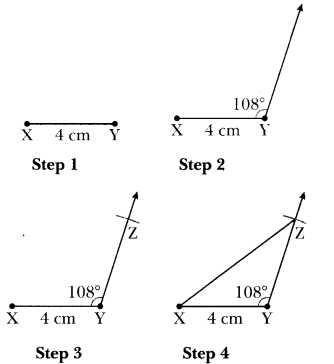
Construct a triangle ∆XYZ with XY = 4 cm, YZ = 7 cm and ∠Y = 108°.
Solution:
Given, in ∆XYZ, XY = 4 cm, YZ = 7 cm and ∠Y = 108°
Steps of construction of ∆XYZ are as follows:
Step 1: Using a ruler, draw a line segment XY, 4 cm long.
Step 2: Using protractor, draw the given vertex angle, ∠Y = 108°.
Step 3: On the new arm created from point F, mark a point Z such that YZ = 7 cm using a ruler and a compass.
Step 4: Using a ruler, connect points X and Z to complete the required triangle XYZ.
Question 5.
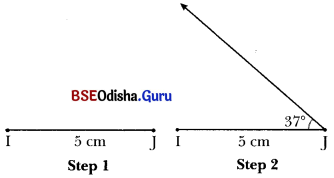
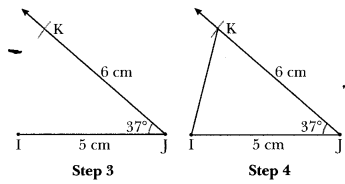
Construct a triangle IJK if IJ = 5 cm, JK = 6 cm and included angle between sides IJ and JK is 37°.
Solution:
Given, in ∆IJK, IJ = 5 cm, JK = 6 cm and included angle between sides IJ and JK is 37°.
Steps of construction of ∆IJK are as follows:
Step 1: Using a ruler, draw a line segment IJ of 5 cm length.
Step 2: Using protractor, draw the given vertex angle, ∠J = 37°.
Step 3: On the new arm created from point K mark a point K such that JK = 6 cm using a ruler anti a compass.
Step 4: Using a ruler, connect points I and K to complete the triangle IJK.
Question 6.
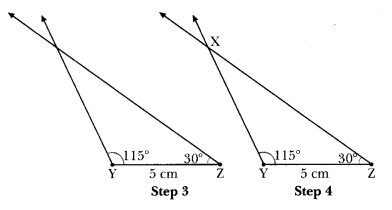
Construct a triangle XYZ with ∠Z = 30°, ∠Y = 115° and YZ = 5 cm.
Solution:
Given, in ∆XYZ, ∠Z = 30°, ∠Y = 115° and YZ = 5 cm
Steps of construction of ∆XYZ are as follows:
Step 1: Using a ruler, draw a line segment YZ of 5 cm length.
Step 2: Using protractor, draw the given vertex angle, ∠Y = 115°.
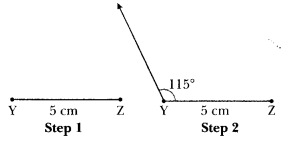
Step 3: Using protractor, draw the given vertex angle, ∠Z = 30°.
Step 4: Mark the intersecting point of two new lines (arms of angles) as X. Thus, the required triangle, ∆XFZ is constructed.