
Students can refer to BSE Odisha Class 7 Math Solution and Ganita Prakash Chapter 5 Parallel and Intersecting Lines Class 7 Question Answer to understand textbook questions step by step.
Class 7 Maths Chapter 5 Parallel and Intersecting Lines Solutions
Ganita Prakash Class 7 Chapter 5 Solutions
Class 7 Maths Ganita Prakash Chapter 5 Solutions Parallel and Intersecting Lines
Question 1.
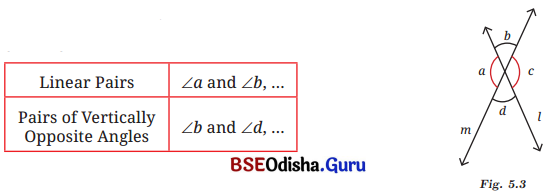
List all the linear pairs and vertically opposite angles you observe in the given figure:
Solution:
We know that adjacent angles formed by two intersecting lines, are called linear pairs. Linear pairs always add up to 180°.
And opposite angles formed by two intersecting lines, are called vertically opposite angles. Vertically opposite angles are always equal to each other.
| Linear pairs | ∠a and ∠b, ∠b and ∠c, ∠c and ∠d, ∠d and ∠a |
| Pairs of Vertically Opposite Angles | ∠b and ∠d, ∠a and ∠c |
Question 2.
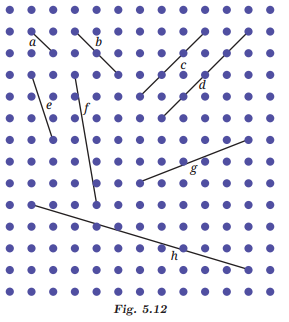
Using your sense of how parallel lines look, try to draw lines parallel to the line segments on this dot paper.
(a) Did you find it challenging to draw sorne of them?
(b) Which ones?
(c) How did you do ii?
Solution:
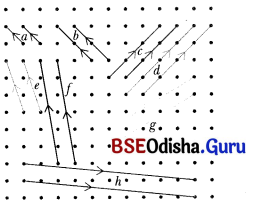
(a) Yes, some line segments are a litle more difficult to draw than others.
(b) Line segments e,f. h and g.
(c) Lines parallel to a given line segment are drawn by keeping thern equidistant from the given line segment.

Question 3.
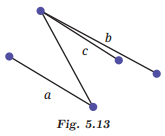
In the figure, which line is parallel to line a — line b or line c? How do you decide this?
Solution:
Line c is parallel to line a because the corresponding dots on these lines are equidistant from each other. So, they do not intersect, no matter how far they are extended.
Question 4.
Can you draw a line parallel to l, that goes through point A? How will you do it with the tools from your geometry box? Describe your method.
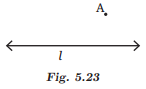
Solution:
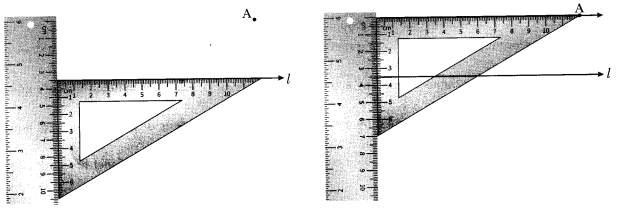
Tools needed: Ruler, Set-squares (right-angled triangle), Pencil Steps of Construction:
Step 1: Place the set square so that one side is along the line l.
Step 2: Hold the ruler against the other side of the set square (the ruler won’t move).
Step 3: Slide the set square along the ruler until one side reaches point A.
Step 4: Draw a line along the edge of the set square through point A.
Step 5: This new line is parallel to line l and passes through point A.
Question 5.
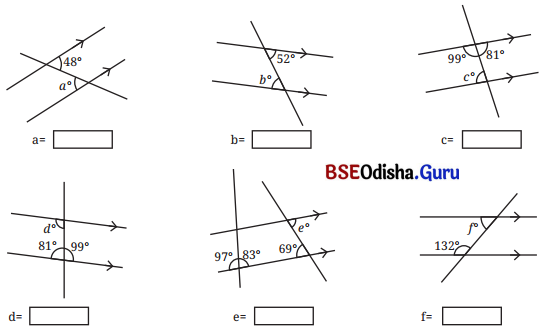
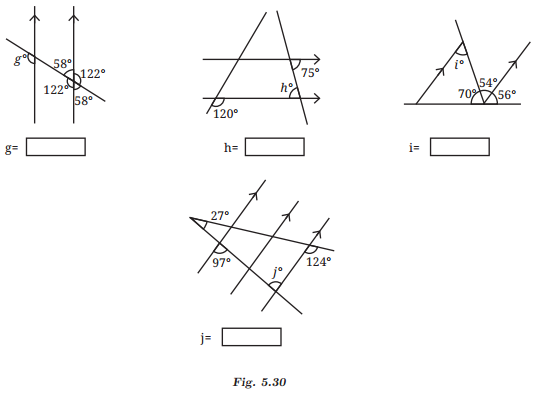
Find the angles marked below.
Solution:
(i) Since alternate interior angles formed by a transversal intersecting a pair of parallel lines are equal, we obtain a = 48°.
(ii) Since alternate interior angles formed by a transversal intersecting a pair of parallel lines are equal, we obtain b = 52°.
(iii) Since alternate interior angles formed by a transversal intersecting a pair of parallel lines are equal, we obtain c = 81°.
(iv) Since alternate interior angles formed by a transversal intersecting a pair of parallel lines are equal, we obtain d = 99°.
(v) Since alternate interior angles formed by a transversal intersecting a pair of parallel lines are equal, we obtain e = 69°.
(vi) Since the sum of interior angles on the same side of a transversal intersecting a pair of parallel lines is always equal to 180°,f + 132° = 180° ⇒ f = 180°- 132° ⇒ f = 48°
(vii) Since corresponding angles formed by a transversal intersecting a pair of parallel sides are equal, we obtain g = 122°.
(viii) Since alternate interior angles formed by a transversal intersecting a pair of parallel lines are equal, we obtain h = 75°.
(ix) Since alternate interior angles formed by a transversal intersecting a pair of parallel lines are equal, we obtain i = 54°.
(x) Since alternate interior angles formed by a transversal intersecting a pair of parallel lines are equal, we obtain j = 97°.
Question 6.
In the figures below, what angles do x and y stand for?
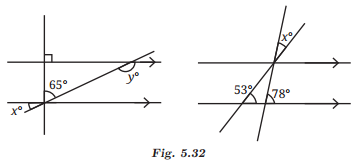
Solution:
(i) The lines and angles are marked as shown in the figure.
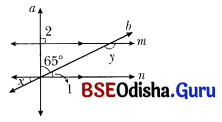
Line m is parallel to line n and line a is a transversal.
∴ ∠2 = 65° + ∠1 [∵ Corresponding angles]
⇒ 90° = 65° + ∠1
⇒ ∠1 = 90°- 65°
⇒ ∠1 = 25°
And, ∠1 = x = 25° [∵ Vertically opposite angles]
Also, line m is parallel to line n and line b is a transversal.
∴ ∠1 +y = 180° [∵ Sum of co-interior angles = 180°]
⇒ 25° + y = 180° [∵ ∠1 = 25°]
⇒ y = 180° – 25° ⇒ y = 155°
Thus, the values of x and y are 25° and 155°, respectively.
(ii) The lines and angles are marked as shown in the figure.
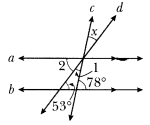
Line a is parallel to line b and line d is a transversal.
∴ ∠2 = 53° [∵ Alternate interior angles]
Also, line a is parallel to line b and c is a transversal.
∴ ∠1 + ∠2 = 78° [∵ Alternate interior angles]
⇒ ∠1 + 53° = 78° [∵ ∠2 = 53°]
⇒ ∠1 = 78°- 53°
⇒ ∠1 = 25°
Therefore, ∠1 = x = 25° [∵ Vertically opposite angles]
Question 7.
What is the measure of ∠NOP in the figure?
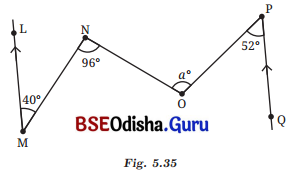
[Hint: Draw lines parallel to LM and PQ through points N and O.]
Solution:
Lines parallel to LM and PQ through points N and O are drawn and angles are marked as shown in the figure.
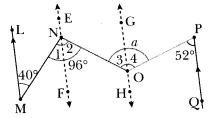
Since LM is parallel to EF and MN is a transversal,
∠1 = 40° [∵ Alternate interior angles]
Now, ∠1 + ∠2 = 96°
⇒ 40° + ∠2 = 96° [∵ ∠1 = 40°]
⇒ ∠2 = 96° – 40°
⇒ ∠2 = 56°
Since EF is parallel to GH and AT is a transversal,
∠2 = ∠3 = 56° [∵ Alternate interior angles]
Also, GH is parallel to PQ and OP is a transversal.
∴ ∠4 = 52° [∵ Alternate interior angles]
So, a = ∠3 + ∠4
⇒ a = 56° + 52° ⇒ a = 108°
Thus, ∠NOP = 108°.
InText Questions
Question 1.
Can two straight lines intersect at more than one point?
Solution:
No, two straight lines cannot intersect at more than one point. If two lines intersect at more than one point, then they are coincident lines.
Question 2.
Take a plain square sheet of paper (use a newspaper for this).
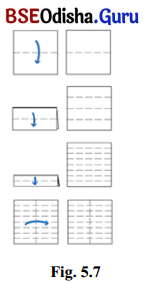
(i) How would you describe the opposite edges of the sheet? They are ________ to each other.
(ii) How would you describe the adjacent edges of the sheet? The adjacent edges are ________ to each other. They meet at a point. They form right angles.
(iii) Fold the sheet horizontally in half. A new line is formed (see figure).
How many parallel lines do you see now?
(iv) Make one more horizontal fold in the folded sheet. How many parallel lines do you see now?
(v) What will happen if you do it once more? How many parallel lines will you get? Is there a pattern? Check if the pattern extends further, if you make another horizontal fold.
(vi) Make a vertical fold in the square sheet. This new vertical line is _________ to the previous horizontal lines.
(vii) Fold the sheet along a diagonal. Can you find a fold that creates a line parallel to the diagonal line?
Solution:
(i) They are parallel to each other.
(ii) The adjacent edges are perpendicular to each other.
(iii) We see three parallel horizontal lines — the top edge, the fold and the bottom edge. The new horizontal line is perpendicular to the vertical edges of paper.
(iv) On folding the paper horizontally one more time, we see five parallel horizontal lines.
(v) On folding the paper horizontally once more, we will get nine parallel lines. The number of horizontal parallel lines follow the sequence:
1st fold → 3 lines
2nd fold → 5 lines
3rd fold → 9 lines and so on
So, after each fold, the number of horizontal lines increases as folding doubles the sections and add extra fold lines. The pattern continues as we fold more.
(vi) This new vertical line is perpendicular to the previous horizontal lines.
(vii) Yes, we can make a fold parallel to the diagonal by folding the sheet in the same slanting direction at equal angles or by folding a smaller triangle inside the square.
Parallel and Intersecting Lines Class 7 Extra Questions
Parallel and Intersecting Lines Class 7 Very Short Question Answer
Question 1.
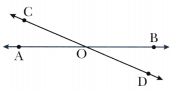
In the given figure, write the vertically opposite angles of ∠AOD and ∠AOC.
Solution:
We know that when two lines intersect, the angles opposite to each other are called vertically opposite angles. They are formed without sharing a common arm and are always equal.
Thus, in the given figure, ∠BOC is vertically opposite angle of ∠AOD and ∠BOD is vertically opposite angle of ∠AOC.
Question 2.
Find the complement of each of the following angles:
(i) 28°
(ii) 66°
(iii) 75°
(iv) 80°
Solution:
We know that complement of angle x° is (90° – x°).
(i) Complement of 28° = 90° – 28° = 62°
(ii) Complement of 66° = 90° – 66° = 24°
(iii) Complement of 75° = 90° – 75° = 15°
(iv) Complement of 80° = 90° – 80° = 10°
Question 3.
Find the supplement of each of the following angles:
(i) 28°
(ii) 95°
(iii) 130°
(iv) 155°
Solution:
We know that supplement of angle x° is (180° – x°).
(i) Supplement of 28° = 180° – 28° = 152°
(ii) Supplement of 95° = 180° – 95° = 85°
(iii) Supplement of 130° = 180° – 130° = 50°
(iv) Supplement of 155° = 180° – 155° = 25°
Question 4.
Find the complement of each of the following angles:
(i) 32°
(ii) 72°
(iii) 68°
(iv) 20°
Solution:
We know that complement of angle x° is (90 – x)°.
(i) Complement of 32° = 90° – 32° = 58°
(ii) Complement of 72° = 90° – 72° = 18°
(iii) Complement of 68° = 90° – 68° = 22°
(iv) Complement of 20° = 90° – 20° = 70°
Question 5.
Find the supplement of each of the following angles:
(i) 25°
(ii) 92°
(iii) 142°
(iv) 165°
Solution:
We know that supplement of angle x° is (180 – x)°.
(i) Supplement of 25° = 180° – 25° = 155°
(ii) Supplement of 92° = 180° – 92° = 88°
(iii) Supplement of 142° = 180° – 142° = 38°
(iv) Supplement of 165° =180° – 165° = 15°
Question 6.
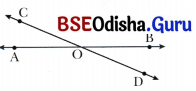
In the given figure, write the angles that form a linear pair with ∠AOD and with ∠BOC.
Solution:
We know that the adjacent angles formed by two lines intersecting each other, are called linear pair of angles. Linear pairs always add up to 180°.
In the given figure, ∠AOC and ∠BOD form a linear pair of angles with ∠AOD.
∠AOC and ∠BOD form a linear pair of angles with ∠BOC.
Question 7.
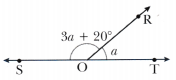
In the given figure, find the value of a.
Given,
∠SOR = 3a + 20° and ∠ROT = a
From the given figure, we can say that ∠SOR and ∠ROT form a linear pair.
∴ ∠SOR + ∠ROT = 180°
⇒ 3a + 20° + a = 180°
⇒ 4a = 160° ⇒ a = 40°
Question 8.
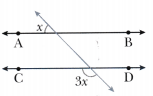
Find the value of x in the following figure, if AB is parallel to CD.
Solution:
Given, AB is parallel CD.
Since x and 3x are co-exterior angles on the same side of transversal, they add up to 180°.
∴ x + 3x = 180° ⇒ 4x = 180°
⇒ x = \(\frac{180^{\circ}}{4}\) ⇒ x = 45°
Question 9.
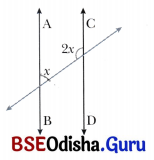
Find the value of x in the following figure, if AB is parallel to CD.
Solution:
Given, AB is parallel CD.
Since x and 2x are interior angles on the same side of transversal, they add up to 180°.
∴ x + 2x = 180°
⇒ 3x = 180° ⇒ x = 60°
Parallel and Intersecting Lines Class 7 Short Question Answer
Question 1.
Identify the complementary and supplementary pairs of angles from the following pairs:
(i) 42°, 48°
(ii) 85°, 95°
(iii) 30°, 60°
(iv) 135°, 45°
Solution:
We know that if the sum of the measures of two angles is 90°, then the angles are called complementary angles and if the sum of the measures of two angles is 180°, then the angles are called supplementary angles.
(i) The given angles are 42° and 48°.
Now, sum of given angles = 42° + 48° = 90°
Thus, the given angles are complementary angles.
(ii) The given angles are 85° and 95°.
Now, sum of given angles = 85° + 95° = 180°
Thus, the given angles are supplementary angles.
(iii) The given angles are 30° and 60°.
Now, sum of given angles = 30° + 60° = 90°
Thus, the given angles are complementary angles.
(iv) The given angles are 135° and 45°.
Now, sum of given angles = 135° + 45° = 180°
Thus, the given angles are supplementary angles.
Question 2.
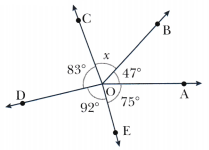
In the given figure, find the value of x.
Solution:
Given, ∠AOB = 47°, ∠BOC = x, ∠COD = 83°, ∠DOE = 92° and ∠EOA = 75°
Now, as ∠AOB, ∠BOC, ∠COD, ∠DOE and ∠EOA are angles at a point, they add up to 360°.
∴ ∠AOB + ∠BOC + ∠COD + ∠DOE + ∠EOA = 360°
⇒ 47° + x + 83° + 92° + 75°= 360°
⇒ 297° + x = 360°
⇒ x = 360° – 297° = 63°
Thus, the value of x is 63°.
Question 3.
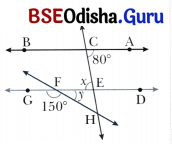
In the given figure, line AB is parallel to line DG. Find the value of x + y.
Solution:
Given, line AB is parallel to line DG.
∴ ∠ACE = ∠CEG
[∵ Alternate interior angles are equal]
⇒ x = 80° [∵ ∠ACE = 80° and ∠CEF = x]
Since ∠GFH and ∠EFH form linear pair, they add up to 180°.
∴ ∠GFH + ∠EFH = 180°
⇒ 150° + y = 180° [∵ ∠GFH = 150°]
⇒ y = 180° – 150° = 30°
∴ x + y = 80° + 30° = 110°
Question 4.
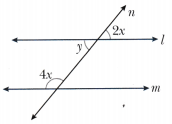
In the given figure, l is parallel to m. Find the value of x and y.
Solution:
Given, l is parallel to m and n is transversal to l and m.
Since 2x and y are vertically opposite angles, they are equal.
∴ y = 2x …(i)
Since 4x and y are interior angles on the same side of the transversal, they add up to 180°.
∴ 4x + y = 180°
⇒ 4x + 2x = 180° [From (i)]
⇒ 6x = 180° ⇒ x = 30°
Substituting the value of x in (i), we get
y = 2 × 30° = 60°
Parallel and Intersecting Lines Class 7 Long Question Answer
Question 1.
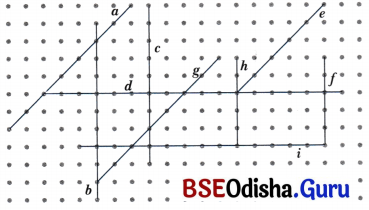
Which lines appear to be perpendicular to each other in the given figure?
Solution:
When two lines intersect and the angles formed are 90° (i.e. all four angles are equal), the lines are said to be perpendicular to each other.
In the given figure, since line i is parallel to line d, perpendicular to any of these lines is also perpendicular to other. Therefore, lines b, c, h and /are perpendicular to lines i and d.
Similarly, lines d and i are perpendicular to lines b, c, h andf.
Question 2.
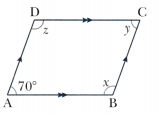
In the given figure, AB is parallel to CD and AD is parallel to BC. Find the values of x, y and z.
Solution:
Given, AB || CD, AD ||
BC and ∠BAD = 70°.
As AD || BC and AB is transversal, ∠ABC and ∠BAD are co-interior angles.
∴ ∠ABC + ∠BAD = 180°
⇒ x + 70° = 180° [∵ ∠BAD = 70°]
⇒ x = 180°- 70° = 110°
Now, as AB || DC and AD is transversal, ∠ADC and ∠BAD are co-interior angles.
∴ ∠ADC + ∠BAD = 180°
⇒ z + 70° = 180° [∵ ∠BAD = 70°]
⇒ z = 180°- 70° = 110°
Also, as AD || BC and DC is transversal, ∠ADC and ∠BCD are co-interior angles.
∴ ∠ADC + ∠BCD = 180°
⇒ 110°+ y = 180° [∵ ∠ADC =110°]
⇒ y = 180°- 110° = 70°
Question 3.
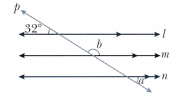
In the following figure, find the value of each marked angle.
Solution:
Given, line l || m || n.
Let point P lie on line l, point R lie on line p and the point of intersection of lines p and l be Q, as shown in the figure.
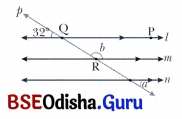
Since ∠PQR and 32° are vertically opposite angles, they are equal.
∴ ∠PQR = 32°
As l || m, ∠b and ∠PQR are interior angles on the same side of transversal p.
∴ ∠b + ∠PQR = 180°
⇒ ∠b + 32° = 180° [∵ ∠PQR = 32°]
⇒ ∠b = 180°- 32° = 148°
As l || n, ∠a and ∠PQR are corresponding angles.
∴ ∠a = ∠PQR
⇒ ∠a = 32° [∵ ∠PQR = 32°]
Question 4.
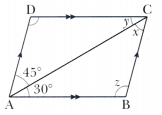
In the following figure, AB is parallel to CD and AD is parallel to BC. Find the values of x, y and z.
Solution:
Given, AB || CD, AD || BC, ∠DAC = 45° and ∠BAC = 30°.
As AB || CD anddC is transversal, ∠DAC and ∠ACB are alternate interior angles.
∴ ∠ACB = ∠DAC ⇒ x = 45°
[∵ ∠DAC = 45° and ∠ACB = x]
As AB || CD and AC is transversal, ∠BAC and ∠ACD are alternate interior angles.
∴ ∠ACD = ∠BAC ⇒ y = 30°
[∵ ∠BAC = 30° and ∠ACD = y]
As AD || BC and AB is transversal. ∠DAB and ∠ABC are co-interior angles.
∴ ∠DAB +∠ABC = 180°
⇒ ∠DAC + ∠CAB + ∠ABC = 180°
[∵ ∠DAB = ∠DAC + ∠CAB]
⇒ 45° + 30° + z = 180°
[∵ ∠DAC = 45°, ∠CAB = 30° and ∠ABC = z]
⇒ z = 180°- 75° = 105°
Parallel and Intersecting Lines Class 7 Case Based Questions
Question 1.
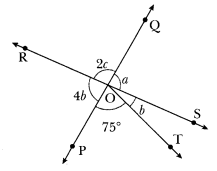
In the given figure, two straight lines PQ and RS intersect each other at O such that ∠POT = 75°.
Based on the above information, answer the following questions:
(i) Find the value of b.
(ii) Find the value of a.
(iii) Find the value of c.
Solution:
(i) Given, ∠ROP = 4b, ∠POT = 75°, ∠TOS = b
Here, ∠ROS = 180°
[Since ∠ROS is a straight angle]
⇒ ∠ROP + ∠POT + ∠TOS = 180°
⇒ 4b + 75° + b = 180°
⇒ 5b + 75° = 180°
⇒ 5b = 180° – 75° = 105°
b = \(\frac{105^{\circ}}{5}\) = 21°
Thus, the value of b is 21°.
(ii) Since ∠ROP and ∠QOS are vertically opposite angles, they are equal.
∴ ∠QOS = ∠ROP
⇒ a = 4b
⇒ a = 4 × 21° [∵ b = 21°]
⇒ a = 84°
Thus, the value of a is 84°.
(iii) Since ∠QOS and ∠QOR form a linear pair, they add up to 180°.
∴ ∠QOS + ∠QOR = 180°
⇒ a + 2c = 180°
⇒ 84° + 2c =180° [∵ a = 84°]
⇒ 2c = 180° – 84° = 96°
c = \(\frac{96^{\circ}}{2}\) = 48°
Thus, the value of c is 48°.
Question 2.
In a class, a teacher asked a student to draw three lines on the board. The student draws the lines on the board as shown.
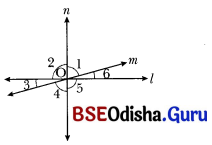
The line l is perpendicular to line n and ∠1 = 75°.
Based on the above information answer the following questions:
(i) What is the measure of ∠6?
(ii) What is the measure of ∠5?
(iii) What is the measure of ∠3?
(iv) What is the sum of the measure of ∠2 and ∠1?
Solution:
(i) Given, line l is perpendicular to line n.
∴ ∠1 + ∠6 = 90°
⇒ 75° + ∠6 = 90° [∵ ∠1 = 75°]
⇒ ∠6 = 90° – 75° = 15°
(ii) Given, line l is perpendicular to line n.
∴ ∠5 = 90°
(iii) We have, ∠6 = 15°
Since ∠3 and ∠6 are vertically opposite angles, they are equal.
∴ ∠3 = ∠6 = 15°
(iv) Given, line l is perpendicular to line n. So, ∠2 is equal to 90°.
∴ ∠1 + ∠2 = 75° + 90° = 165°