
Students can refer to BSE Odisha Class 6 Math Solution and Ganita Prakash Chapter 1 Patterns in Mathematics Class 6 Question Answer to understand textbook questions step by step.
Class 6 Maths Chapter 1 Patterns in Mathematics Solutions
Ganita Prakash Class 6 Chapter 1 Solutions
Class 6 Maths Ganita Prakash Chapter 1 Solutions Patterns in Mathematics
Question 1.
Why are 1, 3, 6, 10, 15, … called triangular numbers? Why are 1, 4, 9, 16, 25, … called square numbers or squares? Why are 1, 8, 27, 64, 125, … called cubes?
Solution:
As the dot representation of sequence 1,3, 6, 10, 15, … forms triangles, it is called triangular numbers sequence. As the dot representation of sequence 1,4, 9, 16, 25, … forms squares, it is called square numbers sequence.
As the dot representation of sequence 1,8, 27, 64, 125, … forms cubes, it is called cube numbers sequence.

Question 2.
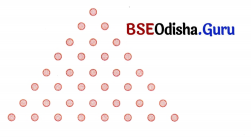
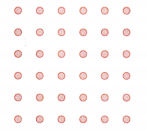
You will have noticed that 36 is both a triangular number and a square number! That is, 36 dots can be arranged perfectly both in a triangle and in a square. Make pictures in your notebook illustrating this!
This shows that the same number can be represented differently and play different roles, depending on the context. Try representing some other numbers pictorially in different ways!
Solution:
Representation of 36 as a triangular number:
Representation of 36 as a square number:
Representation of 10 as even number:

Representation of 10 as triangular number:

Question 3.
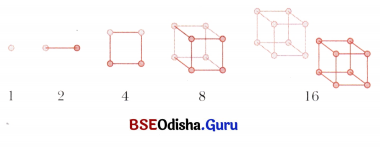
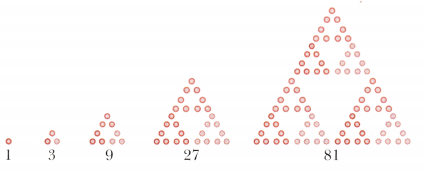
Can you think of pictorial way to visualise the sequence of Powers of 2? Powers of 3?
Solution:
Powers of 2 can be visualised as:
Powers of 3 can be visualised as:
Question 4.
Can you find a similar pictorial explanation for why adding counting numbers up and down, i.e., 1, 1+2 + 1,1+2 + 3 + 2 + 1, … , gives square numbers?
Solution:
Yes,
As we can see, the dot representation of the addition of counting numbers up and down forms the dot representation of square numbers.
Question 5.
Which sequence do you get when you start to add the All 1’s sequence up? What sequence do you get when you add the All l’s sequence up and down?
Solution:
Adding all 1 ’s sequence up
1 = 1
1 + 1 = 2
1 + 1 + 1 = 3
1 + 1 + 1 + 1 = 4 and so on.
Here, we get a sequence of counting numbers i.e. 1, 2, 3, 4, … .
Adding all l’s sequence up and down 1 = I
1 + 1 + 1 = 3
1 + 1 + 1 + 1 + 1 = 5 and so on.
Here, we get a sequence of odd numbers.
Question 6.
What happens when you add up pairs of consecutive triangular numbers? That is, take 1 + 3, 3 + 6, 6 + 10, 10 + 15,… ? Which sequence do you get?
Solution:
Adding up pairs of consecutive triangular numbers, we get
1 + 3 = 4;
3 + 6 = 9;
6 + 10 = 16;
10 + 15 = 25 and so on.
Here, we get a sequence of square numbers.
Question 7.
What happens when you multiply the triangular numbers by 6 and add 1 ? Which sequence do you get?
Solution:
Triangular numbers are 1, 3, 6, 10, 15, …
On multiplying triangular numbers by 6 and add 1 to it, we get
1 × 6 + 1 = 7;
3 × 6 + 1 = 19;
6 × 6 + 1 = 37;
10 × 6 + 1 = 61;
15 × 6 + 1 = 91 and so on.
Hence, we get a sequence of hexagonal numbers.
InText Questions
Question 1.
Observe the pattern given below:
1 = 1
1 + 3 = 4
1 + 3 + 5 = 9
Why does this happen? Do you think it will happen forever?
Solution:
The sequence of odd numbers is: 1, 3, 5, 7, 9, 11,…
Sum of first 1 odd number = 1 = 12
Sum of first 2 odd numbers = 1 + 3 = 4 = 22
Sum of first 3 odd numbers = 1 + 3 + 5 = 9 = 32
Sum of first 4 odd numbers =1 + 3 + 5 + 7 = 16 = 42
Sum of first 5 odd numbers =1+3 + 5 + 7 + 9 = 25 = 52
Sum of first 6 odd numbers =1 + 3 + S + 7 + 9 + 11 = 36 = 62
Each time we add another odd number, the total becomes a perfect square.
Since the sequence of odd numbers keeps going forever, and the sum of the first n odd numbers is always n2, this pattern will continue forever.
Question 2.
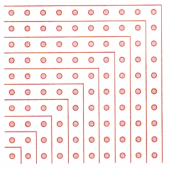
Pictorially represent and find the sum of the first 10 odd numbers.
Solution:
From figure, it is clear that
1 + 3 + 5 + 7 + 9 + 11 + 13 + 15 + 17 + 19 = 100 = 102
Patterns in Mathematics Class 6 Extra Questions
Patterns in Mathematics Class 6 Very Short Question Answer
Question 1.
Find the next term of the sequence 1, 4, 9, 16,… .
Solution:
Given sequence is 1, 4, 9, 16, …, i.e. 12, 22, 32, 42, …, which is a sequence of squares.
So, next term, i.e. fifth term = 52 = 25
Question 2.
What is the sum of first 10 terms of the sequence of counting numbers?
Solution:
We know, the sequence of counting numbers is 1, 2, 3, 4, ….
Now, sum of first 10 terms of the sequence of counting numbers
= 1 + 2 + 3 + 4 + 5 + 6 + 7 + 8 + 9 + 10 = 55
Question 3.
Identify the rule in the following number pattern and write the missing entries:
111 × 11 = 1221
121 × 11 = 1331
131 × 11 = 1441
141 × _____ = ______
_____ × 11 = 1661
161 × 11 = ______
Solution:
We observe that the first number on the left side increases by 10 each time: 111, 121, 131, 141, 151, 161,…
The result also increases by 110 each time: 1221, 1331, 1441, 1551, 1661, 1771, …
The first number is multiplied by 11 each time.
Thus, the missing numbers are as follows:
141 × 11 = 1551;
151 × 11 = 1661;
161 × 11 = 1771
Question 4.
Find the next term of the sequence 2 + 1, 2 + 2, 2 + 3, 2 + 4,… .
Solution:
Given sequence is 2 + 1, 2 + 2, 2 + 3, 2 + 4, ….
First term = 2 + 1
Second term = 2 + 2
Third term = 2 + 3
Fourth term = 2 + 4
So, next term, i.e. fifth term = 2 + 5
Question 5.
Find the next term of the sequence 2, 6, 12, 20, …
Solution:
C liven sequence is 2, 6, 12, 20, ….
Here, 2 = 1 × 2
6 = 2 × 3
12 = 3 × 4
20 = 4 × 5
So, next term = 5 × 6 = 30
Question 6.
Find the next term of the sequence 1, 3, 6, 10, 15,
Solution:
Given sequence is 1, 3, 6, 10, 15
First term = 1
Second term = 3 = 1 + 2 (First term + 2)
Third term = 6 = 3 + 3 (Second term + 3)
Fourth term = 10 = 6 + 4 (Third term + 4)
Fifth term = 15 = 10 + 5 (Fourth term + 5)
So, next term = Fifth term + 6 = 15 + 6 = 21
Question 7.
What is the sum of first 12 terms of the sequence of all 1s?
Solution:
We know, the sequence of all 1 s is 1, 1, 1, 1, ….
Now, sum of first 12 terms of the sequence of all 1s
= 1 + 1 + 1 + 1 + 1 + 1 + 1 + 1 + 1 + 1 + 1 + 1 = 12
Question 8.
What is the sum of first 6 terms of the sequence of odd numbers?
Solution:
The sequence of odd numbers is 1, 3, 5, 7
Now, sum of first 6 terms of the sequence of odd numbers = 1 + 3 + 5 + 7 + 9 + 11 = 36 = 62
Question 9.
Write the first 5 square numbers.
Solution:
We know, the sequence of square numbers is 1, 4, 9, 16, 25, 36, …….
So, the first 5 square numbers are 1, 4, 9, 16 and 25.
Question 10.
Write the first 4 triangular numbers.
Solution:
We know, the sequence of triangular numbers is 1, 3, 6, 10, 15, 21, 28, … .
So, the first 4 triangular numbers are 1, 3, 6 and 10.
Question 11.
Which sequence do you get on adding the counting numbers up?
Solution:
We know, the sequence of counting numbers is 1. 2, 3, 4, 5, … .
Now, on adding the counting numbers up, we get the following sequence:
1 = 1
1 + 2 = 3
1 + 2 + 3 = 6
1 + 2 + 3 + 4 = 10
1 + 2 + 3 + 4 + 5 = 15
So, the sequence is 1, 3, 6, 10, 15, …, which is the sequence of triangular numbers.
Patterns in Mathematics Class 6 Short Question Answer
Question 1.
Find the next term of the sequence 2, 16, 54, 128,
Solution:
Given sequence is 2, 16, 54, 128, ….
First term = 2 = 2 × 1 = 2 × 13
Second term = 16 = 2 × 8 = 2 × 23
Third term = 54 = 2 × 27 = 2 × 33
Fourth term = 128 = 2 × 64 = 2 × 43
So, next term, i.e. fifth term = 2 × 53 = 2 × 125 = 250
Question 2.
Can you identify numbers which are both triangular as well as square numbers? Find 2 such numbers.
Solution:
We know, the sequence of triangular numbers is 1, 3, 6, 10, 15, 21, 28, 36, 45, ….
And the sequence of squares is 1,4, 9, 16, 25, 36, 49, 64, 81, ….
So, 1 and 36 are both triangular as well as square numbers.
Question 3.
Observe the pattern shown below and write the next three steps:
1 × 9 + 2 = 11
12 × 9 + 3 = 111
123 × 9 + 4 = 1111
Solution:
We observe that
- On the left side, the first number starts at 1, then becomes 12, then 123, each time we add the next digit in order.
- We multiply by 9 each time.
- Then, we add next number (2, then 3, then 4)
- On the right side the answer is made of all 1 s and the number of Is is one more than the number of digits in starting number.
So, next three steps will be:
1234 × 9 + 5 = 11111
12345 × 9 + 6 = 111111
123456 × 9 + 7 = 1111111
Question 4.
Identify the pattern in the following number pattern and write the missing terms:
2178 × 4 = 8712
21978 × 4 = 87912
219978 × 4 = _______
_____ × 4 = 8799912
21999978 × 4 = ________
219999978 × ______ = 879999912
Solution:
In the first number, we start with 2178 and keep adding one more 9 before 78 in each step.
Then, we multiply the number by 4. The result is a number starting with 87, followed by the same number of 9s, and ending with 12.
The missing numbers are as follows:
2178 × 4 = 8712
21978 × 4 = 87912
219978 × 4 = 879912
2199978 × 4 = 8799912
21999978 × 4 = 87999912
219999978 × 4 = 879999912
Question 5.
Pairs of consecutive triangular numbers are added (i.e. 1 + 3, 3 + 6, …). Which sequence will you get on such addition? Write the 6th term of the new obtained sequence.
Solution:
We know, the sequence of triangular numbers is 1, 3, 6, 10, 15, 21, 28, … .
Now, on adding pairs of consecutive triangular numbers we get the following sequence:
1 + 3 = 4
3 + 6 = 9
6 + 10 = 16
10 + 15 = 25
15 + 21 = 36
21 + 28 = 49
So, the sequence is 4, 9, 16, 25, 36, 49, …, which represents the square numbers starting with 4.
Now, 6th term of the new obtained sequence is 49.
Question 6.
Which sequence do you get on adding the odd numbers up?
Solution:
We know, the sequence of odd numbers is 1, 3, 5, 7, 9, … .
Now, on adding the odd numbers up, we get the following sequence:
1 = 1
1 + 3 = 4
1 + 3 + 5 = 9
1 + 3 + 5 + 7 = 16
1 + 3 + 5 + 7 + 9 = 25
So, the sequence is 1,4, 9, 16, 25, …, which is the sequence of square numbers.
Patterns in Mathematics Class 6 Long Question Answer
Question 1.
What will happen if you multiply the triangular numbers by 6 and add 1? Which sequence do you get?
Solution:
We know, the sequence of triangular numbers is 1, 3, 6, 10, 15, 21, 28, 36, 45, … .
Now, if we multiply the triangular numbers by 6 and add 1, we get the following sequence:
1 × 6 + 1 = 6 + 1 = 7
3 × 6 + 1 = 18 + 1 = 19
6 × 6 + 1 = 36 + 1 = 37
10 × 6 + 1 = 60 + 1 = 61
15 × 6 + 1 = 90 + 1 = 91
So, the required sequence is 7, 19, 37, 61, 91, …, which represents hexagonal numbers starting with 7.
Question 2.
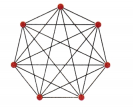
Find the number of line segments connecting any two distinct vertices of the polygon as shown in the figure.

Solution:
We know, in a complete graph, every pair of vertices is connected by a unique line segment. The number of line segments in a complete graph with n vertices is given by \(\frac{n(n-1)}{2}\).
For K7 (Heptagon):
Number of vertices = 7
∴ Number of line segments
= \(\frac{n(n-1)}{2}\) = \(\frac{7(7-1)}{2}\) = 7 × 3 = 21
Question 3.
Find the number of sides of a Koch Snowflake obtained after 5 iterations.
Solution:
To get from one shape to the next shape in the Koch Snowflake sequence, each line segment ‘_______’ is replaced by a speed bump ‘ ‘
‘

| Number of iterations | No. of sides |
| 0 | 3 = 3 × 40 |
| 1 | 12 = 3 × 41 |
| 2 | 48 = 3 × 42 |
| 3 | 192 = 3 × 43 |
| 4 | 768 = 3 × 44 |
Thus,
After 5 iterations, number of sides = 3 × 45 = 3 × 1024 = 3072.
Patterns in Mathematicse Class 6 Case Based Questions
Question 1.
Players wear different jersey numbers to help fans and broadcasters identify them, especially in games like cricket and football where they look similar on the field.
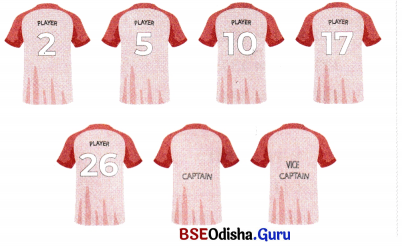
One day, Ashish went to the stadium to watch a cricket match. There, he observed the jersey numbers of some cricketers and found them to follow a sequence.
Based on the above information, answer the following questions:
(i) Write the rule for the sequence followed by the given numbers in words.
(ii) What will be the number on Captain’s jersey?
(iii) What will be the number on Vice-captain’s jersey?
Solution:
(i) Numbers on the jersey of players are given as
2 = 12 + 1;
5 = 22 + 1;
10 = 32 + 1;
17 = 42 + 1;
26 = 52 + 1
Rule of the sequence: n2 + 1; n = 1, 2, 3, …
(ii) Since captain is at 6th position, the number on his jersey is 62 + 1 = 36 + 1 = 37.
(iii) Since vice-captain is at 7th position, the number on his jersey is 72 + 1 = 49 + 1 = 50
Question 2.
In Ms. Rina’s class, each student is given a unique roll number. One day, while arranging the books in the library, she noticed that the roll numbers of the students returning books followed a specific number pattern. She found that the roll numbers were: 1, 2, 3, 5, 8, 13, …
Based on the above information, answer the following questions:
(i) Write the rule for the sequence followed by the given numbers.
(ii) What is the name of the number sequence followed by the given numbers?
(iii) What will be the roll number of the 10th student?
Solution:
The given numbers are 1, 2, 3, 5, 8, 13, …
(i) First number = 1
Second number = 2
Third number = 3 = 1 + 2
(First number + Second Number)
Fourth number = 5 = 2 + 3
(Second number + Third Number)
Fifth number = 8 = 3 + 5
(Third number + Fourth Number)
Sixth number = 13 = 5 + 8
(Fourth number + Fifth Number)
Therefore, the rule for the sequence is,
First number = 1, Second number = 2, any other number = sum of previous two numbers
(ii) The given numbers are known as Virahanka numbers.
(iii) Observing the pattern (from above)
Seventh number = Fifth number + Sixth number
= 8 + 13 = 21
Eighth number = Sixth number + Seventh number
= 13 + 21 = 34
Ninth number = Seventh number + Eighth number
= 21 + 34 = 55
Tenth number = Eighth number + Ninth number
= 34 + 55 = 89
Therefore, the roll number of 10th student is 89.