
Regular revision with Class 6 Maths MCQ with Answers and Ganita Prakash Class 6 Maths Chapter 9 Symmetry MCQ improves accuracy in objective exams.
MCQ on Symmetry Class 6
Symmetry MCQ Class 6
Class 6 Maths Symmetry MCQ
Question 1.
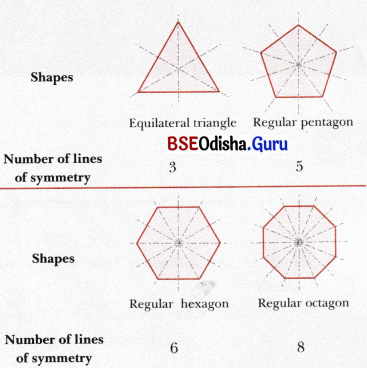
Which regular polygon has 5 lines of symmetry?
(a) Hexagon
(b) Pentagon
(c) Equilateral Triangle
(d) Octagon
Solution:
(b) Pentagon
Question 2.
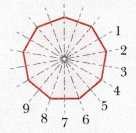
What is the number of lines of symmetry in a regular nonagon?
(a) 6
(b) 8
(c) 9
(d) 12
Solution:
(c) 9
A regular nonagon has nine lines of symmetry.
Question 3.
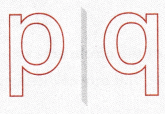
What is the mirror image of the letter ‘p’ across a vertical mirror?
(a) p
(b) d
(c) b
(d) q
Solution:
(d) q
The mirror image of the letter p’ across a vertical mirror is ‘q’.

Question 4.
Which method can generate a symmetric figure?
(a) Drawing random curves
(b) Folding a square paper and cutting a shape
(c) Rotating a shape randomly
(d) Moving a shape sideways
Solution:
(b) Folding a square paper and cutting a shape
We know that if we fold a square paper and cut a shape on one side, the other half appears when you open it. Both halves match.

Question 5.
A line of symmetry divides a figure into:
(a) Two identical but flipped figures
(b) Two unequal parts
(c) One half only
(c) Two unrelated shapes
Solution:
(a) Two identical but flipped figures
We know that a line that cuts a plane figure into two parts that exactly overlap when folded along that line is called a line of symmetry or axis of symmetry of the figure.
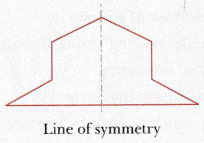
Thus, a line of symmetry divides a figure into two identical but flipped figures.
Question 6.
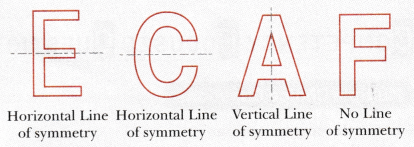
Which of the following letters has a vertical line of symmetry?
(a) E
(b) C
(c) A
(d) F
Solution:
(c) A
From the given letters, only letter ‘A’ has a vertical line of symmetry.
Question 7.
Which shape has an infinite number of lines of symmetry?
(a) Square
(b) Regular Pentagon
(c) Regular Octagon
(d) Circle
Solution:
(d) Circle
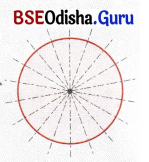
We know that a square has four lines of symmetry.
A regular pentagon has five , lines of symmetry.
A regular octagon has eight lines of symmetry.
A circle has infinite lines of symmetry.
Question 8.
Which of the following is true for a figure drawn using a mirror?
(a) Asymmetrical
(b) Uneven
(c) Symmetrical
(d) Curved
Solution:
(c) Symmetrical
We know that the mirror creates the same shape on the other side, so the whole shape looks balanced and symmetrical.
Question 9.
Which of the following best defines rotational symmetry?
(a) The object looks the same when flipped over.
(b) The object looks the same when rotated about a fixed point.
(c) The object has two identical halves.
(d) The object looks the same from any side.
Solution:
(b) The object looks the same when rotated about a fixed point.
Imagine rotating a defined shape around a fixed point without flipping it. If it looks exactly the same in some positions during the rotation, it has rotational symmetry.
Question 10.
Which of the following shapes does NOT have rotational symmetry?
(a) Equilateral Triangle
(b) Rectangle
(c) Semi-circle
(d) Square
Solution:
(c) Semi-circle
Rotational symmetry occurs if a shape looks exactly the same when we turn (rotate) it at an angle less than 360° around a fixed point (usually the centre).
A semicircle does not look the same as its original shape when rotated by any angle less than 360°; it only matches after completing a full 360° turn.
Question 11.
What is the angle of symmetry for a figure with rotational symmetry of order 4?
(a) 30°
(b) 45°
(c) 60°
(d) 90°
Solution:
(d) 90°
A complete rotation makes 360°.
As the order of symmetry of the figure is 4, it looks the same four times.
Thus, the angle of rotational symmetry for the figure = \(\frac{360^{\circ}}{4}\) = 90°
Question 12.
The centre of the circle acts as:
(a) The point that moves during rotation
(b) A vertex
(c) The centre of rotation
(d) None of these
Solution:
(c) The centre of rotation
The centre of a circle is the centre of rotation because it is the only point within the figure that remains perfectly still when the circle rotates.
Question 13.
What is the angle of rotation that maps a circle onto itself?
(a) Only 360°
(b) Only 180°
(c) Any angle
(d) Only 90°
Solution:
(c) Any angle
No matter how little or how much we rotate a circle, it always looks exactly the same. Whether we rotate it by 1°, 20°, 123° or even 0.5°, it still appears to be the same circle.
Question 14.
If a figure coincides with itself 6 times during a full rotation, its smallest angle of symmetry is:
(a) 30°
(b) 45°
(c) 60°
(d) 90°
Solution:
(c) 60°
Given, a figure coincides with itself 6 times during a full rotation.
Therefore, smallest angle of symmetry for the figure = \(\frac{360^{\circ}}{4}\) = 60°
So, each time the figure is rotated by 60°, it appears the same.
Question 15.
Every diameter of a circle is:
(a) A line not passing through centre
(b) A line of symmetry
(c) A line outside the circle
(d) A line touching the circle at one point
Solution:
(b) A line of symmetry
We know that the diameter of a circle passes through the centre of the circle and divides the circle into two equal halves.
A line of symmetry divides a shape into two mirror-image parts. If we fold the shape along that line, both halves match exactly.
Question 16.
Which of these shapes have both reflection symmetry and rotational symmetry?
(i) Square
(ii) Equilateral triangle
(iii) Circle
(iv) Rectangle
Choose the correct option from the following:
(a) Only (i) and (iv)
(b) Only (i) and (iii)
(c) Only (i), (ii) and (iii)
(d) (i), (ii), (iii) and (iv)
Solution:
(d) (i), (ii), (iii) and (iv)
We know that reflection symmetry occurs when a figure can be divided into two identical halves by a line, where one half is the mirror image of the other.
Rotational symmetry means a figure looks the same after being rotated about a fixed point (centre of rotation) through certain angles.
Square has 4 lines of symmetry and rotational symmetry at 90°, 180°, 270° and 360°.
Equilateral triangle has 3 lines of symmetry and rotational symmetry at 120°, 240° and 360°.
Circle has infinite lines of symmetry and rotational symmetry at every angle.
Rectangle has 2 lines of symmetry and rotational symmetry at 180° and 360°.
Thus, (i), (ii), (iii) and (iv) have both reflection symmetry and rotational symmetry.
Question 17.
A shape has rotational symmetry of order 4. Which statements must be true?
(i) It overlaps with itself at every 90° rotation.
(ii) It has 4 angles of symmetry including 360°.
(iv) It looks exactly the same after a 180° rotation.
Choose the correct option from the following:
(a) Only (i) and (ii)
(b) Only (ii) and (iii)
(c) (i), (ii) and (iv)
(d) (ii), (iii) and (iv)
Solution:
(c) (i), (ii) and (iv)
We know that the number of times a figure fits into itself in one full turn is called the order of rotational symmetry.
Smallest angle of rotational symmetry
= \(\frac{360^{\circ}}{Order of ratational symmetry}\)
Given, a shape has rotational symmetry of order 4.
∴ Smallest angle of rotational symmetry
= \(\frac{360^{\circ}}{4}\) = 90°
Hence, the given shape has rotational symmetry at 90°, 180°, 270° and 360°.
Since the swastika symbol (*****) has rotational symmetry but not reflection symmetry, it is not necessarily true that the given shape must have four lines of symmetry.
Thus, statements (i), (ii) and (iv) are true.
Question 18.
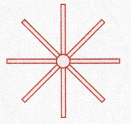
A shape has 8 radial arms. What must be true if it has rotational symmetry?
(i) The angle between adjacent arms is 45°.
(ii) It looks the same after every 45° rotation.
(iii) It has 8 angles of symmetry.
(iv) It has no reflection symmetry.
Choose the correct option from the following:
(a) (i), (ii) and (iii)
(b) (i), (ii) and (iv)
(c) (iii) and (iv) only
(d) (ii), (iii) and (iv)
Solution:
(a) (i), (ii) and (iii)
Given, a shape has 8 radial arms.
We know,
Angle between the adjacent radial arms.
= \(\frac{360^{\circ}}{\text { Number of radial arms }}=\frac{360^{\circ}}{8}=45^{\circ}\)
We observe that the figure with 8 radial arms fits exactly onto itself when it is rotated by 45°, 90°, 135°, 180°, 225°, 270°, 315° and 360°. So, it has eight angles of rotational symmetry and hence the order of rotational symmetry is 8.
We can see that the figure has reflection symmetry.
Thus, statements (i), (ii) and (iii) are true.
Symmetry Class 6 Assertion and Reason Questions
The following questions are Assertion and Reason based questions. Two statements are given, one labelled as Assertion (A) and the other is labelled as Reason (R). Select the correct answer to these questions from the codes (a), (b), (c) and (d) as given below.
(a) Both A and R are true and R is the correct explanation of A.
(b) Both A and R are true but R is not the correct explanation of A.
(c) A is true but R is false.
(d) A is false but R is true.
Question 1.
(A): A circle has an infinite number of lines of
(R): Any diameter of a circle divides it into two identical halves.
Solution:
(a) Both A and R are true and R is the correct explanation of A.
We know that a diameter of a circle passes through its centre and connects two points on its boundary. Every diameter divides the circle into two symmetrical parts, called semicircles.
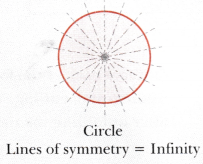
A line of symmetry divides a figure into two mirror-image halves.
In the case of a circle, any line that passes through its centre divides it into two equal halves. Since there are infinitely many such lines (diameters), a circle indeed has an infinite number of lines of symmetry.
Thus, both Assertion (A) and Reason (R) are true, and Reason (R) is the correct explanation of Assertion (A).
Question 2.
(A): A regular pentagon has five lines of symmetry.
(R): Each line of symmetry passes through a vertex and the midpoint of the opposite side.
Solution:
(a) Both A and R are true and R is the correct explanation of A.
We know that a regular pentagon (all sides and angles equal) has 5 lines of symmetry, one corresponding to each vertex and each line of symmetry passes through a vertex and the midpoint of the opposite side, dividing the regular pentagon into two equal halves.
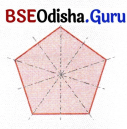
Thus, both Assertion (A) and Reason (R) are true, and Reason (R) is the correct explanation of Assertion (A).
Question 3.
(A): The English letter ‘S’ has no line of symmetry.
(R): The symmetry of a figure depends on its rotational characteristics only.
Solution:
(c) A is true but R is false.
The capital letter ‘S’ has no line of symmetry. It does, however, have rotational symmetry of order 2 (i.e., it looks the same after a 180° rotation), but no reflection symmetry.
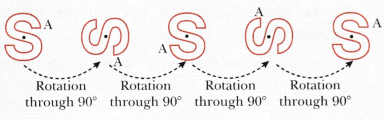
Reflection symmetry and rotational symmetry are different concepts.
A figure can have reflection symmetry, rotational symmetry, both or neither.
For example, an equilateral triangle has both; the letter ‘S’ has rotational but not reflection symmetry.
Thus, .Assertion (A) is true, but Reason (R) is false.
Question 4.
(A): All regular polygons have both reflection and rotational symmetry.
(R): Regular polygons have equal angles and equal sides, which ensures symmetry in both aspects.
Solution:
(a) Both A and R are true and R is the correct explanation of A.
We know that a regular polygon has all sides and angles equal, which ensures symmetry in both aspects.
Equal angles and sides allow for multiple lines of symmetry.
Uniformity ensures the shape can rotate and still match its original form, giving rotational symmetry.
A regular polygon always has reflection symmetry (as many lines of symmetry as sides) and rotational symmetry (order equal to the number of sides).
Thus, both Assertion (A) and Reason (R) are true, and Reason (R) is the correct explanation of Assertion (A).
Question 5.
(A): A figure with rotational symmetry of order 1 has no rotational symmetry.
(R): A figure must match its original position more than once in a full turn to have rotational symmetry.
Solution:
(a) Both A and R are true and R is the correct explanation of A.
We know that rotational symmetry is the property of a shape looking the same after rotating it less than 360°. If a shape looks the same only once in a full turn (at the starting position), it has rotational symmetry of order 1. But in practice, this means it has no real rotational symmetry. For a shape to have rotational symmetry, it should match its original look more than once during one full rotation.
Thus, both Assertion (A) and Reason (R) are true, and Reason (R) is the correct explanation of Assertion (A).
Symmetry Class 6 Fill in the Blanks
Question 1.
A _______ line of symmetry divides the figure in the vertical direction.
Solution: vertical
A vertical line of symmetry divides the figure in the vertical direction.
Question 2.
A square has _______ lines of symmetry.
Solution: four
A square has four lines of symmetry.
Question 3.
In an isosceles triangle, there is only _______ line of symmetry.
Solution: one
In an isosceles triangle, there is only one line of symmetry.
Question 4.
A figure is said to have ________ symmetry if itlooks the same after a certain amount of rotation around a fixed point.
Solution: rotational
A figure is said to have rotational symmetry if it looks the same after a certain amount of rotation (less than 360°) around a fixed point. This amount of rotation is called angle of rotational symmetry.
Question 5.
The number of times a figure matches itself in one full rotation is called its _______ of rotational symmetry.
Solution: order
The number of times a figure matches itself in one full rotation is called its order of rotational symmetry.
Question 6.
The smallest angle of rotation for a figure with a rotational symmetry of order 5 is _________ .
Solution: 72°
If a figure has rotational symmetry of order 5, it means it matches itself every \(\frac{360^{\circ}}{5}\) = 72°.
Thus, the smallest angle of rotation for a figure with a rotational symmetry of order 5 is 72°.
Question 7.
All the ______ of a circle are its lines of symmetry.
Solution: diameters
All the diameters of a circle are its lines of symmetry.
Question 8.
A square has rotational symmetry of order _________ .
Solution: 4
A square fits onto itself 4 times during a 360° turn (at every 90°), so the order is 4.
Thus, a square has rotational symmetry of order 4.