
Regular revision with Class 6 Maths MCQ with Answers and Ganita Prakash Class 6 Maths Chapter 6 Perimeter and Area MCQ improves accuracy in objective exams.
MCQ on Perimeter and Area Class 6
Perimeter and Area MCQ Class 6
Class 6 Maths Perimeter and Area MCQ
Question 1.
The perimeter of a closed plane figure is:
(a) The total space occupied by the figure
(b) The sum of all angles
(c) The distance covered along its boundary
(d) The distance from the centre to the boundary
Solution:
(c) The distance covered along its boundary
We know that the perimeter of any closed plane figure is the distance covered along its boundary when you go around it once.
Question 2.
The perimeter of a rectangle with length l and breadth b is:
(a) l + b
(b) 2l + 2b
(c) l × b
(d) 2 × l × b
Solution:
(b) 2l + 2b
Given, the length and breadth of a rectangle are l and b, respectively.
Now, perimeter of a rectangle = 2 × (length + breadth)
= 2 × (l + b) = 2l + 2b
Question 3.
If the length and breadth of a rectangle are 12 cm and 8 cm respectively, its perimeter is:
(a) 20 cm
(b) 40 cm
(c) 96 cm
(d) 80 cm
Solution:
(b) 40 cm
Given, the length and breadth of a rectangle are 12 cm and 8 cm, respectively.
Now, perimeter of a rectangle = 2 × (12 cm + 8 cm) = 2 × 20 cm = 40 cm

Question 4.
If the sides of a triangle are 3 cm, 5 cm and 7 cm, its perimeter is:
(a) 15 cm
(b) 16 cm
(c) 17 cm
(d) 18 cm
Solution:
(a) 15 cm
Given, the sides of a triangle are 3 cm, 5 cm and 7 cm.
Now, perimeter of a triangle = sum of the lengths of its three sides
= 3 cm + 5 cm + 7 cm = 15 cm
Question 5.
The perimeter of a regular polygon is given by:
(a) Number of sides × length of one side
(b) Sum of two sides
(c) Side length × side length
(d) Half the sum of all sides
Solution:
(a) Number of sides × length of one side
We know that the perimeter of a regular polygon is number of sides × length of one side.
Question 6.
The perimeter of a polygon is equal to:
(a) The sum of the areas of all sides
(b) The sum of the lengths of all sides
(c) The product of the lengths of all sides
(d) Twice the length of one side
Solution:
(b) The sum of the lengths of all sides
We know that a polygon is a closed plane figure made up of line segments and the perimeter of a polygon is the sum of the lengths of its all sides, i.e., the total distance along its outer boundary.
Question 7.
Which of the following figures has a perimeter?
(a) Open curve
(b) Line segment
(c) Polygon
(d) Ray
Solution:
(c) Polygon
We know that the perimeter of any closed plane figure is the distance covered along its boundary when we go around it once.
An open curve is not dosed, so it doesn’t have a perimeter.
A line segment is just a straight line between two points, not a closed figure.
A ray extends infinitely in one direction, so it doesn’t have a perimeter.
A polygon is a closed figure and it has a perimeter.
Question 8.
The perimeter of a square with side a is:
(a) 2a
(b) 3a
(c) 4a
(d) 5a
Solution:
(c) 4a
Given, the length of a side of a square is a. Now, perimeter of a square
= 4 × length of a side = 4 × a = 4a
Question 9.
In a triangle, the perimeter depends on:
(a) Only two sides
(b) Two angles and one side
(c) All three sides
(d) None of these
Solution:
(c) All three sides
We know that the perimeter of a triangle is the sum of the lengths of its three sides.
Therefore, the perimeter of a triangle depends on all three sides.
Question 10.
The perimeter of a regular pentagon with side 6 cm is:
(a) 24 cm
(b) 30 cm
(c) 36 cm
(d) 42 cm
Solution:
(b) 30 cm
Given, length of the side of a pentagon is 6 cm.
We know that the number of sides in a pentagon is 5.
And perimeter of a regular polygon = Number of sides × length of one side
Now, perimeter of a regular pentagon = 5 × Length of the side = 5 × 6 cm = 30 cm
Question 11.
What is the formula for the area of a rectangle?
(a) 2 × (length + breadth)
(b) length × breadth
(c) length + breadth
(d) 4 × side
Solution:
(b) length × breadth
We know, area of a rectangle = Length × Breadth
Question 12.
A square has a side of 11 m. What is its area?
(a) 51 sq. m
(b) 44 sq. m
(c) 100 sq. m
(d) 121 sq. m
Solution:
(d) 121 sq. m
Given, a square has a side of 11 m.
So, area of the square = Side × Side
= 11 m × 11 m
= 121 sq. m
Question 13.
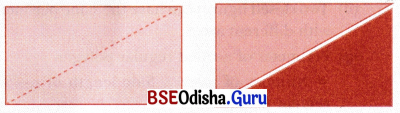
The triangle formed by cutting a rectangle along one diagonal has:
(a) Same area as the rectangle
(b) Half the area of the rectangle
(c) Double the area of the rectangle
(d) No relation
Solution:
(b) Half the area of the rectangle
We know that if a rectangle is cut along one of its diagonals, then the area of each resulting triangle is half the area of the rectangle.
Question 14.
A triangle has a base of 8 cm and height of 6 cm. What is its area?
(a) 48 sq. cm
(b) 32 sq. cm
(c) 16 sq.cm
(d) 24 sq. cm
Solution:
(d) 24 sq. cm
Given, base of the triangle = 8 cm; and height of the triangle = 6 cm
So, area of the triangle = \(\frac{1}{2}\) × Base × Height
= \(\frac{1}{2}\) × 8 cm × 6 cm
= 4 cm × 6 cm = 24 sq. cm
Question 15.
A floor is 6 m long and 5 m wide. What is its area?
(a) 11 sq. m
(b) 30 sq. m
(c) 60 sq. m
(d) 25 sq. m
Solution:
(b) 30 sq. m
Given, length of the floor = 6 m
And, breadth of the floor = 5 m
So, area of floor = Length × Breadth
= 6 m × 5 m = 30 sq. m
Question 16.
The area of a rectangle is 48 sq. m, and the length is 8 m. What is the breadth?
(a) 6 m
(b) 4 m
(c) 8 m
(d) 12 m
Solution:
(a) 6 m
Given, length of the rectangle = 8 m
And, area of the rectangle = 48 sq. m
We know, area of the rectangle
= Length × Breadth
⇒ 48 sq. m = 8 m × Breadth
⇒ Breadth = \(\frac{48 \mathrm{sq} \cdot \mathrm{~m}}{8 \mathrm{~m}}\) = 6m
Question 17.
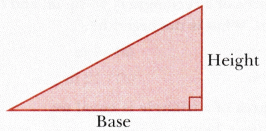
The area of a triangle is equal to:
(a) base × height
(b) \(\frac {1}{2}\) × base × height
(c) base + height
(d) base ÷ height
Solution:
(b) \(\frac {1}{2}\) × base × height
We know, area of a triangle = \(\frac{1}{2}\) × base × height
Question 18.
A triangle with base 10 cm and height 5 cm has an area of:
(a) 25 sq. cm
(b) 15 sq. cm
(c) 50 sq. cm
(d) 40 sq. cm
Solution:
(a) 25 sq. cm
Given, base of the triangle =10 cm
And, height of the triangle = 5 cm
So, area of the triangle = \(\frac{1}{2}\) × Base × Height
= \(\frac{1}{2}\) × 10 cm × 5 cm
= 5 cm × 5 cm = 25 sq. cm
Question 19.
Which of the following is correct?
(i) The perimeter of a closed figure is the distance around its boundary.
(ii) The perimeter of a rectangle is twice the sum of its length and breadth.
(iii) The perimeter of a square is quadruple the length of its side.
(iv) The perimeter of an equilateral triangle is twice the length of one side.
Choose the correct option from the following:
(a) (i), (ii) and (iii)
(b) (ii), (iii) and (iv)
(c) (i), (ii) and (iv)
(d) (i), (iii) and (iv)
Solution:
(a) (i), (ii) and (iii)
(i) We know that the perimeter of any closed plane figure is the distance covered along its boundary when you go around it once.
∴ Statement (i) is correct.
(ii) Perimeter of rectangle = 2(length + breadth) i.e., the perimeter of a rectangle is twice the sum of its length and breadth.
∴ Statement (ii) is correct.
(iii) Perimeter of square = 4 × side i.e., the perimeter of a square is quadruple (four times) the length of its side.
∴ Statement (iii) is correct.
(iv) Perimeter of equilateral triangle = 3 × side of equilateral triangle i.e., the perimeter of an equilateral triangle is thrice the length of one side.
∴ Statement (iv) is incorrect.
Question 20.
Which of the following is correct?
(i) Two closed figures can have the same area with different perimeters.
(ii) Two closed figures can have the same perimeter with different areas.
(iii) Perimeter of n-sided regular polygon
= Number of sides × Side length of n-sided regular polygon
(iv) Area of triangle = \(\frac{1}{2}\) × Base v Height
Choose the correct option from the following:
(a) (i), (ii) and (iii) only
(b) (ii), (iii) and (iv) only
(c) (i), (ii) and (iv) only
(d) (i), (ii) (iii) and (iv)
Solution:
(d) (i), (ii) (iii) and (iv)
(i) Two closed figures can have the same area with different perimeters, or the same perimeter with different areas.
(ii) For a given area of rectangular shapes, a square has the smallest perimeter and for a given perimeter of rectangular shapes, the square covers the most space
∴ Statements (i) and (ii) are correct.
(iii) If s is side length of an n-sided regular polygon, then:
Perimeter of n-sided regular polygon
= n × s
= Number of sides × Side length of n-sided regular polygon
∴ Statement (iii) is correct.
(iv) Area of a triangle with base b and height h is given by
Area of triangle = \(\frac{1}{2}\) × base × height
= \(\frac{1}{2}\) × b × h
∴ Statement (iv) is correct.
Question 21.
Which of the following is correct?
(i) If the area of a square is 144 cm2, then the perimeter of the square is 12 cm.
(ii) The perimeter of a regular hexagon having a side of 6 cm is 36 cm.
(iii) A triangle with base 12 cm and height 7 cm has an area of 84 cm2.
(iv) The perimeter of a rectangle with area 72 cm2 and length 9 cm is 34 cm.
Choose the correct option from the following:
(a) (ii) and (iii)
(b) (iii) and (iv)
(c) (ii) and (iv)
(d) (i) and (ii)
Solution:
(c) (ii) and (iv)
(i) We know that area of square = side × side
Given, area of a square =144 cm2 =12 cm × 12 cm
Side of square = 12 cm
Perimeter of square = 4 × side = 4 × 12 = 48 cm
(i) is incorrect.
(ii) If s is side length of an n-sided regular polygon, then:
Perimeter of n-sided regular polygon
= n × s
= Number of sides × Side length of n-sided regular polygon
Side of regular hexagon = 6 cm
∴ Perimeter of a regular hexagon = 6 × 6 = 36 cm
(ii) is correct.
(iii) Area of triangle = \(\frac{1}{2}\) × base × height
= \(\frac{1}{2}\) × 12 × 7 = 42 cm2
(iii) is incorrect.
(iv) Area of rectangle = length × breadth
⇒ 72 cm2 = 9 cm × breadth
⇒ Breadth = \(\frac{72}{9}\) = 8 cm
Perimeter of rectangle = 2(length + breadth)
= 2(9 + 8) = 2 × 17 = 34 cm
(iv) is correct.
Question 22.
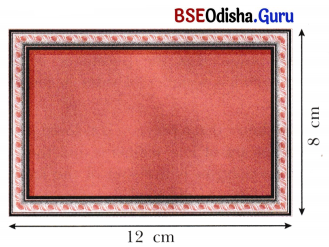
A rectangular frame with length 12 cm and breadth 8 cm is shown below. Which of the following is correct?
(i) The perimeter of the rectangular frame is 40 cm.
(ii) The area of the rectangular frame is 96 cm2.
(iii) If the breadth of the rectangular frame is doubled, the new perimeter of the rectangular frame will be 64 cm.
(iv) If the length of the rectangular frame is doubled, the new area of the frame will be 384 cm2.
Choose the correct option from the following:
(a) (ii) and (iii)
(b) (iii) and (iv)
(c) (i) and (iv)
(d) (i) and (ii)
Solution:
(d) (i) and (ii)
We have, length of rectangular frame = 12 cm breadth of rectangular frame = 8 cm
(i) Perimeter of rectangular frame
= 2(length + breadth)
= 2(12 + 8) = 2 × 20 = 40 cm
(i) is correct.
(ii) Area of rectangular frame = length × breadth
= 12 × 8 = 96 cm2
(ii) is correct.
(iii) New breadth of rectangular frame = 2 × 8 = 16 cm
New perimeter of rectangular frame = 2(length + new breadth)
= 2(12 +16) = 2 × 28 = 56 cm
(iii) is incorrect.
(iv) New length of rectangular frame = 2 × 12 = 24 cm
New area of rectangular frame = new length × breadth
= 24 × 8 = 192 cm2
(iv) is incorrect.
Perimeter and Area Class 6 Assertion and Reason Questions
The following questions are Assertion and Reason based questions. Two statements are given, one labelled as Assertion (A) and the other is labelled as Reason (R). Select the correct answer to these questions from the codes (a), (b), (c) and (d) as given below.
(a) Both A and R are true and R is the correct explanation of A.
(b) Both A and R are true but R is not the correct explanation of A.
(c) A is true but R is false.
(d) A is false but R is true.
Question 1.
(A): The perimeter of a closed figure is the distance around its boundary.
(R): The perimeter is calculated by multiplying the length by the breadth.
Solution:
(c) A is true but R is false.
We know that the perimeter of any closed plane figure is the distance covered along its boundary when you go around it once.
Thus, Assertion (A) is true, but Reason (R) is false.
Question 2.
(A): The perimeter of a rectangle is twice the sum of its length and breadth.
(R): Opposite sides of a rectangle are always equal.
Solution:
(a) Both A and R are true and R is the correct explanation of A.
Let ABCD be a rectangle.
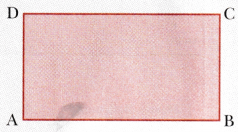
Now, perimeter of the rectangle
= Sum of the lengths of its four sides
= AB + BC + CD + DA
= 2 × AB + 2 × BC [∴ Opposite sides of a rectangle are always equal. So, AB = CD and AD = BC]
= 2 × (AB + BC)
= 2 × (Length + Breadth)
Thus, both Assertion (A) and Reason (R) are true, and Reason (R) is the correct explanation of Assertion (A).
Question 3.
(A): The perimeter of a regular polygon is the product of the number of sides and the length of one side.
(R): In a regular polygon, all sides are equal.
Solution:
(a) Both A and R are true and R is the correct explanation of A.
We know that in a regular polygon, all sides are equal.
So, perimeter of a regular polygon = Number of sides × Length of one side i.e. the perimeter of a regular polygon is the product of the number of sides and the length of one side.
Thus, both Assertion (A) and Reason (R) are true, and Reason (R) is the correct explanation of Assertion (A).
Question 4.
(A): The perimeter of an equilateral triangle is twice the length of one side.
(R): An equilateral triangle has all sides equal.
Solution:
(d) A is false but R is true.
We know that the perimeter of a triangle is the sum of the lengths of its three sides.
In an equilateral triangle, all sides are of equal length.
Thus, Assertion (A) is false, but Reason (R) is true.
Question 5.
(A): The perimeter of a rectangle is given by 2 × (length + breadth).
(R): A rectangle has four unequal sides.
Solution:
(c) A is true but R is false.
Let ABCD be a rectangle.
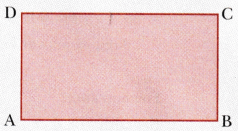
Now,
perimeter of the rectangle = Sum of the lengths of its four sides
= AB + BC + CD + DA
= 2 × AB + 2 × BC [∴ Opposite sides of a rectangle are always equal. So, AB = CD and AD = BC]
= 2 × (AB + BC) = 2 × (Length + Breadth)
Thus, Assertion (A) is true, but Reason (R) is false.
Question 6.
(A): The perimeter of a square having a side of 5 cm is 10 cm.
(R): Perimeter of a square = 4 × side.
Solution:
(d) A is false but R is true.
We know, perimeter of a square = 4 × side
Given, the length of side of a square is 5 cm.
Now, perimeter of the square = 4 × side = 4 × 5 cm = 20 cm
Thus, Assertion (A) is false,’but Reason (R) is true.
Question 7.
(A): The area of a rectangle having length 5 cm & breadth 2.5 cm is 12.5 sq. cm.
(R): The area of a rectangle is calculated as length × breadth.
Solution:
(a) Both A and R are true and R is the correct explanation of A.
Given, length of the rectangle = 5 cm; and, breadth of the rectangle = 2.5 cm
Now, area of the rectangle = Length × Breadth
= 5 cm × 2.5 cm = 12.5 sq. cm
Thus, both Assertion (A) and Reasqn (R) are true, and Reason (R) is the correct explanation
of Assertion (A).
Question 8.
(A): The area of a square of side 4.5 cm is 20.25 sq. cm.
(R): The area of a square = side × side
Solution:
(a) Both A and R are true and R is the correct explanation of A.
Given, the side of a square is 4.5 cm.
Now, area of the square = Side × Side
= 4.5 cm × 4.5 cm = 20.25 sq. cm
Thus, both Assertion (A) and Reason (R) are true, and Reason (R) is the correct explanation of Assertion (A).
Question 9.
(A): If four square flower beds of side 3.5 m each are placed on a 10 m × 12 m held, the remaining area is 71 sq. m.
(R): The total area of the field is 120 sq. m and the area of the four flower beds is 49 sq. m.
Solution:
(a) Both A and R are true and R is the correct explanation of A.
Given, the side of a square flower bed is 3.5 m.
Now, area of one square flower bed = Side × Side
= 3.5 m × 3.5 m = 12.25 sq. m
So, total area of four flower beds = 4 × Area of one flower bed
= 4 × 12.25 sq. m = 49 sq. m
Also, length of the field = 10 m
Aid, breadth of the field = 12 m
So, area of the field = Length × Breadth
= 10 m × 12 m = 120 sq. m
If all the four square flower beds are placed in the field,
Remaining area = Area of the field – Total area of four flower beds
= 120 sq. m – 49 sq. m = 71 sq. m
Thus, both Assertion (A) and Reason (R) are true, and Reason (R) is the correct explanation of Assertion (A).
Perimeter and Area Class 6 Fill in the Blanks
Question 1.
A regular polygon has all sides and _______ equal.
Solution: angles
We know that the closed figures that have all sides and all angles equal are called regular polygons.
Therefore, a regular polygon has all sides and angles equal.
Question 2.
The unit of measurement of perimeter is same as that of _____ of sides.
Solution: length
The unit of measurement of perimeter is same as that of length of sides.
Question 3.
The perimeter of closed plane figure is the length of its _____ .
Solution: boundary
We know that the perimeter of closed plane figure is the length of its boundary.
Question 4.
The ________ of a regular polygon is calculated by multiplying the number of its sides by the length of one side.
Solution: perimeter
We know, perimeter of a regular polygon = Number of sides × length of one side
So, the perimeter of a regular polygon is calculated by multiplying the number of its sides by the length of one side.
Question 5.
The amount of region enclosed by a closed figure is called its __________.
Solution: area
We know, the amount of region enclosed by a closed figure is called its area.
Question 6.
The area of a square is always equal to the _______ of its side length.
Solution: square
We know, the area of a square is always equal to the square of its side length.
Question 7.
For the given area of rectangular shapes, _______ has smallest perimeter.
Solution: square
For the given area of rectangular shapes, square has smallest perimeter.
Question 8.
For the given perimeter of rectangular shapes, square has the largest _______ .
Solution: area
For the given perimeter of rectangular shapes, square has the largest area.