
Regular revision with Class 6 Maths MCQ with Answers and Ganita Prakash Class 6 Maths Chapter 10 The Other Side of Zero MCQ improves accuracy in objective exams.
MCQ on The Other Side of Zero Class 6
The Other Side of Zero MCQ Class 6
Class 6 Maths The Other Side of Zero MCQ
Question 1.
The additive inverse of – 4 is:
(a) 2
(b) 4
(c) -4
(d) -2
Solution:
(b) 4
We know that every number has another number associated to it which when added to the number gives zero.
∴ The additive inverse of – 4 is 4 as -4 + 4 = 0.
Question 2.
Number of integers lying between – 1 and 1 is:
(a) 3
(b) 2
(c) 1
(d) 0
Solution:
(c) 1
The integers between – 1 and 1 are the integers that come after – 1 and before 1.
So, 0 is the only integer between – 1 and 1.
Hence, there is only one integer between – 1 and 1.
Question 3.
– 22 + 33 + 21 – 38 – 16 + 19 =
(a) -3
(b) – 7
(c) 0.3
(d) 7
Solution:
(a) -3
-22 + 33 + 21 – 38 – 16 + 19
= (-22 – 38 – 16) + (+33 + 21 + 19) [Grouping positive and negative integers]
= (-76) + (+ 73) = – 3

Question 4.
The sum of two integers is 36. If one of them is – 24, then the other integer is:
(a) – 12
(b) 60
(c) 12
(d) -60
Solution:
(b) 60
It is given that the sum of two integers is 36 and one of them is – 24.
Since the sum is 36, the other integer is obtained bv subtracting – 24 from 36.
∴ Required integer = 36 – ( – 24)
= (+ 36) + (+ 24)
[The number that is being subtracted can be replaced by its additive inverse and then added.]
= 60
Question 5.
If a lift goes from floor – 2 to floor + 3, how many floors did it move?
(a) 2
(b) 3
(c) 4
(d) 5
Solution:
(d) 5
We know, target position – starting position = movement
Here, target position = + 3;
Starting position = – 2
∴ Movement = +3 – (-2) = + 3 + (+2)
= 5 floors
Question 6.
Choose the greatest integer among all the given integers:
(a) -10
(b) -5
(c) 0
(d) -1
Solution:
(c) 0
Given integers are – 10, – 5, 0 and – 1.
We know that zero is greater than every negative integer. Also, a number that is more to the left of zero on the number line has a smaller value.
∴ The given integers can be arranged in ascending order as: – 10, – 5, – 1, 0 Thus, 0 is the greatest integer among the given integers.
Question 7.
Which of the following integers is 4 less than – 3?
(a) 2
(b) -2
(c) 7
(d) -7
Solution:
(d) -7
To find the integer which is 4 less than – 3, we start at – 3 on the number line and move 4 steps backward. We reach – 7. Hence, the required integer is – 7.

Question 8.
Which of the following statements is true?
(a) -3 > 2
(b) -1 > 0
(c) 0 > -5
(d) -6 > -2
Solution:
(c) 0 > -5
A number is smaller than all the numbers to its right on the number line and larger than all the numbers to its left.
-3 is to the left of 2, so -3 < 2. Therefore, option (a) is incorrect.
-1 is to the left of 0, so -1 < 0. Therefore, option (b) is incorrect. 0 is to the right of -5, so 0 > -5. Therefore, option (c) is correct.
-6 is to the left of -2, so -6 < -2. Therefore, option (d) is incorrect.
Question 9.
3 + (-3) + 3 + (-3) + 3 + (-3) + … upto 189 terms, is equal to:
(a) 567
(b) -567
(c) 3
(d) -3
Solution:
(c) 3
We know that the sum of an integer with its additive inverse is zero.
The additive inverse of – 3 is 3.
∴ 3 + (-3) = 0
Here, the total number of terms is 189 i.e. odd. So, we have
3 + [(-3) + 3] + [(-3) + 3] +[(-3) + 3] + … = 3 + 0 + 0 + 0 + … = 3
Question 10.
Which of the following subtractions is correctly represented by the given arrangement of tokens?

(a) (-8) + (-5)
(b) (+8) – (+5)
(c) (-8) – (-5)
(d) (+8) – (-5)
Solution:
(b) (+8) – (+5)
Clearly, 5 positive tokens are taken away from 8 positive tokens.
So, the given arrangement of tokens represents (+ 8) – (+ 5).
Question 11.
How many minimum zero-pairs must be introduced to model -5 – (+ 2) using tokens?
(a) 1
(b) 2
(c) 3
(d) 4
Solution:
(b) 2

Since there are no positive tokens initially, two zero-pairs must be added in order to remove two positives.
-5 – (+2) = -7
Thus, two zero-pairs are needed.
Question 12.
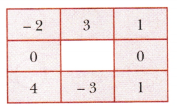
The border sum of the given grid is:
(a) -3
(b) 2
(c) 3
(d) – 2
Solution:
(b) 2
Sum of numbers in the top row
= (-2) + 3 + 1 – 2
Sum of numbers in the bottom row
= 4 + (-3) + 1 = 2
Sum of numbers in the left column
= (-2) + 0 + 4 = 2
Sum of numbers in the right column
= 1 + 0 + 1 = 2
So, the border sum of the given grid is 2.
Question 13.
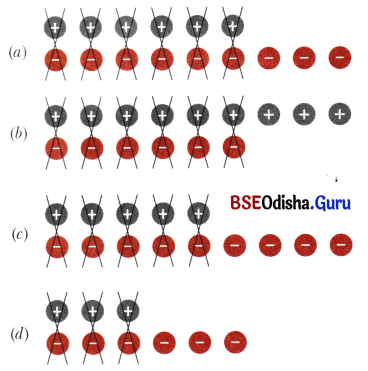
(+ 6) + (- 9) = -3 is correctly represented by:
Solution:
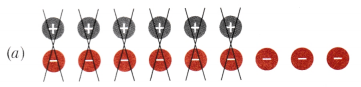
(+6) + (-9) = – 3
There must be 6 positive tokens and 9 negative tokens. So, we can remove six zero pairs and then we are left with 3 negative tokens.
Question 14.
Which of the following subtractions is correctly represented by the given arrangement of tokens?

(a) (+7) – (-4)
(b) (+7) – (+4)
(c) (-7) + (-4)
(d) (-7) – (-4)
Solution:
(d) (-7) – (-4)
Clearly, 4 negative tokens are taken away from 7 negative tokens.
So, the given arrangement of tokens represents (-7) – (-4).
Question 15.
Which of the following statements are correct?
(i) The additive inverse of — 5 is 5.
(ii) – 5 < 0 < 5
(iii) The successor and predecessor of – 5 are – 6 and – 4 respectively.
(iv) The absolute value of – 5 is 5.
Choose the correct option from the following:
(a) (i), (iii) and (iv)
(b) (i), (ii) and (iv)
(c ) (i), (ii) and (iii)
(d) (ii), (iii) and (iv)
Solution:
(b) (i), (ii) and (iv)
(i) We know that two numbers are said to be
additive inverse of each other if their sum is zero.
Therefore, the additive inverse of -5 is 5 as (-5) + 5 = 0.
Thus, statement (1) is correct.
(ii) Since 0 is greater than every negative integer and less than every positive integer.
-5 < 0 < 5.
Thus, statement (ii) is correct.
(iii) If we move 1 to the right of a number, we get the successor of that number and if we move 1 to the left of a number, we get the predecessor of that number.
The successor and predecessor of – 5 are
– 4 and – 6 respectively.
Thus, statement (iii) is incorrect.
(iv) The absolute value of a negative integer is the same as the integer but without the negative sign.
The absolute value of – 5 is 5.
Thus, statement (iv) is correct.
Question 16.
Which of the following are correct?
(i) -3 < -2 < -1
(ii) -2 < -5 < 1
(iii) -5 < 8 < 10
(iv) -2 < 0 < 1
Choose the correct option from the following:
(a) (i), (iii) and (iv)
(b) (i), (ii) and (iii)
(c) (i), (ii) and (iv)
(d) (ii), (iii) and (iv)
Solution:
(a) (i), (iii) and (iv)
(i) A number farther to the left of zero on the number line has a smaller value.
∴ -3 < -2 < -1
(i) is correct.
(ii) Every positive integer is greater than every negative integer and a number farther to the left of zero on the number line has a smaller value.
∴ -5 < -2 < 1
(ii) is incorrect.
(iii) A number located farther to the right of zero on the number line is greater in value.
∴ 5 < 8 < 10
(iii) is correct.
(iv) On the number line, the numbers right to 0 are greater than 0, and the numbers left to 0 are less than 0.
-2 < 0 < 1 (iv) is correct.
Question 17.
Which of the following statements are correct?
(i) The number that is being subtracted can be replaced bv its additive inverse and then added.
(ii) The absolute value of -7 is equal to the absolute value of 7.
(iii) The absolute value of -2 is less than -1.
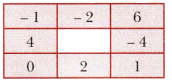
(iv) The border sum of the given grid is 3.
Choose the correct option from the following:
(a) (i) and (iii) only
(b) (ii), (iii) and (iv)
(c) (i), (ii) and (iv)
(d) (iii) and (iv) only
Solution:
(c) (i), (ii) and (iv)
(i) The number that is being subtracted can be replaced by its additive inverse and then added.
For example, 3 – (-5) = 3 + (+ 5) = 8 (i) is correct.
(ii) The absolute value of a positive integer is the integer itself.
∴ Absolute value of 7 = 7
The absolute value of a negative integer is the same as the integer but without the negative sign.
∴ Absolute value of -7 = 7
(ii) is correct.
(iii) Absolute value of -2 = 2 and 2 > -1.
(iii) is incorrect.
(iv) Sum of numbers in the top row = (-1) + (- 2) + 6 = 3
Sum of numbers in the bottom row = 0 + 2 + 1 = 3
Sum of numbers in the left column = -1 + 4 + 0 = 3
Sum of numbers in the right column = 6 + (- 4) + 1 = 3
∴ The border sum of grid is 3.
(iv) is correct.
The Other Side of Zero Class 6 Assertion and Reason Questions
The following questions are Assertion and Reason based questions. Two statements are given, one labelled as Assertion (A) and the other is labelled as Reason (R). Select the correct answer to these questions from the codes (a), (b), (c) and (d) as given below.
(a) Both A and R are true and R is the correct explanation of A.
(b) Both A and R are true but R is not the correct explanation of A.
(c) A is true but R is false.
(d) A is false but R is true.
Question 1.
(A): Zero is a positive integer.
(R): Zero lies between – 1 and + 1.
Solution:
(d) A is false but R is true.
We know that zero is neither positive integer nor negative integer.
And, zero lies between – 1 and + 1 on the number line.
Thus, Assertion (A) is false, but Reason (R) is true.
Question 2.
(A): The additive inverse of- 5 is + 5.
(R): The additive inverse of a number is the same number with the opposite sign.
Solution:
(a) Both A and R are true and R is the correct explanation of A.
We know that the additive inverse of a number is the same number with the opposite sign.
So, the additive inverse of – 5 is + 5.
Thus, both Assertion (A) and Reason (R) are true, and Reason (R) is the correct explanation of Assertion (A).
Question 3.
(A): – 5 is greater than – 2.
(R): A number is smaller than every number that is to its right on the number line.
Solution:
(d) A is false but R is true.
A number is smaller than any number positioned to its right on the number line.
Since – 2 is to the right of- 5, – 5 is smaller than -2.
Thus, Assertion (A) is false, but Reason (R) is true.
Question 4.
(A): On the number line, – 5 is at a greater distance from zero than – 8.
(R): Farther a number from zero on left, smaller is the value.
Solution:
(d) A is false but R is true.
We know that the farther ,a number is to the left of zero on the number line, the smaller its value.
Since – 8 is to the left of – 5, – 8 is at a greater distance from 0 than – 5.
Thus, Assertion (A) is false, but Reason (R) is true.
The Other Side of Zero Class 6 Fill in the Blanks
Question 1.
The number that is neither positive nor negative is _________ .
Solution: zero
The number that is neither positive nor negative is zero.
Question 2.
On a number line, integers to the left of zero are called _______ integers.
Solution: negative
On a number line, integers to the left of zero are called negative integers.
Question 3.
Use unmarked number lines to evaluate these expressions -87 + (-133) = ________ .
Solution: -220
We start at -87 and move 133 steps backward on the number line.
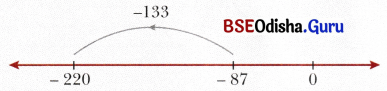
Therefore, -87 + (-133) = -220
Question 4.
The additive inverse of zero is ________ .
Solution: zero
We know that the additive inverse of a number is the number which, when added to the original number, gives zero. Here, 0 + 0 = 0
Therefore, the additive inverse of zero is zero.
Question 5.
Integers to the right side of zero are _______ than those to the left side on number line.
Solution: greater
A number is smaller than all the numbers to its right on the number line and larger than all the numbers to its left.
Therefore, integers to the right side of zero are greater than those to the left side on number line.
Question 6.
The number of integers lying between – 3 and 2 is _______ .
Solution: four
The integers that come between – 3 and 2 on the number line are – 2, – 1, 0 and 1.
So, the number of integers lying between – 3 and 2 is four.