Easy-to-read Ganita Prakash Class 6 Notes and Chapter 10 The Other Side of Zero Class 6 Notes save valuable study time during exam season.
Class 6 Maths Chapter 10 The Other Side of Zero Notes
Class 6 The Other Side of Zero Notes
Positive numbers {+ 1, + 2, + 3, …} and negative numbers {…, – 3, – 2, – 1}, along with zero, are called integers.
If a number is written without a sign, it is generally understood to he a positive number.
Zero is neither a positive nor a negative number. We do not put a ‘+ ’ or ‘-‘ sign before it.
Every number has another number associated to it which when added to the number gives zero. This is called the additive inverse of the number.
For positive integers, a number with greater numerical value is greater.
For negative integers a number with greater numerical value is smaller.
A positive integer is always greater than a negative integer (e.g., 2 > – 3 and 2 > – 1).
+ and – sign placed side by side without any number in between, gives a – sign.
For example, + (- 6) = – 6 or – (+ 6) = – 6

Addition and Subtraction of Integers
| Addition of Integers | Subtraction of integers |
| 1. The sum of two positives is positive. e.g. 5 + 3 = 8 | 1. If a smaller positive is subtracted from a larger positive, the result is positive, e.g. 5-4 = 1 |
| 2. The sum of two negatives is negative. To add two negatives, add the numbers (without the signs), and then place a minus sign to obtain the result. e.g. (- 3) + (- 4) = – 7 | 2. If a larger positive is subtracted from a smaller positive, the result is negative. e.g. 4 – 5 = – 1 |
| 3. To add a positive number and a negative number, subtract the smaller number (without the sign) from the greater number (without the sign), and place the sign of the greater number to obtain the result, e.g. – 6 + 2 = – 4, 5 + (- 8) = – 3 and -2 + 6 = 4 | 3. Subtracting a negative number is the same as adding the corresponding positive number. e.g. 3 – (- 6) = 3 + 6 |
| 4. The sum of a number and its additive inverse is zero. e.g. 3 + (- 3) = 0 | 4. Subtracting a number from itself gives zero. e.g. 5 – 5 = 0 and – 5 – (- 5) = 0 |
| 5. The sum of any number and zero is the same number. e.g. – 4 + 0 = – 4 and 4 + 0 = 4 Note: The number that is being subtracted can be replaced by its additive inverse and then added. For example, 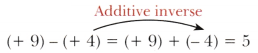 |
5. Subtracting zero from a number gives the same number e.g. – 3 – 0 = – 3 and 3-0 = 3. Subtracting a number from zero gives the number’s additive inverse e.g. 0 – (- 3) = 3. Note: The number that is being added can be replaced by its additive inverse and then subtracted.  |
Addition and Subtraction of Integers using Tokens
| Addition with Tokens | Subtraction with Tokens |
| Combine tokens of the same color and cancel out equal numbers of opposite colored tokens (zero pairs). For example, (+ 4) + (- 7) = – 3 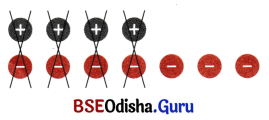 |
Subtract by taking away tokens of the required type. Use zero pairs when there are not enough tokens to remove. For example, (a) (- 6) – (- 5) = – 1  (b) (+ 2) – (+ 5) = – 3 From 2 positive tokens, we need to take out 5 positive tokens, which is not possible. So, we need to add 3 w w w w w zero pairs. After removing 5 positive tokens, we are left with 3 negative tokens. 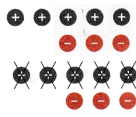 |
NOTE: A zero pair is one positive and one negative token that cancel each other to make zero, so the overall value remains unchanged during addition or subtraction.
Geographical Cross Sections
- Height above the sea level is represented by a positive number.
- Height below the sea level or depth is represented by a negative number.
- Temperature above 0°C is taken as positive and temperature below 0°C is taken as negative.
- In direction, if north is considered as positive, then south will be negative and vice versa.
In Vedic math, Rekhank means ‘a digit with a bar on its top’. In other words it is a negative number.
- For example: A bar on 7 is written as (7) and means – 7.
- This line (now the minus sign -) was used to show debt or loss, the opposite of gain.
The great Indian mathematician Brahmagupta was the first in the world to define:
- Positive numbers as Dhana (धन) — meaning wealth/gain;
- Negative numbers as Rina (ऋण) or Rekhank (रेखांक ) — meaning debt/loss
In profit and loss, if profit is taken as positive, then loss will be negative and vice versa.
Integers and their Applications
Positive numbers { + 1, +2, +3, …} and negative numbers {- 1, – 2, – 3, …} along with zero, are called integers.
The integer – 6 is read as ‘negative 6’ or ‘minus 6’ while 4- 6 is read as ‘positive 6’ or simply ‘six’.
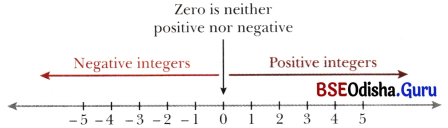
Every given number has another number associated to it which when added to the given number gives zero. This is called the additive inverse of the number. For example, the additive inverse of +7 is – 7 because +7 + (- 7) = 0.
The absolute value of a number is its distance from zero on the number line. It is always non-negative. For example, |-4| = 4 and |3| = 3.

Temperature above 0°C is taken as positive and temperature below 0°C is taken as negative.
In height, if the sea level is considered as the zero level, height above the sea level is taken as positive height and the depth or height below the sea level is taken as negative height.
Comparison of Integers
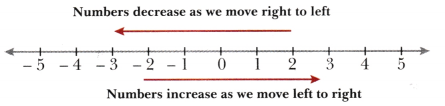
Integers are compared by their position on the number line. Numbers to the right are greater than those to the left.
For example, – 5 < -2 < 0 < +3 < +7.
For positive integers, a number with greater numerical value is greater while for negative integers a number with greater numerical value is smaller.
For example, – 8 < – 4 and + 6 < + 9.
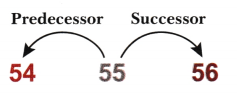
The predecessor of a number is the number that comes directly before it, while the successor is the number that comes directly after it.