
Easy-to-read Ganita Prakash Class 6 Notes and Chapter 5 Prime Time Class 6 Notes save valuable study time during exam season.
Class 6 Maths Chapter 5 Prime Time Notes
Class 6 Prime Time Notes
Multiples and Factors
A multiple of a number is the result of multiplying that number by counting numbers i.e. {1, 2, 3, …}. For example, the multiples of 3 are 3, 6, 9, 12, … .
A common multiple is a number that can be divided exactly (without remainder) by two or more different numbers. For example, the common multiples of 3 and 5 are 15, 30, 45, 60, … .
Factors of a number are numbers that divide the given number exactly i.e. if a number is divisible by another, the second number is called a factor of the first.
For example, 8 is divisible by 2, then 2 is a factor of 8.
Factors of a number are also called its divisors.
Factors are finite (countable) whereas every number has infinitely many multiples (uncountable).
1 is a factor of all the numbers.
Common factors are numbers that divide two or more numbers exactly.

A number for which the sum of all its factors is equal to twice the number is called a perfect number. For example, the factors of 28 are 1, 2, 4, 7, 14, 28.
Now, 1+ 2 + 4 + 7 + 14 + 28 = 56 (which is double of 28). Hence, 28 is an example of a perfect number.
Prime Numbers and Composite Numbers
A prime number is a counting number greater than 1 that has exactly two distinct factors: 1 and itself. It cannot be divided evenly by any other number. For example, 2 is a prime number because its only factors are 1 and 2.
2 is the only even number which is a prime number.
The numbers that have more than two factors are called composite numbers. For example, 4, 6, 8, 9, 10, 12, … are composite numbers.
1 is neither prime nor composite because it has only one factor.
Twin primes are pairs of primes having a difference of 2. For example, 3 and 5, 5 and 7, 11 and 13 etc.
Prime triplets are a group of three prime numbers such that the difference between the largest and the smallest prime number is less than or equal to 6.
Sieve of Eratosthenes – A Method of Listing Prime Numbers
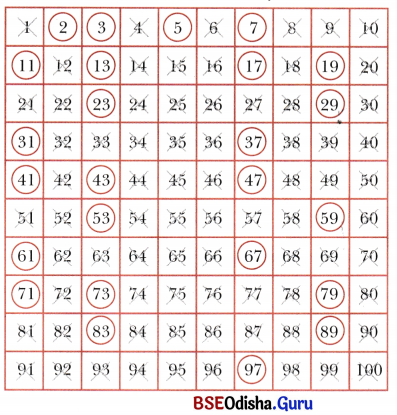
To find all the prime numbers from 1 to 100, follow the steps given below:
Step 1: Write down all the numbers from 1 to 100.
Step 2: Cross out 1 as it is neither prime nor composite.
Step 3: Circle number 2, the smallest and first prime number. Then, cross out all multiples of 2 (like 4, 6, 8, etc.)
Step 4: Circle 3, recognising it as a prime. Cross out all its multiples (such as 6, 9, 12, etc.).
Step 5: Continue this pattern. Stop when all the numbers in the list are either circled or crossed out.
All the circled numbers are prime numbers.
All the crossed-out numbers, other than 1, are composite numbers.
How to check whether a number is prime or not?
Let n be a prime number.
Step 1: Find \(\sqrt{n}\) (approximate value).
Step 2: Divide the prime number n by all prime numbers (say m) smaller than \(\sqrt{n}\).
Step 3: If there exists no prime number (m) smaller than \(\sqrt{n}\) to divide n, then n is a prime number.
Co-prime Numbers
Two numbers are called co-prime if their only common factor is 1. For example, 8 and 15 are co-prime numbers.
Two consecutive counting numbers are always co-prime numbers. For example, 9 and 10 are co-prime numbers.
Two prime numbers are always co-prime numbers. For example, 5 and 7 are co-prime numbers.
Two composite numbers may or may not be co-prime numbers. For example, 10 and 12 are not co-prime numbers as 2 is their common factor. But 10 and 21 are co-prime numbers as there is no common factor other than 1.
As prime numbers have exactly two factors 1 and itself , squares of prime numbers will have exactly three factors. For example, factors of 3 are 1 and 3, so, factors of 32 = 9 are 1, 3 and 9.
Prime Factorisation
When a number is written as the product of prime numbers only, it is called prime factorisation of the number. The individual factors are called prime factors.
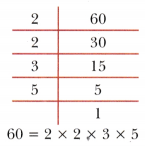
The prime factorisation of a composite number is unique, meaning it always consists of the same set of prime factors, regardless of the order in which they occur.
If there is no common prime factor of numbers a and b, then a and b are co-prime numbers.
For two numbers a and b, if prime factorisation of b is included in the prime factorisation of a, then a is divisible by b i.e. all the prime factors of b are prime factors of a.
Divisibility Tests
A number is divisible by 2, if its units digit is 0, 2, 4, 6 or 8.
A number is divisible by 3, if the sum of its digits is divisible by 3.
A number is divisible by 4, if number formed by last two digits of given number is divisible by 4.
A number is divisible by 5, if its units digit is either 0 or 5.
A number is divisible by 6, if it is divisible by both 2 and 3.
A number is divisible by 7, if the difference between twice the unit digit of the given number and the remaining part of the given number is 0 or a multiple of 7.
A number is divisible by 8, if number formed by last three digits of given number is divisible by 8.
A number is divisible by 9, if the sum of its digits is divisible by 9.
A number is divisible by 10, if its units digit is 0.
A number is divisible by 11, if the difference between the sum of its digits in odd places and the sum of its digits in even places (starting from units place) is either 0 or a multiple of 11.
If a number is divisible by another number, then it is also divisible by each of the factors of that number. For example, every number divisible by 9 is divisible by 3.
If a number is divisible by two prime numbers, then it is also divisible by their product. For example, every number divisible by 2 and 3 is divisible by 6.
If two numbers a and b are divisible by a number c, then a + b is also divisible by c.
For example, 48 and 72 are divisible by 4, their sum 48 + 72 = 120 is also divisible by 4.
If two numbers a and b are divisible by a number c, then a – b is also divisible by c.
For example, 78 and 42 are divisible by 6, their difference 78 – 42 = 36 is also divisible by 6.
Multiples and Factors
A multiple of a number is the result of multiplying that number by counting numbers. For example, the multiples of 3 are 3, 6, 9, 12, …
A common multiple is a number that can be divided exactly by two or more different numbers.
For example, the common multiples of 3 and 5 are 15, 30, 45, 60, …
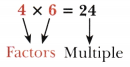
A factor of a number is an exact divisor of that number.
For example, 24 ÷ 6 = 4. So, 6 is a factor of 24 or 24 is a multiple of 6.
Prime Factorisation
Prime factorisation is the way of expressing a composite number as a product of its prime factors.
For example, 40 = 2 × 2 × 2 × 5
The prime factorisation of a composite number is unique, regardless of the order in which they occur.
For example, 12 = 2 × 2 × 3 or 2 × 3 × 2 or 3 × 2 × 2
Divisibility Tests
| Divisibility by | Condition |
| 2 | The digit at the ones place is either 0, 2, 4, 6, or 8. |
| 3 | Sum of digits of given number is divisible by 3. |
| 4 | Number formed by last two digits of given number is divisible by 4. |
| 5 | Units digit of the given number is either 0 or 5. |
| 6 | The given number is divisible by both 2 and 3. |
| 7 | The difference between twice the unit digit of the given number and the remaining part of the given number is either 0 or a multiple of 7. |
| 8 | Number formed by last three digits of given number is divisible by 8. |
| 9 | Sum of digits of given number is divisible by 9. |
| 10 | Units digit of given number is 0. |
| 11 | The difference between the sum of digits of given number in odd places and the sum of its digits in even places starting from units place is either 0 or a multiple of 11. |
Types of Number
A number is called a perfect number if the sum of all its factors is equal to twice the number.
Numbers with only two factors, 1 and the number itself are called prime numbers.
Numbers with more than two factors are called composite numbers.
- 2 is the smallest and the only even prime number.
- 1 is neither prime nor composite.
Two numbers are said to be co-prime if they have only 1 as their common factor.
Twin primes are pairs of prime numbers that differ exactly by 2.
Prime triplets are a group of three prime numbers such that the difference between the largest and the smallest prime number is less than or equal to 6.