
Easy-to-read Ganita Prakash Class 6 Notes and Chapter 3 Number Play Class 6 Notes save valuable study time during exam season.
Class 6 Maths Chapter 3 Number Play Notes
Class 6 Number Play Notes
Supercells
In a row, a cell is a supercell, if the number in it is greater than the numbers in the neighbouring cells that are just before and after it. For example, in the row of numbers, the cells containing 60 and 65 are supercells.
| 25 | 60 | 15 | 24 | 65 | 50 |
Two adjacent cells can never be supercells in a row.
If there are n cells in a row, then maximum number of supercells = 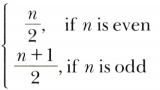
In a grid, a cell is a supercell, if the number in it is greater than every number in its adjacent cells (i.e. left, right, top and bottom). For example, in the given grid, the cells containing 270 and 250 are supercells.
| 200 | 160 | 270 |
| 210 | 250 | 230 |
| 180 | 120 | 200 |
- In a grid, cell containing the largest number is always a supercell.
- In a grid, cell containing the smallest number can never be a supercell.
Digit Play
Numbers are constructed using ten fundamental digits: 0, 1, 2, 3, 4, 5, 6, 7, 8 and 9.
While these digits can be combined in various ways to form numbers of different lengths, it is important to note that multi-digit numbers do not begin with the digit 0. This is because a leading zero does not contribute to the value of a number.
Number of 1-digit counting numbers = (9 – 1) + 1 = 9
Number of 2-digit counting numbers = (99 – 10) + 1 = 90
Number of 3-digit counting numbers = (999 – 100) + 1 = 900
Digit sum is the sum of all digits in a number. For example, digit sum of 85 is 8 + 5 = 13.
Two different numbers can have the same digit sum. For example, 63 and 54 have digit sum 9.

Palindromes
A palindromic number is a number that reads the same from left to right and from right to left. For example, 88, 121,4224, etc.
Two digit numbers upon reversing and adding always give a palindrome, however, sometime they require multiple iterations.
Generating a Palindrome from a Number
To generate a palindrome from a Number, follow the given steps:
Step 1: Obtain the given number.
Step 2: Obtain another number by reversing the digits of given number.
Step 3: Add the numbers obtained in step 1 and step 2.
Step 4: If the result is not a palindromic number, then repeat the process again until a palindromic number is obtained.
Applying the reverse-and-add method to 196 does not lead to a palindrome, no matter how many times it is repeated.
The Magic Number of Kaprekar
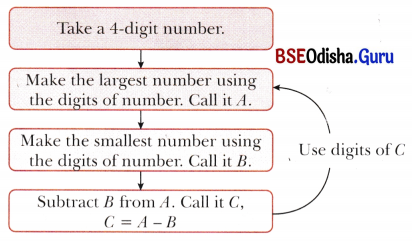
The number 6174 is called the Kaprekar Constant.
6174 is a number that pulls other numbers towards it. No matter which 4-digit number you start with (as long as not all digits are the same), a simple rearrangement-and-subtraction process lands you on 6174 every time.
Kaprekar’s routine can also be performed on a 3-digit number, and it always leads to the number 495.
Clock and Calendar Numbers
Our clocks and calendars are secret pattern-factories. They repeat, mirror, and even recycle themselves.
Repeating-Digit Times on a 12-Hour Clock
Type A: Hour digit copied in the minutes (e.g., 4:44, 2:22, 5:55)
Type B: Twin pairs (e.g., 10:10,11:11,12:12)
TypeC : Palindromic times (e.g., 12:21, 10:01)
Date Patterns (DD/MM/YYYY)
There are two main types of date patterns as follows:
Type A: Repeated Digits Date: YYYY same as DD/MM (e.g., 20/12/2012)
Other such historical dates are : 20/08/2008, 17/11/1711, 19/12/1912 etc.
Other such futuristic dates are : 21/09/2109, 22/10/2210, 23/12/2312 etc.
Type B: Palindromic Date (e.g., 22/02/2022)
Other such historical dates are : 11/02/2011, 21/02/2012, 12/02/2021 etc.
Other such futuristic dates are : 13/02/2031, 23/02/2032, 23/12/2132 etc.
The Collatz Conjecture
Rule: Start with any number; if the number is even, take half of it; if the number is odd,
multiply it by 3 and add 1; repeat.
The same rule is applied in all the sequences (starting with 5, 13, 42, 34);
5, 16, 8, 4, 2, 1
13, 40, 20, 10, 5, 16, 8, 4, 2, 1
42, 21, 64, 32, 16, 8, 4, 2, 1
34, 17, 52, 26, 13, 40, 20, 10, 5, 16, 8, 4, 2, 1
No matter which positive number you start with, every sequence eventually ends with 1.
Despite decades of study by mathematicians around the world, no one has been able to prove whether this is always true – making it one of the most intriguing unsolved problems in mathematics!
Estimation does not give the exact values. It is just a way to find an approximate answer quickly.
border=”2″
A palindromic number is a number that reads the same from left to right and from right to left. For example, 88, 121,4224, etc.
Generating a Palindrome from a Number:
Step 1: From given number, obtain another number by reversing the digits of given number.
Step 2: Add the given number with its reverse.
Step 3: If the result is not a palindromic number, then repeat the process again until a palindromic number is obtained.
For example, consider 36. Here, 36 + 63 = 99, which is a palindromic number.
Note: Applying the reverse-and-add method to 196 does not lead to a palindrome, no matter how many times it’s repeated.
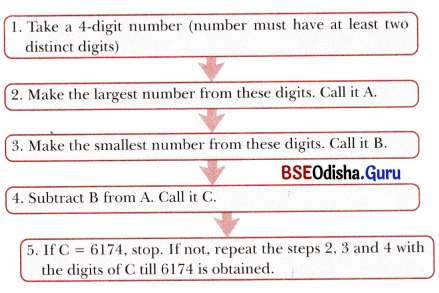
Kaprekar’s routine on a 4-digit number
Note:
(i) The number 6174 is called the Kaprekar Constant
(ii) Kaprekar’s routine can also be performed on a 3-digit number, and it always leads to the number 495.
The Collatz Conjecture
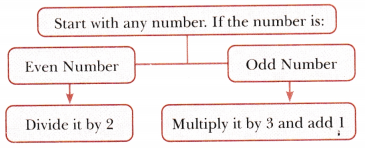
No matter which positive number you start with, every sequence eventually ends with 1.
For example:
(i) 26 (even), 13, 40, 20, 10, 5, 16, 8, 4, 2, 1
(ii) 53 (odd), 160, 80, 40, 20, 10, 5, 16, 8, 4, 2, 1