
Students can include Class 7 Curiosity Extra Questions and Class 7 Science Chapter 2 Exploring Substances Acidic Basic and Neutral Extra Question Answer in their daily self-study routine.
Class 7 Science Chapter 2 Exploring Substances Acidic Basic and Neutral Extra Questions
Class 7 Science Chapter 2 Extra Questions on Exploring Substances Acidic Basic and Neutral
Exploring Substances Acidic Basic and Neutral Class 7 Very Short Question Answer
Question 1.
Naman was playing in the garden when a red ant bit him on his hand. His mother rubbed moist baking soda on the affected area. What is the reason behind it?
Answer:
When a red ant bites, it injects formic acid into the skin which causes pain and irritation. This can be relieved by applying moist baking soda, which is basic in nature, as it neutralises the effect of acid.

Question 2.
An experiment was set up with onion extract strips. Strip A was treated with tamarind water, Strip B with baking soda solution, and Strip C with distilled water. Predict the odour changes in all three strips.
Answer:
Onion extract acts as an olfactory indicator, which retains its odour in acidic and neutral solutions, while its odour fades in basic solutions. With tamarind water (acidic) and distilled water (neutral), the smell remains, while with baking soda solution (basic), the smell fades.
Question 3.
During a science experiment, Abhishek added orange juice and washing powder solution separately to two test tubes containing red rose extract. What colour changes (if any) would have been observed? State the nature of these substances.
Answer:
Orange juice changes the colour of the red rose indicator to a shade of red, while washing powder solution turns the red rose indicator green. Hence, the orange juice is acidic, while the washing powder solution is basic.
Question 4.
Why is it advised not to taste any unknown substance to test its nature?
Answer:
Tasting unknown substances is not recommended because they can be harmful. Some substances may be poisonous or can cause burns in the mouth. Instead of tasting, indicators like litmus paper, turmeric, or red rose extract should be used to test the nature of substances.
Question 5.
What will happen if a few drops of amla juice are added to a test tube containing red rose extract? What does this indicate about the nature of the amla juice?
Answer:
The colour of the red rose extract changes to a shade of red when a few drops of amla juice are added to it in a test tube. The colour change from deep pink to red indicates that amla juice is acidic in nature.
Question 6.
Amit wants to test the nature of the soil in his field. How can he test the nature of the soil using a hydrangea plant?
Answer:
The nature of the soil can be tested using the hydrangea plant as follows:
- If blue-coloured flowers grow on the plant, this indicates that the soil is acidic in nature.
- If pink-coloured flowers grow on the plant, this indicates that the soil is basic in nature.
Question 7.
Answer the following questions:
(i) What colour is obtained on a turmeric paper when it is dipped in a beaker containing a baking soda solution?
(ii) Using the litmus paper test, what can you conclude about the nature of the vinegar?
Answer:
(i) Red colour is obtained on the turmeric paper when it is dipped in a beaker containing baking soda solution, as it is basic in nature.
(ii) When a strip of blue litmus paper is dipped in the vinegar solution, it turns red. But when a strip of red litmus paper is dipped in the vinegar solution, it remains red. This indicates that vinegar is acidic in nature.
Question 8.
Between tamarind water and distilled water, which one is acidic? How can you confirm the same using red rose extract?
Answer:
Between tamarind water and distilled water, tamarind water is acidic. When a few drops of red rose extract are added to a test tube containing tamarind water, its colour changes to a shade of red, confirming the acidic nature of tamarind water. Whereas, when a few drops of the red rose extract are added to a separate test tube containing distilled water, there occurs no change in its colour, confirming the neutral nature of distilled water.
Question 9.
Do bases have a sour or a bitter taste? Can you confirm the basic nature of a substance using blue litmus paper? Justify your answer.
Answer:
Bases generally have a bitter taste. No, the basic nature of a substance cannot be confirmed using a blue litmus paper, as both basic as well as neutral solutions do not change the colour of blue litmus paper. Thus, it will be difficult to identify if the given substance is basic or neutral.
Question 10.
Predict what will happen if:
(i) turmeric strip is dipped in a test tube containing detergent solution
(ii) Blue litmus paper is dipped in a test tube containing tomato juice
Answer:
(i) The colour of the turmeric strip changes to red when dipped in a detergent solution.
(ii) The colour of the blue litmus paper changes to red when dipped in a test tube containing tomato juice.
Exploring Substances Acidic Basic and Neutral Class 7 Short Question Answer
Question 1.
Look at the figure given alongside which shows solutions taken in test tubes A, B, C and D. What colour is expected when a piece of red litmus paper is dropped in each test.
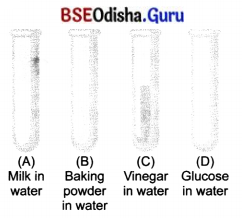
| Test Tube | Nature of Solution | Change in colour of red litmus |
| A B C D |
Neutral Basic Acidic Neutral |
Answer:
Test tube A: No change; Test tube B: colour changes to blue; Test tube C: No change; Test tube D: No change
Question 2.
The given box contains a few substances used in daily life.
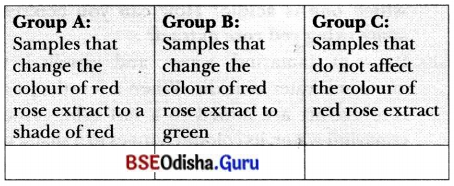
Soap solution, baking soda solution, lemon juice, amla juice, sugar solution, tamarind water, vinegar, washing powder solution, salt solution, lime water, tomato juice, distilled water, orange juice Identify the nature of these substances and group them in the table given below:
Answer:
| Group A: Samples that change the colour of red rose extract to a shade of red | Group B: Samples that change the colour of red rose extract to green | Group C: Samples that do not affect the colour of red rose extract |
| Group A: Samples that change the colour of red rose extract to a shade of red. Lemon juice, amla juice, tamarind water, vinegar, tomato juice, and orange juice. |
Group B: Samples that change the colour of red rose extract to green. Soap solution, baking soda solution, washing powder solution, and lime water. |
Group C: Samples that do not affect the colour of red rose extract Sugar solution, salt solution, and distilled water |
Question 3.
(i) During a laboratory experiment, Karan added amla juice to a test tube and mixed it with a few drops of blue litmus solution. Then, he slowly added soap solution dropwise. What changes will he observe, and what did they prove?
(ii) Define the term acid-base indicators.
Answer:
(i) When a few drops of blue litmus solution are added to the test tube containing amla juice, the colour changes to red. When a few drops of soap solution are added to the same test tube, the red colour starts to fade. On further addition of the soap solution, the solution in the test tube turned blue. This experiment proved that the acidic nature of the amla juice is neutralised by the addition of soap solution. On further addition, the solution turned basic.
(ii) Substances that show different colours in acidic and basic solutions are known as acid-base indicators.
Question 4.
What do you mean by a neutralisation reaction? Explain with the help of two examples.
Answer:
The process in which an acid and a base present in sufficient quantities react with each other to form salt and water is called a neutralisation reaction.
Examples:
- Lime water is added to acidic soil to neutralise it, which helps improve the growth of plants.
- Moist baking soda is applied to an ant bite to neutralise the formic acid injected by it.
Question 5.
Answer the following questions.
(i) Ramesh used turmeric paper and red rose extract to test unknown solutions. How will these indicators help him in the identification of the nature of these solutions?
(ii) Name the acid present in (a) tomatoes, (b) tamarind.
Answer:
(i) Turmeric paper turns red upon the addition of a basic solution but shows no colour change with neutral or acidic solution. On the other hand, red rose extract turns green in basic solutions and a shade of red in acidic solutions. If the colour remains unchanged, the substance is neutral.
(ii) (a) Citric acid and oxalic acid (b) Tartaric acid
Question 6.
Jaivik, a class 7 student, tested the same solution P, using red litmus paper and then with red rose extract. The red litmus paper turned blue, and the colour of the red rose extract changed to green.
(i) Between orange juice and soap solution, what could be solution P? Give a reason for your answer.
(ii) A neutralisation reaction was carried out in a boiling tube. The boiling tube immediately became hot. What could be the possible reason for this?
Answer:
(i) Based on the given observations, solution P could be a soap solution, as it is basic in nature. Basic solutions turn red litmus paper blue and change the colour of red rose extract to green.
(ii) In the given case, the test tube immediately became hot due to the evolution of heat, as neutralisation reactions are always accompanied by the evolution of heat.
Question 7.
A group of students went to a nearby agricultural field that had a partition in the middle. They noticed that the plants weren’t showing proper growth. They collected the samples of soil from the left and right sides of the partition and prepared sample solutions marked A and B, respectively. Red rose extract is used as an indicator to test the nature of both sample solutions and following results are obtained:
(i) Sample solution A changed the colour of the red rose extract to a shade of red.
(ii) Sample solution B changed the colour of red rose extract to green.
Based on results, what inference can be drawn about the nature of soil in both the samples?
Answer:
(i) Since the sample solution A changed the colour of the red rose extract to a shade of red, it must be acidic in nature. Hence, the soil present on the left side of the partition is acidic in nature.
(ii) Since the sample solution B changed the colour of the red rose extract to green, it must be basic in nature. Hence, the soil present on the right side of the partition is basic in nature.
Question 8.
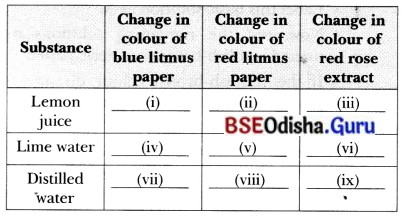
Identify (i) to (ix) in the given table.
Answer:
(i) Red
(iii) Red
(iv) No change
(v) Blue
(vi) Green
(vii) No change
(viii) No change
(ix) No change
Question 9.
Sachin asked his classmate to prepare a solution using lime (chuna, i.e. calcium oxide). Name the solution obtained, and how is it prepared? How can he distinguish this solution from lemon juice?
Answer:
Lime water.
The following procedure can be followed to prepare lime water:
- Take a small amount of lime (chuna, i.e. calcium oxide) in a clean container and mix it with water.
- Stir the mixture well to dissolve as much calcium oxide as possible.
- Cover the container with a lid and leave the mixture undisturbed for several hours or up to 24 hours so that the undissolved solid settles at the bottom.
- Carefully pour the clear solution into another container without disturbing. The clear liquid (solution of calcium hydroxide) obtained is lime water.
It can be distinguished from lemon juice via a litmus test. Lime water, being basic, turns red litmus blue while lemon juice, being acidic turns blue litmus red.
Exploring Substances Acidic Basic and Neutral Class 7 Long Question Answer
Question 1.
Parvati is given three unknown solutions and a turmeric indicator. How can she identify which solution is acidic, which is basic, and which is neutral?
Answer:
Parvati should follow the following procedure:
- Take three strips of turmeric paper indicator, and dip a paper strip in each of the solutions.
- The solution that changes the colour of the paper to reddish-brown is basic.
- Label this basic solution as A.
- Now, test the remaining solutions on the turned reddish-brown turmeric paper.
- If the reddish-brown colour disappears, the solution is acidic; label it as B. If there is no change, the solution is neutral; label it as C.
Question 2.
You are given three solutions: tamarind juice (P), sugar solution (Q), and soap solution (R). What will be your observations when you add
(i) a few drops of solution R to a small amount of red rose extract taken in a test tube?
(ii) a strip of blue and red litmus papers in solution P?
(iii) a strip of turmeric paper and red litmus paper in solution Q?
Answer:
(i) Solution R is a soap solution; thus, it is basic in nature. The colour of the red rose extract changes to green.
(ii) Solution P is tamarind juice; thus, it is acidic in nature. The colour of blue litmus paper turns red in this solution. There will be no change in the colour of red litmus paper.
(iii) Solution Q is a sugar solution; thus, it is neutral in nature. There will be no change in the colour of the turmeric paper indicator and red litmus paper.
Question 3.
(i) Form scientifically correct and meaningful sentences using the words given in each group.
(a) neutralises / base / acid / produce / salt / water / to / and / of / with / heat / evolution / along / the
(b) litmus / paper / blue / red / acid / turns
(c) litmus / natural / a / obtained / is / lichens / substance / from
(ii) A solution X turns blue litmus red, but shows no colour change with turmeric indicator. A solution Y turns red litmus blue, and changes the colour of turmeric indicator to red. What could be the nature of X and Y ? What will happen if a few drops of these solutions are added to small amounts of red rose extract taken in separate test tubes?
Answer:
(i) (a) Acid neutralises base to produce salt and water along with the evolution of heat.
(b) Acid turns blue litmus paper red.
(c) Litmus is a natural substance obtained from lichens.
(ii) Since X turns blue litmus red and does not change the colour of turmeric indicator, it must be an acidic solution. Since Y turns red litmus blue and turmeric indicator red, it must be a basic solution. Solution X will change the colour of the red rose extract to a shade of red, while solution Y will turn the red rose extract green.
Exploring Substances Acidic Basic and Neutral Class 7 Case Based Questions
Read the following passages and answer the questions that follow:
Question 1.
Ritu and Kabir got excited when their science teacher showed them how to write secret messages using things present in the kitchen. First, they dipped a cotton earbud in lemon juice and wrote on white paper. At first, nothing could be seen. But when they sprayed a solution of a red rose extract indicator, the hidden writing slowly appeared.
(i) Why was lemon juice used to write the secret message?
(ii) What made the message appear when the paper was sprayed with a red rose extract indicator?
(iii) Name another substance that can be used to write the hidden message. Which indicator will you use to make the message visible?
OR
(iii) Can turmeric spray be used to reveal the secret message written using lemon juice? Explain.
Answer:
(i) Lemon juice being colourless, is suitable for writing secret messages as it becomes invisible when the paper dries, and becomes visible when exposed to an appropriate acid-base indicator.
(ii) When red rose extract is sprayed on lemon juice, it turns a shade of red, causing the message to become visible. This is because lemon juice is acidic and red rose extract turns a shade of red in acidic solutions.
(iii)
- Vinegar can be used to write the message and blue litmus solution can be used as the indicator. On spraying, the message will appear red.
- Soap solution can be used to write the message and red litmus solution can be used as the indicator. On spraying, the message will appear blue.
OR
(iii) Turmeric spray cannot be used as an indicator to reveal the secret message written using lemon juice, as it does not change its colour in acidic solutions.
Question 2.
A farmer was worried about the low yield from his crops. He had been working hard, watering the plants regularly and using fertilisers, but still, the plants were not growing well. He spoke to an agricultural scientist for help. The scientist visited the field and took some samples of the soil for testing. After testing, he found that the soil was too acidic. The scientist explained that acidic soil prevents plants from taking in important nutrients, even if they are present in the soil.
(i) Name a substance that can be used to treat the acidity of the soil.
(ii) If the soil is basic, what should be added to the soil to cancel out its basic nature?
(iii) Name and define the process involved in treating the acidity/basicity of the soil.
OR
(iii) How did the soil become acidic? Is neutral soil the only requirement for plants to grow healthy?
Answer:
(i) Lime water, which is basic in nature, can be used to treat the acidity of the soil.
(ii) If the soil is too basic, organic matter like manure and composted leaves can be added to it. Organic matter releases acids that neutralise the basic nature of the soil.
(iii) The process involved in treating the soil is a neutralisation reaction.
A neutralisation reaction can be defined as the reaction between sufficient quantities of an acid and a base to produce salt and water. Heat is also evolved in this reaction.
OR
(iii) The excessive use of chemical fertilisers could have made the soil too acidic.
If the soil is neutral, the plants growing in it may still show poor health, which can be due to the deficiency of certain nutrients in the soil.
Question 3.
During a science activity, a group of students set out to prepare a natural indicator using red rose petals, following the instructions in their textbook. They collected fallen red rose petals, washed them with water, crushed them using a pestle and mortar, and soaked the crushed petals in hot water for a few minutes. After filtering the mixture, they obtained an extract, which they used as an acid-base indicator. The students labeled three transparent test tubes as P, Q, and R.
They added equal amounts of this extract to each test tube. Next, they introduced a few drops of three different solutions-amla juice, common salt solution, and baking soda solution-into the respective test tubes. They then carefully observed the colour changes. The students then got engaged in a discussion about their observations, relating them to the nature of the solutions and the behaviour of indicators.
(i) In addition to a red rose, name any other flower whose extract can also be used as an acid-base indicator.
(ii) Based on the given activity, select the correct statement from the following:
(a) The colour of the red rose extract changes to a shade of red in the test tube Q.
(b) The colour of the red rose extract changes to green in the test tube P.
(c) The colour of the red rose extract does not change at all in the test tube R.
(d) The colour of the red rose extract does not change at all in the test tube Q.
(iii) What colour change will you observe in test tube P when an excess of soap solution is added to it? Explain briefly.
OR
(iii) Is the nature of the solutions added to test tubes Q and R the same? Why or why not? Justify your answer based on the given activity.
Answer:
(i) Red hibiscus
(ii) (d) The colour of the red rose extract changes to a shade of red in test tube P, as amla juice is acidic in nature. The colour of the red ose extract does not change in test tube Q, as a common salt solution is neutral. The colour of the red rose extract changes to green in test tube R, as the baking soda solution is basic in nature.
(iii) Initially, when a few drops of amla juice are added to test tube P, the colour of the red rose extract changes to a shade of red. When an excess of soap solution is added to this test tube, the colour of the red rose extract gradually changes to green, as a soap solution is basic in nature.
OR
(iii) No, the nature of the solutions added to test tubes Q and R is not the same. In test tube Q, when a few drops of common salt solution are added, there is no change in the colour of the red rose extract. Whereas, in test tube R, the colour of the red rose extract changes to green upon the addition of a few drops of baking soda solution. This suggests that the common salt solution is neutral, while the baking soda solution is basic in nature.
Exploring Substances Acidic Basic and Neutral Class 7 Picture Based Questions
Observe the given pictures and answer the questions that follow:
Question 1.
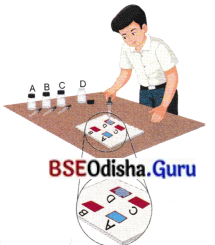
Rohit, a student of class 7, was testing the nature of substances A, B, C, and D, using red litmus paper as shown in the picture along side.
(i) Based on the change in colour of red litmus paper, the possible substances A, B, C, and D are, respectively
(a) Lime water, distilled water, vinegar, amla juice
(b) Lemon juice, lime water, carbonated drink, soap solution
(c) Soap solution, lemon juice, distilled water, lime water
(d) Distilled water, soap solution, lime water, lemon juice
Answer:
(c) Substances A and D are basic in nature, as they turn red litmus paper blue; substances B and C can either be acidic or neutral, as there is no change in the colour of red litmus paper. Thus, the possible substances A, B, C, and D are soap solution, lemon juice, distilled water, and lime water, respectively.
(ii) How is litmus obtained from nature?
Answer:
Litmus is a natural substance obtained from lichens.
(iii) Considering the correct answer for part (i), explain what will be the change in colour if turmeric paper was used as an indicator instead of red litmus paper.
Answer:
Here, soap solution (A) and lime water (D) will change the colour of turmeric paper to red, while there will be no change in the colour of the turmeric paper in case of lemon juice (B) and distilled water (C).
OR
(iii) Based on your observations about solutions B and D in the given activity, will you expect a colour change when a few drops of these solutions are added to small amounts of red rose extract taken in separate test tubes? Explain briefly.
Answer:
In the given activity, it can be observed that solution B did not change the colour of the red litmus paper. Hence, it could be acidic or neutral. If the solution B is acidic, the red rose indicator will turn to a shade of red. However, if this solution is neutral, there will be no change in the colour of the red rose indicator.
Solution D is basic in nature, as it turned red litmus blue. Hence, it will change the colour of red rose extract to green.
Question 2.
A student added red rose extract to two test tubes containing different unknown solutions. The colour changes observed are shown in the picture given below.
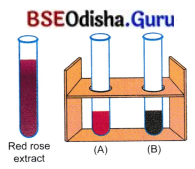
(i) Which of these test tubes is most likely to contain the lime water and why?
Answer:
Test tube (B) is most likely to contain the lime water, as in this test tube, the colour of the red rose extract changes to green.
(ii) What colour change would be observed if turmeric paper is dipped in solution (B)?
Answer:
The turmeric paper will turn red, as solution in test tube (B) is basic in nature.
(iii) Which test tube is likely to contain vinegar solution? Give a reason for your answer. What will happen if a few drops of this solution are placed on a strip of blue litmus paper?
Answer:
Test tube A is most likely to contain vinegar solution, as the colour of the red rose extract changes to a shade of red in this test tube. When a few drops of vinegar solution are placed over a strip of blue litmus paper, the colour of the paper changes to red.
OR
(iii) Based on the observed colour change, identify the nature of solutions in test tubes (A) and (B). Is red rose extract a natural or a synthetic indicator?
Answer:
Since the colour of the red rose extract changes to red in test tube (A), the solution present in this test tube is acidic. Since the colour of the red rose extract changes to green in test tube (B), the solution present in this test tube is basic. Red rose extract is a natural indicator.
Question 3.
Consider the following edible substances:
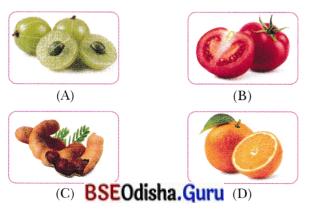
(i) The nature of which of the above substances can be identified using an onion extract indicator?
Answer:
None, because all of the substances contain acids. Onion extract, an olfactory indicator, can only detect basic substances in which the odour of the onion extract is not retained. It cannot distinguish between neutral and acidic substances, as it retains its odour in neutral and acidic media.
(ii) Do all these substances taste sour? Between acids and bases, what is likely to be present in these substances?
Answer:
Yes, all the given substances are sour in taste. Generally, acids are sour in taste, while bases are bitter in taste. Hence, acids are likely to be present in all the given.
(iii) Do the juices present in all these substances turn red litmus paper blue?
Answer:
No, the juices present in the given substances do not turn red litmus paper blue because they are acidic in nature.
OR
(iii) Name the acids or bases present in each of the given substances.
Answer:
The given substances contain acids represented as follows:
- (A) – Ascorbic acid and citric acid
- (B)- Citric acid and oxalic acid
- (C) – Tartaric acid
- (D) – Citric acid
Question 4.
The students of class 7 were provided with the given listed substances along with some indicators as shown in the image:
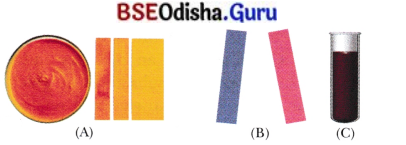
(i) Classify the given substances as acidic, basic and neutral.
Answer:
(i) Acidic- I, V and VII
Basic- II, III and IV
Neutral- VI
(ii) Name the indicators A, B and C.
Answer:
A- Turmeric paper
B – Red and blue litmus papers
C – Red rose extract
(iii) Select the incorrect statement regarding the change in colour of the given indicators when added to the given substances.
(a) Substances II, III, and IV change the colour of indicator A to red and indicator C to green.
(b) Substances I, V, and VII change the colour of the blue-coloured indicator B to red.
(c) Substances I, V, VI, and VII do not change the colour of indicator A.
(d) Substances II, III, and V change the colour of the red-coloured indicator B to blue.
Answer:
(d) Substances II and III are basic in nature. Thus, they change the colour of red litmus paper (B) to blue, while substance V, being acidic in nature, does not change the colour of red litmus paper (B).
OR
(iii) Which of the given indicators cannot be used to distinguish between substances VI and VII? Why?
Answer:
Turmeric paper indicator (A) and red litmus paper (B) cannot be used to distinguish between distilled water (neutral) and amla juice (acidic) because both acidic and neutral solutions have no effect on the colour of these indicators.
Exploring Substances Acidic Basic and Neutral Class 7 Activity Based Questions
Read the following activity and answer the questions that follow:
Objective: To determine the nature of given solutions using turmeric paper and blue litmus solution as indicators.
Materials required: Four different solutions in separate test tubes, turmeric paper strips, blue litmus solution, and droppers.
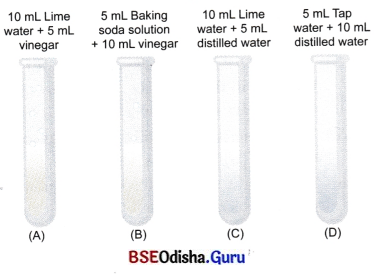
Procedure:
- Take a strip of turmeric paper and dip it into the solution A. Observe and record the colour change.
- Add a few drops of blue litmus solution to solution A and observe the colour change.
- Repeat the above steps for solutions B, C, and D.
(i) Classify the given solutions as acidic, basic and neutral.
Answer:
Solution A: 10 mL lime water +5 mL vinegar – Basic
Solution B: 5 mL baking soda +10 mL vinegar – Acidic
Solution C: 10 mL lime water + 5 mL distilled water – Basic
Solution D: 5 mL tap water +10 mL distilled water – Neutral
(ii) Identify the solutions in which the colour of the turmeric paper changes to red.
Answer:
The colour of turmeric paper changes to red in basic solutions, i.e., A and C.
(iii) Which of the given solutions do not change the colour of the blue litmus paper, and why?
Answer:
The blue litmus paper changes its colour in acidic solution, but there is no change in its colour in basic as well as neutral solutions. Thus, solutions A, C and D do not change the colour of blue litmus paper.
OR
(iii) If lime water in A is replaced with lemon juice, what will be the change in colour of blue litmus paper and turmeric paper?
Answer:
If lime water in solution A is replaced with lemon juice, the resultant solution will become acidic and it will change the colour of blue litmus paper to red. Also, there will be no change in the colour of turmeric paper.
Exploring Substances Acidic Basic and Neutral Extra Questions for Practice
Question 1.
Vanita, a class 7 student, was provided with two solutions, i.e., I and II. Solution I was lime water, while solution II was a common salt solution. Which of the following statements about these solutions is correct?
(a) Solutions I and II cannot be differentiated using the turmeric paper indicator.
(b) Solution I will turn blue litmus paper red, while solution II will turn red litmus paper blue.
(c) Solutions I and II can be differentiated using the turmeric paper indicator.
(d) Solutions I and II will show the same colour change with the red rose extract.
Answer:
(c) Solution 1, i.e., lime water turns turmeric paper indicator red, while solution II, i.e., common salt solution does not change the colour of the turmeric paper indicator thus, they can be differentiated using this indicator.
Question 2.
Turmeric is a natural indicator. On adding its paste to acid and base separately, which colours would be observed?
(a) Yellow in both acid and base
(b) Yellow in acid and red in base
(c) Pink in acid and yellow in base
(d) Red in acid and blue in base
Answer:
(b) Yellow in acid and red in base
Question 3.
A few substances are grouped as: Common salt solution, curd, amla juice, orange juice, lemon juice, vinegar Which of the following is the odd one out in this group and why?
(a) Lemon juice, as it is acidic.
(b) Common salt solution, as it is neutral.
(c) Vinegar, as it is basic.
(d) Curd, as it is neutral.
Answer:
(b) Common salt solution is neutral, whereas all other substances are acidic in nature.
Question 4.
A science experiment was conducted in a school laboratory to determine the nature of various solutions.
Based on the observation table given alongside, select the correct statements from the following:
(i) Both solutions Y and Z are acidic in nature.
(ii) Solution W is basic in nature, and it can be a soap solution.
(iii) Both solutions X and Y are basic in nature.
(iv) Solution W is neutral, while solution Z is acidic in nature.
(v) Solution Y is acidic in nature, while solution Z is basic in nature.
(a) (i) and (ii)
(b) (i) and (iv)
(c) (iii) and (iv)
(d) (ii) and (v)
| Solution | Observation |
| W | No colour change in any of the litmus papers |
| X | Changed the colour of the turmeric indicator to red |
| Y | Changed the colour of the red rose extract to green |
| Z | Turned blue litmus paper red |
Answer:
(c) Solution W is neutral, as it did not change the colour of any of the limus papers. Solution X is basic, as it changed the colour of the turmeric indicator to red. Solution Y is basic, as it changed the colour of the red rose extract to green. Solution Z is acidic, as it changed the colour of blue litmus paper to red.
Questions 5 and 6 consist of two statements – Assertion (A) and Reason (R). Answer these questions by selecting the correct option:
(a) Both A and R are true and R is the correct explanation of A.
(b) Both A and R are true but R is not the correct explanation of A.
(c) A is true but R is false.
(d) A is false but R is true.
Question 5.
Assertion (A): If a solution does not change the colour of red litmus paper, it must be neutral.
Reason (R): A basic solution turns the red litmus paper blue.
Answer:
(d) If a solution does not change the colour of red litmus paper, it is not always necessary that it must be neutral. The solution can also be acidic, as acidic solutions also do not change the colour of red litmus paper.
Question 6.
Assertion (A): Lime water is added to soil by farmers if the soil is too acidic.
Reason (R): Lime water is basic in nature.
Answer:
(a) Both A and R are true and R is the correct explanation of A.
Question 7.
While playing in a playground, a red ant bit Ankita on her hand. Her hand turned red, and she immediately felt a burning sensation. What do you think was injected into her skin? What can be applied on the skin to neutralise its effect? Justify your answer.
Answer:
When a red ant bites, formic acid is injected into the skin. It can be neutralised by rubbing a paste of baking soda, as it is basic and therefore helps relieve the irritation.
Question 8.
A detergent solution, which we use every day, is considered basic in nature. Mention a real-life phenomenon that proves its basic nature.
Answer:
When a detergent solution is rubbed onto a white shirt with a turmeric stain, the colour of the stain changes to red. It is known that only basic solutions change the colour of the turmeric indicator to red. Therefore, a detergent solution is basic in nature.
Question 9.
A student of class 7 tested the nature of three household substances (P, Q, and R) using red and blue litmus papers. The observations are as follows:
P: Turns red litmus paper blue
R: No colour change in any of the litmus papers
Q: Turns blue litmus paper red
(i) Which of these substances is likely to contain lactic acid, and why?
(ii) Turmeric is a natural acid-base indicator. Which of the given substances cannot be distinguished using the turmeric indicator? Explain your answer briefly.
Answer:
(i) Substance Q is likely to contain lactic acid, as it turns blue litmus red.
(ii) Substances Q and R cannot be distinguished using the turmeric indicator. Q is acidic, as it turns the blue litmus paper red. While R is neutral, as it does not change the colour of any of the litmus papers. It is known that turmeric indicator turns red in basic solutions, but does not change its colour in either acidic or neutral solutions.
Question 10.
(i) Between the turmeric strip and the onion strip, which one is an olfactory indicator? Can both these strips be used to distinguish between acidic and neutral solutions? Give a reason for your answer.
Answer:
Between the turmeric strip and the onion strip, the onion strip is an of factory indicator as it changes its odour in acidic or basic medium. The turmeric strip is a visual indicator as it shows different colours in acidic or basic medium. None of these strips can be used to distinguish between acidic and neutral solutions. This is because the turmeric strip does not show any colour change in acidic and neutral solutions. Also, the odour of the onion strip is retained in both acidic and neutral solutions.
(ii) Is a common salt solution acidic, basic, or neutral? Give a reason for your answer.
Answer:
A common salt solution is neutral, as it does not change the colour of any of the litmus papers or any other indicators. In addition, it does not react with any acid or a base to undergo a neutralisation reaction.
Question 11.
During a science exhibition, students tested various household solutions using natural indicators such as blue litmus paper, red rose extract and turmeric paper to identify their acidic/basic nature. They noted that some indicators exhibited colour changes only in specific solutions, while others effectively distinguished between acidic, basic, and neutral substances.
(i) Which of the given indicators will not show any colour change in basic and neutral solutions?
Answer:
The colour of the blue litmus paper does not change in either basic or neutral solution.
(ii) Do red rose extract and turmeric paper show the same colour in a basic solution?
Answer:
No, the red rose extract and turmeric paper show different colours in a basic solution. Red rose extract turns green, while turmeric paper turns red in a basic solution.
(iii) What is the colour of turmeric paper in an acidic solution? Does it show the same colour in a neutral solution?
Answer:
The colour of the blue litmus paper does not change in either basic or neutral solution.
OR
(iii) Which of the given indicators act as olfactory indicators? Give a reason for your answer.
Answer:
None of the given indicators act as an olfactory indicator. Rather, all these are visual acidbase indicators that show different colours in acidic and basic media. An olfactory indicator is an indicator that exhibits different odours in acidic and basic media.
Question 12.
(i) What are the natural sources of (a) acetic acid, and (b) lactic acid?
Answer:
(a) Vinegar
(b) Curd
(ii) Kritika was conducting a science experiment, with three different solutions, tomato juice, soap solution, and sugar solution. She tested each of these solutions using red rose extract. Tomato juice changed the colour of the red rose extract to a shade of red, soap solution changed the colour of red rose extract to green, while sugar solution caused no change in the colour of the red rose extract.
(a) Which of the given solutions will change the colour of the turmeric paper to red? Why?
Answer:
Since the soap solution changed the colour of red rose extract to green, it is basic in nature. Hence, it will change the colour of the turmeric paper to red.
(b) Which of the given solutions has the same nature as exhibited by vinegar? Why?
Answer:
Tomato juice has the same nature as exhibited by vinegar, as both are acidic in nature.
(c) Can you suggest any other indicator that can distinguish between a tomato juice and a soap solution?
Answer:
Litmus papers can be used to distinguish between a tomato juice and a soap solution. A tomato juice will turn bluc litmus paper red, while a soap solution will turn red limus paper blue.