Easy-to-read Ganita Prakash Class 7 Notes and Part 2 Chapter 6 Constructions and Tilings Class 7 Notes save valuable study time during exam season.
Class 7 Maths Chapter 6 Constructions and Tilings Notes
Class 7 Constructions and Tilings Notes
A geometric construction is a step-by-step method of drawing lines, angles and shapes with accuracy, without guessing or drawing freehand.
Each construction is based on mathematical reasoning.
Perpendicular Bisector
A line that bisects a given line and is perpendicular to it, is called the perpendicular bisector.
Construction of Perpendicular Bisector:
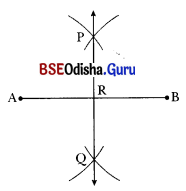
Step 1: Draw the given line segment, say AB.
Step 2: Open the compass such that its radius is greater than half of AB. Place the compass’s pointer on point A and draw two arcs, one above and one below the line segment.
Step 3: Keeping the same radius (do not change the compass setting), place the pointer on B. Draw another two arcs intersecting the previous arcs at points P and Q.
Step 4: Using a ruler, draw a line passing through P and Q. The line PQ is the required perpendicular bisector of AB, intersecting it at point R. Here, R is the midpoint of AB.

Angle Bisector
An angle bisector is a ray drawn from the vertex of an angle that makes the two parts of the angle exactly of the same measure.
For example, in the figure, ray KM divides the ∠LKJ measuring 60° into two equal parts, the measure of each smaller angle is equal to 30°, i.e. ∠LKM = ∠JKM = 30°.
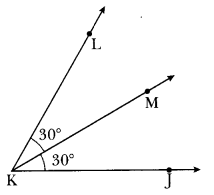
Additionally, ray KM is called angle bisector of ∠LKJ.
Construction of an Angle Bisector:
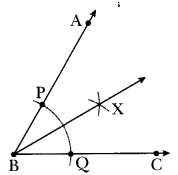
Step 1: Draw the given angle, say ∠ABC.
Step 2: Place compass pointer on B. Open it to an arbitrary radius and draw an arc intersecting both arms of ∠ABC at points P and Q. This ensures BP = BQ.
Step 3: With P as the centre and a radius more than half of PQ, draw an arc. With the same radius and Q as the centre, draw another arc intersecting the previous arc at point X.
Step 4: Join BX. The ray BX is the required angle bisector of ∠ABC.
Construction of an Angle Equal to Given Angle
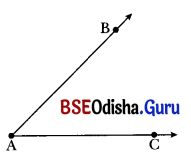
Suppose we have to copy an angle ∠BAC i.e. to make an angle equal to ∠BAC. However, we do not know the measure of ∠BAC. For this we follow the given steps:
Step 1: Draw a ray PQ with initial point P.
Step 2: Place the compass pointer at vertex A. Open it to a convenient/arbitrary radius and draw an arc intersecting both arms of ∠BAC at points J and K.
Step 3: Taking caution and making sure that the opening (or the radius) of the compass does not change, place the pointer on P. Draw an arc intersecting ray PQ at point M.
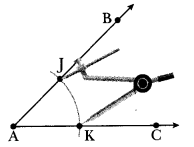
Step 4: Place the compass pointer on K and adjust the width so that pencil lead rests exactly on measuring the distance KJ).
Step 5: Again, taking caution that the radius of the compass has not changed, place the pointer on M and draw a new arc that intersects the previous arc at point L.
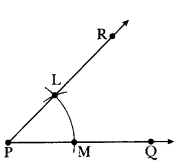
Step 6: Draw a ray starting from point P and passing through point L using a ruler.
Step 7: Label a point R on ray PL. ∠QPR is required angle, which is an exact copy of ∠BAC.
Construction of an Angle Measuring 60°
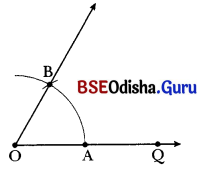
To draw 60° angle, we follow the given steps:
Step 1: Draw a ray OQ with initial point O.
Step 2: Taking 0 as the centre and with the convenient radius, draw an arc intersecting the ray OQ at point A.
Step 3: With A as the centre and using the same radius as step 2, draw another arc to intersect the first arc at point B.
Step 4: Draw ray OB. ∠AOB is required angle of measure 60°.
Construction of a line parallel to a Given Line
If a transversal intersects two lines and the corresponding angles formed are equal, then the two lines are parallel.
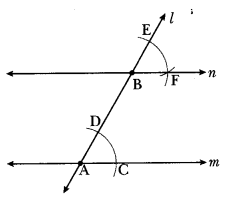
To draw a line through B which is parallel to line m, we follow the given steps:
Step 1: Take any point A on line m. Join B and A to form a transversal line l.
Step 2: With A as centre and any convenient radius, draw an arc intersecting line m at point
C and line l at point D.
Step 3: Using the same radius as in step 2, draw another arc with B as centre. Let this arc intersect line l at point E.
Step 4: Place the pointed tip of the compass at D and adjust the opening so that the pencil lead is at C. This measures the length CD.
Step 5: With E as centre and the radius equal to length CD, draw an arc. This arc will cut the previous arc (drawn in step 3) at point F.
Step 6: Join B and F with a ruler to get a new line n.
The line n drawn through point B is parallel to line m, because the corresponding angles formed are equal, i.e. ∠EBF = ∠DAC.
Arch Designs
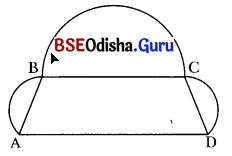
Arch designs have a symmetrical and geometric structure.
To create these arches, one must first draw accurate supporting lines on a flat surface like paper or stone.
A trefoil arch is a type of arch that has three rounded curves joined together, forming a shape like three small overlapping circles. The word “trefoil” means three leaves, so the arch looks a bit like a three-leaf clover.
Symmetry is essential for a trefoil arch. It must posses line symmetry to ensure the structure is balanced.
A pointed arch is formed by two arcs that meet at a sharp top point.
It uses two equal line segments placed at an angle. By locating their midpoints, arcs are drawn using the wavy wave method
Regular Hexagons
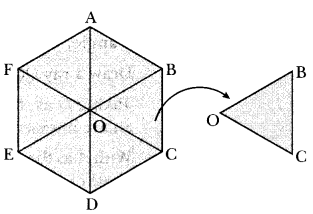
A regular polygon is a shape whose all sides are equal in length and all angles are equal in measure.
A regular hexagon can be visualised as being made up of six identical equilateral triangles.
The six triangles form a closed hexagonal shape.
The outer boundary becomes a regular hexagon.
Each interior angle of the hexagon is 120° (since two 60° angles meet at each vertex of hexagon).
Lines joining opposite vertices (diagonals) of the hexagon pass straight through the centre.
Tiling
Tiling means covering a region completely with given shapes, without any gaps or overlaps. One important type of tiling problem is to check whether the total number of unit squares in a given region can be fully covered by a given type of tile.
In any tiling problem, the first and most important step is a counting check, i.e. the total number of unit squares in the grid must be divisible by the area of one tile.
In general, an m × n rectangular grid can be tiled using 2×1 dominoes if and only if m × n is even, which means at least one of m orn must be even.
Certain regular shapes, like squares, equilateral triangles, and regular hexagons, can tile the entire plane without leaving gaps or overlaps. For example, regular hexagons form a natural tiling pattern, commonly seen in bee hives.
Other regular polygons (like Pentagon) result in unavoidable gaps or overlaps, so they cannot tile a flat surface (plane) perfectly.
Types of Bisector
Perpendicular bisector:
A line that bisects a given line and is perpendicular to it, is called the perpendicular bisector
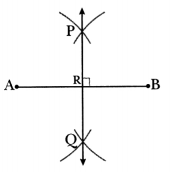
PQ is perpendicular bisector of AB.
Angle bisector: A ray drawn from the vertex of an angle that divides the angle into two equal parts is called the angle bisector.
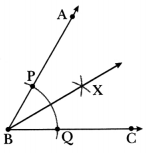
Here, BX is angle bisector of ∠ABC.
Copying An Angle
Copying an angle means constructing an angle that is exactly equal in measure to a given angle. We can copy a given angle using geometric instruments (a ruler and a compass), without measuring the angle with a protractor.
Consider the given angle to be ∠BAC.
Steps of construction to copy an angle:
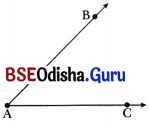
Step 1: Draw a ray PQ with P as the initial point.
Step 2: With the compass at A and any radius, draw an arc cutting the arms of ∠BAC at J and K.
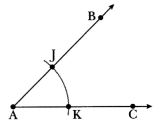
Step 3: Without changing the compass opening, place it at P and draw an arc cutting PQ at M.
Step 4: Place the compass at K and open it to reach J (measure KJ).
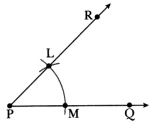
Step 5: Keeping the same opening, place the compass at M and draw an arc intersecting the previous arc at L.
Step 6: Using a ruler, draw a ray from P through L.
Step 7: Mark any point R on this ray. ∠RPQ is the required angle, equal to ∠BAC.
Tilings
Tiling (or tessellation) is the process of covering a flat region using a set of shapes so that there are absolutely no gaps or overlaps.
In general, a regular polygon can tile the plane only if the interior angle divides 360° exactly (whole number of times).
The hexagonal tiling is highly efficient; it is famously used by bees in honeycombs because it covers the area without wasting space and uses the minimum amount of wax to store the maximum amount of honey.
Tangram
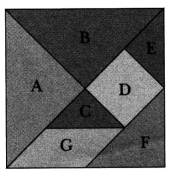
A tangram is a mathematical puzzle made by cutting a square into seven geometric pieces, called tans.