
Easy-to-read Ganita Prakash Class 7 Notes and Part 2 Chapter 7 Finding the Unknown Class 7 Notes save valuable study time during exam season.
Class 7 Maths Chapter 7 Finding the Unknown Notes
Class 7 Finding the Unknown Notes
The Weighing Scale and the Idea of Equality
A weighing scale compares weights placed on its two pans.
The number in the middle shows the total weight on both sides.
The scale is balanced only when both sides have equal total weights. The scale tilts in the direction of the heavier weight.
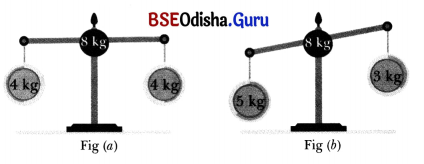
This is similar to the mathematical principle of equality (a = b) which states:
“Lets assume two expressions represent the same value. To maintain this equality, any operation applied to one side must be exactly applied to the other.”
Meaning of an Equation
A statement of equality between two algebraic expressions is called an equation.
We write an equation as two algebraic expressions with an equal sign ‘= ’ between them.
Here are some examples of equations:
2x + 7 = 11, 5 – 3y = 2y + 12, \(\frac{m+5}{3}\) = 3p + 2 etc.
An equation may contain one or more letter numbers (called variables) representing unknown quantities.

Solving Equations Systematically
The process of finding the value(s) of the letter-numbers for which the equality holds, or for which the value of LHS of the equation becomes equal to the value of RHS of the equation, is called solving the equation.
The specific value that satisfies the equation is known as its solution.
For example, x = 5 is the solution of equation 3x – 5 = 10 as x = 5 satisfies the equation.
There are three methods of solving an equation:
- Trial and error method
- Balancing / Systematic method
- Transposition method
Trial and error method
To solve an equation using trial and error method, we follow the given steps:
Step 1: Obtain the LHS and RHS of the given equation.
Step 2: Check the different values of the variable in LHS and RHS one by one until LHS = RHS.
Step 3: The value of the variable for which LHS = RHS is the solution of the given equation.
The trial and error method is considered a crude approach because it involves testing many possible solutions one by one.
Balancing / Systematic method
An equation remains balanced when we perform the same operation (addition/subtraction/ multiplication/division) on both sides.
There are four rules which must be followed while balancing an equation.
- If a number is added to one side of the equation, it must also be added to the other side.
- If a number is subtracted from one side of the equation, it must also be subtracted from the other side.
- If one side of an equation is multiplied by a number, the other side must also be multiplied by the same number.
- If one side of an equation is divided by a non-zero number, the other side must also be divided by the same non-zero number.
Transposition Method
Transposition method is an efficient version of the balancing method.
If a term is transposed from one side of the equation to the other side, its sign changes.
If a number in multiplication (or division) is transposed from one side of the equation to the other side, its operation changes to division (or multiplication).
Solving Real Life Situations Using Equations
The word problems are first translated into an equation containing variables and constants.
Then, the equation is solved using the methods discussed earlier.
Follow the steps given below to solve a word problem:
Step 1: Obtain the given word problem.
Step 2: Study the problem carefully and identify what information is provided and what is the “unknown” or required to be found.
Step 3: Denote the unknown quantities by variables x,y, z, etc.
Step 4: Convert the language statements (or the practical situation) into a mathematical statement. For example, twice of a number is written as 2x.
Step 5: Accordingly, apply all the conditions which are given in the problem to form the equation.
Step 6: Solve the equation obtained in step 5.
The Weighing Scale and Equality
- A weighing scale compares weights on two pans.
- The scale is balanced when both sides have equal weight.
- If one side is heavier and other side is lighter, then the heavier side goes down and lighter side goes up.
- Adding (or removing) the same weight to (or from) both sides keeps the scale balanced.
Idea of an Equation
An equation shows equality between two expressions.
Example: 5x = 2x + 21, 3m – 4 = 11, 8y = 4 + 7y, etc.
It uses the equals sign (=).
Value of both sides of an equation are equal.
The value of variable that makes LHS = RHS is called the solution of the equation.
Variables and Expressions
Letters like x, y, n represent unknown numbers.
Expressions are formed using numbers and variables.
The same variable always represents the same value.
Methods of Solving Equations
The process of finding the solution of the equation is called “solving the equation’
Important methods of solving equations are:
Balancing Method
An equation remains balanced when we perform the same operation (addition / subtraction / multiplication / division) on both sides.
Rules:
Anything added to one side of the equation must also be added to the other side.
Anything subtracted from one side of the equation must also be subtracted from the other side.
If one side of an equation is multiplied by a number, the other side must also be multiplied by the same number.
If one side of an equation is divided by a non-zero number, the other side must also be divided by the same number.
Transposition Method
Transposition method is an efficient version of balancing method.
If a term is transposed from one side of the equation to the other side, its sign changes. For example, 5x + 2 = 4 ⇒ 5x = 4 – 2 If a number in multiplication (or division) is transposed from one side of the equation to the other side, its operation changes to division (or multiplication).
For example, 3x = 15 ⇒ x = \(\frac{15}{3}\)
Solving Word Problems
Follow the path given below to solve a word problem:
