
Combining textbook study with BSE Odisha Class 7 Science Notes and Class 7 Science Curiosity Chapter 1 The Ever Evolving World of Science Notes can make exam preparation more effective.
The Ever Evolving World of Science Notes Class 7
Class 7 Science Curiosity Chapter 1 Notes
Science is present all around us. It is not just a subject limited to our classrooms and laboratories.
It encourages curiosity, careful observation, questioning, reasoning, and experimentation.
Science and Nature
- Science must be experienced through different activities and experiments.
- It is continuously evolving. Discoveries lead to new technologies, which in turn lead to new questions.
- This process has helped us better understand our surroundings, improve health, develop new materials, and explore space.
- It challenges your thinking, expands your knowledge, and helps you become an explorer.
- Exploration is not always about discovering new facts or learning about different things in nature; it is a way of thinking that welcomes curiosity and prompts us to wonder, “Why?”
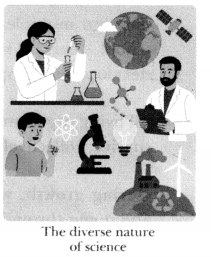

Scientific Journey
This scientific journey begins by exploring materials all around us, the things that we encounter in our day-to-day lives.
You might have wondered, “Why does lemon juice taste sour?” or “What happens when we try to wash off turmeric stains from our school uniforms?” This is because different substances have different natures, i.e., they can be acidic, basic, or neutral, and they interact with each other differently.
Similar to different substances that affect our daily lives, there are also invisible forces that make our lives easier and more comfortable. For example, a light switch makes our room bright in a second, or a fan starts spinning the moment we switch it on. All of this happens because of electricity.
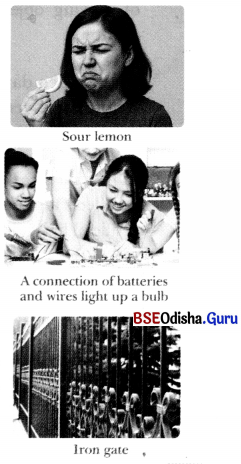
Some materials allow electricity to pass through, while others do not. This is because different substances are made up of different materials.
The iron gate outside our houses, the aluminium foil used in the kitchen, or the pencil lead we write with, each have their own special strength and use. Such properties will introduce us to a world of metals and non-metals.
Melting of ice and breaking of glass are small incidents that introduce us to the topic of changes around us. Some changes around us can be reversed, while others cannot. Some changes are desirable, while others are undesirable.
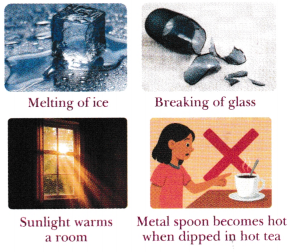
Many of these changes are influenced by heat. For example, a metal spoon kept in a hot cup of tea becomes hot. Similarly, the room becomes warm
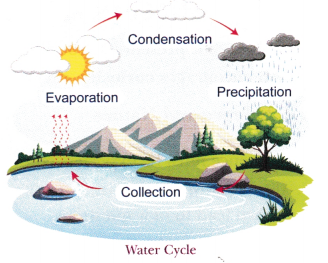
Flow of heat is also responsible for the water cycle. Heat from the Sun evaporates water from different water bodies and adds water vapour to the atmosphere. The water vapour condenses to form clouds, and water falls back to the Earth as rain.
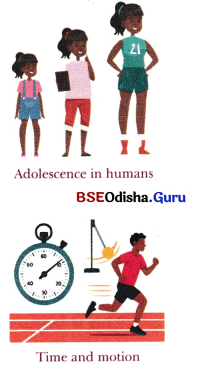
These changes are not limited to materials, our bodies also undergo multiple changes, especially during the middle school years. This is the period when growth and development happen rapidly in our bodies.
All living organisms carry out certain essential activities to survive, collectively called life processes.
During growth, we see changes in ourselves, like becoming taller, stronger, and going through many physical and emotional changes. This is the stage of adolescence, a natural process of rapid growth and development.
The world around us is constantly moving. The study of the motion and speed of moving objects around us comes under the measurement of time and motion.
In the olden days, the measurement of time was heavily dependent on sunlight. Before the invention of clocks and digital watches, shadows cast by the Sun were used to track the passage of time.
Light and shadows are not only used for telling time. When light hits an object, it reflects and enables us to see the object. The invention of light bulbs, lamps, and other sources of artificial light allows us to see even at night.
The ultimate source of light for us is the Sun. Along with the Earth and the Moon, it creates the cycles of days, nights, and seasons, maintaining the rhythm of life on our planet.
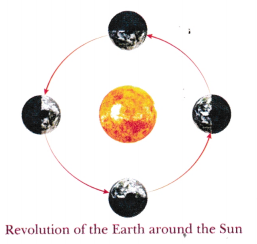
The Earth and the Moon also cast shadows. This results in a phenomenon called an eclipse. The study of the Earth, the Moon, and the Sun gives us an understanding of these events.
The Nature of Science
- Experimental: Science relies on experiments to test ideas and hypotheses.
- Self-correcting: Science evolves over time as new discoveries are made and previous understandings are revised.
- Thinking-based: Logic and curiosity play key roles in scientific exploration.
- Collaborative: Science is a community effort where scientists share their findings, enabling others to review, critique, and build upon their work.
- Evidence-based: Scientific conclusions are based on evidence rather than on what is popular or widely accepted.
Science Surrounds Us
- Exploring Materials and Substances
- Nature of Substances
- Properties of Materials
- Changes Around Us
- Heat Transfer in Nature
- Heat Transfer
- The Water Cycle
- Light and Space
- Shadows and Reflection
- Earth, Moon, and Sun
- Life Processes
- Animals
- Plants