
Combining textbook study with BSE Odisha Class 6 Science Notes and Class 6 Science Curiosity Chapter 9 Methods of Separation in Everyday Life Notes can make exam preparation more effective.
Methods of Separation in Everyday Life Notes Class 6
Class 6 Science Curiosity Chapter 9 Notes
- A mixture is formed when two or more substances are mixed in such a way that they retain their individual properties.
- For example, air (a mixture of gases), seawater (a mixture of salt, water and other substances dissolved in water), and soil (a mixture of sand, broken rocks, microorganisms, etc.).
- Since the individual components of a mixture are only physically mixed, they do not form any new substance.
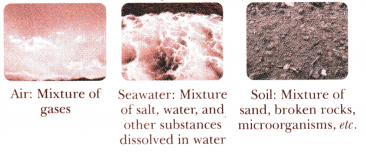
Hence, the mixtures can be separated into their individual components via physical methods.

Methods of Separating Mixtures
- Methods of separating involve sorting and removing different components of a mixture.
- The method used for separating the components of a given mixture depends on the physical properties, such as shape, size, weight, and magnetic nature of its individual components.
Handpicking
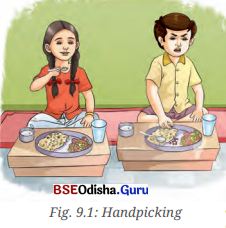
- The method of handpicking is used to separate the components of a solid- solid mixture having differences in size, colour, and shape.
- In this method, the components to be separated are picked up by hand.
- For example, small stones from wheat grains, rice, or lentils.
- This method of separation is effective when the components of a mixture to be separated are large enough in size to be seen clearly.
- They should also be present in small amounts within the mixture.
Threshing
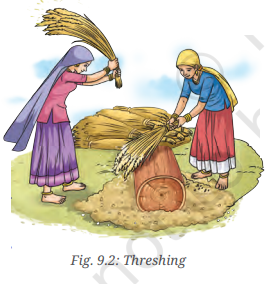
- The method of threshing is used to separate grains from the harvested stalks.
- In this method, the harvested stalks are beaten on a large wooden log, resulting in the separation of grains from the stalks.
Winnowing
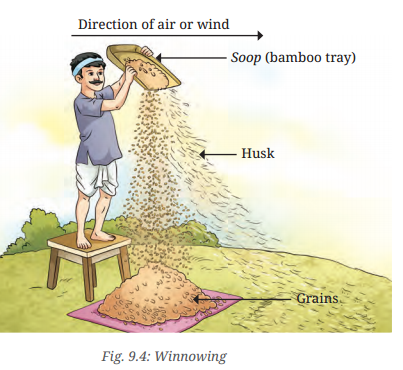
- The method of winnowing is used to separate components of a mixture that have differences in their weights.
- By this process, lighter components, e.g., husk, are separated from the heavier ones, e.g. grains, using moving air or wind.
- In this method of separation, the solid-solid mixture is dropped from a height, where the heavier components drop down forming a heap on the ground, while the lighter components are carried away by the blowing air.
Sieving
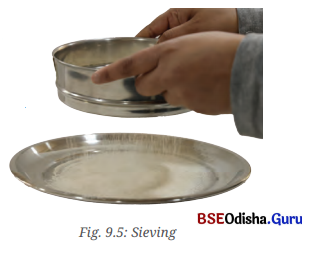
- The method of sieving is used to separate the components of a solid-solid mixture based on differences in their sizes.
- It is done using a sieve, which is a utensil with a steel or plastic mesh inside a frame.
- In this method, a sieve with holes of a certain size allows smaller particles to pass through, while larger particles remain on the sieve, n
- For example, wheat bran or small stones can be separated from fine wheat flour by sieving.
- Here, the small holes in the sieve allow fine wheat flour to pass through, and larger stones or wheat bran are left behind on the sieve.
Evaporation
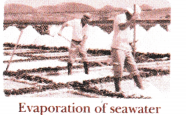
- The method of evaporation is used to obtain soluble solids from their solutions.
- In this method, liquid turns into vapour and the soluble solids present in the mixture are left behind.
- This method is used to obtain salt from seawater.
To obtain both the soluble solid and liquid from a solid-liquid mixture, distillation process is used. In this process, liquid is evaporated from the mixture kept in a container, and the evaporated liquid can then be condensed back in a separate container, while the soluble solid remains at the bottom of the first container.
Sedimentation and Decantation
- Sedimentation-decantation method can be used to separate:
- a mixture of an insoluble solid (heavier than liquid) and a liquid.
- a mixture of two immiscible liquids.
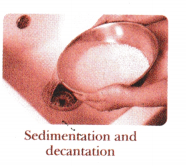
- In this method, the heavier components of a mixture settle at the bottom, when left undisturbed for some time, which is called sedimentation.
- Whereas, the process of separating the liquid from the insoluble solids by carefully pouring out the top layer without disturbing the lower layer is called decantation.
- For example, the separation of water from rice and pulses while washing.
- When a mixture containing two immiscible liquids is allowed to stand for some time, the heavier component forms the bottom layer, while the lighter component forms the top layer. The lighter component that forms the top layer can then be separated by decantation.
Filtration
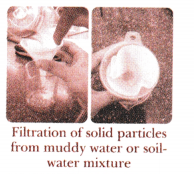
- The method of filtration is used to separate insoluble solids (lighter or heavier than the liquid) from their mixtures.
- In this method, filter paper with small, fine holes is used, n When the mixture is passed through a filter paper, liquid can pass through it to form a filtrate, while insoluble solids, such as chalk powder or mud particles, remain on the filter paper as residue.
Churning
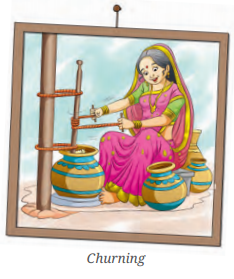
- The method of churning is used for obtaining butter from curd. In this process, butter, being lighter, floats at the top, while the buttermilk is left behind.
- Nowadays, a blender is used to prepare butter milk. It can churn curd to separate the buttermilk.
Magnetic Separation
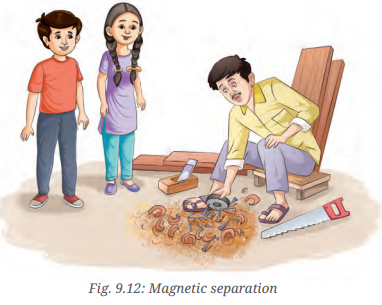
- In this method of separation, a magnetic substance is separated from a non¬magnetic substance. This is done using a magnet.
- For example, the separation of iron filings from a mixture containing iron filings and sand.
- When a magnet is brought closer to the mixture, the iron filings, being magnetic, are attracted to the magnet, and the sand, being non-magnetic, remains unaffected.
Pure Substances
These are made up of only one type of particles.
Examples: Sugar, water, etc.
Impure Substances Or Mixtures
These are made up of two or more types of particles mixed together.
Examples: Air, seawater, etc.
Seperation
Separation of Solid-Solid Mixtures
- Handpicking: Components to be separated are picked up by hand.
- Threshing: Separation of grains from stalks by beating them on hard surfaces.
- Winnowing: Separation of heavier and lighter components of a mixture by wind or by blowing air.
- Seiving: Separation of solid components of a solid- solid mixture which differ in their sizes using a sieve.
- Magnetic Separation : Separation of magnetic materials from non-magnetic materials by using a magnet.
Separation of Solid-Liquid Mixtures
Separation of Insoluble Solids from Liquids
- Sedimentation: Settling down of heavier insoluble solid particles (sediments) of a solid-liquid mixture at the bottom of a container.
- Decantation: Separation of liquid from the insoluble solid by pouring off the liquid while leaving the sediments behind.
- Filtration: Separation of insoluble solid components from a liquid by using a filter.
Separation of Soluble Solids from Liquids
- Evaporation: Separation of soluble solid from a solid-liquid mixture by converting liquid into its vapour.
- Distillation: Separation of the liquid from the solution by evaporation followed by condensation of the vapour.
- Churning: Separation of butter from curd using a churner.