
Students can include Class 7 Curiosity Extra Questions and Class 7 Science Chapter 6 Adolescence: A Stage of Growth and Change Extra Question Answer in their daily self-study routine.
Class 7 Science Chapter 6 Adolescence: A Stage of Growth and Change Extra Questions
Class 7 Science Chapter 6 Extra Questions on Adolescence: A Stage of Growth and Change
Adolescence: A Stage of Growth and Change Class 7 Very Short Question Answer
Question 1.
Which of the following food groups would be a better choice for adolescents and why?
(i) Rice, sweets, pulses
(ii) Leafy vegetables, rice, pulses, and dry fruits
Answer:
(ii) Leafy vegetables, rice, pulses, and dry fruits are better as they provide a balanced mix of important nutrients and energy essential for growth and development during adolescence.

Question 2.
How does an adolescent experience emotional changes?
Answer:
Adolescents become more self-aware, develop stronger feelings, compassion, and may experience mood swings. They begin to understand responsibility, social behaviour, and engage themselves in varied activities.
Question 3.
Mention any two features each that are seen in boys and girls each to distinguish them from each other at puberty.
Answer:
Two features observed in boys during puberty are:
- Growth of facial hair, and chest and back hair in some
- Voice becomes hoarse
- Growth of voice box, visible as the Adam’s apple
- Broadening of shoulders
Two features observed in girls during puberty are:
- Development of breasts
- Widening of hips
Question 4.
Aditi, a teenager, has been feeling tired and low on energy lately. After a check-up, her doctor advised her to improve her eating habits by following a balanced diet. Why is a balanced diet important during adolescence, and what should it include?
Answer:
Adolescence is a time of rapid growth and development. Hence, a healthy, balanced diet is crucial to ensure the body receives proper nutrients during this phase. A balanced diet includes carbohydrates, proteins, fats, vitamins, and minerals, along with sufficient roughage and water intake.
Question 5.
In a group discussion, Jai said that during adolescence physical changes are more commonly observed in boys, while emotional changes occur mainly in girls. Do you think Jai is correct? If not, explain your answer.
Answer:
No, Jai is not correct because both boys and girls experience physical, emotional, and behavioural changes during adolescence.
Question 6.
Give a suitable word for each of the following statements.
(i) The disease that is caused by the deficiency of iron and vitamin B12.
(ii) The excessive or improper use of addictive substances.
(iii) It marks the beginning of reproductive period.
(iv) Chemicals which control changes at adolescence stage.
Answer:
(i) Anaemia
(ii) Substance abuse
(iii) Puberty
(iv) Hormones
Question 7.
Aman and Shweta noticed increased sweating and occasional body odour after sports class. Feeling concerned, they asked their PT teacher, “Why is personal hygiene important during adolescence?”
Answer:
- Increased sweat and oil production can lead to skin problems like acne.
- Menstruating girls need to maintain hygiene to prevent infections.
Question 8.
Name one government scheme that promotes menstrual hygiene. Also mention some state-level initiatives to provide free sanitary pads.
Answer:
Menstrual Hygiene Scheme (MHS). Under this scheme, sanitary pads are provided either free of cost or at a reduced rate. States like Tamil Nadu and Odisha provide free sanitary napkins to girls.
Question 9.
After receiving hurtful and upsetting messages online, Mahi felt confused and emotionally disturbed. Identify this issue and suggest whom Mahi can talk to for support and guidance.
Answer:
Mahi experienced cyberbullying. It involves the use of digital devices such as phones or computers to harass others by sending misleading messages, spreading false rumours, or sharing personal information without consent. Mahi should talk to trusted elders, such as a parent or a teacher.
Question 10.
Anamika feels tired and stressed due to long hours of study and lack of exercise. Her elder brother suggests that she should practise yoga and do regular exercise. Anamika wonders how these activities can help her maintain good mental and physical health. Can you explain?
Answer:
Regular physical activities and yoga help keep the body fit by improving strength, stamina, and flexibility. They help reduce stress and anxiety by calming the mind and improving mood. Together, they also improve concentration and overall mental well-being.
Adolescence: A Stage of Growth and Change Class 7 Short Question Answer
Question 1.
Name an important internal change experienced by girls during adolescence. What does it indicate? Is this change permanent throughout life?
- An important internal change experienced by girls during adolescence is the onset of the menstrual cycle, also known as menstruation or having a ‘period’.
- This indicates that the girl’s body is now capable of reproduction, and it is one of the signs of a good reproductive health.
- No, menstruation stops naturally, marking the end of a woman’s reproductive capability by the age of 45 to 55.
Question 2.
(i) Why should adolescents avoid comparing themselves with others?
(ii) Mention two ways in which adolescents can handle stress positively.
Answer:
(i) Adolescents should avoid comparing themselves with others because it can lead to unnecessary stress, low self-esteem, and anxiety. Every individual grows and develops at their own pace.
(ii)
- Talk to a trusted elder, friend or teacher about their feelings.
- Engage in hobbies like reading, drawing, music, dance, or sports.
Question 3.
Sameer has started noticing physical changes in his body and is curious about puberty. How would you explain what is puberty, and also mention the main change that occurs during this stage of development?
Answer:
Puberty is the stage during which an individual undergoes external and internal changes to develop into adults. The human body experiences various transformations during adolescence, which mark the beginning of puberty. The most significant change marking puberty is that boys and girls become capable of reproduction.
Question 4.
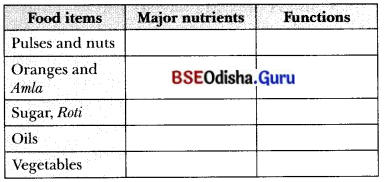
Given in the next page are certain food items required for proper nourishment of adolescents. Name the nutrients present in the food items and write their functions.
Answer:
| Food items | Major nutrients | Functions |
| Pulses and nuts | Proteins | Growth, repair of body parts |
| Oranges and Amla | Vitamin C and iron | Formation of blood, keep the body healthy |
| Sugar, Roti | Carbohydrates | Provide energy |
| Oils | Fats and Vitamin E | Provide energy, maintain healthy skin |
| Vegetables | Vitamins and minerals, roughage | Keep the body healthy and disease-free |
Question 5.
(i) The school counsellor was taking a session on adolescent issues. Sameer, a Grade 7 student, had a friend struggling with addiction. Feeling worried, he asked the teacher the following questions:
(a) What is substance abuse?
(b) How does it affect one’s health?
(ii) Name the harmful substances that should be avoided.
Answer:
(i) (a) The use of harmful substances for nonmedical purposes regularly, leading to addiction, is called substance abuse.
(b) These substances are harmful to our physical and mental health. Using these substances can cause serious health problems such as breathing difficulties, memory loss and damage to the lungs.
(ii) Tobacco, gutka, beedi, cigarettes, alcohol, and illegal drugs
Question 6.
Ved has observed that during the school’s morning assembly, students regularly perform yoga together. Later, during the games period, the teacher encouraged all students to actively participate in sports and games of their choice. Based on these observations, list any three benefits of regular physical activities for adolescents.
Answer:
- Keep the body and mind healthy and active
- Improve stamina and help maintain a healthy body weight
- Enhance mood and reduce stress levels
- Build strength and overall fitness
Question 7.
Adolescents sometimes feel pressured by friends to try harmful substances like tobacco, beedi, alcohol, or illegal drugs.
(i) How can peer pressure influence adolescents to consume such harmful substances?
(ii) Suggest two ways to avoid or overcome such peer pressure.
Answer:
(i) Peer pressure can influence adolescents to try harmful and addictive substances, such as tobacco or alcohol, to gain approval or acceptance from their peer group.
(ii)
- Say ‘No’ confidently.
- Choose friends wisely and spend time with people who encourage healthy habits.
- Seek help from family, teachers, and trusted friends.
Adolescence: A Stage of Growth and Change Class 7 Long Question Answer
Question 1.
(i) Disha was told to prepare a poster on physical changes in girls during puberty. Help her list these changes.
(ii) What voice changes happen in boys and girls during adolescence?
Answer:
(i) The changes in girls during puberty are:
- Development of breasts
- Widening of hips
- Growth of hair under armpits and in the pubic region
(ii) Boys: Voice becomes deep and hoarse due to the growth of the voice box.
Girls: The voice box also grows in adolescent girls, but it is less prominent than boys, leading to minimal change in voice.
Question 2.
(i) Name the government initiatives to promote menstrual hygiene.
(ii) Under which scheme are biodegradable sanitary pads provided? [Knowledge-based Skill]
Answer:
(i) To support menstrual hygiene, the government has introduced several initiatives like:
- Menstrual Hygiene Scheme (MHS)
- Rashtriya Kishor Swasthya Karyakram (RKSK)
- Suvidha Sanitary Napkin Initiative
- State-level Initiatives (e.g., Shuchi Scheme in Karnataka)
(ii) Under Suvidha Sanitary Napkin Initiative, biodegradable sanitary pads are provided at affordable prices through Jan Aushadhi Kendras.
Question 3.
(i) Ritu heard about the terms adolescence and puberty and wondered if they mean the same. How would you explain her the difference between both the terms?
(ii) Why does adolescence starts at different ages for different people?
(iii) Ritu also learnt about hormones in class. What are hormones, and do they influence adolescence?
Answer:
| Adolescence | Puberty |
| It is the period of life between childhood and adulthood. | Puberty is the stage, within adolescence, in which an adolescent reaches reproductive maturity. |
| It refers to physical, internal, emotional, social, and behavioural changes. | It refers to internal and external changes that indicate reproductive maturity. |
(ii) Adolescence varies from person to person depending upon various factors such as early life experience, nutrition, etc.
(iii) Hormones are the chemical messengers produced by the body.
- Yes, hormones influence growth and development of body during adolescence.
Question 4.
(i) “Menstrual hygiene and healthy sanitary habits are important for adolescent girls.” Comment.
(ii)What problems can arise if proper menstrual hygiene and healthy sanitary habits are not followed during menstruation?
Answer:
Maintaining hygiene prevents infections and irritation in the pubic region.
- Always use clean sanitary pad or reusable cloth pads.
- Dispose the used sanitary pads properly by wrapping them in newspaper and placing them inside a dustbin to promote community health and environmental cleanliness.
- Never flush sanitary pads in the toilet.
- Wash hands with soap after changing pads.
(ii) If proper menstrual hygiene and healthy sanitary habits are not followed, it can lead to infections of the reproductive and urinary tract, along with skin irritation and foul odour. In severe cases, these infections may cause discomfort and long-term health problems.
Question 5.
During a school health checkup, Arya was diagnosed as underweight. Arya spoke to the nurse and asked the following questions:
(i) What is the role of nutrition during adolescence?
(ii) What are the nutrients essential during adolescence?
(iii) What else should we do to stay healthy besides having a balanced diet? [Critical Thinking Skill]
Answer:
(i) Proper nutrition during adolescence supports growth and development of both the mind and body. Adolescents require a balanced diet rich in essential nutrients to fuel their bodies through this period of change.
(ii) The nutrients essential during adolescence, along with adequate water intake and roughage are:
- Carbohydrates
- Fats
- Proteins
- Vitamins and Minerals
(iii) Regular physical activity is also important to stay healthy, along with a balanced diet during adolescence. These activities keep the body and mind fit and healthy, build up stamina and also function as a mood booster.
Adolescence: A Stage of Growth and Change Class 7 Case Based Questions
Read the following passages and answer the questions that follow:
Question 1.
Aryan and Riya, both 13-years-old, noticed that they were growing taller much faster than the previous year. Aryan observed that his voice had started cracking during conversations. Their science teacher explained that this is normal during adolescence and that they should not worry about these changes.
(i) Explain the term adolescence.
Answer:
The stage of life when the body undergoes changes that lead to reproductive maturity is called adolescence.
(ii) Name one factor, other than hormones that affects growth during adolescence.
Answer:
A nutritious diet is necessary to support growth and development during this stage.
(iii) Why does the voice change during adolescence? Is the change in voice the same in boys and girls?
Answer:
- Voice changes because of the growth of the voice box during puberty.
- No, the Adam’s apple is more prominent in boys, causing a deeper voice, while in girls, the change is minimal.
OR
(iii) Write any two common physical changes that will be experienced by Aryan and Riya during adolescence.
Answer:
Two common changes in boys and girls during adolescence are:
- Growth of hair in the armpits
- Increase in height
Question 2.
Daksh’s cousin, Arnav, who is in Grade 7, has started grooming himself and behaving differently. Daksh also observes changes in his attitude and realised that he may be influenced by the wrong peer group. Daksh understands that his cousin is going through adolescence and feels confused about how to manage this phase of life.
(i) Adolescence is a stage when teenagers want to develop/gain:
(a) Physical strength
(b) Identity and independence
(c) Intelligence
(d) All of the above
Answer:
(d) All of the above
(ii) Behavioural changes during adolescence are mainly due to:
(a) Ageing
(b) Lack of discipline
(c) Hormonal changes
(d) Physical changes
Answer:
(c) Hormonal changes
(iii) How does excessive use of social media platforms influence adolescents?
Answer:
Social media platforms influence adolescents by shaping their thoughts, behaviour, peer opinions, and online trends. Excessive use can affect their confidence, studies, and real-life relationships if not used responsibly.
OR
(iii) Suggest two ways in which family members can support adolescents during this phase of life.
Answer:
Family members can support adolescents by:
- Listening patiently and giving them a chance to share their feelings without scolding or judging them.
- Providing guidance and encouraging healthy habits and respectful communication in them.
Adolescence: A Stage of Growth and Change Class 7 Picture Based Questions
Observe the given pictures and answer the questions that follow:

Question 1.
A teenager is looking at himself in the mirror and notices pimples on his face.
(i) Which stage of life is the boy likely going through?
Answer:
Adolescence
(ii) Acne is an example of which type of change?
(a) Physical change
(b) Change in reproductive capabilities
(c) Emotional change
(d) Behavioural change
Answer:
(a) Physical change
(iii) What changes in the body cause the appearance of pimples during this stage?
Answer:
Pimples appear during adolescence due to hormonal changes and an increase in oily secretions from the skin, which clog pores and lead to infections.
OR
(iii) Suggest some hygiene practices that can help reduce acne.
Answer:
Avoid squeezing pimples:
- Avoid touching your face with dirty hands
- Drink plenty of water
- Wash your face with a gentle cleanser
Question 2.
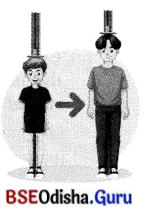
(i) Identify the physical change shown in the picture.
Answer:
An increase in height (rapid growth) during adolescence.
(ii) What do we call the period when secondary sexual characteristics begin to appear in boys and girls?
Answer:
Puberty
(iii) State whether these changes are uniform in all individuals.
Answer:
No, these changes are not uniform in all individuals. It occurs at different ages and at different rates in different people.
OR
(iii) Mention any two other physical changes observed only in boys during adolescence.
Answer:
Two other physical changes observed in boys during adolescence are:
- Deepening of voice
- Growth of facial hair (beard and moustache)
Electricity: Circuits and Their Components Class 7 Activity Based Questions
Read the following activities and answer the questions that follow:
Question 1.
To create awareness about cybercrime among students, Meena, a science teacher, planned an activity. She divided the class into two groups and assigned different tasks to each group.
- Group A was asked to collect information from newspapers and news channels about the types of cybercrimes that people face nowadays.
- Group B was instructed to explore reliable websites to find out the common types of cybercrimes and the safety measures that can be taken to prevent them.
After collecting the data, each group prepared a table to present their findings to the class.
| Source | Types of Cybercrime |
| Newspaper and news channels | Cyberbullying |
| Cyberstalking | |
| Trusted Websites | Online fraud (financial scams) |
| Digital harassment | |
| Identity theft |
(i) What is cyberbullying?
Answer:
Use of digital devices such as phones, computers, or online platforms to harass others by sending misleading messages, spreading false rumours, or sharing personal information without consent is called cyberbullying.
OR
(i) How can sharing a password on online platforms with a stranger be harmful?
Answer:
Sharing an account password with a stranger is harmful because the person may misuse the account, change important settings, access or share personal information, or even lock the user out of the account.
(ii) Chirag is facing cyber harassment. Which of the following is the most appropriate action he should take in this situation?
(a) Ignore the messages
(b) Inform a trusted adult, such as a parent or teacher, and seek help
(c) Reply to the harasser with rude or hurtful messages
(d) Isolate himself and stop socialising
Answer:
(b) Inform a trusted adult, such as a parent or a teacher, and seek help.
(iii) Which of the following is a safe online practice?
(a) Sharing location with virtual friends
(b) Clicking on unknown links
(c) Keeping personal information private
(d) Accepting friend requests from strangers
Answer:
(c) Personal information should be kept private as it can be misused by strangers to harm an individual, leading to cyber harassment or cyberbullying.
Question 2.
Observe the chart and graph given below carefully and answer the following questions.
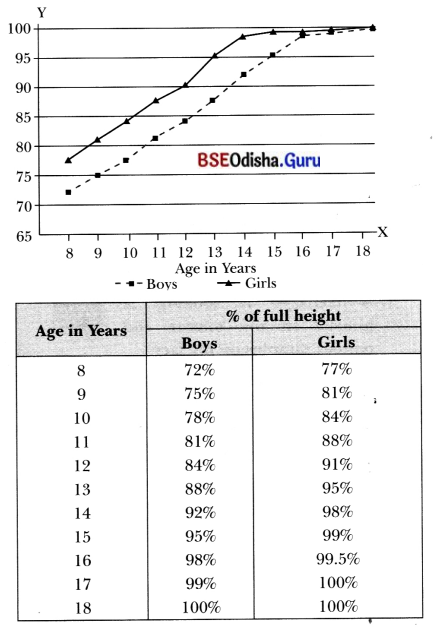
(i) Which of the line represents the height of boys?
Answer:
The dashed line represents the beight of boys.
(ii) Which line represents the height of girls?
Answer:
The solid line represents the height of girls.
(iii) What is the difference between the pattern of increase in the height of boys and girls?
Answer:
At the onset of puberty, girls grow faster in height than boys, and by the age of 18 years, both reach their maximum height.
OR
(iii) Is this pattern true for each individual?
Answer:
No, the rate of increase in height varies among individuals. Some may grow tall suddenly at puberty and then slow down, while others may grow gradually.
Electricity: Circuits and Their Components Extra Questions for Practice
Question 1.
Kush, a 14-year-old boy, often feels confused and gets angry over small issues. His teachers notice that his behaviour has changed compared to earlier years. What is the main reason for such sudden mood swings at his age?
(a) Physical growth
(b) Change in food habits
(c) Hormones
(d) Social awareness
Answer:
(c) Hormones affect both emotions and behaviour, leading to mood swings that occur during adolescence.
Question 2.
Sarla, a science teacher showed the following picture while conducting a seminar on the topic of adolescence. Select the option that best describes the activity depicted in the picture.

(a) Engaging in peer group activities
(b) Exploring different clothing styles
(c) Social interactions
(d) Both (a) and (c)
Answer:
(d) Both (a) and (c)
Question 3.
Pratiksha, a student of class 7, has begun getting her monthly periods. She notices that it recurs every 28-30 days and lasts for about 3 to 7 days. As she is still learning about menstruation, she comes across some common beliefs related to menstruation, many of which are myths. Identify the correct statement related to menstruation from the following options.
(a) Menstruation occurs lifelong in women.
(b) Menstruation is a natural process and a sign of good reproductive health.
(c) Menstruation stops naturally between the ages of 55-65
(d) Physical isolation during menstruation relieves pain and discomfort.
Answer:
(b) Menstruation is a natural process and a sign of good reproductive health.
Question 4.
Aditi noticed small pimples on her face after frequently consuming fried foods. Identify the correctly matched pair that best explains the likely cause of this condition. [1]
(i) Pimples are caused due to a deficiency of vitamin B12.
(ii) Pimples are associated with excessive oily secretion from the skin.
(iii) Pimples can result from bacterial infection in clogged skin pores.
(iv) Pimples can result from an improper diet.
(a) (ii), (iii), and (iv)
(b) (i) and (iii) only
(c) (ii) only
(d) (iii) and (iv) only
Answer:
(a) Deficiency of vitamin B12 results in anacmia.
Questions 5 and 6 consist of two statements – Assertion (A) and Reason (R). Answer these questions by selecting the correct option:
(a) Both A and R are true and R is the correct explanation of A.
(b) Both A and R are true but R is not the correct explanation of A.
(c) A is true but R is false.
(d) A is false but R is true.
Question 5.
Assertion (A): Besides proper nutrition, maintaining personal hygiene is crucial during adolescence.
Reason (R): Menstrual hygiene is important for both comfort and health.
Answer:
(b) Both A and R are true but R is not the correct explanation of A.
Question 6.
Assertion (A): Adolescence is the critical period during which girls may sometimes suffer from blood-related health problems.
Reason (R): The most common blood-related health issues like anaemia arise due to a deficiency of vitamin C in the body.
Answer:
(c) Most common blood-related health issues like anaemia arise from iron and vitamin B12 deficiency.
Question 7.
Puberty starts at different ages in different individuals. Justify this statement.
Answer:
Puberty starts at different ages because every individual has a unique growth pattern. Factors like nutrition and health influence the timing of hormonal changes that lead to puberty.
Question 8.
Name the essential components of a balanced diet required during adolescence. Explain why a balanced diet is especially important at this stage.
Answer:
A balanced diet for adolescents should include proteins, carbohydrates, fats, vitamins and minerals like iron, calcium and iodine, along with roughage and water for supporting proper growth and development.
Question 9.
(i) Describe the emotional changes observed during adolescence.
Answer:
During adolescence, some emotional and social changes experienced by adolescents are:
- Mood swings
- Development of personal identity
- Social and behavioural changes
- A growing sense of independence
(ii) Suggest some ways to deal with emotional stress.
Answer:
To deal with cmotional stress, adolescents should:
- Talk to their parents
- Avoid comparing themselves to others
- Take part in physical activities for fitness
- Take part in various extra-curricular activitics like music, dance, or sports
Question 10.
Ms. Ahuja, a Grade 7 science teacher, showed before-and-after images of human lungs after prolonged exposure to cigarette smoke on the smartboard.
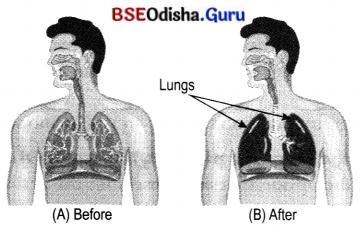
(i) What message does she wants to convey to the class?
Answer:
(i) She wants to show the class the difference between healthy lungs and lungs affected by smoking. The ‘before’ image represents healthy lungs, while the ‘after’ image shows lungs that are damaged and darkened due to long-term smoking.
(ii) Explain how harmful substances affect the body, especially during adolescence.
Answer:
Harmful substances like tobacco, beedi, and cigarettes not only damage physical and mental health, but are also addictive. Using these substances can cause serious health problems, such as breathing difficulties, reduced lung function, and long-term diseases, especially during adolescence when the body is still developing.
Question 11.
Aisha, a 12-year-old girl, got her first period at school, and felt scared and confused. Her teacher took her to the school nurse, who explained that it was a natural part of growing up. The nurse reassured Aisha that there was nothing to be ashamed of and also guided her on how to maintain proper hygiene during this time.
(i) What biological process did Aisha experience? At what age does it usually begin?
Answer:
- Lisha experienced menstruation, which is a natural biological process in girls.
- It usually begins during adolescence, between the ages of 10 to 14 years.
(ii) Why is hygiene important during this time?
Answer:
Hygiene is important to prevent infections and maintain personal cleanliness and comfort.
(iii) What does this process indicate? Is it a life-long process in females?
Answer:
- Menstruation is one of the signs of good reproductive health and the beginning of puberty (reproductive maturity).
- No. Menstruation naturally stops by the age of 45-55 in females.
OR
(iii) Mention two hygiene practices that girls should follow during this phase.
Answer:
Use clean sanitary pads, reusable cloth or biodegradable pads during menstruation.
- Change the sanitary pads at regular intervals.
- Dispose of used sanitary pads properly by wrapping them in newspaper and inside a dustbin.
Question 12.
Kirti was invited to attend Rahul’s 13th birthday. While greeting Rahul, she noticed he has grown taller, and his voice has also become deeper. Based on her observations, answer the following questions:
(i) What could be the possible reasons for these changes in Rahul?
Answer:
Rahul is going through a stage called adolescence. During this period, the body develops and transforms from a child into an adult.
(ii) List out some other changes that occur during this period in:
(a) Boys
(b) Girls
Answer:
(a) In boys:
- Broadening of shoulders
- Growth of facial hair (beard and moustache)
(b) In girls:
- Development of breasts
- Onset of menstruation
(iii) What is the age range during which these changes occur? What is the cause behind these changes?
Answer:
These changes typically occur between the ages of 10 to 19 years. These changes occur due to production and release of special chemicals in the body called hormones.