
Combining textbook study with BSE Odisha Class 6 Science Notes and Class 6 Science Curiosity Chapter 12 Beyond Earth Notes can make exam preparation more effective.
Beyond Earth Notes Class 6
Class 6 Science Curiosity Chapter 12 Notes
Stars and Constellations
At night, many stars are visible; some look bright, others dim, and they shine with their own light.
Groups of stars appear to form patterns that resemble familiar objects, animals or characters from stories. In earlier times, these groups of stars forming patterns were called constellations.
Long ago, different cultures named these patterns based on their own stories, and these patterns were useful for navigation before compasses and modern technology.
At present, constellations are defined as regions of the sky that include these groups of stars, but the word “constellation” is still commonly used for the star patterns themselves.

Different cultures marked constellation boundaries in different ways, so in the early twentieth century the International Astronomical Union (IAU) defined an internationally agreed set of constellation boundaries.
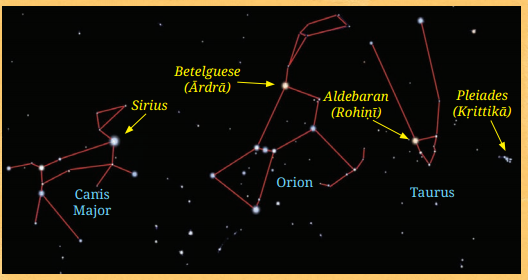
The IAU officially listed 88 constellations, dividing the entire sky into 88 regions, and these regions of the sky are now defined as constellations.
The constellation Orion is often represented as a hunter; three bright stars in the middle form the hunter’s belt.
Nearby constellations include Canis Major (imagined as a dog) and Taurus (imagined as a bull). Sirius, the brightest star in the night sky, lies in Canis Major.
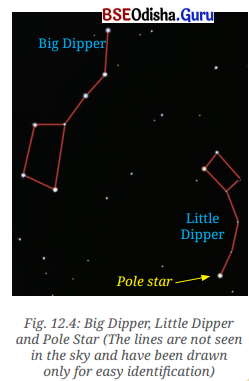
In Indian astronomy, the term nakshatra is used for certain stars or star groups, such as Ardra (Betelgeuse in Orion), Krittika (the Pleiades star group in Taurus) and Rohini (Aldebaran in Taurus). Two well-known star patterns are the Big Dipper and the Little Dipper. The Big Dipper lies in the constellation Ursa Major, and the Little Dipper lies in Ursa Minor.
The Pole Star (Polaris) is part of the Little Dipper, appears almost stationary in the northern sky, and is useful for finding the North direction in the northern hemisphere.
In India, the Big Dipper is called Saptarishi, and the Pole Star is called Dhruva tara.
Note: The lines used to show a constellation are not seen in the sky; they are imaginary lines drawn only for easy identification.
Night Sky Watching
We cannot see the same stars and constellations all the time. Their visibility depends on our location on Earth, the season, sky conditions (light pollution, cloudy sky) and the time of night.
- Some stars are visible only during certain months or from particular places on Earth.
- Dhruv Tara (Pole Star) is visible only in the Northern Hemisphere because it lies almost in line with Earth’s axis towards the north; it cannot be seen from the Southern Hemisphere, o The visibility of constellations changes with seasons.
- Orion is a constellation that is prominent in winter months.
- Some stars rise and set during the night, similar to how the Sun rises and sets during the day.
- To identify a star or constellation, it is important to know its pattern and the part of the sky and time when it will be visible.
- Images of constellations and sky-mapping apps on phones and computers (such as Sky Map and Stellarium) are helpful in learning where and when to look.
Using Patterns to Locate Stars
The Big Dipper can be seen in the northern sky on suitable nights in summer; drawing an imaginary straight line from the two stars at the end of its “cup” about five times their separation leads to the Pole Star.
Our Solar System
The Solar System is made up of the Sun, the eight planets, their moons, and many smaller objects including asteroids and comets. The Sun is the largest and heaviest object in the Solar System and produces almost all the energy in it.
The Sun
- The Sun is a star and is the closest star to the Earth. It is an extremely hot, glowing sphere of gases that emits a huge amount of energy in the form of heat and light.
- The Sun’s heat keeps the Earth warm enough for life and drives climate, seasons, weather, winds and the water cycle. Plants use sunlight to make food and oxygen, supporting animals and humans, so the Sun is essential for life on Earth.
- The average distance between the Earth and the Sun is about 150 million kilometres; this distance is taken as 1 astronomical unit (1 au) and is used to measure distances within the Solar System.
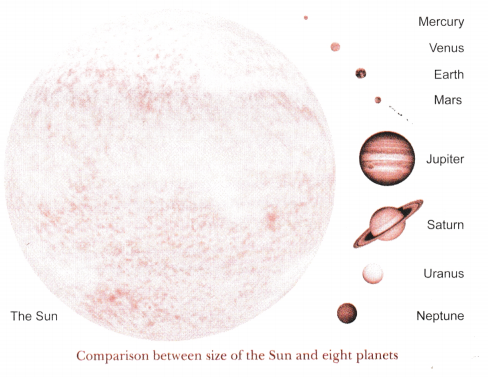
- The Sun’s diameter is about 100 times that of the Earth, but it appears small in the sky because it is very far away.
- The Sun appears much larger and brighter than other stars because it is so much closer to us; many stars that look like tiny points may actually be larger than the Sun.
- During daytime, the bright sunlight makes it impossible to see other stars with the naked eye.
- The star nearest to us after the Sun is Proxima Centauri, which is at a distance of about 269000 au.
Planets
- A planet is a large, nearly spherical object that revolves around the Sun along a path called its orbit.
- The eight planets, in order of increasing distance from the Sun, are Mercury, Venus, Earth, Mars, Jupiter, Saturn, Uranus and Neptune.
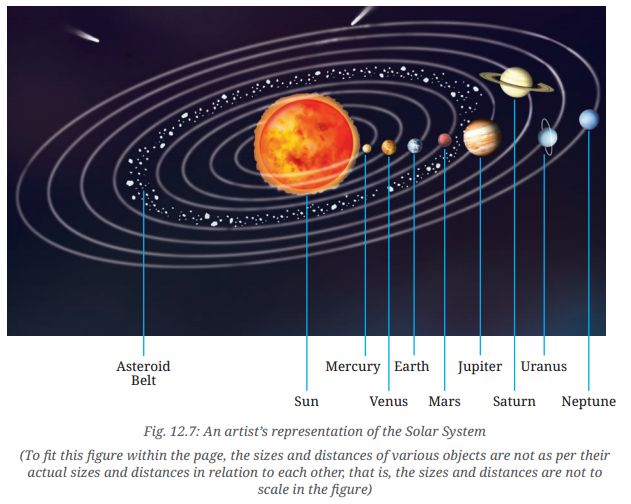
- The four inner planets—Mercury, Venus, Earth and Mars—are smaller and have solid, rocky surfaces.
- The four outer planets—Jupiter, Saturn, Uranus and Neptune—are much larger than the Earth and are mostly made of gases; they are called giant gaseous planets. These giant planets have broad, flat ring-like structures around them, made of dust particles and rocky material.
- The Earth takes nearly one year to complete one revolution around the Sun. While revolving around the Sun, the Earth also rotates about its own axis once in about 24 hours, giving rise-to day and night; other planets also rotate about their own axes.
- A large portion of the Earth’s surface is covered with water, so from space it appears blue and is called the Blue Planet.
- Venus shines very brightly at dawn and dusk and is commonly called the Morning Star or Evening Star, although it is a planet, not a star.
- Mars appears reddish because its soil is red in colour, so it is known as the Red Planet.
- Planets receive most of their energy from the Sun, so in general, planets farther from the Sun are colder.
- The atmosphere of a planet can trap heat and greatly affect its temperature; for example, Venus is hotter than Mercury even though it is farther from the Sun. because its atmosphere traps more heat.
- Beyond Neptune, there are smaller bodies that also revolve around the Sun; one of these is Pluto, which is smaller than Earth’s Moon. It was once considered a planet but was reclassified as a dwarf planet in 2006 after the International Astronomical Union (IAU) redefined the criteria for planets.
- Among the planets, Venus is easiest to identify in the night sky because it is very bright; after the Moon, it is the brightest object in the night sky. Mercury, Mars, Jupiter and Saturn can also be seen with the naked eye but appear as shining dots. Neptune is the only planet in our solar system not visible to the naked eye.
- Planets generally shine with a steadier light, while stars appear to twinkle a lot, which helps to distinguish planets from stars.
- Many celestial objects can be seen more clearly and brightly using binoculars or a telescope, and telescopes also allow us to see many dim objects that cannot be seen with the naked eye.
Natural Satellites
- Objects that move around planets are commonly called satellites; they are smaller than the planets. In general, any object that moves around a much larger object can also be called a satellite; for example, the Earth can be considered a satellite of the Sun.
- Moons are natural satellites of planets; the Earth has one moon (The Moon), Mars has two moons (Phobos and Deimos), and Jupiter, Saturn, Uranus and Neptune each have many moons.
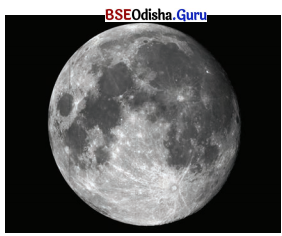
The Moon
- The Moon is the Earth’s natural satellite and is our nearest neighbour in space. It takes about 27.3 days to complete one revolution around the Earth.
- The Moon’s diameter is about one-quarter that of the Earth.
- The Moon is about 3,84,000 km away from the Earth.
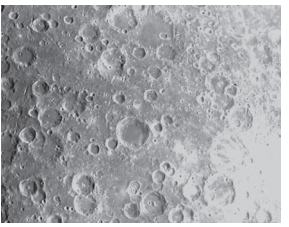
- The Moon’s surface is covered with circular, bowl-shaped depressions called craters, formed mainly by impacts of asteroids or rocks from space. There is almost no atmosphere, water or life on the Moon, so these surface features remain unchanged for very long periods.
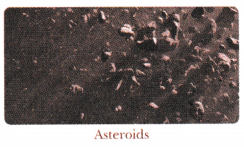
Asteroids
- The Sun and the planets are nearly spherical, but the Solar System also contains many smaller, rocky objects that are irregular in shape, called asteroids.
- Many asteroids revolve around the Sun in orbits that lie mainly between Mars and Jupiter; this region is called the asteroid belt.
- Asteroids vary in size from about 10 metres to about 500 kilometres across. Occasionally, some asteroids pass very close to the Earth.
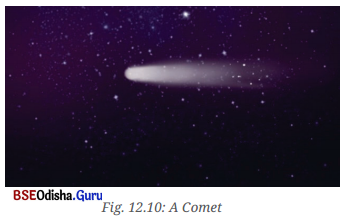
Comets
- Comets are icy, rocky objects that usually come from the outer regions of the Solar System and sometimes pass through the inner Solar System.
- Comets are made up of dust, gases, rocks and ice. As a comet approaches the Sun, the frozen material in it starts to evaporate and forms a glowing tail that always points away from the Sun.
- Comets look bright when close to the Sun but become dimmer as they move away and mav no longer be visible to the naked eye.
- Many comets revolve around the Sun in long, stretched orbits and approach the Sun periodically; some may escape the Solar System, break up, or fall into the Sun or a planet.
- A famous comet is Halley’s Comet, which appears roughly every 76 years; its last appearance was in 1986.
Galaxy
- A galaxy is a huge group of stars, planets, clouds of gas, and dust that move
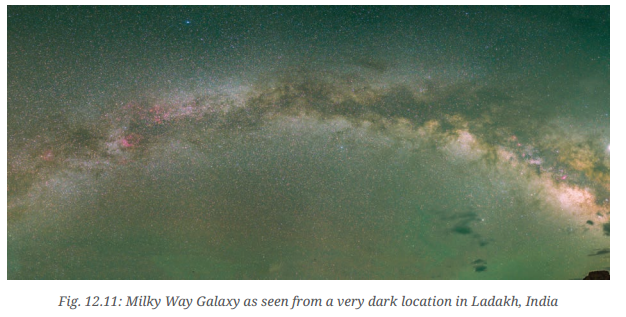
- Our galaxy is called the Milky Way.
The Milky Way Galaxy
- The Milky Way is a spiral galaxy that contains our Solar System along with billions of stars, gas, and dust.
- It appears in the night sky as a faint, continuous band of light stretching across the sky and can be seen only on a clear, moonless night from a dark place away from city lights.
- Our Solar System and all the stars visible in the sky are part of the Milky Way Galaxy.
The Universe
- The universe is an extremely vast and seemingly endless space.
- There are trillions of galaxies in the universe, and the Milky Way is just one of them. .
Exoplanets
- Exoplanets are planets that revolve around stars other than the Sun in our galaxy.
- Thousands of exoplanets have been discovered with the help of powerful telescopes.
- Scientists are still searching for signs of life beyond our Solar System, but no confirmed evidence has been found so far.
- The search for life beyond Earth is mainly focused on these exoplanets.
Universe:
There are many galaxies in the outer space beyond the Milky Way galaxy which together constitutes the whole universe.
Galaxy:
A galaxy is a group of stars, planets, clouds of gas, and dust that move together through space.
Milky Way Galaxy (Akasha Ganga)
- This is our home galaxy.
- Our solar system, along with all the stars and constellations we see in the night sky, is part of the Milky Way Galaxy.
Constellations
- In earlier times, a group of stars forming patterns was called a constellation.
- Nowadays, the sky is divided into 88 regions called constellations, which include groups of stars that appear to form patterns.
- Some important constellations are, Orion, Taurus, Canis Major, Ursa Major, Ursa Minor.
- The Pole Star which is a star in the Ursa Minor constellation appears stationary in the north direction, and helps in locating the north direction in the northern hemisphere.
- Sirius is the brightest star in the night sky and is part of the constellation Canis Major.
Solar System: The Sun, planets, their moons, and many smaller objects including asteroids and comet, together form the solar system.
Sun
- It is the nearest star to the Earth.
- It emits huge amounts of heat and light.
- The Sun is the main source of energy on the Earth.
- It is about 100 times bigger than the Earth in diameter.
- The Sun is nearly 150,000,000 km’ (150 million km) away from the Earth.
Planets
- Planets are large, nearly spherical objects that revolve around the Sun.
- Planets do not have light of their own.
- They shine because of the reflection of sunlight from their surfaces.
- Planets get most of their energy from the Sun.
- Inner Planets
- Mercury (Budha)
- Venus (Shukra)Earth (Prithvi)
- Mars (Mangala)
- They are closer to the Sun and smaller in size.
- They have solid surfaces with rocks on them.
Outer Planets
- Jupiter (Brihaspati or Guru)
- Saturn (Shani)
- Uranus (Aran)
- Neptune (Varun)
- They are much bigger than Earth, and are mostly made of gases.
- They have large flat ring-like structures around them which are made of dust particles and rocky materials.
- They are colder than inner planets due to their distance from the Sun.
Natural Satellites
- Objects that orbit around planets.
- They are smaller in size than planets
- Moons are natural satellites of planets.
- The Earth has one moon.
- Mars has two moons.
- Jupiter, Saturn, Uranus and Neptune have a large number of moons.
Earth’s Natural Satellite
- The Moon is Earth’s natural satellite.
- It revolves around the Earth in nearly 27 days.
- Its diameter is about one-fourth that of the Earth.
- It is about 3,84,000 km away from the Earth.
- Rocky and irregular objects in space.
- Asteroid belt lies between Mars and | upiter.
Asteroids
- Rocky and irregular objects in space.
- Asteroid belt lies between Mars and Jupiter.
Comets
- Comets are small bodies made of ice, dust, gas. and rocks.
- They come from the outer regions of the solar system.
- As they move near the Sun, heat causes them to form a glowing head and a long tail.