
Combining textbook study with BSE Odisha Class 7 Science Notes and Class 7 Science Curiosity Chapter 7 Heat Transfer in Nature Notes can make exam preparation more effective.
Heat Transfer in Nature Notes Class 7
Class 7 Science Curiosity Chapter 7 Notes
Heat
- Heat is a form of energy that flows from a body at a higher temperature to a body at a lower temperature.
- Heat transfer is the process by which heat energy moves from a hotter region to a colder region until both reach the same temperature.
- In nature, heat is transferred in three main ways: conduction, convection, and radiation.

Conduction
The process in which heat is transferred from the hotter part of an object to its colder part without the actual movement of the particles is called conduction of heat.
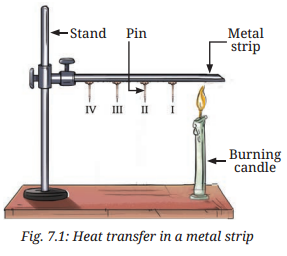
In this process, a particle that is heated passes on energy to its neighbouring particles, but the particles do not leave their positions.
For example, when one end of a metal strip, as shown in the figure alongside, is heated in a flame, the pins near the flame fall first, and pins farther away fall later; this shows that heat travels along the metal from the hot end to the cold end.
Materials Conducting Heat
Materials can be classified into two categories according to their ability to conduct heat.
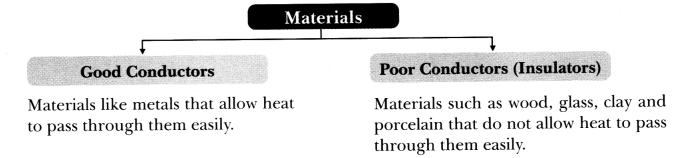
Applications of Good and Bad Conductors
- Metals are good conductors of heat; therefore, cooking utensils are usually made of metals.
- Hot drinks in clay or porcelain cups stay hot for a longer time because these materials are poor conductors of heat.
- Woollen fabric traps air in its pores; air trapped in wool and between layers of clothing reduces heat loss from the body, as air is a poor conductor of heat, so we feel warm in winter.
- Two thin blankets with air trapped between them keep us warmer than one thick blanket.
- In very cold regions, houses may be built with double wooden walls filled with mud or cow dung. Since wood and mud are poor conductors of heat, they reduce heat loss and help in keeping the houses warm.
- Some houses are made with hollow bricks, which keep them warm in winter and cool in summer. The air trapped in the hollow bricks is a poor conductor of heat and slows down the flow of heat between the inside and outside.
Convection
Convection is the transfer of heat in liquids and gases by the actual movement of their particles.
- When a fluid is heated, the warmer, lighter particles rises and the cooler, heavier particles sinks. This continuous circulation of particles carries heat from one place to another.
- When air is heated, it expands, becomes lighter and moves upward; the surrounding cooler, heavier air moves in to replace it. This continuous movement sets up convection currents.
- Examples of convection:
- A partially inflated balloon kept in the Sun becomes larger because the air inside it gets heated and expands.
- Smoke from a burning incense stick rises up because it is warmer than the surrounding air and moves upward.
- When water in a beaker is heated with a candle, the water at the bottom of a beaker gets heated up and rises upward through the centre and cooler water sinks from the sides, setting up a convection current.
Land and Sea Breeze
- Soil and water heat up and cool down at different rates, soil heats up and cools down faster than water.
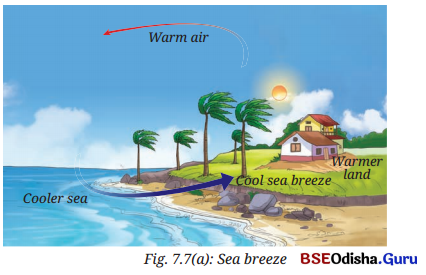
- During the day, land becomes hotter than the sea. The warm air over land rises, and cooler air from the sea moves towards the land, forming a sea breeze. This breeze cools coastal areas, so houses near the sea often have windows facing the sea.
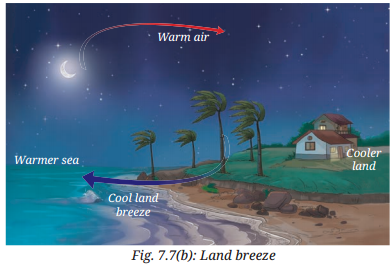
- At night, land cools faster than the sea, so air above the sea is warmer and rises, and cooler air from the land moves towards the sea, forming a land breeze.
- People living near the seashore experience that the direction of the wind reverses between day and night due to this convection in air.
Radiation
Radiation is the process in which heat travels directly from a hot object to its surroundings without the need for a medium.
- When we sit near a fire, we feel warm even without touching the flames or the air above them directly; in this case, heat is reaching us by radiation.
- The heat from the Sun reaches the Earth by radiation.
- A hot utensil kept away from the flame cools down majorly by radiating heat to its surroundings.
- All objects continuously radiate heat to and simultaneously absorb heat from their surroundings.
Effect of Colour on Absorption of Heat
- Light-coloured surfaces reflect most of the heat falling on them, so wearing white or light-coloured clothes in summer keep us cooler and more comfortable.
- Dark-coloured surfaces absorb more heat, so wearing black or dark-coloured clothes make us feel warmer in winter.
Simultaneous Modes of Heat Transfer in Daily Life
- When water is heated in a metal pan placed over a flame, conduction heats the pan from the flame, convection heats the water inside, and radiation from the hot pan and flame warms our body and nearby objects; often, all three modes of heat transfer act together.
- A bukhari (traditional iron room heater) used in Himalayan regions involves all three modes of heat transfer, i.e., conduction (through the metal), convection (of air in the room) and radiation (from its hot surfaces) during heating and cooking.
Water Cycle
- Heat from the Sun makes water in oceans, rivers, lakes and ponds warm and causes it to evaporate as water vapour. Water also enters the atmosphere from plants through transpiration.
- Higher up in the atmosphere, water vapour cools and condenses to form clouds. From clouds, water returns to the Earth as rain, snow or hail; this process is called precipitation.
- The water cycle is the continuous movement of water on Earth — upward as water vapour and downward as precipitation, passing through soil, rocks and plants, and finally returning to water bodies.
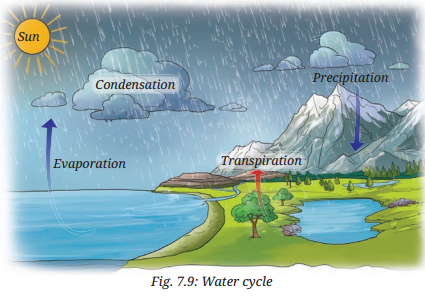
- The water cycle redistributes and replenishes water in rivers, lakes and oceans and helps maintain the overall balance of water on Earth.
Seepage of Water beneath the Earth
- When water is poured over clay, sand and gravel, it seeps fastest through gravel, more slowly through sand and slowest through clay. This is because the spaces between gravel particles are wider and better connected than those in sand and clay.
- The process by which surface water seeps down through soil and rocks is called infiltration.
- Water that infiltrates into the ground gets stored in the pore spaces of sediments and in openings in rocks as groundwater.
- The underground layers of sediments and rocks that hold and store groundwater are called aquifers. Water drawn from wells and hand pumps usually comes from these aquifers.
Water Conservation
Groundwater is limited; excessive extraction, reduced vegetation and the spread of more concrete surfaces decrease infiltration and cause groundwater depletion.
Methods such as rainwater harvesting and recharge pits are used to replenish groundwater and make water use more sustainable.
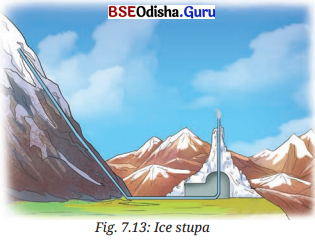
In cold regions like Ladakh, ice stupas are built as a traditional water-storage method. Water from mountain streams is sprayed into cold winter air to form cone-shaped ice structures. This stored ice melts slowly in spring and summer, supplying water when it is most needed.
Transfer of Heat:
The transfer of heat energy from a hotter object to a colder one continues until both reach the same temperature.
Conduction
- The process of heat transfer from the hotter part of an object to the colder part.
- In conduction, particles themselves do not move from their positions; they only transfer energy to neighbouring particles.
Conductors
- Materials like metals that allow heat to pass through them easily.
- For example, steel, copper, etc.
Insulators
- Materials such as glass and wood that do not allow heat to pass through them easily.
- For example, clay, porcelain, etc.
NOTE: Air is a poor conductor of heat. This is why two thin blankets are often warmer than one thick blanket.
Convection
- The process of heat transfer by the actual movement of particles.
- For example, heating of water in a pan on a stove.
Radiation
- The process of heat transfer in which medium is not required.
- For example, heat from a bonfire.
Land and Sea Breeze:
Land and sea breeze are caused by differences in the rates of heating and cooling of land and water.
Sea Breeze:
During the day, land becomes hotter than the sea water, due to which warm air above land rises and cooler air from the sea moves towards the land, creating a sea breeze.
Land Breeze:
During the night, land cools faster than the sea water, due to which warm air above the sea rises and cooler air from the land moves towards the sea, creating a land breeze.
Water Cycle
The continuous movement of water i.e,, upward as water vapour and downward through precipitation, passing through soil, rocks, and plants, and finally returning to water bodies, is called the water cycle.
Infiltration:
- The process of surface water seeping through soil and rocks.
- Water seepage depends on the size of spaces between the particles of soil.
- Rate of seepage: Clay < Sand < Gravel
- Aquifers: The underground layers of sediments and rocks that store water in pore spaces are called aquifers. Simultaneous Heat Transfer During boiling of water on a gas stove, we can observe conduction, convection, and radiation happening together.
- Conduction: The flame heats the base of the metal utensil. The heat then conducts through the metal surface and passes into the water.
- Convection: Heated water at the bottom rises while cooler water sinks, and this convection helps in heating the water evenly.
- Radiation: The flame of the gas stove emits heat energy in the form of radiation, which travels in all directions.