
Go through BSE Odisha Class 8 Science Solutions Chapter 13 Our Home: Earth a Unique Life Sustaining Planet Question Answer to understand textbook questions more clearly.
Class 8 Science Curiosity Chapter 13 Question Answer
Class 8 Science Ch 13 Our Home: Earth a Unique Life Sustaining Planet Question Answer
Class 8 Science Chapter 13 Our Home: Earth a Unique Life Sustaining Planet Question Answer
Probe and Ponder Questions
Question 1.
What do you think Earth would look like if there were no life on it at all?
Answer:
Earth would appear as a barren, rocky world with large stretches of empty land, dried up riverbeds and oceans, no green forests or animals and a much quieter surface. Without plants to hold soil together, erosion and dust stroms would be common; without life producing oxygen, the atmosphere would be thinner and different in composition. Overall, it would look more like Mars or the Moon – lifeless and still.

Question 2.
Life on Earth has survived for billions of years. What allows it to keep going despite major changes and disasters?
Answer:
Earth’s balance of air, water, sunlight and soil plus its position in the habitable zone, helps life adapt. Reproduction passes on traits that help survive changes, like disasters or climate shifts. Ecosystems recover through intera tions between living things (like plants regrowing after a fire) and non-living parts (like nutrient recycling in soil).
Question 3.
Why don’t dogs lay eggs? Or hens give birth to live chicks?
Answer:
Because of differences in how these groups of animals evolved and reproduce. Dogs are mammals: their embryos develop inside the mother and get nourishment directly, so they give birth to live young. Hens are birds; their embryos develop inside eggs outside the mother, with stored food in the egg. Each method works for the life-history and survival strategies of that group.
Question 4.
If a spaceship carried soil and water to Mars, could plants start growing there?
Answer:
May be simple plants or microbes could grow if we add the right conditions, like protection from Mars’ thin atmosphere, extreme cold and radiation. But most Earth plants would struggle without enough air pressure, liquid water stability, or Earth’s magnetic shield. Experiments show some bacteria survive but full growth needs more, like a greenhouse dome.
Question 5.
Share your questions ……………
Answer:
Here are some fun questions from the chapter:
- Why is Earth called the Blue Planet?
- What would happen if Earth’s magnetic field disappeared?
- How does the ozone layer protect us?
- Could life exist on other planets in the habitable zone?
InText Questions
Question 1.
I wonder what makes the Earth unique for living beings to grow and survive! (Page 212)
Answer:
Earth’s uniqueness for supporting life stems from a rare combination of factors. Its distance from the Sun, about 93 million miles, places it in the habitable zone where temperatures (-88°C to 58°C) allow liquid water, essential for life. The atmosphere, rich in nitrogen and oxygen, supports breathing, regulates climate, and shields against harmful radiation via the ozone layer.
A strong magnetic field protects the atmosphere from solar wind erosion. Plate tectonics and volcanic activity recycle nutrients and stabilize the climate, while Earth’s size and gravity retain a breathable atmosphere without crushing organisms. The Moon stabilizes axial tilt, ensuring predictable seasons, and the planet’s chemical composition provides life’s building blocks, carbon, hydrogen, and more. This delicate balance, unlike conditions on Mars or Venus, creates diverse ecosystems where life thrives.
Question 2.
Is the temperature or distance from the sun the only factor that makes the Earth habitable? (Page 215)
Answer:
Earth’s habitability isn’t solely due to its temperature or distance from the Sun, though its position in the habitable zone is crucial for liquid water. Other key factors include a protective atmosphere, a magnetic field shielding against solar wind, active geology like plate tectonics, and a stable rotation and tilt influenced by the Moon. Earth’s size, gravity, and chemical composition also provide the essential elements and conditions for life, creating a delicate balance that makes our planet uniquely suited for diverse ecosystems.
Question 3.
What would happen if the size of the Earth were too small or too big? (Page 215)
Answer:
If Earth were significantly smaller or larger, its habitability would be compromised due to changes in gravity, atmosphere, and geological processes. A smaller Earth, with weaker gravity, would struggle to retain a dense atmosphere, leading to insufficient pressure for liquid water and poor protection from solar radiation, much like Mars. It might also lack the mass to sustain plate tectonics, limiting nutrient cycling and climate regulation.
Conversely, a larger Earth with stronger gravity could trap a thick, oppressive atmosphere, like Venus, potentially causing extreme temperatures and pressure that crush life. Increased geological activity might lead to excessive volcanism, disrupting stable climates. Both scenarios would likely prevent the delicate balance of conditions, liquid water, breathable air, and stable ecosystems required for life as we know it.
Question 4.
Does the magnetic field of the Earth have any role in sustaining life on Earth?} (Page 217)
Answer:
Yes, the Earth’s magnetic field shields the planet from harmful solar wind and many cosmic charged particles. By deflecting these particles, the magnetic field helps prevent the atmosphere from being stripped away and reduces radiation at the surface, both of which are important for protecting living organisms and maintaining a stable climate.
Question 5.
How is life supported and sustained on Earth? (Page 217)
Answer:
Life is supported by several key factors:
- The presence of water which is essential for the chemical reactions of living cells.
- The atmosphere which supplies gases (oxygen and carbon dioxide), regulates temperature and blocks some harmful radiation.
- TheSun’senergy, which powers photosynthesis and drives weather and climate systems.
- The Earth’s magnetic field, which helps protect life from charged particles from space.
Question 6.
How do bamboo and sugarcane grow into new plants? (Page 221)
Answer:
Bamboo and sugarcane reproduce by vegetative propagation. This is a type of asexual reproduction where new plants grow from parts of the parent plant rather than from seeds. For example, sugarcane produces new shoots from nodes on its stem and bamboo spreads through underground rhizomes that produce new shoots at some distance from the parent plant.
Our Home: Earth a Unique Life Sustaining Planet Class 8 Questions and Answers
Keep the Curiosity Alive (Pages 226-227)
Question 1.
What is one major reason Mars cannot currently support life like Earth?
(i) It has too many volcanoes.
(ii) It is too close to the Sun.
(iii) It lacks a thick atmosphere and liquid water.
(iv) Its magnetic field is too strong.
Answer:
(ii) It lacks a thick atmosphere and liquid water.
Explanation: Mars currently has a very thin atmosphere that cannot hold heat or stable liquid water on the surface. Without a thick atmosphere and liquid water, conditions are too cold and dry for most Earth- like life.
Question 2.
Which of these is an example of geodiversity?
(i) A variety of birds chirping in a forest.
(ii) Different landforms like mountains,valleys, and deserts.
(iii) Changing weather during monsoons.
(iv) Number of different types of fish in a pond.
Answer:
(ii) Different landforms like mountains, valleys, and deserts.
Explanation: Geodiversity refers to the variety of rocks, soils and landforms. Different landforms such as mountains, valleys and deserts are clear examples of geodiversity because they create distinct habitats and landscapes.
Question 3.
If the Earth were smaller with the same density, what might happen to its atmosphere?
(i) It would become thicker and hotter.
(ii) It would escape into space due to weaker gravity.
(iii) It would become frozen.
(iv) It would cause stronger winds.
Answer:
(ii) It would escape into space due to weaker gravity.
Explanation: A smaller Earth would have weaker gravity and would find it harder to hold on to gases. Over time, the atmosphere could escape into space, leaving the planet thin-airred and less able to support liquid water and life.
Question 4.
In sexual reproduction, why are offspring different from their parents?
(i) They grow in different climates.
(ii) They eat different food.
(iii) They acquire new instructions after birth.
(iv) They get mixed instructions (genes) from both parents.
Answer:
(iv) They get mixed instructions (genes) from both parents.
Explanation: Offspring receive a combination of genetic material (genes) from both parents by the fusion of gametes. This mixing produces individuals that share traits with both parents but are not identical to either, which creates variation in the population.
Question 5.
You notice tiny green plants growing in cracks on your school wall after the monsoon. Where do you think the seeds came from? What conditions helped these plants grow there?
Answer:
The seeds likely came from nearby plants, carried by wind, birds, or insects. For example, a bird eating a fruit may have dropped or excreted the seed into the crack. The monsoon provided water, which is essential for seed germination. The crack in the wall likely trapped some soil or organic matter, offering nutrients. Sunlight and air, available in the outdoor environment, support photosynthesis and respiration. The moist, sheltered crack created a microhabitat suitable for growth.
Question 6.
A city has recently cut down a large patch of forest to build new roads and buildings. Discuss the possible effects this could have on the local climate and biodiversity. How might this affect water availability or quality in the area?
Answer:
(a) Effects on Local Climate: Deforestation reduces trees that absorb carbon dioxide, potentially increasing local temperatures due to less shade and a weakened greenhouse gas balance. It may also disrupt rainfall patterns, as trees contribute to water vapour for cloud formation.
(b) Effects on Biodiversity: Loss of forest habitat threatens plants and animals, reducing biodiversity. For example, animals like deer or predators like tigers may lose food sources or habitats, disrupting ecosystems. Deforestation can reduce water availability by disrupting the water cycle, as trees help retain soil moisture and contribute to rainfall. Soil erosion from cleared land can pollute nearby water bodies with sediment, affecting water quality.
Question 7.
A friend says, “The Earth has always had climate changes in the past, so today’s global warming is nothing new.” How would you respond using what you’ve learnt in this and other chapters of your science book?
Answer:
While Earth has experienced natural climate changes in the past (e.g., ice ages), today’s global warming is different because it is primarily driven by human activities, such as burning fossil fuels, which release large amounts of greenhouse gases like carbon dioxide and methane.
These gases intensify the greenhouse effect, causing rapid warming, melting ice caps, rising sea levels, and extreme weather, unlike slower natural changes. The triple planetary crisis (climate change, biodiversity loss, pollution) shows how human actions are disrupting Earth’s balance, threatening life. Unlike past changes, current warming requires urgent action, like using renewable energy, to protect ecosystems.
Question 8.
Imagine Earth’s magnetic field suddenly disappeared. What kinds of problems could arise for life on Earth? Explain.
Answer:
Without Earth’s magnetic field, high energy particles like cosmic rays and solar wind would directly hit the atmosphere, potentially depleting the ozone layer and allowing harmful UV rays to reach the surface. This could damage living cells, increasing risks like skin cancer in humans and harming plants and animals. The atmosphere might erode over time, reducing oxygen levels and altering the climate, making Earth less habitable. Satellites and communication systems could also be disrupted by unshielded particles, affecting human technology.
Question 9.
You are tasked with designing a new settlement for humans on Mars. Name three things you would need to recreate from Earth to support human life there. Which of these do you think is the hardest to replicate, and why?
Answer:
Three things needed:
(a) Liquid Water: Essential for drinking, growing crops, and supporting life processes.
(b) Breathable Atmosphere: An oxygenrich atmosphere for respiration, protected from Mars’ thin, carbon dioxide-heavy atmosphere.
(c) Temperature Control: A system to maintain Earth-like temperatures, as Mars’ average temperature is around -60°C
(d) Hardest to’ Replicate: Creating a breathable atmosphere is likely the hardest. Mars’ atmosphere is 100 times thinner than Earth’s and is mostly carbon dioxide, requiring complex systems to produce and maintain oxygen at the right pressure for humans: Generating enough oxygen for a settlement, shielding it from radiation, and preventing leaks in a harsh environment is technologically challenging compared to providing water (which can be transported or extracted) or temperature control (achievable with insulated habitats).
Question 10.
In a village, the temperature has been increasing, and rainfall has become unpredictable over the past few years. What could be causing this change? Suggest two ways the village could adapt to these new conditions.
Answer:
Causes: The changes are likely due to climate change, driven by increased greenhouse gases from burning fossil fuels, leading to global warming and altered weather patterns. Deforestation or local land use changes could also reduce moisture and affect rainfall.
Adaptation Strategies:
- Water Conservation: Implement rainwater harvesting and efficient irrigation systems to store water during unpredictable rainfall.
- Sustainable Farming: Use drought-resistant crops and sustainable farming practices to cope with higher temperatures and reduced water availability.
Question 11.
If there were no atmosphere on the Earth, would it affect life, temperature, and water on the planet? Explain.
Answer:
Without an atmosphere:
- Life: Life would struggle to survive, as most organisms require oxygen for respiration. The absence of the ozone layer would allow harmful UV rays to damage cells, affecting plants, animals, and humans.
- Temperature: Earth would lose heat to space without the greenhouse effect, becoming extremely cold, similar to the Moon. Daytime temperatures could soar due to unfiltered sunlight, and nights would be freezing.
- Water: Liquid water would evaporate or freeze due to extreme temperature swings and low pressure, making it unavailable for life processes. The water cycle (rainfall, clouds) would cease without atmospheric water vapour.
Question 12.
Discuss five examples of vegetative propagation.
Answer:
Vegetative propagation is a sexual reproduction where plant parts like stems, roots, or leaves grow into new plants.
Five examples:
- Money Plant: A stem cutting with a node grows roots when placed in water or soil, forming a new plant.
- Potato: The “eyes” (buds) on a sprouted potato can be planted to grow a new potato plant.
- Ginger: A piece of ginger rhizome with a bud, when planted in soil, develops into a new plant.
- Sugarcane: Stem cuttings with nodes are planted to produce new sugarcane plants, as sugarcane rarely produces seeds.
- Bamboo: Sections of bamboo stems or rhizomes can be planted to grow new bamboo plants, relying on vegetative propagation.
Class 8 Science Chapter 13 Question Answer
Activity 1.
Let us find out
Aim: To identify the features of the Earth.
Procedure:
- List the features of the Earth.
- These are features that we generally take for granted but are very much interesting and important for us.
- Complete the table, a few of them are filled for you.
Observations:
Interesting features of the Earth
- The air we breathe doesn’t fly off and disappear into space. (As we know that the particles of a gas move freely, and gases do not have a fixed volume).
- We can stand on the ground thanks to gravity (as we learnt in the previous Chapter 5), but our heart can pump blood upwards to our head.
- Earth has water-essential for all living things-found in rivers, lakes, oceans and as rain.
- Soil covers the land, allowing us to grow crops and food.
- Earth gives us materials like rocks, metals and wood for building houses and making things we use everyday.
- Right distance form the sun-make the temperature of Earth suitable for life.
- The atmosphere protect us from harmful UV-rays from the sun and flying debris from space.
Inferences: Earth is a unique planet which not only allow life to exist but also sustains it.
Activity 2.
Let us find out
Aim: Comparative study of planets.
Materials or Sources Required: Books in your school library, trusted websites or discuss with your teacher.
Procedure:
- Collect and compare information about: average temperature, radius compared to Earth (i.e., size), wheather it has an atmosphere.
- Now, fill out the missing information in this table.
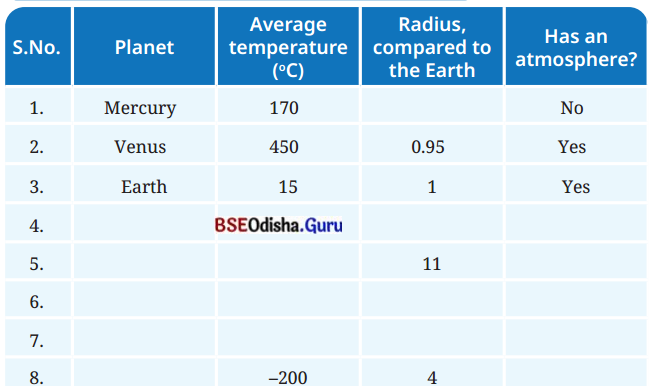
Observations and Inferences:
- All planets in the solar system get their energy from the Sun.
- Generally, planets closer to the Sun are hotter and those farther away are colder.
Activity 3.
Let us find out
Aim: To show the vegetative propagation in plants.
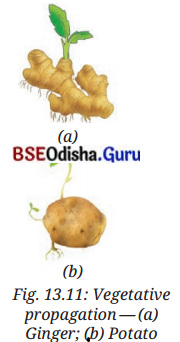
Procedure:
- Plant stem cuttings (e.g., money plant), potato eyes or pieces of ginger in moist soil.
- Give them water, air and sunlight.
- Observe daily to see when roots, stems and new leaves appear.
Observations: We observed that new leaves appears after a few days.
Inference: This shows how some plants can grow new individuals from just a part of the original plant.
Our Home: Earth a Unique Life Sustaining Planet Class 8 Extra Questions and Answers
Short Answer Type Questions
Question 1.
Why is Venus the hottest planet despite being farther from the Sun than Mercury?
Answer:
Venus is the hottest planet (average 450°C ) due to its thick carbon dioxide atmosphere, which causes a strong greenhouse effect, trapping heat. Mercury, despite being closer to the Sun, lacks an atmosphere to retain heat, resulting in a lower average temperature (170°C).
Question 2.
How does Earth’s geography contribute to its habitability?
Answer:
Earth’s gravity is strong enough to hold its atmosphere, preventing gases from escaping into space, unlike Mars. It is not too strong to crush organisms, unlike a larger planet, ensuring a balanced environment for life with oxygen and protection.
Question 3.
What role does the hydrosphere play in sustaining life ?
Answer:
The hydrosphere, covering 70% of Earth’s surface, provides water for drinking, crop growth and aquatic ecosystems. It drives the water cycle, producing rainfall that supports plants and animals and acts as a solvent for nutrient transport.
Question 4.
Differentiate between asexualand sexual reproduction in terms of offspring variation.
Answer:
- Asexual reproduction produces offspring identical to the single parent, with no variation (e.g., vegetative propagation).
- Sexual reproduction involves two parents, combining gametes to create offspring with mixed genetic traits, leading to variation.
Question 5.
How does the magnetic field protect life on Earth?
Answer:
Earth’s magnetic field deflects harmful cosmic rays and solar wind, preventing atmospheric erosion and ozone depletion. This protects living organisms from damaging UV radiation and maintains conditions for life.
Long Answer Type Questions
Question 1.
Explain how Earth’s position, atmosphere, and magnetic field make it uniquely suitable for life.
Answer:
Earth’s unique suitability for life stems from:
- Position: Located in the habitable zone, Earth’s distance from the Sun allows liquid water to exist, essential for all known life forms. Its nearly circular orbit ensures stable temperatures, avoiding extreme heat or cold.
- Atmosphere: The atmosphere provides oxygen for respiration, supports photosynthesis, and includes an ozone layer that blocks harmful UV rays. The greenhouse effect traps heat, maintaining temperatures suitable for liquid water.
- Magnetic Field: Generated by molten iron in the core, it shields Earth from cosmic rays and solar wind, preventing atmospheric loss and protecting life from radiation damage. These factors create a balanced environment, unlike Venus (too hot) or Mars (too cold, thin atmosphere), enabling diverse life forms to thrive.
Question 2.
Describe the processes of sexual reproduction in plants and animals and highlight their key differences.
Answer:
- Plants: Sexual reproduction involves flowers with male (anther, producing pollen) and female (ovule) parts. Pollination, often by wind or insects, transfers pollen to the stigma. Fertilization forms a zygote, developing into a seed, with the flower’s fleshy part becoming a fruit for dispersal.
- Animals: Sexual reproduction involves male (sperm) and female (egg) gametes. In aquatic animals like fish, fertilization is external in water. In birds, internal fertilization produces eggs that develop externally during hatching. In mammals, internal fertilization and embryo development occur inside the female, who provides nutrition.
- Differences: Plants use pollination for gamete transfer, while animals rely on direct sperm-egg interaction. Plant zygotes form seeds, while animal zygotes develop into embryos. Animals may provide parental care (e.g., bird egg incubation), unlike plants, which rely on seed dispersal.
Case-Study Based Questions
1. Read the following passage carefully and answer the questions that follow:
When sperms come in contact with an egg, one of the sperms may fuse with the egg. Such fusion of the egg and the sperm is called fertilisation. Fertilisation which takes place inside the female body is called internal fertilisation. Internal fertilisation occurs in many animals including humans, cows, dogs and hens. In many animals fertilisation takes place outside the body of the female. In these animals, fertilisation takes place in water.
During spring or rainy season, frogs and toads move to ponds and slow-flowing streams. This type of fertilisation in which the fusion of a male and a female gamete takes place outside the body of the female is called external fertilisation. Fertilisation results in the formation of zygote which begins to develop into an embryo. The embryo gets embedded in the wall of the uterus for further development. The embryo continues to develop in the uterus.
(i) The fusion of male and female gametes that takes place outside the body of the female is called:
(a) internal fertilisation
(b) fertilisation
(c) external fertilisation
(d) reproduction
Answer:
(c) external fertilisation
(ii) The zygote that begins to develop tissues of the body is known as :
(a) fertiliser
(b) zygote
(c) embryo
(d) foetus
Answer:
(c) embryo
(iii) The stage of the embryo where all the body parts can be identified is known as:
(a) zygote
(b) foetus
(c) embryo
(d) infant
Answer:
(b) foetus
(iv) Fertilisation which takes place inside a female body is:
(a) internal fertilization
(b) external fertilisation
(c) reproduction
(d) None of the above
Answer:
(a) internal fertilization
Picture Based Questions
I. Look at the picture and answer the following questions:
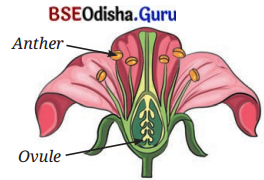
(i) Write the name of parts ‘A’ and ‘B’ in the adjoining figure.
Answer:
A → Anther B → Ovule
(ii) What is pollination ?
Answer:
Transfer of pollen grain from anther to stigma of another flower by wind, insects or animals is called pollination.
(iii) Write the name of male and female gametes in a flower.
Answer:
Male gametes – Anther Female gametes-Ovule
Our Home: Earth a Unique Life Sustaining Planet Class 8 MCQ
Multiple Choice Questions (Mcqs)
Question 1.
Which zone allows water to exist in liquid form?
(a) Frost line
(b) Habitable zone
(c) Solar belt
(d) Red zone
Answer:
(b) Habitable zone
Question 2.
What makes Earth’s crust special for life?
(a) It is made entirely of gas
(b) It supports life on a thin layar
(c) It reflects sunlight
(d) It contains radioactive elements
Answer:
(b) It supports life on a thin layar
Question 3.
Why is Earth called the “Blue Planet” ?
(a) Its surface is mostly coverted with oceans
(b) It has a blue atmosphere
(c) It glows at night
(d) It reflects sunlight
Answer:
(a) Its surface is mostly coverted with oceans
Question 4.
What element is crucial for breathing ?
(a) Hydrogen
(b) Oxygen
(c) Nitrogen
(d) Carbon dioxide
Answer:
(b) Oxygen
Question 5.
What is the function of the ozone layer?
(a) Produces oxygen
(b) Block harmful ultraviolet ray
(c) Regulates season
(d) Maintains Earth’s gravity
Answer:
(b) Block harmful ultraviolet ray
Assertion and Reasoning
These questions consist of two statements, each printed as Assertion (A) and Reason (R). While answering these questions, you are required to choose any one of the following four responses.
(a) Assertion and reason both are correct and reason is correct explanation for assertion.
(b) Assertion and reason both are correct and reason is not correct explanation for assertion.
(c) Assertion is correct but the reason is wrong.
(d) Assertion is wrong but the reason is correct.
1. Assertion: There are two modes by which animals reproduce: Sexual reproduction, and Asexual reproduction.
Reason: Reproduction beginning from the fusion of male and female gametes is called sexual reproduction.
Answer:
Assertion and reason both are correct and reason is not correct explanation for assertion.
2. Assertion: Fertilisation which takes place inside the female body is called internal fertilisation.
Reason: The first step in the process of reproduction is the fusion of a sperm and an ovum and is called fertilization.
Answer:
(a) Assertion and reason both are correct and reason is correct explanation for assertion.
Fill in the blanks
1. The Earth’s crust is like the thin ………… of an apple.
Answer:
skin
2. ………… is the hottest planet.
Answer:
Venus
3. ………… is a greenhouse gas.
Answer:
Carbon dioxide
4. The greenhouse effect plays an important role in maintaining the right ………… on Earth.
Answer:
emperature
5. The ozone layer acts like a shield and blocks harmful ………… rays.
Answer:
ultraviolet (UV)
True or False
1. Each sperm is a single cell.
Answer:
True
2. External fertilization takes place in frog.
Answer:
True
3. A zygote is formed as a result of fertilization.
Answer:
True
4. An embyro is made up of a single cell.
Answer:
False
5. Our solar system has nine planets.
Answer:
False