
Students can refer to BSE Odisha Class 8 Math Solution and Ganita Prakash Chapter 5 Number Play Class 8 Question Answer to understand textbook questions step by step.
Class 8 Maths Chapter 5 Number Play Solutions
Ganita Prakash Class 8 Chapter 5 Solutions
Class 8 Maths Ganita Prakash Chapter 5 Solutions Number Play
1. IS THIS A MULTIPLE OF?
Figure it Out (Page 122 – 123) :
Question 1.
The sum of four consecutive numbers is 34. What are these numbers?
Answer:
Let four consecutive numbers be x, (x + 1), (x + 2) and (x + 3) respectively.
x + x + 1 + x + 2 + x + 3 = 34
⇒ 4x + 6 = 34
⇒ 4x = 34 – 6
⇒ 4x = 28
x = \(\frac{28}{4}\) = 7.
So, (x + 1) = 7 + 1 = 8
(x + 2) = 7 + 2 = 9
(x + 3) = 7 + 3 = 10
Therefore, the given four consecutive numbers are 7, 8, 9, and 10.
Question 2.
Suppose p is the greatest of five consecutive numbers. Describe the other four numbers in terms of p.
Answer:
If p is the greatest office consecutive numbers, then the other four numbers in terms of p are (p – 1), (p – 2), (p – 3), and (p – 4).
Question 3.
For each statement below, determine whether it is always true, sometimes true, or never true. Explain your answer. Mention examples and non-examples as appropriate. Justify your claim using algebra.
(i) The sum of two even numbers is a multiple of 3.
Answer:
Let the two even numbers be 2a + 2b
Sum = 2a + 2b = 2(a + b)
For 2(a + b) to be a multiple of 3, (a + b) must be multiple of 3.
Example:
2 + 4 = 6 → divisible by 3
2 + 8 = 10 → not divisible by 3
Conclusion: Sometimes true.
(ii) If a number is not divisible by 18, then it is also not divisible by 9.
Answer:
If a number is divisible by 18, then it is also divisible by 9 because 9 is a factor of 18.
18 ÷ 9 = 2 → divisible by 9.
But if a number is divisible by 9, it is not always divisible by 18.
9 ÷ 18 = 0.5 → not divisible by 9.
Example: 9 is divisible by 9 but not divisible by 18.
27 is divisible by 9, but not 18.
Conclusion : Sometimes true.
(iii) If two numbers are not divisible by 6, then their sum is not divisible by 6.
Answer:
Let the two numbers be a and b.
Not divisible by 6 means they do not satisfy
\(\frac{a}{6}\) or \(\frac{b}{6}\)
But their sum can still be divisible by 6.
Example :
• 8 and 10 are not divisible by 6.
The sum of two numbers = 8 + 10 = 18, is divisible by 6.
• 10 and 13 are not divisible by 6.
The sum of 10 and 13 = 10 + 13 = 23, which is not divisible by 6.
(iv) The sum of a multiple of 6 and a multiple of 9 is a multiple of 3.
Answer:
Let the multiple of 6 be 6a, the multiple of 9 be 9b.
Sum: 6a + 9b = 3(2a + 36) → clearly divisible by 3.
Example :
6 + 9 = 15 → divisible by 3.
12 + 18 = 30 → divisible by 3.
Conclusion : Always true.
(v) The sum of a multiple of 6 and a multiple of 3 is a multiple of 9.
Answer:
Let multiple of 6 be 6a, multiple of 3 be 3b.
Sum : 6a + 3b = 3(2a + b).
For it to be divisible by 9, 2a + b must be divisible by 3.
Example :
6 (6 × 1) + 3 (3 × 1) = 9 → divisible by 9
6 + 6 = 12 → not divisible by 9
Conclusion : Sometimes true.

Question 4.
Find a few numbers that leave a remainder of 2 when divided by 3 and a remainder of 2 when divided by 4. Write an algebraic expression to describe all such numbers.
Answer:
Here, Remainder = 2, Dividend = 3
∴ Number = (Quotient × Dividend) + Remainder
= (K × 3) + 2
where, K = 1, 2, 3,…..
Numbers = 1 × 3 + 2 = 3 + 2 = 5
Numbers = 2 × 3 + 2 = 6 + 2 = 8
Numbers = 3 × 3 + 2 = 9 + 2 = 11
Thus, 5, 8, and 11 are numbers that leave a remainder of 2 when divided by 3.
Algebraic expression = 3K + 2
Here, Remainder = 2, dividend = 4
Number = 4K + 2, where K = 1, 2, 3, 4,…
Numbers = 4 × 1 + 2 = 4 + 2 = 6
Numbers = 4 × 2 + 2 = 8 + 2 = 10
Numbers = 4 × 3 + 2 = 12 + 2 = 14
Algebraic expression = 4K + 2
Thus, 6, 10, and 14 are numbers that leave a remainder of 2 when divided by 4.
Question 5.
“I hold some pebbles, not too many, When I group them in 3’s, one stays with me. Try pairing them up – it simply won’t do, A stubborn odd pebble remains in my view. Group them by 5, yet one’s still around, But grouping by seven, perfection is found. More than one hundred would be far too bold, Can you tell me the number of pebbles I hold?”

Answer:
The LCM of 3, 5, and 7
= 3 × 5 × 7 = 105 [∵ 3, 5, and 7 are prime numbers]
No. of pebbles = 105 + 1 = 106
Question 6.
Tathagat has written several numbers that leave a remainder of 2 when divided by 6. He claims, “If you add any three such numbers, the sum will always be a multiple of 6.” Is Tathagat’s claim true?
Answer:
The expression has been written by Tathagat = 6k + 2
where, k = 1, 2, 3, 4, 5, 6,…
6 × 1 + 2 = 8
6 × 2 + 2 = 14
6 × 3 + 2 = 20
6 × 4 + 2 = 26
The sum of three numbers
8 + 14 + 20 = 42, it is a multiple of 6.
14 + 20 + 26 = 60, it is a multiple of 6.
Yes, Tathagat’s claim is true.
Question 7.
When divided by 7, the number 661 leaves a remainder of 3, and 4779 leaves a remainder of 5. Without calculating, can you say what remainders the following expressions will leave when divided by 7? Show the solution both algebraically and visually.
(i) 4779 + 661
(ii) 4779 – 661
Answer:
(i) 4779 + 661
= Remainder 5 + Remainder 3
= Remainder 8
8 divided by 7 → remainder 1.
Visualization Method:
4779 + 661
= (682 × 7) + 5 + (94 × 7) + 3
= 7 × (682 + 94) + 5 + 3
= 7 × 776 + 8
= Divisible by 7 + 87
= 1, Remainder
(ii) 4779 – 661
= Remainder 5 → Remainder 3
= Remainder 2
Visualization Method:
4779 – 661
= (682 × 7) + 5 – (94 × 7) – 3
= 7 × (682 – 94) + 5 – 3
= 7 × 588 + 2
= Divisible by 7 + 2
= 2, Remainder
Question 8.
Find a number that leaves a remainder of 2 when divided by 3, a remainder of 3 when divided by 4, and a remainder of 4 when divided by 5. What is the smallest such number? Can you give a simple explanation of why it is the smallest?
Answer:
A number that leaves a remainder of 2 when divided by 3 is = 3x + 2
A number that leaves a remainder of 3 when divided by 4 is = 4x + 3
A number that leaves a remainder of 4 when divided by 5 is = 5x + 4
L.C.M of 3, 4, and 5 = 60
All the numbers are the same,
so 4x + 3 = 3x + 2
4x – 3x = 2 – 3
x = -1
Each remainder is 1 less than the divisor.
Hence, the number is 1 less than the L.C.M = (60 – 1) = 59.
So, 59 is the smallest number that satisfies all the given conditions.
2. CHECKING DIVISIBILITY QUICKLY
Figure it Out (Page 126) :
Question 1.
Find, without dividing, whether the following numbers are divisible by 9.
(i) 123
(ii) 405
(iii) 8888
(iv) 93547
(v) 358095
Answer:
If the sum of the digits of a number is divisible by 9, then the number is divisible by 9.
(i) Sum of the digits = 1 + 2 + 3 = 6, is not divisible by 9.
Thus, 123 is not divisible by 9.
(ii) Sum of the digits = 4 + 0 + 5 = 9, is divisible by 9.
Thus, 405 is divisible by 9.
(iii) Sum of the digits = 8 + 8 + 8 + 8 = 32, is not divisible by 9.
Thus, 8888 is not divisible by 9.
(iv) Sum of the digits = 9 + 3 + 5 + 4 + 7 = 28, is not divisible by 9.
Thus, 93547 is not divisible by 9.
(v) Sum of the digits = 3 + 5 + 8 + 0 + 9 + 5 = 30, is not divisible by 9.
Hence, 358095 is not divisible by 9.
Question 2.
Find the smallest multiple of 9 with no odd digits.
Answer:
Multiples of 9 = 9, 18, 27, 36, …, 288, ……….
The smallest multiple of 9 with an odd digit is 9.
The smallest multiple of 9 that can be formed by summing even digits is 18 (since 9 is odd).
Thus, the smallest multiple of 9 with no odd digits is 288.
Question 3.
Find the multiple of 9 that is closest to the number 6000.
Answer:
Given, 6000
Sum of the digits = 6 + 0 + 0 + 0 = 6
We know that, if the number is divisible by 9, then the sum of the digits is divisible by 9.
If we add 3 to the number 6000.
6000 + 3 = 6003, it is divisible by 3.
Thus, the multiple of 9 that is closest to the number is 6003.
Question 4.
How many multiples of 9 are there between the numbers 4300 and 4400?
Answer:
The multiples of 9 are there between the numbers 4300 and 4400 are 4302, 4311, 4320, ………… , 4392
The number of multiples of 9
= \(\frac{\text { Last term }- \text { First term }}{\text { Difference }}\) + 1
= \(\frac{4392 – 4302}{9}\) + 1
= \(\frac{90}{9}\) + 1 = 10 + 1 = 11
Thus, the multiples of 9 are 11.
Figure it Out (Page 131) :
Question 1.
The digital root of an 8-digit number is 5. What will be the digital root of 10 more than that number?
Answer:
Consider the 8-digit number 80000006.
The digital root of 80000006 = 8 + 0 + 0 + 0 + 0 + 0 + 0 + 6 = 14
= 1 + 4 = 5
10 more than 80000006 = 80000006 + 10 = 80000016
The digital root of 80000016 = 8 + 0 + 0 + 0 + 0 + 0 + 1 + 6
= 15 = 1 + 5 = 6
Thus, the digital root of 10 more than 80000006 is 6.
Question 2.
Write any number. Generate a sequence of numbers by repeatedly adding 11. What would be the digital roots of this sequence of numbers? Share your observations.
Answer:
Consider the number = 40
The sequence of numbers by repeatedly adding 11 are 40, 51(40 + 11), 62(51 + 11), 73(62 + 11), 84(73 + 11), 95(84 + 11), 106(95 + 11), 117(106 + 11), 128(117 + 11), 139(128 + 11), etc.
The digital roots of this sequence of numbers are:
40 = 4 + 0 = 4;
51 = 5 + 1 = 6;
62 = 6 + 2 = 8;
73 = 7 + 3 = 10 = 1 + 0 = 1;
84 = 8 + 4 = 12 = 1 + 2 = 3;
95 = 9 + 5 = 14 = 1 + 4 = 5;
106 = 1 + 0 + 6 = 7;
117 = 1 + 1 + 7 = 9;
128 = 1 + 2 + 8 = 11 = 1 + 1 = 2;
139 = 1 + 3 + 9 = 13 = 1 + 3 = 4, …. etc.
Thus, the digital roots of this sequence of numbers are 4, 6, 8, 1, 3, 5, 7, 9, 2, 4, ………..
Observations:
The digital roots are 4. 6, 8, 1, 3, 5, 7, 9, 2, 4, ………..
This sequence starts repeating after 9 steps.
So the digital roots form a cycle: 4, 6, 8, 1, 3, 5, 7, 9, 2, 4, ………..
Question 3.
What will be the digital root of the number 9a + 36b + 13?
Answer:
First Method:
The digital root of the number 9a + 36b + 13
= 9a + 366 + 9 + 4
= 9(a + 4b + 1)+ 4 = 9 + 4 = 13 [∵ The digital root of multiples of 9 is always 9.]
= 1 + 3 = 4
Thus, the digital root of the number 9a + 36b + 13 will be 4.
Second Method:
We have 9a + 36b + 13
Here, a and 6 are integers
Put a = 1, 6 = 1,
9a + 36b + 13 = 9 × 1 + 36 × 1 + 13 = 9 + 36 + 13 = 58
The digital root of 58 = 5 + 8 = 13 = 1 + 3 = 4
Put a = 2, 6 = 3,
9a + 36b + 13 = 9 × 2 + 36 × 3 + 13 = 18 + 108 + 13 = 139
The digital root of 139 = 1 + 3 + 9 = 13 = 1 + 3 = 4
Thus, the expression 9a + 36b + 13 always has a digital root of 4.
Question 4.
Make conjectures by examining if there are any patterns or relations between
(i) the parity of a number and its digital root.
(ii) the digital root of a number and the remainder obtained when the number is divided by 3 or 9.
Answer:
Consider the pattern: 8, 16, 24, 32, 40, ……….
(i) 8 = 8 = digital root, parity → even
16 = 1 + 6 = 7 = digital root, parity → odd
24 = 2 + 4 = 6 = digital root, parity → even
32 = 3 + 2 = 5 = digital root, parity → odd
40 = 4 + 0 = 4 = digital root, parity → even
(ii) Divided by 3
8 ÷ 3 ⇒ 2, Remainder
24 ÷ 3 ⇒ 0, Remainder
32 ÷ 3 ⇒ 2, Remainder
40 ÷ 3 ⇒ 1, Remainder
Divided by 9
8 ÷ 9 ⇒ 8, Remainder
24 ÷ 9 ⇒ 6, Remainder
32 ÷ 9 ⇒ 5, Remainder
40 ÷ 9 ⇒ 4, Remainder
3. DIGITS IN DISGUISE
Figure it Out (Page 132 – 134) :
Question 1.
If 31z5 is a multiple of 9, where z is a digit, what is the value of z? Explain why there are two answers to this problem.
Answer:
Here, 31z5
Sum of the digits = 3 + 1 + z + 5 = 9 + z (9 + z)
should be divisible by 9.
z = 0, 3105 is divisible by 9.
z = 9, 3195 is also divisible by 9.
∴ z = 0 or 9
There are two answers to this problem because, excluding z, the sum of the digits is divisible by 9.
Question 2.
“I take a number that leaves a remainder of 8 when divided by 12. I take another number which is 4 short of a multiple of 12. Their sum will always be a multiple of 8”, claims Snehal. Examine his claim and justify your conclusion.
Answer:
A number that leaves a remainder of 8. when divided by 12 : 12k + 8, where k ≥ 1.
Also, another number 4 short of a multiple of 12: 12k – 4
Question 3.
When is the sum of two multiples of 3, a multiple of 6 and when is it not? Explain the different possible cases, and generalise the pattern.
Answer:
Multiples of 3 are: 3, 6, 9, 12, 15, 18, ………….
3 + 6 = 9, not a multiple of 6.
6 + 9 = 15, not a multiple of 6.
3 + 9 = 12, multiple of 6.
6 + 12 = 18, multiple of 6.
There are two possible cases.
• If both numbers are odd, then the sum is a multiple of 6.
• If both numbers are even, then the sum is a multiple of 6.
Question 4.
Sreelatha says, “I have a number that is divisible by 9. If I reverse its digits, it will still be divisible by 9”.
(i) Examine if her conjecture is true for any multiple of 9.
(ii) Are any other digit shuffles possible such that the number formed is still a multiple of 9?
Answer:
Consider a number that is divisible by 9 = 72
We know that,
If the sum of the digits is divisible by 9, then the number is divisible by 9.
If its digits are reversed
27 = 2 + 7 = 9, it is also divisible by 9.
(i) True
(ii) Yes, any other digit shuffle is possible that the number is still a multiple of 9.
Question 5.
If 48a23b is a multiple of 18, list all possible pairs of values for a and b.
Answer:
Given by question,
48a23b is a multiple of 18.
As we know that,
If the number is a multiple of 18, then it is also a multiple of 2 and 9.
∴ 48a23b
Sum of the digits = 4 + 8 + a + 2 + 3 + 5 = 17 + a + 5
Case 1: Put a = 1 and 5 = 0
481230, it is possible values of a and b.
Sum = 18, it is divisible by 9.
Case 2: Put a = 4 and 5 = 6
484236
Sum = 17 + 10 = 27, it is divisible by 9.
Thus, the possible values of a and 6 are a = 1 and b = 0, a = 4 and b = 6; there are two possible cases.
Question 6.
If 3p7q8 is divisible by 44, list all possible pairs of values for p and q.
Answer:
Given by question, 3p7q8 is divisible by 44.
As we know, if a number is divisible by 44, then it is also divisible by 4 and 11.
∴ 3p7q8
Case 1: Put p = 1 and q = 0 v
37708 is divisible by 4 and 11, then it is also divisible by 44.
Case 2: Put p = 5 and q = 2
35728 is divisible by 4 and 11, then it is also divisible by 44.
Case 3: Put p = 3 and q = 4
33748 is divisible by 4 and 11, then it is also divisible by 44.
Case 4: Put p = 1 and q = 6
31768 is divisible by 4 and 11, then it is also divisible by 11.
Thus, (p = 7, q = 0), (p = 5, q = 2), (p = 3, q = 4), and (p = 1 and q = 6) are the possible pairs of values for p and q.
Question 7.
Find three consecutive numbers such that the first number is a multiple of 2, the second number is a multiple of 3, and the third number is a multiple of 4. Are there more such numbers? How often do they occur?
Answer:
Let x, x + 1 and (x + 2) be the three numbers
Put x = 2, ⇒ 2, 3, 4
Put x = 14, ⇒ 14, 15, 6
Put x = 26, ⇒ 26, 27, 28
Put x = 38, ⇒ 38, 39, 40
Thus, the three consecutive numbers are (14, 15, 16),
Put x = 26, ⇒ 26, 27, 28
(26, 27, 28) and (38, 39, 40)
There are infinite numbers, spaced apart by 12.
Question 8.
Write five multiples of 36 between 45,000 and 47,000. Share your approach with the class.
Answer:
We know that if a number is a multiple of 36, then it is also a multiple of 4 and 9.
45000
Last two digits = 00, it is divisible by 4.
Sum of the digits = 4 + 5 + 0 + 0 + 0 = 9, it is also divisible by 9.
Thus, 45000 is completely divisible by 36.
The five multiples of 36 between 45,000 and 47,000.
(45,000 + 36), (45,000 + 2 × 36), (45,000 + 3 × 36), (45,000 + 4 × 36) and (45,000 + 5 × 36)
i.e., 45,036, 45,072, 45,108, 45,144, and 45,180.
Question 9.
The middle number in the sequence of 5 consecutive even numbers is 5p. Express the other four numbers in sequence in terms of p.
Answer:
Given the middle number in the sequence of 5 consecutive even numbers 5p.
The other four numbers in the sequence in terms of p are 5p – 4, 5p – 2, 5p + 2, 5p + 4
Hence, the other four numbers in sequence are p, 3p, 7p and 9p.
Question 10.
Write a 6-digit number that it is divisible by 15, such that when the digits are reversed, it is divisible by 6.
Answer:
We know that if the number is divisible by 3 and 5, then it is also divisible by 15.
Consider the number 643215.
Sum of the digits = 6 + 4 + 3 + 2 + 1 + 5 = 21,
which is divisible by 3.
Thus, 643215 is divisible by 3.
One’s place = 5, it is also divisible by 5.
Hence, 643215 is divisible by 15.
One’s place is not 0, because the digits are reversed, it becomes a 5-digit number.
Lakhs place is always taken as an even number.
Reversed the digits: 512346
One’s place = 6, 512346 is divisible by 2.
Sum of the digits = 5 + 1 + 2 + 3 + 4 + 6 = 21.
It is also divisible by 3.
Hence, 512346 is divisible by 6.
Question 11.
Deepak claims, “There are some b multiples of 11 which, when doubled, are still multiples of 11. But other multiples e of 11 don’t remain multiples of 11 when doubled”. Examine if his conjecture is true; explain your conclusion.
Answer:
The multiples of 11 are: 11, 22, 33, 44, 55, … When doubled, 22, 44, 66, 88, 110, …….
i.e. (11) × 2, 11 × 4, 11 × 6, 11 × 8, 11 × 10, …. are also multiples of 11.
False, if multiples of 11 are doubled, then the multiples of 11 are these numbers.
Question 12.
Determine whether the statements below are ‘Always True’, ‘Sometimes True’, or ‘Never True’. Explain your reasoning.
(i) The product of a multiple of 6 and a multiple of 3 is a multiple of 9.
(ii) The sum of three consecutive even numbers will be divisible by 6.
(iii) If abcdef is a multiple of 6, then badcef will be a multiple of 6.
(iv) 8(7b – 3) – 4 (11b + 1) is a multiple of 12.
Answer:
(i) Always True,
The multiple of 6 can be written as 6a, where a is an integer.
The multiple of 3 can be written as 36, where 6 s is an integer.
∴ Product = (6a) × (36) = 18(ab) is a multiple of 9. e
(ii) Always True,
The sum of three consecutive even numbers will be divisible by 6.
For example 2 + 4 + 6 = 12, 4 + 6 + 8 = 18, 6 + 8 + 10 = 24, 8 + 10 + 12 = 30,…
These numbers are divisible by 6.
(iii) Always True, because one’s place does not change.
(iv) Sometimes true,
Conclusion:
8(7 × 1 – 3) – 4(11 × 1 + 1) = -16, not divisible by 12. 8(7 × 10 – 3) – 4(4 × 10 + 1) = 536 – 164 = 372, divisible by 12.
Question 13.
Choose any 3 numbers. When is their sum divisible by 3? Explore all possible cases and generalise.
Answer:
Let the three numbers be n1, n2, and n3.
Let their remainders when divided by 3 be r1, r2, and r3.
The sum n1 + n2 + n3 is divisible by 3 if and only if r1 + r2 + r3 is divisible by 3.
Case 1: All remainders are 0.
r1 = 0, r2 = 0, r3 = 0
Sum of remainders = 0 + 0 + 0 = 0, which is divisible by 3.
Case 2: All remainders are 1.
r1 = 1, r2 = 1, r3 = 1
Sum of remainders = 1 + 1 + 1 = 3, which is divisible by 3.
Case 3: All remainders are 2.
r1 = 2, r2 = 2, r3 = 2
Sum of remainders = 2 + 2 + 2 = 6, which is divisible by 3.
Case 4: One remainder is 0, one is 1, and one is 2.
r1 = 0, r2 = 1, r3 = 2 (in any order).
Sum of remainders = 0 + 1 + 2 = 3, which is divisible by 3.
The sum of three numbers is divisible by 3 if and only if all three numbers have the same remainder when divided by 3, or if they all have different remainders when divided by 3.
Question 14.
Is the product of two consecutive integers always multiple of 2? Why? What about the product of these consecutive integers? Is it always a multiple of 6? Why or why not? What can you say about the product of 4 consecutive integers? What about the product of five consecutive integers?
Answer:
Yes, the product of two consecutive integers is always a multiple of 2.
1 × 2 = 2, 2 × 3 = 6, 5 × 6 = 30, 10 × 11 = 110, and so on.
Since we know that multiplying by an odd number and an even number is always an even number.
No, it is not always a multiple of 6.
1 × 2 = 2, 4 × 5 = 20, 7 × 8 = 56
Since it is not divisible by 6.
The product of 4 consecutive integers
2 × 3 × 4 × 5 = 120,
4 × 5 × 6 × 7 = 840,
5 × 6 × 7 × 8 = 1680
We can say that the product of 4 consecutive integers, divisible by 12.
The product of five consecutive integers is:
1 × 2 × 3 × 4 × 5 = 120,
2 × 3 × 4 × 5 × 6 = 720,
3 × 4 × 5 × 6 × 7 = 2520
Hence, we can say that the product of five consecutive integers is always divisible by 24.
Question 15.
Solve the cryptarithms –
(i) EF × E = GGG
(ii) WOW × 5 = MEOW
Answer:
(i) This means a 2-digit number multiplied by 5 gives a 3-digit number.
2-digit number = 20, 21,…., 99
37 × 3 = 111, all conditions are satisfied,
(ii) This means a 3-digit number multiplied by 5 gives 4-digit numbers.
Pick 3-digit number = 200, 201,…., 999
525 × 5 = 2625
Question 16.
Which of the following Venn diagrams captures the relationship between the multiples of 4, 8, and 32?
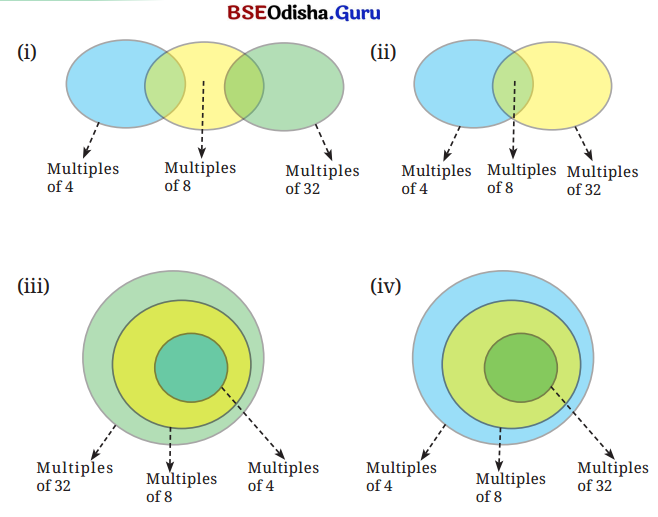
Answer:
(iv) Multiples of 4 are: 4, 8, 12,16, 20, 24, 28, 32, 36, 40, 44, 48, 52, 56, 60, 64,…
Multiples of 8 are: 8, 16, 24, 32, 40, 48, 56, 64,….
Multiples of 32 are: 32, 64, 96, 128,…
The Venn diagram captures the relationship between the multiples of 4, 8, and 32 :
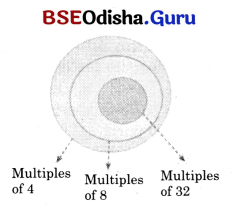
Number Play Class 8 Extra Questions
Multiple Choice Questions
Question 1.
Which of the following arithmetic expressions is even?
(a) 119 × 303
(b) (513)3
(c) 708 – 477
(d) 4 × 347 × 3
Solution:
Here, 119 × 303 = odd, as 119 and 303 both have odd parity.
(513)3 = odd, as cube of odd number has odd parity.
708 – 477 = 231, which is odd.
4 × 347 × 3 = even, as 4 has even parity, 347 and 3 have odd parity and thus the product will have even parity.
(d) 4 × 347 × 3
Question 2.
Which of the following arithmetic expression is odd?
(a) 2 × 1037
(b) 24 × 7
(c) 365 × 7
(d) 365 × 24 × 7
Solution:
Here, 2 × 1037 = even, as 2 has even parity and 1037 has odd parity. So, the product will have an odd parity.
24 × 7 = even, as 24 has an even parity and hence its product with 7 having an odd parity will be having an even parity.
In 365 × 24 × 7, 24 has even parity, so the product will have the even parity.
Finally, in 365 × 7, both have odd parity so the product will have the odd parity.
(c) 365 × 7
Question 3.
Which of the following algebraic expressions gives an even number for any integer values for the letter-numbers?
(a) 4a + 3b
(b) 2x – 5y
(c) x2 + 2
(d) 2u – 4υ
Solution:
2u – 4υ = 2(u – 2υ), which has even parity.
∴, it will give an even number for any integer value.
(d) 2u – 4υ
Question 4.
Which of the following algebraic expressions give an odd number for any integer values for the letter-numbers?
(a) 2x + 1
(b) 2x + 2
(c) 2x
(d) 2x – 2
Solution:
2x + 1 has odd parity as 2x has even parity while 1 has an odd parity.
If we add an even number with an odd number we get a number whose parity is odd.
(a) 2x + 1
Question 5.
Three consecutive numbers have sum 96. Smallest number amongst them is :
(a) 29
(b) 30
(c) 31
(d) 33
Solution:
Let the three consecutive numbers be a, a + 1 and a+ 2.
Now sum of the numbers
= a + (a + 1) + (a + 2)
= 3a + 3 = 96 (given)
∴, 3a = 96 – 3 = 93
⇒ a = \(\frac{93}{3}\) = 31
∴, smallest number = a = 31
(c) 31
Assertion and Reasoning
(a) Assertion (A) and Reason (R) both are true and Reason (R) is the correct explanation for the Assertion (A).
(b) Assertion (A) and Reason (R) both are true but Reason (R) is not the correct explanation for the Assertion (A).
(c) Assertion (A) is true but Reason (R) is false.
(d) Assertion (A) is false but Reason (R) is true.
Question 1.
Assertion (A) : Algebraic expression 2u – 6v will always give an even number for any integer value for the letter number.
Reason (R) : Difference of two expressions or terms having even parity has an even parity.
Solution:
Here, 2u – 6v = 2(u – 3v), which has even parity. So Assertion (A) is true.
Also, the Reason (R) is true and it explains the truthness of the Assertion (A).
Answer:
(a) Assertion (A) and Reason (R) both are true and Reason (R) is the correct explanation for the Assertion (A).
Question 2.
Assertion (A) : 252525 is divisible by 3.
Reason (R) : Any number having 5 at units place digit is divisible by 5.
Solution:
Here, 252525 is divisible by 3 as sum of digits of 252525 = 2 + 5 + 2 + 5 + 2 + 5 = 21, is divisible by 3.
Reason (R) is also true as any number having 5 at its units place is divisible by 5.
But Reason does not explain the divisibility of the number 252525 by 3.
Answer:
(b) Assertion (A) and Reason (R) both are true but Reason (R) is not the correct explanation for the Assertion (A).
Case Based Questions
Question 1.
Aadya was trying to solve some cryptarithms which are as follows :
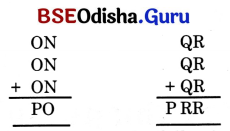
Based on the above, answer the following:
(a) What is the value of N? Are they more than one?
(b) What is the value of R? How many such values are there?
(c) What is the value of P in the first cryptarithm?
(d) What is the value of P in the second cryptarithm? Is it same as that for the first cryptarithm?
(e) What are the values of 0 and Q?
Answer:
To answer these questions, we first solve the two cryptarithms:
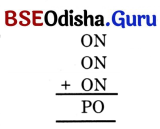
Here we have to consider a two digit number when added thrice to itself gives a two digit number having PO units digit same as the tens digit of the number
The two digit number must be less than 33. We can consider the numbers 17, 24 and 31.
Here,
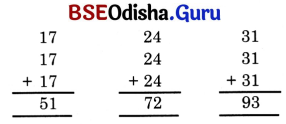
For the cryptarithm,
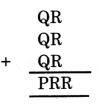
We should consider the two digit numbers greater than 33 as we need the sum a three-digit number.
Here, R can be 0 or 5 as in only these two cases the sum will be 0 or 5, when added thrice. If we consider 85, we get
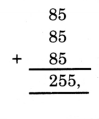
which is the answer for the given cryptarithm.
Now we can answer any question on the given cryptarithms.
(a) N = 7, 4 or 1
They are more than one in number.
(b) R = 5
They are more than one in number.
(c) The value of P in the first cryptarithm is 5, 7 or 9.
(d) The value of P in the second cryptarithm is 2. No. The values of P are different in the two cryptarithms.
(e) O = 1, 2 or 3
Q = 8