
Go through BSE Odisha Class 8 Science Solutions Chapter 3 Health: The Ultimate Treasure Question Answer to understand textbook questions more clearly.
Class 8 Science Curiosity Chapter 3 Question Answer
Class 8 Science Ch 3 Health: The Ultimate Treasure Question Answer
Class 8 Science Chapter 3 Health: The Ultimate Treasure Question Answer
Probe and Ponder Questions
Question 1.
How does your body respond to an infection such as common cold?
Answer:
The body responds to a common cold (caused by viruses) through the immune system. Symptoms like a runny nose, sore throat, or cough occur as the body fights the infection. The immune system produces antibodies to neutralize the virus, and white blood cells attack infected cells. Rest, hydration, and sometimes medication (e.g., for fever) help recovery.
Question 2.
We rarely see cases of smallpox or polio these days, but diseases like diabetes and heart problems are more common. Why?
Answer:
Smallpox and polio have been nearly eradicated due to widespread vaccination programs (e.g., Edward Jenner’s smallpox vaccine, polio vaccines). In contrast, non-communicable diseases (NCDs) like diabetes and heart problems are increasing due to modern lifestyle factors such as unhealthy diets (e.g., processed and junk foods like pizza, burgers, etc.), lack of exercise, stress, and longer life expectancies.

Question 3.
Could climate change lead to new types of diseases?
Answer:
Yes, climate change can lead to new or increased disease risks. Warmer temperatures and changing weather patterns can expand the range of disease-carrying vectors like mosquitoes (e.g., malaria, dengue), alter water quality, and create conditions for new pathogens to emerge or spread more easily.
Question 4.
How do emotions like stress or worry affect us and make us sick?
Answer:
Stress or worry can weaken the immune system by releasing hormones like cortisol, making the body more susceptible to infections (e.g., colds). Chronic stress can also contribute to non-communicable diseases like high blood pressure or diabetes by affecting sleep, diet, and mental health.
Question 5.
Why do some groups of people get affected more than others during disease outbreaks?
Answer:
Some groups are more affected due to factors like weaker immunity (e.g., children, elderly), poor living conditions (e.g., lack of sanitation), malnutrition, or preexisting health issues. Social factors, such as crowded living spaces or limited healthcare access, also increase vulnerability.
Question 6.
Share your questions
(i) What habits do you think are important for staying healthy every day?
Answer:
The following habits are important for daily good health:
- Eating a balanced and nutritious diet (with fruits, vegetables, and whole grains)
- Maintaining personal hygiene (bathing, brushing teeth, washing hands regularly)
- Exercising or being active every day and drinking clean water.
- Getting enough sleep every night.
- Spending time with family and friends for a healthy mind.
- Limiting screen time (phones, TV, computers).
- Staying positive and managing stress (through relaxation, hobbies, or talking to someone)
- Saying no to harmful substances like tobacco, alcohol, and drugs.
(ii) How do your surroundings (like home, school, or playground) affect your health?
Answer:
Your surroundings affect health in many ways:
- Clean surroundings (at home, school, or playground) reduce germs, insects, and the chances of getting diseases.
- Dirty or polluted places can cause illnesses like cough, asthma, and infections.
- Playgrounds that are clean and safe encourage exercise and outdoor activities, which make you physically stronger.
- Clean water and good sanitation at home and school help prevent diseases spread by germs.
- People who live or study in healthy and hygienic environments feel happier, less stressed, and get sick less often.
InText Questions
Question 1.
List some good habits that your parents, teachers or elders often encourage you to follow.
Answer:
- Keep yourself clean and maintain personal hygiene.
- Eat a healthy and balanced diet.
- Exercise regularly.
- Make time to relax or meditate every day.
Question 2.
List some habits that are not good for your health.
Answer:
- Spending too much time on mobile phones or other digital screens.
- Eating fast food and other junk food every day.
- Sleeping very late or not getting enough sleep.
- Skipping meals, especially breakfast.
Question 3.
Are diseases always caused by infections? (Page 35)
Answer:
No, diseases are not always caused by infections. It may causes due to some other reasons also which is given below :
- Hormonal imbalance
- Unhealthy eating habits
- Lack of physical activity
- Overweight or obese
- Cholesterol buildup and other reasons.
Question 4.
What will happen if I take excess amount of Iodine? (Page 36)
Answer:
Excess iodine disrupt the normal functioning of the thyroid gland, which can lead to various issues like both hypothyroidism and hyperthyroidism.
Health: The Ultimate Treasure Class 8 Questions and Answers
Keep the Curiosity Alive (Pages 42-45)
Question 1.
Group the diseases shown in the images as communicable or non-communicable.
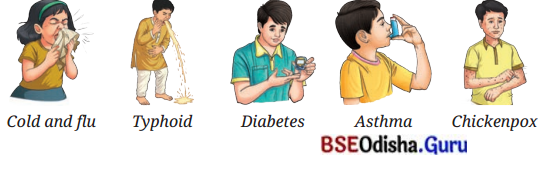
Communicable Diseases:
- Cold and flu: Spread from person to person (through air, droplets, etc.).
- Typhoid: Spread through contaminated food and water.
- Chickenpox: Spread from person to person (through air or direct contact).
Non-Communicable Diseases:
- Diabetes: It is not caused by pathogens and does not spread from person to person: usually linked to lifestyle or genetic factors.
- Asthma: It is not an infections disease; related to environmental, genetic or lifestyle causes.
Question 2.
Diseases can be broadly grouped into communicable and non-communicable diseases. From the options given below, identify the non-communicable diseases.
(i) Typhoid
(ii) Asthma
(iii) Diabetes
(iv) Measles
Options:
(a) (i) and (ii)
(b) (ii) and (iii)
(c) (i) and (iv)
(d) (ii) and (iv)
Answer:
The non-communicable diseases from the options are Asthma and Diabetes. So, the correct answer is: (b) (ii) and (iii).
Question 3.
There is a flu outbreak in your school. Several classmates are absent, while some are still coming to school coughing and sneezing.
(a) What immediate actions should the school take to prevent further spread?
(b) If your classmate, who shares the bench with you, starts showing symptoms of the flu, how can you respond in a considerate way without being rude or hurtful?
(c) How can you protect yourself and others from getting infected in this situation?
Answer:
The following immediate actions should be taken by the school to prevent further spread
(a)
- Give advice to sick students to stay at home until they are fully recovered.
- Provide soap or hand sanitizers in classrooms and washrooms.
- Open the windows and doors.
- Give instructions everyone to cover their mouth and nose when coughing or sneezing (use tissue, handkerchief or elbow).
- Do not share personal items such as water bottles, food and handkerchiefs.
(b) You should speak kindly and gently: You can say something like, “You are not looking well. May be you should tell the teacher or visit the school nurse.”
- You should offer them a tissue or hand sanitizer if they are coughing or sneezing.
- You should encourage them to cover their mouth and nose while coughing or sneezing, if they aren’t already doing so.
- You should keep a reasonable distance if possible, but without making them feel excluded or embarrassed.
- You should do not tease or blame them-show understanding, as anyone can get sick.
(c)
- Wash your hands with soap after touching the shared surfaces or before eating.
- Do not touch your face (nose, mouth, eyes) after touching the surfaces, desk etc. in the class.
- Use a mask.
- Maintain a proper distance from those who are coughing or sneezing.
- Bring and use your own water bottle.
- Eat nutritious food and get enough sleep to keep your immune system strong.
- Tell your teacher if you start to feel unwell so that you can go home.
Question 4.
Your family is planning to travel to another city where malaria is prevalent.
(a) What precautions should you take before, during, and after the trip?
(b) How can you explain the importance of mosquito nets or repellents to your sibling?
(c) What could happen if travellers ignore health advisories in such areas?
Answer:
(a) You must take the following precautions before the trip:
- You should learn about malaria in the city you’re visiting.
- Visit a doctor for advice-sometimes preventive medicines (antimalarial tablets) may be recommended.
- You should pack mosquito repellents, bed nets, and long-sleeved clothes.
- Make sure your vaccinations are up to date.
During the trip :
- Sleep under a mosquito net, especially at night.
- Apply mosquito repellent to skin and clothes, especially during dusk and dawn when mosquitoes are most active.
- Wear long-sleeved shirts, long pants, and socks to cover your skin.
- Stay in places with screened windows/doors or air conditioning if possible.
- Avoid areas with stagnant water, as these are mosquito breeding spots.
After the trip :
- Watch for symptoms like fever, shivering, body aches or tiredness for several weeks after travel.
- Visit a doctor immediately if you feel unwell or develop a fever.
- Complete any recommended preventive medication even after
(b) Explain to your sibling that mosquitoes spread malaria and that nets or repellents protect by blocking bites.
(c) If travellers ignore health advisories in such areas, they risk malaria infection, severe illness, or even death.
- Tell your teacher if you start to feel unwell so that you can go home.
Question 5.
Your uncle has started smoking just to fit in with his friends, even though it is well known that smoking can seriously harm health and even cause death.
(a) What would you say to him to make him stop, without being rude?
(b) What would you do if your friend offers you a cigarette at a party?
(c) How can schools help prevent students from indulging in such harmful habits?
Answer:
(a) Dear Uncle, I care about your health and well-being, and I want to talk to you about smoking. It’s well-known that smoking can lead to serious health issues, including heart disease and lung cancer. Quitting smoking can greatly improve your health and quality of life.
(b) Politely decline the cigarette at the party and explain the health risks to your friend. Remember: It’s okay to say NO and you don’t need to do something just to fit in.
(c) Schools can help prevent students from indulging in such habits by educating them about the health risks and organizing awareness programs regularly.
Question 6.
Saniya claims to her friend Vinita that “Antibiotics can cure any infection, so we don’t need to worry about diseases.” What question(s) can Vinita ask her to help Saniya understand that her statement is incorrect?
Answer:
Antibiotics only work against bacterial infections, not viral diseases like cold or flu. Overuse can lead to resistance. Here are some questions Vinita can ask Saniya.
- Can antibiotics cure infections caused by viruses, like the common cold or flu ?
- Do you know what could happen if people use antibiotics when they don’t need them ?
Question 7.
The following table contains information about the number of dengue cases reported in a hospital over a period of one vear:
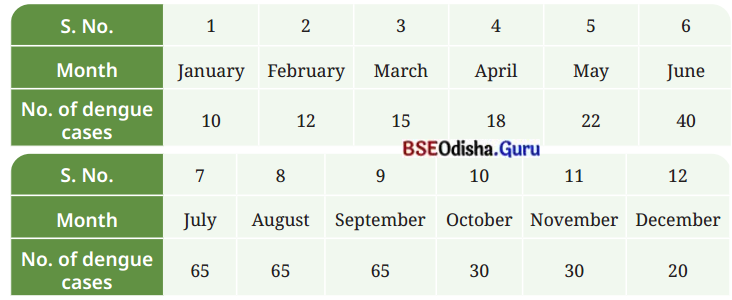
Make a bar graph of the number of cases on the Y-axis and the month on the X-axis. Critically analyse your findings and answer the following:
Answer:
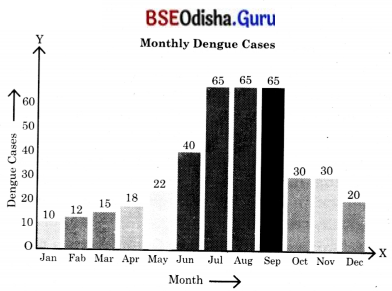
(i) In which three months were the dengue cases highest?
Answer:
The three months with the highest number of dengue cases are: July: 65 cases August: 65 cases September:65 cases These are the peak months where the number of cases remained the same and were the highest for the year.
(ii) In which month(s) were the cases lowest?
Answer:
The lowest number of dengue cases was reported in January (10 cases). February (12 cases) and March ( 15 cases) are also low, but January is the lowest.
(iii) What natural or environmental factors during the peak months might contribute to the increase in dengue cases?
Answer:
Natural or environmental factors during the peak months, such as the rainy season and standing water for mosquito breeding, might contribute to the increase in dengue cases.
(iv) Suggest a few preventive steps that the community or government can take before the peak season to reduce the spread of dengue.
Answer:
The community or government can take preventive steps like removing stagnant water, using mosquito nets, and spraying insecticides during this period regularly to reduce the spread of dengue.
Question 8.
Imagine you are in charge of a school health campaign. What key messages would you use to reduce communicable and non-communicable diseases?
Answer:
I would use the following key health messages to reduce communicable and noncommunicable diseases:
(a) Personal Hygiene: like wash your hand with soap, keep your cloth, body and surroundings clean.
(b) Healthy eating: Take balanced diet with fruits, vegetables, whole grains etc., Avoid junk food and fatty snacks.
(c) Physical Activity: Do exercises, yoga and play outdoor games.
(d) Vaccination: Get vaccinated like polio, measles, hepatitis.
(e) Take some preventive measures: Cover your mouth and nose when coughing, sneezing and do not share personal items.
(f) Avoid harmful habits: Say no to tobacco, alcohol and drugs.
(g) Good Sanitation:
- Use of toilets, do not practice open defecation.
- Cover your water container and do not allow water to be stagnant around your house.
(h) Mental and Social well-being :
- Talk to some one when you are stressed.
- Maintain friendship and positive mind.
Question 9.
It is recommended that we should not take an antibiotic for a viral infection like a cold, a cough, or flu. Can you provide the possible reason for this recommendation?
Answer:
This is because antibiotics work only against bacteria. It do not work against viruses. Diseases like the common cold, cough or flu are caused by viruses. So, antibiotics will not cure them. If you take antibiotics when they are not needed can make bacteria in your body resistant. So, it will not work when you really needed for bacterial infections later.
Question 10.
Which disease(s) among the following may spread if drinking water gets contaminated by the excreta from an infected person?
Hepatitis A, Tuberculosis, Poliomyelitis, Cholera, Chickenpox.
Answer:
The following diseases may spread if drinking water gets contaminated by the excreta of an infected person :
- Hepatitis A
- Poliomyelitis (Polio)
- Cholera
Tuberculosis and Chickenpox do not spread through contaminated water from excreta; they mainly spread through the air from person-to-person contact.
Question 11.
When our body encounters a pathogen for the first time, the immune response is generally low but on exposure to the same pathogen again, the immune response by the body is much more compared to the first exposure. Why is it so?
Answer:
- On exposure to the same pythogen again the immune system “remembers” the germ. If the same pathogen enters the body again, the immune system responds much faster and stronger because it is already prepared to fight it.
- This is why vaccinations work-they help train our immune system so we are protected if we ever encounter the real germ in the future.
Class 8 Science Chapter 3 Question Answer
Activity 1.
Let us read
Aim: A student’s story
A Case Study: A Grade 8 student moved to a new school in another city. With no friends in his new environment and busy parents, he felt lonely. To cope, he spent more time on his phone and social media, but this made him feel worse and caused.
- Headaches
- Weight loss
- Trouble sleeping
Cause and Solution :
A doctor advised him to reduce screen time and consult a counsellor. The school counsellor arranged help to support him in making friends and improving his health.
- Loneliness and too much screen time caused both physical and mental health problems.
- Making new friends and support from adults helped him feel better.
Inferences:
- According to the World Health Organization (WHO), Health is defined as a ‘state of complete physical, mental, and social well-being, and not merely the absence of disease’.
- A healthy person can perform various tasks more efficiently and cope well in different and difficult situations and they can adjust well with peer groups and other members of society.
Activity 2.
Let us list
Aim: To make a list of good and bad habits.
Materials Required: A pen, paper and scale.
Procedure:
1. Make a list of some good habits that your parents, teachers, or elders often advise you to follow. How many of these are already a part of your daily routine? Which ones would you like to start following? Add to the list below:
2. Good Habits:
- You should keep yourself clean and maintain personal hygiene.
- You must eat a healthy and balanced diet.
- You should exercise regularly.
- You should make time to relax or meditate every day.
3. Bad Habits :
- Spending too much time on mobile phones or other digital screens.
- Do not eat junk food and other junk food every day.
- Avoid sleeping very late or not getting enough sleep.
- Skipping meals, especially breakfast.
Observations: Taking care of our body and mind is important. Healthy habits support a healthy body as well as a healthy mind.
Inference: Our health depends on many factors. These factors include our lifestyle (how we live) and our environment (our surroundings).
Activity 3
Let us compare
Aim: To keep the environment clean.
Procedure / Theory:
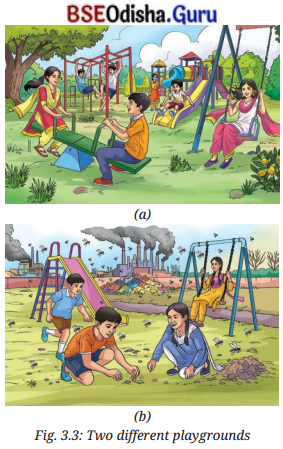
1. Look at Fig. (a) and Fig. (b). Which playground would you like to play in, and why?
2. A clean, well-maintained playground is better for playing because it’s safe and healthy (and looks beautiful).
3. The playground in Fig. (b) is polluted, dirty, unhygienic, and full of flies and mosquitoes. People living in such areas may fall sick more often.
4. Why clean surroundings matter:
- Clean air and water are important for our health.
- In cities, air pollution from vehicles and factories can cause problems like coughing or asthma.
- The Air Quality Index (AQI) helps us to know how clean the air is. A cleaner environment helps us to stay healthy and feel better.
5. Importance of feelings and relationships :
- Health is not just about the body; feelings and relations matter too.
Health: The Ultimate Treasure (Curiosity)
- Even if we eat well and live in a clean place, we may not feel good if we are lonely or upset.
- Spending time with friends and family, talking, laughing, and having fun help keep our minds healthy too.
Observations: We must keep ourselves and our surroundings clean.
Inference :
- In addition to good habits and adopting a healthy lifestyle, we must clean ourselves and our surroundings clean.
- Clean air, water are also important.
- Feelings and relationships matter for good health.
Activity 4
Let us find out
Aim:
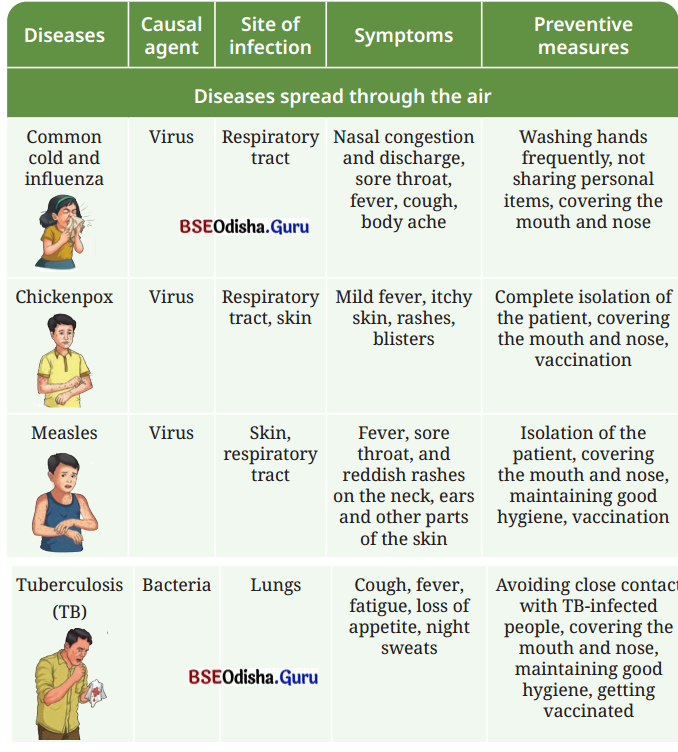
(I) Diseases spread through air
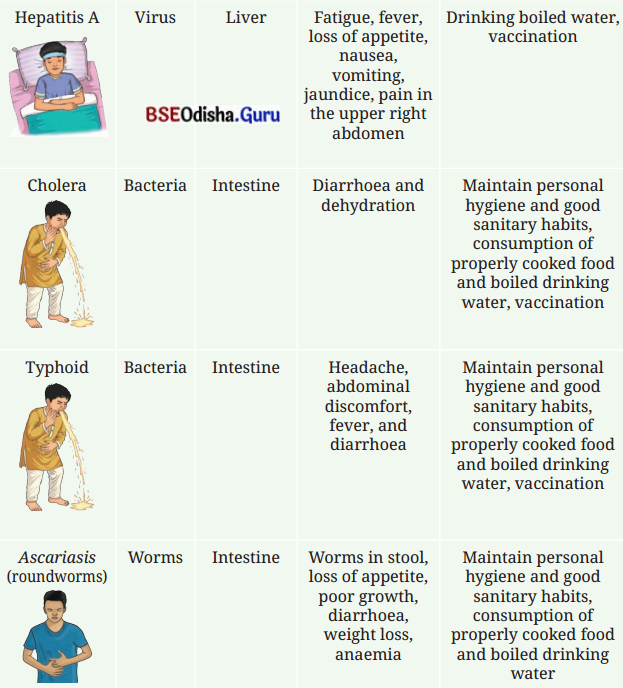
(II) Diseases spreads through contaminated water and food.
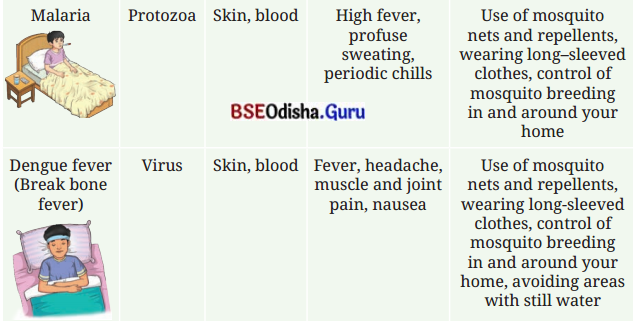
(III) Diseases transmitted by insects. Their symptoms and preventive measures.
Procedure / Theory:
I. Table: Some common communicable diseases affecting humans
II. Diseases spread through contaminated water and food.
III. Diseases transmitted by insects
Activity 5
Let us survey
Aim: To perform a survey in your neighbourhood.
Sources Required: Books, trusted websites (Internet), teachers, doctors etc.
Procedure :
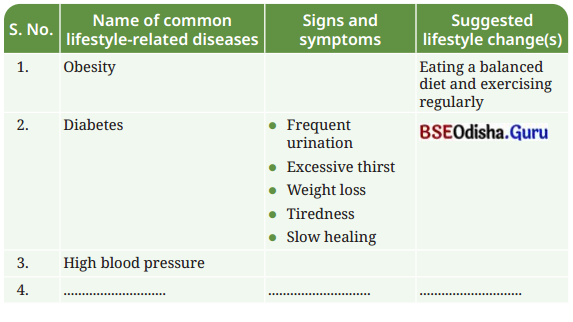
- First of all make a group of 5 students and find out the three most common lifestyle-related diseases in your colony or neighbourhood.
- Talk to a doctor, nurse, health worker or any other persons who knows about lifestyle diseases and their preventive measures.
- You have to understand that how lifestyle changes can help to prevent or manage these diseases.
Observations: Fill in the table given below with the help of doctors, teachers, websites etc. and observe more about lifestyle-related diseases.
Answer:
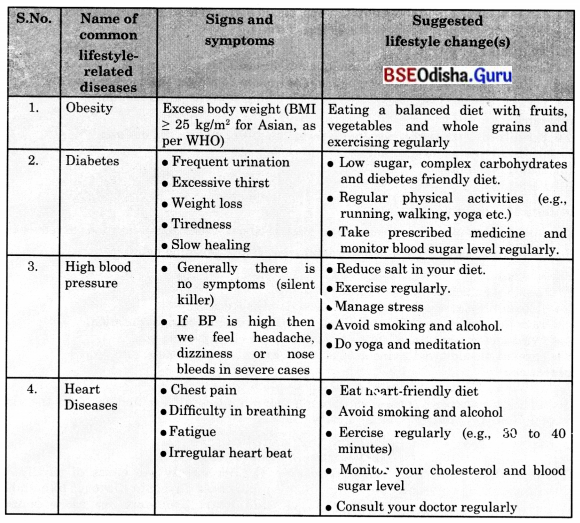
Inference:
- Lifestyle-related diseases can be prevented or controlled by changing your lifestyle, diet etc.
- Regular exercise, yoga and meditation are essential to mange your stress.
Theory:
Case Study 1: Odisha – community-led sanitation campaign.
- In Bhadrak district, Odisha, a community sanitation campaign helped more people build and use toilets. This reduced open defecation significantly, and improved child health, with fewer cases of diarrhoea and infections.
- What do you infer from this case study ?
Case Study 2: Ability of the body to fight diseases
We have noticed that some childrens or people get sick more frequently than others, even though they are living in a similar environment. Do you know why ?
Case Study 3: Edward Jenner and the smallpox vaccine
We might have taken some drops or injections in our childhood to protect ourself from certain diseases, such as polio, measles, tetanus, and hepatitis. These are vaccines that help prevent serious infections caused by viruses and bacteria.
Observations:
- Good sanitation reduced the communicable diseases.
- Childrens or people having strong immune system do not get sick more frequently.
- Vaccine help our body fight certain disease by providing acquired immunity.
Inference:
The following three methods are essential to prevent and control diseases.
- Good sanitation and cleanliness.
- Strong immunity
- Vaccination
Activity 7
Let us infer
Aim: Develoment of antibiotic resistance in bacterial pathogens and precautions to reduce it.
Theory / Resources: Study the infographic given in the adjoining figure.
Observations :
We should take the following precautions:
- Take antibiotics wisely – only when prescribed by a doctor.
- Take the correct dose of it even if you feel better and for the right duration.
- Avoid unnecessary use of antibiotics or some one else’s prescription.
- Farmers should avoid giving antibiotics unnecessarily to animals.
Inference:
- Antibiotic resistance can be controlled if we use it wisely.
- Antibiotic resistance make common infections harder to treat and increase the risk of complications, prolonged illness and even death.
Health: The Ultimate Treasure Class 8 Extra Questions and Answers
Short Answer Type Questions
Question 1.
How did screen time and loneliness affect the health of students?
Answer:
Excessive screen time and loneliness caused headaches, weight loss and problems in sleeping-which shows that there is a link between mental and physical health. Counselling and making friends improved his well-being.
Question 2.
How do communicable diseases spread through air ?
Answer:
Infected people release droplets with pathogens by coughing/sneezing/talking; others inhale them and get infected (e.g., flu, TB).
Question 3.
What are the differences between actue and chronic diseases ?
Answer:
| Actue disease | Chronic disease |
| 1. They are short duration diseases. | 1. A chronic disease is one that lasts for a long time. (more than 3 months) |
| 2. It recovers very soon, not have enough time to cause major effects on general health. E.g. : common cold. | 2. It is treated in a long time and causes prolonged general poor health. Example : cancer. |
Question 4.
Why does a person suffered once from small pox cannot suffer with it again?
Answer:
This is because when the immune system of our body first comes across an infectious organism like a virus causing small pox, it responds against virus and then remembers it specifically. When next time that particular microbe or its close relatives enter the body, the immune system of the body responds with the pathogen even with greater vigour. This eliminates the infection more quickly than the first time and thus we do not suffer with disease again.
Question 5.
How is malaria transmitted ?
Answer:
Malaria is caused by a protozoan called plasmodium, which lives in the blood and liver of an infected person. When a female, Anopheles mosquito sucks blood from an infected person, it absorbs plasmodium into its stomach along with blood. Here, the plasmodium multiplies and then passes in the salivary glands of the mosquito. When this infected mosquito bites a healthy person it injects plasmodium into his blood alongwith saliva. The healthy person then gets infected with malaria.
Long Answer Type Questions
Question 1.
How would you maintain a healthy lifestyle?
Answer:
We can maintain a healthy lifestyle.
- By eating a balanced diet with plenty of fruits, vegetables and whole grains.
- Avoid processed, fatty, or sugary food and drinks.
- Stay physically active by playing outdoors, walking, running, cycling, or exercising.
- Limit screen time and spend more time in nature.
- Get enough sleep to help your body and mind rest and recover.
- Practice yoga or simple breathing exercises like pranayama regularly.
- Say ‘NO’ to harmful substances things like tobacco, alcohol, and addictive drugs.
Question 2.
Explain giving reasons :
(a) Balanced diet is necessary for maintaining healthy body.
(b) Health of an organism depends upon the surrounding environmental conditions.
(c) Our surrounding area should be free of stagnant water.
(d) Social harmony and good economic conditions are necessary for good health.
Answer:
(a) Food is necessary for the growth and development of the body. Balanced diet provides raw materials and energy in appropriate amount needed for the substances likes protein, carbohy-drates, fats, minerals etc, which in turn are essential for the proper growth and functioning of the healthy body.
(b) Health is a state of being well enough to function well physically, mentally and socially and these conditions depend upon the surrounding environmental conditions, e.g., If there is unhygienic conditions in surroundings area, it is likely we might get infected or diseased.
(c) This is so because many water borne diseases and insect vectors flourish in stagnant water which cause diseases in human beings.
(d) Human beings live in societies and different localities like villages or cities, which determines the social and physical environment and hence both are to be kept in harmony. Public cleanliness is important for individual health. For better living conditions lot of money is required. We need good food for healthy body and for this we have to earn more. For the treatment of diseases also, one has to be in good economic condition.
Case-Study Based Questions
1. Read the following passage carefully and answer the questions that follow :
Diseases such as cancer, diabetes and asthma may often persist for a long time (more than 3 months) and are referred to as chronic diseases.
Diabetes is a common disease which is becoming more prevalent in adults as well as children. In fact, India now has one of the highest numbers of people with diabetes in the world. It often develops due to a combination of hormonal imbalances, unhealthy eating habits, lack of physical activity, being overweight or obese and other reasons.
(i) Which of the following is not a chronic disease ?
(a) diabetes
(b) asthma
(c) cancer
(d) common cold
Answer:
(d) common cold
(ii) Diabetes develops due to :
(a) harmonal imbalances
(b) unhealthy eating
(c) being overweight
(d) all of these
Answer:
(d) all of these
(iii) Chronic diseases generally persist for:
(a) 2 months only
(b) 1 month only
(c) more than 3 months
(d) less than 3 months
Answer:
(c) more than 3 months
Picture Based Questions
I. Study the picture given below and answer the following questions.
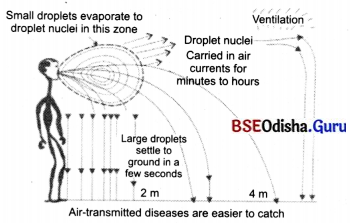
(a) How can the spread of such diseases be controlled?
(a) By preventing overcrowding
(b) By making rooms and houses well ventilated
(c) Both (a) and (b)
(d) none of these
Answer:
(c) Both (a) and (b)
(b) Name the diseases that can be spread through the above means.
(a) Tuberclosis
(b) pneumonia
(c) Both (a) and (b)
(d) none of these
Answer:
Both (a) and (b)
Health: The Ultimate Treasure Class 8 MCQ
Multiple Choice Questions (Mcqs)
Question 1.
Which of the following is a communicable disease ?
(a) Diabetes
(b) Measles
(c) Cancer
(d) Asthma
Answer:
(b) Measles
Question 2.
What is the main cause of diarrhoea in children according to the Odisha campaign?
(a) Air pollution
(b) Open defecation
(c) Loud noise
(d) Eating sweets
Answer:
(b) Open defecation
Question 3.
Vectors can be defined as :
(a) microorganisms which cause many diseases
(b) animal carry the infecting agents from sick person to another healthy person
(c) infected person
(d) diseased plants
Answer:
(b) animal carry the infecting agents from sick person to another healthy person
Question 4.
If you live in a overcrowded and poorly ventilated house, it is possible that you may suffer from which of the following diseases.
(a) Cholera
(b) AIDS
(c) Air borne diseases
(d) Cancer
Answer:
(c) Air borne diseases
Question 5.
Which one of the following is not important for individual health ?
(a) living in clean space
(b) good economic condition
(c) social equality and harmony
(d) living in a large and well furnished house
Answer:
(d) living in a large and well furnished house
Assertion and Reasoning
These questions consist of two statements, each printed as Assertion (A) and Reason (R). While answering these questions, you are required to choose any one of the following four responses.
(a) Assertion and reason both are correct and reason is correct explanation for assertion.
(b) Assertion and reason both are correct and reason is not correct explanation for assertion.
(c) Assertion is correct but the reason is wrong.
(d) Assertion is wrong but the reason is correct.
1. Assertion (A): The site of infection in chickenpox is respiratory tract and skin.
Reason (R): It is a non-communicable disease.
Answer:
(c) Assertion is correct but the reason is wrong.
2. Assertion (A): Antibiotics kill the bacteria and virus both.
Reason (R): Penicillin was the first antibiotic discovered by Alexander Fleming.
Answer:
(d) Assertion is wrong but the reason is correct.
Fill in the blanks
1. Health is state of physical, mental and ………… well being.
Answer:
social
2. Infectious agents are spread through air, water, ………… or vector.
Answer:
physical contact
3. Our immune system helps protect us from harmful ………….
Answer:
pathogens
4. ………… are what we fell, signs are what can be seen or ………….
Answer:
Symptoms, measured
5. India had a traditional method called ………… to protect against smallpox.
Answer:
variolation.
True or False
1. Eating fresh, wholesome food suited to one’s prakriti (body consumption) is essential.
Answer:
True
2. Health does not includes staying positive and having strong relationships.
Answer:
False
3. A calm mind support overall well-being.
Answer:
True
4. To stay healthy we do not need spending time with family and friends and having a positive attitude.
Answer:
False