
Go through BSE Odisha Class 8 Science Solutions Chapter 4 Electricity: Magnetic and Heating Effects Question Answer to understand textbook questions more clearly.
Class 8 Science Curiosity Chapter 4 Question Answer
Class 8 Science Ch 4 Electricity: Magnetic and Heating Effects Question Answer
Class 8 Science Chapter 4 Electricity: Magnetic and Heating Effects Question Answer
Probe and Ponder Questions
Question 1.
If we don’t have an electric lamp while making an electric circuit with an electric cell, is there any other way to find out if current is flowing in the circuit?
Answer:
Yes, there are other ways to check if current is flowing. One way is to use a magnetic compass. If you place a compass near the wire and close the circuit, the needle of the compass will deflect when the current flows through the wire. This shows that electricity is passing through the circuit. Another way is to use a device like an electric bell or buzzer, which will make a sound if current is present.

Question 2.
Is it possible to make temporary magnets? How can these be made?
Answer:
Yes, temporary magnets can be made easily. Wrapping a long insulated wire around an iron nail and connecting both ends of the wire to a battery turns the nail into an electromagnet (a temporary magnet). When electric current flows through the wire, the nail acts like a magnet and can attract magnetic materials. When the current is switched off, the nail loses its magnetism.
Question 3.
We can generate heat by burning fossil fuels and wood; but how is heat generated in various electrical appliances?
Answer:
In electrical appliances, heat is generated due to the heating effect of electric current. When electric current passes through a wire or coil (often made of materials like nichrome), the wire offer resistance to the current. This resistance causes some electrical energy to change into heat energy, making the wire hot. That’s why devices like heaters, irons, and toasters become warm when switched on.
Question 4.
How do we know if a cell or a battery is dead? Can all cells and batteries be recharged?
Answer:
A cell or battery is considered dead if it can no longer provide enough current to light a bulb, move a motor, or run any electrical device. Sometimes the device works weakly or not at all, which signals that the battery is dead. Not all cells and batteries can be recharged. Dry cells, like those used in TV remotes, are single-use and cannot be recharged. Rechargeable batteries, such as those in mobile phones and laptops, can be used again and again by recharging them with a charger.
Question 5.
Share your questions …………..
Answer:
Questions are as follows:
Why does reversing the battery terminals in a coil change the direction of the compass needle?
What happens if we use longer wires to make an electromagnet?
Which fruit or vegetable makes the strongest electric cell?
How does a rechargeable battery work differently from a single-use battery?
What materials are best for making heating elements in electric appliances?
InText Questions
Question 1.
Can we use electric current to make a magnet? (Page No. 49)
Answer:
Yes, the magnetic effect of the electric current is used to make a magnet. If an electric current is passed through a long conducting wire coiled around a metal nail or rod, the nail or rod becomes a magnet during the flow of the current. When the electric current flow stops, the nail or the rod does not have a magnetic force.
Question 2.
Does an electromagnet also have two poles like a bar magnet? (Page No. 50)
Answer:
Electromagnets also have two poles like a bar magnet. When an electric current is passed through a conducting wire coiled around an iron nail, one end of the nail becomes the North pole of the magnet, and the other end of the nail becomes the South pole of the magnet. This can be shown by bringing the North pole of a compass needle near two ends (one by one) of the nail, while current is flowing, and observing its deflection in each case. The property of magnets that ‘like poles repel each other’ shows that the electromagnets also have two poles like a bar magnet.
Question 3.
Are electromagnets also used in real life, for lifting objects? (Page No. 52)
Answer:
Electromagnets are widely used in factories and scrap yards to move, lift, and sort heavy metal items. These electromagnets are hung to the cranes. The crane operator moves the hanging magnet with the crane to heavy metal items and switches ON the current. The magnet lifts all magnetic items from the pile of heavy metal items. The crane operator controls and moves the magnet to the other position where these items are to be released. He then switches OFF the current, and the magnetic field disappears; the items are released.
Question 4.
While doing the activity for the electromagnet, did you also notice that the wire ends got warm? Why would that happen? (Page No 52)
Answer:
The wire ends get warm when current flows through the wires for some time. This happens due to the heating effect of electric current. Depending on the nature of the metals used as conductors, the conductors offer some resistance to the flow of the current. In the process, a part of the electric energy is converted into heat energy that warms the ends of the wires.
Question 5.
Can we also make our Voltaic cell using easily available materials? (Page No. 56)
Answer:
We can make our Voltaic cell using fresh lemon pieces, iron nails, copper wires or thin strips and an LED lamp to check the current of the cell. Five iron nails and five copper strips have to be inserted, one in each lemon piece. The copper strip of the first lemon piece should be connected to the iron nail of the second lemon. The copper strip of the second lemon should be connected to the iron nail of the third lemon, and so on. The first iron nail is to be connected to the negative terminal of the LED, and the last copper strip to the positive terminal of the LED. The LED will glow to show that the Voltaic cell is ready.
Electricity: Magnetic and Heating Effects Class 8 Questions and Answers
Keep the Curiosity Alive (Pages 58-61)
Question 1.
Fill in the blanks :
(i) The solution used in a Voltaic cell is called …………
Answer:
Electrolyte
(ii) A current carrying coil behaves like a ………….
Answer:
magnet.
Question 2.
Choose the correct :
(i) Dry cells are less portable compared to Voltaic cells. (True/False)
Answer:
False.
Dry cells are more portable than Voltaic cells because they don’t contain liquid electrolyte.
(ii) A coil becomes an electromagnet only when electric current flows through it. (True/False)
Answer:
True.
(iii) An electromagnet, using a single cell, attracts more iron paper clips than the same electromagnet with a battery of 2 cells. (True/False)
Answer:
False. When more cells are connected, a higher current flows through the coil. This makes the electromagnet stronger, so it should attract more iron paper clips with 2 cells than with a single cell.
Question 3.
An electric current flows through a nichrome wire for a short time.
(i) The wire becomes warm.
(ii) A magnetic compass placed below the wire is deflected.
Choose the correct option :
(a) Only (i) is correct
(b) Only (ii) is correct
(c) Both (i) and (ii) are correct
(d) Both (i) and (ii) are not correct
Answer:
(c) Both (i) and (ii) are correct.
Question 4.
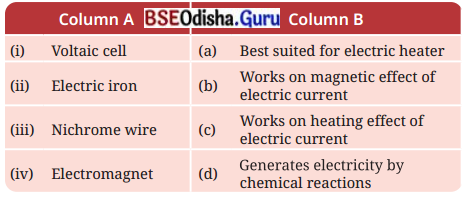
Match the items in Column A with those in Column B.
Answer:
| Column A | Column B |
| (i) Votaic cell | (d) Generates electricity by chemical reactions |
| (ii) Electric iron | (c) Works on heating effect of electric current |
| (iii) Nichrome wire | (a) Best suited for electric heater |
| (iv) Electromagnet | (b) Works on magnetic effect of electric current |
Question 5.
Nichrome wire is commonly used in electrical heating devices because it
(i) is a good conductor of electricity.
(ii) generates more heat for a given current.
(iii) is cheaper than copper.
(iv) is an insulator of electricity.
Answer:
(ii) generates more heat for a given current.
Question 6.
Electric heating devices (like an electric heater or a stove) are often considered more convenient than traditional heating methods (like burning firewood or charcoal). Give reason(s) to support this statement considering societal impact.
Answer:
Electrical heating devices are more convenient than traditional heating methods because:
- They do not produce smoke or harmful gases, thus keeping the environment clean.
- They can be easily turned on or off, and the heat can be controlled.
- They help reduce the cutting of trees for firewood and save forests.
Question 7.
Look at the Fig. given below. If the compass placed near the coil deflects :
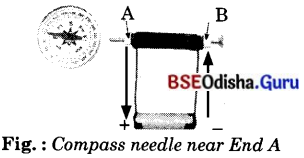
(i) Draw an arrow on the diagram to show the path of the electric current.
(ii) Explain why the compass needle moves when current flows.
(iii) Predict what would happen to the deflection if you reverse the battery terminals.
Answer:
(i) Path of electric current : The current flows from the positive terminal of the cell to end B, passes through the coil from B to A and then returns to the negative terminal of the cell.
(ii) When the current flows through the coil, it behaves like an electromagnet and produces a magnetic field around it. This magnetic field deflects the compass needle.
(iii) On reversing the battery terminals, the direction of the current in the coil is reversed. As a result, the polarity of the coil’s magnetic field also reverses, and the compass needle deflects in the opposite direction.
Question 8.
Suppose Sumana forgets to move the switch of her lifting electromagnet model to OFF position (in introduction story). After some time, the iron nail no longer picks up the iron paper clips, but the wire wrapped around the iron nail is still warm. Why did the lifting electromagnet stop lifting the clips? Give possible reasons.
Answer:
A lifting electromagnet works only when current flows through it. Since Sumana forgot to switch her electromagnet model to the OFF position, current kept flowing through the coil for a long time. This continuous passage of current made the wire around the iron nail warm and gradually weakened the cell. Finally, the cell ran out of charge, and the electromagnet stopped picking up the paper clips. Another possible reason is that the iron nail became too hot due to the heating of the wire. When iron is heated, it loses its magnetic strength temporarily, so the electromagnet could no longer lift the clips.
Question 9.
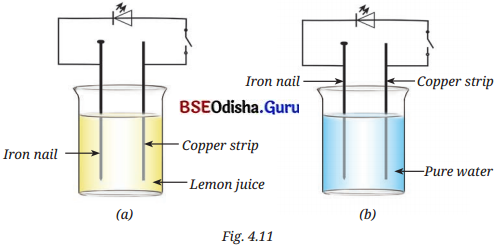
In given Fig., in which case the LED will glow when the switch is closed?
Answer:
An electrolyte in a cell is usually an acid, or salt solution. In case (a), lemon juice is a weak acid and a good conductor of electricity. Therefore, a chemical reaction takes place between the electrodes (iron nail and copper strip), allowing current to flow, and the LED glows. In case (b), pure water is a very poor conductor of electricity. Since it is not a good electrolyte, no current flows, so the LED does not glow.
Question 10.
Neha keeps the coil exactly the same as in Activity 4 but slides the iron nail out, leaving only the coiled wire. Will the coil still deflect the compass? If yes, will the deflection be more or less than before?
Answer:
Yes. When the iron nail is removed, the coil alone will still produce a magnetic field and cause the compass needle to deflect. However, the deflection will be less than when the iron nail is inside the coil. This is because inserting the iron nail in the core makes the electromagnet much stronger, leading to greater deflection of the compass needle.
Question 11.
We have four coils, of similar shape and size, made up from iron, copper, aluminium, and nichrome as shown in Fig.
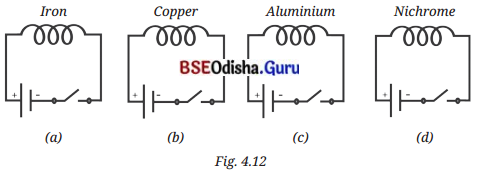
When current is passed through the coils, compass needles placed near the coils will show deflection.
(i) Only in circuit (a)
(ii) Only in circuits (a) and (b)
(iii) Only in circuits (a), (b), and (c)
(iv) In all four circuits
Answer:
(iv) In all four circuts because the compass needle will show deflection in all four circuits.
However, the amount of deflection will not be the same. It depends on the resistance of the coils used in the circuits. The coil with the least resistance allows the maximum current to flow and produces the greatest deflection, while the coil with higher resistance allows less current and produces smaller deflection.
Class 8 Science Chapter 4 Question Answer
Activity 1.
Let us investigate
Aim : To demonstrate the magnetic effect of electric current.
Materials Required : A compass, an electric cell, a cell holder two drawing pins, a safety pin, two nails, two pieces of connecting wire (one longer and one shorter), two small pieces of card board.
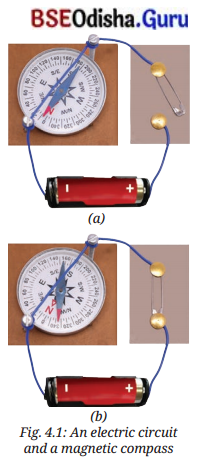
Procedure:
- Make a switch with the help of two drawing pins, a safety pin and a cardboard piece.
- Now, place the cell in the cell holder.
- Take two nails and fix it to a piece of cardboard as shown in figure (a).
- Now, attach one end of the wire to the cell holder and another end to switch.
- Place the magnetic compass just beneath the wire between the two nails as shown in figure (a).
- Move the switch to ‘ON’ position and allow electric current to pass through the wire. Note down your observation.
- Now, move the switch to ‘OFF’ position and once again note down your observation.
- Repeat the switch between ‘ON’ and ‘OFF’ position a few more times.
Observations:
- When the switch is ‘ON’ i.e., the current flows and the compass needle gets deflected from its original direction.
- When the switch is ‘OFF’ i.e., current stops and the needle returns to its original direction.
Inferences : The deflection of compass needle shows that the current carrying wire placed above it behaves like a magnet and produce a magnetic field around it.
Activity 2.
Let us explore
Aim : To demonstrate that a coil of wire connected with a cell behaves as a magnet.
Materials Required : 50cm long insulated wire, An iron nail, An electric cell, Iron paper clips, An adhesive tape.
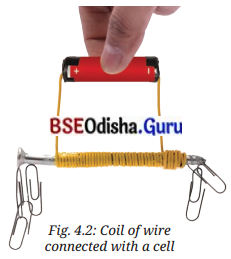
Procedure:
- Take a nail and wrap it tightly with wire around it in the form of a coil and fix it with an adhesive tape.
- Now, connect the ends of the wire to the cell.
- Now, take 4 or 5 iron paper clips and bring the iron nail cose to it. Note down your observation.
- Now disconnect the wire from the cell to stop the flow of electric current in the wire. Again note down your observation.
Activity 3.
Let us experiment
Aim : To construct an electromagnet and show that it attracts iron/steel clips.
Materials Required : 100 cm long flexible insulated wire, a piece of chart paper, an iron nail, an electric cell, two magnetic compasses and few iron/steel paper clips, adhesive tape.
Procedure :
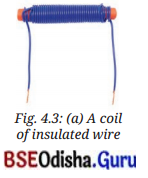
- Take a piece of chart paper and roll it to make a cylinder of diameter approximately equal to the width of a pen or pencil.
- Now, fix the chart paper with adhesive tape.
- Wind the insulated wire 50 times around the cylinder to make a cylindrical coil. [(see fig. (a)]
- Fix the wire with adhesive tape.
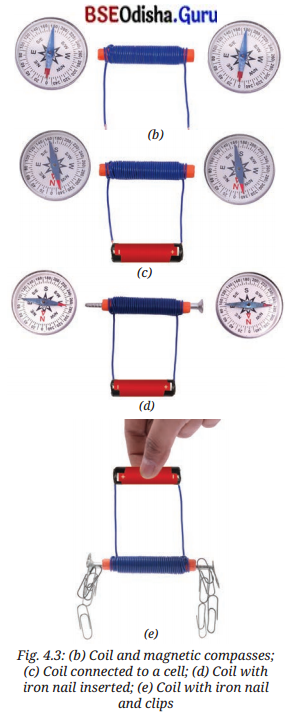
- Bring two compasses near the ends of the coil. [see fig. (b)]
- Now, connect the two ends of the coil with a cell and observe the magnetic compasses. [fig. (c)]
- Disconnect the wire from the cell after few seconds, and note down your observation.
- Now, insert an iron nail inside the cylinder and repeat the above steps and note down your observations. [see fig. (d)]
- Bring some iron paper clips near the ends of the nail. [see fig. (e)]
Observations :
- When the coil is connected to a cell it behaves like a magnet and deflects the needle of the magnetic compasses.
- When an iron nail is inserted in the core of the coil, it becomes a stronger magnet and the deflection in compasss is much more than previous.
- It attracts the iron/steel clips.
- As soon as the current is stopped the coil loses its magnetic effect and paper clips fell off.
Inference :
When the current flows through the coil wound around the cylinder in which iron nail is inserted, it produces a magnetic effect. The cylindrical coil behaves like an electromagnet, thus attracting iron/steel paper clips or (pins made of iron). When the circuit is disconnected, the coil (or iron nail) loses its magnetic property.
Activity 4.
Let us investigate
Aim : To demonstrate that an electromagnet also has two poles – North and South.
Materials Required : Same as activity 4.3
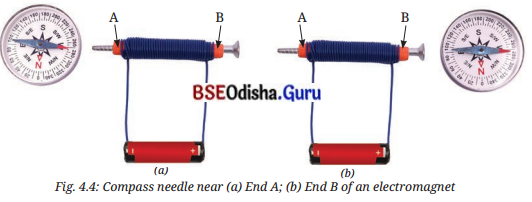
Procedure :
- Take an electromagnet which is made in the activity-3 and a magnetic compass.
- Now, label the two ends of the coil as A and B.
- Bring the magnetic compass near end A of the coil. [see fig. (a)]
- Now, we will connect the coil to the cell and not down your observation.
- Which pole of the magnetic compass is attracted towards the end A ?
- Repeat the above steps to find the polarity of end B.
Observations :
- Electromagnet has two poles.
- North pole of magnetic compass is attracted by end A. It means end ‘A’ is south pole.
- South pole of magnetic compass is attracted by end B. It shows that end ‘ B ‘ is North pole.
Inference:
- An electromagnets also has two poles and unlike poles (North-South) attract each other.
- The polarity of the electromagnet reverses if the direction of the current is reversed.
Activity 5.
Let us observe
Aim : To demonstrate the heating effect of electric current.
Materials Required: A nichrome wire of length 10 cm and thickness 0.3 mm (26-28 gauge), a cardboard piece of about 10 cm by 10 cm, two nails, an electric cell, a cell holder, a switch and connecting wires.
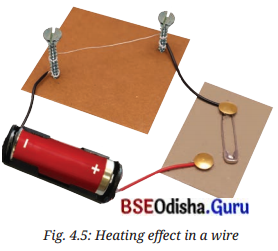
Procedure:
- Take two iron nails and fix them 5 cm apart on a cardboard.
- Take about 10 cm long piece of nichrome wire and tie it between the two nails.
- Setup an electric circuit by connecting the two nails to the two terminals of a cell through a switch with the help of copper wire. Switch should be in ‘OFF’ position. (See fig.)
- Now, pass the electric current in the circuit by moving the switch to ‘ON’ position.
- After 30 seconds switch ‘OFF’ and touch the nichrome wire just for a moment.
- Repeat the step (4) and step (5) and confirm your observation.
Observations: We have observed that nichrome wire becomes warm when electric current flows through it.
Inference: This happens because the conductor resists the flow of electric current. This resistance causes some electrical energy to turn into heat energy.
Activity 6.
Let us construct
Aim : To make our own voltanic cell using easily available materials like lemons.
Materials Required : Five or six juicy lemons, copper wires/strips (1-2 mm thick), iron nails, LED and some connecting wire.
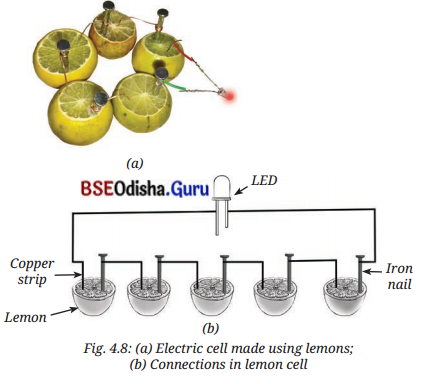
Procedure :
- Take five lemons and insert the iron nails in it. There should be small distances between them as shown in fig. (a).
- Now, join the copper wires and nails as shown in fig. (b).
- Take LED and connect the copper wire of the first lemon and the iron nail of the last lemon with the help of connecting wires.
- Note down your observation.
- If LED does not glow we will reverse the connections.
- We should connect positive terminal (longer wire) of the LED to positive terminal of the battery and negative terminal (shorter wire) of the LED to the negative terminal of the battery.
- Observations : LED glows which indicates that cell is working.
Inference:
- Glowing of LED shows that our volatic cell is working.
- Here, metal electrods are copper wires and iron nails and the electrolyte is lemon juice, which help to conduct electricity.
Electricity: Magnetic and Heating Effects Class 8 Extra Questions and Answers
Short Answer Type Questions
Question 1.
What is an electromagnet? What does it consist of ?
Answer:
An electromagnet is a rod of magnetic material (say soft iron) placed inside a solenoid coil. On passing current in solenoid coil, iron rod begins to behave as a magnet. However, on stopping flow of current in solenoid coil, the iron rod loses its magnetism. Such a magnet is known as the electromagnet.
Question 2.
Do you think an electromagnet can be used for separating plastic bags from a garbage heap? Explain.
Answer:
No, the plastic bags do not get attracted by the magnet, so they cannot be separated by an electromagnet. Plastic bags are not magnetic materials, only magnetic materials like iron can be attracted by the magnet.
Question 3.
A nicrome wire get heated but a copper wire do not get heated when electric current flows through them. Why ?
Answer:
This is because different conductors offer different levels of resistance to flow the current. A nicrome wire, offers higher resistance compare to a copper wire of the same size and length.
Question 4.
Write three factors on which the amount of heat produced by the electric iron depends.
Answer:
- The length of the coil: The longer the coil, the greater is the heat produced.
- The thickness of the coil: The thinner, the coil, more is the heat produced.
- The material of the coil: Coil made of tungsten produces more heat than a coil made of copper.
Long Answer Type Questions
Question 1.
(a) What is an electromagnet ? What does it consist of?
(b) Name one material in each case which is used to make a :
(i) permanent magnet
(ii) temporary magnet.
Answer:
(a) An electromagnet is an appliance which produces a magnetic field around its conductor coil on passing electric current through its coil.
It consists of a core of iron metal or its alloy and a solenoid conductor coil around the core.
(b)
- Alnico alloy is used for making permanent magnets.
- Soft iron metal is used for making temporary magnet.
Question 2.
When the current is switched on through a wire, a compass needle kept nearby gets deflected from its north-south position. Explain.
Answer:
When current is passed through the wire, it deflects the compass near it from its north-south position, behaving like a magnet. This is called magnetic effect of the current. As we know that needle of the compass is made up of a thin magnet, when this needle comes in contact with another magnet the like poles of the magnet repeld each other and opposite poles attract each other. So the deflection is seen in the needle. In this case the wire behaves like a magnet and cause deflection in needle of the compass.
Case-Study Based Questions
1. Read the following passage carefully and answer the questions that follow :
Many devices such as torches, transistors, toys, TV remote controls, use batteries. However, in some of these devices the electric cells are not always placed one after the other. Sometimes the cells are placed side by side. Look carefully inside the battery compartment of any device. There is usually a thick wire or a metal strip connecting the positive terminal of one cell to the negative terminal of the next cell. In order to help you to place the cells correctly in the battery compartment, ‘ + ‘ and ‘-‘ symbols are usually printed there.
(i) In making a battery :
(a) positive terminal of one cell is connected to the negative terminal of the next cell.
(b) positive terminal of one cell is connected to the positive terminal of the next cell.
(c) negative terminal of one cell is connected to the negative terminal of next cell.
(d) none of these
Answer:
(a) positive terminal of one cell is connected to the negative terminal of the next cell.
(ii) Which of the devices use a battery?
(a) Torch
(b) Transistor
(c) TV remote control
(d) All of these
Answer:
(d) All of these
(iii) Arrangement of cells in a device is :
(a) side by side
(b) one after the other
(c) Both (a) and (b)
(d) none of these
Answer:
(c) Both (a) and (b)
Picture Based Questions
I. Observe the picture and answer the following questions :
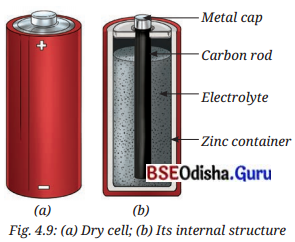
(a) What is shown in this picture ?
Answer:
- Dry cell
- Its internal structure.
(b) Name the parts labelled as A, B, C and D.
Answer:
- A → Metal cap
- B → Carbon rod
- C → Electrolyte
- D → inc container
(c) Which part is used as positive terminal ?
Answer:
A and B together act as positive terminal.
Electricity: Magnetic and Heating Effects Class 8 MCQ
Multiple Choice Questions (Mcqs)
Question 1.
What is produced around a wire when electric current flows through it ?
(a) Magnetic field
(b) Light
(c) Sound
(d) Heat
Answer:
(a) Magnetic field
Question 2.
What does a coil with current flowing through it behave like?
(a) Lamp
(b) Switch
(c) Magnet
(d) Heater
Answer:
(c) Magnet
Question 3.
What makes an electromegnet stronger?
(a) Reducting battery size
(b) Adding more turns to the coil
(c) Using thin wire
(d) Short circuiting the coil
Answer:
(b) Adding more turns to the coil
Question 4.
What happens to a nichrome wire when electric current flows through it ?
(a) It becomes cold
(b) It becomes warm
(c) It melts immediately
(d) It glows in the dark
Answer:
(b) It becomes warm
Question 5.
What material is commonly used in heating devices ?
(a) Aluminium
(b) Nichrome
(c) Copper
(d) Zinc
Answer:
(b) Nichrome
Assertion and Reasoning
These questions consist of two statements, each printed as Assertion (A) and Reason (R). While answering these questions, you are required to choose any one of the following four responses.
(a) Assertion and reason both are correct and reason is correct explanation for assertion.
(b) Assertion and reason both are correct and reason is not correct explanation for assertion.
(c) Assertion is correct but the reason is wrong.
(d) Assertion is wrong but the reason is correct.
1. Assertion (A) : When a electric current flows through a wire , it behaves like a magnet.
Reason (R): Magnetic field is perpendicular to the direction of current flow.
Answer:
(a) Assertion and reason both are correct and reason is correct explanation for assertion.
2. Assertion (A) : Amount of heat produced in a wire depends on its material, length and thickness.
Reason (R) : Resistance is directly proportional to the area of cross section and inversely proportional to length of conductor.
Answer:
(c) Assertion is correct but the reason is wrong.
Fill in the blanks
1. The conducting path through the bulb, wires, switch and battery is called …………
Answer:
electric circuit
2. The magnet made by using electric current is called an …………
Answer:
electromagnet
3. An electric current flowing in a wire produces a …………effect.
Answer:
magnetic
4. A current carrying coil of an insulated wire wrapped around a piece of iron is called …………
Answer:
electromagnet
5. A combination of ………… is called a battery.
Answer:
two or more cells
True or False
1. A battery is made by connecting positive terminal of one cell with the positive terminal of the other cell.
Answer:
False
2. The heating element of an electric iron is made of tungsten.
Answer:
False
3. An electromagnet is a temporary magnet.
Answer:
True
4. Electrical fuse is based on the magnetic effect of current.
Answer:
False
5. An electromagnet has two poles.
Answer:
True