
Go through BSE Odisha Class 8 Science Solutions Chapter 1 Exploring the Investigative World of Science Question Answer to understand textbook questions more clearly.
Class 8 Science Curiosity Chapter 1 Question Answer
Class 8 Science Ch 1 Exploring the Investigative World of Science Question Answer
Class 8 Science Chapter 1 Exploring the Investigative World of Science Question Answer
Probe and Ponder Questions
Question 1.
Why is one side of a puri thinner than the other?
Answer:
When making puris, the dough is rolled out into flat discs. If the rolling is not even, one side often becomes thinner than the other. While frying, the thinner side cooks and expands faster, often creating an uneven puff and making that side even thinner. This happens because:
- Uneven rolling pressure leads to variable thickness.
- The thinner side traps less air and expands more quickly.

Question 2.
Are there more grains of sand on all the beaches and deserts of the world or more stars in our galaxy?
Answer:
Grains of Sand:
- An average cubic meter of beach sand contains about 1015 (1 quadrillion) grains.
- Earth’s beaches and deserts are estimated to have approximately 1020 to 1024 grains of sand in total.
Stars in Our Galaxy:
- The Milky Way galaxy contains about 100-400 billion stars ( 1011 to 4 × 10¹¹).
Conclusion: There are far more grains of sand on Earth than stars in our galaxy. However, there are more stars in the universe (about 1022 to 1024) than sand grains on Earth.
Question 3.
Why has nature created such a vast variety of plants and animals?
Answer:
Nature has produced such diversity through the process of evolution. The variety of life forms, called biodiversity, exists because:
- Different environments require different adaptations for survival.
- Variation helps species survive sudden changes in climate, disease, or food supply.
- Random mutations and genetic changes produce new traits, some of which are best suited for specific conditions.
- In summary, the diversity of plants and animals is nature’s way of ensuring survival in constantly changing environments.
Question 4.
Is there such a question that makes you curious about the world?
Answer:
One question that makes me curious is: “How did the very first living cell form from nonliving matter on Earth?” This brings up fascinating discussions about the origin of life, chemistry, and early Earth conditions.
InText Questions
Question 1.
What symbols are used in the book to represent deep knowledge and imagination, respectively? (Page 2)
Answer:
A root at the bottom of the left pages represents deep knowledge, and a kite on top of the right pages represents curiosity and imagination.
Question 2.
What does it mean to investigate like a scientist? (Page 2, 6, 7)
Answer:
It means asking specific questions, designing controlled experiments, making observations, measuring, and drawing conclusions one step at a time.
Question 3.
What is the importance of curiosity in Science? (Page 2)
Answer:
Curiosity is the starting point of Science. Asking “why” and “how” helps us begin investigations and discover new knowledge.
Question 4.
What scientific topics will be covered in the textbook this year? (Page 3, 4, 5)
Answer:
The following chapter will be covered this year:
- Microbes and health
- Electricity and its effects
- Force, pressure, and motion
- Particles, elements, compounds, mixtures
- Light: reflection, mirrors, and lenses
- Phases of the Moon and calendars
- Ecosystems and climate change
Question 5.
How can human activity affect the Earth’s climate? (Page 5)
Answer:
Human actions like burning fossil fuels and deforestation can change the Earth’s temperature, disrupt climate patterns, and cause serious consequences.
Question 6.
Why is one side of a puri thinner than the other? (Page 6)
Answer:
When a puri is fried, steam forms inside, expanding and pushing one side more, making it thinner. This can depend on dough thickness, temperature, or how it’s dropped in oil.
Question 7.
Do puris puff better when made fresh or from stored dough? (Page 7)
Answer:
Puris usually puff better when made from fresh dough rather than stored dough. Fresh dough has the right moisture and softness, which helps the puris puff up properly. Stored dough often becomes dry and hard, making it difficult for the puris to puff up well.
Question 8.
What is a systematic investigation? (Page 7)
Answer:
A method where only one variable is changed at a time, others are kept constant, and careful observations and records are made.
Class 8 Science Chapter 1 Question Answer
Activity.
Activity : Investigating Everyday Phenomena
Aim : To observe various things while making puri or bhatura in your kitchen.
Procedure:
1. Science starts with being curious and asking questions like: Why does a puri puff up? Why is one side thinner? You don’t need a lab-your kitchen is a great place to observe and experiment.2. Step 1 : Ask a scientific question
E.g., How a Puri or a bhatura puffs up when placed in hot oil?
3. Step 2: Identify things you can change (variables):
- Thickness of the dough
- Size of the puri
- Type of flour (atta, maida, etc.)
- Temperature of the oil
- How you put the puri into the oil (dropped straight or slid in)
4. Step 3 : Decide what to observe or measure :
- Does the puri puff up (yes or no) ?
- How long does it take to puff ?
- Does the thickness affect puffing ?
5. Step 4 : Change only one thing at a time :
- So you know what causes the difference. (For example, test different oil temperatures but keep dough thickness the same.)
6. Step 5 : Write down what you see :
- (Does the oil splatter ? Does it smoke ? What smells do you notice ?)
7. Step 6 : Ask new questions based on what you observe :
- Example : Does fresh dough puff better than stored dough? What if there’s a hole in the puri?
Observations:
- A puri puff up due to steam inside it.
- One side of a puri becomes thinner due to uneven thickness during rolling out the puri dough.
Inferences:
- This step-by-step way of experimenting is called systematic investigation.
- Remember, science is about being curious and carefully observing even simple things around you like a puffing puri!
Exploring the Investigative World of Science Class 8 Extra Questions and Answers
Short Answer Type Questions
Question 1.
How does a puri puff up while frying?
Answer:
A puri puff up due to the water in the dough turning into steam when heated. The steam gets trapped inside, making the puri swell like a balloon.
Question 2.
What is the importance of curiosity in science?
Answer:
Curiosity helps us ask questions about everyday things and look for their answers through observation and investigation. It is the first step toward becoming a good scientist.
Question 3.
What does the roots and kites represents ?
Answer:
The roots and kites represents you to stay grounded in real observations, but allow your ideas to soar towards new horizons. i.e., root means deep, solid foundation and kites represents unique ideas, creativity and imaginations.
Question 4.
How do vaccines helps us stay healthy?
Answer:
Vaccines train our body to fight infections by making it ready to respond to certain harmful microbes, thus protecting us from serious diseases.
Question 5.
Explain force with an example.
Answer:
A force is a push or pull that changes the motion of an object. For example, kicking a football applies force and makes it move.
Question 6.
Why do cyclones occur ?
Answer:
Cyclones form due to a large difference in air pressure. Warm moist air rises quickly, forming strong winds and heavy rain around low pressure areas.
Long Answer Type Questions
Question 1.
Describe the step involved in scientific investigation.
Answer:
- Ask a focused question based on curiosity.
- Plan a simple experiment to test the idea.
- Control one variable at a time.
- Observe and record carefully.
- Analyse results and draw conclusions.
Question 2.
Explain how electric current is useful in our daily life.
Answer:
- Provides light through electric bulbs.
- Heats water in geysers and cooks food in heaters.
- Runs motors and machines via magnetic effect.
- Powers home appliances like fans, televisions (TV’s) and fridges.
Question 3.
Write differences between elements, compound and mixtues.
Answer:
- Element : Pure substance made of one kind of atom (e.g., Iron).
- Compound : Two or more elements chemically combined (e.g., Water).
- Mixture : Two or more substances physically combined (e.g., Air).
Question 4.
What is the difference between an observation and an inference in science ?
Answer:
Observation means what you noticed using your tools or senses like seeing a puri puff. But an inference is a logical idea you form from observations, like guessing that hot oil makes steam inside the puri and it becomes puff.
Case-Study Based Questions
1. Read the following passage carefully and answer the questions that follow :
A fair experiment is possible if you change one thing at a time and keep others constant. It will help you to do fair experiments. For example, when frying a puri, you can change the oil temperature or flour type to see how it affects puffing. This is a systematic investigation. Learn important terms like “variables”, “observations” and “experimentation”. They also improve your ability to pick the correct reason or outcome when small changes are made in an experiment.
(i) Why is observation considered critical in science ?
(a) It provides real data to interpret
(b) It replaces theory
(c) It guarantees success
(d) It help avoid reading
Answer:
(a) It provides real data to interpret
(ii) What does this chapter explain about experiments done in professional labs vs. home ?
(a) Home experiments are fake
(b) Home experiments are unsafe
(c) Both are equally valuable
(d) Only lab work is valid
Answer:
(c) Both are equally valuable
(iii) Which phenomenon is used in this chapter to explain scientific curiosity ?
(a) Frying a puri
(b) Spinning top
(c) Lightning
(d) Melting chocolate
Answer:
(a) Frying a puri
(iv) What kind of questions do scientists ask about a puri ?
(a) Why does it taste good ?
(b) Why does it puff ?
(c) Why is it round?
(d) Why is it salty?
Answer:
(b) Why does it puff ?
Picture Based Questions
I. Look at the picture and answer the following questions :
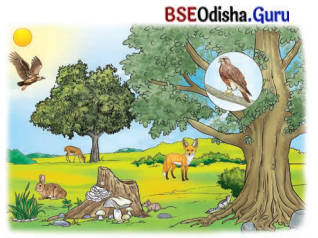
(i) Name a scientific term that can define the picture.
(a) ecosystem
(b) observation
(c) analyses
(d) non of these
Answer:
(a) Ecosystem.
(ii) Why changes in one part of an ecosystem can affect the whole system ?
Answer:
Because all living things are connected which forms an ecosystem.
(iii) Write the name of the elements of ecosystem.
Answer:
Plants, animals, water, air, sunlight, soil etc.
Exploring the Investigative World of Science Class 8 MCQ
Multiple Choice Questions (Mcqs)
Question 1.
Why is one side of a puri often thinner than the other ?
(a) Uneven rolling or frying
(b) Moisture in the dough
(c) Poor oil temperature
(d) Uneven flour quality
Answer:
(a) Uneven rolling or frying
Question 2.
What is meant by ‘systematic investigation’ in science ?
(a) Observing and changing one factor at a time
(b) Memorising theory
(c) Repeating errors
(d) Doing one experiment only
Answer:
(a) Observing and changing one factor at a time
Question 3.
How does one begin a scientific investigation according to the chapter ?
(a) By writing a hypothesis
(b) By buying lab tools
(c) By watching videos
(d) By asking simple or focused questions
Answer:
(d) By asking simple or focused questions
Question 4.
What is the importance of keeping notes during experiments ?
(a) To decorate the textbook
(b) To record change and observations
(c) To write poetry
(d) To impress teachers
Answer:
(b) To record change and observations
Question 5.
Which one is NOT a controllable factor during puri frying, as per the chapter?
(a) Brand of cooking pot
(b) Temperature of oil
(c) Type of flour
(d) Dough thickness
Answer:
(a) Brand of cooking pot
Assertion and Reasoning
These questions consist of two statements, each printed as Assertion (A) and Reason (R). While answering these questions, you are required to choose any one of the following four responses.
(a) Assertion and reason both are correct and reason is correct explanation for assertion.
(b) Assertion and reason both are correct and reason is not correct explanation for assertion.
(c) Assertion is correct but the reason is wrong.
(d) Assertion is wrong but the reason is correct.
1. Assertion (A): In a drop of water, countless microbes live.
Reason (R): All microbes are harmful.
Answer:
(c) Assertion is correct but the reason is wrong.
2. Assertion (A): Electricity has only heating effect.
Reason (R): Electricity has both heating and magnetic effects.
Answer:
(d) Assertion is wrong but the reason is correct.
Fill in the blanks
1. Writing down what you see is called ………….
Answer:
observation
2. Air moves from high pressure to ………… pressure to form winds.
Answer:
low
3. All matter is made of tiny ………… that behave differently in solids, liquids and gases.
Answer:
particles
4. Light can ………… from mirror and ………… through lenses.
Answer:
reflect, refract
5 . Science balance careful observation with ……….. thinking.
Answer:
creative
True or False
1. Light bends when passes through lenses.
Answer:
True
2. Vaccines do not help us to stay healthy and fight infections.
Answer:
False
3. The root and the kite have certain meanings which symbolizes respectively to stay grounded in real observations and creative thinking.
Answer:
True
4. All living things are connected and they form an ecosystems.
Answer:
True