
Students can refer to BSE Odisha Class 8 Math Solution and Ganita Prakash Chapter 2 Power Play Class 8 Question Answer to understand textbook questions step by step.
Class 8 Maths Chapter 2 Power Play Solutions
Ganita Prakash Class 8 Chapter 2 Solutions
Class 8 Maths Ganita Prakash Chapter 2 Solutions Power Play
Page : 19
Question 1.
How many times can you fold it over and over?
Estu says “I heard that a sheet of paper can’t be folded more than 7 times”.
Roxie replies “What if we use a thinner paper, like a newspaper or a tissue paper?”
Try it with different types of paper and see what happens.
Answer:
Any paper, how big or small, thick or thin, cannot be folded for more than 7 times.
Question 2.
Say you can fold a sheet of paper as many times as you wish. What would its thickness be after 30 folds? Make a guess.
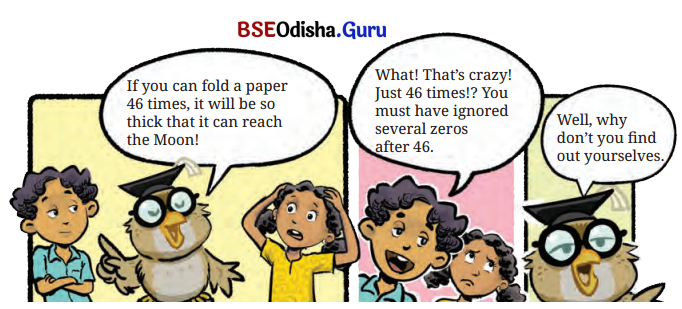
Let us find out how thick a sheet of paper will be after 46 folds. Assume that the thickness of the sheet is 0.001 cm.
Answer:
We know that,
Thickness after 1st fold = 2t, if t is the initial thickness.
∴, Thickness after 2nd fold = 22t.
In this way, we can find that after 30 folds, the thickness = 230t.

Page : 20
Question 1.
The following table lists the thickness after each fold. Observe that the thickness doubles after each fold.
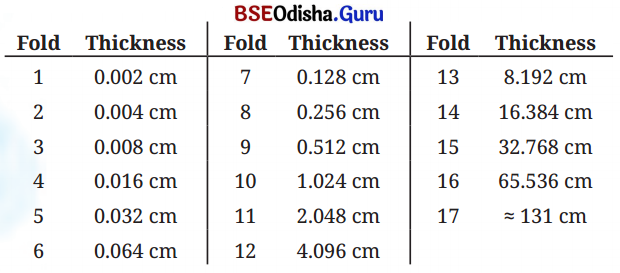
(We use the sign ‘≈’ to indicate ‘approximately equal to’.)
After 10 folds, the thickness is just above 1 cm (1.024 cm).
After 17 folds, the thickness is about 131 cm (a little more than 4 feet).
Answer:
| Fold | Thickness |
| 1 | 0.002 cm |
| 2 | 0.004 cm |
| 3 | 0.008 cm |
| 4 | 0.016 cm |
| 5 | 0.032 cm |
| 6 | 0.064 cm |
| 7 | 0.128 cm |
| 8 | 0.256 cm |
| 9 | 0.512 cm |
| 10 | 1.024 cm |
| 11 | 2.048 cm |
| 12 | 4.096 cm |
| 13 | 8.192 cm |
| 14 | 16.384 cm |
| 15 | 32.768 cm |
| 16 | 65.536 cm |
| 17 | ≈ 131 cm |
Question 2.
Now, what do you think the thickness would be after 30 folds? 45 folds? Make a guess.
Answer:
After 30 folds :
Thickness = 0.002 × 230
= 0.002 × 536,870,912
= 1073741824
After 45 folds :
Thickness = 0.002 × 245
= 0.002 × 35184372088832
= 3.518 × 10¹³ m
Question 3.
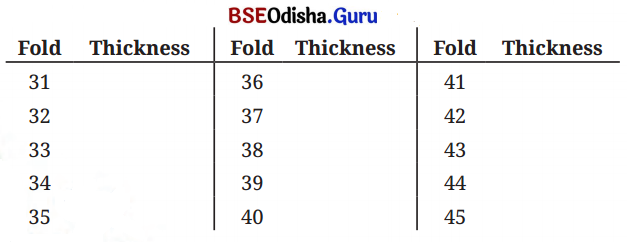
Fill the table below.
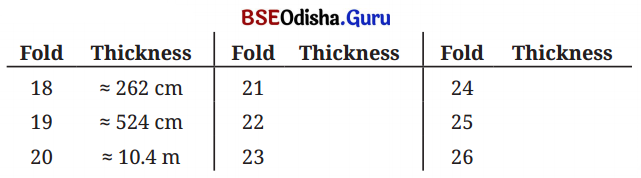
After 26 folds, the thickness is approximately 670 m. Burj Khalifa in Dubai, the tallest building in the world, is 830 m tall.
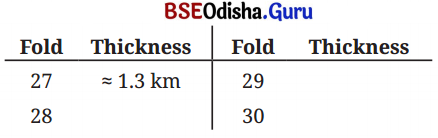
After 30 folds, the thickness of the paper is about 10.7 km, the typical height at which planes fly. The deepest point discovered in the oceans is the Mariana Trench, with a depth of 11 km.
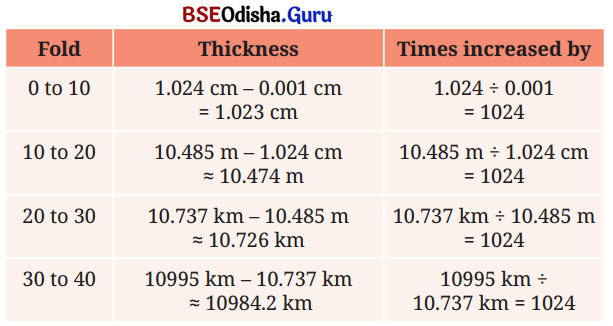
It might be hard to digest the fact that after just 46 folds, the thickness is more than 7,00,000 km. This is the power of multiplicative growth, also called exponential growth. Let us analyse the growth. We have seen that the thickness doubles after every fold.
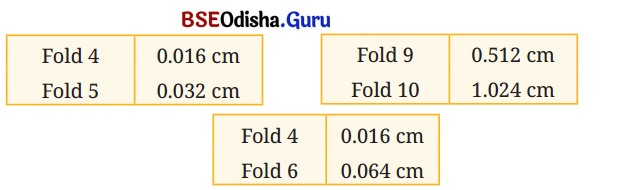
Notice the change in thickness after two folds. By how much does it increase?
After any 3 folds, the thickness increases 8 times (= 2 × 2 × 2). Check if that is true. Similarly, from any point, the thickness after 10 folds increases by 1024 times (= 2 multiplied by itself 10 times), as shown in the table below.
Answer:
| Fold | Thickness |
| 21 | 20.8 m |
| 22 | 41.6 m |
| 23 | 83.2 m |
| 24 | 166.4 m |
| 25 | 332.8 m |
| 26 | 665.6 m |
| 27 | ≈ 1.3 km |
| 28 | 2.6 km |
| 29 | 5.2 km |
| 30 | 10.4 km |
| 31 | 20.8 km |
| 32 | 41.6 km |
| 33 | 83.2 km |
| 34 | 166.4 km |
| 35 | 332.8 km |
| 36 | 665.6 km |
| 37 | 1331.2 km |
| 38 | 2662.4 km |
| 39 | 5324.8 km |
| 40 | 10,649.6 km |
| 41 | 21,299.2 km |
| 42 | 42,598.4 km |
| 43 | 85,196.8 km |
| 44 | 170,393.6 km |
| 45 | 340,786.6 km |
| 46 | 681,572.4 km |
| 47 | 1,363,144.8 km |
We can notice here that with just 30 folds of a paper, which is just 0.002 cm thick, the thickness of the folded paper will be approximately 10.4 km, which is the typical height at which planes fly This thickness is nearly another important milestone of the civilization which is the deepest point discovered in the ocean, i.e., the Mariana Trench, with a depth of about 11 km.
Page : 22
Question 1.
Which expression describes the thickness of a sheet of paper after it is folded 10 times? The initial thickness is represented by the letter-number υ.
(i) 10υ
(ii) 10 + υ
(iii) 2 × 10 × υ
(iv) 210
(v) 210υ
(vi) 102υ
Some more examples of exponential notation:
4 × 4 × 4 = 43 = 64.
(-4) × (-4) × (-4) = (-4)3 = -64.
Similarly,
a × a × a × b × b can be expressed as a3b2 (read as a cubed b squared).
a × a × b × b × b × b can be expressed as a2b4 (read as a squared b raised to the power 4).
Remember that 4 + 4 + 4 = 3 × 4 = 12, whereas 4 × 4 × 4 = 43 = 64.
Solution:
Here the initial thickness is υ.
Thickness after 1st fold = 2υ
Thickness after 2nd fold = 22υ
Thickness after 3rd fold = 23υ …….
Thickness after 10th fold = 210υ
So, (υ) 210υ describes the thickness of a sheet of paper after it is folded 10 times.
Question 2.
Express the number 32400 as a product of its prime factors and represent the prime factors in their exponential form.
Solution:
Prime factors of 32400 :
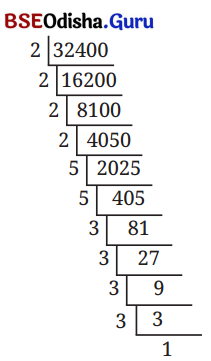
So, 32400 = 2 × 2 × 2 × 2 × 3 × 3 × 3 × 3 × 5 × 5
= 24 × 34 × 52, which is the required exponential form.
Question 3.
What is (-)5? Is it positive or negative? What about (-1)56?
Solution:
(-1)5 = (-1) × (-1) × (-1) × (-1) × (-1)
= (-1)
It is negative.
(-1)56 = 1, it is positive.
Question 4.
Is (-2)4 = 16? Verify.
Solution:
(-2)4 = (-2) × (-2) × (-2) × (-2)
= (+4) × (+4) = (+16) = 16
Figure it Out : Page : 22 – 23
Question 1.
E×press the following in exponential form:
(i) 6 × 6 × 6 × 6
(ii) y × y
(iii) b × b × b × b
(iv) 5 × 5 × 7 × 7 × 7
(v) 2 × 2 × a × a
(vi) a × a × a × c × c × c × c × d
Solution:
(i) 6 × 6 × 6 × 6 = (6)4
(ii) y × y = (y)2
(iii) b × b × b × b = (b)4
(iv) 5 × 5 × 7 × 7 × 7 = (5)2 × (7)3
(v) 2 × 2 × a × a = (2)2 × (a)2
(vi) a × a × a × c × c × c × c × d = (a)3 × (c)4 × (d)1
Question 2.
Express each of the following as a product of powers of their prime factors in exponential form.
(i) 648
(ii) 405
(iii) 540
(iv) 3600
Solution:
(i) 648 Prime factors of 648 :
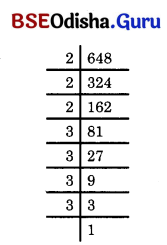
So, 648 = 2 × 2 × 2 × 3 × 3 × 3 × 3
= 23 × 34
(ii) 405
Prime factors of 405 :
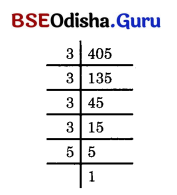
∴, 405 = 3 × 3 × 3 × 3 × 5
= (3)4 × (5) or simply 34 × 5
(iii) 540
Prime factors of 540 :
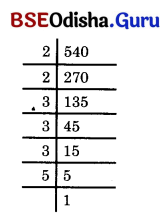
∴, 540 = 2 × 2 × 3 × 3 × 3 × 5
= 22 × 33 × 51
(iv) 3600
Prime factors of 3600 :
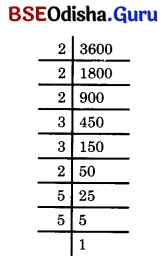
∴, 3600 = 2 × 2 × 2 × 2 × 3 × 3 × 5 × 5
= 24 × 32 × 52
Question 3.
Write the numerical value of each of the following:
(i) 2 × 10³
(ii) 72 × 23
(iii) 3 × 44
(iv) (-3)2 × (-5)2
(v) 32 × 104
(vi) (-2)5 × (-10)6
Solution:
(i) 2 × 103 = 2 × 10 × 10 × 10 = 2000
(ii) 72 × 23 = 7 × 7 × 2 × 2 × 2 = 49 × 8 = 392
(iii) 3 × 44 = 3 × 4 × 4 × 4 × 4 = 3 × 256 = 768
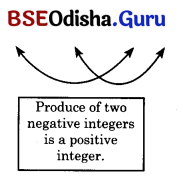
(iv) (-3)2 × (-5)2 = (-3) × (-3) × (-5) × (-5) = 9 × 25 = 225
(v) 32 × 104 = 3 × 3 × 10 × 10 × 10 × 10
= 9 × 10,000 = 90,000
(vi) (-2)5 × (-10)6 = (-2) × (-2) × (-2) × (-2) × (-2) × (-10) × (-10) × (-10) × (-10) × (-10) × (-10)
= (-32) × 10,00,000 = -3,20,00,000
Page : 23
Question 1.
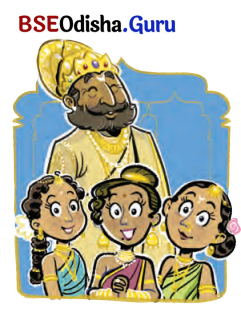
Three daughters with curious eyes,
Each got three baskets – a kingly prize.
Each basket had three silver keys,
Each opens three big rooms with ease.
Each room had tables – one, two, three,
With three bright necklaces on each, you see.
Each necklace had three diamonds so fine…
Can you count these stones that shine?
Hint : Find out the number of baskets and rooms.
Solution:
Number of daughters = 3
Since each daughter has got 3 baskets,
So number of baskets in total = 3 × 3 = 9
Each basket has three silver keys,
So, number of keys in total = 9 × 3 = 27
Since each silver key opens three big rooms,
Total number of rooms opened by these keys = 27 × 3 = 81
Each room has three tables,
Total number of tables = 81 × 3 = 243
Each table has three necklaces on it,
So, total number of necklaces = 243 × 3 = 729
Now, each necklace has three diamonds,
Hence, total number of diamonds = 729 × 3 = 2187
Question 2.
How many rooms were there altogether?
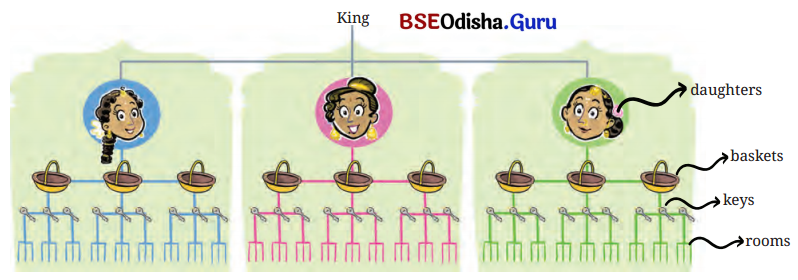
The information given can be visualised as shown below.
Solution:
From the diagram, the number of rooms is 34. This can be computed by repeatedly multiplying 3 by itself,
3 × 3 = 9.
9 × 3 = 27.
27 × 3 = 81.
81 × 3 = 243.
There were 81 rooms altogether as depicted by the above solution.
Question 3.
How many diamonds were there in total? Can we find out by just one multiplication using the products above?
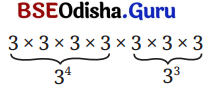
The number of diamonds is 3 × 3 × 3 × 3 × 3 × 3 × 3 = 37.
We can write
37 = (3 × 3 × 3 × 3) × (3 × 3 × 3)
We had computed till 34. To find 37, we can just multiply 34 (= 81) with 33(= 27).
= 34 × 33
= 81 × 27 = 2187
Solution:
Total number of diamonds = 2187
We can find this number by multiplying the number of necklaces by 3, i.e., 729 × 3 = 2187
Or by multiplying total number of tables by 9, i.e., 243 × 9 = 2187
Or by multiplying total number of rooms by 27, i.e., 243 × 27 = 2187
Note : There can be more ways.
Page : 24
Question 1.
37 can also be written as 32 × 35. Can you reason out why?
This can be easily extended to products where exponents are the same letter-numbers.
Solution:
37 can also be written as 32 × 35 as :
32 × 35 = 3 × 3 × 3 × 3 × 3 × 3 × 3 (in expanded form)
= 37 (in exponential form)
Question 2.
Write the product p4 × p6 in exponential form.
p4 × p6 = (p × p × p × p) × (p × p × p × p × p × p) = p10
We can generalise this to –
na nb = na + b where a and b are counting numbers
Solution:
p4 × p6 = p × p × p × p × p × p × p × p × p × p_(expanded form)
= p10 (exponential form)
Question 3.
Use this observation to compute the following.
(i) 29
(ii) 57
(iii) 46
Solution:
(i) 29 = (2 × 2 × 2) × (2 × 2 × 2) × (2 × 2 × 2)
= (8) × (8) × (8) = (64) × (8) = 512
(ii) 57 = (5 × 5 × 5 × 5) × (5 × 5 × 5)
= 54 × 53 = 625 × 125 = 78125
(iii) 46 = (4 × 4) × (4 × 4) × (4 × 4)
= 16 × 16 × 16 = 256 × 16 = 4096
Question 4.
Is 210 also equal to (25)2? Write it as a product.
Solution:
210 = 2 × 2 × 2 × 2 × 2 × 2 × 2 × 2 × 2 × 2
= (2 × 2 × 2 × 2 × 2) × (2 × 2 × 2 × 2 × 2) [Regrouping in group of 5]
= (25) × (25) = (25)2
Note : (am)n = (an)m = am × n = amn), where ‘n’ and ‘n’ are counting numbers.
Question 5.
Write the following expressions as a power of a power in at least two different ways:
(i) 86
(ii) 715
(iii) 914
(iv) 58
Solution:
(i) 86 = (82)3 Also, 86 = (82)3
(ii) 715 = (73)5 Also, 715 = (75)3
(iii) 914 = (92)7 Also, 914 = (97)2
(iv) 58 = (52)4 Also, 58 = (54)2
Page : 25
Question 1.
In the middle of a beautiful, magical pond lies a bright pink lotus. The number of lotuses doubles every day in this pond. After 30 days, the pond is completely covered with lotuses. On which day was the pond half full?
If the pond is completely covered by lotuses on the 30th day, how much of it is covered by lotuses on the 29th day?
Since the number of lotuses doubles every day, the pond should be half covered on the 29th day.

Solution:
Since the pond is fully filled with lotuses in 30 days.
Hence, the pond should be half covered on the 29th day as number of flowers doubles every day.
Question 2.
Write the number of lotuses (in exponential form) when the pond was –
(i) fully covered
(ii) half covered
Solution:
(i) The number of lotuses when the pond was fully covered = 230
(ii) The number of lotuses when the pond was half covered = 229
Question 3.
There is another pond in which the number of lotuses triples every day. When both the ponds had no flowers, Damayanti placed a lotus in the doubling pond. After 4 days, she took all the lotuses from there and put them in the tripling pond. How many lotuses will be in the tripling pond after 4 more days?
After the first 4 days, the number of lotuses is 1 × 2 × 2 × 2 × 2 = 24.
After the next 4 days, the number of lotuses is 2 × 3 × 3 × 3 × 3 = 24 × 34.
Solution:
Number of lotuses in the doubling pond after 4 days = 24 = 16
Number of lotuses in the tripling pond after 4 more days = 24 × 34 = 16 × 81 = 1296
Question 4.
What if Damayanti had changed the order in which she placed the flowers in the lakes? How many lotuses would be there?
1 × 34 × 24 = (3 × 3 × 3 × 3) ×(2 × 2 × 2 × 2).
Solution:
If Damayanti had changed the order then she will place the lotus in the tripling pond first and then after 4 days, she will place all lotuses in the doubling pond.
So, the number of lotuses after first 4 days = (3)4 = 81
and the number of lotuses after next 4 days = (3)4 × (2)4 = 81 × 16 = 1296
Question 5.
Can this product be expressed as an exponent mn, where m and n are some counting numbers?
Solution:
Here the product is 34 × 24 which can also be written as
3 × 3 × 3 × 3 × 2 × 2 × 2 × 2
By regrouping we can write them as:
(3 × 2) × (3 × 2) × (3 × 2) × (3 × 2) = 6 × 6 × 6 × 6 = 64, which is the required “mn” form.
Note : am × bm = (a × b)m = (ab)m, where ‘m is- a counting number.
Question 6.
Simplify \(\frac{10^4}{5^4}\) and write it in exponential form.
In general, we can show that \(\frac{m^a}{n^a}\) = \(\left(\frac{m}{n}\right)^a .\).
Solution:
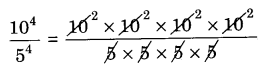
= 2 × 2 × 2 × 2 = 24
Note : \(\frac{a^m}{b^m}\) = (\(\frac{a}{b}\))m
, where ‘m’ is a counting number.
Page : 26
Question 1.
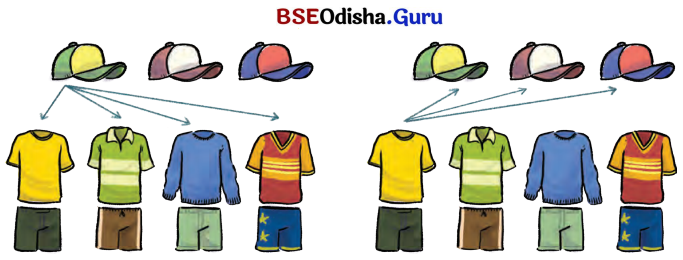
Estu has 4 dresses and 3 caps. How many different ways can Estu combine the dresses and caps?
For each cap, he can choose any of the 4 dresses, so for 3 caps, 4 + 4 + 4 = 4 × 3 = 12 combinations are possthle. We can also look at it as – for each dress, Estu can choose any of the 3 caps, so for 4 outfits, 3 + 3 + 3 + 3 = 3 × 4 = 12 combinations are possible.
Solution:
Estu can combine 4 dresses and 3 caps in 4 × 3 ways = 12 ways.
Question 2.
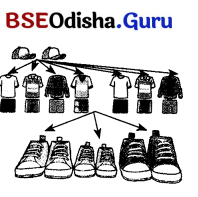
Roxie has 7 dresses, 2 hats, and 3 pairs of shoes. How many different ways can Roxie dress up?
Solution:
Roxie has 7 dresses, 2 hats, and 3 pairs of shoes.
Number of different ways Roxie can dress up = 7 × 2 × 3 = 42.
Question 3.
Estu and Roxie came’across a safe containing old stamps and coins that their great-grandfather had collected. It was secured with a 5-digit password. Since nobody knew the password, they had no option except to try every password until it opened. They were unlucky and the lock only opened with the last password, after they had tried all possible combinations. How many passwords did they end up checking?

Solution:
Getting the 5-digit password is the same as filling 5 empty boxes by 10 different objects if it comes after all the possible combinations.
So, 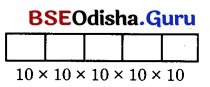
We can fill the first box in 10 ways, 2nd box in 10 ways, 3rd box in 10 ways, 4th box in 10 ways, and 5th box in 10 ways.
So, total number of possible combinations:
= 10 × 10 × 10 × 10 × 10 = 105
Page : 27
Question 1.
How many passwords are possible with such a lock?
Solution:
There will be 105 passwords.
Question 2.
Think about how many combinations are possible in different contexts. Some examples are-
(i) Pincodes of places in India – The Pincode of Vidisha in Madhya Pradesh is 464001. The Pincode of Zemabawk in Mizoram is 796017.
(ii) Mobile numbers.
(iii) Vehicle registration numbers.
Try to find out how these numbers or codes are allotted/generated.
Solution:
(i) Pincodes of places in India contain 6 digits, but the first digit cannot be a zero, though there is no restriction on the rest of the digits. Total number of combinations :
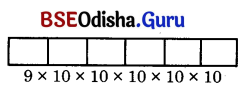
Also, there are no PINs like 100000, 200000, 300000, 400000, 500000, 600000, 700000, 800000, 900000.
So, total number of combinations for the pincode = 9 × 10⁵ – 9.
(ii) Ignoring the actual system followed while framing a mobile number, we can get the number of combinations as:
= 9 × 10⁹, as there are 10 digits in a mobile number.
(iii) Vehicle registration numbers in Delhi can be like DL4SAG7336.
So, the required number of possible combinations for vehicle registration number can be:
26 × 26 × 9 × 26 × 26 × 10 × 10 × 10 × 10 – 1
= 265 × 9 × 104 – 1
1 is subtracted as there will not be a registration number in India which will have all four zeroes at the end.
Question 3.
What is 2100 ÷ 225 in powers of 2?
In a generalised form,
na ÷ nb = na – b,
where n ≠ 0 and a and b are counting numbers and a > b.
Solution:
2100 ÷ 225 = (\(\frac{2^{100}}{2^{25}}\)) = 2100 – 25 = 2275
Note : am ÷ an = am – n, where a ≠ 0 and m and n are counting numbers and m > n.
Page : 28
Question 1.
Why can’t n be 0?
Solution:
n cannot be zero as division by zero is not defined.
Question 2.
We have not covered the case when the exponent is 0; for example, what is 20?
Let us define 20 in a way that the generalised form above holds true.
20 = 24 – 4 = 24 ÷ 24 = \(\frac{2 \times 2 \times 2 \times 2}{2 \times 2 \times 2 \times 2}\) = 1.
In fact for any letter number a
20 = 2a – a = 2a ÷ 2a 1.
In general,
xa ÷ xa = xa – a, and so
1 = x0,
where x ≠ 0 and a is a counting number.
Solution:
Let us write 20 = 2 5 – 5
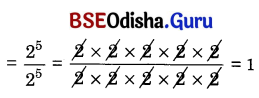
Therefore, 20 = 1
Page : 29
Question 1.
Can we write 103 = \(\frac{1}{10^{-3}}\)?
We can write,
\(\frac{1}{10^{-3}}\) = \(\frac{1}{1 / 10^3}\) = 1 ÷ \(\frac{1}{10^{-3}}\) – 1 × 103 = 103.
Similarly, 72 \(\frac{1}{7^{-2}}
\) = and 4a = \(\).
In a generalised form,
n-a = \(\) and na = \(\), where n ≠ 0
Consider the following general forms we have identified.
| na × nb = na + b | (na)b = (nb)a = na × b | na ÷ nb = na – b |
Solution:
Yes, we can write 103 = \(\frac{1}{10^{-3}}\)
Note:
(i) na × nb = na + b
(ii) (na)b = (nb)a = na × b
(iii) na ÷ nb = na – b
Question 2.
We had required a and b to be counting numbers. Can a and b be any integers? Will the generalised forms still hold true?
Solution:
Yes. But for the case of division, it must be non-zero integer.
Question 3.
Write equivalent forms of the following.
(i) 2-4
(ii) 10-5
(iii) (-7)-2
(iv) (-5)-3
(v) 10-100
Solution:
(i) 2-4 = \(\frac{1}{2^4}\)
(ii) 10-5 = \(\frac{1}{10^5}\)
(iii) (-7)-2 = \(\frac{1}{(-7)^2}\)
(iv) (-5)-3 = \(\frac{1}{(-5)^3}\)
(v) 10-100 = \(\frac{1}{10^100}\)
Question 4.
Simplify and write the answers exponential form.
(i) 2-4 × 27
(ii) 32 × 3-5 × 36
(iii) p3 × p-10
(iv) 24 × (-4)-2
(v) 8p × 8q
Solution:
(i) 2-4 × 27 = 2– 4 + 7 = 23
(ii) 32 × 3-5 × 36 = 32 + (-5) + 6 = 33
(iii) p3 × p-10 = p3 – 10 = p-7
(iv) 24 × (-4)-2 = \(\frac{2^4}{(-4)^2}\) = \(\frac{2^4}{(-4) \times(-4)}\) = \(\frac{2^4}{16}\) = \(\frac{2^4}{2^4}\) = 1
(v) 8p × 8q = 8p + q
Page : 30
Question 1.
Can we say that 16384 (47) is 16 (42) times larger than 1,024 (45)?
Yes, since 47 ÷ 45 = 42.
Solution:
16384 = 47 = 42 × 45 = 16 × 1024
So, we can definitely say that 16384 is 16 times larger than 1024.
Question 2.
How many times larger than 4-2 is 42?
Solution:
42 = 4– 2 + 4 = 4-2 × 44
∴ 42 is 44 times larger than 4-2.
Question 3.
Use the power line for 7 to answer the following questions.
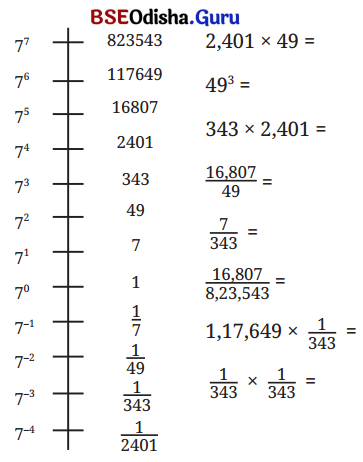
Solution:
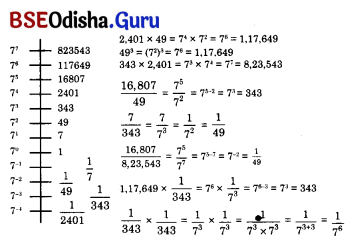
Question 4.
Write these numbers in the same way:
(i) 172,
(ii) 5642,
(iii) 6374.
Solution:
(i) 172 = 1 × 10² + 7 × 101 + 2 × 100
(ii) 5642 = 5 × 10³ + 6 × 10² + 4 × 101 + 2 × 100
(iii) 6374 = 6 × 10³ + 3 × 10² + 7 × 101 + 4 × 100.
Question 5.
How can we write 561.903?
561.903 = (5 × 100) + (6 × 10) + 1 + (9 × \(\frac{1}{10}\)) + (0 × \(\frac{1}{100}\)) + (3 × \(\frac{1}{1000}\)).
Writing it using powers of 10, we have
561.903 = (5 × 10²) + (6 × 101) + (1 × 100) + (9 × 10⁻¹) + (0 × 10-2) + (3 × 10⁻³).
Solution:
561.903 = 5 × 10² + 6 × 101 + 1 × 100 + 9 × 10⁻¹ + 0 × 10-2 + 3 × 10⁻³
Page : 31
Question 1.
Write the large-number facts we read just before in this form.
Solution:
In scientific notation or scientific form (also called standard form), we write numbers as x × 10y where x ≥ 1 and x < 10 is the coefficient and ‘y’, the exponent, is any integer.
For example :
(i) The sun is located
30,00,00,00,00,00,00,00,00,000 m from the centre of our Milky Way galaxy, i.e., 3.0 × 10²⁰ m.
(ii) The number of stars in our galaxy is 1,00,00,00,00,000, i.e., 1.0 × 10¹¹.
(iii) The mass of the Earth is 59,76,00,00,00,00,00,00,00,00,00,000 kg,
i.e., 5.976 × 1024 kg.
Page : 32
Question 1.
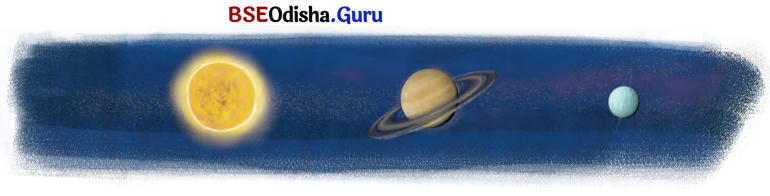
Can you say which of the three distances is the smallest?
Solution:
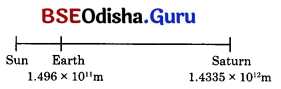
The distance between the Sun and Saturn is 14,33,50,00,00,000 m = 1.4335 × 10¹² m.
The distance between Saturn and Uranus is
14,39,00,00,00,000 m = 1.439 × 10¹² m.
The distance between the Sun and Earth is
1,49,60,00,00,000 m = 1.496 × 10¹¹ m.
Amongst the given distances, the distance between the Sun and the Earth is the smallest.
Question 2.
The number line below shows the distance between the Sun and Saturn (1.4335 × 10¹² m). On the number line below, mark the relative position of the Earth. The distance between the Sun and the Earth is 1.496 × 10¹¹ m.

Solution:
Question 3.
Express the following numbers in standard form.
(i) 59,853
(ii) 65,950
(iii) 34,30,000
(iv) 70,04,00,00,000
Solution:
(i) 59,853 = 5.9853 × 10⁴
(ii) 65,950 = 6.595 × 10⁴
(iii) 34,30,000 = 3.43 × 10⁶
(iv) 70,04,00,00,000 = 7.004 × 10¹⁰
Page : 33
Question 1.
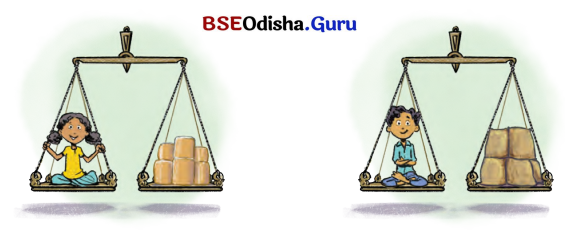
What would be the worth (in rupees) of the donated jaggery? What would be the worth (in rupees) of the donated wheat?
Solution:
Worth of jaggery (₹) = Roxie’s weight in kg × cost of 1 kg jaggery.
Worth of wheat (₹) = Estu’s weight in kg × cost of 1 kg wheat.
Question 2.
Make necessary and reasonable assumptions for the unknowns and find the answers. Remember, Roxie is 13 years old and Estu is 11 years old.
Solution:
Assuming Roxie’s weight to be 45 kg and the cost of 1 kg of jaggery to be ₹70, the worth of the donated jaggery is 45 × 70 = ₹3,150.
Assuming Estu’s weight to be 50 kg and the cost of 1 kg of wheat to be ₹50, the worth of donated wheat is 50 × 50 = ₹2,500.
Question 3.
Roxie wonders, “Instead of jaggery if we use 1-rupee coins, how many coins are needed to equal my weight?”. How can we find out?
Solution:
Weight of a 1-rupee coin = 3.76 grams (approx.)
Let us assume Roxie’s weight be 45 kg.
So, the number of 1-rupee coins = \(\frac{45 \mathrm{~kg}}{3.76 \mathrm{gram}}\) = \(\frac{45000 \text { gram }}{3.76 \text { gram }}\) = 11,968.08511 ≈ 11,968, ₹1 coins
Page : 34
Question 1.
Would the number of coins be in hundreds, thousands, lakhs, crores, or even more? Make an instinctive guess.
Solution:
The number of coins will be in thousands.
Question 2.
Find the answer by making necessary and reasonable assumptions and approximations for the unknowns. Remember, we are not looking for an exact answer but a reasonably close estimate.
Estu asks, “What if we use 5-rupee coins or 10-rupee notes instead?
How much money could it be?”
Solution:
The number of coins = 11,968 (approx.)
Estu says, “When I become an adult, I would like to donate notebooks worth my weight every year”. Roxie says, “When I grow up, I would like to do annadana (offering grains or meals) worth my weight every year”.
Question 3.
How many people might benefit from each of these offerings in a year? Again, guess first before finding out.
Roxie and Estu overheard someone saying- “We did pādayātra for about 400 km to reach this place! We arrived early this morning.”
Solution:
Assuming Roxie’s weight to be 45 kg, she will donate 45 kg of grains. Further assuming that one person requires 15 kg of grains for a month, it will help 1 person for 3 months.
Assuming Estu’s weight to be 50 kg, he will donate 50 notebooks. Further assuming that one person requires 10 notebooks in a year for academic works, it will help 5 children.
Roxie and Estu overheard someone saying – “We did padayatra for about 400 km to reach this place! We arrived early this morning.”
Question 4.
How long ago would they have started their journey?
Solution:
Assuming that a person can walk at the speed of about 4 km/hour, we can find that they have walked for 100 hours to cover 400 km distance:
Assuming that they must have rested during their journey (Padayatra) for about 8 hours each day. So, they have travelled: (24 – 8) = 16 hours each day.
So, number of days they have travelled
= \(\frac{100}{16}\) = 6.25 days
Thus, we can conclude that they would have started their journey 6 days ago.
Page : 35
Question 1.
How many times can a person circumnavigate (go around the world) the Earth in their lifetime if they walk nonstop? Consider the distance around the Earth as 40,000 km.
Solution:
Assuming that a person can walk at the speed of 4 km/h.
If the person walks non-stop, then the person requires:
\(\frac{40,000}{4}\) hours = 10,000 hours to circumnavi-gate the Earth.
Again, let us assume that a person lives for 100 years. Then, in his lifetime he has 100 × 365 × 24 hours.
So, hypothetically the person will circumnavigate for:
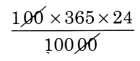 = \(\frac{8760}{100}\) = 87.6 times.
Hence, the person will circumnavigate the Earth for 87 times approximately (hypothetically).
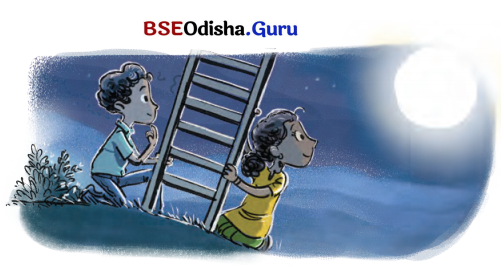
Roxie tells Estu about a science- fiction novel she is reading where they build a ladder to reach the moon,
“… I wonder if we actually had a ladder like that, how many steps would it have?”.
Question 2.
What do you think? Make an instinctive guess first.
Solution:
The average distance between the Earth and the Moon is approximately 384,400 km. If
we place steps at \(\frac{1}{2}\) m each, then there will be:
384,400 × 1000 × 2 steps
= 768,800,000 steps = 7.688 × 10⁸ steps.
Page : 36
Question 1.
We have to find out how many 20 cm make 3,84,400 km.
If we calculate the value, we get the result as 1,92,20,00,000 steps, which is 192 crore and 20 lakh steps or 1 billion 922 million steps. The fixed increase in the distance from the earth with each step (a 20 cm gain after each step) is called linear growth.
To cover the distance between the Earth and the Moon, it takes
1,92,20,00,000 steps with linear growth whereas it takes just 46 folds of
a piece of paper with exponential growth! Linear growth is additive,
whereas exponential growth is multiplicative.

Some examples of exponential growth we have seen earlier in this chapter are ‘The Stones that Shine’, ‘Magical Pond’, ‘How Many Combinations’. We shall explore more such interesting examples in a later chapter and also in the next grade.
Solution:
To find out how many 20 cm make 3,84,400 km
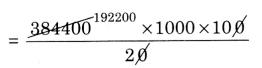
= 1.922 × 10⁹
So, 1.922 × 10⁹, 20 cm make 3,84,400 km.
Question 2.
Can you come up with some examples of linear growth and of exponential growth?
Solution:
Some examples of Linear Growth :
(i) Aarya deposits ₹10 everyday in a piggy bank. The money accumulated will be a linear growth as money in the piggy bank will have a sequence as ₹10, ₹20, ₹30, ₹40, ₹50, ₹60, ₹70, ….
(ii) Distance covered by a car which gives a mileage of 12 km by using every litre of fuel. The sequence will be 12 km, 24 km, 36 km, 48 km, 60 km, 72 km, etc.
Some examples of Exponential Growth:
(i) The spread of a virus generally follows exponential growth.
(ii) Savings with a bank increases exponentially when the interest is compounded using compound interest.
Page : 38 – 39
Question 1.
With a global human population of about 8 × 10⁹ and about 4 × 10⁵ African elephants, can we say that there are nearly 20,000 people for every African elephant?
Solution:
To get the number of people for each of the African elephant we divide global human population by the population of African elephants.
So, we obtain \(\frac{8 \times 10^9}{4 \times 10^5}\) = 2 × 104 = 20,000
So, there are nearly 20,000 people for every African elephant.
Question 2.
Calculate and write the answer using scientific notation:
(i) How many ants are there for every human in the world?
(ii) If a flock of starlings contains 10,000 birds, how many flocks could there be in the world?
(iii) If each tree had about 104 leaves, find the total number of leaves on all the trees in the world.
(iv) If you stacked sheets of paper on top of each other, how many would you need to reach the Moon?
Solution:
(i) Population of ants globally = 20 padma
= 20 quadrillion = 2 × 10¹⁶
Global population of humans = 8 × 10⁹
∴, Number of ants for each human being:
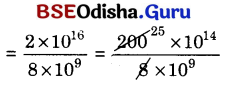
= 25 × 1014 – 9 = 25 × 105 = 25,00,000
Therefore, there are 25 lakh ants for each human being.
(ii) The estimated global population of starlings is around 1.3 arab = 1.3 billion
= 1,300,000,000 = 1.3 × 10⁹
A flock of starlings contains 10,000 birds.
∴, Number of flocks globally = \(\frac{1.3 \times 10^9}{10^4}\) = 1.3 × 10⁵
(iii) Total estimated number of trees in the world = 3 × 10¹²
Number of leaves on each tree = 104
So, the total number of leaves on all the trees in the world = 3 × 1012 × 104 = 3 × 10¹⁶
(iv) The distance between the Earth and the Moon = 3,84,400 km.
Assume that the thickness of the sheet of paper = 0.001 cm
So, number of sheets needed to be stacked to reach the moon: = \(\frac{384400 \times 1000 \times 100}{0.001}\)
= 38,440,000,000 × 1000 (∴, \(\frac{1}{0.001}\) = 1000)
= 3.844 × 10¹³
Question 3.
If you have lived for a million seconds, how old would you be?
Solution:
1 million seconds = 1,000,000 seconds
= \(\frac{1000000}{60}\) minutes = 16,666.67 minutes
= 277.78 hours = 11.574 days
Page : 40
Question 1.
105 seconds ≈ 1.16 days and 106 seconds ≈ 11.57 days. Think of some events or phenomena whose time is of the order of
(i) 105 seconds and
(ii) 106 seconds. Write them in scientific notation.
Solution:
(i) Lifespan of an adult mayfly is of the order of 105 seconds.
(ii) The Commonwealth Games typically span 106 seconds.
Page : 42
Question 1.
Calculate and write the answer using scientific notation:
(i) If one star is counted every second, how long would it take to count all the stars in the Universe? Answer in terms of the number of seconds using scientific notation.
(ii) If one could drink a glass of water (200 ml) every 10 seconds, how long would it take to finish the entire volume of water on Earth?
Solution:
(i) Number of stars in the Universe = 2 × 10²³
If one star is counted every second, then to count these stars:
= 2 × 10²³ seconds = 2.0 × 10²³ seconds
Note: for days = \(\frac{2 \times 10^{23}}{60 \times 60 \times 24}\) days = 2.3 × 10¹⁸ days
(ii) Volume of water a person can drink in 10 sec = 200 ml.
So, the volume of water a person can drink in 1 second = 20 ml
The entire volume of water on the Earth = 1.25 × 1024 ml
∴, Time needed to finish the entire volume of
water on Earth = \(\frac{1.25 \times 10^{24}}{20}\) seconds
= 6.25 × 10²² seconds
Page : 43
Question 1.
What does the first part of each name denote?
Continuing this, a thousand trillion is a quadrillion (1015).
This pattern continues. Observe the names million (106), billion (109), trillion (1012), quadrillion (1015), quintillion (1018), sextillion (1021), septillion (1024), octillion (1027), nonillion (1030), decillion (1033).
Solution:
The first part of each name denotes: mi → one, bi → two, tri → three, quad —» four, quint → five, sext → six, sept → seven, oct → eight, noni → nine, deci → ten.
Figure it Out: Page : 44 – 45
Question 1.
Find out the units digit in the value of 2224 ÷ 432? [Hint: 4 = 22]
Solution:
Here, given expression = 2224 ÷ 432
= 2224 ÷ (22)32 = 2224 ÷ 264
= 2224 – 64 = 2160
To find out the unit’s digit, we consider the following:
(21 = 2, 22 = 4, 23 = 8, 24 = 16, 25 = 32, 26 = 64, 27 = 128, 28 = 256, 29 = 512, …
∴, We get 2 if the power is of the form ‘4n + 1’
We get 4 if the power is of the form ‘4n + 2’
We get 8 if the power is of the form ‘4n + 3’
We get 6 if the power is of the form ‘4n’, as its unit place digit.
Now, 160 = 4n for n = 40
So, the unit place digit of 2224 ÷ 432 is 6.
Question 2.
There are 5 bottles in a container. Every day, a new container is brought in. How many bottles would be there after 40 days?
Solution:
Number of bottles in a container = 5
Number of bottles brought in each day = 1
In 40 days there will be 40 containers inside.
So, after 40 days there will be 40 × 5 bottles = 200 bottles.
Question 3.
Write the given number as the product of two or more powers in three different ways. The powers can be any integers.
(i) 643
(ii) 1928
(iii) 32-5
Solution:
(i) 643 = (26)3 = 218
Now, 218 can be written as 24 + 14, 26 + 12, 210 + 8 etc.
So, 24 × 214, 26 × 212, 210 × 28, etc.
(ii) 1928 = 1921 + 7 = 1921 × 1927
1928 = 1924 + 4 = 1924 × 1924
1928 = 1926 + 2 = 1926 × 1922
(iii) 32-5 = 32– 1 – 4 = 32-1 × 32-4
= 32-5 = 32– 2 – 3 = 32-2 × 32-3
= 32-5 = 32– 6 + 1 = 32-6 × 321
Question 4.
Examine each statement below and find out if it is ‘Always True’, ‘Only Sometimes True’, or ‘Never True’. Explain your reasoning.
(i) Cube numbers are also square numbers.
(ii) Fourth powers are also square numbers.
(iii) The fifth power of a number is divisible by the cube of that number.
(iv) The product of two cube numbers is a cube number.
(v) q46 is both a 4th power and a 6th power (q is a prime number).
Solution:
(i) Sometimes True : Cube numbers like 64, 512, 729, etc., are also square numbers, while numbers like 8, 27, 125, etc., are cube numbers but they are not squares.
(ii) Always True: Any fourth power is also a square number.
It happens because if we consider a4 which is the fourth power of a, then a4 = a × a × a × a
= (a × a) × (a × a) = (a2 × a2 = (a2)2
For example: Consider 54 = 5 × 5 × 5 × 5
= (5 × 5) × (5 × 5) = (25) × (25) = (25)2
So, 54 = (25)2
(iii) Always True:
Consider b5 ÷ b3 = 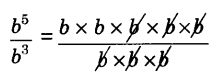 = b × b
So, the fifth power of a number is divisible by the cube of that number.
(iv) Always True: Consider a3 and b3
∴, product of a3 × b3 = (a × b)3
So, the product of two cube numbers is a cube number.
(v) Never True: q46 is neither a 4th power nor a 6th power, where q is a prime number, as 46 is neither divisible by 4 nor divisible by 6.
Question 5.
Simplify and write these in the exponential form.
(i) 10-2 × 10⁻⁵
(ii) 57 ÷ 54
(iii) 9-7 ÷ 94
(iv) (13-2)-3
(v) m5n12(mn)9
Solution:
(i) 10-2 × 10-5 =
10(-2) + (-5) = 10-7
(ii) 5-7 ÷ 54 = 57 – 4 = 53
(iii) 9-7 ÷ 94 = 9-7-4 = 9-11
(iv) (13-2)-3 ÷ 13(-2) × (-3) = 13[(-2) × (-3)] = 136
(v) m5n12(mn)9 = m5n12m9n9 = m5 + 9 + n12 + 9 + 9 = m14n21
Question 6.
If 122 = 144 what is
(i) (1.2)2
(ii) (0.12)2
(iii) (0.012)2
(iv) 1202
Solution:
(i) (1.2)2 = 1.44
(ii) (0.12)2 = 0.0144
(iii) (0.012)2 = 0.000144
(iv) (120)2 = 14400
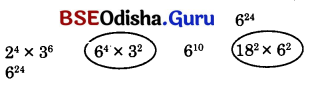
Question 7.
Circle the numbers that are the same-
24 × 36 64 × 32 610 182 × 62 624
Solution:
Question 8.
Identify the greater number in each of the following –
(i) 43 or 34
(ii) 28 or 82
(iii) 1002 or 2100
Solution:
(i) 43 > 34
(ii) 28 > 82
(iii) 2100 > 1002
Question 9.
A dairy plans to produce 8.5 billion packets of milk in a year. They want a unique ID (identifier) code for each packet. If they choose to use the digits 0 – 9, how many digits should the code consist of?
Solution:
8.5 billion = 8.5 × 10⁹
So, the code should consist of 10 digits.
Question 10.
64 is a square number (82) and a cube number (43). Are there other numbers that are both squares and cubes? Is there a way to describe such numbers in general?
Solution:
There are many other numbers which are both squares and cubes, for example- a3 = 729 and 272 = 729, so 729 is both square and cube. 163 = 4096 and 642 = 4096, so 4096 is both square and cube. We can describe such numbers as (a2)3 and (a3)2
Question 11.
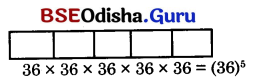
A digital locker has an alphanumeric (it can have both digits and letters) passcode of length 5. Some example codes are G89P0, 38098, BRJKW, and 003AZ. How many such codes are possible?
Solution:
Length of passcode = 5
Since it can have both digits and letter so, there can be (36)5 as it will be equal to the ways we can fill 5 boxes by 26 alphabets and 10 digits (0 – 9).
Question 12.
The worldwide population of sheep in 2024 is about 109, and that of goats is also about the same. What is the total population of sheep and goats?
(i) 209
(ii) 1011
(iii) 1010
(iv) 1018
(v) 2 × 10¹¹
(vi) 109 ÷ 109.
Solution:
Worldwide population of sheep (2024) = 109
Worldwide population of goats (2024) = 109
The total population of sheep and goats = 109 + 109 = 2 × 10⁹
So, (v) 2 × (10)9 and (vi) 109 + 109 are true.
Question 13.
Calculate and write the answer in scientific notation:
(i) If each person in the world had 30 pieces of clothing, find the total number of pieces of clothing.
(ii) There are about 100 million bee colonies in the world. Find the number of honeybees if each colony has about 50,000 bees.
(iii) The human body has about 38 trillion bacterial cells. Find the bacterial population residing in all humans in the world.
(iv) Total time spent eating in a lifetime in seconds.
Solution:
(i) Each person in the world had 30 pieces of clothing.
Number of persons in the world = 8 × 10⁹
The total number of pieces of clothing
= 8 × 109 × 30 = 24 × 1010 = 2.4 × 10¹¹
(ii) Number of bee colonies in the world
= 100 million = 100 × 106
= Number of honeybees in each colony
= 50000
So, total number of honeybees
= 100 × 106 × 50000 = 5 × 10¹²
(iii) Number of bacterial cells in the human body
= 38 trillion = 38 × 1012 = 3.8 × 10¹³
Number of the humans in the world = 8 × 10⁹
The total bacterial population residing in all humans in the world = 3.8 × 1013 × 8 × 109
= 30.4 × 1022 = 3.04 × 10²³
(iv) Assuming time spent eating in a day = 40 min = 40 × 60 seconds = 2400 seconds Appoximate number of days in human’s life of 100 years = 100 × 365
so, number a person spent eating in a lifetime:
= 100 × 365 × 2400 seconds
= 36.5 × 10,000 × 24
= 876,000,000 = 8.76 × 10⁷ seconds
Question 14.
What was the date 1 arab/1 billion seconds ago?
Solution:
1 arab second = 1,000,000,000 seconds
= 16,666,666.67 minutes
= 277,777.7778 hours
= 11,574.07407 days = 31.710 years
Assuming today’s date as 12 August 2024, then 1 arab seconds ago it was 12 August 1993.
Power Play Class 8 Extra Questions
Multiple Choice Questions
Question 1.
Which of the following is same as 24 × 36?
(a) 64
(b) 66
(c) 64 × 32
(d) 62 × 34
Solution:
Here, 24 × 36 = 24 × 34 × 32
= (2 × 3)4 × 32 = 64 × 32
(c) 64 × 32
Question 2.
If thickness of a paper is 0.001 cm, then its thickness after 8th fold is:
(a) 0.128 cm
(b) 0.256 cm
(c) 0.064 cm
(d) 0.032 cm
Solution:
After 1st fold, the thickness = 0.002 cm,
After 2nd fold, the thickness = 0.004 cm,
After 3rd fold, the thickness = 0.008 cm,
After 4th fold, the thickness = 0.016 cm,
After 5th fold, the thickness = 0.032 cm,
After 6th fold, the thickness = 0.064 cm,
After 7th fold, the thickness = 0.128 cm,
After 8th fold, the thickness = 0.256 cm.
(b) 0.256 cm
Question 3.
Which expression describes the thickness of a sheet of paper after it is folded 4 times? The initial thickness is represented by the letter ‘t’
(a) 4t
(b) t4
(c) t + 4
(d) 24 t
Solution:
Initial thickness = t
After 1st fold, thickness = 2t
After 2nd fold, thickness = 22t
After 3rd fold, thickness = 23t
After 4th fold, thickness = 24t
(d) 24t
Question 4.
The sum of exponents of the prime factors of 32400 is:
(a) 10
(b) 9
(c) 8
(d) 11
Solution:
As 32400 = 24 × 52 × 34
Here, sum of exponents = 4 + 2 + 4 = 10.
(a) 10
Question 5.
2-4 × 210 =
(a) 210
(b) 2-4
(c) 26
(d) 2-6
Solution:
2-4 × 210 = 2– 4 + 10 = 26 (∵, xa × xb = xa + b)
(c) 26
Assertion and Reasoning
(a) Assertion (A) and Reason (R) both are true and Reason (R) is the correct explanation for the Assertion (A).
(b) Assertion (A) and Reason (R) both are true but Reason (R) is not the correct explanation for the Assertion (A).
(c) Assertion (A) is true but Reason (R) is false.
(d) Assertion (A) is false but Reason (R) is true.
Question 1.
Assertion (A) : 23 × 22 = 25
Reason (R) : am × an = am + n
Answer:
(a) Assertion (A) and Reason (R) both are true and Reason (R) is the correct explanation for the Assertion (A).
Question 2.
Assertion (A) : am × bm = (ab)m
Reason (R) : am ÷ an = am – n
Answer:
(b) Assertion (A) and Reason (R) both are true but Reason (R) is not the correct explanation for the Assertion (A).
Case Based Questions.
Question 1.
Aarya has some dresses, some caps and some pairs of shoes.
Based on the above, answer the following:

(i) If there are 6 dresses, 4 caps and 4 pairs of shoes, then how many combinations of wearing these items are there?
(ii) If there are in total 48 combinations and there are 6 dresses and 4 caps, then how many pairs of shoes are there?
(iii) If there are 10 dresses, 5 caps and some number of pairs of shoes and total number of combinations of dresses and others is 200, then how many pairs of shoes are there?
(iv) If there are 20 dresses, 10 caps and 15 pairs of shoes, then the number of combinations of these items in scientific notation?
Answer:
(i) Number of dresses = 6
Number of caps = 4
Number of shoes = 4
∴, possible combination = 6 × 4 × 4 = 96
(ii) Number of dresses = 6
Number of caps = 4
Total number of possible combination = 48
∴, the number of pairs of shoes = \(\frac{48}{6 \times 4}\) = \(\frac{48}{24}\) = 2
(iii) Number of dresses = 10
Number of caps = 5
Number of possible combinations = 200
∴, pairs of shoes = \(\frac{200}{10 \times 5}\) = \(\frac{200}{50}\) = 4
(iv) Number of dresses = 20
Number of caps = 10
Number of shoes = 15 pairs
∴, Total number of possible combinations
= 20 × 10 × 15 = 3000 = 3.0 × 10³