Combining textbook study with BSE Odisha Class 6 Science Notes and Class 6 Science Curiosity Chapter 10 Living Creatures: Exploring their Characteristics Notes can make exam preparation more effective.
Living Creatures: Exploring their Characteristics Notes Class 6
Class 6 Science Curiosity Chapter 10 Notes
Features of Living Beings
An organism that can grow, move, require food, respond to stimuli, respire (breath), reproduce, and remove waste from its body is considered living.
Growth
- Growth is characterised by an increase in size, which is measurable and observable in terms of weight and height, e.g., the growth of a baby into an adult, a kitten into a fully grown cat, a seedling into a tree, etc.
- Living beings require food (nutrition) for their growth and development.

Nutrition
- Nutrition is the process by which a living organism prepares (like plants) or consumes (like animals) food to keep itself alive.
Movement
- Movement is an act of moving, i.e., changing position or place by a living thing as a whole or by certain parts of it.
- Animals can move from one place to another based on their needs; however, plants also show some movements:
- Opening of flowers
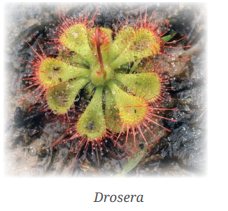
- Drosera, an insectivorous plant, is another example, identified by the presence of saucer-shaped leaves with sticky hair-like projections of unequal length. Whenever an insect comes and sits on the leaves, hairs move inward and trap the insect with their sticky ends.
Respiration
- Respiration is the process of breaking down food to release energy, which is used to carry out various processes of the body. It includes breathing, which is a process of inhaling and exhaling air.
- Exchange of gases in plants takes place by means of tiny pores called stomata, which are primarily present on the surface of leaves.
Excretion
- Excretion is the process by which waste materials are removed from the body.
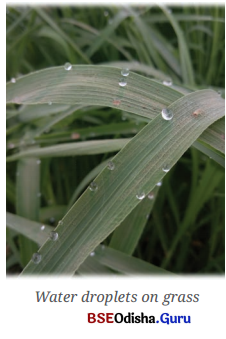
- In case of animals, excess water and salts are removed from the body in the form of sweat and urine. Whereas, in case of plants like grasses and roses, the excess water and minerals are removed in the form of small droplets on their leaves.
Response to Stimulus
Stimulus (plural – stimuli) is any change in the external or internal environment that brings about any response in an organism. Some common examples include:
- Withdrawal of the foot when we step on a sharp object, such as a thorn.
- Withdrawal of hands upon touching a hot object.
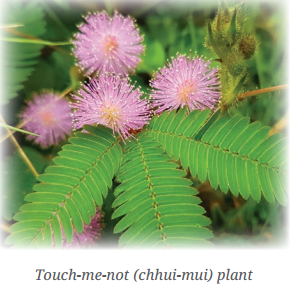
- Folding or closing of leaves in a Mimosa plant (also called touch-me-not, chhui-mui, or lajjalu) when someone touches them.
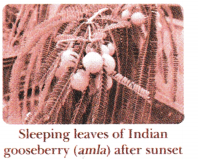
- The leaves of Indian gooseberry (amla) fold up and come together after sunset, thus earning the name sleeping leaves. Here, the absence of sunlight acts as a stimulus.
Reproduction
- Reproduction is the process by which organisms produce individuals of their own kind. It ensures the continuity of life on Earth.
- Animals and plants reproduce in different ways; some animals lay eggs (e.g., frog, fish), some give birth to young ones (e.g., cats, humans), and plants reproduce through seeds that germinate under favourable conditions.
Death
When a living being is not able to exhibit the above mentioned characteristics even after the availability of all the resources (like air, water, food, etc.), it is said to be dead. The absence of any of these features indicates that a particular thing is non-living. However, seeds are an exception, as they can grow into new plants under favourable conditions, through germination.
Germination
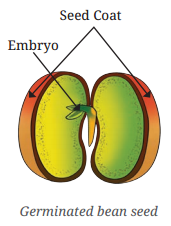
Germination is the process through which a new plant emerges from a seed.
Conditions Required for Seed Germination
- Water
- Enables a seed to carry out all the essential functions necessary for its growth and germination.
- It also softens the outer covering of the seed, called seed coat, and helps the embryo to develop into a plant.
- Air and Soil
- Seeds utilise the air present between the soil particles for respiration.
- Soil particles retain moisture, and the spaces between the soil particles allow roots to grow easily.
- Light and/or dark conditions
- Most of the seeds do not require sunlight for germination.
- However, there are some exceptions; Coleus and Petunia are seeds that require sunlight to germinate, and Calendula and Zinnia are seeds that require complete darkness to germinate.
Growth and Movement in Plants
- Once a seedling is formed, sunlight is very much essential for its growth and development. It is also essential for preparing food.
- Sunlight affects the direction of growth of shoots and roots:
- Shoots of a plant always grow towards the source of light.
- Roots always grow downwards into the soil away from the light source.
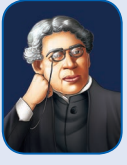
Jagadish Chandra Bose (1858-1937)
Indian scientist who invented the crescograph to study plant responses to stimuli like light, heat, electricity, and gravity, showing that plants can sense and respond to their environment.
Life Cycles of Organisms
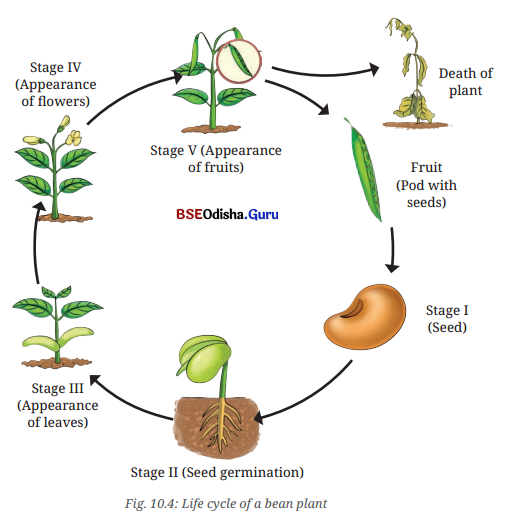
Life cycle refers to the different stages in the life of an organism.
Life Cycle of Plants
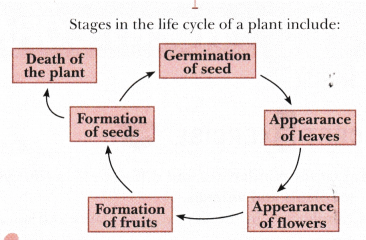
- Sowing of Seeds: Life begins when seeds are sown in the soil.
- Germination: Seeds sprout under suitable conditions, i.e., adequate water, air, and soil.
- Appearance of Leaves: Small leaves grow and prepare food.
- Appearance of Flowers: Buds form and develop into flowers, upon maturity.
- Appearance of Fruits: Flowers change into fruits.
- Seed Formation: Fruits contain seeds, which give rise to a new generation.
- Death: A plant stops growing in spite of the availability of conditions.
Life Cycle of Animals
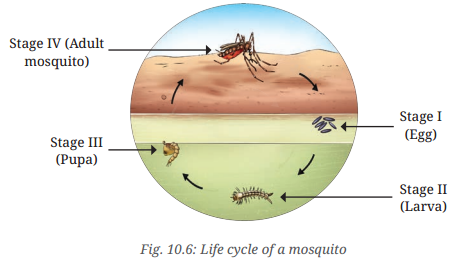
(i) Life Cycle of a Mosquito: Mosquitoes (usually female mosquitoes) are bloodsucking insects that transmit various diseases like malaria, dengue, and chikungunya.
- Stage I (Egg): The female mosquito lays eggs in stagnant water bodies.
- Stage II (Larva): Eggs hatch into worm-like larvae.
- Stage III (Pupa): Larvae grow into pupae. Life cycle of a mosquito
- Stage IV (Adult mosquito): Pupae tranform into adult mosquitoes; they emerge from water rest briefly on the water surface and then fly away. An adult mosquito may survive for about 10-15 days.
- A silk moth’s life cycle, like that of a mosquito, also has four stages: egg, larva, pupa, and adult. Eggs hatch and form larvae which produce thread-like material around it and wrap it around themselves to form a cocoon before becoming pupae. The fibres which they form are used to make silk fabric. In India, the Khadi and Village Industries Commission (KVIC) has established several centres all over the country for silk production.
(ii) Life Cycle of a Frog
Frogs are common amphibians usually found near water bodies.
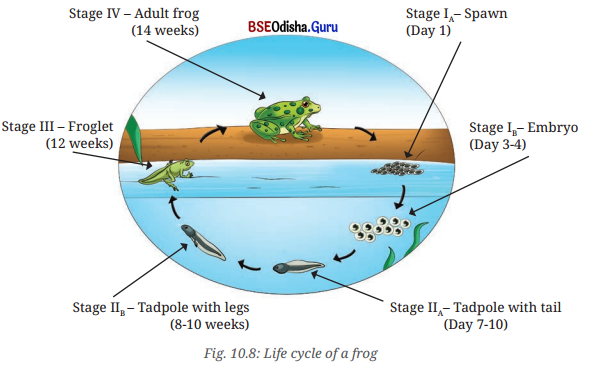
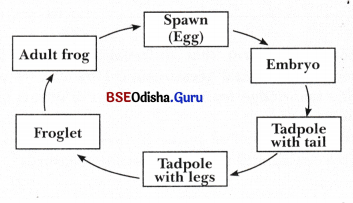
- Stage I (Spawn): Female frogs lay eggs in a cluster of jelly-like substance called spawn, usually found floating near the pond’s edge or attached to plants growing around. Eggs develop into embryos.
- Stage II (Tadpole): Embryos become tadpoles with tails for swimming. Later, they develop hind legs and start transforming into froglets.
- Stage III (Froglet): Eroglets have a tail and hind legs initially, then later lose the tail and develop forelegs, gradually resembling adult frogs. They still live in water but spend more time on land.
- Stage IV (Adult frog): Froglets mature into adult frogs with stronger legs, capable of living both on land and in water.
Characteristics of Living Beings
Growth: It is characterised by an increase in the size (can include weight and height) of the body of an organism.
Examples: Transformation of a baby into an adult, kitten into cat, etc.
Movement: It is an act of moving, i.e., changing position or place by a living thing as a whole or by certain parts of it.
Examples: Opening of flowers, flying of birds, etc.
Nutrition: The process by which an organism prepares or consumes food to keep itself alive.
Example: Plants prepare their own food, while animals depend on plants and other animals for their nutritional requirements.
Respiration: The process of breakdown of food to release energy which is used to perform different functions of the body. It also includes breathing (process of inhaling and exhaling air).
Example: Respiration in plants through stomata
Excretion: The process by which waste materials are removed from the body.
Examples: Water droplets in grass, urine and sweat in humans, etc.
Response to Stimuli All living organisms respond differently to the changes in their surrounding environment (stimuli).
Examples: Withdrawal of hands upon touching a hot object, drooping of leaves in Mimosa (Touch- me-not) when touched, etc.
Reproduction: The process of producing young ones of own kind to maintain the continuity of life.
Examples: Dogs give birth to puppies, germination of seeds to produce seedlings, etc.
Plants
Essential conditions for seed germination:
- Water
- Air
- Soil
Direction of growth and movement in plants:
- Roots grow downwards (away from the light source)
- Shoots grow upwards (towards the light source)
Life Cycles
Animals
Mosquito: Stages in the life cycle of a mosquito include:
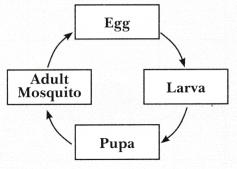
Female mosquitoes are bloodsucking insects and transimit diseases like malaria. dengue. and chikungunya.
Frog
Stages in the life cycle of a frog include: