
Combining textbook study with BSE Odisha Class 6 Science Notes and Class 6 Science Curiosity Chapter 7 Temperature and its Measurement Notes can make exam preparation more effective.
Temperature and its Measurement Notes Class 6
Class 6 Science Curiosity Chapter 7 Notes
The Sense of Temperature: Hot or cold
o Some bodies feel hotter or colder than others when touched, but touch gives only a rough idea.
o Our sense of touch is not always reliable because the same object can feel warm of cool depending on what the hand touched earlier. Therefore, fever or hotness cannot be judged correctly only by touching.
Temperature
Temperature of a body is a measure of its hotness or coldness. A hotter body has a higher temperature than a colder body, and the temperature difference tells how much hotter one body is compared to another.
An instrument used to measure temperature is called a thermometer.

Temperature Scales and Units
- There are three main temperature scales:
(a) Celsius Scale: Temperature is measured in degree Celsius (°C).
(b) Fahrenheit Scale: Temperature is measured in degree Fahrenheit (°F).
(c) Kelvin Scale: Temperature is measured in kelvin (K). The zero in this scale, i.e., 0 K is known as the absolute zero. It is the lowest possible temperature. - The SI unit of temperature is kelvin, it is mostly used in scientific studies.
| Conversion of Units | |
| From → To | Formula |
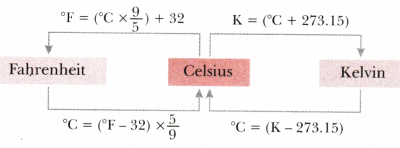
| Celsius → Fahrenheit | °F = (°C x 9/5) + 32 |
| Fahrenheit → Celsius | °C = (°F – 32) × 5/9 |
| Celsius → Kelvin | K = °C + 273.15 |
Rules for Writing Names and Symbols Correctly
- The names of the temperature scales (Celsius, Fahrenheit, Kelvin) start with capital letters.
- In the full unit names “degree Celsius” and “degree Fahrenheit”, the word “degree” begins with a small letter, while “Celsius” and “Fahrenheit” begin with capital letters; the unit name “kelvin” starts with a small letter.
- The symbols °C, °F and K are written as capital letters; the degree sign (°) is not written with K.
- A space is left between the number and the unit symbol (for example, 37.0 °C), and no full stop is written after the symbol unless it ends the sentence.
- While writing the full unit name, the plural “degrees” is used for temperatures more than one degree.
Types of Thermometers
Clinical Thermometer
It is used to measure human body temperature. It usually has a range of 35 °C to 42 °C. There are three main types of clinical thermometers:
(a) Digital clinical thermometer: It displays temperature on a digital display I – screen, and run on batteries. It uses electronic heat sensors to measure the temperature. It is a contact type thermometer, i.e., temperature is measured when the thermometer is placed in contact with a person’s body.
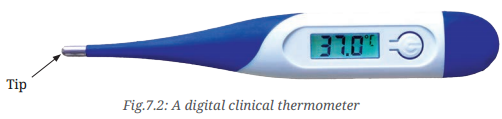
Precautions while using a digital clinical thermometer
- The tip of the thermometer should be washed with soap and water before and after use.
- Care should be taken to keep the digital display away from water while cleaning.
- The thermometer should not be held by its tip.
(b) Mercury thermometer: It consists of a narrow glass tube connected to a bulb filled with mercury. Mercury thermometers are not recommended because mercury is toxic and harmful if released, posing health and environmental risks, and digital thermometers are a safer alternative. It is a contact type thermometer.

(c) Infrared thermometer: It is a non-contact type thermometer. It can measure temperature without touching a person’s body and thus reduce the risk of spreading disease. Infrared thermometers were widely used during COVID-19 pandemic.
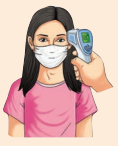
NOTE: Normal human body temperature is about 37.0 °C, but it may vary slightly among individuals as it is an average value. It is influenced by factors such as age, time of the day, and activity level. The temperature of human beings does not normally go below 35 °C or above 42 °C.
Laboratory Thermometer
- A laboratory thermometer is used to measure the temperature of substances other than the human body, such as water and other liquids.
- It consists of a sealed, narrow glass tube with a bulb containing a liquid, and a liquid column that rises or falls with temperature change.
- The liquid used in a laboratory thermometer is usually red coloured alcohol or mercury.
- A typical laboratory thermometer may have a range from -10 °C to 110 °C.
- To find the smallest value (least count) that a thermometer can measure, the temperature difference between two big marks on its scale is divided by the number of small divisions between them.

Precautions while using a Laboratory Thermometer
- It should be kept upright not tilted. Ensure the bulb is fully immersed and does not touch the container. Take the reading while bulb is still in touch with the substance.
- Read the thermometer by keeping your eye directly in line with the level of the liquid column.
NOTE: The temperature of melting ice is 0 °C, and the temperature of boiling water is 100 °C. Laboratory During melting and boiling, the temperature remains constant even if heating continues, thermometer.
Air Temperature
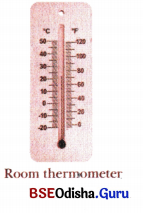
- Air temperature gives a measure of how hot or cold the air of an area is at a specific time. It is measured using a room thermometer.
- Air temperature varies from day to day as it is influenced by several factors.
- It is a crucial weather parameter that affects weather conditions, climate patterns and the environment. It is monitored at weather stations all over the world.
- The data collected by the weather stations plays a vital role in making weather forecasts (predictions) that prepare us for the changing weather conditions.
Temperature
- Temperature is a measure of hotness or coldness of a body.
- The SI unit of temperature is kelvin.
Scales of Temperature
Fahrenheit Scale
- Unit: degree Fahrenheit, denoted by °F.
- Freezing point of water: 32 °F
- Boiling point of water: 212 °F
Celsius Scale
- Unit: degree Celsius, denoted by °C.
- Freezing point of water: 0 °C
- Boiling point of water: 100 °C
Kelvin Scale
- Unit: kelvin, denoted by K.
- Freezing point of water: 273.15 K
- Boiling point of water: 373.15 K
Air Temperature
- It measures how hot or cold the surrounding air is.
- Weather reports show the day’s maximum and minimum air temperature.
- Room thermometers in schools, clinics, and hospitals give an approximate temperature of the surrounding air.
Thermometer
Thermometer is a device that measures temperature.
Clinical Thermometer
- It is used to measure body temperature.
- Range: 35 °C to 42 °C.
Mercury Thermometer
- It has a long, uniform glass tube (capillary) connected to a mercury-filled bulb.
- As mercury is toxic, digital thermometers are now safer alternatives.
Digital Thermometer
- It runs on batteries and uses electronic heat sensors to measure temperature.
- Displays temperature in °C or °F on a digital screen.
- It is easier to read than mercury thermometers.
Infrared Thermometer
- It measures body temperature without touching the skin.
- These are also called non-contact thermometers.
Laboratory Thermometer
- It is used in science labs and industries to measure temperatures other than our body temperature.
- Range:-10 °C to 110°C (Generally).
- The liquid used in the laboratory thermometer is generally alcohol (coloured red to make it easily seen) or mercury.
- The liquid column rises or falls with change in temperature.
- It does not keep the reading. The temperature drops as soon as you remove it from the liquid.