
Combining textbook study with BSE Odisha Class 6 Science Notes and Class 6 Science Curiosity Chapter 6 Materials Around Us Notes can make exam preparation more effective.
Materials Around Us Notes Class 6
Class 6 Science Curiosity Chapter 6 Notes
Understanding Objects and Materials Around Us
Objects: The things that we can see and/or touch.
- Different objects around us have varying shapes and sizes, and each object serves a different purpose.
- All the objects around us are made of different materials.
Materials: The substances or mixtures of substances that are used to make objects.
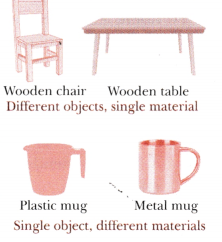
- A single material can be used to make different types of objects, and a single type of object can be made from different types of materials.
- Some objects are also made of multiple materials, e.g., a pen can have a plastic body and a metal nib.
a The choice of material depends upon the intended use of the object.

Classification of Materials Based on their Properties
Classification is defined as the process of arranging or organising materials into groups based on their common properties. It helps in easier identification, sorting, and locating of objects.
Materials can be classified based on the following properties:
Appearance
- Based on appearance, materials are classified as lustrous and non-lustrous.
- Lustrous: The materials that have a shiny surface (lustre), e.g., gold, aluminium, copper, etc.
- Non-lustrous: The materials that do not have a shiny surface and appear to be dull, e.g., rubber, jute, wood, etc.
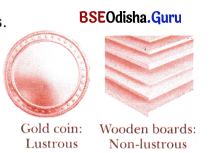
- Generally, metals such as gold, iron, etc., are lustrous, but it should be noted that not all materials that shine are metals. The surfaces of some materials are made shiny by polishing or coating them with thin layers of plastic, wax, or any other material, which makes them look shiny. Some metals may lose their lustre and start to look dull due to the effect of air and moisture.
Hardness and Softness
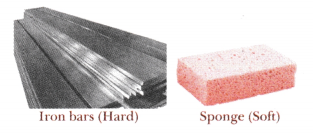
- Materials that cannot be compressed, scratched, bent, or broken easily are known as hard materials. For example, iron bar, diamond, copper sheet, etc.
- Materials that can be compressed, scratched, bent, or broken easily are known as soft materials. For example, rubber, chalk, sponge, cotton, etc.
- Hardness and softness are relative terms. For example, a rubber is harder than a sponge but softer than an iron bar.
Transparency
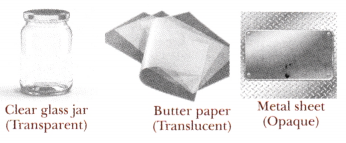
Based on transparency, materials are classified as transparent, translucent, and opaque.
- Materials through which objects can be seen clearly are said to be transparent. For example, clear glass, cellophane paper, etc.
- Materials through which objects can be seen, but not clearly, are said to be translucent. For example, butter paper, frosted glass, muslin cloth, etc.
- Materials through which objects cannot be seen at all are said to be opaque. For example, metal sheet, wooden board, brick, etc.
Solubility in Water
Solubility in water is defined as the property of a material to dissolve completely in water. Based on their solubility, materials are classified as soluble and insoluble, o The materials that completely disappear on mixing in water are said to be soluble. For example, salt, sugar, vinegar, etc.
The materials that do not disappear on mixing in water even when stirred for a long time, are said to be insoluble. For example, sawdust, chalk powder, sand, oil, etc.
(i) Solubility of Solids in Water
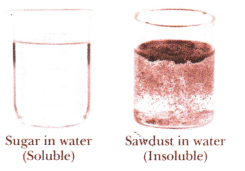
- Some solids, such as sugar, salt, etc, dissolve completely in water to form a mixture that has a uniform composition.
- Some solids, such as sand, sawdust, etc, do not dissolve or disappear in water and hence the resultant mixture has a non¬uniform composition.
(ii) Solubility of Liquids in Water
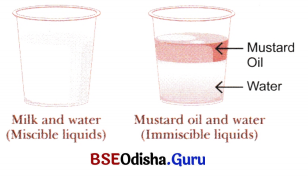
- Some liquids, such as milk, lemon juice, etc., mix completely with water and do not form a distinct layer. These are known as miscible liquids.
- Some liquids, such as petrol, mustard oil, coconut oil, kerosene, etc., form a distinct layer when mixed with water. Such liquids that do not disappear into one another are said to be immiscible liquids.
(iii) Solubility of Gases in Water
- Some gases, like carbon dioxide and oxygen, can dissolve in water. It is the oxygen dissolved in water that helps in the survival of aquatic plants and animals.
- Flowever, gases like nitrogen, do not dissolve in water.
Mass and Volume
- Mass is defined as the amount of matter present in a material.
- It is a measure of the heaviness or lightness of an object. It is usually measured in grams (g) and kilograms (kg).
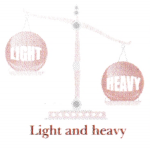
- An object with a higher mass is said to be heavy, and an object with a lower mass is said to be light.
- Heavy and light are relative terms. For example, a pencil is heavier than a feather, but is lighter than a book.
Volume is defined as the space occupied by a material.
- It is usually measured in millilitres (mL) and litres (L).
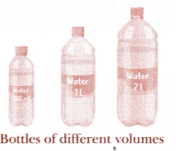
- Water bottles sold in the markets come in different sizes and quantities, with labels such as 500 mL, 1 L, 2 L, etc. These labels indicate the capacity of bottles and the level of water indicate the volume of water present in them.
Matter: Anything that occupies space and has mass is known as matter.
Materials Around Us: Material is definite kind and quality of matter intended for a specific purpose.
Based on Appearance
Lustrous : A material that has a shiny surface is said to be lustrous.
Examples: Gold, silver, etc.
Non-lustrous: A material that does not have a shiny surface and appears to be dull is said to be non- lustrous.
Examples: Wooden board, rubber sheet, etc.
Based on Mass
Heavy: A material that has a higher mass
Light: A material that has a lower mass
Heavy and light are relative terms, e.g., a pencil is heavier than a feather, but is lighter than a book. SI unit: Kilogram (kg)
Based on Volume (Space Occupied)
A material that occupies more space is said to have a larger volume as compared to a material that occupies less space.
SI unit: Cubic metre (m3)
Based on Transparency
Transparent: A material through which we can see things clearly.
Examples: Clear glass, cellophane sheet,
Translucent: A material through which we can see things, but not very clearly.
Examples: Frosted glass, butter paper, etc.
Opaque: A material through which we cannot see things at all.
Examples: Brick, aluminium foil, etc.
Based on Hardness
Hard: A material that is difficult to compress or scratch Examples: Metal block, wooden block, etc.
Soft: A material that is easy to compress or scratch Examples: Cotton ball, sponge, etc.
Based on Solubility in water
Soluble: A material that disappears or dissolves completely in water is said to be soluble in water.
Examples: Sugar, common salt, etc.
Solubility of Solids in Water
- Solids like sugar, common salt, etc., are soluble in water.
- Solids like sand, chalk powder, etc., are insoluble in water.
Solubility of Liquids in Water
- Liquids like milk, vinegar, honey, etc., are soluble in water.
- Liquids like mustard oil, petrol, etc., are insoluble in water.
Solubility of Gases in Water
- Some gases, like oxygen, are soluble in water. This dissolved oxygen allows the survival of aquatic life.
- Some gases, like nitrogen, are insoluble in water.
Insoluble: A material that does not disappear or dissolve completely in water is said to be insoluble in water.
Examples: Sand, chalk powder, etc.