
Combining textbook study with BSE Odisha Class 7 Science Notes and Class 7 Science Curiosity Chapter 8 Measurement of Time and Motion Notes can make exam preparation more effective.
Measurement of Time and Motion Notes Class 7
Class 7 Science Curiosity Chapter 8 Notes
Measurement of Time
People noticed many naturally repeating events such as sunrise and sunset, phases of the Moon and change of seasons, and used them for measuring time. A day is based on the cycle of sunrise and sunset, and longer time intervals are organised using calendars.
To measure smaller intervals of time within a day, people developed simple devices like sundials, water clocks, hourglasses and candle clocks.

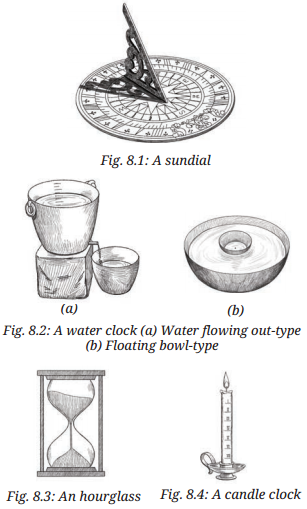
| Device | How it worked |
| Sundial | Measured time using the changing position of a shadow cast by the Sun during the day. |
| Water Clock | Used the flow of water into or out of a vessel.
(a) Water flowing out-type: Water flows out of a vessel that has time markings; the fall in the water level represents different intervals of time. (b) Floating bowl-type (Ghatika-yantra): A bowl with a small hole floats on water; it fills and sinks, showing that a fixed time interval has passed. |
| Hourglass | Measured time by the flow of sand from one glass bulb to another. |
| Candle Clock | Candles with markings that indicated time as the wax burned down. |
Early water clocks of water flowing out-type were inaccurate because the water flow slowed as the level dropped. To improve accuracy, the sinking bowl water clock (Ghatika-yantra) was developed, where a bowl sank in about 24 minutes, called one ghatika (ghati), and a 24-hour day was divided into 60 gliatis.
A Simple Pendulum
A simple pendulum consists of a small, heavy bob (usually a metal ball) suspended by a light, inextensible thread from a fixed support.
When the pendulum is at rest, the bob hangs vertically at its mean position. If the bob is pulled slightly to one side and then released, it moves to and fro about the mean position; this is an example of oscillatory and periodic motion.
One oscillation is completed when the bob goes from the mean position to one extreme, then to the other extreme and back to the mean position again.
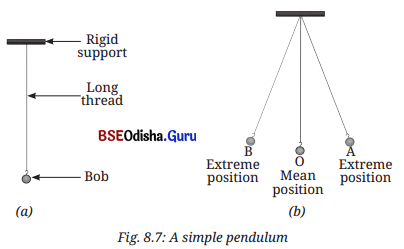
- The time taken for one complete oscillation is called the time period of the pendulum.
- The time period of a simple pendulum at a given place depends only on its length, not on the mass of the bob.
- For small oscillations, a pendulum of fixed length has nearly constant time period. It is used to measure time, such as in pendulum clocks.
Modern Clocks
- All clocks, whether old or modern, are based on some continuously repeating process that can be used to mark equal intervals of time.
- As each oscillation of the pendulum takes the same time, pendulum clocks count the oscillations to show hours, minutes, and seconds.
- Quartz clocks use a tiny quartz crystal that vibrates very rapidly when electricity passes through it, and these vibrations are counted electronically to measure very accurate time.
- Atomic clocks use vibrations of atoms such as caesium or rubidium, and because these vibrations are extremely regular, they are the most accurate clocks in the world.
- Early pendulum clocks could gain or lose several seconds in a day, whereas atomic clocks can be so accurate that they may gain or lose only about a second in millions of years.
SI Unit of Time
- The SI unit of time is the second, written with the symbol s.
- Larger commonly used units are the minute (min) and hour (h), where 60 s = 1 min and 60 min = 1 h.
- Names of time units (second, minute, hour) and their symbols (s, min, h) are written in lowercase, singular, and without a full stop.
- While writing time, leave a space between the number and unit (e.g., 10 s, 5 min, 2 h); short forms like sec or hrs are not correct scientific symbols.
Slow or Fast
- If two objects cover the same distance, the one that takes less time is said to be faster.
- In a race, the runner who is farther ahead after the same time has covered more distance and is therefore running faster.
Need for Precise Time
- In sports, modern timekeeping devices can record hundredths or thousandths of a second, helping to decide winners when differences are very small.
- Medical instruments like ECG machines record very small time differences between heartbeats to detect health problems.
- Digital systems, smartphones, computers and satellites work with signals that change in milliseconds or microseconds, so very precise clocks are needed in communication, navigation, space exploration and advanced science.
Speed
- The speed of an object is the distance covered per unit time.
- The SI unit of speed is metre per second (m/s).
- When we calculate speed using total distance and total time, we are usually finding the average speed, because the actual speed may change during the journey.
- Relationship between speed, distance, and time
Speed = \(\frac{\text { Distance }}{\text { Time }}\) - Distance = Speed × Time
Time = \(\frac{\text { Distance }}{\text { Speed }}\)
Uniform and Non-uniform Linear Motion
- Linear motion: When an object moves along a straight line, its motion is called linear motion.
- Uniform linear motion: An object moving along a straight line with a constant speed is said to be in uniform linear motion. In uniform linear motion, an object covers equal distances in equal intervals of time.
- Non-uniform linear motion: An object moving along a straight line with a speed that changes with time is said to be in non-uniform linear motion. In non-uniform linear motion, an object covers unequal distances in equal intervals of time.
- Uniform linear motion is an ideal case; in everyday life, vehicles and other objects rarely move with perfectly constant speed for long periods.
- Speedometer: It shows the instantaneous speed of the vehicle at any moment, usually in km/h.
- Odometer: It measures the total distance travelled by the vehicle, usually in kilometres.
Measurement of Time
- Time is one of the most important physical quantities that helps us measure, compare, and understand changes in the physical world.
- Since ancient times, people have observed natural events such as sunrise, sunset, and the phases of the Moon to measure time.
Time Measurement Devices
Early Devices
- Sundial: Uses changing position of an object’s shadow cast by the Sun during the day.
Water Clock:
- Flowing-out type: Time was measured by the flow of water out of a marked vessel.
- Floating bowl type: Time was measured by placing a bowl with a small hole at the base on water; the time it took to fill and sink showed the passage of time.
- Hourglass: Two bulbs with sand flowing from upper bulb to the lower one.
- Candle Clock: Markings on candles; time tracked as candle burnt.
Modern Devices
- Pendulum Clock: Measures time by the regular swing of a pendulum.
- Quartz Clock: Used vibration of quartz crystals for higher precision.
- Atomic Clock: Measure time using vibrations of caesium atoms; most accurate, lose only – 1 second in millions of years.
Units of Time
- SI unit: second (s)
- Conversions: 60 s = 1 min, 60 min = 1 h
- Rules of writing units:
- Always use lowercase for unit symbols.
- Do not add plural forms or dots.
Wrong: “sec”, “hrs” → Correct: “s”, “h”.
Simple Pendulum
- A heavy small bob tied to a string and suspended from a rigid support.
- A simple pendulum undergoes oscillatory motion.
- Oscillatory motion is periodic in nature.
One Oscillation: Motion from the mean position → extreme position A → opposite extreme position B → back to the mean position.
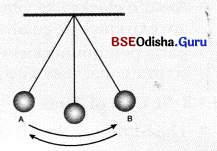
Time Period (T): Time taken for one oscillation.
Factors Affecting Time Period:
- Depends on length of string: longer length, greater time period.
- Independent of mass of the bob.
Speed
Distance travelled by an object per unit time.
Speed = \(\frac{\text { Total distance covered }}{\text { Total time taken }}\)
SI unit: m/s
Other common unit: km/h.
Total distance covered = Speed × Total time taken
Total time taken = \(\frac{\text { Total distance covered }}{\text { Speed }}\)
To convert km/h → m/s, multiply by \(\frac{5}{18}\)
To convert m/s → km/h, multiply by \(\frac{18}{5}\)
Linear Motion
Uniform Linear Motion
An object moving in a straight line covers equal distances in equal time intervals.
Example: Car moving on a straight road at a constant speed of 40 km/h.
Non-uniform Linear Motion
An object moving in a straight line covers unequal distances in equal time intervals.
Example: Car speeding up on a straight road.