
Combining textbook study with BSE Odisha Class 7 Science Notes and Class 7 Science Curiosity Chapter 11 Light: Shadows and Reflections Notes can make exam preparation more effective.
Light: Shadows and Reflections Notes Class 7
Class 7 Science Curiosity Chapter 11 Notes
Sources of Light
- The Sun emits its own light and is the main source of natural light on Earth; stars, lightning, natural fire and some animals such as fireflies, also emit their own light.
- Early humans used fire as the first artificial light source and later used fuels like animal fat, oil, wax and gas for lighting.
- With the invention of electricity and different electric light sources, most everyday lighting needs are now met by electric lamps and bulbs.
- Luminous objects: Objects that emit their own light are called luminous objects.
- Non-luminous objects: Objects that do not emit their own light are called non-luminous objects; they are seen because they reflect light from luminous objects.
- The Moon is a non-luminous object; it does not produce its own light but reflects sunlight falling on it.
LED lamps are modern light sources that use much less electrical power, give brighter light and last longer than traditional lamps. Using LED lamps helps reduce electricity bills and is better for the environment, so their use is being promoted nationwide.
Light from the Sun does not reach us instantly; it takes about 8 minutes 20 seconds to travel from the Sun to the Earth. If the Sun suddenly stopped emitting light, we would still see it shining for about 8 minutes 20 seconds because of this travel time.

Light Travels in a Straight Line
- Light travels in straight lines from a source to objects and then to our eyes. We can see a light source or an illuminated object only when there is a clear, straight path for light to reach our eyes.
- If a series of small openings are arranged in a straight line, light can pass through all of them to form a bright spot on a screen; if any opening is shifted out of line, the light is blocked and the spot disappears.
Light through Transparent, Translucent, and Opaque Materials
| Transparent materials | Translucent materials | Opaque materials |
| When a beam of light falls on a transparent material, it passes through almost unchanged. | When a beam of light falls on a translucent material, only part of the light passes through it, so the beam appears faint or diffused. | When a beam of light falls on an opaque material, light is blocked completely, and no light passes through. |
| Objects placed behind them can be seen clearly. | Objects placed behind them look blurred or unclear. | Objects placed behind them are not visible at all. |
Shadow Formation
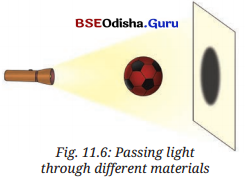
- A shadow is formed when an object blocks light from reaching a surface.
- Opaque objects form dark, well-defined shadows. Translucent objects form lighter, blurred shadows, while some transparent objects may form very faint sfu5£lows.
- We need a source of light, an opaque object, and a screen (such as a wall or ground) to observe a shadow.
- The size, shape and sharpness of a shadow depend on the position of the light source, the object and the screen.
- Moving the object closer to the light source can make the shadow larger and fainter, while moving it closer to the screen can make the shadow smaller and sharper.
- The colour of an object does not affect the colour of its shadow; shadows are always dark.
- Shadows may not accurately show the shape of an object. Shadows usually match an object’s outline, but may appear stretched or distorted if the orientation of the object changes w.r.t the light source.
Reflection of Light
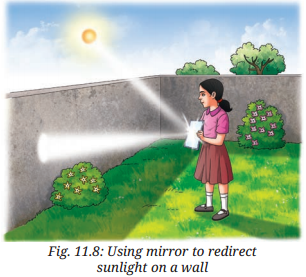
The bouncing back of light into the same medium when it strikes a surface is called reflection of light.
- Reflection is most clearly seen on smooth, polished surfaces such as mirrors, glass, or calm water. Such surfaces reflect incoming light in a regular manner, forming clear images.
- Rough surfaces scatter light in many directions and do not produce sharp images.
- We are able to see objects only because of the reflection of light.
- When light from a source, such as the Sun, a lamp, or a bulb, falls on an object. The object reflects the light in different directions. When the reflected light enters our eyes, we are able to see the object.
Images in a Plane Mirror
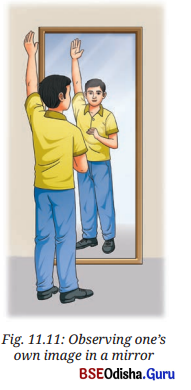
- When you look into a plane mirror, you see your own reflection; similarly, we see reflections of other objects placed in front of the mirror.
- The image formed by a plane mirror is erect (upright) and of the same size as the object.
- The image formed by a plane mirror is virtual i.e., cannot be obtained on a screen.
- The image formed by a plane mirror appears at the same distance behind the mirror as the object is in front of the mirror.
- In the image formed by a plane mirror, your left appears as right and your right appears as left; this left-right reversal is called lateral inversion.
- The word “AMBULANCE” is written as “ECNALUBMA” on the front of an ambulance so that it is read correctly in the rear view mirrors of the vehicles in front.
Pinhole Camera
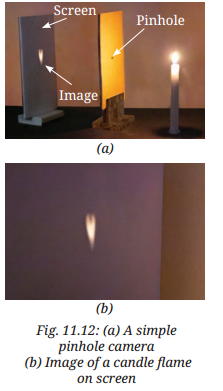
- A pinhole camera is a device in which light rays from an object pass through a tiny hole (pinhole) and form an image on a screen.
- The image formed by a pinhole camera is upside down, i.e., inverted. The image shows the colours of the objects, and its size depends on the distance between the object, pinhole, and screen.
- The image formed by a pinhole camera is also laterally inverted.
Some Optical Devices based on Reflection of Light
Periscope
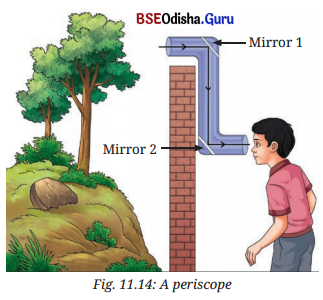
- A periscope is an optical instrument that uses mirrors to see objects over or around obstacles.
- A periscope can be made by placing two plane mirrors, placed parallel to each other at 45° angle, inside a Z-shaped box or tube.
- Reflection from the two mirrors enables us to see over or around obstacles, such as a wall or people standing in front.
- Periscopes are used in submarines, tanks and bunkers so that people inside can see outside.
Kaleidoscope
- A kaleidoscope is an optical instrument that produces beautiful and ever-changing patterns by the reflection of light.
- A kaleidoscope is made using three rectangular plane mirrors of equal size, arranged at 60° to each other to form a triangular prism shape, and placed inside a tube.
- One end of the tube is covered with a transparent sheet, and small pieces of coloured bangles or beads are placed inside near this end.
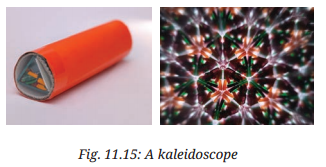
- When you look through the other end, you see beautiful, symmetrical patterns formed by multiple reflections of the coloured pieces in the mirrors. When the kaleidoscope is turned or shaken the pieces move and you see a new pattern each time.
- Multiple images formed due to reflections of reflections in three mirrors combine to form complex patterns.
- Designers and artists often use kaleidoscopes to get ideas for new decorative patterns and designs.
Luminous Objects: Objects that emit their own light.
Natural: Naturally occurring light sources.
For example, Sun, stars, lightning, fireflies etc.
Artificial: Man-made light sources.
For example, candles, oil lamps, tube light, LED etc.
Non-Luminous Objects
- Objects that do not produce their own light.
- These objects become visible when light from a luminous source falls on them and is reflected to our eyes.
- For example, the Moon, trees, books, chairs, buildings, etc.
Interaction of Light with Different Materials
Transparent
Materials that let most light pass through, allowing us to see clearly.
Examples: Clean glass, clear water, air.
Translucent
Materials that let some light pass through but scatter it, giving a blurred view.
Examples: Frosted glass, butter paper, thin fabric.
Opaque
Materials that do not allow light to pass through them.
Examples: Wood, stone, metals.
Formation of Shadow
- When light falling on a screen is blocked by an object, a dark patch called a shadow is formed on the screen.
- To observe a shadow, a source of light, an opaque object, and a screen are required.
- The shape, size, and sharpness of a shadow depends upon the position of the object, light source, and screen.
- Shadows may not always accurately reflect the shape of an object.
Reflection of Light
- Reflection is the bouncing back of light from a surface.
- Reflection of light allows us to see objects and mirror images.
- Regular reflection occurs on smooth surfaces and gives clear images.
- Diffused reflection occurs on rough surfaces and scatters light, producing no clear image.
Reflection of Light by a Plane Mirror
- A plane mirror is a flat, smooth surface that reflects light to form an image of an object.
- The images formed by plane mirrors are upright, virtual, laterally inverted, and of the same size its the object.
- The image appears at the same distance behind the mirror as the object is in front of it.
- Plane mirrors are commonly used in wall mirrors and dressing mirrors.
Optical Devices
Pinhole Camera
- A pinhole camera is a simple optical device that forms a laterally inverted, upside down image of an object on a screen using light passing through a tiny hole.
- It works on the principle that light travels in a straight line.
Periscope
- A periscope is an optical instrument that allows a person to see objects that are not in the direct line of sight, typically over obstacles or from a concealed position.
- It is based on the principle of reflection of light.
- It is commonly used in submarines and tanks.
Kaleidoscope
- A kaleidoscope is an optical instrument that produces beautiful, ever-changing patterns by the reflection of light off multiple mirrors positioned at specific angles.
- It works on the principle of reflections of reflections.
- It is frequently used by artists and designers to generate ideas for new patterns.