
Combining textbook study with BSE Odisha Class 7 Science Notes and Class 7 Science Curiosity Chapter 12 Earth, Moon, and the Sun Notes can make exam preparation more effective.
Earth, Moon, and the Sun Notes Class 7
Class 7 Science Curiosity Chapter 12 Notes
Rotation of the Earth
- Rotation is the motion in which all parts of an object move in circles around an imaginary line (axis) that passes through it.
- The Earth rotates (spins) on its own axis in space, which is an imaginary line passing through the geographic North Pole and the South Pole.
- When viewed from above the North Pole, the Earth rotates in the anticlockwise direction, that is, from west to east.
- The Earth completes one rotation in about 24 hours, file Sun appears to rise in the east and set in the west, and its position in the sky changes during the day.
- This apparent motion of the Sun is due to the rotation of the Earth, not because the Sun moves around the Earth.
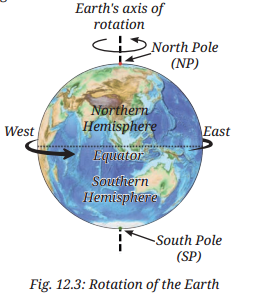
Ancient Indian astronomer, Aryabhata, explained that the apparent westward motion of stars is due to Earth’s rotation and calculated the time for one rotation of the Earth to be about 23 hours 56 minutes 4.1 seconds, which is very close to the presently accepted value.

Day-Night Cycle
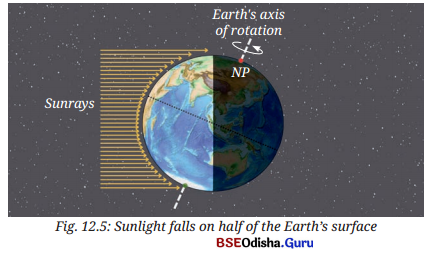
- At any instant, sunlight falls only on half of the Earth, while the other half remains dark. The half of the Earth that faces the Sun has day, and the half that faces away from the Sun has night.
- As the Earth rotates from west to east, any place on its surface moves into sunlight (sunrise), then to a position where the Sun is highest in the sky (noon), and then out of sunlight (sunset), giving rise to the day-night cycle.
- In India, sunrise occurs first in the eastern parts and later in western parts because the Earth rotates from west to east.
Apparent Motion of Stars and Moon
- The stars, like the Sun, also appear to move across the sky because of the Earth’s rotation.
- The Earth’s axis points very close to the Pole Star (Dhruva Tara) in the Northern Hemisphere, so the Pole Star appears nearly stationary in the sky. Other stars appear to move in circular paths around the Pole Star.
- In long-exposure photographs, the apparent motion of stars due to Earth’s rotation is recorded as arcs of circles called star trails.
- The moon also appears to rise in the east and set in the west due to the Earth’s rotation from west to east.
Revolution of the Earth
- Revolution is the motion of an object around another object.
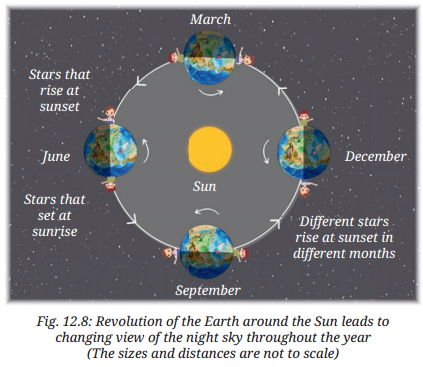
- The Earth revolves around the Sun in an almost circular path called an orbit. It takes about 365 days and 6 hours for one complete revolution.
Changing View of Night Sky from the Earth
As the Earth revolves around the Sun, the night side of the Earth faces different directions in space at different times of the year.
Different patterns of stars (constellations) are seen in the sky at a fixed time of night in different months.
Indigenous communities such as the Bhil and Pawara in western India used the appearance of certain star patterns in the sky as markers for the arrival of monsoon rains.
Seasons on the Earth
The Earth’s axis of rotation is tilted with respect to its orbit around the Sun. The Earth maintains this tilt in the same direction in space as it revolves around the Sun.
Seasons are caused by the tilt of the Earth’s axis and the spherical shape of the Earth, which lead to variations in the duration and intensity of sunlight received at different places during the year.
In June, the Northern Hemisphere is tilted towards the Sun, while the Southern Hemisphere is tilted away. The same amount of sunlight falls on a smaller area in the Northern Hemisphere as compared to the Southern Hemisphere due to the spherical shape of the Earth’s surface, so the sunlight is more intense in the Northern hemisphere.
The Northern Hemisphere also receives sunlight for more than 12 hours a day in June, so days are longer and nights shorter. Therefore, the Northern Hemisphere has summer in June, while the Southern Hemisphere has winter at the same time.
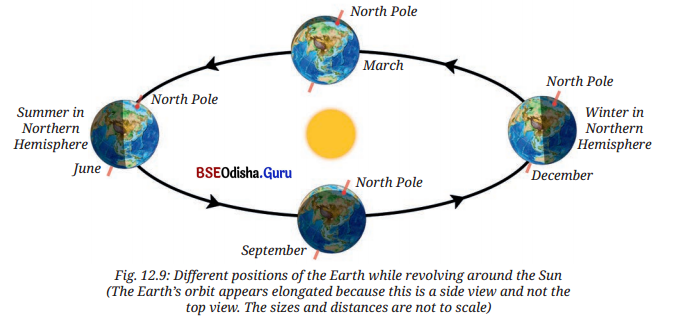
In December, the situation is reversed. The Northern Hemisphere is tilted away from the Sun, receives less intense sunlight and has shorter days, leading to winter, while the Southern Hemisphere experiences summer.
Near the Equator, the length of day and night is almost always about 12 hours each, and the intensity of sunlight changes very little over the year. Therefore, regions near the Equator, including some southern states oflndia, do not experience very prominent seasons. However, local geographical factors can influence the climate of these regions.
NOTE: Two incorrect explanations often given for seasons are:
- The hemisphere tilted towards the Sun is closer to it.
- The oval shape of the Earth’s orbit makes the distance from the Sun vary greatly.
In reality, the differences in the Earth’s distance from the Sun over the year are small and are not the cause of seasons, and the Earth is actually closest to the Sun in January.
Solstices, Equinoxes, and Regional Effects
- In the Northern Hemisphere, the longest clay and shortest night occur around 21 June, called the summer solstice. The shortest day and longest night occur around 22 December, called the winter solstice.
- Around 21 March and 23 September, day and night are nearly equal in length; these clays are called equinoxes (spring equinox and autumn equinox).
- At the North Pole, the Sun rises around 21 March and remains above the horizon for about six months, then sets around 22 September, after which there is almost six months of darkness. The South Pole experiences the opposite pattern.
Eclipses
Solar Eclipse
A solar eclipse occurs when the Moon comes between the Sun and the Earth in such a way that it blocks sunlight from reaching a part of the Earth.
The apparent size of an object depends on its actual size and its distance from the observer. Although the Sun is much larger than the Moon, it is very far away, while the Moon is much closer to the Earth; therefore, the Sun and the Moon appear nearly the same size in the sky.
Because their apparent sizes are similar, the Moon can cover the entire disc of the Sun, causing a total solar eclipse.
During a solar eclipse, the shadow of the Moon falls on a small region of the Earth’s surface.
In the central dark part of this region, the Sun is completely covered, and people see a total solar eclipse. In the surrounding region, where only part of the Sun is covered by the Moon, people see a partial solar eclipse.
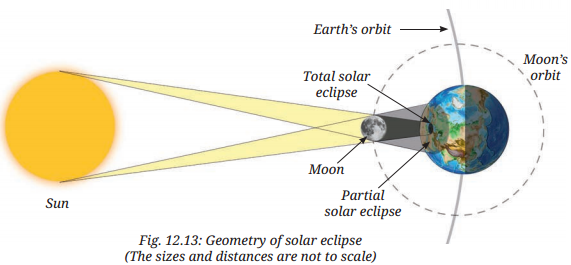
As the Moon moves along its orbit and the Earth continues to rotate, the Moon’s shadow moves across the Earth’s surface; therefore, a total solar eclipse is visible at any one place only for a short time.
CAUTION: Even during a solar eclipse, sunlight is strong never look directly at the Sun, whether during an eclipse or like eclipse goggles or projection techniques should be used.
The planets Mercury and Venus revolve around the Sun between the Earth and the Sun but they do not cause eclipses. These planets, though larger than the Moon, are much farther from the Earth, so their apparent sizes are much smaller and they cannot block the Sun.
When Venus passes between the Sun and the Earth, it appears aS a tiny black dot moving across the Sun’s bright face; this rare event is called a Transit of Venus.
Lunar Eclipse
A lunar eclipse occurs when the Earth comes between the Sun and the Moon, so that sunlight cannot reach the Moon directly.
When the Moon passes completely into the Earth’s shadow, it is called a total lunar eclipse. When only a part of the Moon enters the Earth’s shadow and the rest remains sunlit, it is called a partial lunar eclipse.
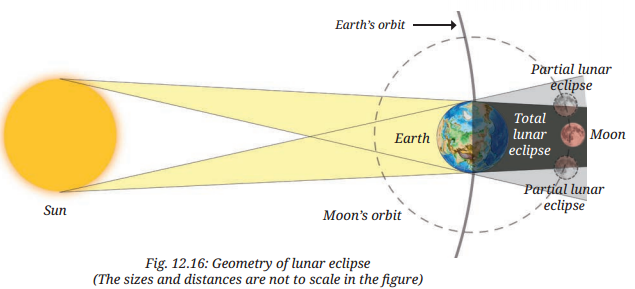
During a total lunar eclipse, the bright disc of the Moon appears dark red in colour and remains so until the Moon moves out of the Earth’s shadow.
Unlike the Sun, the eclipsed full Moon can be safely watched with the naked eye, without any special protection.
Rotation of the Earth
- Earth rotates on its axis from west to east.
- This makes the Sun appear to move from east to west as observed from Earth.
- One rotation takes about 24 hours, causing day and night.
Effect of the Tilt
- The hemisphere tilted toward the Sun gets concentrated direct sunlight and longer days, causing summer.
- The opposite hemisphere receives less direct sunlight and shorter days, causing winter.
Season in June
In June, the Northern Hemisphere is tilted toward the Sun.
- Summer in the Northern Hemisphere.
- Winter in the Southern Hemisphere
- Summer Solstice: Longest day (21 June in the Northern Hemisphere)
Seasons in March and September
- Equinoxes: Around 21 March (spring equinox) and 23 September (autumn equinox).
- The Earth’s axis is not tilted toward or away from the Sun.
- Both hemispheres receive equal amounts of sunlight, resulting in nearly equal day and night durations.
Season in December
In December, the Southern Hemisphere is tilted toward the Sun.
- Winter in the Northern Hemisphere
- Summer in the Southern Hemisphere.
- Winter Solstice: Shortest day (22 December in the Northern Hemisphere).
Revolution of the Earth
The Earth revolves around the Sun in an orbit, completing one revolution in about 365 days and 6 hours.
Changing View of the Night Sky Annually
The stars visible in the night sky change throughout the year due to Earth’s revolution around the Sun.
Seasons
- Seasons occur mainly because of the tilt of the Earth’s axis and the spherical shape of the Earth.
- This tilt makes sunlight fall differently on different parts of Earth during the year.
Eclipses
- Eclipses happen when the Sun, Moon and the Earth come in a straight line.
- Eclipses can be total or partial, depending on the alignment of the Sun, Moon, and the Earth.
Solar Eclipse
A solar eclipse occurs when the Moon comes between the Sun and the Earth, blocking the sunlight from reaching the Earth.
CAUTION: Viewing a solar eclipse requires safety precautions to protect the eyes.
Lunar Eclipse
A lunar eclipse happens when the Earth comes between the Sun and the Moon and blocks sunlight from reaching the Moon. Viewing a Lunar eclipse is safe with the naked eye.