Pressure, Winds, Storms, and Cyclones Class 8 Question Answer Science Chapter 6

Go through BSE Odisha Class 8 Science Solutions Chapter 6 Pressure, Winds, Storms, and Cyclones Question Answer to understand textbook questions more clearly.

Class 8 Science Curiosity Chapter 6 Question Answer

Class 8 Science Ch 6 Pressure, Winds, Storms, and Cyclones Question Answer

Class 8 Science Chapter 6 Pressure, Winds, Storms, and Cyclones Question Answer

Probe and Ponder Questions

Question 1.
Why are winds stronger on some days than on others?
Answer:
Winds are stronger on some days due to greater differences in air pressure (pressure gradients) between different locations. When a weather system, such as storm or a cyclone, creates steep pressure differences, air moves rapidly from high-pressure areas to low-pressure areas, resulting in strong winds. Temperature contrasts (such as between land and sea, or during weather fronts), and local topography can intensify these differences and wind speeds.

Question 2.
Why are water tanks usually placed at a height?
Answer:
Water tanks are placed at a height so that water can flow down easily with pressure due to gravity, ensuring a steady supply to all parts of a building or area without needing extra pumping.

Pressure, Winds, Storms, and Cyclones Class 8 Question Answer Science Chapter 6

Question 3.
Can air pressure really crush us?
Answer:
No, air pressure cannot crush us because the pressure inside our bodies is equal to the air pressure outside. The atmosphere presses on us with great force, but our body fluids and gases push outward with the same amount of pressure, keeping everything balanced. That’s why we don’t feel the weight of the air or get crushed by it under normal conditions on Earth.

Question 4.
What causes storms and cyclones? If the Earth stopped rotating, would cyclones still form?
Answer:
Storms and cylones are formed when warm, moist air from the sea rises and cools, causing strong winds and heavy rain. The spinning of the Earth makes these winds rotate, forming a cyclone. If the Earth stopped rotating, there would be no spinning effect, so cyclones would not form, though normal storms could still happen.

Question 5.
Share your questions ………………
Answer:
Possible questions you might ask after exploring these ideas:

  • Why don’t we feel atmospheric pressure even though it is so high?
  • How do buildings and bridges withstand strong winds during storms?
  • Do animals sense changes in air pressure before storms?
  • What scientific instruments are used to measure wind speed and pressure?
  • How do disaster warning systems work for cyclones?

InText Questions

Question 1.
Why do fall leaves rise in the air or trees bend when a strong wind blows? (Page 81)
Answer:
The force exerted by the wind creates wind pressure, which causes fallen leaves to rise in the air and the bending or swinging of trees when a strong wind blows.

Question 2.
Can the shape or size of the straps make a difference, provided both bags are equally heavy? (Page 81)
Answer:
When we carry a bag, we feel its weight because of the force of gravity acting on our shoulders. The weight of the bag with narrow straps acts on a smaller area of our shoulders, whereas the weight of the bag with broad straps is spread over a larger area of our shoulders. Although both bags have equal weight, we feel more comfortable carrying a bag with broad straps. Broad straps reduce the pressure exerted by the bag on the shoulders.

Pressure, Winds, Storms, and Cyclones Class 8 Question Answer Science Chapter 6

Question 3.
Do liquids also exert pressure? (Page 83)
Answer:
Yes, liquids also exert pressure. The pressure from a liquid acts in all directions and increases with depth – the deeper you go, the greater the pressure.

Question 4.
What will happen to the bulge of the balloon if we increase the height of the water column? (Page 84)
Answer:
If we increase the height of the water column, the bulge of the balloon will become bigger because the pressure of the water increases with height, pushing more strongly on the balloon.

Question 5.
(a) Why are overhead tanks kept at a height?
(b) Suppose you are living on the second floor of a three-story building and an overhead tank is placed on the top floor. Will you or your friend on the first floor receive a more powerful stream of tap water? Give reasons. (Page 84)
Answer:
(a) Overhead tanks are placed at a height so that the pressure in the taps is increased, resulting in a good stream of water from the taps.

(b) Pressure exerted by water increases with the increase of height of the liquid column. Suppose I live on the second floor of the building that has three floors, and the overhead tank is installed on the top floor. The pressure of water and hence the power of water stream from the taps will depend on the height of the overhead tank above the taps of the second floor. My friend living on the first floor will have a longer distance from the taps to the overhead tank, which means the height of the water column above his taps will be more compared to my water taps on the second floor. Therefore, my friend will receive more powerful stream of tap water.

Question 6.
Why does water spurt out like a fountain from leaking joints or holes in water pipes? (Page 85)
Answer:
Water in water pipes has long water columns, as the water tanks to which the water pipes are connected are placed at heights. The pressure inside the pipes is high. The water exerts pressure in all sides of the container including the bottom and walls of the pipe. When this water exerting pressure on all sides, finds a narrow opening like a hole or a leaking joint, it spurts like a fountain.

Question 7.
What happens when an inflated balloon is kept without closing its mouth? (Page 86)
Answer:
The inflated balloon has air inside, which exerts pressure on the walls of the balloon, resulting in expansion of the balloon on all sides. The elastic walls of the balloon exert equal but opposite pressure on the air. When we keep the inflated balloon without closing its mouth, the air from within the balloon escapes through its mouth from high pressure inside the balloon to low pressure outside the balloon.

Pressure, Winds, Storms, and Cyclones Class 8 Question Answer Science Chapter 6

Question 8.
Does the difference in air pressure have anything to do with the formation of winds? (Page 88)
Answer:
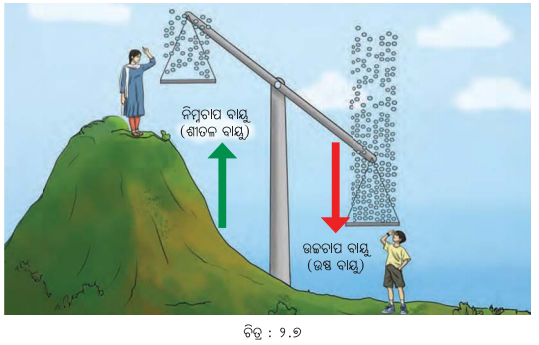
Air moves from a high-pressure region to a low-pressure region. Moving air is called wind. Thus, it is the difference in air pressure that results in the formation of wind.

Pressure, Winds, Storms, and Cyclones Class 8 Questions and Answers

Keep the Curiosity Alive (Pages 94-96)

Question 1.
Choose the correct statement.
(i) Look at figure carefully. Vessel R is filled with water. When pouring of water is stopped, the level of water will be ………………
Pressure, Winds, Storms, and Cyclones Class 8 Question Answer Science Chapter 6.1
(a) the highest in vessel P
(b) the highest in vessel Q
(c) the highest in vessel R
(d) equal in all three vessels
Answer:
(d) equal in all three vessels
Reason: The level of water in connected vessels (communicating vessels) will be the same regardless of shape, as liquid pressure depends on the height of the column, not the vessel’s shape or width.

(ii) A rubber sucker (M) is pressed on a flat smooth surface and an identical sucker (N) is pressed on a rough surface:
(a) Both M and N will stick to their surfaces.
(b) Both M and N will not stick to their surfaces.
(c) M will stick but N will not stick.
(d) M will not stick but N will stick.
Answer:
(c) M will stick but N will not stick.
Reason: The rubber sucker sticks due to atmospheric pressure creating a vacuum on a smooth surface. On a rough surface, air leaks in, preventing the vacuum and thus the sticking.

Pressure, Winds, Storms, and Cyclones Class 8 Question Answer Science Chapter 6

(iii) A water tank is placed on the roof of a building at a height ‘H’. To get water with more pressure on the ground floor, one has to
(a) increase the height ‘H’ at which the tank is placed.
(b) decrease the height ‘H’ at which the tank is placed.
(c) replace the tank with another tank of the same height that can hold more water.
(d) replace the tank with another tank of the same height that can hold less water.
Answer:
(a) increase the height ‘ H ‘ at which the tank is placed.
Reason: Liquid pressure increases with the height of the water column. Raising the tank increases the pressure, resulting in a stronger stream of water.

(iv) Two vessels, A and B contain water up to the same level as shown in figure. PA and PB is the pressure at the bottom of the vessels. FA and FB is the force exerted by the water at the bottom of the vessels A and B.
Pressure, Winds, Storms, and Cyclones Class 8 Question Answer Science Chapter 6.2
(a) PA=PB, FA=FB
(b) PA=PB, FA<FB
(c) PA<PB, FA=FB
(d) PA>PB, FA>FB
Answer:
(b) PA=PB, FA<FB
Reason: Pressure at the bottom depends on the height of the water, which is the same in both vessels, so PA=PB. Force equals pressure times area; since vessel A is narrower (smaller area), FA<FB.

Question 2.
State whether the following statements are True [T] or False [F].
(i) Air flows from a region of higher pressure to a region of lower pressure.
Answer:
True.

(ii) Liquids exert pressure only at the bottom of a container.
Answer:
False (liquids exert pressure in all directions, including on the walls of the container.)

(iii) Weather is stormy at the eye of a cyclone.
Answer:
False (it is calm at the eye of a cyclone)

(iv) During a thunderstorm, it is safer to be in a car.
Answer:
True.

Pressure, Winds, Storms, and Cyclones Class 8 Question Answer Science Chapter 6

Question 3.
Figure (a) shows a boy lying horizontally, and Figure (b) shows the boy standing vertically on a loose sand bed. In which case does the boy sink more in sand? Give reasons.
Pressure, Winds, Storms, and Cyclones Class 8 Question Answer Science Chapter 6.3
Answer:
The boy in Figure (b) will sink more. The weight of the boy is the same, but in Fig. (a), the force (of the weight) is acting on a large area. The pressure in this case is less. In Fig. (b), the same force (of the weight) is acting on a small area. The pressure, therefore, is more. The boy will sink more into the sand in this case.

Question 4.
An elephant stands on four feet. If the area covered by one foot is 0.25 m2, calculate the pressure exerted by the elephant on the ground if its weight is 20000 N.
Answer:
Force (the weight) of the elephant acting on the ground =20000 N
Area on the ground covered by the four feet of the elephant =4 × 0.25 m2 = 1 m2
Pressure exerted by the elephant on the ground
= \(\frac{\text { Force }}{\text { Area }}=\frac{200000 \mathrm{~N}}{1 \mathrm{~m}^2}\)=20000 Pa

Question 5.
There are two boats, A and B. Boat A has a base area of 7 m2, and 5 persons are seated in it. Boat B has a base area of 3.5 m2, and 3 persons are seating in it. If each person has a weight of 700 N, find out which boat will experience more pressure on its base and by how much?
Answer:
Force of the weight of 5 persons acting on the base of boat A=5 × 700 N=3500 N
Base area of boat A=7 m2
Pressure exerted on the base of boat A
\(= \frac{\text { Force }}{\text { Area }}=\frac{3500 \mathrm{~N}}{7 \mathrm{~m}^2}\) = 500 Pa
Force of the weight of 3 persons acting on the base of boat B = 3 ×700 N=2100 N
Base area of boat B = 3.0 m2
Pressure exerted on the base of boat B
= \(\frac{\text { Force }}{\text { Area }}=\frac{2100 \mathrm{~N}}{3.5 \mathrm{~m}^2}\) =600Pa
Therefore, boat B will experience more pressure on its base by 100 Pa.

Pressure, Winds, Storms, and Cyclones Class 8 Question Answer Science Chapter 6

Question 6.
Would lightning occur if air and clouds were good conductors of electricity? Give reasons for your answer.
Answer:
In case the air and the clouds were good conductors of electricity, the charges could not accumulate in the clouds (because they would flow into the air), there would be no charge buildup, which is necessary for lightning to occur. Therefore, if air and clouds were good conductors of electricity, lightning would not occur.

Question 7.
What will happen to the two identical balloons A and B as shown in figure when water is filled into the bottle up to a certain height. Will both the balloons bulge? If yes, will they bulge equally? Explain your answer.
Pressure, Winds, Storms, and Cyclones Class 8 Question Answer Science Chapter 6.4
Answer:
When water is filled into the bottle up to a certain height (sufficiently above the level of the entry points of water from the bottle) both the balloons will bulge. The entry points of water from the bottle to the balloons are at the same height. The balloons, being elastic, exert some force on the water. Assuming that the balloons are equally elastic, both balloons will bulge equally.

Question 8.
Explain how a storm becomes a cyclone.
Answer:
Cyclones are large storms that form over warm ocean waters.

  • As the ocean water gets heated, the air above it becomes moist and warm and rises to a height where water vapor condenses to form raindrops.
  • Condensing water vapor releases heat back into the atmosphere.
  • This further warms the ascending air, leading to its further rise, creating an even lower pressure.
  • Air from the surrounding regions rushes in, and it also starts rising.
  • The moving air starts to spin under the influence of the Earth’s rotation.
  • This cycle is repeated, resulting in the creation of a very low-pressure area with high-speed winds revolving around it.
  • This spinning system of clouds, winds, and rain is called a Cyclone.

Question 9.
The figure shows trees along the sea coast in a summer afternoon. Identify which side is land A or B. Explain your answer.
Pressure, Winds, Storms, and Cyclones Class 8 Question Answer Science Chapter 6.5
Answer:
During the daytime on a summer afternoon, there is a sea breeze that blows from sea to land. This happens because the land gets heated faster and the air above land rises, resulting in a low-pressure region over land. Cooler air over sea moves from the high-pressure region towards the land. The bending of trees due to wind, as shown in the figure, suggests that wind is blowing in the direction from B to A. This suggests ‘A’ side is land.

Pressure, Winds, Storms, and Cyclones Class 8 Question Answer Science Chapter 6

Question 10.
Describe an activity to show that air flows from a region of high pressure to a region of low pressure.
Answer:
Activity to show that air flows from a region of high pressure to a region of low pressure.
Materials required: Two similar balloons made of thin rubber, a drinking straw, and some thread.
Pressure, Winds, Storms, and Cyclones Class 8 Question Answer Science Chapter 6.6
Procedure:

  • Insert one end of the straw into one balloon and secure it with the thread.
  • Inflate the second balloon and insert the free end of the straw into the neck of the inflated balloon, and secure it with the thread. (Ensure that the air from the inflated balloon does not leak.)

Observations: Some air moves from the inflated balloon to the uninflated balloon, and the sizes of both balloons change. After some time, both the balloons attain almost the same size, and the flow of air stops.

Conclusion: The inflated balloon has higher pressure inside it, and the uninflated balloon has low pressure inside. When the two balloons are connected through a straw, air moves from the high-pressure area (inside the inflated balloon) to the low-pressure area (inside the uninflated balloon).

Question 11.
What is a thunderstorm? Explain the process of its formation.
Answer:
(a) A Thunderstorm is a storm that produces thunder, lightning, heavy rain, and strong winds. It usually occurs during hot weather when the atmosphere becomes unstable.
(b) During a thunderstorm formation, under certain conditions, warm air rises to great heights, and the low temperature there changes water droplets into ice particles. Strong winds blowing upwards and downwards result in rubbing between water droplets and ice particles. This generates electric charges within clouds. Ice particles are positively charged, and they move upwards in the upper part of the clouds. Water droplets are negatively charged and occupy the lower part of the clouds.

When negatively charged water droplets in the lower part of the cloud move closer to the ground, trees, buildings, and the ground become positively charged. Normally, air acts as an electrical insulator and does not let opposite charges meet. This insulating property of the air breaks down when the build-up charges becomes very large.

A sudden flow of charges takes place, resulting in a bright flash of light called lightning. Lightning can occur as opposite charges collide within a cloud, between clouds, or between clouds and the ground. Lightning rapidly heats the air around it. This results in expansion of air to produce a loud sound called thunder. A storm accompanied by lightning and thunder is called a thunderstorm.

Question 12.
Explain the process that causes lightning.
Answer:
During a thunderstorm formation, under certain conditions, warm air rises to great heights, and the low temperature there changes water droplets into ice particles. Strong winds blowing upwards and downwards result in rubbing between water droplets and ice particles. This generates electric charges within clouds. Ice particles are positively charged, and they move upwards in the upper part of the clouds. Water droplets are negatively charged and occupy the lower part of the clouds. When negatively charged water droplets in the lower part of the cloud move closer to the ground, the trees, buildings, and the ground become positively charged.

Normally, air acts as an electrical insulator and does not let opposite charges meet. This insulating property of the air breaks down when the build-up charges becomes very large. A sudden flow of charges takes place, resulting in a bright flash of light called lightning. Lightning can occur as opposite charges collide within a cloud, between clouds, or between clouds and the ground. Lightning rapidly heats the air around it. This results in expansion of air to produce a loud sound called thunder.

Pressure, Winds, Storms, and Cyclones Class 8 Question Answer Science Chapter 6

Question 13.
Explain why holes are made in banners and hoardings.
Answer:
Holes are made in banners and hoardings to save them from blowing off with high-speed winds. High-speed winds are accompanied by a reduced pressure. If there are no holes in the banners or hoardings, they block the wind, but the wind blows on the sides of these banners and hoardings. This forms low-pressure area on sides and opposite side of the banners/hoardings.

There remains a high-pressure area on the side of the banner or hoarding that faces the direction from which wind is blowing. When the pressure difference is large the banners or the hoardings are blown away. With the holes in the banners or hoardings, the wind blows through these holes, and the pressure difference is minimised, keeping them intact.

Class 8 Science Chapter 6 Question Answer

Activity 1.

Aim: To show that the pressure exerted by water at the bottom of the container depends on the height of its column.
Materials Required: Two rubber balloons, glass or plastic pipes of different diameters.
Pressure, Winds, Storms, and Cyclones Class 8 Question Answer Science Chapter 6.1

Procedure:

Case I: When two pipes are of different diameters.

  • First of all we will take two transparent glass or plastic pipes of the same length (about 25 cm), these pipes must be of different diameters, as shown in fig.
  • Now, we will take two good-quality rubber balloons and attach them to one end of each pipe.
  • Clamp the pipes on a stand as shown in fig. (1)
  • Now, fill both the pipes with water up to the same level about halfway.

Case II: When two pipes are of same diameters.

Pressure, Winds, Storms, and Cyclones Class 8 Question Answer Science Chapter 6.2

  • Take two pipes of same length and same diameter.
  • Now, pour water in both the pipes.
  • Water should be at different leves in the pipes. See fig. (2) Note down your observations.

Observations:

  • When the water levels in both pipes are same. Two balloons bulge to the same extent.
  • Higher heights of water column produce bigger bulge of the balloon.

Pressure, Winds, Storms, and Cyclones Class 8 Question Answer Science Chapter 6

Inferences:

  • More height of water column produce bigger buldge (i.e., bulge of balloon increases as the height of water column increases).
  • Bulging of balloons do not depends on the diameters of the pipes. It depends on height of water column.
  • Hence, the pressure due to liquid increases with height of water column.

Activity 2.

Let us find out
Aim: To show that a liquid exert pressure on the walls of the container and also equal pressure at the same depth.
Materials Required: An empty plastic bottle, water, a needle or a nail.

Pressure, Winds, Storms, and Cyclones Class 8 Question Answer Science Chapter 6.3

Procedure:

  • Take an empty plastic bottle.
  • Drill four holes near the bottom of the bottle using a needle or a nail.
  • Now, seal the holes with a tape and fill the bottle with water.
  • Make sure that the holes are at the same height from the bottom.
  •  Remove the tape from all holes at the same time.

Observations:

  • Water flowing out from the holes on the side of the bottle.
  • Different streams of water coming out of the holes falls at the same distance from the bottle.

Inference:

  • Therefore, we can conclude that liquids exert pressure not only at the bottom of the container, but also on its sides. In fact liquids exert pressure in all directions.
  • Liquid exert equal pressure at same depth.

Activity 3.

Let us explore
Aim: To show that air exert pressure.
Materials Required: A paper plate, two identical chart paper of size about 70 cm × 56 cm

Pressure, Winds, Storms, and Cyclones Class 8 Question Answer Science Chapter 6.4

Pressure, Winds, Storms, and Cyclones Class 8 Question Answer Science Chapter 6.5

Procedure:

  • First of all we will take a paper plate and invert it and attach a stick to it see fig. (a).
  • Now place it on a plain wooden surface.
  • Then, take two sheets of chart paper of same size 70cm × 56cm each. Fold one sheet twice and make a hole in the centre of the folded chart paper sheet – big enough for the stick to come out. Place the folded sheet on top of the inverted paper plate as see fig. (b).
  • Now, try to lift the paper plate covered with a folded sheet using the stick.
  • What did you observed ? How much effort is needed to lift it.
  • Now, put the second unfolded chart paper sheet in place of the folded sheet. Make a hole at the centre of this chart paper for the stick to pass through. Cover the paper plate with the unfolded chart paper as shown in fig. (c).
  • Try to lift the paper plate once again and feel the effort needed to do so.
  • Which of the above case, with the folded or the unfolded is easy to lift, either chart paper covering the paper plate.

Pressure, Winds, Storms, and Cyclones Class 8 Question Answer Science Chapter 6

Observations:

  • We feel more effort to lift the paper plate when it is covered with the unfolded chart paper, than with the folded chart paper.
  • The larger the surface area covered, the greater the force needed to life the plate.

Inference:

  • Air exert force on the covering sheet.
  • Force increases with increase in the area of covering sheets.
  • It is clear that air is exerting a force on the paper plate, which increases as the area of the sheet covering it increases.

Activity 4.

Let us perform
Aim: To show the effect of pressure due to air.
Materials Required: A good quality rubber sucker.

Pressure, Winds, Storms, and Cyclones Class 8 Question Answer Science Chapter 6.6

Procedure:

  • Take a good quality rubber sucker. It looks like a small rubber cup.
  • Press it hard on a smooth, plane surface.
  • Does it stick to the surface ? Yes, it sticks to the surface very hard.
  • Now, try to pull it off the surface. Do you find it difficult to pull it off ?

Observations: It is very difficult to pull off a rubber sucker.

Inference:

  • All gases exert pressure.
  • The sucker sticks to the surface because the pressure of air surrounding the sucker is higher than the pressure exerted by the air inside the sucker.

Activity 5.

Let us observe
Aim: To show that air (winds) blows untill there is a pressure difference. (i.e., from a high pressure region to low pressure region)
Materials Required: Two balloons of same size, a drinking straw, thread.

Pressure, Winds, Storms, and Cyclones Class 8 Question Answer Science Chapter 6.7

Procedure:

  • First of all we will take two balloons made of thin rubber of same size and a drinking straw.
  • Now, we will insert one end of the straw into one balloon and tie its mouth properly with a rubber band or thread.
  • Now, we will inflate the second balloon and hold its mouth with our fingers, in such away that air does not escape.
  • Now, insert the free end of the straw into the neck of the inflated balloon and tie it with a rubber band or thread.
  • We should take precaution at the time of insertion of straw that there is no leakage of air from the balloons.
  • Now, we can see in fig. that one end of the straw is inside the inflated balloon and the other end inside the uninflated balloon.

Observations:

  • Size of uninflated balloon increases and that of inflated balloon decreases.
  • After sometime both the balloons attain almost the same size and flow of air stops.

Inference:

  • We can conclude that the air pressure in the inflated balloon is higher than that in the uninflated balloon. So, air moves from the inflated balloon to the uninflated balloon, resulting in changes in the size of these two balloons.
  • The air flow stops when the pressure in both balloons becomes equal.
  • Hence, it shows that air moves or blows untill there is a pressure difference.

Activity 6.

Let us observe

Aim: To show that high speed winds are due to a reduced air pressure.
Materials Required: Two balloons of same size, string or thread, a stick.

Pressure, Winds, Storms, and Cyclones Class 8 Question Answer Science Chapter 6.8

Procedure:

  • Take two balloons of the same size.
  • Now, inflate both balloons and tie strings to them.
  • Take a stick and hang the two balloons from it.
  • We must leave a gap of 6-10 cm (See fig.).
  • Now, blow air with your mouth into the narrow space between the balloons.
  • What happens to the balloons? Note down your observations.
  • Now blow harder and observe.

Observations:

  • Both balloons move towards each other.
  • When we blow harder the balloons approaches towards each other with more speed.

Inference:

  • When you blow air between the balloons, a low pressure area is created between them.
  • We conclude that high speed winds are accompanied by a reduced air pressure.

Pressure, Winds, Storms, and Cyclones Class 8 Extra Questions and Answers

Short Answer Type Questions

Question 1.
Why school bags have wide straps ?
Answer:
A school bag has wide strap so that the weight of a bag may fall over a large area of the shoulder of the child producing less force on the shoulder. Due to less pressure, it is more comfortable to carry the heavy school bag.

Question 2.
Why is the bottom part of the foundation of a building made wider ?
Answer:
Foundation of a building is made wider so that it may not sink under the extremely high pressure of building. The wider foundation distributes the weight of the building over a large area on the ground.

Question 3.
Why cutting instruments are sharpened?
Answer:
All cutting instruments such as blades, axes etc., are sharpened so that the area of cross-section decreases and hence pressure exerted by them increases. Thus they can easily cut and penetrate a given surface.

Question 4.
Calculate the pressure if a force of 8 N is applied on an area of 2 cm2
Answer:
Force =8 N
Area =2cm2
[ ∵ 1cm2= \(\frac{1}{10,000}\)=\(\frac{2 \mathrm{~m}^2}{10,000}\)
Pressure = \(\frac{8}{2 / 10,000}=40,000 \mathrm{~N} / \mathrm{m}^2 \)

Question 5.
Why a sharp knife cuts better than a blunt knife?
Answer:
A sharp knife cuts objects (like vegetables) better because due to its very thin edge, the force of our hand falls over a very small area of the object producing a large pressure. This large pressure cuts the object easily. On the other hand, a blunt knife has a thicker edge. A blunt knife does not cut an object easily because due to its thicker edge, the force of our hand falls over a larger area of the object and produces lesser pressure. This lesser pressure cuts the object with difficulty.

Question 6.
Why does water spurt out like a fountain from leaking joints or holes in water pipes?
Answer:
Water spurting out like a fountain from holes because:

  • Water pipes are connected to tank at certain height by a long pipes and create a long water column and the pressure inside the pipes is high.
  • Liquid exert pressure not only at the bottom of the container, but also on its side, i.e., liquid exert pressure in all directions. Due to the pressure exerted by water on the walls of the pipes we have seen water spurting out like a fountain from leaking joints or holes in water pipes.

Question 7.
How does rubber sucker stick to the surface like wall ?
Answer:
The sucker sticks to the surface because the pressure of air surrounding the sucker is higher than the pressure exerted by the air inside the sucker. To pull the sucker off the surface, the applied force should be strong enough to overcome the pressure difference between outside the sucker and inside the sucker.

Question 8.
Why do mountainers suffer from nose-bleeding at higher altitudes?
Answer:
This is because, at higher altitude, the atmospheric pressure suddenly drops. This leads to the rapture of blood vessels in the body causing bleeding from the nose.

Question 9.
How do thunderstorms produce lightning through charge separation?
Answer:
Strong updrafts and downdrafts make water droplets and ice rub and become charged, with opposite charges separating within the cloud. When the charge difference becomes very large, a sudden discharge occurs as lightning.

Long Answer Type Questions

Question 1.
Why it is easier to walk on soft sand if we have flat shoes rather than shoes with sharp heels (or pencil heels) ?
Answer:
This is because a flat shoe has a greater area in contact with the soft sand due to which there is less pressure on the soft ground. Due to this the ‘flat’ shoes do not sink much in soft sand and it is easy to walk on it.

On the other hand, a sharp heel has a small area in contact with the soft sand and so exerts a greater pressure on the soft sand. Due to this greater pressure, the sharp heels tend to sink deep into soft sand making it difficult for the wearer to walk on soft sand.

Question 2.
It is difficult to cut cloth using a pair of scissors with blunt blades. Explain.
Answer:
We know that more area of contact will produce less pressure and vice-versa. Blunt blades have larger area as compared to the sharp-edged blades. Thus, the applied force produces a lower pressure in case of blunt blades, which makes it difficult to cut the cloth.

Question 3.
Two rods of the same weight and equal length have different thickness. They are held vertically on the surface of sand as shown in figure. Which one of them will sink more? Why?
Answer:
Since rod B is thinner than ‘A’. Therefore, rod B will go more deeper as it has a smaller area of contact, therefore the same force (weight of the rod) will produce more pressure. But in case of rod A the same force produces less pressure.

Question 4.
Two women are of the same weight. One wears sandals with pointed heels while the other wears sandals with flat soles. Which one would feel more comfortable while walking on a sandy beach? Give reasons for your answer.
Answer:
Two women are of the same weight but the woman wearing sandals with flat soles will feel more comfortable while walking on the sandy beach. Because, the flat soles have larger area as compared to the sandals with pointed heels. Here, the two women are of the same weight, they will apply same force on the ground.

Hence, the pressure exerted by the pointed heels will be more compared to that with sandals having flat soles. So, the pointed heel sandals will sink more in the sand than the flat sole sandals. Hence, walking with flat sole sandals will be more comfortable.

Question 5.
It is much easier to burst an inflated balloon with a needle than by a finger. Explain.
Answer:
Smaller area produces large pressure. When we prick the surface of an inflated balloon with a needle it exerts a large pressure because it has a smaller area of contact compared to the finger. So, the large pressure pierces the surface of the balloon easily.

Case-Study Based Questions

1. Read the following passage carefully and answer the questions that follow:

Our earth is surrounded by a large amount of air consisting of Nitrogen, Oxygen, Argon, Carbon dioxide and traces of other gases. Layers of air surrounding the earth are called the atomsphere.

(a) What is atmosphere?
Answer:
The layers of air surrounding the earth are called the atmosphere.

(b) What is atmospheric pressure?
Answer:
The pressure exerted by air on the surface of the earth is known as the atmospheric pressure.

Pressure, Winds, Storms, and Cyclones Class 8 Question Answer Science Chapter 6

(c) Is the pressure inside our bodies equal to the atmospheric pressure? Why are we not crushed?
Answer:
Yes, the pressure inside our bodies balances the outside pressure of the atmosphere. That is why we are not crushed under the atmospheric pressure.

Picture Based Questions

I. Observe the picture and answer the questions.

Pressure, Winds, Storms, and Cyclones Class 8 Question Answer Science Chapter 6.9

(i) Do the different streams of water coming out of the holes fall over it the same distance from the bottle?
(a) Different distance
(b) Same distance
(c) Two holes same distance
(d) None of these
Answer:
(b) Same distance

(ii) Does liquid exert equal pressure on the same depth?
(a) No
(b) Some times
(c) Yes
(d) 50-50
Answer:
(c) Yes

(iii) What does this indicate?
Answer:
This indicates that liquids exert equal pressure at the same depth.

Pressure, Winds, Storms, and Cyclones Class 8 MCQ

Multiple Choice Questions (Mcqs)

Question 1.
What is the SI unit of pressure ?
(a) N/m2
(b) Newton (N)
(c) N/m
(d) m2
Answer:
(a) N/m2

Question 2.
Bulging of balloons depends on :
(a) height of water or liquid column
(b) diameter of pipes
(c) weight of liquid or water
(d) none of these
Answer:
(a) height of water or liquid column

Pressure, Winds, Storms, and Cyclones Class 8 Question Answer Science Chapter 6

Question 3.
The sucker sticks to the surface because :
(a) the pressure of air surrounding the sucker is lower than the pressure exerted by air inside the sucker.
(b) the pressure of air is equal to the pressure inside the sucker.
(c) the pressure of air outside is higher than the air pressure inside the sucker
(d) none of these
Answer:
(c) the pressure of air outside is higher than the air pressure inside the sucker

Question 4.
1 hectopascal (hpa) is equal to :
(a) 10 Pa
(b) 50 Pa
(c) 100 Pa
(d) 1000 Pa
Answer:
(c) 100 Pa

Question 5.
Figure shows a container filled with water. Which of the following statements is correct about pressure of water?
(a) Pressure at A> Pressure at B> Pressure at C
(b) Pressure at A= Pressure at B= Pressure at C
(c) Pressure at A<Pressure at B>Pressure at C
(d) Pressure at A<Pressure at B<Pressure at C
Answer:
(d) Pressure at A<Pressure at B<Pressure at C

Assertion and Reasoning

These questions consist of two statements, each printed as Assertion (A) and Reason (R). While answering these questions, you are required to choose any one of the following four responses.
(a) Assertion (A) and Reason (R) both are correct and reason is correct explanation for assertion.
(b) Assertion (A) and Reason (R) both are correct and reason is not correct explanation for assertion.
(c) Assertion (A) is correct but the Reason (R) is wrong.
(d) Assertion (A) is wrong but the Reason (R) is correct.

1. Assertion (A): We feel more comfortable carrying a bag with broad straps as compared to bag of the same weight with narrow straps.
Reason (R): Broad straps reduce the pressure exerted by the bag on our shoulders as compared to narrow straps.
Answer:
(a) Assertion (A) and Reason (R) both are correct and reason is correct explanation for assertion.

2. Assertion (A): The base of the dam is kept narrower than the top to keep the dam strong to hold a huge amount of water.
Reason (R): The water stored in the dam exerts pressure horizontally on the side walls of the dam and vertically on the floor due to the height of the water level. The pressure that acts horizontally is very large near its bottom.
Answer:
(d) Assertion (A) is wrong but the Reason (R) is correct.

Fill in the blanks

1. Force acting on a area is called …………
Answer:
pressure

2. The pressure exerted by a liquid ………… with depth.
Answer:
increases

Pressure, Winds, Storms, and Cyclones Class 8 Question Answer Science Chapter 6

3. Overhead water tanks are placed high to increase water ………… in the pipes.
Answer:
pressure

4. 1 Pascal (Pa) equals 1 ………… per square metre.
Answer:
Newton

5. Liquid exert pressure at the bottom and also on the ………… of a container.
Answer:
walls

True or False

1. The pressure exerted by a liquid depends on the area of a base of its container.|
Answer:
False

2. A drinking straw works on the pressure exerted by the liquid filled in a soft drink bottle in which it is placed.
Answer:
False

3. Atmospheric pressure decreases with altitude.
Answer:
True

4. A liquid exerts presure either in downward direction or sideways, but not in upward direction.
Answer:
False

Pressure, Winds, Storms, and Cyclones Class 8 Question Answer Science Chapter 6

5. When the height of the liquid column in a tall jar is doubled, the pressure at the bottom also gets doubled.
Answer:
True

Quadrilaterals Class 8 Solutions Maths Ganita Prakash Chapter 4

Students can refer to BSE Odisha Class 8 Math Solution and Ganita Prakash Chapter 4 Quadrilaterals Class 8 Question Answer to understand textbook questions step by step.

Class 8 Maths Chapter 4 Quadrilaterals Solutions

Ganita Prakash Class 8 Chapter 4 Solutions

Class 8 Maths Ganita Prakash Chapter 4 Solutions Quadrilaterals

1. RECTANGLES AND SQUARES
Figure it Out : Page : 94

Question 1.
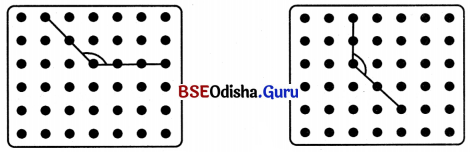
Find all the other angles inside the following rectangles.
Quadrilaterals Class 8 Solutions Maths Ganita Prakash Chapter 4 1
Solution:
Quadrilaterals Class 8 Solutions Maths Ganita Prakash Chapter 4 2
∠1 + ∠9 = 90° …. (All corner angles of a rectangle are 90°)
∠1 + 30° = 90°
∠1 = 90° – 30°
∠1 = 60°
∠1 = ∠5 = 60° … (Alternate interior angles)
∠9 = ∠4 = 30° … (Alternate interior angles)
In ΔAOB, OA = OB, then the angles opposite them are equal
∴ ∠9 = ∠7 = 30°
∠7 = ∠3 = 30° … (Alternate interior angles)
In ΔAOD, OA = OD, then the angles opposite them are equal
∴ ∠2 = ∠1 = 60°
∠2 = ∠6 = 60° … (Alternate interior angles)
In ΔAOB
∠9 + ∠7 + ∠AOB = 180° … (Sum of angles of a triangle)
30° + 30° + ∠AOB = 180°
60° + ∠AOB = 180°
∠AOB = 180° – 60°
∠AOB = 120°
∠AOB = ∠COD = 120° … (Vertically opposite angles)
∠AOB + ∠AOD = 180° … (Linear pair)
120° + ∠AOD = 180°
∠AOD = 180° – 120°
∠AOD = 60°
∠AOD = ∠BOC = 60° … (Vertically opposite angles)
Thus, ∠1 = ∠5 = ∠2 = ∠6= ∠AOD = ∠BOC = 60°.
∠AOB = ∠COD = 120°.
∠9= ∠4 = ∠7 = ∠3 = 30°.

(ii) The given rectangle is PSRQ.
Quadrilaterals Class 8 Solutions Maths Ganita Prakash Chapter 4 3
∠POS = ∠ROQ = 110° … (Vertically opposite angles)
∠POS + ∠POQ = 180° … (Linear Pair)
110°+∠POQ = 180°
∠POQ = 180° – 110°
∠POQ = 70°
∠POQ = ∠SOR = 70° … (Vertically opposite angles)
In ΔPOS, OP = OS, then the angles opposite them are equal.
∴ ∠1 = ∠2 = a
In ΔPOS,
∠1 + ∠2 + ∠POS = 180° … (Sum of all angles of a triangle)
a + a + 110° = 180°
2a = 180°- 110°
2a = 70°
a = 35°
∠1 = ∠2 = a = 35°
∠1 = ∠5 = 35° …. (Alternate interior angles)
∠2 = ∠6 = 35° … (Alternate interior angles)
Since ABCD is a rectangle, ∠P = 90°
∠9 = ∠1 + ∠8
90° = 35° + ∠8
∠8 = 90° – 35°
∠8 = 55°
∠8 = ∠4 = 55° …. (Alternate interior angles)
In ΔPOQ, OP = OQ, then the angles opposite to them are equal
i. e. ∠7 = ∠8 = 55°
∠7 = ∠2 = 55° … (Alternate interior angles)
Thus, ∠POS = ∠ROQ = 110°.
∠POQ = ∠SOR = 70°.
∠1 = ∠2 = 5 = ∠6 = 35°.
∠3 = ∠4 = ∠7 = ∠8 = 55°.

Quadrilaterals Class 8 Solutions Maths Ganita Prakash Chapter 4

Question 2.
Draw a quadrilateral whose diagonals have equal lengths of 8 cm that bisect each other, and intersect at an angle of
(i) 30°
(ii) 40°
(iii) 90°
(iv) 140°
Solution:
(i) Draw a line AB equal to 8 cm.
Take point M on AB such that AM = BM = 4 cm.
Using a protractor, draw an angle of 30° at M on MB. On this line, take points C and D such that MC = MD = 4 cm.
Join AD, DB, BC, and CA.
ABCD is the required quadrilateral.
Quadrilaterals Class 8 Solutions Maths Ganita Prakash Chapter 4 4
Since diagonals AB and CD are equal and are bisecting each other at M, ACBD is a rectangle.

(ii) Draw a line AB equal to 8 cm.
Take point M on AB such that AM = BM = 4 cm.
Using a protractor, draw an angle of 40° at M on MB.
On this line, take points C and D such that MC = MD = 4 cm.
Join AD, DB, BC, and CA.
ABCD is the required quadrilateral.
Quadrilaterals Class 8 Solutions Maths Ganita Prakash Chapter 4 5
Since diagonals AB and CD are equal and are bisecting each other at M, ACBD is a rectangle.

(iii) Draw a line AB equal to 8 cm.
Take a point M on AB such that AM = BM = 4 cm.
Using a protractor, draw an angle of 90° at M on MB.
On this line, take points C and D such that MC = MD = 4 cm.
Join AD, DB, BC, and CA.
ACBD is the required square.
Quadrilaterals Class 8 Solutions Maths Ganita Prakash Chapter 4 6
Since diagonals AB and CD are equal and are bisecting each other at M, and also the diagonals are perpendicular to each other, ACBD is a square.

(iv) Draw a line AB equal to 8 cm.
Take a point M on AB such that AM = BM = 4 cm.
Using a protractor, draw an angle of 140° at M on MB.
On this line, take points C and D such that MC = MD = 4 cm.
Join AD, DB, BC, and CA.
ACBD is the required quadrilateral.
Quadrilaterals Class 8 Solutions Maths Ganita Prakash Chapter 4 7
Since diagonals AB and CD are equal and are bisecting each other at M, ACBD is a rectangle.

Question 3.
Consider a circle with centre O. Line segments PL and AM are two perpendicular diameters of the circle. What is the figure APML? Reason and/or experiment to figure this out.
Solution:
In the figure, PL and AM are two perpendicular diameters of the circle. Let r be the radius of the circle.
Quadrilaterals Class 8 Solutions Maths Ganita Prakash Chapter 4 8
∴ PL = PO + OL
= r + r
= 2 r
and AM = AO + OM
= r + r
= 2 r
∴ PL = AM
∴ In the quadrilateral
APML, diagonals PL and
AM are equal and are perpendicular to each other.
Also, OP = OA = OL = OM = r
∴ Diameters PL and AM bisect each other at 0.
∴ Quadrilateral APML is a square.

Question 4.
We have seen how to get 90° using paper folding. Now, suppose we do not have any paper but two sticks of equal length, and a thread. How do we make an exact 90° using these?
Solution:
Quadrilaterals Class 8 Solutions Maths Ganita Prakash Chapter 4 9

  • Let AB and CD be two sticks of equal length, say 6 cm.
  • Mark the midpoints of the sticks using a ruler.
  • Fix a screw to the sticks at their midpoints.
  • Using a thread, measure distances AD and BD.
  • Keep on moving the sticks about the screw, so that the distances AD and BD are equal.
  • In this position, fix the sticks by tightening the screw.
  • The new positions of the sticks are shown in the figure.
  • The pieces of thread along AD and BD.
    Quadrilaterals Class 8 Solutions Maths Ganita Prakash Chapter 4 10
    Consider ΔAMD and ΔBMD.
    We have AM = BM, AD = BD and MD is common
    ∴ By the SSS condition,
    ΔAMD and ABMD are congruent.
    ∴ ∠AMD = ∠BMD
    Also ∠AMD + ∠BMD = 180° (Linear angles)
    ∴ ∠AMD + ∠AMD = 180°
    ⇒ 2 ∠AMD = 180°
    ⇒ ∠AMD = 90°
    ∴ ∠AMD = ∠BMD = 90°
    ∴ Angle between the sticks is 90°.

Question 5.
We saw that one of the properties of a rectangle is that its opposite sides are parallel. Can this be chosen as a definition of a rectangle? In other words, is every quadrilateral that has opposite sides parallel and equal a rectangle?
Solution:
No, this can’t be the definition of a rectangle. A quadrilateral with opposite sides parallel and equal is a parallelogram, but not all parallelograms are rectangles. A rectangle needs all angles to be right angles.

Quadrilaterals Class 8 Solutions Maths Ganita Prakash Chapter 4

2. QUADRILATERALS WITH EQUAL SIDELENGTHS
Figure it Out: Page : 102

Question 1.
Find the remaining angles in the following quadrilaterals.
Quadrilaterals Class 8 Solutions Maths Ganita Prakash Chapter 4 11
Solution:
(i) Here PR || EA, and PE || RA
Therefore, PEAR is a parallelogram.
∠P = ∠A = 40° … (Opposite angles of a parallelogram are equal)
∠ P + ∠R = 180° … (The sum of the adjacent angles of a parallelogram is 180°)
40° + ∠R = 180°
∠R = 180° – 40°
∠R = 140°.
∠R = ∠E = 140°… (Oppositeangles of a parallelogram are equal)

(ii) Here PQ // SR, and PS // QR
∴ PQRS is a parallelogram.
∠P = ∠R = 110° … (Opposite angles of a parallelogram are equal)
∠P + ∠S = 180° … (The sum of the adjacent angles of a parallelogram is 180°)
110° + ∠S = 180°
∠S = 180° – 110°
∠S = 70°.
∠S = ∠Q = 70° … (Opposite angles of a parallelogram are equal)

(iii) Here, XWVU is a rhombus (all sides equal).
In ΔVUX, UV = UX, then the angles opposite them are equal.
∴ ∠UXV = ∠UVX = 30°
∠UXV = ∠WXV = 30° ………….. (The diagonals of a rhombus bisect its angles)
Also, ∠UVX = ∠WVX = 30° ………….. (The diagonals of a rhombus bisect its angles)
∠E = 2 × ∠UVX = 2 × 30° = 60°
∠V = ∠X = 60° ………….. (Opposite angles of a rhombus are equal)
∠V + ∠U = 180° ………….. (The sum of adjacent angles of a rhombus is 180°)
60° + ∠U = 180°
∠U = 180° – 60°
∠U = 120°
∠U = ∠W = 120° ………….. (Opposite angles of a rhombus are equal)

(iv) Here, AEIO is a rhombus (all sides equal).
In ΔEAO, AE = AO, then the angles opposite them are equal.
∴ ∠AOE = ∠AEO = 20°
∠AEO = ∠IEO = 20° ………….. (The diagonals of a rhombus bisect its angles)
Also, ∠AOE = ∠IOE = 20° ………….. (The diagonals of a rhombus bisect its angles)
∠E = 2 × ∠AEO = 2 × 20° = 40°
∠E = ∠O = 40° ………….. (Opposite angles of a rhombus are equal)
∠E + ∠A = 180° ………….. (The sum of adjacent angles of a rhombus is 180°)
40° + ∠A = 180°
∠A = 180° – 40°
∠A = 140°
∠A = ∠I = 140° ………….. (Opposite angles of a rhombus are equal)

Question 2.
Using the diagonal properties, construct a parallelogram whose diagonals are of lengths 7 cm and 5 cm, and intersect at an angle of 140°.
Solution:
Quadrilaterals Class 8 Solutions Maths Ganita Prakash Chapter 4 12
Steps of construction:
(i) Draw a line segment AC of length 7 cm and mark its midpoint as 0.
(ii) At point 0, draw an angle of 140° with respect to diagonal AC.
(iii) At 0, along the 140° angle’s free arms in both directions, mark OD = 2.5 cm and OB = 2.5 cm using a compass.
(iv) Join D to A and C.
Join B to A and C.
So, ABCD is the required parallelogram.

Question 3.
Using the diagonal properties, construct a rhombus whose diagonals are of lengths 4 cm and 5 cm.
Solution:
Quadrilaterals Class 8 Solutions Maths Ganita Prakash Chapter 4 13
Steps of construction:
(i) Draw a line segment AC of length 5 cm.
(ii) Draw the perpendicular bisector of AC, intersecting it at 0.
(iii) With 0 as centre and radius 2 cm, mark points B (below) and D (above) on the perpendicular bisector.
(iv) Join A with D, D with C, B with A and C with B.
∴ ABCD is the required rhombus.

3. KITE AND TRAPE∠IUM
Figure it Out : Page : 107 – 109

Question 1.
Find all the sides and the angles of the quadrilateral obtained by joining two equilateral triangles with sides 4 cm.
Solution:
Quadrilaterals Class 8 Solutions Maths Ganita Prakash Chapter 4 13
Since all sides of an equilateral triangle are equal.
Thus, the lengths of all sides of the given quadrilateral are equal.
∴ PQ = QR = RS = SP = 4 cm.
Also, the measure of all angles of an equilateral triangle is 60°.
∠P = ∠R = 60°
∠S = ∠PSQ + ∠RSQ = 60° + 60° = 120°.
∠Q = ∠PQS + ∠RQS = 60° + 60° = 120°.

Question 2.
Construct a kite whose diagonals are of lengths 6 cm and 8 cm.
Solution:
Quadrilaterals Class 8 Solutions Maths Ganita Prakash Chapter 4 15
(i) Draw a line segment AC = 6 cm.

(ii) Construct the perpendicular bisector of AC; let it meet AC at 0 (so 0 is the midpoint).

(iii) With centre at 0 and radius 3 cm draw an arc to cut the bisector above AC; label that point D. With centre 0 and radius 5 cm draw an arc to cut the bisector below AC; label that point B.

(iv) Join A with B, B with C, C with D and D with A.
ABCD is the required kite.

Quadrilaterals Class 8 Solutions Maths Ganita Prakash Chapter 4

Question 3.
Find the remaining angles in the following trapeziums-
Quadrilaterals Class 8 Solutions Maths Ganita Prakash Chapter 4 16
Solution:
Quadrilaterals Class 8 Solutions Maths Ganita Prakash Chapter 4 17
Since AB // DC, and AD is a tranversal, then ∠A + ∠D = 180° … (Sum of angles on the same side of the transversal)
135° + ∠D = 180°
∠D = 180° – 135°
∠D = 45°
Also, since AB // DC, and BC is a tranversal, then So, ∠B + ∠C = 180°
… (Sum of angles on the same side of the transversal)
105° + ∠C = 180°
∠C = 180° – 105°
∠C = 75°
In the second figure :
Quadrilaterals Class 8 Solutions Maths Ganita Prakash Chapter 4 18
Since PQ // SR, and PS is a tranversal, then ∠P + ∠S = 180° … (Sum of angles on the same side of the transversal)
∠P + 100° = 180°
∠P = 180° – 100° = 80°.
∠S = ∠R = 100° … (In an isosceles trape∠ium base angles are equal)
Also, since PQ // SR, and QR is a tranversal,
So, ∠Q + ∠R = 180° … (Sum of angles on the same side of the transversal)
∠Q + 100° = 180°
∠Q = 180° – 100° = 80°.

Question 4.
Draw a Venn diagram showing the set of parallelograms, kites, rhombuses, rectangles, and squares. Then, answer the following questions –
(i) What is the quadrilateral that is both a kite and a parallelogram?
(ii) Can there be a quadrilateral that is both a kite and a rectangle?
(iii) Is every kite a rhombus? If not, what is the correct relationship between these two types of quadrilaterals?
Solution:
Quadrilaterals Class 8 Solutions Maths Ganita Prakash Chapter 4 19
(i) A rhombus is a quadrilateral that is both a kite and a parallelogram.

(ii) A kite is not a rectangle and a rectangle is not a kite.
∴ There can be no quadrilateral that is both a kite and a rectangle.
Also, there is no common portion of the set of kites and the set of rectangle.

(iii) No, every kite is not a rhombus.
Correct relationship:
Every rhombus is a kite, but not every kite is a rhombus.
Quadrilaterals Class 8 Solutions Maths Ganita Prakash Chapter 4 20

Question 5.
If PAIR and RODS are two rectangles, find ∠IOD.
Quadrilaterals Class 8 Solutions Maths Ganita Prakash Chapter 4 21
Solution:
Since PAIR and RODS are two triangles.
∠RIO = 90° … (Corner angle of a rectangle)
In ΔRIO,
∠IRO + ∠IOR + ∠RIO = 180° … (Sum of angles of a triangle)
30° + ∠IOR + 90° = 180°
120° + ∠IOR = 180°
∠IOR = 180° – 120° = 60°.
∴ ∠IOD = 90° – ∠IOR
= 90° – 60° = 30°.

Question 6.
Construct a square with diagonal 6 cm without using a protractor.
Solution:
Quadrilaterals Class 8 Solutions Maths Ganita Prakash Chapter 4 22
Steps of construction:
(i) Draw a line segment AC = 6 cm and mark its midpoint as O.

(ii) With O as centre and radius greater than half of AC, draw arcs above and below AC from points A and C.

(iii) Join the arcs intersections to get a line perpendicular to AC and passing through 0.

(iv) Again, with 0 as centre and radius equal to 3 cm, mark points B and D on the perpendicular line.

(v) Join (A, B), (C, B), (A, D) and (C, D). Hence, ABCD is the required square with a diagonals of 6 cm.

Question 7.
CASE is a square. The points U, V, W and X are the midpoints of the sides of the square. What type of quadrilateral is UVWX? Find this by using geometric reasoning, as well as by construction and measurement. Find other ways of constructing a square within a square such that the vertices of the inner square lie on the sides of the outer square, as shown in Figure (b).
Quadrilaterals Class 8 Solutions Maths Ganita Prakash Chapter 4 23
Solution:
(a) U, V, W, and X are the midpoints of the sides of the square.
In ΔVCU and ΔUAX,
we have VC = UA,
∠VCU = ∠UAX = 90°,
and CU = AX.
∴ By the SAS condition, ΔVCU and ΔUAX are congruent.
∴ VU = UX
Similarly, VU = XW, VU = WV.
∴ Sides of the quadrilateral UVWX are equal.
Quadrilaterals Class 8 Solutions Maths Ganita Prakash Chapter 4 24
In ΔVCU, VC = CU
⇒ ∠1 = ∠2
Also, ∠1 + ∠C + ∠2 = 180°
⇒ ∠1 + 90° + ∠1 = 180°
⇒ 2∠1 = 90°
⇒ ∠1 = 45°
∴ ∠2 is also 45°.
Similarly, ∠3 = ∠4 = 45°
We have ∠2 + ∠VUX + ∠3 = 180°
⇒ 45° + ∠VUX + 45° = 180°
⇒ ∠VUX = 180° – 90°
⇒ ∠VUX = 90°
Similarly, ∠VXW = 90°,
∠XWV = 90°
and ∠WVU = 90°.
∴ By definition, the quadrilateral UVWX is a square.

(b) Let ABCD be a square.
Take points P, Q, R, and S such that AS = BP = CQ = DR.
Quadrilaterals Class 8 Solutions Maths Ganita Prakash Chapter 4 25
Since the sides of squares are equal,
we have DS = AP = BQ = CR.
In ΔPAS and ΔSDR, we have
PA = SD,
∠PAS = ∠SDR = 90°,
and AS = DR.
∴ By the SAS condition, ΔPAS and ΔSDR are congruent.
∴ PS = SR
Similarly, PS = RQ, PS = QP.
∴ Sides of the quadrilateral PQRS are equal.
In ΔPAS, ∠1 + ∠2 + 90° = 180°
⇒ ∠1 + ∠2 = 90°
⇒ ∠3 + ∠2 = 90° (∵ ∠1 = ∠3)
Also, ∠2 + ∠4 + ∠3 = 180°
⇒ 90° + ∠4 = 180°
⇒ ∠4 = 180° – 90°
⇒ ∠4 = 90°
∴ Similarly, ∠5 = 90°,
∠6 = 90°,
and ∠7 = 90°.
By definition, the quadrilateral PQRS is a square.

Quadrilaterals Class 8 Solutions Maths Ganita Prakash Chapter 4

Question 8.
If a quadrilateral has four equal sides and one angle of 90°, will it be a square? Find the answer using geometric reasoning as well as by construction and measurement.
Solution:
Quadrilaterals Class 8 Solutions Maths Ganita Prakash Chapter 4 26
Let ABCD be a quadrilateral such that AB = BC = CD = DA and ∠DAB = 90°.
Join BD.
In ΔADB and ΔCDB, we have AD = CD, AB = CB, and DB is a common side.
∴ ΔADB and ΔCDB are congruent.
∴ ∠C = ∠A = 90°
In ΔDAB, ∠1 = ∠2 (∵ AB = AD)
Also, ∠1 + 90° + ∠2 = 180°
⇒ ∠1 + ∠2 = 90°
⇒ ∠1 = 45°
and ∠2 = 45° (∵ ∠1 = ∠2)
In ΔCDB, ∠3 = ∠4 (∵ CD = CB)
Also, ∠3 + 90° + ∠4 = 180°
⇒ ∠3 + ∠4 = 90°
⇒ ∠3 = ∠4 = 45° (∵ ∠3 = ∠4)
∴ ∠ABC = ∠1 + ∠4 = 45° + 45° = 90°
and ∠ADC = ∠2 + ∠3 = 45° + 45° = 90°.
∴ Each angle of the quadrilateral ABCD is 90°.
∴ ABCD is a square.
Also, by measurement, we find
AB = BC = CD = DA
and ∠A = ∠B = ∠C = ∠D = 90°.

Question 9.
What type of quadrilateral is one in which the opposite sides are equal? Justify your answer.
Hint: Draw a diagonal and check for congruent triangles.
Solution:
Quadrilaterals Class 8 Solutions Maths Ganita Prakash Chapter 4 27
Let ABCD be a quadrilateral in which opposite sides are equal. Join AC.
In ΔADC and ΔCDA,
AD = CB (given)
DC = BA (given)
AC = AC (common side)
By SSS condition, ΔADC ≅ ΔCBA.
∴ ∠1 = ∠3 and ∠2 = ∠4
AC is a transversal of lines AB and DC, and alternate angles ∠1 and ∠3 are equal.
∴ Lines AB and DC are parallel.
AC is a transversal of lines AD and BC, and alternate angles ∠2 and ∠4 are equal.
∴ Lines AD and BC are parallel.
∴ By definition, the quadrilateral ABCD is a parallelogram.

Question 10.
Will the sum of the angles in a quadrilateral such as the following one also be 360°? Find the answer using geometric reasoning as well as by constructing this figure and measuring.
Quadrilaterals Class 8 Solutions Maths Ganita Prakash Chapter 4 28
Solution:
In the given quadrilateral, join BD.
In ΔABD, we have
∠A + ∠3 + ∠1 = 180°
In ΔCBD, we have ∠C + ∠4 + ∠2 = 180°
Quadrilaterals Class 8 Solutions Maths Ganita Prakash Chapter 4 29
Adding, we get
(∠A + ∠3 + ∠1) + (∠C + ∠4 + ∠2) = 180° + 180°
⇒ ∠A + (∠3 + ∠4) + ∠C + (∠1 + ∠2) = 360°
⇒ ∠A + ∠B + ∠C + ∠D = 360°
∴ The sum of the angles of the quadrilateral ABCD is 360°.
Also, by using a protractor, we find that the sum of all angles is 360°.

Question 11.
State whether the following statements are true or false. Justify your answers.
(i) A quadrilateral whose diagonals are equal and bisect each other must be a square.
Solution:
False.
A quadrilateral whose diagonals are equal and bisect each other is a rectangle. A square is a special case of a rectangle where all sides are also equal.

(ii) A quadrilateral having three right angles must be a rectangle.
Solution:
True.
Three right angles force the fourth to be right angle as well and a quadrilateral with four right angles is a rectangle.

(iii) A quadrilateral whose diagonals bisect each other must be a parallelogram.
Solution:
True.
If the diagonals bisect each other, then the two triangles formed by a diagonal are congruent, which gives pairs of opposite sides parallel. Hence the figure is a parallelogram.

(iv) A quadrilateral whose diagonals are perpendicular to each other must be a rhombus.
Solution:
False.
Squares, kites, and some other quadrilaterals also have perpendicular diagonals. Therefore, having perpendicular diagonals does not necessarily mean the quadrilateral is a rhombus.

(v) A quadrilateral in which the opposite angles are equal must be a parallelogram.
Solution:
True.
If both pairs of opposite angles are equal, then each pair of adjacent angles are supplementary, which implies opposite sides are parallel. Hence the quadrilateral is a parallelogram.

(vi) A quadrilateral in which all the angles are equal is a rectangle.
Solution:
True.
If all four angles are equal, each angle must be 360°/4 = 90°. A quadrilateral with four right angles is a rectangle.

(vii) Isosceles trapeziums are parallelograms.
Solution:
False.
An isosceles trapezium has exactly one pair of parallel sides and equal non-parallel sides. While a parallelogram must have two pairs of parallel sides. So an isosceles trapezium is not a parallelogram.

Quadrilaterals Class 8 Solutions Maths Ganita Prakash Chapter 4

Quadrilaterals Class 8 Extra Questions

Multiple Choice Questions

Question 1.
The angles in a square are :
(a) 90° each
(b) 70° each
(c) 60° each
(d) 100° each
Solution:
Each angle of a square is 90°.
(a) 90° each

Question 2.
ABCD is a quadrilateral. Sum of angles ∠A + ∠B + ∠C + ∠D is :
(a) 180°
(b) 270°
(c) 360°
(d) 540°
Solution:
Sum of all angles of any quadrilateral is 360°.
(c) 360°

Question 3.
In a square ABCD, AC and BD are its two diagonals. Then which of the following is true?
(a) AC > BD
(b) BD > AC
(c) AC = BD
(d) AC + BD = AB
Solution:
Diagonals of a square are equal.
(c) AC = BD

Question 4.
In the following figure, ABCD is a rectangle. ∠AOB =
Quadrilaterals Class 8 Solutions Maths Ganita Prakash Chapter 4 30
(a) 90°
(b) 60°
(c) 45°
(d) 35°
Solution:
Here, ABCD is a rectangle.
Hence, ∠DAB = 90°
⇒ ∠DAO + ∠BAO = 90°
⇒ 30° + ∠BAO = 90°
⇒ ∠BAO = 90° – 30° = 60°
Now, if we consider ΔOAB, then .
OA = OB (∵, diagonals are equal and they bisect each other)
∴, ΔOAB is an equilateral Δ as ∠BAO = 60°
So, ∠AOB = 60°

Question 5.
In the following figure, ABCD is a rectangle. ∠OAB =
Quadrilaterals Class 8 Solutions Maths Ganita Prakash Chapter 4 31
(a) 60°
(b) 30°
(c) 45°
(d) 90°
Solution:
In ΔOAB, if ∠AOB = 60° then all of its angles are 60° each.
(a) 60°

Assertion and Reasoning

(a) Assertion (A) and Reason (R) both are true and Reason (R) is the correct explanation for the Assertion (A).
(b) Assertion (A) and Reason (R) both are true but Reason (R) is not the correct explanation for the Assertion (A).
(c) Assertion (A) is true but Reason (R) is false.
(d) Assertion (A) is false but Reason (R) is true.

Question 1.
Assertion (A) : In a quadrilateral ABCD, if ∠A = 40°, ∠B = 90° and ∠C = 110°, then ∠D = 120°.
Reason (R) : Sum of all angles of a quadrilateral is 380°.
Solution:
Reason (R) is false as sum of all angles of a quadrilateral is 360°.
Answer:
(c) Assertion (A) is true but Reason (R) is false.

Question 2.
Assertion (A) : If PQRS is a square, then ∠P = 90°.
Reason (R) : Each angle of a square is 90°.
Solution:
In a square PQRS, ∠P = ∠Q = ∠R = ∠S = 90°.
So, ∠P = 90°.
Answer:
(a) Assertion (A) and Reason (R) both are true and Reason (R) is the correct explanation for the Assertion (A).

Quadrilaterals Class 8 Solutions Maths Ganita Prakash Chapter 4

Case Based Questions

Question 1.
A carpenter needs to put together two thin strips of laminates, as shown in the following figure, So that when a thread is passed through their end points, it forms a rectangle.
She already has one 12 cm long strip.
Quadrilaterals Class 8 Solutions Maths Ganita Prakash Chapter 4 32
Based on the above, answer the following:
(a) What should be the length of the other strip?
(b) At what point they should be joined?
(c) If thread is passed through B, E, S, T, then what will be the angle between the arms BT and BE?
(d) Will the lengths of BT and ES same? Why?
Answer:
(a) The lengths of both the strips must be same. Hence, the length of the other strip must be 12 cm.

(b) The two strips must be joined at O.

(c) The resultant figure is a rectangle. In a rectangle, the opposite sides are equal. Hence, BT = ES.

Exploring Forces Class 8 Question Answer Science Chapter 5

Go through BSE Odisha Class 8 Science Solutions Chapter 5 Exploring Forces Question Answer to understand textbook questions more clearly.

Class 8 Science Curiosity Chapter 5 Question Answer

Class 8 Science Ch 5 Exploring Forces Question Answer

Class 8 Science Chapter 5 Exploring Forces Question Answer

Probe and Ponder Questions

Question 1.
Why does it feel harder to pedal a bicycle when going uphill than on flat ground?
Answer:
When we cycle uphill, we’re constantly fighting against the Earth’s gravitational pull, which tries to pull us back down. This force acts perpendicular to the ground on a flat surface, meaning it doesn’t directly oppose our forward movement. But on a slope, a portion of the gravity acts against our direction of motion, requiring us to exert more force to move forward and upward.

Question 2.
Why is it easier to slip on a wet surface?
Answer:
It is easier to slip on a wet surface due to reduced friction between the foot and the surface. Water acts as a lubricant, minimizing the grip and making it easier to slide.

Exploring Forces Class 8 Question Answer Science Chapter 5

Question 3.
Why do we feel ‘light’ or like we are ‘floating’ just after our swing reaches its highest point and begins to come down?
Answer:
When the swing reaches its highest point, it momentarily comes to rest before moving downward. A this point, gravity still acts downward, but the support (normal) force exerted by the swing on our body decreases. Because the normal force is reduced, we feel less push from the swing, which makes us feel “light” or as if we are “floating” for a brief moment.

Question 4.
Share your questions
Answer:

  • Why does sliding work better on ice than on sand?
  • What would happen if friction did not exist at all?
  • Why do heavier objects sink more in water than lighter ones of the same size?
  • Does air also provide friction to moving objects?
  • Why can some birds fly easily for long periods without getting tired?

InText Questions

Question 1.
Does this mean that whenever there is a change in speed or direction, or change in shape, a force is acting on the object? (Page 65)
Answer:
Yes, none of these take place without the action of force.

Question 2.
Suppose an object is at rest. Does it mean that no force is acting on this object? (Page 65)
Answer:
No, the forces are acting on this object. But all these forces acting on them are balancing one another. That is why an object is at rest.

Question 3.
Does this mean that the force of friction will be greater if the surfaces are rough? (Page 68)
Answer:
Yes, more the roughness of a surface, larger is the number of irregularities on its surfaces and hence greater will be the friction.

Exploring Forces Class 8 Question Answer Science Chapter 5

Question 4.
Is it essential for an object applying force on another object to always be in contact with it? (Page 69)
Answer:
No. Forces can be applied either through direct contact (contact forces) or without direct contact (non-contact forces) such as gravitational or magnetic forces.

Question 5.
Does it mean that there are two kinds of electrical charges?(Page 71)
Answer:
Yes, there are two kinds of electrical charges ‘positive’ and ‘negative’.

Question 6.
Why do all the objects fall towards the Earth? (Page 72)
Answer:
All the objects fall towards the Earth because the Earth attracts (pull) them. This force is called gravitational force.

Question 7.
Is there any force which acts on them. ? What exerts this force ?(Page 72)
Answer:
Yes, there is a force acting on any object in the universe, and it is called gravity. Gravity is a force of attraction that exists between any two objects with mass. The Earth, due to its large mass, exerts a gravitational orce on all objects near it, pulling them towards its center.

Question 8.
Does the Earth pull every object with equal force ? (Page 72)
Answer:
No, the Earth does not pull every object with equal force. The force of gravity is stronger on objects with greater mass. While the Earth exerts a gravitational pull on all objects, the strength of that pull depends on the mass of the object being attracted.

Question 9.
What is the difference between weight and mass ? (Page 75)
Answer:
Mass is the amount of matter in an object and is measured in grams (g) or kilograms (kg). Its value remains the same at every place. Weight, on the other hand, is the gravitational force with which the Earth (or another planet) pulls an object.

Exploring Forces Class 8 Question Answer Science Chapter 5

Question 10.
If we place some objects on water, some of them float, while others fall to the bottom. The gravitational force of the Earth is acting on all objects, then why don’t all objects fall to the bottom? (Page 76)
Answer:
While the Earth’s gravitational force acts on all objects, whether they sink or float in water depends on the buoyant force and the density of the object relative to water. Objects with a density lower than water experience a stronger buoyant force, causing them to float, while those with a higher density experience a weaker buoyant force and sink.

Exploring Forces Class 8 Questions and Answers

Keep the Curiosity Alive (Pages 25-26)

Question 1.
Match items in Column A with the items in Column B.
Electricity Magnetic and Heating Effects Class 8 Question Answer Science Chapter 4.1
Answer:

Column A (Type of force) Column A (Type of force)
(i) Muscular force (b) A child lifting a school bag
(ii) Magnetic force (e) A compass needle pointing North
(iii) Frictional force (a) A cricket ball stopping on its own just before touching the boundary line
(iv) Gravitational force (c) A fruit falling from a tree
(v) Electrostatic force (d) Balloon rubbed on woollen cloth attracting hair strands

Question 2.
State whether the following statements are True or False.
(i) A force is always required to change the speed of motion of an object.
(ii) Due to friction, the speed of the ball rolling on a flat ground increases.
(iii) There is no force between two charged objects placed at a small distance apart.
Answer:
(i) True: A force is indeed always required to change the speed of motion of an object. If there is no force acting on an object, it will maintain its current speed and direction (unless it’s already at rest, in which case it will stay at rest).
(ii) False: Friction opposes motion, so it will decrease the speed of a rolling ball.
(iii) False: There is a force between charged objects. This force can be attractive or repulsive depending on the charges. But it is always present when charges are close to each other.

Question 3.
Two balloons rubbed with a woollen cloth are brought near each other. What would happen and why?
Answer:
When two balloons are rubbed with a woollen cloth and brought near each other, they will repel each other. This happens because both balloons will acquire a negative charge when rubbed with wool, and like charges repel.

Question 4.
When you drop a coin in a glass of water, it sinks, but when you place a bigger wooden block in water, it floats. Explain.
Answer:
A coin sinks in water because its density (mass per unit volume) is greater than that of water. A wooden block floats because its density is less than that of water, causing it to be buoyed up by the water.

Exploring Forces Class 8 Question Answer Science Chapter 5

Question 5.
If a ball is thrown upwards, it slows down, stops momentarily, and then falls back to the ground. Name the forces acting on the ball and specify their directions.
(i) During its upward motion
(ii) During its downward motion
(iii) At its topmost position
Answer:
When a ball is thrown upwards, the only force acting on it throughout its entire motion is gravity, which pulls it downwards. However, depending on the motion of the ball, the direction of this force relative to the ball’s velocity changes.
(i) During its upward motion: The force of gravity is downwards, opposing the upward motion of the ball, causing it to slow down.
(ii) During its downward motion: The force of gravity is still downwards, but now it aligns with the ball’s direction of motion, accelerating it downwards.
(iii) At its topmost position: The ball has zero velocity, meaning it’s momentarily stationary. At this point, the force of gravity is still downwards, but since the ball is not moving upwards or downwards, it has no net effect on the ball’s motion.

Question 6.
A ball is released from the point P and moves along an inclined plane and then along a horizontal surface as shown in the fig. It comes to stop at the point A on the horizontal surface. Think of a way so that when the ball is released from the same point P, it stops
(i) before the point A
(ii) after crossing the point A.
Exploring Forces Class 8 Question Answer Science Chapter 5.2
Answer:
The ball’s motion is governed by the forces of gravity and friction. On the inclined plane, gravity provides the acceleration for the motion. On the horizontal surface, only friction acts on the ball.

  • Stopping before A: Increasing friction on the horizontal surface will cause the ball to decelerate more rapidly, meaning it will come to a stop sooner, potentially before reaching point A.
  • Stopping after A: Decreasing friction on the horizontal surface will reduce the deceleration, allowing the ball to travel further before losing all its kinetic energy and stopping.

Question 7.
Why do we sometimes slip on smooth surfaces like ice or polished floors? Explain.
Answer:
When we walk on surfaces like ice, we often slip, which means we lose our balance and fall. This happens because the force that helps us stay upright and move forward (friction) is not enough. These surfaces have fewer irregularities. Minimizing the contact area and the force of friction between the surface and our shoes makes it easier to slide instead of grip. A layer of water, even a thin one on ice, can further reduce friction by acting as a lubricant, making the surface even more slippery.

Question 8.
Is any force being applied to an object in a non-uniform motion?
Answer:
Yes, for an object to be in non-uniform motion, a force must be acting upon it. Nonuniform motion, also known as accelerated motion, means the object’s velocity is changing, either in speed or direction, or both. This change in velocity requires a force to be applied.

Question 9.
The weight of an object on the Moon becomes one-sixth of its weight on the Earth. What causes this change? Does the mass of the object also become one-sixth of its mass on the Earth?
Answer:
The change in an object’s weight on the moon compared to Earth is due to the difference in gravitational force. The moon’s gravity is significantly weaker than Earth’s, roughly one-sixth as strong. However, the mass of an object remains the same regardless of location; only weight changes with gravitational pull.

Exploring Forces Class 8 Question Answer Science Chapter 5

Question 10.
Three objects 1,2 and 3 of the same size and shape but made of different materials are placed in the water. They dip to different depths as shown in fig. If the weights of the three objects 1,2 and 3 are w1, w2, and w3, respectively, then
Exploring Forces Class 8 Question Answer Science Chapter 5.3
(i) w1=w2=w3
(ii) w1>w2>w3
(iii) w2>w3>w1
(iv) w3>w1>w2
Answer:
(ii) The relationship between the weights of the objects is w1>w2>w3.
Object 1 is the deepest meaning it displaces the most water.
Object 2 is less deep than object 1 but deeper than object 3.
Object 3 is the least deep, meaning it displaces the least amount of water.
Since the objects have the same size and shape, the greater the depth, the greater the weight of the object (assuming they are all made of the same material).
Hence, the object with the greatest weight will sink the deepest, and the object with the least weight will be the closest to the surface.

Class 8 Science Chapter 5 Question Answer

Activity 1.

Let us explore
Aim: To experience the push or pull.
Materials Required: A large cardboard box, a rope.

Exploring Forces Class 8 Question Answer Science Chapter 5.4
Procedure :

  • Take a heavy and large cardboard box.
  • Try to push or pull it by yourself.
  • Try to move the box in as many different ways as you can do.
  • Are you able to move the box in any other way than shown in fig?

Answer:
It is really very difficult to move.
Observations: In every method you are either pushing or pulling the box.

Inferences:

  • No matter how you chose to move the box – by dragging, sliding, rolling, lifting etc. Some form of push or pull is always involved.
  • Generally, the push or pull applied on an object is called force.

Exploring Forces Class 8 Question Answer Science Chapter 5

Activity 2.

Let us analyse
Aim: To analyse and study the effect of force.

Exploring Forces Class 8 Question Answer Science Chapter 5.6

Procedure:

  • Think of different examples and situations where a force either push or pull is applied.
  • List them in the table given below.
  • Write the effect of the force in the table also.
  • Some of them are already listed for you.

Observations :
Different actions and their effects
Exploring Forces Class 8 Question Answer Science Chapter 5.5
Answer:
Exploring Forces Class 8 Question Answer Science Chapter 5.7
Inferences:
We have noticed that the effect of the force are :

  • A force can make an object move from rest.
  • A force can change the speed of an object if it is moving. Either increase or decrease.
  • A force can change the direction of motion of an object.
  • A force can bring about a change in the shape of an object.
  • A force can cause some or all of these effects.

Activity 3.

Let us investigate
Aim : To show that friction always opposes the relative motion between the two bodies, irrespective of the direction of motion.
Materials Required : A book.
Exploring Forces Class 8 Question Answer Science Chapter 5.8

Procedure :

  • Gently push a book on a table.
  • It stops after moving for some distance.
  • Repeat this activity pushing the book from the opposite direction. [Fig. (b).
  • Does the book stop this time, too? Yes, the book stop this time too.
  • Can you think of an explanation ?
    The book slides for some time and then stops. The reason is that

Exploring Forces Class 8 Question Answer Science Chapter 5.9

Inference:
The force acting along the two surfaces in contact which opposes the motion of one body over the other, is called the force of friction.

Exploring Forces Class 8 Question Answer Science Chapter 5

Activity 4.

Let us explore
Aim: To study that force of friction depends upon the nature of the two surfaces in contact.
Materials Required: A wooden board, a pencil cell, bricks or books, a piece of cloth, sand.

Exploring Forces Class 8 Question Answer Science Chapter 5.10
Procedure:

  • Make an inclined plane on a smooth floor, or on a table. (You may use a wooden board supported by bricks or books).
  • Put a mark with a pen at any point ‘A’ on the inclined plane.
  • Now let a pencil cell move down from this point.
  • How far does it move on the plane before coming to rest ?
    It moves up to the end of the inclined plane and comes to rest on the table.
  • Note down the distance.
  • Now spread a piece of cloth over the table. Make sure that there are no wrinkles in the cloth.
    Try this activity again [Fig. (b).
  • Repeat this activity by spreading a thin layer of sand over the table. Maintain the same slope throughout the activity.
    Inference: Friction depends upon the nature of surfaces in contact.

Activity 5.

Let us test
Aim : To show that a magnet can exert force on another magnet without being in contact with it.
Materials Required : Two ring magnets, a wooden stick.

Exploring Forces Class 8 Question Answer Science Chapter 5.11

Procedure :

  • First of all we will take two ring magnets and a wooden stick.
  • Now, hold the stick in a vertical position on a wooden table.
  • Insert one ring magnet into the stick. (See fig.)
  • Now, take another ring magnet and insert in such a way that like poles of two magnets face each other.

Observations:

  • Second magnet stay floating above the first magnet. It means that they repel each other.
  • The second magnet still remains floating after reversing the poles of both magnets.

Inference:

  • A magnet can exert force on another magnet without being in contact with it.
  • The force exerted by a magnet on another magnet or a magnetic material is called magnetic force. Since a magnet can exert a force from a distance without being in contact it is called a non-contact force.

Activity 6.

Let us experiment
Aim: To show electrostatic force.
Materials Required : A plastic straw, a plastic scale, a piece of polythene and small piece of paper.

Exploring Forces Class 8 Question Answer Science Chapter 5.12

Procedure :

  • Take a plastic scale/straw and rub it vigorously with polythene.
  • It is advised that never touch the rubbed part with your hand or any other metal object.
  • Bring the rubbed straw or scale close to the small pieces of paper which is kept on the table.
  • Do not touch the paper.
  • Write down your observations.

Observations:
The paper pieces get pulled towards the plastic scale/straw and stick to it when it is brought close to paper pieces.

Inference:

  • When two objects are rubbed, electrical charges are build up on their surfaces which is called static charges.
  • A charged object attract an uncharged objects like small pieces of paper.
  • This is called electrostatic force and comes into play even when the two bodies are not in contact.

Exploring Forces Class 8 Question Answer Science Chapter 5

Activity 7.

Let us experiment
Aim: To show that like charges repel and unlike charges attract each other.
Materials Required: Two balloons, a length of thread, and a woollen cloth.

Exploring Forces Class 8 Question Answer Science Chapter 5.13

Procedure:

  • First of all we will take two balloons, a thread and a woollen cloth.
  • Now, inflate the two balloons and hang them.
  • We should be careful that the two balloons do not touch each other. (See fig. (a))
  • Now, rub both balloons with the woollen cloth and release them. Remember that these two balloons should not be touched with your fingers. Note down your observation.
  • Now, bring the woollen cloth used for rubbing the balloons close to one of the rubbed balloons. Note down your observation.

Observations :

  • Case-I: The balloons move away from each other i.e., repelling each other.
  • Case-II: They attract each other.

Inference:

  • The force exerted by a charged body on another charged body or an uncharged body is called electrostatic force. It is a non-contact force.
  • We can infer that like or similar charged body repel each other and unlike (opposite) charged bodies attract each other.
  • The two kinds of static charges are said to be ‘positive’ and ‘negative’ charges.

Activity 8.

Let us observe
Aim: To demonstrate the gravitational force.
Materials Required: A ball, a stone or any object around you.

Exploring Forces Class 8 Question Answer Science Chapter 5.15
Procedure :

  • Take a ball or a stone or your eraser and throw it vertically upwards.
  • Now, throw it again, but this time harder than previous.
  • Not down your observations in both the cases.
  • You may think of different situations around you and can throw any object in any direction.

Observations :

  • Case-I: The ball or stone come down.
  • Case-II: Even in this case also the ball still fall back down to the ground but takes little more time.

Inference:

  • Finally all objects falls or comes back to the ground or floor.
  • This shows that some force is acting in downward direction. This is called the gravitational force or force of gravity or simply gravity.

Exploring Forces Class 8 Question Answer Science Chapter 5

Activity 9.

Let us explore
Aim : To show that the earth pulls different objects with different forces and it depends on their masses.
Materials Required : A spring, a few objects of different masses e.g., a pencil box, a tiffin box, a small stone.

Exploring Forces Class 8 Question Answer Science Chapter 5.16

Procedure :

  • Hang one end of the spring from a nail and on the other end, hang an object and observe the spring.
  • When you suspend an object from a spring, the spring stretches due to the force applied by the earth.
  • Now hang the other objects, one by one and notice the stretch in the spring in each cases.

Observations: If you hang objects of different mass one after another, each time causes a different amount of stretching.
Inference: This proves that heavier objects are pulled with more force i.e., the weight of an object depends on its mass; heavier objects have greater weight.

Activity 10.

Let us observe
Aim : To measure maximum weight by a spring balance.
Materials Required : A spring balance.

Exploring Forces Class 8 Question Answer Science Chapter 5.17

Procedure :

  • Take a spring balance and hang it as shown in fig.
  • Now, look at the spring balance carefully.
  • What is the maximum weight it can measure ?

Observations :

  • The maximum weight a spring balance can measure is 10 N.
  • Range of spring balance is the maximum weight it can measure.

Inference : If a spring balance shows values from 0 to 10 N , its range is 0.10 N . means that it can measure weight upto 10 N.

Activity 11.

Let us calculate
Aim: To determine the smallest readable value (Least count) of and close-up of its scale a spring balance.
Materials Required: A spring balance.

Exploring Forces Class 8 Question Answer Science Chapter 5.18

Procedure :

  • Note down the weight difference indicated between the two bigger marks.
  • The weight difference between 0 and 01 N or between 01 N and 02 N is 1 N.
  • Count the number of divisions between these two bigger marks.

Demonstration :

1. Weight different between 0 and 1 N or between 01 N and 2 N =1 N Number of divisions between 0 and 1 or 1 and 2=5
∴ Least count = \(\frac{1}{5}\)=0.2 N

Inference:

  • The least count of a spring balance is the smallest difference in weight it can measure.
  • So, the least count of a spring balance is 0.2 N.

Exploring Forces Class 8 Question Answer Science Chapter 5

Activity 12.

Let us measure
Aim: To measure the weight and mass of an object using a spring balance.
Materials Required: Pencil box, water bottle filled with water partially.

Procedure :

  • Hang a spring balance from the hook of a spring balance (without exceeding its maximum range).
  • The pointer or reading on the scale shows the object’s weight in newtons (N).
  • This method can be repeated for many objects and results should be recorded in a table.
  • The mass scale (in g/kg) on a spring balance assuming earth’s gravity.
  • The mass reading is only correct on earth where gravitational acceleration is standard.
  • You can repeat the above Activities-10 to 12 for the mass scale which is shown on the left side on the spring balance (Fig. 13) to measure the mass of an object.

Observations :
Measuring weight using a spring balance

S.No. Object Weight (N)
1. Pencil Box
2. Partially filled water bottle

Inference: We can measure the weight and mass of an object using a spring balance.

Activity 13.

Let us investigate
Aim: To experience a buoyant force or upthrust by a liquid.
Materials Required: A bucket, an empty plastic bottle.

Exploring Forces Class 8 Question Answer Science Chapter 5.19

Procedure:

  • Take an empty plastic bottle (with its lid closed tightly) and a bucket full of water.
  • Now, push the bottle in the water. (See fig.)
  • You will feel an upward force or push.
  • Does the bottle bounce up and comes on top of water ?

Observation:

  • Yes, we feel an upward push on our hand.
  • The bottle bounces back up when released.

Exploring Forces Class 8 Question Answer Science Chapter 5

Inference:

  • Gravity (gravitational force acts on downward direction i.e., pulls downward. The buoyant force (upthrust) pushes it upwards.
  • If the gravitational force (weight of the object) is greater than buoyant force, the object sinks. i.e. W>U, sink
  • If the two forces are equal i.e., W=U, the object floats.
  • The density of the liquid affects the buoyant force.

Exploring Forces Class 8 Extra Questions and Answers

Short Answer Type Questions

Question 1.
What is electrostatic force ? Why is it called non-contact force?
Answer:
The force exerted by a charged body on another charged or uncharged body is called electrostatic force. This force comes into play even when the bodies are not in contact, so it is called non-contact force.

Question 2.
What is Muscular Force ? Why is the force called contact force?
Answer:
Muscular Force : The force resulting due to the action of muscles is called Muscular Force. Since muscular force can be applied on an object when muscle is in contact with the object, so it is called a contact force.

Question 3.
What causes friction ?
Answer:
Friction occurs when two bodies move on each other. Each surface has some irregularities on it. When two such objects move on each other their irregularities get interlocked and friction arises.

Question 4.
You might have noticed that when used for a long time, slippers with rubber soles become slippery. Explain the reason.
Answer:
After using a rubber soles for a long time, their surfaces become smooth. Hence, the friction between the sole and the floor decreases. So, the slippers become slippery.

Question 5.
A blacksmith hammers a hot piece of iron while making a tool. How does the force due to hammering affect the piece of iron?
Answer:
The force due to hammering causes the change in the shape of the iron and iron can be moulded in the shape of the required tool.

Exploring Forces Class 8 Question Answer Science Chapter 5

Question 6.
Iqbal has to push a lighter box and Seema has to push a similar heavier box on the same floor. Who will have to apply a larger force and why ?
Answer:
The heavy object will be pressed hard against the opposite surface and produces more friction. So Seema will have to apply a larger force due to excess friction.

Long Answer Type Questions

Question 1.
In the following situations identify the agent exerting a force and the object on which it acts. State the effect of the force in each case.
(a) Squeezing a piece of lemon between the fingers to extract its juice.
(b) Taking out paste from a toothpaste tube.
(c) A load suspended from a spring while its other end is on a hook fixed to a wall.
(d) An athlete making a high jump to clear the bar at a certain height.
Answer:
(a) Agent are fingers, object is lemon, effect of force can be observable in form of lemon juice being expelled by squeezing.
(b) Agent is hand of the person squeezing the tube, object is toothpaste tube and effect of the force can be observed as the paste coming out of the tube.
(c) Agent is the load suspended, object is the spring and effect can be seen in the form of elongation of spring on suspension of load.

Question 2.
What are the different types of forces ? Give an example of each.
Answer:
Types of forces : The following are the different types of forces :
(a) Muscular force
(b) Magnetic force
(c) Electrostatic force
(d) Gravitational force
(e) Frictional force
(a) Muscular Force : The force applied by a living being with its muscles is known as muscular force e.g., bullocks apply muscular force to draw a cart.
(b) Magnetic Force : The force exerted by a magnet is called magnetic force. Example: A magnet attracts nails and pins made fron iron even from some distance.
(c) Electrostatic Force : The force exerted by an electrified body is called electrostatic force. Example : Pieces of paper get attracted towards a charged comb.
(d) Gravitational Force : The force of attraction between any two objects possessing mass is called force gravitation. An object dropped from a certain height falls on the earth due to the gravitational force.
(e) Frictional Force : The force which always opposes the motion of one body over another body is called frictional force. Example, a marble rolled on the ground stops after some time due to the frictional force.

Question 3.
An archer shoots an arrow in the air horizontally. However, after moving some distance, the arrow falls to the ground. Name the initial force that sets the arrow in motion. Explain why the arrow ultimately falls down.
Answer:
When an archer shoots an arrow he stretches the string of the bow by applying muscular force. In this process the shape of the bow changes. As soon as the string is released, it regains its original position which provides the initial force to set the arrow in motion. The force of gravity that acts on the arrow in the downward direction which finally brings it to the ground.

Case-Study Based Questions

1. Read the following passage carefully and answer the questions that follow :

Generally, to apply a force on an object, your body has to be in contact with the object. The contact may also be with the help of a stick or a piece of rope. This force is caused by the action of muscles in our body. The force resulting due to the action of muscles is known as the muscular force. Animals also make use of muscular force to carry out their physical activities and other tasks. Animals like bullocks, horses, donkeys and camels are used to perform various tasks for us. In per-forming these tasks they use muscular force. Since muscular force can be applied only when it is in contact with an object, it is also called a contact force.

Exploring Forces Class 8 Question Answer Science Chapter 5

Like Poles of two magnets repel each other and unlike poles attract each other. A straw is said to have acquired electrostatic charge after it has been rubbed with a sheet of paper. Such a straw is an example of a charged body. The force exerted by a charged body on another charged or uncharged body is known as electrostatic force. This force comes into play even when the bodies are not in contact. The electrostatic force, therefore, is another example of a non-contact force.

Similarly, the force exerted by a magnet on a piece of iron is also a noncontact force. Objects or things fall towards the earth because it pulls them. This force is called the force of gravity, or just gravity. This is an attractive force. The force of gravity acts on all objects. The force of gravity acts on all of us all the time without our being aware of it. Water begins to flow towards the ground as soon as we open a tap. Water in rivers flows downward due to the force of gravity.

(i) Gravity is : …………..
(a) Repulsive
(b) Attraction + Repulsive force
(c) Attractive force
(d) Not a force
Answer:
(c) Attractive force

(ii) An example of a non-contact force is :
(a) force exerted by us to lift a bucket
(b) pushing a stationary car
(c) force exerted by magnet
(d) hitting a circket ball for a 6 run
Answer:
(c) force exerted by magnet

(iii) The force exerted by a charged body on another charged body can :
(a) attract each other
(b) both (a) and (c)
(c) repel each other
(d) none of these
Answer:
(b) both (a) and (c)

(iv) Two objects repel each other. This repulsion could be due to charged or uncharged body is :
(a) magnetic force
(b) frictional force
(c) musculer force
(d) electrostatic force
Answer:
(d) electrostatic force

Picture Based Questions

I. Observe the picture and answer the following questions :
Exploring Forces Class 8 Question Answer Science Chapter 5.20
(i) Why do soles of shoes wear out?
(a) Due to friction
(b) Due to
old shoes
(c) Due to bad quality
(d) None of
Answer:
(a) Due to friction

Exploring Forces Class 8 Question Answer Science Chapter 5

(ii) Can it is possible to reduce friction upto zero ?
(a) Yes
(b) No
(c) Some times
(d) 50-50
Answer:
(b) No

Exploring Forces Class 8 MCQ

Multiple Choice Questions (Mcqs)

Question 1.
What is the SI unit of force ?
(a) Newton
(b) Joule
(c) Watt
(d) Kilogram
Answer:
(a) Newton

Question 2.
What is force described as in science ?
(a) Pressure
(b) Push or pull
(c) Friction
(d) Energy
Answer:
(b) Push or pull

Question 3.
Which of these is a non-contact force ?
(a) Friction
(b) Electrostatic force
(c) Tension
(d) Muscular force
Answer:
(b) Electrostatic force

Question 4.
What causes an object thrown upwards to return to earth ?
(a) Air pressure
(b) Gravity
(c) Electrostatics
(d) Friction
Answer:
(b) Gravity

Question 5.
Which of the following changes can a force cause ?
(a) Director change in
(b) Shape change in
(c) Speed change in
(d) All of these
Answer:
(d) All of these

Assertion and Reasoning

These questions consist of two statements, each printed as Assertion (A) and Reason (R). While answering these questions, you are required to choose any one of the following four responses.

(a) Assertion and reason both are correct and reason is correct explanation for assertion.
(b) Assertion and reason both are correct and reason is not correct explanation for assertion.
(c) Assertion is correct but the reason is wrong.
(d) Assertion is wrong but the reason is correct.

1. Assertion (A): A push or a pull on an object is called a force.
Reason (R): Forces applied on an object in the same direction add to one another.
Answer:
(b) Assertion and reason both are correct and reason is not correct explanation for assertion.

2. Assertion (A): A change in either the speed of an object, or its direction of motion, or both, is described as a change in its state of motion.
Reason (R): A force may bring a change in the state of motion of an object.
Answer:
(a) Assertion and reason both are correct and reason is correct explanation for assertion.

Fill in the blanks

1. To strecth the bow, the archer applies a force that causes a change in its ………….
Answer:
shape

2. The force applied by the archer to stretch the bow is an example of ………… force.
Answer:
muscular

3. The type of force responsible for a change in the state of motion of the arrow is an example of a ………… force.
Answer:
contact

4. While the arrow moves towards its target, the forces acting on it are due to ………… and that due to ………… of air.
Answer:
gravity and friction

5. A force arises due to ………… between two objects.
Answer:
interaction

True or False

1. A cyclist exerts a force of pull on the paddles of bicycle.
Answer:
False

2. Magnetic force is a contact force.
Answer:
False

Exploring Forces Class 8 Question Answer Science Chapter 5

3. A force can change the direction of motion of a moving object.
Answer:
True

4. The S.I. unit of pressure is newton per square metre.
Answer:
True

5. Pressure due to a liquid contained in a vessel is equal to all the points on its surface.
Answer:
True

A Story of Numbers Class 8 Solutions Maths Ganita Prakash Chapter 3

Students can refer to BSE Odisha Class 8 Math Solution and Ganita Prakash Chapter 3 A Story of Numbers Class 8 Question Answer to understand textbook questions step by step.

Class 8 Maths Chapter 3 A Story of Numbers Solutions

Ganita Prakash Class 8 Chapter 3 Solutions

Class 8 Maths Ganita Prakash Chapter 3 Solutions A Story of Numbers

1. REEMA’S CURIOSITY
Page : 51

Question 1.
How do we ensure that all cows have returned safely after grazing?
Answer:
To ensure all cows return safely after grazing, farmers should use a combination of proper fencing and herd management, including counting cows as they enter and leave paddocks, using incentives like feed to encourage return to the holding area, and having a routine that minimizes the risk of lost or separated animals. Regular observation, clear containment through effective fencing, and understanding the animals’ natural behaviors are crucial for a safe herd return.

Question 2.
Do we have fewer cows than our neighbour?
Answer:
How to solve the problem
1. Identify the variables – Look for two specific numbers:
(i) The number of cows you have.
(ii) The number of cows your neighbor has.

2. Compare the numbers – Using the greater than (> is greater than >) and less than (< is less than <) symbols and compare the two numbers.
(i) If your cows < neighbor’s cows, then you have fewer cows.
(ii) If your cows > neighbor’s cows, then you do not have fewer cows than your neighbours.

3. State your conclusion – Answer the question based on the comparison you made

Question 3.
If there are fewer, how many more cows would we need so that we have the same number of cows as our neighbour?
Answer:
To find out how many more cows you need, you simply subtract the number of cows you have from the number of cows your neighbor has.

Formula : Number of more cows needed = (Number of your neighbor’s cows) – (Number of your cows)

A Story of Numbers Class 8 Solutions Maths Ganita Prakash Chapter 3

Figure it Out : Page : 54

Question 1.
Suppose you are using the number system that uses sticks to represent numbers, as in Method 1. Without using either the number names or the numerals of the Hindu number system, -give a method for adding, subtracting, multiplying and dividing two numbers or two collections of sticks.
Answer:
Method 1 : Addition (Putting Together)

  • Collect sticks representing the first quantity.
  • Collect another set of sticks representing the second quantity.
  • Combine both sets into a single group.
  • The total number of sticks in the combined group represents the sum.
    Example:
    Group A: | | | | (4 sticks)
    Group B: | | | (3 sticks)
    Total: | | | | | | | (7 sticks)

Method 2: Subtraction (Taking Away)

  • Take the Part with the group of sticks representing the larger collection.
  • Remove or take away sticks equal to the number of the smaller quantity.
  • The remaining sticks show me result of subtraction.
    Example:
    Start with: | | | | | | | (7 sticks)
    Take away: | | | (3 sticks)
    Left: | | | | (4 sticks)

Method 3: Multiplication (Repeated Addition)

  • Make several groups of sticks, each containing the same number.
  • Count all the sticks across all groups together.
  • The total number of sticks represents the product.
    Example:
    Multiply 3 groups of | | | (3 sticks each):
    Group 1: | | |
    Group 2: | | |
    Group 3: | | |
    Total: (| | |) (| | |) (| | |) (9 sticks)

Method 4: Division (Equal Sharing or Grouping)

  • Take the total number of sticks.
  • Split them into equal groups equal to the given number by which we need to divide
    Either:

    • Count how many sticks are in each group (equal sharing), or
    • Count how many such groups can be made (repeated subtraction).
      Example (Equal Sharing):
      Total: | | | | | | (6 sticks), divide into 2 groups → | | | and | | | (3 sticks each)
      Example (Grouping):
      How many groups of | | (2 sticks) can be made from | | | | | | (6 sticks)?
      3 groups.

Question 2.
One way of extending the number system in Method 2 is by using strings with more than one letter for example, we could use ‘aa’ for 27. How can you extend this system to represent all the numbers? There are many ways of doing it!
Answer:
Treat it like a base-26 system using letters.
Each letter acts like a number and we treat sequences like base-26 numbers, where:
‘a’ = 1, ‘b’ = 2, …, ‘z’ = 26

After ‘z’, we continue with:
‘aa’ = 27
‘ab’ = 28 …
‘az’ = 52
‘ba’ = 53 …,
bb = 54,…, bz = 78, ca = 79, cb = 80,…, cz = 104,…

Question 3.
Try making your own number system.
Answer:
My Own Number System: The “ABC Number System”

  • In this number system, I use the letters A, B, C, D and E instead of normal digits.
  • Each letter stands for a number: A = 0, B = 1, C = 2, D = 3 and E = 4.
    This means I can count using only these five letters, just like we normally count with digits 0 to 9 in the usual number system.
  • I also follow place value – the rightmost letter is worth Is, then 5s, then 25s, and so on (because this is a base-5 system).
    For example, the code BD means B = 1 (in 5s place) and D = 3 (in Is place). So BD = (1 × 5) + 3 = 8.
    This system is fun and feels like a secret code!
  • I can count and do Maths using only letters, which helps me understand how numbers can be written in many different ways.

2. SOME EARLY NUMBER SYSTEMS
Figure it Out : Page : 59

Question 1.
Represent the following numbers in the Roman system.
(i) 1222
(ii) 2999
(iii) 302
(iv) 715
Answer:
(i) 1222
Break into parts:
1000 + 200 + 20 + 2 = M + CC + XX + II = MCCXXII

(ii) 2999
Break into parts:
1000 + 1000 + 900 + 90 + 9
= M + M + CM + XC + IX
= MMCMXCIX

(iii) 302
Break into parts:
300 + 2 = CCC + II = CCCII

(iv) 715
Break into parts:
700 + 10 + 5 = DCC + X + V = DCCXV

A Story of Numbers Class 8 Solutions Maths Ganita Prakash Chapter 3

Figure it Out : Page : 60 – 61

Question 1.
A group of indigenous people in a Pacific island use different sequences of number names to count different objects. Why do you think they do this?
Answer:
Indigenous people on a Pacific island might use different sequences of number names for different objects because their language and culture are closely connected to daily life and nature. They may count coconuts, fish, people or days differently because each object is important in a different way and may follow different traditions.

For example, they might use one type of number word for living things and another for non-living things or they may count pairs of items (like eyes or shoes) instead of single pieces. Using different number systems helps them understand, group and remember things more easily in their own way.

Question 2.
Consider the extension of the Gumulgal number system beyond 6 in the same way of counting by 2s. Come up with ways of performing the different arithmetic operations (+, ×, ÷) for numbers occurring in this system, without using Hindu numerals. Use this to evaluate the following:
(i) (ukasar-ukasar-ukasar-ukasar- urapon) + (ukasar-ukasarukasar- urapon)
(ii) (ukasar-ukasar-ukasar-ukasar- urapon) – (ukasar-ukasarukasar)
(iii) (ukasar-ukasar-ukasar-ukasar- urapon) × (ukasar-ukasar)
(iv) (ukasar-ukasar-ukasar-ukasar- ukasar-ukasar-ukasar-ukasar) ÷ (ukasar- ukasar)
Answer:
Understanding the Gumulgal number system, which counts in groups of 2 using the following number names:
urapon = 1
ukasar = 2
ukasar-urapon = 3 (2 + 1)
ukasar-ukasar = 4 (2 + 2)
ukasar-ukasar-urapon = 5 (2 + 2 + 1)
ukasar-ukasar-ukasar = 6 (2 + 2 + 2) and so on…
► Converting Gumulgal terms to Hindu numerals:
(ukasar-ukasar-ukasar-ukasar-urapon) → 2 + 2 + 2 + 2 + 1 = 9 (ukasar-ukasar-ukasar-urapon) → 2 + 2 + 2 + 1 = 7
(ukasar-ukasar) → 2 + 2 = 4
(ukasar-ukasar-ukasar-ukasar-ukasar-ukasar-ukasar-ukasar) → 8 ukasar = 8 × 2 = 16
► Performing Arithmetic Operations:
(i) Addition : 9 + 7 = 16
→ Convert 16 back into Gumulgal style:
8 ukasar → ukasar-ukasar-ukasar-ukasar- ukasar-ukasar-ukasar-ukasar

(ii) Subtraction : 9 – 6 = 3 → 2 + 1 = ukasar-urapon

(iii) Multiplication : 9 × 4 = 36 → Break 36 as 2 + 2 + 2 + … 18 times =18 ukasar → ukasar-ukasar-ukasar-ukasar-ukasar-ukasar-ukasar-ukasar-ukasar-ukasar-ukasar-ukaar- ukasar-ukasar-ukasar-ukasar-ukasar-ukasar

(iv) Division : 16 ÷ 4 = 4 → 2 + 2 = ukasar-ukasar

Question 3.
Identify the features of the Hindu number system that make it efficient when compared to the Roman number system.
Answer:
Features that Make the Hindu Number System Efficient than Roman number system:

  • Uses a place value system where the position of a digit determines its value.
  • Includes zero (0) as both a digit and a placeholder.
  • Needs only 10 symbols (0 – 9) to represent any number.
  • Allows for easy and quick arithmetic operations (addition, subtraction; etc.).
  • Unambiguous and compact representation of even very large numbers.
  • Forms the base for modern mathematics and science.
  • Globally accepted and used in all fields today.

Question 4.
Using the ideas discussed in this section, try refining the number system you might have made earlier.
Answer:
After learning from this chapter, I improved my number system as follows:

  • I improved my number system by making it a base-5 system.
  • It uses five symbols: A, B, C, D, E (where A = 0, B = 1, …, E = 4).
  • Each position from right to left represents powers of 5 (1, 5, 25, 125…).
  • I added place value, so the same symbol has different values based on its position.
  • Including A as zero helps avoid confusion and allows writing large numbers easily.
  • This system is now more compact, clear and good for calculations, just like the Hindu number system.

3. THE IDEA OF A BASE
Figure it Out : Page : 62

Question 1.
Represent the following numbers in the Egyptian system: 10458, 1023, 2660, 784, 1111, 70707.
Answer:
A Story of Numbers Class 8 Solutions Maths Ganita Prakash Chapter 3 1

Question 2.
What numbers do these numerals stand for?
A Story of Numbers Class 8 Solutions Maths Ganita Prakash Chapter 3 2
Answer:
(i) 100 + 100 + 10 + 10 + 10 + 10 + 10 + 10 + 10 + 1 + 1 + 1 + 1 + 1 + 1
= 200 + 70 + 6 = 276

(ii) 1000 + 1000 + 1000 + 1000 + 100 + 100 + 100 + 10 + 10 + 1 + 1 = 4000 + 300 + 20 + 2
= 4322

A Story of Numbers Class 8 Solutions Maths Ganita Prakash Chapter 3

Figure it Out : Page: 63

Question 1.
Write the following numbers in the above base-5 system using the symbols in Table 2: 15, 50,137, 293, 651.
Answer:
A Story of Numbers Class 8 Solutions Maths Ganita Prakash Chapter 3 3

Question 2.
Is there a number that cannot be represented in our base-5 system above? Why or why not?
Answer:
No, there is no number that cannot be represented in our base-5 system.

Because:

  • A base-5 system uses digits A, B, C, D, E (which stand for 0 to 4).
  • Any number, no matter how big, can be written using combinations of these symbols and place values based on powers of 5 (1,5,25,125…).
  • Since there is no upper limit on how many places we can use, we can represent every whole number.

Question 3.
Compute the landmark numbers of a base-7 system. In general, what are the landmark numbers of a base-n system?
Answer:
The landmark numbers of a base-7 system:
In a base-7 system, the landmark numbers are powers of 7:
70 = 1
71 = 7
72 = 49
73 = 343
74 = 2401
75 = 16807 …and so on.
The landmark numbers of a base-n number system are the powers of n starting from n0 = 1, n, n2, n3,…

Figure it Out : Page : 65

Question 1.
Add the following Egyptian-numerals:
A Story of Numbers Class 8 Solutions Maths Ganita Prakash Chapter 3 4
Answer:
A Story of Numbers Class 8 Solutions Maths Ganita Prakash Chapter 3 5
A Story of Numbers Class 8 Solutions Maths Ganita Prakash Chapter 3 6

Question 2.
Add the following numerals that are in the base-5 system that we created:
A Story of Numbers Class 8 Solutions Maths Ganita Prakash Chapter 3 7
Answer:
A Story of Numbers Class 8 Solutions Maths Ganita Prakash Chapter 3 8

Figure it Out : Page : 69 – 70

Question 1.
Can there be a number whose representation in Egyptian numerals has one of the symbols occurring 10 or more times? Why not?
Answer:
No, there cannot be a number whose representation in Egyptian numerals has one of the symbols occurring 10 or more times.
Because :

  • The Egyptian number system is an additive system, not a place value system.
  • Symbols are repeated to add up values, but each symbol is used at most 9 times.
  • The system had only a limited number of symbols, each of which was repeated no more than 9 times in writing any number.
    So, whenever a symbol would be needed 10 times or more, Egyptians would move to the next higher symbol instead of repeating it, making their writing more compact and systematic.

Question 2.
Create your own number system of base 4, and represent numbers from 1 to 16.
Answer:
I have created my own number system called the Quad-Code System, which is based on base-4. In this system, I use four special symbols instead of regular digits:
A = 0 B = 1 C = 2 D = 3
In base-4, the place values increase as powers of
4. So, the rightmost place is 40 = 1 = 1, the next is 41 = 4 and then 42 = 16 and so on. Using this system, I can write any number using just these four symbols.

Here is how I write numbers from 1 to 16 :

  • 1 is written as B
  • 2 is written as C
  • 3 is written as D
  • 4 is written as BA
  • 5 is written as BB
  • 6 is written as BC
  • 7 is written as BD
  • 8 is written as CA
  • 9 is written as CB
  • 10 is written as CC
  • 11 is written as CD
  • 12 is written as DA
  • 13 is written as DB
  • 14 is written as DC
  • 15 is written as DD
  • 16 is written as ABA

Question 3.
Give a simple rule to multiply a given number by 5 in the base-5 system that we created.
Answer:
The simple rule to multiply a number by 5 in the base-5 system I created using symbols (A = 0, B = 1, C = 2, D = 3, E = 4):
Rule : Add a zero (A) at the end of the number In base-5, multiplying any number by 5 is the same as shifting its digits one place to the left and adding A (zero) at the right end – just like adding a zero in base-10 when multiplying by 10.
Example :
Let’s take the number BC (which is 1 × 5 + 2 = 7 in decimal)

Now multiply by 5, just add A at the end to get BCA. BCA in base-5 = 7 × 5 = 35 in decimal
Because in base-5, the digits shift just like in base-10. Adding a zero (A) multiplies the number by the base itself, i.e., 5.

A Story of Numbers Class 8 Solutions Maths Ganita Prakash Chapter 3

4. PLACE VALUE REPRESENTATION
Figure it Out : Page : 73

Question 1.
Represent the following numbers in the Mesopotamian system –
(i) 63
(ii) 132
(iii) 200
(iv) 60
(v) 3605
Answer:
A Story of Numbers Class 8 Solutions Maths Ganita Prakash Chapter 3 9

Page : 76

Question 1.
Represent the following numbers using the Mayan system:
(i) 77
(ii) 100
(iii) 361
(iv) 72.1
Answer:
Mayan System Representation of Numbers
1. Convert to base-20: Divide the number by 20.

2. Determine the remainder and quotient : The quotient becomes the next level, and the remainder the value for the current level.

3. Represent with symbols : Convert the quotient and remainder into Mayan symbols.
(i) For 77:
(i) 77 ÷ 20 = 3 remainder 17
(ii) The remainder 17 would be at the bottom (ones place).
(iii) The quotient 3 would be in the next level (twenties place).
(iv) Result : This would be written with a bar and two dots for 3 at the top, and three bars and two dots for 17 at the bottom.

(ii) For 100 :

  • 100 ÷ 20 = 5 remainder 0.
  • Result: A bar (5) at the top and a shell (0) at the bottom.

(iii) For 361 :

  • 361 ÷ 20 = 18 remainder 1.
  • 18 ÷ 20 = 0 remainder 18.
  • Result: This would be written with two bars and three dots for 18 at the top, and two bars and three dots for 18 at the bottom.

(iv) For 721 :

  • 721 ÷ 20 = 36 remainder 1.
  • 36 ÷ 20 = 1 remainder 16.
  • 1 ÷ 20 = 0 remainder 1.
  • Result: This would be written with two bars and three dots for 18 at the bottom, a bar and one dot for 16 in the middle, and two dots for 1 at the top.

Figure it Out : Page : 80

Question 1.
Why do you think the Chinese alternated between the Zong and Heng symbols? If only the Zong symbols were to be used, how would 41 be represented? Could this numeral be interpreted in any other way if there is no significant space between two successive positions?
Answer:
Using Zong and Heng symbols:

  • The Chinese number system used Zong (vertical) and Heng (horizontal) symbols to show place value clearly.
  • They alternated the direction of the symbols at each place (units, tens, hundreds, etc.) to avoid confusion when reading the number.
  • This made it easier to know which digit belonged to which place even when spaces were small or missing.

► If only Zong symbols were used, how would 41 be written?
In Chinese system : 41 = 4 tens and 1 unit. Using only Zong symbols, it would be written as: (Zong for 4) followed by (Zong for 1) → looks like: IIII IWithout alternating the symbol direction or keeping proper spacing: IIII I could be misread as 5 (i.e., 1 five) instead of 41.
The lack of direction or spacing removes the clue that one part is “tens” and the other is “units”.

► The Chinese alternated between Zong and Heng symbols to make place values visually clear and easy to read, especially in handwritten or closely packed texts. Without this, numbers like 41 could easily be misunderstood.

Question 2.
Form a base-2 place value system using ‘ukasar’ and ‘urapon’ as the digits. Compare this system with that of the Gumulgal’s.
Answer:
To form a base-2 place value system using ‘ukasar’ and ‘urapon’, we assign:

  • ‘ukasar’ = 0
  • ‘urapon’ = 1
    This system works just like the binary number system, where each position from right to left represents increasing powers of 2. For example:
  • The first place is 20 = 1
  • The next is 21 = 2
  • Then 22 = 4 and so on.

So, we can represent numbers like this :

  • The number 1 is written as urapon
  • The number 2 is written as urapon ukasar
  • The number 3 is urapon urapon
  • The number 4 becomes urapon ukasar ukasar Each position tells us how many of that power of 2 we have and we use ukasar for 0 and urapon for 1.

Comparison: If we compare this to the Gumulgal number system, there’s a big difference. The Gumulgal system doesn’t use place value. Instead, it adds groups of 2s (ukasar) and Is (urapon) to build numbers. For example, to make 7, they would say something like ukasar-ukasar- ukasar-urapon (2 + 2 + 2 + 1).

So the main difference is the base-2 system with ukasar and urapon is a place value system – more efficient and better for large numbers. The Gumulgal system is group-based and additive, which is fine for small numbers but becomes confusing as numbers get bigger.

Question 3.
Where in your daily lives, and in which professions, do the Hindu numerals, and 0, play an important role? How might our lives have been different if our number system and 0 hadn’t been invented or conceived of?
Answer:
Hindu numerals and the digit 0 are used every day in our lives-for telling time, counting money, reading prices, doing math in school and writing phone numbers. Many professions like banking, teaching, engineering and science rely heavily on this number system. Zero plays a key role in place value and calculations, making big numbers easy to write and understand.

If zero and the Hindu number system had not been invented, life would be very difficult. We would struggle to calculate, trade or even write dates properly. Modern technology like comput¬ers and calculators would not exist, slowing down progress in every field.

Question 4.
The ancient Indians likely used base 10 for the Hindu number system because humans have 10 fingers, and so we can use our fingers to count. But what if we had only 8 fingers? How would we be writing numbers then? What would the Hindu numerals look like if we were using base 8 instead? Base 5? Try writing the base- 10 Hindu numeral 25 as base-8 and base-5 Hindu numerals, respectively. Can you write it in base-2?
A Story of Numbers Class 8 Solutions Maths Ganita Prakash Chapter 3 10
Answer:
If humans had only 8 fingers :
We would probably have developed a base-8 number system instead of base-10. Just like we now count from 0 to 9 in base-10, we would count from 0 to 7 in base-8. All our numerals, math and calculations would be based on powers of 8.

Conversion of the base-10 number 25 :
► In base-8:
25 ÷ 8 = 3 remainder 1
3 ÷ 8 = 0 remainder 3
So, 25 in base-8 = 31

► In base-5:
25 ÷ 5 = 5 remainder 0
5 ÷ 5 = 1 remainder 0
1 ÷ 5 = 0 remainder 1
So, 25 in base-5 = 100

► In base-2 (binary):
25 ÷ 2 = 12 remainder 1
12 ÷ 2 = 6 remainder 0
6 ÷ 2 = 3 remainder 0
3 ÷ 2 = 1 remainder 1
1 ÷ 2 = 0 remainder 1

A Story of Numbers Class 8 Solutions Maths Ganita Prakash Chapter 3

A Story of Numbers Class 8 Extra Questions

Multiple Choice Questions

Question 1.
What numeral is represented by ‘v’ in Roman System?
(a) 1
(b) 5
(c) 10
(d) 100
Solution:
In Roman system ‘v’ represents 5.
(b) 5

Question 2.
Which of the following is incorrectly matched?
A Story of Numbers Class 8 Solutions Maths Ganita Prakash Chapter 3 11
Answer:
(d) M 250, is incorrectly matched as M in Roman System represents 1000.

Question 3.
Which of the following Roman Numbers represents the number 1222?
(a) MIIXXII
(b) MCCXII
(c) MCCXXII
(d) MCCCXI
Solution:
Here, 1222 = 1000 + 100 + 100 + 20 + 2
= 1000 + 100 + 100 + 10 + 10 + 1 + 1
= M + C + C + X + X + I + I
= MCCXXII
(c) MCCXXII

Question 4.
Which of the following Roman Numbers represents the number 2999?
(a) MMCMXCIX
(b) IMMM
(c) CMMIC
(d) MMCMCIX
Solution:
Here, 2999 = 1000 + 1000 + 900 + 90 + 9
= MMCMXCIX.
(a) MMCMXCIX

Question 5.
Which of the following Roman Numerals is represented by 2362?
(a) MMCCCLXII
(b) MMMCCLXII
(c) MMCCCLLII
(d) MMCCLCXII
Solution:
Here,
2362 = 1000 + 1000 + 100 + 100 + 100 + 50 + 10 + 1 + 1 = MMCCCLXII
(a) MMCCCLXII

Assertion and Reasoning

(a) Assertion (A) and Reason (R) both are true and Reason (R) is the correct explanation for the Assertion (A).
(b) Assertion (A) and Reason (R) both are true but Reason (R) is not the correct explanation for the Assertion (A).
(c) Assertion (A) is true but Reason (R) is false.
(d) Assertion (A) is false but Reason (R) is true.

Question 1.
Assertion (A) : In Roman numerals LXII represents 62 of Hindu numerals.
Reason (R) : In Roman Numerals L represents 50, X represents 10 and I represents 1 of Hindu System.
Answer:
(a) Assertion (A) and Reason (R) both are true and Reason (R) is the correct explanation for the Assertion (A).

Question 2.
Assertion (A) : Roman Numeral CDXIII = Hindu Numeral 413
Reason (R) : ∵, C = 100, D = 500, XIII = 13.
∵, So CD = 400 and CDXIII = 413.
Answer:
(a) Assertion (A) and Reason (R) both are true and Reason (R) is the correct explanation for the Assertion (A).

A Story of Numbers Class 8 Solutions Maths Ganita Prakash Chapter 3

Case Based Questions

Question 1.
Aarya was writing some numbers on a white board. She had put some operation sign in between the numbers.
A Story of Numbers Class 8 Solutions Maths Ganita Prakash Chapter 3 12
Based on the above answer the following:
(i) In which numeral these numbers are written?
(ii) What will come in place of blank space in (A)?
(iii) What will come in place of blank space in (B)?
(iv) What will come in place of blank space in (C)?
(v) What will come in place of blank space in (D)?
Answer:
(i) These numbers are of Egyptian number system.
A Story of Numbers Class 8 Solutions Maths Ganita Prakash Chapter 3 13

Power Play Class 8 Solutions Maths Ganita Prakash Chapter 2

Students can refer to BSE Odisha Class 8 Math Solution and Ganita Prakash Chapter 2 Power Play Class 8 Question Answer to understand textbook questions step by step.

Class 8 Maths Chapter 2 Power Play Solutions

Ganita Prakash Class 8 Chapter 2 Solutions

Class 8 Maths Ganita Prakash Chapter 2 Solutions Power Play

Page : 19

Question 1.
How many times can you fold it over and over?
Estu says “I heard that a sheet of paper can’t be folded more than 7 times”.
Roxie replies “What if we use a thinner paper, like a newspaper or a tissue paper?”
Try it with different types of paper and see what happens.
Power Play Class 8 Solutions Maths Ganita Prakash Chapter 2 1
Answer:
Any paper, how big or small, thick or thin, cannot be folded for more than 7 times.

Question 2.
Say you can fold a sheet of paper as many times as you wish. What would its thickness be after 30 folds? Make a guess.
Let us find out how thick a sheet of paper will be after 46 folds. Assume that the thickness of the sheet is 0.001 cm.
Answer:
We know that,
Thickness after 1st fold = 2t, if t is the initial thickness.
∴, Thickness after 2nd fold = 22t.
In this way, we can find that after 30 folds, the thickness = 230t.

Power Play Class 8 Solutions Maths Ganita Prakash Chapter 2

Page : 20

Question 1.
The following table lists the thickness after each fold. Observe that the thickness doubles after each fold.
Power Play Class 8 Solutions Maths Ganita Prakash Chapter 2 2
(We use the sign ‘≈’ to indicate ‘approximately equal to’.)
After 10 folds, the thickness is just above 1 cm (1.024 cm).
After 17 folds, the thickness is about 131 cm (a little more than 4 feet).
Answer:

Fold Thickness
1 0.002 cm
2 0.004 cm
3 0.008 cm
4 0.016 cm
5 0.032 cm
6 0.064 cm
7 0.128 cm
8 0.256 cm
9 0.512 cm
10 1.024 cm
11 2.048 cm
12 4.096 cm
13 8.192 cm
14 16.384 cm
15 32.768 cm
16 65.536 cm
17 ≈ 131 cm

Question 2.
Now, what do you think the thickness would be after 30 folds? 45 folds? Make a guess.
Answer:
After 30 folds :
Thickness = 0.002 × 230
= 0.002 × 536,870,912
= 1073741824

After 45 folds :
Thickness = 0.002 × 245
= 0.002 × 35184372088832
= 3.518 × 10¹³ m

Question 3.
Fill the table below.
Power Play Class 8 Solutions Maths Ganita Prakash Chapter 2 3
After 26 folds, the thickness is approximately 670 m. Burj Khalifa in Dubai, the tallest building in the world, is 830 m tall.
Power Play Class 8 Solutions Maths Ganita Prakash Chapter 2 4
After 30 folds, the thickness of the paper is about 10.7 km, the typical height at which planes fly. The deepest point discovered in the oceans is the Mariana Trench, with a depth of 11 km.
Power Play Class 8 Solutions Maths Ganita Prakash Chapter 2 5
It might be hard to digest the fact that after just 46 folds, the thickness is more than 7,00,000 km. This is the power of multiplicative growth, also called exponential growth. Let us analyse the growth. We have seen that the thickness doubles after every fold.
Power Play Class 8 Solutions Maths Ganita Prakash Chapter 2 6
Notice the change in thickness after two folds. By how much does it increase?
After any 3 folds, the thickness increases 8 times (= 2 × 2 × 2). Check if that is true. Similarly, from any point, the thickness after 10 folds increases by 1024 times (= 2 multiplied by itself 10 times), as shown in the table below.
Power Play Class 8 Solutions Maths Ganita Prakash Chapter 2 7
Answer:

Fold Thickness
21 20.8 m
22 41.6 m
23 83.2 m
24 166.4 m
25 332.8 m
26 665.6 m
27 ≈ 1.3 km
28 2.6 km
29 5.2 km
30 10.4 km
31 20.8 km
32 41.6 km
33 83.2 km
34 166.4 km
35 332.8 km
36 665.6 km
37 1331.2 km
38 2662.4 km
39 5324.8 km
40 10,649.6 km
41 21,299.2 km
42 42,598.4 km
43 85,196.8 km
44 170,393.6 km
45 340,786.6 km
46 681,572.4 km
47 1,363,144.8 km

We can notice here that with just 30 folds of a paper, which is just 0.002 cm thick, the thickness of the folded paper will be approximately 10.4 km, which is the typical height at which planes fly This thickness is nearly another important milestone of the civilization which is the deepest point discovered in the ocean, i.e., the Mariana Trench, with a depth of about 11 km.

Page : 22

Question 1.
Which expression describes the thickness of a sheet of paper after it is folded 10 times? The initial thickness is represented by the letter-number υ.
(i) 10υ
(ii) 10 + υ
(iii) 2 × 10 × υ
(iv) 210
(v) 210υ
(vi) 102υ
Some more examples of exponential notation:
4 × 4 × 4 = 43 = 64.
(-4) × (-4) × (-4) = (-4)3 = -64.
Similarly,
a × a × a × b × b can be expressed as a3b2 (read as a cubed b squared).
a × a × b × b × b × b can be expressed as a2b4 (read as a squared b raised to the power 4).
Remember that 4 + 4 + 4 = 3 × 4 = 12, whereas 4 × 4 × 4 = 43 = 64.
Solution:
Here the initial thickness is υ.
Thickness after 1st fold = 2υ
Thickness after 2nd fold = 22υ
Thickness after 3rd fold = 23υ …….
Thickness after 10th fold = 210υ
So, (υ) 210υ describes the thickness of a sheet of paper after it is folded 10 times.

Question 2.
Express the number 32400 as a product of its prime factors and represent the prime factors in their exponential form.
Solution:
Prime factors of 32400 :
Power Play Class 8 Solutions Maths Ganita Prakash Chapter 2 8
So, 32400 = 2 × 2 × 2 × 2 × 3 × 3 × 3 × 3 × 5 × 5
= 24 × 34 × 52, which is the required exponential form.

Question 3.
What is (-)5? Is it positive or negative? What about (-1)56?
Solution:
(-1)5 = (-1) × (-1) × (-1) × (-1) × (-1)
= (-1)
It is negative.
(-1)56 = 1, it is positive.

Question 4.
Is (-2)4 = 16? Verify.
Solution:
(-2)4 = (-2) × (-2) × (-2) × (-2)
= (+4) × (+4) = (+16) = 16

Power Play Class 8 Solutions Maths Ganita Prakash Chapter 2

Figure it Out : Page : 22 – 23

Question 1.
E×press the following in exponential form:
(i) 6 × 6 × 6 × 6
(ii) y × y
(iii) b × b × b × b
(iv) 5 × 5 × 7 × 7 × 7
(v) 2 × 2 × a × a
(vi) a × a × a × c × c × c × c × d
Solution:
(i) 6 × 6 × 6 × 6 = (6)4
(ii) y × y = (y)2
(iii) b × b × b × b = (b)4
(iv) 5 × 5 × 7 × 7 × 7 = (5)2 × (7)3
(v) 2 × 2 × a × a = (2)2 × (a)2
(vi) a × a × a × c × c × c × c × d = (a)3 × (c)4 × (d)1

Question 2.
Express each of the following as a product of powers of their prime factors in exponential form.
(i) 648
(ii) 405
(iii) 540
(iv) 3600
Solution:
(i) 648 Prime factors of 648 :
Power Play Class 8 Solutions Maths Ganita Prakash Chapter 2 9
So, 648 = 2 × 2 × 2 × 3 × 3 × 3 × 3
= 23 × 34

(ii) 405
Prime factors of 405 :
Power Play Class 8 Solutions Maths Ganita Prakash Chapter 2 10
∴, 405 = 3 × 3 × 3 × 3 × 5
= (3)4 × (5) or simply 34 × 5

(iii) 540
Prime factors of 540 :
Power Play Class 8 Solutions Maths Ganita Prakash Chapter 2 11
∴, 540 = 2 × 2 × 3 × 3 × 3 × 5
= 22 × 33 × 51

(iv) 3600
Prime factors of 3600 :
Power Play Class 8 Solutions Maths Ganita Prakash Chapter 2 12
∴, 3600 = 2 × 2 × 2 × 2 × 3 × 3 × 5 × 5
= 24 × 32 × 52

Question 3.
Write the numerical value of each of the following:
(i) 2 × 10³
(ii) 72 × 23
(iii) 3 × 44
(iv) (-3)2 × (-5)2
(v) 32 × 104
(vi) (-2)5 × (-10)6
Solution:
(i) 2 × 103 = 2 × 10 × 10 × 10 = 2000

(ii) 72 × 23 = 7 × 7 × 2 × 2 × 2 = 49 × 8 = 392

(iii) 3 × 44 = 3 × 4 × 4 × 4 × 4 = 3 × 256 = 768

(iv) (-3)2 × (-5)2 = (-3) × (-3) × (-5) × (-5) = 9 × 25 = 225
Power Play Class 8 Solutions Maths Ganita Prakash Chapter 2 13

(v) 32 × 104 = 3 × 3 × 10 × 10 × 10 × 10
= 9 × 10,000 = 90,000

(vi) (-2)5 × (-10)6 = (-2) × (-2) × (-2) × (-2) × (-2) × (-10) × (-10) × (-10) × (-10) × (-10) × (-10)
= (-32) × 10,00,000 = -3,20,00,000

Page : 23

Question 1.
Three daughters with curious eyes,
Each got three baskets – a kingly prize.
Each basket had three silver keys,
Each opens three big rooms with ease.
Each room had tables – one, two, three,
With three bright necklaces on each, you see.
Each necklace had three diamonds so fine…
Can you count these stones that shine?
Hint : Find out the number of baskets and rooms.
Power Play Class 8 Solutions Maths Ganita Prakash Chapter 2 14
Solution:
Number of daughters = 3
Since each daughter has got 3 baskets,
So number of baskets in total = 3 × 3 = 9
Each basket has three silver keys,
So, number of keys in total = 9 × 3 = 27
Since each silver key opens three big rooms,
Total number of rooms opened by these keys = 27 × 3 = 81
Each room has three tables,
Total number of tables = 81 × 3 = 243
Each table has three necklaces on it,
So, total number of necklaces = 243 × 3 = 729
Now, each necklace has three diamonds,
Hence, total number of diamonds = 729 × 3 = 2187

Question 2.
How many rooms were there altogether?
The information given can be visualised as shown below.
Power Play Class 8 Solutions Maths Ganita Prakash Chapter 2 15
Solution:
From the diagram, the number of rooms is 34. This can be computed by repeatedly multiplying 3 by itself,
3 × 3 = 9.
9 × 3 = 27.
27 × 3 = 81.
81 × 3 = 243.
There were 81 rooms altogether as depicted by the above solution.

Question 3.
How many diamonds were there in total? Can we find out by just one multiplication using the products above?
The number of diamonds is 3 × 3 × 3 × 3 × 3 × 3 × 3 = 37.
We can write
37 = (3 × 3 × 3 × 3) × (3 × 3 × 3)
We had computed till 34. To find 37, we can just multiply 34 (= 81) with 33(= 27).
= 34 × 33
Power Play Class 8 Solutions Maths Ganita Prakash Chapter 2 16
= 81 × 27 = 2187
Solution:
Total number of diamonds = 2187
We can find this number by multiplying the number of necklaces by 3, i.e., 729 × 3 = 2187
Or by multiplying total number of tables by 9, i.e., 243 × 9 = 2187
Or by multiplying total number of rooms by 27, i.e., 243 × 27 = 2187
Note : There can be more ways.

Page : 24

Question 1.
37 can also be written as 32 × 35. Can you reason out why?
This can be easily extended to products where exponents are the same letter-numbers.
Solution:
37 can also be written as 32 × 35 as :
32 × 35 = 3 × 3 × 3 × 3 × 3 × 3 × 3 (in expanded form)
= 37 (in exponential form)

Question 2.
Write the product p4 × p6 in exponential form.
p4 × p6 = (p × p × p × p) × (p × p × p × p × p × p) = p10
We can generalise this to –
na nb = na + b where a and b are counting numbers
Solution:
p4 × p6 = p × p × p × p × p × p × p × p × p × p_(expanded form)
= p10 (exponential form)

Question 3.
Use this observation to compute the following.
(i) 29
(ii) 57
(iii) 46
Solution:
(i) 29 = (2 × 2 × 2) × (2 × 2 × 2) × (2 × 2 × 2)
= (8) × (8) × (8) = (64) × (8) = 512

(ii) 57 = (5 × 5 × 5 × 5) × (5 × 5 × 5)
= 54 × 53 = 625 × 125 = 78125

(iii) 46 = (4 × 4) × (4 × 4) × (4 × 4)
= 16 × 16 × 16 = 256 × 16 = 4096

Question 4.
Is 210 also equal to (25)2? Write it as a product.
Solution:
210 = 2 × 2 × 2 × 2 × 2 × 2 × 2 × 2 × 2 × 2
= (2 × 2 × 2 × 2 × 2) × (2 × 2 × 2 × 2 × 2) [Regrouping in group of 5]
= (25) × (25) = (25)2
Note : (am)n = (an)m = am × n = amn), where ‘n’ and ‘n’ are counting numbers.

Question 5.
Write the following expressions as a power of a power in at least two different ways:
(i) 86
(ii) 715
(iii) 914
(iv) 58
Solution:
(i) 86 = (82)3 Also, 86 = (82)3
(ii) 715 = (73)5 Also, 715 = (75)3
(iii) 914 = (92)7 Also, 914 = (97)2
(iv) 58 = (52)4 Also, 58 = (54)2

Power Play Class 8 Solutions Maths Ganita Prakash Chapter 2

Page : 25

Question 1.
In the middle of a beautiful, magical pond lies a bright pink lotus. The number of lotuses doubles every day in this pond. After 30 days, the pond is completely covered with lotuses. On which day was the pond half full?
If the pond is completely covered by lotuses on the 30th day, how much of it is covered by lotuses on the 29th day?
Since the number of lotuses doubles every day, the pond should be half covered on the 29th day.
Power Play Class 8 Solutions Maths Ganita Prakash Chapter 2 17
Solution:
Since the pond is fully filled with lotuses in 30 days.
Hence, the pond should be half covered on the 29th day as number of flowers doubles every day.

Question 2.
Write the number of lotuses (in exponential form) when the pond was –
(i) fully covered
(ii) half covered
Solution:
(i) The number of lotuses when the pond was fully covered = 230
(ii) The number of lotuses when the pond was half covered = 229

Question 3.
There is another pond in which the number of lotuses triples every day. When both the ponds had no flowers, Damayanti placed a lotus in the doubling pond. After 4 days, she took all the lotuses from there and put them in the tripling pond. How many lotuses will be in the tripling pond after 4 more days?
After the first 4 days, the number of lotuses is 1 × 2 × 2 × 2 × 2 = 24.
After the next 4 days, the number of lotuses is 2 × 3 × 3 × 3 × 3 = 24 × 34.
Solution:
Number of lotuses in the doubling pond after 4 days = 24 = 16
Number of lotuses in the tripling pond after 4 more days = 24 × 34 = 16 × 81 = 1296

Question 4.
What if Damayanti had changed the order in which she placed the flowers in the lakes? How many lotuses would be there?
1 × 34 × 24 = (3 × 3 × 3 × 3) ×(2 × 2 × 2 × 2).
Solution:
If Damayanti had changed the order then she will place the lotus in the tripling pond first and then after 4 days, she will place all lotuses in the doubling pond.
So, the number of lotuses after first 4 days = (3)4 = 81
and the number of lotuses after next 4 days = (3)4 × (2)4 = 81 × 16 = 1296

Question 5.
Can this product be expressed as an exponent mn, where m and n are some counting numbers?
Solution:
Here the product is 34 × 24 which can also be written as
3 × 3 × 3 × 3 × 2 × 2 × 2 × 2
By regrouping we can write them as:
(3 × 2) × (3 × 2) × (3 × 2) × (3 × 2) = 6 × 6 × 6 × 6 = 64, which is the required “mn” form.
Note : am × bm = (a × b)m = (ab)m, where ‘m is- a counting number.

Question 6.
Simplify \(\frac{10^4}{5^4}\) and write it in exponential form.
In general, we can show that \(\frac{m^a}{n^a}\) = \(\left(\frac{m}{n}\right)^a .\).
Solution:
Power Play Class 8 Solutions Maths Ganita Prakash Chapter 2 18
= 2 × 2 × 2 × 2 = 24
Note : \(\frac{a^m}{b^m}\) = (\(\frac{a}{b}\))m
, where ‘m’ is a counting number.

Page : 26

Question 1.
Estu has 4 dresses and 3 caps. How many different ways can Estu combine the dresses and caps?
For each cap, he can choose any of the 4 dresses, so for 3 caps, 4 + 4 + 4 = 4 × 3 = 12 combinations are possthle. We can also look at it as – for each dress, Estu can choose any of the 3 caps, so for 4 outfits, 3 + 3 + 3 + 3 = 3 × 4 = 12 combinations are possible.
Power Play Class 8 Solutions Maths Ganita Prakash Chapter 2 19
Solution:
Estu can combine 4 dresses and 3 caps in 4 × 3 ways = 12 ways.

Question 2.
Roxie has 7 dresses, 2 hats, and 3 pairs of shoes. How many different ways can Roxie dress up?
Power Play Class 8 Solutions Maths Ganita Prakash Chapter 2 20
Solution:
Roxie has 7 dresses, 2 hats, and 3 pairs of shoes.
Number of different ways Roxie can dress up = 7 × 2 × 3 = 42.

Question 3.
Estu and Roxie came’across a safe containing old stamps and coins that their great-grandfather had collected. It was secured with a 5-digit password. Since nobody knew the password, they had no option except to try every password until it opened. They were unlucky and the lock only opened with the last password, after they had tried all possible combinations. How many passwords did they end up checking?
Power Play Class 8 Solutions Maths Ganita Prakash Chapter 2 21
Solution:
Getting the 5-digit password is the same as filling 5 empty boxes by 10 different objects if it comes after all the possible combinations.
So, Power Play Class 8 Solutions Maths Ganita Prakash Chapter 2 22
We can fill the first box in 10 ways, 2nd box in 10 ways, 3rd box in 10 ways, 4th box in 10 ways, and 5th box in 10 ways.
So, total number of possible combinations:
= 10 × 10 × 10 × 10 × 10 = 105

Power Play Class 8 Solutions Maths Ganita Prakash Chapter 2

Page : 27

Question 1.
How many passwords are possible with such a lock?
Solution:
There will be 105 passwords.

Question 2.
Think about how many combinations are possible in different contexts. Some examples are-
(i) Pincodes of places in India – The Pincode of Vidisha in Madhya Pradesh is 464001. The Pincode of Zemabawk in Mizoram is 796017.
(ii) Mobile numbers.
(iii) Vehicle registration numbers.
Try to find out how these numbers or codes are allotted/generated.
Solution:
(i) Pincodes of places in India contain 6 digits, but the first digit cannot be a zero, though there is no restriction on the rest of the digits. Total number of combinations :
Power Play Class 8 Solutions Maths Ganita Prakash Chapter 2 23
Also, there are no PINs like 100000, 200000, 300000, 400000, 500000, 600000, 700000, 800000, 900000.
So, total number of combinations for the pincode = 9 × 10⁵ – 9.

(ii) Ignoring the actual system followed while framing a mobile number, we can get the number of combinations as:
= 9 × 10⁹, as there are 10 digits in a mobile number.

(iii) Vehicle registration numbers in Delhi can be like DL4SAG7336.
So, the required number of possible combinations for vehicle registration number can be:
26 × 26 × 9 × 26 × 26 × 10 × 10 × 10 × 10 – 1
= 265 × 9 × 104 – 1
1 is subtracted as there will not be a registration number in India which will have all four zeroes at the end.

Question 3.
What is 2100 ÷ 225 in powers of 2?
In a generalised form,
na ÷ nb = na – b,
where n ≠ 0 and a and b are counting numbers and a > b.
Solution:
2100 ÷ 225 = (\(\frac{2^{100}}{2^{25}}\)) = 2100 – 25 = 2275
Note : am ÷ an = am – n, where a ≠ 0 and m and n are counting numbers and m > n.

Page : 28

Question 1.
Why can’t n be 0?
Solution:
n cannot be zero as division by zero is not defined.

Question 2.
We have not covered the case when the exponent is 0; for example, what is 20?
Let us define 20 in a way that the generalised form above holds true.
20 = 24 – 4 = 24 ÷ 24 = \(\frac{2 \times 2 \times 2 \times 2}{2 \times 2 \times 2 \times 2}\) = 1.
In fact for any letter number a
20 = 2a – a = 2a ÷ 2a 1.
In general,
xa ÷ xa = xa – a, and so
1 = x0,
where x ≠ 0 and a is a counting number.
Solution:
Let us write 20 = 2 5 – 5
Power Play Class 8 Solutions Maths Ganita Prakash Chapter 2 24
Therefore, 20 = 1

Page : 29

Question 1.
Can we write 103 = \(\frac{1}{10^{-3}}\)?
We can write,
\(\frac{1}{10^{-3}}\) = \(\frac{1}{1 / 10^3}\) = 1 ÷ \(\frac{1}{10^{-3}}\) – 1 × 103 = 103.
Similarly, 72 \(\frac{1}{7^{-2}}
\) = and 4a = \(\).
In a generalised form,
n-a = \(\) and na = \(\), where n ≠ 0
Consider the following general forms we have identified.

na × nb = na + b (na)b = (nb)a = na × b na ÷ nb = na – b

Solution:
Yes, we can write 103 = \(\frac{1}{10^{-3}}\)
Note:
(i) na × nb = na + b
(ii) (na)b = (nb)a = na × b
(iii) na ÷ nb = na – b

Question 2.
We had required a and b to be counting numbers. Can a and b be any integers? Will the generalised forms still hold true?
Solution:
Yes. But for the case of division, it must be non-zero integer.

Question 3.
Write equivalent forms of the following.
(i) 2-4
(ii) 10-5
(iii) (-7)-2
(iv) (-5)-3
(v) 10-100
Solution:
(i) 2-4 = \(\frac{1}{2^4}\)
(ii) 10-5 = \(\frac{1}{10^5}\)
(iii) (-7)-2 = \(\frac{1}{(-7)^2}\)
(iv) (-5)-3 = \(\frac{1}{(-5)^3}\)
(v) 10-100 = \(\frac{1}{10^100}\)

Question 4.
Simplify and write the answers exponential form.
(i) 2-4 × 27
(ii) 32 × 3-5 × 36
(iii) p3 × p-10
(iv) 24 × (-4)-2
(v) 8p × 8q
Solution:
(i) 2-4 × 27 = 2– 4 + 7 = 23

(ii) 32 × 3-5 × 36 = 32 + (-5) + 6 = 33

(iii) p3 × p-10 = p3 – 10 = p-7

(iv) 24 × (-4)-2 = \(\frac{2^4}{(-4)^2}\) = \(\frac{2^4}{(-4) \times(-4)}\) = \(\frac{2^4}{16}\) = \(\frac{2^4}{2^4}\) = 1

(v) 8p × 8q = 8p + q

Power Play Class 8 Solutions Maths Ganita Prakash Chapter 2

Page : 30

Question 1.
Can we say that 16384 (47) is 16 (42) times larger than 1,024 (45)?
Yes, since 47 ÷ 45 = 42.
Solution:
16384 = 47 = 42 × 45 = 16 × 1024
So, we can definitely say that 16384 is 16 times larger than 1024.

Question 2.
How many times larger than 4-2 is 42?
Solution:
42 = 4– 2 + 4 = 4-2 × 44
∴ 42 is 44 times larger than 4-2.

Question 3.
Use the power line for 7 to answer the following questions.
Power Play Class 8 Solutions Maths Ganita Prakash Chapter 2 25
Solution:
Power Play Class 8 Solutions Maths Ganita Prakash Chapter 2 26

Question 4.
Write these numbers in the same way:
(i) 172,
(ii) 5642,
(iii) 6374.
Solution:
(i) 172 = 1 × 10² + 7 × 101 + 2 × 100
(ii) 5642 = 5 × 10³ + 6 × 10² + 4 × 101 + 2 × 100
(iii) 6374 = 6 × 10³ + 3 × 10² + 7 × 101 + 4 × 100.

Question 5.
How can we write 561.903?
561.903 = (5 × 100) + (6 × 10) + 1 + (9 × \(\frac{1}{10}\)) + (0 × \(\frac{1}{100}\)) + (3 × \(\frac{1}{1000}\)).
Writing it using powers of 10, we have
561.903 = (5 × 10²) + (6 × 101) + (1 × 100) + (9 × 10⁻¹) + (0 × 10-2) + (3 × 10⁻³).
Solution:
561.903 = 5 × 10² + 6 × 101 + 1 × 100 + 9 × 10⁻¹ + 0 × 10-2 + 3 × 10⁻³

Page : 31

Question 1.
Write the large-number facts we read just before in this form.
Solution:
In scientific notation or scientific form (also called standard form), we write numbers as x × 10y where x ≥ 1 and x < 10 is the coefficient and ‘y’, the exponent, is any integer.
For example :
(i) The sun is located
30,00,00,00,00,00,00,00,00,000 m from the centre of our Milky Way galaxy, i.e., 3.0 × 10²⁰ m.

(ii) The number of stars in our galaxy is 1,00,00,00,00,000, i.e., 1.0 × 10¹¹.

(iii) The mass of the Earth is 59,76,00,00,00,00,00,00,00,00,00,000 kg,
i.e., 5.976 × 1024 kg.

Page : 32

Question 1.
Can you say which of the three distances is the smallest?
Power Play Class 8 Solutions Maths Ganita Prakash Chapter 2 27
Solution:
The distance between the Sun and Saturn is 14,33,50,00,00,000 m = 1.4335 × 10¹² m.
The distance between Saturn and Uranus is
14,39,00,00,00,000 m = 1.439 × 10¹² m.
The distance between the Sun and Earth is
1,49,60,00,00,000 m = 1.496 × 10¹¹ m.
Amongst the given distances, the distance between the Sun and the Earth is the smallest.

Question 2.
The number line below shows the distance between the Sun and Saturn (1.4335 × 10¹² m). On the number line below, mark the relative position of the Earth. The distance between the Sun and the Earth is 1.496 × 10¹¹ m.
Power Play Class 8 Solutions Maths Ganita Prakash Chapter 2 28
Solution:
Power Play Class 8 Solutions Maths Ganita Prakash Chapter 2 29

Question 3.
Express the following numbers in standard form.
(i) 59,853
(ii) 65,950
(iii) 34,30,000
(iv) 70,04,00,00,000
Solution:
(i) 59,853 = 5.9853 × 10⁴
(ii) 65,950 = 6.595 × 10⁴
(iii) 34,30,000 = 3.43 × 10⁶
(iv) 70,04,00,00,000 = 7.004 × 10¹⁰

Power Play Class 8 Solutions Maths Ganita Prakash Chapter 2

Page : 33

Question 1.
What would be the worth (in rupees) of the donated jaggery? What would be the worth (in rupees) of the donated wheat?
Power Play Class 8 Solutions Maths Ganita Prakash Chapter 2 30
Solution:
Worth of jaggery (₹) = Roxie’s weight in kg × cost of 1 kg jaggery.
Worth of wheat (₹) = Estu’s weight in kg × cost of 1 kg wheat.

Question 2.
Make necessary and reasonable assumptions for the unknowns and find the answers. Remember, Roxie is 13 years old and Estu is 11 years old.
Solution:
Assuming Roxie’s weight to be 45 kg and the cost of 1 kg of jaggery to be ₹70, the worth of the donated jaggery is 45 × 70 = ₹3,150.

Assuming Estu’s weight to be 50 kg and the cost of 1 kg of wheat to be ₹50, the worth of donated wheat is 50 × 50 = ₹2,500.

Question 3.
Roxie wonders, “Instead of jaggery if we use 1-rupee coins, how many coins are needed to equal my weight?”. How can we find out?
Solution:
Weight of a 1-rupee coin = 3.76 grams (approx.)
Let us assume Roxie’s weight be 45 kg.
So, the number of 1-rupee coins = \(\frac{45 \mathrm{~kg}}{3.76 \mathrm{gram}}\) = \(\frac{45000 \text { gram }}{3.76 \text { gram }}\) = 11,968.08511 ≈ 11,968, ₹1 coins

Page : 34

Question 1.
Would the number of coins be in hundreds, thousands, lakhs, crores, or even more? Make an instinctive guess.
Solution:
The number of coins will be in thousands.

Question 2.
Find the answer by making necessary and reasonable assumptions and approximations for the unknowns. Remember, we are not looking for an exact answer but a reasonably close estimate.

Estu asks, “What if we use 5-rupee coins or 10-rupee notes instead?
How much money could it be?”
Solution:
The number of coins = 11,968 (approx.)
Estu says, “When I become an adult, I would like to donate notebooks worth my weight every year”. Roxie says, “When I grow up, I would like to do annadana (offering grains or meals) worth my weight every year”.

Question 3.
How many people might benefit from each of these offerings in a year? Again, guess first before finding out.
Roxie and Estu overheard someone saying- “We did pādayātra for about 400 km to reach this place! We arrived early this morning.”
Solution:
Assuming Roxie’s weight to be 45 kg, she will donate 45 kg of grains. Further assuming that one person requires 15 kg of grains for a month, it will help 1 person for 3 months.

Assuming Estu’s weight to be 50 kg, he will donate 50 notebooks. Further assuming that one person requires 10 notebooks in a year for academic works, it will help 5 children.

Roxie and Estu overheard someone saying – “We did padayatra for about 400 km to reach this place! We arrived early this morning.”

Question 4.
How long ago would they have started their journey?
Solution:
Assuming that a person can walk at the speed of about 4 km/hour, we can find that they have walked for 100 hours to cover 400 km distance:

Assuming that they must have rested during their journey (Padayatra) for about 8 hours each day. So, they have travelled: (24 – 8) = 16 hours each day.
So, number of days they have travelled
= \(\frac{100}{16}\) = 6.25 days
Thus, we can conclude that they would have started their journey 6 days ago.

Page : 35

Question 1.
How many times can a person circumnavigate (go around the world) the Earth in their lifetime if they walk nonstop? Consider the distance around the Earth as 40,000 km.
Solution:
Assuming that a person can walk at the speed of 4 km/h.
If the person walks non-stop, then the person requires:
\(\frac{40,000}{4}\) hours = 10,000 hours to circumnavi-gate the Earth.

Again, let us assume that a person lives for 100 years. Then, in his lifetime he has 100 × 365 × 24 hours.
So, hypothetically the person will circumnavigate for:
Power Play Class 8 Solutions Maths Ganita Prakash Chapter 2 31 = \(\frac{8760}{100}\) = 87.6 times.
Hence, the person will circumnavigate the Earth for 87 times approximately (hypothetically).

Roxie tells Estu about a science- fiction novel she is reading where they build a ladder to reach the moon,
“… I wonder if we actually had a ladder like that, how many steps would it have?”.
Power Play Class 8 Solutions Maths Ganita Prakash Chapter 2 32

Question 2.
What do you think? Make an instinctive guess first.
Solution:
The average distance between the Earth and the Moon is approximately 384,400 km. If
we place steps at \(\frac{1}{2}\) m each, then there will be:
384,400 × 1000 × 2 steps
= 768,800,000 steps = 7.688 × 10⁸ steps.

Page : 36

Question 1.
We have to find out how many 20 cm make 3,84,400 km.
If we calculate the value, we get the result as 1,92,20,00,000 steps, which is 192 crore and 20 lakh steps or 1 billion 922 million steps. The fixed increase in the distance from the earth with each step (a 20 cm gain after each step) is called linear growth.

To cover the distance between the Earth and the Moon, it takes
1,92,20,00,000 steps with linear growth whereas it takes just 46 folds of
a piece of paper with exponential growth! Linear growth is additive,
whereas exponential growth is multiplicative.
Power Play Class 8 Solutions Maths Ganita Prakash Chapter 2 33
Some examples of exponential growth we have seen earlier in this chapter are ‘The Stones that Shine’, ‘Magical Pond’, ‘How Many Combinations’. We shall explore more such interesting examples in a later chapter and also in the next grade.
Solution:
To find out how many 20 cm make 3,84,400 km
Power Play Class 8 Solutions Maths Ganita Prakash Chapter 2 34
= 1.922 × 10⁹
So, 1.922 × 10⁹, 20 cm make 3,84,400 km.

Question 2.
Can you come up with some examples of linear growth and of exponential growth?
Solution:
Some examples of Linear Growth :
(i) Aarya deposits ₹10 everyday in a piggy bank. The money accumulated will be a linear growth as money in the piggy bank will have a sequence as ₹10, ₹20, ₹30, ₹40, ₹50, ₹60, ₹70, ….

(ii) Distance covered by a car which gives a mileage of 12 km by using every litre of fuel. The sequence will be 12 km, 24 km, 36 km, 48 km, 60 km, 72 km, etc.

Some examples of Exponential Growth:
(i) The spread of a virus generally follows exponential growth.
(ii) Savings with a bank increases exponentially when the interest is compounded using compound interest.

Power Play Class 8 Solutions Maths Ganita Prakash Chapter 2

Page : 38 – 39

Question 1.
With a global human population of about 8 × 10⁹ and about 4 × 10⁵ African elephants, can we say that there are nearly 20,000 people for every African elephant?
Solution:
To get the number of people for each of the African elephant we divide global human population by the population of African elephants.
So, we obtain \(\frac{8 \times 10^9}{4 \times 10^5}\) = 2 × 104 = 20,000
So, there are nearly 20,000 people for every African elephant.

Question 2.
Calculate and write the answer using scientific notation:
(i) How many ants are there for every human in the world?
(ii) If a flock of starlings contains 10,000 birds, how many flocks could there be in the world?
(iii) If each tree had about 104 leaves, find the total number of leaves on all the trees in the world.
(iv) If you stacked sheets of paper on top of each other, how many would you need to reach the Moon?
Solution:
(i) Population of ants globally = 20 padma
= 20 quadrillion = 2 × 10¹⁶
Global population of humans = 8 × 10⁹
∴, Number of ants for each human being:
Power Play Class 8 Solutions Maths Ganita Prakash Chapter 2 35
= 25 × 1014 – 9 = 25 × 105 = 25,00,000
Therefore, there are 25 lakh ants for each human being.

(ii) The estimated global population of starlings is around 1.3 arab = 1.3 billion
= 1,300,000,000 = 1.3 × 10⁹
A flock of starlings contains 10,000 birds.
∴, Number of flocks globally = \(\frac{1.3 \times 10^9}{10^4}\) = 1.3 × 10⁵

(iii) Total estimated number of trees in the world = 3 × 10¹²
Number of leaves on each tree = 104
So, the total number of leaves on all the trees in the world = 3 × 1012 × 104 = 3 × 10¹⁶

(iv) The distance between the Earth and the Moon = 3,84,400 km.
Assume that the thickness of the sheet of paper = 0.001 cm
So, number of sheets needed to be stacked to reach the moon: = \(\frac{384400 \times 1000 \times 100}{0.001}\)
= 38,440,000,000 × 1000 (∴, \(\frac{1}{0.001}\) = 1000)
= 3.844 × 10¹³

Question 3.
If you have lived for a million seconds, how old would you be?
Solution:
1 million seconds = 1,000,000 seconds
= \(\frac{1000000}{60}\) minutes = 16,666.67 minutes
= 277.78 hours = 11.574 days

Page : 40

Question 1.
105 seconds ≈ 1.16 days and 106 seconds ≈ 11.57 days. Think of some events or phenomena whose time is of the order of
(i) 105 seconds and
(ii) 106 seconds. Write them in scientific notation.
Solution:
(i) Lifespan of an adult mayfly is of the order of 105 seconds.
(ii) The Commonwealth Games typically span 106 seconds.

Page : 42

Question 1.
Calculate and write the answer using scientific notation:
(i) If one star is counted every second, how long would it take to count all the stars in the Universe? Answer in terms of the number of seconds using scientific notation.
(ii) If one could drink a glass of water (200 ml) every 10 seconds, how long would it take to finish the entire volume of water on Earth?
Solution:
(i) Number of stars in the Universe = 2 × 10²³
If one star is counted every second, then to count these stars:
= 2 × 10²³ seconds = 2.0 × 10²³ seconds
Note: for days = \(\frac{2 \times 10^{23}}{60 \times 60 \times 24}\) days = 2.3 × 10¹⁸ days

(ii) Volume of water a person can drink in 10 sec = 200 ml.
So, the volume of water a person can drink in 1 second = 20 ml
The entire volume of water on the Earth = 1.25 × 1024 ml
∴, Time needed to finish the entire volume of
water on Earth = \(\frac{1.25 \times 10^{24}}{20}\) seconds
= 6.25 × 10²² seconds

Page : 43

Question 1.
What does the first part of each name denote?
Continuing this, a thousand trillion is a quadrillion (1015).
This pattern continues. Observe the names million (106), billion (109), trillion (1012), quadrillion (1015), quintillion (1018), sextillion (1021), septillion (1024), octillion (1027), nonillion (1030), decillion (1033).
Solution:
The first part of each name denotes: mi → one, bi → two, tri → three, quad —» four, quint → five, sext → six, sept → seven, oct → eight, noni → nine, deci → ten.

Power Play Class 8 Solutions Maths Ganita Prakash Chapter 2

Figure it Out: Page : 44 – 45

Question 1.
Find out the units digit in the value of 2224 ÷ 432? [Hint: 4 = 22]
Solution:
Here, given expression = 2224 ÷ 432
= 2224 ÷ (22)32 = 2224 ÷ 264
= 2224 – 64 = 2160
To find out the unit’s digit, we consider the following:
(21 = 2, 22 = 4, 23 = 8, 24 = 16, 25 = 32, 26 = 64, 27 = 128, 28 = 256, 29 = 512, …
∴, We get 2 if the power is of the form ‘4n + 1’
We get 4 if the power is of the form ‘4n + 2’
We get 8 if the power is of the form ‘4n + 3’
We get 6 if the power is of the form ‘4n’, as its unit place digit.
Now, 160 = 4n for n = 40
So, the unit place digit of 2224 ÷ 432 is 6.

Question 2.
There are 5 bottles in a container. Every day, a new container is brought in. How many bottles would be there after 40 days?
Solution:
Number of bottles in a container = 5
Number of bottles brought in each day = 1
In 40 days there will be 40 containers inside.
So, after 40 days there will be 40 × 5 bottles = 200 bottles.

Question 3.
Write the given number as the product of two or more powers in three different ways. The powers can be any integers.
(i) 643
(ii) 1928
(iii) 32-5
Solution:
(i) 643 = (26)3 = 218
Now, 218 can be written as 24 + 14, 26 + 12, 210 + 8 etc.
So, 24 × 214, 26 × 212, 210 × 28, etc.

(ii) 1928 = 1921 + 7 = 1921 × 1927
1928 = 1924 + 4 = 1924 × 1924
1928 = 1926 + 2 = 1926 × 1922

(iii) 32-5 = 32– 1 – 4 = 32-1 × 32-4
= 32-5 = 32– 2 – 3 = 32-2 × 32-3
= 32-5 = 32– 6 + 1 = 32-6 × 321

Question 4.
Examine each statement below and find out if it is ‘Always True’, ‘Only Sometimes True’, or ‘Never True’. Explain your reasoning.
(i) Cube numbers are also square numbers.
(ii) Fourth powers are also square numbers.
(iii) The fifth power of a number is divisible by the cube of that number.
(iv) The product of two cube numbers is a cube number.
(v) q46 is both a 4th power and a 6th power (q is a prime number).
Solution:
(i) Sometimes True : Cube numbers like 64, 512, 729, etc., are also square numbers, while numbers like 8, 27, 125, etc., are cube numbers but they are not squares.

(ii) Always True: Any fourth power is also a square number.
It happens because if we consider a4 which is the fourth power of a, then a4 = a × a × a × a
= (a × a) × (a × a) = (a2 × a2 = (a2)2
For example: Consider 54 = 5 × 5 × 5 × 5
= (5 × 5) × (5 × 5) = (25) × (25) = (25)2
So, 54 = (25)2

(iii) Always True:
Consider b5 ÷ b3 = Power Play Class 8 Solutions Maths Ganita Prakash Chapter 2 36 = b × b
So, the fifth power of a number is divisible by the cube of that number.

(iv) Always True: Consider a3 and b3
∴, product of a3 × b3 = (a × b)3
So, the product of two cube numbers is a cube number.

(v) Never True: q46 is neither a 4th power nor a 6th power, where q is a prime number, as 46 is neither divisible by 4 nor divisible by 6.

Question 5.
Simplify and write these in the exponential form.
(i) 10-2 × 10⁻⁵
(ii) 57 ÷ 54
(iii) 9-7 ÷ 94
(iv) (13-2)-3
(v) m5n12(mn)9
Solution:
(i) 10-2 × 10-5 =
10(-2) + (-5) = 10-7

(ii) 5-7 ÷ 54 = 57 – 4 = 53

(iii) 9-7 ÷ 94 = 9-7-4 = 9-11

(iv) (13-2)-3 ÷ 13(-2) × (-3) = 13[(-2) × (-3)] = 136

(v) m5n12(mn)9 = m5n12m9n9 = m5 + 9 + n12 + 9 + 9 = m14n21

Question 6.
If 122 = 144 what is
(i) (1.2)2
(ii) (0.12)2
(iii) (0.012)2
(iv) 1202
Solution:
(i) (1.2)2 = 1.44

(ii) (0.12)2 = 0.0144

(iii) (0.012)2 = 0.000144

(iv) (120)2 = 14400

Question 7.
Circle the numbers that are the same-
24 × 36 64 × 32 610 182 × 62 624
Solution:
Power Play Class 8 Solutions Maths Ganita Prakash Chapter 2 37

Question 8.
Identify the greater number in each of the following –
(i) 43 or 34
(ii) 28 or 82
(iii) 1002 or 2100
Solution:
(i) 43 > 34
(ii) 28 > 82
(iii) 2100 > 1002

Question 9.
A dairy plans to produce 8.5 billion packets of milk in a year. They want a unique ID (identifier) code for each packet. If they choose to use the digits 0 – 9, how many digits should the code consist of?
Solution:
8.5 billion = 8.5 × 10⁹
So, the code should consist of 10 digits.

Question 10.
64 is a square number (82) and a cube number (43). Are there other numbers that are both squares and cubes? Is there a way to describe such numbers in general?
Solution:
There are many other numbers which are both squares and cubes, for example- a3 = 729 and 272 = 729, so 729 is both square and cube. 163 = 4096 and 642 = 4096, so 4096 is both square and cube. We can describe such numbers as (a2)3 and (a3)2

Question 11.
A digital locker has an alphanumeric (it can have both digits and letters) passcode of length 5. Some example codes are G89P0, 38098, BRJKW, and 003AZ. How many such codes are possible?
Solution:
Length of passcode = 5
Since it can have both digits and letter so, there can be (36)5 as it will be equal to the ways we can fill 5 boxes by 26 alphabets and 10 digits (0 – 9).
Power Play Class 8 Solutions Maths Ganita Prakash Chapter 2 38

Question 12.
The worldwide population of sheep in 2024 is about 109, and that of goats is also about the same. What is the total population of sheep and goats?
(i) 209
(ii) 1011
(iii) 1010
(iv) 1018
(v) 2 × 10¹¹
(vi) 109 ÷ 109.
Solution:
Worldwide population of sheep (2024) = 109
Worldwide population of goats (2024) = 109
The total population of sheep and goats = 109 + 109 = 2 × 10⁹
So, (v) 2 × (10)9 and (vi) 109 + 109 are true.

Question 13.
Calculate and write the answer in scientific notation:
(i) If each person in the world had 30 pieces of clothing, find the total number of pieces of clothing.
(ii) There are about 100 million bee colonies in the world. Find the number of honeybees if each colony has about 50,000 bees.
(iii) The human body has about 38 trillion bacterial cells. Find the bacterial population residing in all humans in the world.
(iv) Total time spent eating in a lifetime in seconds.
Solution:
(i) Each person in the world had 30 pieces of clothing.
Number of persons in the world = 8 × 10⁹
The total number of pieces of clothing
= 8 × 109 × 30 = 24 × 1010 = 2.4 × 10¹¹

(ii) Number of bee colonies in the world
= 100 million = 100 × 106
= Number of honeybees in each colony
= 50000
So, total number of honeybees
= 100 × 106 × 50000 = 5 × 10¹²

(iii) Number of bacterial cells in the human body
= 38 trillion = 38 × 1012 = 3.8 × 10¹³
Number of the humans in the world = 8 × 10⁹
The total bacterial population residing in all humans in the world = 3.8 × 1013 × 8 × 109
= 30.4 × 1022 = 3.04 × 10²³

(iv) Assuming time spent eating in a day = 40 min = 40 × 60 seconds = 2400 seconds Appoximate number of days in human’s life of 100 years = 100 × 365
so, number a person spent eating in a lifetime:
= 100 × 365 × 2400 seconds
= 36.5 × 10,000 × 24
= 876,000,000 = 8.76 × 10⁷ seconds

Question 14.
What was the date 1 arab/1 billion seconds ago?
Solution:
1 arab second = 1,000,000,000 seconds
= 16,666,666.67 minutes
= 277,777.7778 hours
= 11,574.07407 days = 31.710 years
Assuming today’s date as 12 August 2024, then 1 arab seconds ago it was 12 August 1993.

Power Play Class 8 Solutions Maths Ganita Prakash Chapter 2

Power Play Class 8 Extra Questions

Multiple Choice Questions

Question 1.
Which of the following is same as 24 × 36?
(a) 64
(b) 66
(c) 64 × 32
(d) 62 × 34
Solution:
Here, 24 × 36 = 24 × 34 × 32
= (2 × 3)4 × 32 = 64 × 32
(c) 64 × 32

Question 2.
If thickness of a paper is 0.001 cm, then its thickness after 8th fold is:
(a) 0.128 cm
(b) 0.256 cm
(c) 0.064 cm
(d) 0.032 cm
Solution:
After 1st fold, the thickness = 0.002 cm,
After 2nd fold, the thickness = 0.004 cm,
After 3rd fold, the thickness = 0.008 cm,
After 4th fold, the thickness = 0.016 cm,
After 5th fold, the thickness = 0.032 cm,
After 6th fold, the thickness = 0.064 cm,
After 7th fold, the thickness = 0.128 cm,
After 8th fold, the thickness = 0.256 cm.
(b) 0.256 cm

Question 3.
Which expression describes the thickness of a sheet of paper after it is folded 4 times? The initial thickness is represented by the letter ‘t’
(a) 4t
(b) t4
(c) t + 4
(d) 24 t
Solution:
Initial thickness = t
After 1st fold, thickness = 2t
After 2nd fold, thickness = 22t
After 3rd fold, thickness = 23t
After 4th fold, thickness = 24t
(d) 24t

Question 4.
The sum of exponents of the prime factors of 32400 is:
(a) 10
(b) 9
(c) 8
(d) 11
Solution:
As 32400 = 24 × 52 × 34
Here, sum of exponents = 4 + 2 + 4 = 10.
(a) 10

Question 5.
2-4 × 210 =
(a) 210
(b) 2-4
(c) 26
(d) 2-6
Solution:
2-4 × 210 = 2– 4 + 10 = 26 (∵, xa × xb = xa + b)
(c) 26

Assertion and Reasoning

(a) Assertion (A) and Reason (R) both are true and Reason (R) is the correct explanation for the Assertion (A).
(b) Assertion (A) and Reason (R) both are true but Reason (R) is not the correct explanation for the Assertion (A).
(c) Assertion (A) is true but Reason (R) is false.
(d) Assertion (A) is false but Reason (R) is true.

Question 1.
Assertion (A) : 23 × 22 = 25
Reason (R) : am × an = am + n
Answer:
(a) Assertion (A) and Reason (R) both are true and Reason (R) is the correct explanation for the Assertion (A).

Question 2.
Assertion (A) : am × bm = (ab)m
Reason (R) : am ÷ an = am – n
Answer:
(b) Assertion (A) and Reason (R) both are true but Reason (R) is not the correct explanation for the Assertion (A).

Power Play Class 8 Solutions Maths Ganita Prakash Chapter 2

Case Based Questions.

Question 1.
Aarya has some dresses, some caps and some pairs of shoes.
Based on the above, answer the following:
Power Play Class 8 Solutions Maths Ganita Prakash Chapter 2 39
(i) If there are 6 dresses, 4 caps and 4 pairs of shoes, then how many combinations of wearing these items are there?
(ii) If there are in total 48 combinations and there are 6 dresses and 4 caps, then how many pairs of shoes are there?
(iii) If there are 10 dresses, 5 caps and some number of pairs of shoes and total number of combinations of dresses and others is 200, then how many pairs of shoes are there?
(iv) If there are 20 dresses, 10 caps and 15 pairs of shoes, then the number of combinations of these items in scientific notation?
Answer:
(i) Number of dresses = 6
Number of caps = 4
Number of shoes = 4
∴, possible combination = 6 × 4 × 4 = 96

(ii) Number of dresses = 6
Number of caps = 4
Total number of possible combination = 48
∴, the number of pairs of shoes = \(\frac{48}{6 \times 4}\) = \(\frac{48}{24}\) = 2

(iii) Number of dresses = 10
Number of caps = 5
Number of possible combinations = 200
∴, pairs of shoes = \(\frac{200}{10 \times 5}\) = \(\frac{200}{50}\) = 4

(iv) Number of dresses = 20
Number of caps = 10
Number of shoes = 15 pairs
∴, Total number of possible combinations
= 20 × 10 × 15 = 3000 = 3.0 × 10³

Electricity: Magnetic and Heating Effects Class 8 Question Answer Science Chapter 4

Go through BSE Odisha Class 8 Science Solutions Chapter 4 Electricity: Magnetic and Heating Effects Question Answer to understand textbook questions more clearly.

Class 8 Science Curiosity Chapter 4 Question Answer

Class 8 Science Ch 4 Electricity: Magnetic and Heating Effects Question Answer

Class 8 Science Chapter 4 Electricity: Magnetic and Heating Effects Question Answer

Probe and Ponder Questions

Question 1.
If we don’t have an electric lamp while making an electric circuit with an electric cell, is there any other way to find out if current is flowing in the circuit?
Answer:
Yes, there are other ways to check if current is flowing. One way is to use a magnetic compass. If you place a compass near the wire and close the circuit, the needle of the compass will deflect when the current flows through the wire. This shows that electricity is passing through the circuit. Another way is to use a device like an electric bell or buzzer, which will make a sound if current is present.

Electricity: Magnetic and Heating Effects Class 8 Question Answer Science Chapter 4

Question 2.
Is it possible to make temporary magnets? How can these be made?
Answer:
Yes, temporary magnets can be made easily. Wrapping a long insulated wire around an iron nail and connecting both ends of the wire to a battery turns the nail into an electromagnet (a temporary magnet). When electric current flows through the wire, the nail acts like a magnet and can attract magnetic materials. When the current is switched off, the nail loses its magnetism.

Question 3.
We can generate heat by burning fossil fuels and wood; but how is heat generated in various electrical appliances?
Answer:
In electrical appliances, heat is generated due to the heating effect of electric current. When electric current passes through a wire or coil (often made of materials like nichrome), the wire offer resistance to the current. This resistance causes some electrical energy to change into heat energy, making the wire hot. That’s why devices like heaters, irons, and toasters become warm when switched on.

Question 4.
How do we know if a cell or a battery is dead? Can all cells and batteries be recharged?
Answer:
A cell or battery is considered dead if it can no longer provide enough current to light a bulb, move a motor, or run any electrical device. Sometimes the device works weakly or not at all, which signals that the battery is dead. Not all cells and batteries can be recharged. Dry cells, like those used in TV remotes, are single-use and cannot be recharged. Rechargeable batteries, such as those in mobile phones and laptops, can be used again and again by recharging them with a charger.

Electricity: Magnetic and Heating Effects Class 8 Question Answer Science Chapter 4

Question 5.
Share your questions …………..
Answer:
Questions are as follows:
Why does reversing the battery terminals in a coil change the direction of the compass needle?
What happens if we use longer wires to make an electromagnet?
Which fruit or vegetable makes the strongest electric cell?
How does a rechargeable battery work differently from a single-use battery?
What materials are best for making heating elements in electric appliances?

InText Questions

Question 1.
Can we use electric current to make a magnet? (Page No. 49)
Answer:
Yes, the magnetic effect of the electric current is used to make a magnet. If an electric current is passed through a long conducting wire coiled around a metal nail or rod, the nail or rod becomes a magnet during the flow of the current. When the electric current flow stops, the nail or the rod does not have a magnetic force.

Question 2.
Does an electromagnet also have two poles like a bar magnet? (Page No. 50)
Answer:
Electromagnets also have two poles like a bar magnet. When an electric current is passed through a conducting wire coiled around an iron nail, one end of the nail becomes the North pole of the magnet, and the other end of the nail becomes the South pole of the magnet. This can be shown by bringing the North pole of a compass needle near two ends (one by one) of the nail, while current is flowing, and observing its deflection in each case. The property of magnets that ‘like poles repel each other’ shows that the electromagnets also have two poles like a bar magnet.

Question 3.
Are electromagnets also used in real life, for lifting objects? (Page No. 52)
Answer:
Electromagnets are widely used in factories and scrap yards to move, lift, and sort heavy metal items. These electromagnets are hung to the cranes. The crane operator moves the hanging magnet with the crane to heavy metal items and switches ON the current. The magnet lifts all magnetic items from the pile of heavy metal items. The crane operator controls and moves the magnet to the other position where these items are to be released. He then switches OFF the current, and the magnetic field disappears; the items are released.

Electricity: Magnetic and Heating Effects Class 8 Question Answer Science Chapter 4

Question 4.
While doing the activity for the electromagnet, did you also notice that the wire ends got warm? Why would that happen? (Page No 52)
Answer:
The wire ends get warm when current flows through the wires for some time. This happens due to the heating effect of electric current. Depending on the nature of the metals used as conductors, the conductors offer some resistance to the flow of the current. In the process, a part of the electric energy is converted into heat energy that warms the ends of the wires.

Question 5.
Can we also make our Voltaic cell using easily available materials? (Page No. 56)
Answer:
We can make our Voltaic cell using fresh lemon pieces, iron nails, copper wires or thin strips and an LED lamp to check the current of the cell. Five iron nails and five copper strips have to be inserted, one in each lemon piece. The copper strip of the first lemon piece should be connected to the iron nail of the second lemon. The copper strip of the second lemon should be connected to the iron nail of the third lemon, and so on. The first iron nail is to be connected to the negative terminal of the LED, and the last copper strip to the positive terminal of the LED. The LED will glow to show that the Voltaic cell is ready.

Electricity: Magnetic and Heating Effects Class 8 Questions and Answers

Keep the Curiosity Alive (Pages 58-61)

Question 1.
Fill in the blanks :

(i) The solution used in a Voltaic cell is called …………
Answer:
Electrolyte

(ii) A current carrying coil behaves like a ………….
Answer:
magnet.

Question 2.
Choose the correct :
(i) Dry cells are less portable compared to Voltaic cells. (True/False)
Answer:
False.
Dry cells are more portable than Voltaic cells because they don’t contain liquid electrolyte.

Electricity: Magnetic and Heating Effects Class 8 Question Answer Science Chapter 4

(ii) A coil becomes an electromagnet only when electric current flows through it. (True/False)
Answer:
True.

(iii) An electromagnet, using a single cell, attracts more iron paper clips than the same electromagnet with a battery of 2 cells. (True/False)
Answer:
False. When more cells are connected, a higher current flows through the coil. This makes the electromagnet stronger, so it should attract more iron paper clips with 2 cells than with a single cell.

Question 3.
An electric current flows through a nichrome wire for a short time.
(i) The wire becomes warm.
(ii) A magnetic compass placed below the wire is deflected.
Choose the correct option :
(a) Only (i) is correct
(b) Only (ii) is correct
(c) Both (i) and (ii) are correct
(d) Both (i) and (ii) are not correct
Answer:
(c) Both (i) and (ii) are correct.

Question 4.
Match the items in Column A with those in Column B.
Electricity Magnetic and Heating Effects Class 8 Question Answer Science Chapter 4.1
Answer:

Column A Column B
(i) Votaic cell (d) Generates electricity by chemical reactions
(ii) Electric iron (c) Works on heating effect of electric current
(iii) Nichrome wire (a) Best suited for electric heater
(iv) Electromagnet (b) Works on magnetic effect of electric current

Question 5.
Nichrome wire is commonly used in electrical heating devices because it
(i) is a good conductor of electricity.
(ii) generates more heat for a given current.
(iii) is cheaper than copper.
(iv) is an insulator of electricity.
Answer:
(ii) generates more heat for a given current.

Question 6.
Electric heating devices (like an electric heater or a stove) are often considered more convenient than traditional heating methods (like burning firewood or charcoal). Give reason(s) to support this statement considering societal impact.
Answer:
Electrical heating devices are more convenient than traditional heating methods because:

  • They do not produce smoke or harmful gases, thus keeping the environment clean.
  • They can be easily turned on or off, and the heat can be controlled.
  • They help reduce the cutting of trees for firewood and save forests.

Question 7.
Look at the Fig. given below. If the compass placed near the coil deflects :
Electricity Magnetic and Heating Effects Class 8 Question Answer Science Chapter 4.2
(i) Draw an arrow on the diagram to show the path of the electric current.
(ii) Explain why the compass needle moves when current flows.
(iii) Predict what would happen to the deflection if you reverse the battery terminals.
Answer:
(i) Path of electric current : The current flows from the positive terminal of the cell to end B, passes through the coil from B to A and then returns to the negative terminal of the cell.

(ii) When the current flows through the coil, it behaves like an electromagnet and produces a magnetic field around it. This magnetic field deflects the compass needle.

(iii) On reversing the battery terminals, the direction of the current in the coil is reversed. As a result, the polarity of the coil’s magnetic field also reverses, and the compass needle deflects in the opposite direction.

Electricity: Magnetic and Heating Effects Class 8 Question Answer Science Chapter 4

Question 8.
Suppose Sumana forgets to move the switch of her lifting electromagnet model to OFF position (in introduction story). After some time, the iron nail no longer picks up the iron paper clips, but the wire wrapped around the iron nail is still warm. Why did the lifting electromagnet stop lifting the clips? Give possible reasons.
Answer:
A lifting electromagnet works only when current flows through it. Since Sumana forgot to switch her electromagnet model to the OFF position, current kept flowing through the coil for a long time. This continuous passage of current made the wire around the iron nail warm and gradually weakened the cell. Finally, the cell ran out of charge, and the electromagnet stopped picking up the paper clips. Another possible reason is that the iron nail became too hot due to the heating of the wire. When iron is heated, it loses its magnetic strength temporarily, so the electromagnet could no longer lift the clips.

Question 9.
In given Fig., in which case the LED will glow when the switch is closed?
Electricity Magnetic and Heating Effects Class 8 Question Answer Science Chapter 4.3
Answer:
An electrolyte in a cell is usually an acid, or salt solution. In case (a), lemon juice is a weak acid and a good conductor of electricity. Therefore, a chemical reaction takes place between the electrodes (iron nail and copper strip), allowing current to flow, and the LED glows. In case (b), pure water is a very poor conductor of electricity. Since it is not a good electrolyte, no current flows, so the LED does not glow.

Question 10.
Neha keeps the coil exactly the same as in Activity 4 but slides the iron nail out, leaving only the coiled wire. Will the coil still deflect the compass? If yes, will the deflection be more or less than before?
Answer:
Yes. When the iron nail is removed, the coil alone will still produce a magnetic field and cause the compass needle to deflect. However, the deflection will be less than when the iron nail is inside the coil. This is because inserting the iron nail in the core makes the electromagnet much stronger, leading to greater deflection of the compass needle.

Electricity: Magnetic and Heating Effects Class 8 Question Answer Science Chapter 4

Question 11.
We have four coils, of similar shape and size, made up from iron, copper, aluminium, and nichrome as shown in Fig.
Electricity Magnetic and Heating Effects Class 8 Question Answer Science Chapter 4.4
When current is passed through the coils, compass needles placed near the coils will show deflection.
(i) Only in circuit (a)
(ii) Only in circuits (a) and (b)
(iii) Only in circuits (a), (b), and (c)
(iv) In all four circuits
Answer:
(iv) In all four circuts because the compass needle will show deflection in all four circuits.
However, the amount of deflection will not be the same. It depends on the resistance of the coils used in the circuits. The coil with the least resistance allows the maximum current to flow and produces the greatest deflection, while the coil with higher resistance allows less current and produces smaller deflection.

Class 8 Science Chapter 4 Question Answer

Activity 1.

Let us investigate
Aim : To demonstrate the magnetic effect of electric current.
Materials Required : A compass, an electric cell, a cell holder two drawing pins, a safety pin, two nails, two pieces of connecting wire (one longer and one shorter), two small pieces of card board.
Electricity Magnetic and Heating Effects Class 8 Question Answer Science Chapter 4.5
Procedure:

  • Make a switch with the help of two drawing pins, a safety pin and a cardboard piece.
  • Now, place the cell in the cell holder.
  • Take two nails and fix it to a piece of cardboard as shown in figure (a).
  • Now, attach one end of the wire to the cell holder and another end to switch.
  • Place the magnetic compass just beneath the wire between the two nails as shown in figure (a).
  • Move the switch to ‘ON’ position and allow electric current to pass through the wire. Note down your observation.
  • Now, move the switch to ‘OFF’ position and once again note down your observation.
  • Repeat the switch between ‘ON’ and ‘OFF’ position a few more times.

Observations:

  • When the switch is ‘ON’ i.e., the current flows and the compass needle gets deflected from its original direction.
  • When the switch is ‘OFF’ i.e., current stops and the needle returns to its original direction.

Inferences : The deflection of compass needle shows that the current carrying wire placed above it behaves like a magnet and produce a magnetic field around it.

Electricity: Magnetic and Heating Effects Class 8 Question Answer Science Chapter 4

Activity 2.

Let us explore
Aim : To demonstrate that a coil of wire connected with a cell behaves as a magnet.
Materials Required : 50cm long insulated wire, An iron nail, An electric cell, Iron paper clips, An adhesive tape.

Electricity Magnetic and Heating Effects Class 8 Question Answer Science Chapter 4.6

Procedure:

  • Take a nail and wrap it tightly with wire around it in the form of a coil and fix it with an adhesive tape.
  • Now, connect the ends of the wire to the cell.
  • Now, take 4 or 5 iron paper clips and bring the iron nail cose to it. Note down your observation.
  • Now disconnect the wire from the cell to stop the flow of electric current in the wire. Again note down your observation.

Activity 3.

Let us experiment
Aim : To construct an electromagnet and show that it attracts iron/steel clips.
Materials Required : 100 cm long flexible insulated wire, a piece of chart paper, an iron nail, an electric cell, two magnetic compasses and few iron/steel paper clips, adhesive tape.

Electricity Magnetic and Heating Effects Class 8 Question Answer Science Chapter 4.7
Electricity Magnetic and Heating Effects Class 8 Question Answer Science Chapter 4.8
Procedure :

  • Take a piece of chart paper and roll it to make a cylinder of diameter approximately equal to the width of a pen or pencil.
  • Now, fix the chart paper with adhesive tape.
  • Wind the insulated wire 50 times around the cylinder to make a cylindrical coil. [(see fig. (a)]
  • Fix the wire with adhesive tape.
  • Bring two compasses near the ends of the coil. [see fig. (b)]
  • Now, connect the two ends of the coil with a cell and observe the magnetic compasses. [fig. (c)]
  • Disconnect the wire from the cell after few seconds, and note down your observation.
  • Now, insert an iron nail inside the cylinder and repeat the above steps and note down your observations. [see fig. (d)]
  • Bring some iron paper clips near the ends of the nail. [see fig. (e)]

Observations :

  • When the coil is connected to a cell it behaves like a magnet and deflects the needle of the magnetic compasses.
  • When an iron nail is inserted in the core of the coil, it becomes a stronger magnet and the deflection in compasss is much more than previous.
  • It attracts the iron/steel clips.
  • As soon as the current is stopped the coil loses its magnetic effect and paper clips fell off.

Inference :
When the current flows through the coil wound around the cylinder in which iron nail is inserted, it produces a magnetic effect. The cylindrical coil behaves like an electromagnet, thus attracting iron/steel paper clips or (pins made of iron). When the circuit is disconnected, the coil (or iron nail) loses its magnetic property.

Electricity: Magnetic and Heating Effects Class 8 Question Answer Science Chapter 4

Activity 4.

Let us investigate
Aim : To demonstrate that an electromagnet also has two poles – North and South.
Materials Required : Same as activity 4.3

Electricity Magnetic and Heating Effects Class 8 Question Answer Science Chapter 4.9

Procedure :

  • Take an electromagnet which is made in the activity-3 and a magnetic compass.
  • Now, label the two ends of the coil as A and B.
  • Bring the magnetic compass near end A of the coil. [see fig. (a)]
  • Now, we will connect the coil to the cell and not down your observation.
  • Which pole of the magnetic compass is attracted towards the end A ?
  • Repeat the above steps to find the polarity of end B.

Observations :

  • Electromagnet has two poles.
  • North pole of magnetic compass is attracted by end A. It means end ‘A’ is south pole.
  • South pole of magnetic compass is attracted by end B. It shows that end ‘ B ‘ is North pole.

Inference:

  • An electromagnets also has two poles and unlike poles (North-South) attract each other.
  • The polarity of the electromagnet reverses if the direction of the current is reversed.

Activity 5.

Let us observe
Aim : To demonstrate the heating effect of electric current.
Materials Required: A nichrome wire of length 10 cm and thickness 0.3 mm (26-28 gauge), a cardboard piece of about 10 cm by 10 cm, two nails, an electric cell, a cell holder, a switch and connecting wires.

Electricity Magnetic and Heating Effects Class 8 Question Answer Science Chapter 4.10
Procedure:

  • Take two iron nails and fix them 5 cm apart on a cardboard.
  • Take about 10 cm long piece of nichrome wire and tie it between the two nails.
  • Setup an electric circuit by connecting the two nails to the two terminals of a cell through a switch with the help of copper wire. Switch should be in ‘OFF’ position. (See fig.)
  • Now, pass the electric current in the circuit by moving the switch to ‘ON’ position.
  • After 30 seconds switch ‘OFF’ and touch the nichrome wire just for a moment.
  • Repeat the step (4) and step (5) and confirm your observation.

Observations: We have observed that nichrome wire becomes warm when electric current flows through it.
Inference: This happens because the conductor resists the flow of electric current. This resistance causes some electrical energy to turn into heat energy.

Activity 6.

Let us construct
Aim : To make our own voltanic cell using easily available materials like lemons.
Materials Required : Five or six juicy lemons, copper wires/strips (1-2 mm thick), iron nails, LED and some connecting wire.

Electricity Magnetic and Heating Effects Class 8 Question Answer Science Chapter 4.11

Procedure :

  • Take five lemons and insert the iron nails in it. There should be small distances between them as shown in fig. (a).
  • Now, join the copper wires and nails as shown in fig. (b).
  • Take LED and connect the copper wire of the first lemon and the iron nail of the last lemon with the help of connecting wires.
  • Note down your observation.
  • If LED does not glow we will reverse the connections.
  • We should connect positive terminal (longer wire) of the LED to positive terminal of the battery and negative terminal (shorter wire) of the LED to the negative terminal of the battery.
  • Observations : LED glows which indicates that cell is working.

Electricity: Magnetic and Heating Effects Class 8 Question Answer Science Chapter 4

Inference:

  • Glowing of LED shows that our volatic cell is working.
  • Here, metal electrods are copper wires and iron nails and the electrolyte is lemon juice, which help to conduct electricity.

Electricity: Magnetic and Heating Effects Class 8 Extra Questions and Answers

Short Answer Type Questions

Question 1.
What is an electromagnet? What does it consist of ?
Answer:
An electromagnet is a rod of magnetic material (say soft iron) placed inside a solenoid coil. On passing current in solenoid coil, iron rod begins to behave as a magnet. However, on stopping flow of current in solenoid coil, the iron rod loses its magnetism. Such a magnet is known as the electromagnet.

Question 2.
Do you think an electromagnet can be used for separating plastic bags from a garbage heap? Explain.
Answer:
No, the plastic bags do not get attracted by the magnet, so they cannot be separated by an electromagnet. Plastic bags are not magnetic materials, only magnetic materials like iron can be attracted by the magnet.

Question 3.
A nicrome wire get heated but a copper wire do not get heated when electric current flows through them. Why ?
Answer:
This is because different conductors offer different levels of resistance to flow the current. A nicrome wire, offers higher resistance compare to a copper wire of the same size and length.

Question 4.
Write three factors on which the amount of heat produced by the electric iron depends.
Answer:

  • The length of the coil: The longer the coil, the greater is the heat produced.
  • The thickness of the coil: The thinner, the coil, more is the heat produced.
  • The material of the coil: Coil made of tungsten produces more heat than a coil made of copper.

Long Answer Type Questions

Question 1.
(a) What is an electromagnet ? What does it consist of?
(b) Name one material in each case which is used to make a :
(i) permanent magnet
(ii) temporary magnet.
Answer:
(a) An electromagnet is an appliance which produces a magnetic field around its conductor coil on passing electric current through its coil.
It consists of a core of iron metal or its alloy and a solenoid conductor coil around the core.
(b)

  • Alnico alloy is used for making permanent magnets.
  • Soft iron metal is used for making temporary magnet.

Question 2.
When the current is switched on through a wire, a compass needle kept nearby gets deflected from its north-south position. Explain.
Answer:
When current is passed through the wire, it deflects the compass near it from its north-south position, behaving like a magnet. This is called magnetic effect of the current. As we know that needle of the compass is made up of a thin magnet, when this needle comes in contact with another magnet the like poles of the magnet repeld each other and opposite poles attract each other. So the deflection is seen in the needle. In this case the wire behaves like a magnet and cause deflection in needle of the compass.

Case-Study Based Questions

1. Read the following passage carefully and answer the questions that follow :

Many devices such as torches, transistors, toys, TV remote controls, use batteries. However, in some of these devices the electric cells are not always placed one after the other. Sometimes the cells are placed side by side. Look carefully inside the battery compartment of any device. There is usually a thick wire or a metal strip connecting the positive terminal of one cell to the negative terminal of the next cell. In order to help you to place the cells correctly in the battery compartment, ‘ + ‘ and ‘-‘ symbols are usually printed there.

(i) In making a battery :
(a) positive terminal of one cell is connected to the negative terminal of the next cell.
(b) positive terminal of one cell is connected to the positive terminal of the next cell.
(c) negative terminal of one cell is connected to the negative terminal of next cell.
(d) none of these
Answer:
(a) positive terminal of one cell is connected to the negative terminal of the next cell.

(ii) Which of the devices use a battery?
(a) Torch
(b) Transistor
(c) TV remote control
(d) All of these
Answer:
(d) All of these

(iii) Arrangement of cells in a device is :
(a) side by side
(b) one after the other
(c) Both (a) and (b)
(d) none of these
Answer:
(c) Both (a) and (b)

Picture Based Questions

I. Observe the picture and answer the following questions :
Electricity Magnetic and Heating Effects Class 8 Question Answer Science Chapter 4.12
(a) What is shown in this picture ?
Answer:

  • Dry cell
  • Its internal structure.

(b) Name the parts labelled as A, B, C and D.
Answer:

  • A → Metal cap
  • B → Carbon rod
  • C → Electrolyte
  • D → inc container

(c) Which part is used as positive terminal ?
Answer:
A and B together act as positive terminal.

Electricity: Magnetic and Heating Effects Class 8 MCQ

Multiple Choice Questions (Mcqs)

Question 1.
What is produced around a wire when electric current flows through it ?
(a) Magnetic field
(b) Light
(c) Sound
(d) Heat
Answer:
(a) Magnetic field

Question 2.
What does a coil with current flowing through it behave like?
(a) Lamp
(b) Switch
(c) Magnet
(d) Heater
Answer:
(c) Magnet

Electricity: Magnetic and Heating Effects Class 8 Question Answer Science Chapter 4

Question 3.
What makes an electromegnet stronger?
(a) Reducting battery size
(b) Adding more turns to the coil
(c) Using thin wire
(d) Short circuiting the coil
Answer:
(b) Adding more turns to the coil

Question 4.
What happens to a nichrome wire when electric current flows through it ?
(a) It becomes cold
(b) It becomes warm
(c) It melts immediately
(d) It glows in the dark
Answer:
(b) It becomes warm

Question 5.
What material is commonly used in heating devices ?
(a) Aluminium
(b) Nichrome
(c) Copper
(d) Zinc
Answer:
(b) Nichrome

Assertion and Reasoning

These questions consist of two statements, each printed as Assertion (A) and Reason (R). While answering these questions, you are required to choose any one of the following four responses.
(a) Assertion and reason both are correct and reason is correct explanation for assertion.
(b) Assertion and reason both are correct and reason is not correct explanation for assertion.
(c) Assertion is correct but the reason is wrong.
(d) Assertion is wrong but the reason is correct.

1. Assertion (A) : When a electric current flows through a wire , it behaves like a magnet.
Reason (R): Magnetic field is perpendicular to the direction of current flow.
Answer:
(a) Assertion and reason both are correct and reason is correct explanation for assertion.

2. Assertion (A) : Amount of heat produced in a wire depends on its material, length and thickness.
Reason (R) : Resistance is directly proportional to the area of cross section and inversely proportional to length of conductor.
Answer:
(c) Assertion is correct but the reason is wrong.

Fill in the blanks

1. The conducting path through the bulb, wires, switch and battery is called …………
Answer:
electric circuit

2. The magnet made by using electric current is called an …………
Answer:
electromagnet

3. An electric current flowing in a wire produces a …………effect.
Answer:
magnetic

4. A current carrying coil of an insulated wire wrapped around a piece of iron is called …………
Answer:
electromagnet

5. A combination of ………… is called a battery.
Answer:
two or more cells

True or False

1. A battery is made by connecting positive terminal of one cell with the positive terminal of the other cell.
Answer:
False

2. The heating element of an electric iron is made of tungsten.
Answer:
False

3. An electromagnet is a temporary magnet.
Answer:
True

4. Electrical fuse is based on the magnetic effect of current.
Answer:
False

Electricity: Magnetic and Heating Effects Class 8 Question Answer Science Chapter 4

5. An electromagnet has two poles.
Answer:
True

Exploring the Investigative World of Science Class 8 Question Answer Science Chapter 1

Go through BSE Odisha Class 8 Science Solutions Chapter 1 Exploring the Investigative World of Science Question Answer to understand textbook questions more clearly.

Class 8 Science Curiosity Chapter 1 Question Answer

Class 8 Science Ch 1 Exploring the Investigative World of Science Question Answer

Class 8 Science Chapter 1 Exploring the Investigative World of Science Question Answer

Probe and Ponder Questions

Question 1.
Why is one side of a puri thinner than the other?
Answer:
When making puris, the dough is rolled out into flat discs. If the rolling is not even, one side often becomes thinner than the other. While frying, the thinner side cooks and expands faster, often creating an uneven puff and making that side even thinner. This happens because:

  • Uneven rolling pressure leads to variable thickness.
  • The thinner side traps less air and expands more quickly.

Exploring the Investigative World of Science Class 8 Question Answer Science Chapter 1

Question 2.
Are there more grains of sand on all the beaches and deserts of the world or more stars in our galaxy?
Answer:
Grains of Sand:

  • An average cubic meter of beach sand contains about 1015 (1 quadrillion) grains.
  • Earth’s beaches and deserts are estimated to have approximately 1020 to 1024 grains of sand in total.

Stars in Our Galaxy:

  • The Milky Way galaxy contains about 100-400 billion stars ( 1011 to 4 × 10¹¹).

Conclusion: There are far more grains of sand on Earth than stars in our galaxy. However, there are more stars in the universe (about 1022 to 1024) than sand grains on Earth.

Question 3.
Why has nature created such a vast variety of plants and animals?
Answer:
Nature has produced such diversity through the process of evolution. The variety of life forms, called biodiversity, exists because:

  • Different environments require different adaptations for survival.
  • Variation helps species survive sudden changes in climate, disease, or food supply.
  • Random mutations and genetic changes produce new traits, some of which are best suited for specific conditions.
  • In summary, the diversity of plants and animals is nature’s way of ensuring survival in constantly changing environments.

Exploring the Investigative World of Science Class 8 Question Answer Science Chapter 1

Question 4.
Is there such a question that makes you curious about the world?
Answer:
One question that makes me curious is: “How did the very first living cell form from nonliving matter on Earth?” This brings up fascinating discussions about the origin of life, chemistry, and early Earth conditions.

InText Questions

Question 1.
What symbols are used in the book to represent deep knowledge and imagination, respectively? (Page 2)
Answer:
A root at the bottom of the left pages represents deep knowledge, and a kite on top of the right pages represents curiosity and imagination.

Question 2.
What does it mean to investigate like a scientist? (Page 2, 6, 7)
Answer:
It means asking specific questions, designing controlled experiments, making observations, measuring, and drawing conclusions one step at a time.

Question 3.
What is the importance of curiosity in Science? (Page 2)
Answer:
Curiosity is the starting point of Science. Asking “why” and “how” helps us begin investigations and discover new knowledge.

Question 4.
What scientific topics will be covered in the textbook this year? (Page 3, 4, 5)
Answer:
The following chapter will be covered this year:

  • Microbes and health
  • Electricity and its effects
  • Force, pressure, and motion
  • Particles, elements, compounds, mixtures
  • Light: reflection, mirrors, and lenses
  • Phases of the Moon and calendars
  • Ecosystems and climate change

Question 5.
How can human activity affect the Earth’s climate? (Page 5)
Answer:
Human actions like burning fossil fuels and deforestation can change the Earth’s temperature, disrupt climate patterns, and cause serious consequences.

Question 6.
Why is one side of a puri thinner than the other? (Page 6)
Answer:
When a puri is fried, steam forms inside, expanding and pushing one side more, making it thinner. This can depend on dough thickness, temperature, or how it’s dropped in oil.

Exploring the Investigative World of Science Class 8 Question Answer Science Chapter 1

Question 7.
Do puris puff better when made fresh or from stored dough? (Page 7)
Answer:
Puris usually puff better when made from fresh dough rather than stored dough. Fresh dough has the right moisture and softness, which helps the puris puff up properly. Stored dough often becomes dry and hard, making it difficult for the puris to puff up well.

Question 8.
What is a systematic investigation? (Page 7)
Answer:
A method where only one variable is changed at a time, others are kept constant, and careful observations and records are made.

Class 8 Science Chapter 1 Question Answer

Activity.

Activity : Investigating Everyday Phenomena
Aim : To observe various things while making puri or bhatura in your kitchen.

Procedure:
1. Science starts with being curious and asking questions like: Why does a puri puff up? Why is one side thinner? You don’t need a lab-your kitchen is a great place to observe and experiment.2. Step 1 : Ask a scientific question
E.g., How a Puri or a bhatura puffs up when placed in hot oil?
3. Step 2: Identify things you can change (variables):

  • Thickness of the dough
  • Size of the puri
  • Type of flour (atta, maida, etc.)
  • Temperature of the oil
  • How you put the puri into the oil (dropped straight or slid in)

4. Step 3 : Decide what to observe or measure :

  • Does the puri puff up (yes or no) ?
  • How long does it take to puff ?
  • Does the thickness affect puffing ?

5. Step 4 : Change only one thing at a time :

  • So you know what causes the difference. (For example, test different oil temperatures but keep dough thickness the same.)

6. Step 5 : Write down what you see :

  • (Does the oil splatter ? Does it smoke ? What smells do you notice ?)

Exploring the Investigative World of Science Class 8 Question Answer Science Chapter 1

7. Step 6 : Ask new questions based on what you observe :

  • Example : Does fresh dough puff better than stored dough? What if there’s a hole in the puri?

Observations:

  • A puri puff up due to steam inside it.
  • One side of a puri becomes thinner due to uneven thickness during rolling out the puri dough.

Inferences:

  • This step-by-step way of experimenting is called systematic investigation.
  • Remember, science is about being curious and carefully observing even simple things around you like a puffing puri!

Exploring the Investigative World of Science Class 8 Extra Questions and Answers

Short Answer Type Questions

Question 1.
How does a puri puff up while frying?
Answer:
A puri puff up due to the water in the dough turning into steam when heated. The steam gets trapped inside, making the puri swell like a balloon.

Question 2.
What is the importance of curiosity in science?
Answer:
Curiosity helps us ask questions about everyday things and look for their answers through observation and investigation. It is the first step toward becoming a good scientist.

Question 3.
What does the roots and kites represents ?
Answer:
The roots and kites represents you to stay grounded in real observations, but allow your ideas to soar towards new horizons. i.e., root means deep, solid foundation and kites represents unique ideas, creativity and imaginations.

Question 4.
How do vaccines helps us stay healthy?
Answer:
Vaccines train our body to fight infections by making it ready to respond to certain harmful microbes, thus protecting us from serious diseases.

Question 5.
Explain force with an example.
Answer:
A force is a push or pull that changes the motion of an object. For example, kicking a football applies force and makes it move.

Exploring the Investigative World of Science Class 8 Question Answer Science Chapter 1

Question 6.
Why do cyclones occur ?
Answer:
Cyclones form due to a large difference in air pressure. Warm moist air rises quickly, forming strong winds and heavy rain around low pressure areas.

Long Answer Type Questions

Question 1.
Describe the step involved in scientific investigation.
Answer:

  • Ask a focused question based on curiosity.
  • Plan a simple experiment to test the idea.
  • Control one variable at a time.
  • Observe and record carefully.
  • Analyse results and draw conclusions.

Question 2.
Explain how electric current is useful in our daily life.
Answer:

  • Provides light through electric bulbs.
  • Heats water in geysers and cooks food in heaters.
  • Runs motors and machines via magnetic effect.
  • Powers home appliances like fans, televisions (TV’s) and fridges.

Question 3.
Write differences between elements, compound and mixtues.
Answer:

  • Element : Pure substance made of one kind of atom (e.g., Iron).
  • Compound : Two or more elements chemically combined (e.g., Water).
  • Mixture : Two or more substances physically combined (e.g., Air).

Question 4.
What is the difference between an observation and an inference in science ?
Answer:
Observation means what you noticed using your tools or senses like seeing a puri puff. But an inference is a logical idea you form from observations, like guessing that hot oil makes steam inside the puri and it becomes puff.

Case-Study Based Questions

1. Read the following passage carefully and answer the questions that follow :

A fair experiment is possible if you change one thing at a time and keep others constant. It will help you to do fair experiments. For example, when frying a puri, you can change the oil temperature or flour type to see how it affects puffing. This is a systematic investigation. Learn important terms like “variables”, “observations” and “experimentation”. They also improve your ability to pick the correct reason or outcome when small changes are made in an experiment.

(i) Why is observation considered critical in science ?
(a) It provides real data to interpret
(b) It replaces theory
(c) It guarantees success
(d) It help avoid reading
Answer:
(a) It provides real data to interpret

(ii) What does this chapter explain about experiments done in professional labs vs. home ?
(a) Home experiments are fake
(b) Home experiments are unsafe
(c) Both are equally valuable
(d) Only lab work is valid
Answer:
(c) Both are equally valuable

(iii) Which phenomenon is used in this chapter to explain scientific curiosity ?
(a) Frying a puri
(b) Spinning top
(c) Lightning
(d) Melting chocolate
Answer:
(a) Frying a puri

Exploring the Investigative World of Science Class 8 Question Answer Science Chapter 1

(iv) What kind of questions do scientists ask about a puri ?
(a) Why does it taste good ?
(b) Why does it puff ?
(c) Why is it round?
(d) Why is it salty?
Answer:
(b) Why does it puff ?

Picture Based Questions

I. Look at the picture and answer the following questions :
Exploring the Investigative World of Science Class 8 Question Answer Science Chapter 1.1
(i) Name a scientific term that can define the picture.
(a) ecosystem
(b) observation
(c) analyses
(d) non of these
Answer:
(a) Ecosystem.

(ii) Why changes in one part of an ecosystem can affect the whole system ?
Answer:
Because all living things are connected which forms an ecosystem.

(iii) Write the name of the elements of ecosystem.
Answer:
Plants, animals, water, air, sunlight, soil etc.

Exploring the Investigative World of Science Class 8 MCQ

Multiple Choice Questions (Mcqs)

Question 1.
Why is one side of a puri often thinner than the other ?
(a) Uneven rolling or frying
(b) Moisture in the dough
(c) Poor oil temperature
(d) Uneven flour quality
Answer:
(a) Uneven rolling or frying

Question 2.
What is meant by ‘systematic investigation’ in science ?
(a) Observing and changing one factor at a time
(b) Memorising theory
(c) Repeating errors
(d) Doing one experiment only
Answer:
(a) Observing and changing one factor at a time

Question 3.
How does one begin a scientific investigation according to the chapter ?
(a) By writing a hypothesis
(b) By buying lab tools
(c) By watching videos
(d) By asking simple or focused questions
Answer:
(d) By asking simple or focused questions

Question 4.
What is the importance of keeping notes during experiments ?
(a) To decorate the textbook
(b) To record change and observations
(c) To write poetry
(d) To impress teachers
Answer:
(b) To record change and observations

Exploring the Investigative World of Science Class 8 Question Answer Science Chapter 1

Question 5.
Which one is NOT a controllable factor during puri frying, as per the chapter?
(a) Brand of cooking pot
(b) Temperature of oil
(c) Type of flour
(d) Dough thickness
Answer:
(a) Brand of cooking pot

Assertion and Reasoning

These questions consist of two statements, each printed as Assertion (A) and Reason (R). While answering these questions, you are required to choose any one of the following four responses.
(a) Assertion and reason both are correct and reason is correct explanation for assertion.
(b) Assertion and reason both are correct and reason is not correct explanation for assertion.
(c) Assertion is correct but the reason is wrong.
(d) Assertion is wrong but the reason is correct.

1. Assertion (A): In a drop of water, countless microbes live.
Reason (R): All microbes are harmful.
Answer:
(c) Assertion is correct but the reason is wrong.

2. Assertion (A): Electricity has only heating effect.
Reason (R): Electricity has both heating and magnetic effects.
Answer:
(d) Assertion is wrong but the reason is correct.

Fill in the blanks

1. Writing down what you see is called ………….
Answer:
observation

2. Air moves from high pressure to ………… pressure to form winds.
Answer:
low

3. All matter is made of tiny ………… that behave differently in solids, liquids and gases.
Answer:
particles

4. Light can ………… from mirror and ………… through lenses.
Answer:
reflect, refract

5 . Science balance careful observation with ……….. thinking.
Answer:
creative

True or False

1. Light bends when passes through lenses.
Answer:
True

2. Vaccines do not help us to stay healthy and fight infections.
Answer:
False

3. The root and the kite have certain meanings which symbolizes respectively to stay grounded in real observations and creative thinking.
Answer:
True

Exploring the Investigative World of Science Class 8 Question Answer Science Chapter 1

4. All living things are connected and they form an ecosystems.
Answer:
True

Health: The Ultimate Treasure Class 8 Question Answer Science Chapter 3

Go through BSE Odisha Class 8 Science Solutions Chapter 3 Health: The Ultimate Treasure Question Answer to understand textbook questions more clearly.

Class 8 Science Curiosity Chapter 3 Question Answer

Class 8 Science Ch 3 Health: The Ultimate Treasure Question Answer

Class 8 Science Chapter 3 Health: The Ultimate Treasure Question Answer

Probe and Ponder Questions

Question 1.
How does your body respond to an infection such as common cold?
Answer:
The body responds to a common cold (caused by viruses) through the immune system. Symptoms like a runny nose, sore throat, or cough occur as the body fights the infection. The immune system produces antibodies to neutralize the virus, and white blood cells attack infected cells. Rest, hydration, and sometimes medication (e.g., for fever) help recovery.

Question 2.
We rarely see cases of smallpox or polio these days, but diseases like diabetes and heart problems are more common. Why?
Answer:
Smallpox and polio have been nearly eradicated due to widespread vaccination programs (e.g., Edward Jenner’s smallpox vaccine, polio vaccines). In contrast, non-communicable diseases (NCDs) like diabetes and heart problems are increasing due to modern lifestyle factors such as unhealthy diets (e.g., processed and junk foods like pizza, burgers, etc.), lack of exercise, stress, and longer life expectancies.

Health: The Ultimate Treasure Class 8 Question Answer Science Chapter 3

Question 3.
Could climate change lead to new types of diseases?
Answer:
Yes, climate change can lead to new or increased disease risks. Warmer temperatures and changing weather patterns can expand the range of disease-carrying vectors like mosquitoes (e.g., malaria, dengue), alter water quality, and create conditions for new pathogens to emerge or spread more easily.

Question 4.
How do emotions like stress or worry affect us and make us sick?
Answer:
Stress or worry can weaken the immune system by releasing hormones like cortisol, making the body more susceptible to infections (e.g., colds). Chronic stress can also contribute to non-communicable diseases like high blood pressure or diabetes by affecting sleep, diet, and mental health.

Question 5.
Why do some groups of people get affected more than others during disease outbreaks?
Answer:
Some groups are more affected due to factors like weaker immunity (e.g., children, elderly), poor living conditions (e.g., lack of sanitation), malnutrition, or preexisting health issues. Social factors, such as crowded living spaces or limited healthcare access, also increase vulnerability.

Question 6.
Share your questions
(i) What habits do you think are important for staying healthy every day?
Answer:
The following habits are important for daily good health:

  • Eating a balanced and nutritious diet (with fruits, vegetables, and whole grains)
  • Maintaining personal hygiene (bathing, brushing teeth, washing hands regularly)
  • Exercising or being active every day and drinking clean water.
  • Getting enough sleep every night.
  • Spending time with family and friends for a healthy mind.
  • Limiting screen time (phones, TV, computers).
  • Staying positive and managing stress (through relaxation, hobbies, or talking to someone)
  • Saying no to harmful substances like tobacco, alcohol, and drugs.

Health: The Ultimate Treasure Class 8 Question Answer Science Chapter 3

(ii) How do your surroundings (like home, school, or playground) affect your health?
Answer:
Your surroundings affect health in many ways:

  • Clean surroundings (at home, school, or playground) reduce germs, insects, and the chances of getting diseases.
  • Dirty or polluted places can cause illnesses like cough, asthma, and infections.
  • Playgrounds that are clean and safe encourage exercise and outdoor activities, which make you physically stronger.
  • Clean water and good sanitation at home and school help prevent diseases spread by germs.
  • People who live or study in healthy and hygienic environments feel happier, less stressed, and get sick less often.

InText Questions

Question 1.
List some good habits that your parents, teachers or elders often encourage you to follow.
Answer:

  • Keep yourself clean and maintain personal hygiene.
  • Eat a healthy and balanced diet.
  • Exercise regularly.
  • Make time to relax or meditate every day.

Question 2.
List some habits that are not good for your health.
Answer:

  • Spending too much time on mobile phones or other digital screens.
  • Eating fast food and other junk food every day.
  • Sleeping very late or not getting enough sleep.
  • Skipping meals, especially breakfast.

Question 3.
Are diseases always caused by infections? (Page 35)
Answer:
No, diseases are not always caused by infections. It may causes due to some other reasons also which is given below :

  • Hormonal imbalance
  • Unhealthy eating habits
  • Lack of physical activity
  • Overweight or obese
  • Cholesterol buildup and other reasons.

Health: The Ultimate Treasure Class 8 Question Answer Science Chapter 3

Question 4.
What will happen if I take excess amount of Iodine? (Page 36)
Answer:
Excess iodine disrupt the normal functioning of the thyroid gland, which can lead to various issues like both hypothyroidism and hyperthyroidism.

Health: The Ultimate Treasure Class 8 Questions and Answers

Keep the Curiosity Alive (Pages 42-45)

Question 1.
Group the diseases shown in the images as communicable or non-communicable.
Health The Ultimate Treasure Class 8 Question Answer Science Chapter 3.1
Communicable Diseases:

  • Cold and flu: Spread from person to person (through air, droplets, etc.).
  • Typhoid: Spread through contaminated food and water.
  • Chickenpox: Spread from person to person (through air or direct contact).

Non-Communicable Diseases:

  • Diabetes: It is not caused by pathogens and does not spread from person to person: usually linked to lifestyle or genetic factors.
  • Asthma: It is not an infections disease; related to environmental, genetic or lifestyle causes.

Question 2.
Diseases can be broadly grouped into communicable and non-communicable diseases. From the options given below, identify the non-communicable diseases.
(i) Typhoid
(ii) Asthma
(iii) Diabetes
(iv) Measles
Options:
(a) (i) and (ii)
(b) (ii) and (iii)
(c) (i) and (iv)
(d) (ii) and (iv)
Answer:
The non-communicable diseases from the options are Asthma and Diabetes. So, the correct answer is: (b) (ii) and (iii).

Health: The Ultimate Treasure Class 8 Question Answer Science Chapter 3

Question 3.
There is a flu outbreak in your school. Several classmates are absent, while some are still coming to school coughing and sneezing.
(a) What immediate actions should the school take to prevent further spread?
(b) If your classmate, who shares the bench with you, starts showing symptoms of the flu, how can you respond in a considerate way without being rude or hurtful?
(c) How can you protect yourself and others from getting infected in this situation?
Answer:
The following immediate actions should be taken by the school to prevent further spread
(a)

  • Give advice to sick students to stay at home until they are fully recovered.
  • Provide soap or hand sanitizers in classrooms and washrooms.
  • Open the windows and doors.
  • Give instructions everyone to cover their mouth and nose when coughing or sneezing (use tissue, handkerchief or elbow).
  • Do not share personal items such as water bottles, food and handkerchiefs.

(b) You should speak kindly and gently: You can say something like, “You are not looking well. May be you should tell the teacher or visit the school nurse.”

  • You should offer them a tissue or hand sanitizer if they are coughing or sneezing.
  • You should encourage them to cover their mouth and nose while coughing or sneezing, if they aren’t already doing so.
  • You should keep a reasonable distance if possible, but without making them feel excluded or embarrassed.
  • You should do not tease or blame them-show understanding, as anyone can get sick.

(c)

  • Wash your hands with soap after touching the shared surfaces or before eating.
  • Do not touch your face (nose, mouth, eyes) after touching the surfaces, desk etc. in the class.
  • Use a mask.
  • Maintain a proper distance from those who are coughing or sneezing.
  • Bring and use your own water bottle.
  • Eat nutritious food and get enough sleep to keep your immune system strong.
  • Tell your teacher if you start to feel unwell so that you can go home.

Question 4.
Your family is planning to travel to another city where malaria is prevalent.
(a) What precautions should you take before, during, and after the trip?
(b) How can you explain the importance of mosquito nets or repellents to your sibling?
(c) What could happen if travellers ignore health advisories in such areas?
Answer:
(a) You must take the following precautions before the trip:

  • You should learn about malaria in the city you’re visiting.
  • Visit a doctor for advice-sometimes preventive medicines (antimalarial tablets) may be recommended.
  • You should pack mosquito repellents, bed nets, and long-sleeved clothes.
  • Make sure your vaccinations are up to date.

During the trip :

  • Sleep under a mosquito net, especially at night.
  • Apply mosquito repellent to skin and clothes, especially during dusk and dawn when mosquitoes are most active.
  • Wear long-sleeved shirts, long pants, and socks to cover your skin.
  • Stay in places with screened windows/doors or air conditioning if possible.
  • Avoid areas with stagnant water, as these are mosquito breeding spots.

After the trip :

  • Watch for symptoms like fever, shivering, body aches or tiredness for several weeks after travel.
  • Visit a doctor immediately if you feel unwell or develop a fever.
  • Complete any recommended preventive medication even after

(b) Explain to your sibling that mosquitoes spread malaria and that nets or repellents protect by blocking bites.

(c) If travellers ignore health advisories in such areas, they risk malaria infection, severe illness, or even death.

  • Tell your teacher if you start to feel unwell so that you can go home.

Health: The Ultimate Treasure Class 8 Question Answer Science Chapter 3

Question 5.
Your uncle has started smoking just to fit in with his friends, even though it is well known that smoking can seriously harm health and even cause death.
(a) What would you say to him to make him stop, without being rude?
(b) What would you do if your friend offers you a cigarette at a party?
(c) How can schools help prevent students from indulging in such harmful habits?
Answer:
(a) Dear Uncle, I care about your health and well-being, and I want to talk to you about smoking. It’s well-known that smoking can lead to serious health issues, including heart disease and lung cancer. Quitting smoking can greatly improve your health and quality of life.

(b) Politely decline the cigarette at the party and explain the health risks to your friend. Remember: It’s okay to say NO and you don’t need to do something just to fit in.

(c) Schools can help prevent students from indulging in such habits by educating them about the health risks and organizing awareness programs regularly.

Question 6.
Saniya claims to her friend Vinita that “Antibiotics can cure any infection, so we don’t need to worry about diseases.” What question(s) can Vinita ask her to help Saniya understand that her statement is incorrect?
Answer:
Antibiotics only work against bacterial infections, not viral diseases like cold or flu. Overuse can lead to resistance. Here are some questions Vinita can ask Saniya.

  • Can antibiotics cure infections caused by viruses, like the common cold or flu ?
  • Do you know what could happen if people use antibiotics when they don’t need them ?

Question 7.
The following table contains information about the number of dengue cases reported in a hospital over a period of one vear:
Health The Ultimate Treasure Class 8 Question Answer Science Chapter 3.2
Make a bar graph of the number of cases on the Y-axis and the month on the X-axis. Critically analyse your findings and answer the following:
Answer:
Health The Ultimate Treasure Class 8 Question Answer Science Chapter 3.3
(i) In which three months were the dengue cases highest?
Answer:
The three months with the highest number of dengue cases are: July: 65 cases August: 65 cases September:65 cases These are the peak months where the number of cases remained the same and were the highest for the year.

(ii) In which month(s) were the cases lowest?
Answer:
The lowest number of dengue cases was reported in January (10 cases). February (12 cases) and March ( 15 cases) are also low, but January is the lowest.

Health: The Ultimate Treasure Class 8 Question Answer Science Chapter 3

(iii) What natural or environmental factors during the peak months might contribute to the increase in dengue cases?
Answer:
Natural or environmental factors during the peak months, such as the rainy season and standing water for mosquito breeding, might contribute to the increase in dengue cases.

(iv) Suggest a few preventive steps that the community or government can take before the peak season to reduce the spread of dengue.
Answer:
The community or government can take preventive steps like removing stagnant water, using mosquito nets, and spraying insecticides during this period regularly to reduce the spread of dengue.

Question 8.
Imagine you are in charge of a school health campaign. What key messages would you use to reduce communicable and non-communicable diseases?
Answer:
I would use the following key health messages to reduce communicable and noncommunicable diseases:
(a) Personal Hygiene: like wash your hand with soap, keep your cloth, body and surroundings clean.
(b) Healthy eating: Take balanced diet with fruits, vegetables, whole grains etc., Avoid junk food and fatty snacks.
(c) Physical Activity: Do exercises, yoga and play outdoor games.
(d) Vaccination: Get vaccinated like polio, measles, hepatitis.
(e) Take some preventive measures: Cover your mouth and nose when coughing, sneezing and do not share personal items.
(f) Avoid harmful habits: Say no to tobacco, alcohol and drugs.
(g) Good Sanitation:

  • Use of toilets, do not practice open defecation.
  • Cover your water container and do not allow water to be stagnant around your house.

(h) Mental and Social well-being :

  • Talk to some one when you are stressed.
  • Maintain friendship and positive mind.

Question 9.
It is recommended that we should not take an antibiotic for a viral infection like a cold, a cough, or flu. Can you provide the possible reason for this recommendation?
Answer:
This is because antibiotics work only against bacteria. It do not work against viruses. Diseases like the common cold, cough or flu are caused by viruses. So, antibiotics will not cure them. If you take antibiotics when they are not needed can make bacteria in your body resistant. So, it will not work when you really needed for bacterial infections later.

Question 10.
Which disease(s) among the following may spread if drinking water gets contaminated by the excreta from an infected person?
Hepatitis A, Tuberculosis, Poliomyelitis, Cholera, Chickenpox.
Answer:
The following diseases may spread if drinking water gets contaminated by the excreta of an infected person :

  • Hepatitis A
  • Poliomyelitis (Polio)
  • Cholera

Tuberculosis and Chickenpox do not spread through contaminated water from excreta; they mainly spread through the air from person-to-person contact.

Health: The Ultimate Treasure Class 8 Question Answer Science Chapter 3

Question 11.
When our body encounters a pathogen for the first time, the immune response is generally low but on exposure to the same pathogen again, the immune response by the body is much more compared to the first exposure. Why is it so?
Answer:

  • On exposure to the same pythogen again the immune system “remembers” the germ. If the same pathogen enters the body again, the immune system responds much faster and stronger because it is already prepared to fight it.
  • This is why vaccinations work-they help train our immune system so we are protected if we ever encounter the real germ in the future.

Class 8 Science Chapter 3 Question Answer

Activity 1.

Let us read
Aim: A student’s story
A Case Study: A Grade 8 student moved to a new school in another city. With no friends in his new environment and busy parents, he felt lonely. To cope, he spent more time on his phone and social media, but this made him feel worse and caused.

  • Headaches
  • Weight loss
  • Trouble sleeping

Cause and Solution :
A doctor advised him to reduce screen time and consult a counsellor. The school counsellor arranged help to support him in making friends and improving his health.

  • Loneliness and too much screen time caused both physical and mental health problems.
  • Making new friends and support from adults helped him feel better.

Inferences:

  • According to the World Health Organization (WHO), Health is defined as a ‘state of complete physical, mental, and social well-being, and not merely the absence of disease’.
  • A healthy person can perform various tasks more efficiently and cope well in different and difficult situations and they can adjust well with peer groups and other members of society.

Activity 2.
Let us list
Aim: To make a list of good and bad habits.
Materials Required: A pen, paper and scale.

Procedure:

1. Make a list of some good habits that your parents, teachers, or elders often advise you to follow. How many of these are already a part of your daily routine? Which ones would you like to start following? Add to the list below:

2. Good Habits:

  • You should keep yourself clean and maintain personal hygiene.
  • You must eat a healthy and balanced diet.
  • You should exercise regularly.
  • You should make time to relax or meditate every day.

3. Bad Habits :

  • Spending too much time on mobile phones or other digital screens.
  • Do not eat junk food and other junk food every day.
  • Avoid sleeping very late or not getting enough sleep.
  • Skipping meals, especially breakfast.

Observations: Taking care of our body and mind is important. Healthy habits support a healthy body as well as a healthy mind.
Inference: Our health depends on many factors. These factors include our lifestyle (how we live) and our environment (our surroundings).

Health: The Ultimate Treasure Class 8 Question Answer Science Chapter 3

Activity 3

Let us compare
Aim: To keep the environment clean.

Procedure / Theory:
1. Look at Fig. (a) and Fig. (b). Which playground would you like to play in, and why?
2. A clean, well-maintained playground is better for playing because it’s safe and healthy (and looks beautiful).
3. The playground in Fig. (b) is polluted, dirty, unhygienic, and full of flies and mosquitoes. People living in such areas may fall sick more often.
4. Why clean surroundings matter:

  • Clean air and water are important for our health.
  • In cities, air pollution from vehicles and factories can cause problems like coughing or asthma.
  • The Air Quality Index (AQI) helps us to know how clean the air is. A cleaner environment helps us to stay healthy and feel better.

5. Importance of feelings and relationships :

  • Health is not just about the body; feelings and relations matter too.
    Health The Ultimate Treasure Class 8 Question Answer Science Chapter 3.7

Health: The Ultimate Treasure (Curiosity)

  • Even if we eat well and live in a clean place, we may not feel good if we are lonely or upset.
  • Spending time with friends and family, talking, laughing, and having fun help keep our minds healthy too.

Observations: We must keep ourselves and our surroundings clean.

Inference :

  • In addition to good habits and adopting a healthy lifestyle, we must clean ourselves and our surroundings clean.
  • Clean air, water are also important.
  • Feelings and relationships matter for good health.

Activity 4

Let us find out
Aim:
(I) Diseases spread through air
(II) Diseases spreads through contaminated water and food.
(III) Diseases transmitted by insects. Their symptoms and preventive measures.

Health: The Ultimate Treasure Class 8 Question Answer Science Chapter 3

Procedure / Theory:
I. Table: Some common communicable diseases affecting humans
Health The Ultimate Treasure Class 8 Question Answer Science Chapter 3.4

II. Diseases spread through contaminated water and food.

Health The Ultimate Treasure Class 8 Question Answer Science Chapter 3.5

III. Diseases transmitted by insects

Health The Ultimate Treasure Class 8 Question Answer Science Chapter 3.6

Activity 5

Let us survey
Aim: To perform a survey in your neighbourhood.
Sources Required: Books, trusted websites (Internet), teachers, doctors etc.

Procedure :

  • First of all make a group of 5 students and find out the three most common lifestyle-related diseases in your colony or neighbourhood.
  • Talk to a doctor, nurse, health worker or any other persons who knows about lifestyle diseases and their preventive measures.
  • You have to understand that how lifestyle changes can help to prevent or manage these diseases.

Observations: Fill in the table given below with the help of doctors, teachers, websites etc. and observe more about lifestyle-related diseases.
Health The Ultimate Treasure Class 8 Question Answer Science Chapter 3.8
Answer:
Health The Ultimate Treasure Class 8 Question Answer Science Chapter 3.9

Inference:

  • Lifestyle-related diseases can be prevented or controlled by changing your lifestyle, diet etc.
  • Regular exercise, yoga and meditation are essential to mange your stress.

Theory:

Case Study 1: Odisha – community-led sanitation campaign.

  • In Bhadrak district, Odisha, a community sanitation campaign helped more people build and use toilets. This reduced open defecation significantly, and improved child health, with fewer cases of diarrhoea and infections.
  • What do you infer from this case study ?

Case Study 2: Ability of the body to fight diseases
We have noticed that some childrens or people get sick more frequently than others, even though they are living in a similar environment. Do you know why ?

Health: The Ultimate Treasure Class 8 Question Answer Science Chapter 3

Case Study 3: Edward Jenner and the smallpox vaccine
We might have taken some drops or injections in our childhood to protect ourself from certain diseases, such as polio, measles, tetanus, and hepatitis. These are vaccines that help prevent serious infections caused by viruses and bacteria.

Observations:

  • Good sanitation reduced the communicable diseases.
  • Childrens or people having strong immune system do not get sick more frequently.
  • Vaccine help our body fight certain disease by providing acquired immunity.

Inference:

The following three methods are essential to prevent and control diseases.

  • Good sanitation and cleanliness.
  • Strong immunity
  • Vaccination

Activity 7

Let us infer

Aim: Develoment of antibiotic resistance in bacterial pathogens and precautions to reduce it.
Theory / Resources: Study the infographic given in the adjoining figure.

Observations :
We should take the following precautions:

  • Take antibiotics wisely – only when prescribed by a doctor.
  • Take the correct dose of it even if you feel better and for the right duration.
  • Avoid unnecessary use of antibiotics or some one else’s prescription.
  • Farmers should avoid giving antibiotics unnecessarily to animals.

Inference:

  • Antibiotic resistance can be controlled if we use it wisely.
  • Antibiotic resistance make common infections harder to treat and increase the risk of complications, prolonged illness and even death.

Health: The Ultimate Treasure Class 8 Extra Questions and Answers

Short Answer Type Questions

Question 1.
How did screen time and loneliness affect the health of students?
Answer:
Excessive screen time and loneliness caused headaches, weight loss and problems in sleeping-which shows that there is a link between mental and physical health. Counselling and making friends improved his well-being.

Question 2.
How do communicable diseases spread through air ?
Answer:
Infected people release droplets with pathogens by coughing/sneezing/talking; others inhale them and get infected (e.g., flu, TB).

Health: The Ultimate Treasure Class 8 Question Answer Science Chapter 3

Question 3.
What are the differences between actue and chronic diseases ?
Answer:

Actue disease Chronic disease
1. They are short duration diseases. 1. A chronic disease is one that lasts for a long time. (more than 3 months)
2. It recovers very soon, not have enough time to cause major effects on general health. E.g. : common cold. 2. It is treated in a long time and causes prolonged general poor health. Example : cancer.

Question 4.
Why does a person suffered once from small pox cannot suffer with it again?
Answer:
This is because when the immune system of our body first comes across an infectious organism like a virus causing small pox, it responds against virus and then remembers it specifically. When next time that particular microbe or its close relatives enter the body, the immune system of the body responds with the pathogen even with greater vigour. This eliminates the infection more quickly than the first time and thus we do not suffer with disease again.

Question 5.
How is malaria transmitted ?
Answer:
Malaria is caused by a protozoan called plasmodium, which lives in the blood and liver of an infected person. When a female, Anopheles mosquito sucks blood from an infected person, it absorbs plasmodium into its stomach along with blood. Here, the plasmodium multiplies and then passes in the salivary glands of the mosquito. When this infected mosquito bites a healthy person it injects plasmodium into his blood alongwith saliva. The healthy person then gets infected with malaria.

Long Answer Type Questions

Question 1.
How would you maintain a healthy lifestyle?
Answer:
We can maintain a healthy lifestyle.

  • By eating a balanced diet with plenty of fruits, vegetables and whole grains.
  • Avoid processed, fatty, or sugary food and drinks.
  • Stay physically active by playing outdoors, walking, running, cycling, or exercising.
  • Limit screen time and spend more time in nature.
  • Get enough sleep to help your body and mind rest and recover.
  • Practice yoga or simple breathing exercises like pranayama regularly.
  • Say ‘NO’ to harmful substances things like tobacco, alcohol, and addictive drugs.

Question 2.
Explain giving reasons :
(a) Balanced diet is necessary for maintaining healthy body.
(b) Health of an organism depends upon the surrounding environmental conditions.
(c) Our surrounding area should be free of stagnant water.
(d) Social harmony and good economic conditions are necessary for good health.
Answer:
(a) Food is necessary for the growth and development of the body. Balanced diet provides raw materials and energy in appropriate amount needed for the substances likes protein, carbohy-drates, fats, minerals etc, which in turn are essential for the proper growth and functioning of the healthy body.

(b) Health is a state of being well enough to function well physically, mentally and socially and these conditions depend upon the surrounding environmental conditions, e.g., If there is unhygienic conditions in surroundings area, it is likely we might get infected or diseased.

Health: The Ultimate Treasure Class 8 Question Answer Science Chapter 3

(c) This is so because many water borne diseases and insect vectors flourish in stagnant water which cause diseases in human beings.

(d) Human beings live in societies and different localities like villages or cities, which determines the social and physical environment and hence both are to be kept in harmony. Public cleanliness is important for individual health. For better living conditions lot of money is required. We need good food for healthy body and for this we have to earn more. For the treatment of diseases also, one has to be in good economic condition.

Case-Study Based Questions

1. Read the following passage carefully and answer the questions that follow :

Diseases such as cancer, diabetes and asthma may often persist for a long time (more than 3 months) and are referred to as chronic diseases.
Diabetes is a common disease which is becoming more prevalent in adults as well as children. In fact, India now has one of the highest numbers of people with diabetes in the world. It often develops due to a combination of hormonal imbalances, unhealthy eating habits, lack of physical activity, being overweight or obese and other reasons.

(i) Which of the following is not a chronic disease ?
(a) diabetes
(b) asthma
(c) cancer
(d) common cold
Answer:
(d) common cold

(ii) Diabetes develops due to :
(a) harmonal imbalances
(b) unhealthy eating
(c) being overweight
(d) all of these
Answer:
(d) all of these

(iii) Chronic diseases generally persist for:
(a) 2 months only
(b) 1 month only
(c) more than 3 months
(d) less than 3 months
Answer:
(c) more than 3 months

Picture Based Questions

I. Study the picture given below and answer the following questions.
Health The Ultimate Treasure Class 8 Question Answer Science Chapter 3.10
(a) How can the spread of such diseases be controlled?
(a) By preventing overcrowding
(b) By making rooms and houses well ventilated
(c) Both (a) and (b)
(d) none of these
Answer:
(c) Both (a) and (b)

Health: The Ultimate Treasure Class 8 Question Answer Science Chapter 3

(b) Name the diseases that can be spread through the above means.
(a) Tuberclosis
(b) pneumonia
(c) Both (a) and (b)
(d) none of these
Answer:
Both (a) and (b)

Health: The Ultimate Treasure Class 8 MCQ

Multiple Choice Questions (Mcqs)

Question 1.
Which of the following is a communicable disease ?
(a) Diabetes
(b) Measles
(c) Cancer
(d) Asthma
Answer:
(b) Measles

Question 2.
What is the main cause of diarrhoea in children according to the Odisha campaign?
(a) Air pollution
(b) Open defecation
(c) Loud noise
(d) Eating sweets
Answer:
(b) Open defecation

Question 3.
Vectors can be defined as :
(a) microorganisms which cause many diseases
(b) animal carry the infecting agents from sick person to another healthy person
(c) infected person
(d) diseased plants
Answer:
(b) animal carry the infecting agents from sick person to another healthy person

Question 4.
If you live in a overcrowded and poorly ventilated house, it is possible that you may suffer from which of the following diseases.
(a) Cholera
(b) AIDS
(c) Air borne diseases
(d) Cancer
Answer:
(c) Air borne diseases

Question 5.
Which one of the following is not important for individual health ?
(a) living in clean space
(b) good economic condition
(c) social equality and harmony
(d) living in a large and well furnished house
Answer:
(d) living in a large and well furnished house

Assertion and Reasoning

These questions consist of two statements, each printed as Assertion (A) and Reason (R). While answering these questions, you are required to choose any one of the following four responses.
(a) Assertion and reason both are correct and reason is correct explanation for assertion.
(b) Assertion and reason both are correct and reason is not correct explanation for assertion.
(c) Assertion is correct but the reason is wrong.
(d) Assertion is wrong but the reason is correct.

1. Assertion (A): The site of infection in chickenpox is respiratory tract and skin.
Reason (R): It is a non-communicable disease.
Answer:
(c) Assertion is correct but the reason is wrong.

2. Assertion (A): Antibiotics kill the bacteria and virus both.
Reason (R): Penicillin was the first antibiotic discovered by Alexander Fleming.
Answer:
(d) Assertion is wrong but the reason is correct.

Fill in the blanks

1. Health is state of physical, mental and ………… well being.
Answer:
social

2. Infectious agents are spread through air, water, ………… or vector.
Answer:
physical contact

3. Our immune system helps protect us from harmful ………….
Answer:
pathogens

4. ………… are what we fell, signs are what can be seen or ………….
Answer:
Symptoms, measured

5. India had a traditional method called ………… to protect against smallpox.
Answer:
variolation.

True or False

1. Eating fresh, wholesome food suited to one’s prakriti (body consumption) is essential.
Answer:
True

2. Health does not includes staying positive and having strong relationships.
Answer:
False

Health: The Ultimate Treasure Class 8 Question Answer Science Chapter 3

3. A calm mind support overall well-being.
Answer:
True

4. To stay healthy we do not need spending time with family and friends and having a positive attitude.
Answer:
False

CHSE Odisha Class 12 Psychology Unit 3 Long Answer Questions Part-2

Odisha State Board CHSE Odisha Class 12 Psychology Solutions Unit 3 Long Answer Questions Part-2.

CHSE Odisha 12th Class Psychology Unit 3 Long Answer Questions Part-2

Long Questions With Answers

Question 1.
Counselling Process
Answer:
Meaning and Nature of Counselling:
Counselling provides a system for planning the interview, analysing the counsellor’s and client’s behaviour, and determining the developmental impact on the client. In this section, we will discuss skills, concepts and methods that are designed to help develop concrete competencies. A counsellor is most often interested in building an understanding of the client’s problem by focusing on what understanding the client has of her/his problem and how s/he feels about it.

The actual or objective facts of the problems are considered less important, and it is considered more important to work on the feelings and their acknowledgement by the clients. The focus is more on the person and how s/he defines the problem. Counselling involves a helping relationship, which includes someone seeking help, and someone willing to give help, who is capable of or trained to help in a setting that permits help to be given and received (see Fig.9.2).

The following elements about counselling are common to the major theoretical approaches to counselling :

  • Counselling involves responding to the feelings, thoughts and actions of the client
  • Counselling involves a basic acceptance of the client’s perceptions and feelings, without using any evaluative standards.
  • Confidentiality and privacy constitute essential ingredients in the counselling setting. Physical facilities that preserve this quality are important.
  • Counselling is voluntary. It takes place when a client approaches a counsellor. A counsellor never uses any kind of coercion for obtaining information.
  • Counsellors and clients both transmit and receive verbal and non-verbal messages during the process. Therefore, awareness and sensitivity to the nature of the message is an important prerequisites for a counsellor’s effectiveness.

Breaking the Myths of Counselling:

  • Counselling is not merely giving information.
  • Counselling is not giving advice.
  • Counselling is not the selection and placement of individuals onto jobs or for courses.
  • Counselling is not the same as interviewing though interviewing may be involved.
  • Counselling is not influencing attitudes, beliefs and behaviour by persuading, admonishing, threatening or compelling.

Developing Effective Relationships:
For most people who seek help from a counsellor, effective or satisfying relationships are almost non-existent or infrequent. Since the change in behaviour is often created and supported by a network of social support, it is essential for clients to start developing more positive relationships with other persons. The counselling relationship is the initial vehicle through which this begins.

Like all of us, counsellors too are not perfect, but they are trained in developing a more healthy and helpful relationships than others. In brief, counselling usually has an all-inclusive outcome for the clients. Effective behavioural change that takes place in the client is multifaceted. It may show up in the form of a client taking greater responsibility, developing new insight, learning to engage in different behaviours, write down the characteristics of counselling.

Characteristics of an Effective Helper:
Being a trained helper, the counsellor has the responsibility for ensuring that her/his client benefits from counselling and its therapeutic effects are achieved. To a large extent, however, the success of a counselling process depends on the skill, knowledge, attitude, personal qualities and behaviour of a counsellor, any or all of which can enhance or diminish the helping process. In this section, we will discuss four qualities that are associated with effective counsellors. These include:

  • Authenticity,
  • Positive regard for others
  • Ability to empathise and
  • Paraphrasing.
    Let us understand these qualities briefly:

Authenticity:
Your image or perception of yourself makes up your “I”. The self-perceived “I” is revealed through ideas, words, actions, clothing and lifestyle. All of these communicate your “I” to others. Those who come into close contact with you also build their own image of you for themselves, and they also sometimes Communicate this image to you.

For example, friends tell you what they like and dislike about you. Your teachers and parents praise and/or criticise you. You are also evaluated by persons you respect. These collective judgments by people you respect also called ‘significant others, develop into a ‘me’. This other perceived ‘me’ is the person that others perceive you to be.

This perception may be the same as or different from your own self-perception of ‘I’. The degree to which you are aware of these perceptions of others as well as of your own perception of yourself indicates that you are self-aware. Authenticity means that your behavioural expressions are consistent with what you value and the way you feel and relate to your inner self-image.

Positive Regard for Others:
In a counselling-counsellor relationship, a good relationship allows freedom of expression. It reflects acceptance of the idea that the feelings of both are important. We should remember that when we form a new relationship, we experience feelings of uncertainty and anxiety. Such feelings pt minimised when a counsellor extends a positive regard to the client by accepting that it is all right to feel the way the client is feeling. In order to show positive regard to others, the following guidelines may be kept in mind:

  • When you are speaking, get into the habit of using “I” messages rather than “you” messages. An example of this would be, “I understand” rather than “you should not”.
  • Respond to what the other person has said, after checking with her/him.
  • Give the other person the freedom to share feelings or anything she/he wants to say. Do not interrupt or cut in.
  • Do not assume that the other person knows what you are thinking. Express yourself according to the frame of reference, i.e. in the context of the verbal exchange taking place.
  • Do not label either yourself or the other person (e.g., “you are an introvert”, etc.).

Empathy:
This is one of the most critical competencies that a counsellor needs to have. You have already read in Chapter 5 that empathy is the ability of a counsellor to understand the feelings of another person from her/his perspective. It is like stepping into someone else’s shoes and trying to understand the pain and troubling feelings of the other person. There is a difference between sympathy and empathy. In sympathy, you play the saviour. You may think that someone deserves your kindness.

Paraphrasing:
This skill has already been discussed in the section on communication earlier. You will recall that this involves the ability of a counsellor to reflect on what the client says and feels using different Words.

Ethics of Counselling:
In recent years, counsellors have taken important steps to develop their professional identity. A critical criterion for any professional group is the development and implementation of appropriate ethical standards. Social workers, marriage counsellors, family therapists and psychologists —all have their ethical codes. Awareness of ethical standards and codes is extremely important because counselling is a part of the service sector. Not following ethical standards may have legal implications.

While learning about the competencies of a counsellor, it is important for you to know that the client-counsellor relationship is built on ethical practice. The American Psychological Association (APA) has developed a code of ethical conduct for behaviour “‘and decision-making in actual clinical settings. The practical knowledge of these ethical domains can guide the practice of counselling in achieving its desired purpose.

Some of the APA practice guidelines are:

  • Knowledge of ethical/professional codes, standards and guidelines, knowledge of statutes, rules, regulations and case law relevant to the practice of psychology.
  • Recognise and analyse ethical and legal issues across the range of professional activities in the clinical setting.
  • Recognise and understand the ethical dimensions/features of her/his own attitudes and practice in the clinical setting.
  • Seek appropriate information and consultation when faced with ethical issues.
  • Practice appropriate professional assertiveness related to ethical issues.

Interview Stage/Phase:
Any counselling process, be it individual or group, starts with the interview stage. This stage could also be referred to as the familiarization, orientation or introductory stage. This stage is very important because for you as a counsellor to start well determines the success of other stages and the entire counselling relationship. The counsellor and the client meet for the first time.

The counsellor makes a deliberate effort to get acquainted with the client by establishing rapport. This is done by asking the client to sit down so that he or she would be emotionally relaxed in the counsellor’s office. The Counsellor inquires about the client’s name, class, parents, friends, progress in school and mission in the counsellor’s office. This should be done with caution so that the client does not feel as if he or she is being interrogated.

The counsellor further assures the client that whatever is discussed will be kept confidential. This is to win the client’s confidence and make him or her open up to say the purpose for coming to the counsellor’s office.  The client may or may not present his problem during this stage. The counsellor should not be in a hurry to make him/her disclose his mission.

During this stage, the counsellor needs to display in his behaviour all the qualities of an effective counsellor by being patient listening carefully, showing empathy, showing unconditional positive regard that is treating his clients with respect, and warmth, irrespective of his age, sex, race, colour, religion and socio-economic status. This is very important as counsellors are not expected to be segregational or discriminative.

Working Stage/Phase:
This is the second stage/phase of the counselling process. As the title suggests, it is the stage where the counsellor fully engages the client in a discussion about what to do and how it will be done concerning the problem of the client. If the client has not disclosed his/ her mission in the first stage, the counsellor now asks the client. He uses questioning techniques to make the client open up.

Questions such as:
Are you okay? Can I help you? What is the matter? What has brought you to my office? The client now responds. The counsellor having listened, to the client will suggest different techniques depending on the nature of the problem presented on how the problem can be handled. The counsellor uses techniques such as responding, exploring, restatement, interpretation, confrontation, unconditional positive regard, empathy, silence and catharsis to diagnose the problem.

Also, it is during this stage that the goals for counselling are set by the client and counsellor. The counsellor here tells the client that counselling aids such as cassettes, radio, video and tape recorders may be used and the purpose for using them will be explained to the client. The counsellor should also tell the client the number of sessions that the counselling relationship may cover. This will depend on the nature of the problem.

If the problem is a simple one, it may take fewer sessions but if it is a complicated one, it may take a longer period to solve especially problems bordering on a change of behaviour or breaking of habit. If the counsellor needs to contact an “outsider” who may be responsible for the 4 problems faced by the client, the permission and consent of the client must be sought. The counsellor also takes the client through the methods to be used in solving the problem. All these are dope in the working stage of the counselling process.

Termination Stage/Phase:
This stage is the third stage in the counselling process. Termination means bringing an end to the counselling relationship between the counsellor and the client. Different reasons have been given by many authors on why a counselling relationship may end or terminate. Some of these reasons are given below for you to understand. It is important to stress here that the termination of a counselling relationship may be a temporary or permanent one. The following reasons are given by different authors.

Counselling Goals are achieved:
As discussed earlier in this unit, you were told that the client and the counsellor would set the goals for counselling. When these goals have been realised to the satisfaction of the client and counsellor, the relationship can be called off temporarily or permanently. Temporarily because the counsellor may want to follow up the client to see if he is doing well or putting into practice what has been discussed and suggested. Permanently if the client’s: problem is solved and may not need to see the counsellor again. The client should be told that if he has a problem in future, he should be free to see the counsellor.

Un-cooperative Attitude from the Client:
The counsellor may discover that the client he or she is dealing with is not cooperating with him, especially when the client is a referred person, the counsellor should still try his or her best to make the client understand why he or she needs counselling. If after several attempts nothing good is coming out of the relationship, the counsellor can terminate the relationship temporarily and ask the client to think over his behaviour and may decide to come back if convinced to continue.

The client may decide not to continue:
The counsellor and client may enter into a counselling relationship without any problem. After some time, the client may decide not to continue for reasons best known to him. Sometimes it may be due to the fact that the client is not honest in the relationship and when his attention is drawn to this fact he may decide to stay away and remain with his problem. The reasons for the behaviour may not be given to the counsellor. The best thing to do is to allow the client go as counselling is not by force.

Referral to an Expert/Specialist:
The counsellor may discover that the client has a problem that is beyond his competence, area and experience, when this happens the client should be referred to the appropriate quarters for specialized treatment. For instance, the client may approach the counsellor with a problem that is both medical and educational, such as having had eye vision and his inability to read comprehension passages during English language lessons.

The counsellor should handle the educational aspect if he is competent in English or makes a referral to an English teacher and a medical doctor. He should not start to prescribe glasses or drugs for the client because that is not his area of specialization. The counsellor should get the client prepared before referring him or her. The client should know why he is being sent to another person.

Practicum/Internship may end before the Counselling Goals are achieved:
There are instances when the counselee in question is a student, either undergraduate or post-graduate, posted to a school for practicum exercise. There may be instances when the practicum period will end without the counsellor achieving his purpose or the school may close for the holiday, when this happens the relationship can be terminated temporarily or permanently. As far as the school calendar is concerned, that may be permanent termination, but if the counsellor picks interest in a student’s case and wants to help in solving the  problem, he may decide to visit the student at home and continue on a personal basis.

Death of Counsellor or Client:
A counselling relationship may be terminated permanently when the counsellor or client dies. If it is the counsellor that dies, the client may seek counsel from another counsellor. There may be other reasons for terminating a counselling relationship not mentioned here. You should read other books for more information on processes and techniques of counselling.

Follow-Up Stage/Phase:
This is the stage in a counselling process where you the counsellor will want to know what is happening to your client after termination. Hie follow-up aims at finding out whether the client is carrying out the decisions arrived at before you ended the session for every client-so you the counsellor determine with the client whether the stage of follow-up will be necessary.

Counselling Strategy:
Strategy in counselling is basically the technique or method used during counselling to understand and find a solution to a problem presented by the client. Strategies are tools used by the counsellor to handle problems. For instance, a medical doctor may use a stethoscope to diagnose a disease, a fisherman uses fishing nets while a mechanic uses spanners and hammers.

So also the counsellor uses tools such as listening, responding, interpretation, probing, exploring, restatements, confrontation, disclosure, unconditional positive regard, empathy and summarization as techniques or strategies during counselling; all these strategies are emphasis skills that the counsellor uses while counselling. The ability of a counsellor to solve a client’s problem depends on how he uses the strategies.

CHSE Odisha Class 12 Psychology Unit 3 Long Answer Questions Part-2

Question 2.
Meaning Of Listening Skill.
Answer:
The entire counselling process begins with listening to the client. Listening is the ability of the counsellor to pay attention to the verbal and non-verbal expressions of the client. It involves hearing words, receiving the sound made by the client and gaining insight into whatever is uttered. Attentive listening is a skill that must be developed and used by any counsellor. Some counsellors may listen to the client but not hear what he or she has said.

When the counsellor listens attentively he is conveying to the client that he understands him, this he may do by nodding and not speaking as the client talks. Okun (1982) observed that the skill of listening may surface as the only strategy needed in a helping relationship. In fact, listening skill is the foundation stone on which other skills depend. If a counsellor has not listened attentively, he may not be able to use techniques such as responding, restatement, questioning, confrontation and self-disclosure.

All these depend on how well the Counsellor has listened to the client. Kolo (1997) also observed that techniques like “minimal encourager” may not be used if the counsellor had not listened attentively. These minimal encourager-s include, “yes”, “tell me more” “is that so”? “hum! “I am listening”. Kolo (1997) also highlighted some factors that could hinder effective listening by the counsellor. They are:

  • The inability of the client to hear the counsellor.
  • Lack of trust between the client and the counsellor.
  • When the client is shy or timid.
  • Inner rules that inhibit self-disclosure.
  • Tension and anxiety on the part of the client.
  • Gender influence, socio-economic status, and religious background.
    The counsellor should, as much as possible, find a way of handling these factors so that there

Interviewing Skills:
Cast your mind back to our discussion on the counselling process. As earlier mentioned, interviewing skill is very important for any effective counselling to develop. It takes about 50 per cent of the counselling time. A good interviewing skill demonstrated by a counsellor only shows his or her competence as a counsellor and may win the confidence of his/her client. It shows that the counsellor has concern and empathy for the client. A hypothetical case is cited for the readers’ study. A counsellor and a client. A client in SSII reading Arts subjects comes to the counsellor for guidance on the possible courses to study at the university.

The counsellor is sitting in his office reading a textbook on counselling.
The student knocks at the door.
Counsellor: Yes come right in.
Client: She enters the office.
Counsellor: How are you today? Please sit down.
Client: She is hesitant but the counsellor encourages her to feel free and sit down.
Counsellor: What is your name and what class are you in?
Client: I am Amina in SSII.
Counsellor: Can I help you? Or what has brought you to my office?
Client: I saw a notice on the bulletin board to see the counsellor when we have a problem, so I decided to come.
Counsellor: Yes you are right, you are in the right place. What can I do for you?
Client: I bought the JAMB form I don’t know how to fill it and I don’t know what course to read In the University.
Counsellor: What subjects are you reading? And what do you intend to read later in life?
Client: I am offering Arts subjects and I want to read Law.
Counsellor: Most of the Universities offer Law.
Client: I will rather go to the University in the North because I have never been to the South or East.
Counsellor: There is nothing bad in trying other places since you are from the north. You need to go out and interact with people from other places, but your choice is final.
Client: I will think about it and discuss it with my parents because they will be responsible for my upkeep there.
Counsellor: Concerning the subjects you are offering, you need to be good in English, History, Government, Literature and other Arts subjects. You also need to consider the hazards in the job, like travelling to get information about a case, attack from opponents, etc. to mention a few. Are you the outgoing and outspoken type?
Counsellor: You should come to the office at your free period to fill out the form together so that you can submit it on time.
Client: Thank you, Sir, for your time and assistance.
At die, next meeting the counsellor and client will explore the Universities and the client will pick one.

CHSE Odisha Class 12 Psychology Unit 3 Long Answer Questions Part-2

Question 3.
Group Dynamic Process In Counselling Introduction.
Answer:
Group dynamic process in counselling is another method of providing guidance. Counselling services to a group of students or clients. Although information, observations and studies have shown that some problems experienced by clients are better handled when treated individually, the process of using a group process in solving some problems cannot be overemphasized. In this unit, an attempt is made to describe groups in the context of counselling relationships, purposes of group formation, forming a group for counselling intervention and stages of the group process.

Group Dynamics:
Group may be described as any collection of human beings who are brought into a social relationship with one another, while group dynamics is all that it takes to form a group. It should be noted that man’s life, to some extent, consists of group life. When a man is born, he is brought into a group made up of his parents, father and mother himself inclusive making it a group of three that continues to enlarge with the arrival of other siblings.

He leaves home and goes to school, he associates with his classmates, and another group of individuals in the class, and he goes to secondary and university the same is the case even in the working place he may need to work in a group of people. So group dynamics is very important in determining the social relationships of individuals. Group counselling is an important aspect of counselling activities. There are instances where the counsellor must just see the students in the group.

The counsellor may not achieve much progress and success if he adopts the individual counselling strategy. Thus for the formation of a group for counselling purposes,’ some group dynamics procedure must be put in place. For instance, in some schools depending on how prevalent these behaviour problems are, such as excessive fighting, chronic tiredness or fatigue, violent outbursts, aggressiveness, extreme withdrawals (isolates) inability to get along with other peers, shabby dressing, drug abuse, sexual harassment, telling lies etc. these can be approached using group counselling strategy.

When the groups are small, individuals find it easy to express their feelings about a wide range of personal problems. Individuals who have similar problems when put together for counselling intervention, identify with others and realise that they are not alone and that, there are other people who share similar problems. This makes them open up so as to share experiences and find a way of finding solutions to their problems.

Because of the opportunity for interaction in groups, the members can express their concerns and difficulties and believe they can be gently heard, they, therefore, help one another gain increased self-acceptance. A counselling group must have a purpose depending on the nature of the problem.

Some of the purposes and goals of forming a group according to UNESCO (2000) include the following:

  • To grow in self-acceptance and learn not to demand perfection.
  • To learn how to trust oneself and others.
  • To foster self-knowledge and the development of a unique self-identity.
  • To lessen fears of intimacy, and learn to reach out to those who would like to be closer to you.
  • To become aware of choices and to make choices wisely.
  • To become more sensitive to the needs and feelings of others.
  • To clarify values and decide whether, and how to modify them to find ways of understanding and resolving personal problems.

Formation Qf The Group:
In forming a counselling group, students should realise that the place to start is by clarifying the rationale and purpose for forming it. It is very important to note that adequate time should be spent in planning for its formation. If proper planning is not made and if the members are not carefully selected and prepared the entire process can flounder. The step to take is announcing the counsellor’s intentions and recruiting members. The counsellor needs to announce what the group is for and what it intends to do for the members that will be recruited and participate.

How a group is announced influence the way it will be received by potential members, as well as the kind of people that will join the group. Personal contact with potential members has been found to be one of the best methods of recruiting members. For instance, when the writer of this unit conducted a study on three modes of treatment for anxiety and improving English comprehension skills amongst secondary school students, he personally visited the school, met the school counsellors told them her mission and solicited their support to use the students in that school.

All the SS II students were gathered and informed of the purpose of the study and how they stand to benefit from the study in terms of reducing their anxiety level and increasing their performance in the English language through study skills counselling, rational emotive therapy and a combination of the two strategies. Volunteers indicated and forty (40) of them were randomly chosen from the 92 volunteers and were assigned to experimental and control groups.

The next process in forming a group for counselling involves screening and selecting members. The counsellor who is the group leader would conduct a pre-group interview and give them inventory to fill or answer the questionnaire given to them. He then selected group members whose needs, goals, and problems are compatible or similar to the established goals of the group. The counsellor may ask each participant these questions:

  • Why does this person want to join the group?
  • How ready is the person to become actively involved in the process of self-examination that will be part of the group?
  • Does the person have a dear understanding of the nature and purpose of the group? Do they have a view of what is expected of them?
  • Is there any indication that a person may be counterproductive to the „’ development of cohesion in the group? Or will the group be counterproductive to the person?

Some practical considerations in group formation: In selecting members for a particular group, these factors are to be considered.
Size of the Group:
In forming a counselling group, the size of the group matters a lot for the effectiveness of the process. In an ideal situation, the size is determined by the age of the members, the experiences of the counsellor, the type and purpose of the group and whether there is a co-counsellor or co-leader. Children in elementary school maybe 4-5 members in a group, while adolescents may be 8-10 members UNESCO (2000).

For adults, 2-4 hour weekly sessions might be preferable. The frequency and duration of the session are dependent on the style of leadership and the type of people in the group. For instance, in the study on anxiety conducted which was referred to earlier, the members were adolescents, we met once a week for one hour and for ten weeks with the first week as the pre-treatment session and the tenth (10th) week as the post-treatment session.

Duration and Time for Meeting:
In determining the duration and time for the meeting, frequent short sessions may be used. This suits their attention span. If the group is taking place in the school setting, the session can be after the regular class period. This is to avoid clashing with the school timetable and creating unnecessary conflict between the counsellor, students and the school authority.

For the adults, having 2-4 hours may be ideal. However, being civil servants or businessmen and women they may not be changed to spare. 2-4 hours during the week, but this session can take place during the weekends. The duration time is because they have greater or higher attention spans than adolescents or children.

Place of Meeting:
The next pertinent question is where should this meeting take place. Wherever is chosen as the place for the meeting, the leader should ensure adequate physical arrangement, and good ventilation and the place must guarantee some degree of privacy and freedom from distraction. That is why it is not good to have such sessions in the classroom, staffroom or in the counsellor’s office if the space is enough to accommodate all the members.

Nature of Membership:
The counsellor needs to determine if the membership will be on a voluntary or involuntary basis. Voluntary members have been found to be the best because they
voluntarily avail themselves of counselling unlike those referred. Sometimes it may be that the counsellor wants to address a particular issue but can not do it on an individual basis so he adopts the group method. The counsellor must orientate the members and prepare them to become part of the group. Also, the counsellor should tell the group what they would gain by participating in the group.

Nature of the Group:
An open group is one characterized by changing membership while a closed group adds no new members during the lifetime of the group. Sometimes, closed groups have advantages that are distinct, because trust, and openness can be developed and work accomplished. If members are allowed to drop from the group and new ones join at random, it may be difficult to determine the success of the therapy used in the group.

Pre-Group Session:
It is absolutely necessary for the counsellor or leader to conduct a pre-group session. This could be an extension of the screening process. Also, important information is given to members to

Groupdynamicprocess:
This process starts with giving the members certain rules that will guide their participation in the group. It could be verbal or written. Each member has to be committed to this guide as it serves as the guiding rule.

  • Members are to avoid any drugs during or before the meeting.
  • Members are expected to be punctual and regular to meetings.
  • Members should not engage in any illicit sexual relationship with the opposite sex in the group.
  • Members must avoid smoking during sessions.
  • Confidentiality must be maintained by all members.
  • Physical violence must be guided and verbally abusive language should be avoided.
  • Members are given list of their rights and responsibilities and what is expected of them before they join the group.
  • Children and adolescents must produce written consent from their parents and guardians.

Before anyone drops out of the group, he should notify the leader and discuss in the group before leaving. The next step in group process dynamics are the stages involved in the process. Four stages are identified here.

The initial stages:
The central process involved in this stage involves orientation and exploration. Members get to know each other by age, name, class, and family background and also learn how the group functions. They also discuss fears and hopes pertaining to the group’s identified personal goals and determine the safety of the group. They also choose amongst themselves the group monitor. Each of the members assesses himself or herself and ask pertinent questions.

The transition stage:
This is the second stage in the group process and is characterized by the expression of feelings regarding interaction in the group, as well as an individual personal group. Since the group comprises of people from different family backgrounds, cultures, religions, socio-economic status of parents, ages, each member may be sceptical or hesitant to open up. As time goes on and as they realise that sessions are held to help them out, they open up and free themselves from unnecessary anxiety and fear.

The working stage:
The working stage is characterized by the commitment of members to explore significant problems they have brought to the session. Group cohesion is used during this stage, members become transparent with one another, this is shown by the level of cooperation shown by members in the group. Also, each show some degree of initiative behaviour and are punctual to meetings, attendance rate is high, trust for one another is shown, they support and encourage one another after listening to the experiences of each other. Cohesion is ascertained after negative feelings expressed by members have been dealt with. This ensures trustworthiness.

The final stage:
The final stage is characterized by the successful accomplishment of the difficult process of consolidation and termination. This is when the purpose of initiating the group is achieved, if the sessions had been handled adequately, the members may have a feeling of sadness that they are parting with friends and the leader. They may also wonder if they will be able to put into practice what they have learned without the help of group members and leaders.

The leader may suggest having a follow-up session to encourage members put into practice what they have learned or the need to change. The final stage is very important because it gives the members the opportunity to clarify their experiences, consolidate the gains they have made and revisit their decisions about the newly acquired behaviour they want to implement in their everyday life.

The counsellor can use these follow-up devices to check his members.

  • In Follow-up interviews, the leader may try and arrange an interview with each member a few weeks or months after the termination of the group.
  • Members can contact one another periodically after termination to give support.
  • The counsellor can organize a follow-up group session for the entire members after Termination.

CHSE Odisha Class 12 Psychology Unit 3 Long Answer Questions Part-2

Question 4.
Describe the set of competencies that must be kept in mind while administering a psychological test.
Answer:
The set of competencies that must be kept in mind while administering a psychological test are as follows:
Ability to select and implement multiple methods and means of evaluation in ways that are responsive to, and respectful of diverse individuals, couples, families and groups.

  • Ability to utilise systematic approaches to gather data required for taking decisions.
  • Knowledge of psychometric issues and bases of assessment methods.
  • Knowledge of issues related to the integration of different data sources.
  • Ability to integrate assessment data from different sources for diagnostic purposes.
  • Ability to formulate and apply diagnoses to understand the strengths and limitations of current diagnostic approaches.
  • Capacity for effective use of supervision to implement and enhance skills.

Question 5.
What is the typical format of a counselling interview?
Answer:
The format of a counselling interview is as follows:
Opening of the Interview:
The opening of the interview involves establishing rapport between two communicators. The purpose is to make the interviewee comfortable. Generally, the interviewer starts the conversation and does most of the talking at the outset. This serves two functions, i.e, it establishes the goal of the interview and gives the interviewee time to become comfortable with the situation and the interviewer.

Body of the Interview:
The body of the interview is the heart of the process. In this stage, the interviewer asks questions in an attempt to generate information and data that are required for the purpose.

The sequence of Questions:
To accomplish the purpose of an interview, the interviewer prepares a set of questions, also called a schedule, for different domains, or categories s/he wants to cover. To do this, the interviewer must first decide on the domains/ categories under which information is to be generated.

For example, in the questions used in job interviews, die interviewer selected several categories such as the nature of the organisation they last worked for, satisfaction with the past job, views on the product, etc. These categories and the questions within them are framed ranging from easy-to-answer to difficult-to-answer. Questions are also formulated to assess facts as well as subjective assessments.

CHSE Odisha Class 12 Psychology Unit 3 Long Answer Questions Part-2

Question 6.
What do you understand by the term counselling? Explain the characteristics of an effective counsellor.
Answer:
Counselling provides a system for planning the interview, analysing the counsellor’s and client’s behaviour and determining the developmental impact on the client. In this section, we will discuss skills, concepts and methods that are designed to help develop concrete competencies. A counsellor is most often interested in building an understanding of the client’s problem by focusing on what understanding the client has of her/his problem and how s/he feels about it.

The actual or objective facts of the problems are considered less important, and it is considered more important to work on the feelings and their acknowledgement by the clients. The focus is more on the person and how s/he defines the problem.

The following elements about counselling are common to the major theoretical approaches to counselling:

  • Counselling involves responding to the feelings, thoughts and actions of the clients.
  • Counselling involves a basic acceptance of the client’s perceptions and feelings, without using any evaluative standards.
  • Confidentiality and privacy constitute essential ingredients in the counselling setting. Physical facilities that preserve this quality are important.
  • Counselling is voluntary. It takes place when a client approaches a counsellor. A counsellor never uses any kind of coercion for obtaining information.
  • Counsellors and clients both transmit and receive verbal and non-verbal messages during the process. Therefore, awareness and sensitivity to the nature of the message is an important prerequisites for a counsellor’s effectiveness.

CHSE Odisha Class 12 Psychology Unit 3 Long Answer Questions Part-1

Odisha State Board CHSE Odisha Class 12 Psychology Solutions Unit 3 Long Answer Questions Part-1.

CHSE Odisha 12th Class Psychology Unit 3 Long Answer Questions Part-1

Long Questions With Answers

Question 1.
What is a Group?
Answer:
The preceding introduction illustrates the importance of groups in our lives. One question that comes to mind is: “How are groups (e.g. your family, class and the group with which you play) different from other collections of people ?” For example, people who have assembled to watch a cricket match or your school function are at one place but are not interdependent on each other. They do not have defined roles, statuses and expectations from each other.

In the ease of your family, class and the group with which you play, you will realise that there is mutual interdependence, each member has roles, there are status differentials and there are expectations from each other. Thus, Think about your day-to-day life and the various social interactions you have. In the morning, before going to school, you interact with your family members; in school, you discuss topics and issues with your teachers and classmates and after school you phone up, visit or play with your friends.

In each of these instances, you are part of a group which not only provides you the needed support and comfort but also facilitates your growth and development as an individual. Have you ever been away to a place where you were without your family, school and friends? How did you feel? Did you feel there was something vital missing in your life? Our lives are influenced by the nature of the group members we have.

It is, therefore, important to be part of groups which would influence us positively and help us in becoming good citizens. In this chapter, we shall try to understand what groups are and how they influence our behaviour. At this point, it is also important to acknowledge that not only do others influence us, but we, as individuals, are also capable of changing others and society.

The benefits of cooperation and competition and how they influence our personal and social lives will also be examined. We will also see how identity develops—how we come to know ourselves. Similarly, we would try to understand why sometimes group conflicts arise; examine the perils of group conflict and apprise ourselves of various conflict resolution strategies so that we are able to contribute towards making a, harmonious and cohesive society.

Introduction:
Family, class and playgroup are examples of groups and are different from other collections of people. A group may be defined as an organised system of two or more individuals, who are interacting and interdependent, who have common motives, who have a set of role relationships among its members and who have norms that regulate the behaviour of its members.

Groups have the following salient characteristics:

A social unit consisting of two or more individuals who perceive themselves as belonging to the group. This characteristic of the group helps in distinguishing one group from the other and gives the group its unique identity. A collection of individuals who have common motives and goals. Groups function either working towards a given goal or away from certain threats facing the group.

A collection of individuals who are interdependent, i.e. what one is doing may have consequences for others. Suppose one of the fielders in a cricket team drops an important catch during a match—this will have consequences for the entire team. Individuals who are trying to satisfy a need through their joint association also influence each other.

A gathering of individuals who interact with one another either directly or indirectly. A collection of individuals whose interactions are structured by a set of roles mid norms. This means that the group members perform the same functions every time the group meets and the group members adhere to group norms. Norms tell us how we ought to behave in the group and specify the behaviours expected from group members.

Groups can be differentiated from other collections of people. For example, a crowd is also a collection of people who may be present at a place/situation by chance. Suppose you are going on the road and an accident takes place. Soon a large number of people tend to collect. This is an example of a crowd. There is neither any structure nor a feeling of belongingness in a crowd. The behaviour of people in crowds is irrational and there is no interdependence among members.

Teams are special kinds of groups. Members of teams often have complementary skills and are committed to a common goal Or purpose. Members are mutually accountable for their activities. In teams, there is a positive synergy attained through the coordinated efforts of the members. The main difference between groups and teams are: In groups, performance is dependent on the contributions of individual members.

In teams, both individual contributions and teamwork matter. In groups, the leader or whoever is heading the group holds responsibility for the work. However in teams, although there is a leader, members hold themselves responsible. An audience is also a collection of people who have assembled for a special purpose, maybe to watch a cricket match or a movie.

Audiences are generally passive but sometimes they go into a frenzy and become mobs. In mobs, there is a definite sense of purpose. There is polarization in attention and the actions of persons are in a common direction. Mob behaviour is characterised by the homogeneity of thought and behaviour as well as impulsivity.

CHSE Odisha Class 12 Psychology Unit 3 Long Answer Questions Part-1

Question 2.
Why Do People Join Groups?
Answer:
All of you are members of your family, class and groups with which you interact or play. Similarly, other people are also members of a number of groups at any given time. Different groups satisfy different needs and therefore, we are simultaneously members of different groups. This sometimes creates pressure for us because there may be competing demands and expectations. Most often we are able to handle these competing demands and expectations. People join groups because these groups satisfy a range of needs. In general, people join groups for the following reasons :

Security:
When we are alone, we feel insecure. Groups reduce this insecurity. Being with people gives a sense of comfort and protection. As a result, people feel stronger, and are less vulnerable to threats.

Status :
When we are members of a group that is perceived to be important by others, we feel recognised and experience a sense of power. Suppose your school wins in an interinstitutional debate competition, you feel proud and think that you are better than others.

Self-esteem :
Groups provide feelings of self-worth and establish a positive social identity. Being a member of prestigious groups enhances one’s self-concept.

Satisfaction of one’s psychological and social needs:
Groups satisfy one’s social and psychological needs such as sense of belongingness, giving and receiving attention, love and power through a group. .

Goal achievement:
Groups help in achieving such goals which cannot be attained individually. There is power in the majority.

Provide knowledge and information:
Group membership provides knowledge and information and thus broadens our view. As individuals, we may not have all the required information. Groups supplement this information and knowledge.

Group Formation
In this section, we will see how groups are formed. Basic to group formation is some contact and some form of interaction between people. This interaction is facilitated by the following conditions:

Proximity:
Just think about your group of friends. Would you have been friends if you were not living in the same colony, or going to the same school, or may be playing in the same playground? Probably your answer would be ‘No’. Repeated interactions with the same set of individuals give us a chance to know them and their interests and attitudes. Common interests, attitudes and background are important determinants of your liking for your group members.

Similarity:
Being exposed to someone over a period of time makes us assess our similarities and paves the way for the formation of groups. Why do we like people who are similar? Psychologists have given several explanations for this. One explanation is that people prefer consistency and like relationships that are consistent. When two people are similar, there is consistency and they start liking each other.

For example, if you like playing football and another person in your class also loves playing football; there is a matching of your interests. There are higher chances that you may become friends. Another explanation given by psychologists is that when we meet similar people, they reinforce and validate our opinions and values, we feel we are right and thus we start liking them.

Suppose you are of the opinion that too much watching of television is not good, because it shows too much violence. You meet someone who also has similar views. This validates your opinion, and you start liking the person who was instrumental in validating your opinion.

Common motives and goals :
When people have common motives or goals, they get together and form a group which may facilitate their goal attainment. Suppose you want to teach children in a slum area who are unable to go to school. You cannot do this alone because you have your own studies and homework. You, therefore, form a group of like-minded friends and start teaching these children. So you have been able to achieve what you could not have done alone.

Stages of Group FormationRcmember that, like everything else in life, groups develop. You do not become a group member the moment you come together. Groups usually go through different stages of formation, conflict, stabilisation, performance and dismissal. Tuckman suggested that groups pass through five developmental sequences. These are: forming, storming, norming, performing and adjourning.

When group members first meet, there is a great deal of uncertainty about the group, the goal and how it is to be achieved. People try to know each other and assess whether they will fit in. There is excitement as well as apprehension. This stage is called the forming stage. Often, after this stage, there is a stage of intragroup conflict which is referred to as storming.

In this stage, there is conflict among members about how the target of the group is to be achieved, who is to control the group and its resources and who is to perform what task. When this stage is complete, some sort of hierarchy of leadership in the group develops and a clear vision as to how to achieve the group goal. The storming stage is followed by another stage known as norming. Group members by this time develop norms related to group behaviour.

This leads to the development of a positive group identity. The fourth stage is performing. By this time, the structure of the group has evolved and is accepted by group members. The group moves towards achieving the group goal. For some groups, this may be the last stage of group development. However, for some groups, for example, in the case of an organising committee for a school function, there may be another stage known as adjourning stage.

In this stage, once the function is over, the group may be disbanded. However, it must be stated that all groups do not always proceed from one stage to the next in such a systematic manner. Sometimes several stages go on simultaneously, while in other instances groups may go back and forth through the various stages or they may just skip some of the stages. During the process of group formation, groups also develop a structure.

We should remember that group structure develops as members interact Over time this interaction shows regularities in the distribution of task to be performed, responsibilities assigned to members and the prestige or relative status of members. Four important elements of group structure are : Roles are socially defined expectations that individuals in a given situation are expected to fulfil. Roles refer to the typical behaviour that depicts a person in a given social context.

You have the role of a son or a daughter and with this role, there are certain role expectations, i.e. including the behaviour expected of someone in a particular role. As a daughter or a son, you are expected to respect elders, listen to them and be responsible towards your studies. Norms are expected standards of behaviour and beliefs established, agreed upon, and enforced by group members. They may be considered as a group’s ‘unspoken rules’.

In your family, there are norms that guide the behaviour of family members. These norms represent shared, ways of viewing the world. Status refers to the relative social position given to group members by others. This relative position or status may be either ascribed (given may be because of one’s seniority achieved the person has achieved status because of expertise or hard work. By being members of the group, we enjoy the status associated with that group.

All of us, therefore, strive to be members of such groups which are high in status or are viewed favourably by others. Even within a group, different members have different prestige and status. For example, the captain of a cricket team has a higher status compared to the other members, although all are equally important for the team’s success. Cohesiveness refers to togetherness, binding, or mutual attraction among group members.

As the group becomes more cohesive, group members start to think, feel and act as a social unit and less like isolated individuals. Members of a highly cohesive group have a greater desire.to remain in the group in comparison to those who belong to low cohesive groups. Cohesiveness refers to the team spirit or ‘we feeling’ or a sense of belongingness to the group.

It is difficult to leave a cohesive group or to gain membership of a group which is highly cohesive. Extreme cohesiveness, however, may sometimes not be in a group’s interest. Psychologists have identified the phenomenon of groupthink (see Box 7.1) which is a consequence of extreme cohesiveness.

Type Of Groups:
Groups differ in many respects some have a large number of members (e.g., a country), some are small (e.g., a family), some are short-lived (e.g., a committee), some remain together for many years (e.g., religious groups), some are highly organised (e.g., army, police, etc.) and others are informally organised (e.g., spectators of a match). People may belong to different types of groups. Major types of groups are enumerated below:

  • primary and secondary groups
  • formal and informal groups
  • ingroup and outgroup.

Primary and Secondary Groups:
A major difference between primary and secondary groups is that primary groups are pre-existing formations which are usually given to the individual whereas secondary groups are those that the individual joins by choice. Thus, family, caste and religion are primary groups whereas membership of a political party is an example of a secondary group. In a primary group, there is face-to-face interaction, members have close physical proximity and they share warm emotional bonds.

Primary groups are central to an individual’s functioning and have a very major role in developing the values and ideals of the individual during the early stages of development. In contrast, secondary groups are those where relationships among members are more impersonal, indirect and less frequent. In the primary group, boundaries are less permeable, i.e. members do not have the option to choose its membership as compared to secondary groups where it is easy to leave and join another group.

Formal and Informal Groups:
These groups differ in the degree to which the functions of the group are stated explicitly and formally. The functions of a formal group are explicitly stated as in the case of an official organisation. The roles to be performed by group members are stated in an explicit manner. The formal and informal groups differ on the basis of structure.

The formation of formal groups is based on some specific rules or laws and members have definite roles. There are a set of norms which help in establishing order. A university is an example of a formal group. On the other hand, the formation of informal groups is not based on rules or laws and there is a close relationship among members.

Ingroup and Outgroup:
Just as individuals compare themselves with others in terms of similarities and differences with respect to what they have and what others have, individuals also’ compare the group they belong to with groups of which they are not a member. The term ‘ingroup’ refers to one’s own group and ‘outgroup’ refers to another group. For ingroup members, we use the word ‘we’ while for outgroup members, the word ‘they’ is used.

By using the words they and we, one is categorising people as similar or different. It has beefy-found that persons in the ingroup are generally supposed to be similar, are viewed favourably and have desirable traits. Members of the outgroup are viewed differently and are often perceived negatively in comparison to the ingroup members. Perceptions of ingroup and outgroup affect our social lives.

These differences can be easily understood by studying Tajfel’s experiments given in Box 7.2. Although it is common to make these categorisations, it should be appreciated that these categories are not real and are created by us. In some cultures, plurality is celebrated as has been the case in India. We have a unique composite culture which is reflected not only in the lives we live but also in our art, architecture and music.

Influence Of Group On Individual Behaviour:
We have seen that groups are powerful as they are able to influence the behaviour of individuals. What is the nature of this influence? What impact does the presence of others have on our performance? We will discuss two situations:

  • an individual performing an activity alone in the presence of others (social facilitation) and
  • an individual performing an activity along with others as part of a larger group (social loafing).
    Since social facilitation has been briefly discussed in Chapter 6, we would try to understand the: phenomenon of social loafing in this section.

Social Loafing:
Social facilitation research suggests that the presence of others leads to arousal and can motivate individuals to enhance their performance if they are already good at solving something. This enhancement occurs when a person’s efforts are individually evaluated. What would happen if the efforts of an individual in a group are pooled so that you look at the performance of the group as a whole?

Do you know what often happens? It has been found that individuals work less hard in a group than they do when performing alone. This points to a phenomenon referred to as ‘social loafing’. Social Loafing is a reduction in individual effort when working on a collective, task, i.e. one in which outputs are pooled with those of other group members. An example of such a task is the game of tug-of-war.

It is not possible for you to identify how much force each member of the team has been exerting. Such situations give opportunities to group members to relax and become free riders. This phenomenon has been demonstrated in many experiments by Latane and his associates who asked a group of male students to clap or cheer as loudly as possible as they (experimenters) were interested in knowing how much noise people make in social settings.

They varied the group size; individuals were either alone, or in groups of two, four and six. The results of the study showed that although the total amount of noise rose up, as size increased, the amount of noise produced by each participant dropped. In other words, each participant put in less effort as the group size increased. Why does social loafing occur?

The explanations offered are:

  • Group members feel less responsible for the overall task being performed and therefore exert less effort.
  • The motivation of members decreases because they realise that their contributions will not be evaluated on an individual basis.
  • The performance of the group is not to be compared with other groups.
  • There is improper coordination (or no coordination) among members.
  • Belonging to the same group is not important for members. If is only an aggregate of individuals. Social loafing may be reduced by:
  • Making the efforts of each person identifiable.
  • Increasing the pressure to work hard (making group members committed to successful task performance).
  • Increasing the apparent importance or value of a task.
  • Making people feel that their individual contribution is important.
  • Strengthening group cohesiveness increases the motivation for successful group outcomes.

Group Polarisation:
We all know that important decisions are taken by groups and not by individuals Kelman distinguished three forms of social influence, viz. compliance, identification, and internalisation. In compliance, there are external conditions that force the individual to accept the influence of the significant other. Compliance also refers to behaving in a particular way in response to a request made by someone.

Thus, in the example described above, you may sign the letter with the thought that you were accepting to a request, not because you agree with other students, but because you have been requested to do so by a significant member. This would be a case of compliance also called ‘external/public conformity’. Compliance could take place even without a norm.

For example, a member of a community group for ‘clean environment’ requests you to put a sticker on your bike that reads, ‘Say No to Plastic Bags’. You agree to do so, not because of a group norm, or even because you personally believe in banning plastic bags, but because you see no harm or problem in putting such a sticker on your bike. At the same time, you find it easier to say ‘yes’ rather than ‘no’ to such a harmless (and eventually meaningful) request.

Identification, according to Kelman, refers to the influence process based on agreement-seeking or identity¬seeking. Internalisation, on the other hand, is a process based on information-seeking. Yet another form of behaviour is ‘obedience ’. A distinguishing feature of obedience is that such behaviour is a response to a person in authority. In the example given above, you may sign the letter more readily if a senior teacher or a student leader asks you to do so.

In such a situation, you are not necessarily following a group norm but rather carrying out an instruction or an order. The presence of an authority figure immediately makes this behaviour different from conformity. For instance, you may stop talking loudly in the classroom when the teacher asks you to keep quiet, but not when your classmate tells you to do the same thing.

We can see that there are some similarities between conformity, compliance and obedience, but there are also some differences. All three indicate the influence of others on an individual’s behaviour. Obedience is the most direct and explicit form of social influence, whereas compliance is less direct than obedience because someone has requested and thus you comply (here, the probability of refusal is there). Conformity is the most indirect form (you are conforming because you do not want to deviate from the norm).

CHSE Odisha Class 12 Psychology Unit 3 Long Answer Questions Part-1

Question 3.
What is The Autokinetic Effect?
Answer:
Sherif conducted a series of experiments to demonstrate how groups form their norms, and members make their judgments according to these norms. Participants were seated in a dark room and asked to concentrate on a point of light. After watching this point of light, each person was asked to estimate the distance through which the point had moved.

This kind of judgment had to be made over a number of trials. After each trial, the group was given information about the average distance judged by the members. It was observed that on subsequent trials, subjects modified their judgments in a way that made them more similar to the group average. The interesting aspect of this experiment was that the point of light actually did not move at all.

The light was only seen as moving by the participant (therefore, the effect has been called the ‘autokinetic effect’). Yet in response to instructions from the experimenter, the participants not only judged the distance the light moved but also created a norm for this distance. Note that the participants were not given any information regarding the nature of change if any, in their judgments over trials.

Group Pressure and Conformity: The Asch Experiment 7.4
Asch examined how much conformity there would be when one member of a group experiences pressure from the rest of the group to behave in a specific way or to give a particular judgment. A group of seven persons participated in an experiment that was a ‘vision test’. There was actually only one true subject. The other six participants were associates of the experimenter or ‘confederates’ as they are called in social psychology.

These confederates were given instructions to give specific responses. Of course, this was not known to the true subject. All participants were shown a vertical line (standard line) that had to be compared with three vertical lines of different lengths, A, B and C (comparison lines). Participants had to state which of the comparison lines, A, B or C was equal to the standard line.

Standard Line Comparison Lines
ABC

When the experiment began, each participant, by turn, announced her/his answer. The first five persons gave wrong answers (as they had been instructed to do so). The true subject’s turn came last but one in each round. So the true subject had the experience of 5 persons giving incorrect answers before her/him. The last person (also a Confederate) gave the same incorrect answer as the first five persons.

Even if the true subject felt that these answers were incorrect, a norm had been presented to her/him. There were twelve trials. Did the true subject conform to the majority answer, or did she/he give her/his own judgments? It was observed that 67 per cent of subjects showed conformity, and gave the same incorrect answer as the majority. Remember that this was a situation in which the answers were to be given publicly.

Compliance:
It was stated earlier that compliance refers simply to behave in response to a request from another person or group even in the absence of a norm. A good example of compliance is the kind of behaviour shown when a salesperson comes to our door. Very often, this person comes with some goods that we really do not wish to buy.

Yet, sometimes to our own surprise, we find that the salesperson has spoken to us for a few minutes and the conversation has ended with a purchase of what he or she wished to sell. So why do people comply? In many situations, this happens because it is an easy way out of the situation. It is more polite and the other party is pleased. In other situations, there could be other factors at work. The following techniques have been found to work when someone waits for another person to comply.

The foot-in-the-door technique :
The person begins by making a small request that the other person is not likely to refuse. Once the other person carries out the request, a bigger request is made. Simply because the other person has already complied with the smaller request, he or she may feel uncomfortable refusing the second request. For example, someone may come to us on behalf of a group and give us a gift (something free), saying that it is for promotion. Soon afterwards, another member of the same group may come to us again and ask us to buy a product made by the group.

The deadline technique :
In this technique, a ‘last date’ is announced until which a particular product or ‘an offer’ will be available. The aim is to make people ‘hurry’ and make the purchase before they miss the rare opportunity. It is more likely that people will buy a product under this deadline condition than if there is no such deadline.

The door-in-the-face technique:
In this technique, you begin with a large request and when this is refused a later request for something smaller, the one that was actually desired, is made, which is usually granted by the person.

Obedience :
When compliance is shown to instruction or order from a person in authority, such as parents, teachers, leaders, or policemen, that behaviour is called obedience Why people show obedience is easy to understand. Most often it is because if we disobey, some punishment might follow. Sometimes, it is because we believe that persons in authority must be obeyed. People in authority have effective means of enforcing their orders.

Milgram conducted an experiment to show that individuals obey commands from people who are strangers. The experimenter informed the respondents in the study that they were participating in an experiment to study the effects of punishment on learning. The experiment was conducted in pairs. One person in each pair was the “learner”, whose work was to memorise pairs of words.

The other participant was the “teacher”, who would read these words aloud and punish the learner when she/he made errors by giving her/him a shock. The learner would make errors according to prearranged instructions. The teacher was asked to deliver a shock each time the learner made errors. The teacher was further told to increase the strength of the shock each time the learner made an error.

In reality, no shocks were given. The instructions were so arranged that the teacher was faced with a dilemma — should she/he continue shocks even when they were increasingly painful? The experimenter kept on motivating the teacher to continue. In all, 65 per cent showed total obedience. Some participants, however, protested and asked the session to end. Milgram’s study suggests that even ordinary people are willing to harm an innocent person if ordered by someone in authority.

CHSE Odisha Class 12 Psychology Unit 3 Long Answer Questions Part-1

Question 4.
Why do people obey even when they know that their behaviour is harming others?
Answer:
Psychologists have identified several reasons for this. Some of these reasons are:

  • People obey because they feel that they are not responsible for their own actions, they are simply carrying out orders from the authority.
  • Authority generally possesses symbols of status (e.g., uniform, title) which people find difficult to resist.
  • Authority gradually increases commands from lesser to greater levels and initial obedience binds the followers for commitment. Once you obey small orders, slowly there is an escalation of commitment for the person who is in authority and one starts obeying bigger orders.

Determinants of Cooperation and Competition:
What factors determine whether people will cooperate or compete? Some of the important ones are given below:

Reward structure:
Psychologists believe that whether people will cooperate or compete will depend on the reward structure. A cooperative reward structure is one in which there is promotive interdependence. Each is a beneficiary of the reward and the reward is possible only if all contribute. A competitive reward structure is one in which one can get a reward only if others do not get it.

Interpersonal communication:
When there is good interpersonal communication, then cooperation is the likely consequence. Communication facilitates interaction and discussion. As a result, group members can convince each other and learn about each other.

Reciprocity:
Reciprocity means that people feel obliged to return what they get. Initial cooperation may encourage more cooperation. Competition may provoke more competition. If someone helps, you feel like helping that person; on the other hand, if someone refuses to help you when you need help, you would not like to help that person also.

Social Identity:
Have you ever asked the question “who am I ?” What was your answer to this question? Probably your answer was that you are a hard-working, happy-go-lucky girl/ boy. This answer tells you about your social identity which is one’s self-definition of who she/he is. This self-definition may include both personal attributes, e.g. hard working, happy-go-lucky, or attributes which you share with others, e.g. girl or boy.

Although some aspects of our identity are determined by physical characteristics, we may acquire other aspects as a consequence of our interaction with others in society. Sometimes we perceive ourselves as unique individuals and at other times we perceive ourselves as members of groups. Both are equally valid expressions of self. Our personal identities derived from views of ourselves as a unique individuals, and social identities derived from groups we perceive ourselves to be members of, are both important to us.

The extent to which we, define ourselves either at personal or at social levels is flexible. From your own experience; you would realise that identification with social groups can have a great deal of importance for your self-concept. How do you feel when India wins a cricket match? You feel elated and proud. You feel so because of your social identity as an Indian. Social identity is, thus, that aspect of our self-concept which is based on our group membership.

Social identity places us, i.e. tells us what and where we are in the larger social context and thus helps us to locate ourselves in society. You have a social identity of a student of your school. Once you have this identity as a student of your school, you internalise the values emphasised in your school and make these values your own. You strive to fulfil the motto of your school.

Social identity provides members with a shared set of values, beliefs and goals about themselves and about their social world. Once you internalise the values of your school, this helps to coordinate and regulate your attitudes and behaviour. You work hard for your school to make it the best school in your city/state. When we develop a strong identity with our own group, the categorisation as ingroup and outgroup become salient.

The group with which you identify yourself becomes the ingroup and others become the outgroup. The negative aspect of this ownership group and outgroup categorisation is that we start showing favouritism towards our ingroup by rating it more favourably in comparison to the outgroup and begin devaluating the outgroup. This devaluation of the outgroup is the basis of a number of intergroup conflicts.

Intergroup Conflict: Nature And Causes:
Conflict is a process in which either an individual or a group perceives that others (individual or group) have opposing interests and both try to contradict each other. There is this intense feeling of an ‘other’ (also referred to as ‘they’). There is also a belief by both parties that the other will protect only its own interests; their (the other side’s) interests will, therefore, not be protected.

There is not only opposition of each other, but they also try to exert power on each other. Groups have been found to be more aggressive than individuals. This often leads to the escalation of conflict. All conflicts are mostly as there is a human price for them. In wars, there are both victories and defeats, but the human cost of war is far beyond all this. Various types of conflict are commonly seen in society, which turns out to be costly for both sides as well as for society. Mentioned below are some of the major reasons for group conflicts.

One major reason is the lack of communication and faulty communication by both parties. This kind of communication leads to suspicion, i.e. there is a lack of trust. Hence, conflict results. Another reason for intergroup conflict is relative deprivation. It arises when members of a group compare themselves with members of another group and perceive that they do not have what they desire to have, which the other group.

In other words, they feel that they are not doing well in comparison to other groups. This may lead to feelings of deprivation and discontentment, which may trigger off conflict. Another cause of conflict is one party’s belief that it is better than the other and that what it is saying should be done. When this does not happen, both parties start accusing each other.

One may often witness a tendency to magnify even smaller differences, thereby conflict gets escalated because every member wants to respect the norms of her/his group. A feeling that the other group does not respect the norms of my group and actually violates those norms because of malevolent intent. The desire for retaliation for some harm done in the past could be another reason for conflict. Biased perceptions are at the root of most conflicts.

As already mentioned earlier, feelings of ‘they’ and ‘we’ lead to biased perceptions. Research has shown that when acting in groups, people are more competitive as well as more aggressive than when they are on their own. Groups compete over scarce resources, both material resources, e.g, territory and money as well as social resources, e.g. respect and esteem. Perceived inequity is another reason for conflict. Equity refers to the distribution of rewards in proportion to an individual’s contributions, if:

CHSE Odisha Class 12 Psychology Unit 3 Objective & Short Answer Type Questions

Odisha State Board CHSE Odisha Class 12 Psychology Solutions Unit 3 Objective & Short Answer Type Questions.

CHSE Odisha 12th Class Psychology Unit 1 Objective & Short Answer Type Questions

Multiple Choice Questions With Answers

Question 1.
Tuckman suggested that groups pass through the developmental sequences. These are:
(a) forming, storming
(b) norming, performing, and adjourning
(c) only (a)
(d) both (a) and (b)
Answer:
(d) both (a) and (b)

Question 2.
The excitement and apprehension state is called the _____ stage.
(a) storming stage
(b) norming stage
(c) forming state
(d) none of the above
Answer:
(c) forming state

Question 3.
The storming state is followed by another stage known as ______.
(a) norming
(b) storming
(c) forming
(d) none of the above
Answer:
(a) norming

Question 4.
Major types of groups are:
(a) primary/secondary groups
(b) formal and informal groups
(c) ingroup and outgroup
(d) all the above
Answer:
(d) all the above

CHSE Odisha Class 12 Psychology Unit 3 Objective & Short Answer Type Questions

Question 5.
The pre-existing formations whereas usually given to individuals that group called
(a) secondary
(b) primary
(c) only (a)
(d) none of the above
Answer:
(b) primary

Question 6.
Political party is an example of _____ group.
(a) secondary
(b) formal
(c) primary
(d) informal
Answer:
(a) secondary

Question 7.
Kalman distinguished three forms of social influence these are:
(a) compliance
(b) identification
(c) internalisation
(d) all the above
Answer:
(d) all the above

Question 8.
When Kolo observed that the technique line “minimal encourager” may not be used if the counselor had not listened attentively.
(a) 1997
(b) 1995
(c) 1996
(d) 1992
Answer:
(a) 1997

Question 9.
Four stages of the dynamic process:
(a) initial
(b) transition
(c) working
(d) all the above
Answer:
(d) all the above

Question 10.
In the year-1982 who observed that the skill of listening may surface as the only strategy needed in a helping relationship.
(a) Kolo
(b) Tuckman
(c) Okun
(d) none of the above
Answer:
(c) Okun

CHSE Odisha Class 12 Psychology Unit 3 Objective & Short Answer Type Questions

True/False Questions

Question 1.
Teams are special kinds of groups.
Answer:
True

Question 2.
Groups not reduce insecurity.
Answer:
False

Question 3.
The excitement as well as apprehension. This state is called the forming state.
Answer:
True

Question 4.
Intragroup conflict is called forming stage.
Answer:
True

Question 5.
The storming stage is followed by another stage known as norming.
Answer:
True

Question 6.
Status not refers to the relative social position given to group members by other.
Answer:

Question 7.
Cohesiveness refers to togetherness.
Answer:
True

CHSE Odisha Class 12 Psychology Unit 3 Objective & Short Answer Type Questions

Question 8.
Secondary groups is individual joins by choice.
Answer:
True

Question 9.
Tuckman distinguished the 3 forms of social influence.
Answer:
False

Question 10.
Compliance is also called external/plastic conformity.
Answer:
True

Question 11.
Psychologists believe that whether people will cooperate will depend on the reward structure.
Answer:
True

Very Short Answer Questions

Question 1.
What is a Group?
Answer:
The preceding introduction illustrates the importance of groups in our lives. One question that comes to mind is: “How are groups (e.g., your family, class, and the group with which you play different from other collections of people ?” For example, people who have assembled to watch a cricket match or your school function are at one place but are not interdependent on each other.

CHSE Odisha Class 12 Psychology Unit 3 Objective & Short Answer Type Questions

Question 2.
Define the characteristics of the group.
Answer:
A social unit consisting of two or more individuals who perceive themselves as belonging to the group. This characteristic of the group helps in distinguishing one group from the other and gives the group its unique identity. A collection of individuals who have common motives and goals. Groups function either working towards a given goal or away from certain threats facing the group.

Question 3.
What is Teams?
Answer:
Teams are special kinds of groups. Members of teams often have complementary skills and are committed to a common goal or purpose. Members are mutually accountable for their activities. In teams, there is a positive synergy attained through the coordinated efforts of the members

Question 4.
What is Proximity?
Answer:
Just think about your group of friends. Would you have been friends if you were not living in the same colony, going to the same School, or maybe playing in the same playground? Probably your answer would be ‘No’. Repeated interactions with the same set of individuals give us a chance to know them, and their interests and attitudes. Common interests, attitudes, and backgrounds are important determinants of your liking for your group members.

Question 5.
What is The Autokinetic Effect?
Answer:
Sherif conducted a series of experiments to demonstrate how groups form their norms and members make their judgments according to these norms. Participants were seated in a dark room and asked to concentrate on a point of light. After watching this point of light, each person was asked to estimate the distance through which the point had moved. This kind of judgment had to be made over a number of trials. After each trial, the group was given information about the average distance judged by the members.

CHSE Odisha Class 12 Psychology Unit 3 Objective & Short Answer Type Questions

Question 6.
The deadline technique :
Answer:
In this technique, the last date is announced until which a particular product or ‘an offer will be available. The aim is to make people ‘hurry’ and make the purchase before they miss the rare opportunity. It is more likely that people will buy a product under this deadline condition than if there is no such deadline.

Question 7.
Developing Effective Relationships
Answer:
For most people who seek help from a counselor, effective or satisfying relationships are almost non-existent or infrequent. Since the change in behavior is often created and supported by a network of social support, it is essential for clients to start developing more positive relationships with other persons. The counseling relationship is the initial vehicle through which this begins. Like all of us, counselors to are not perfect, but they are trained in developing more healthy and helpful relationships than others.

Question 8.
Authenticity:
Answer:
Your image or perception of yourself makes up your “I”. The self-perceived “I” is revealed through ideas, words, actions, clothing, and lifestyle. All of these communicate your “I” to others. Those who come into close contact with you also build their own image of you for themselves.

Question 9.
Paraphrasing:
Answer:
This skill has already been discussed in the section on communication earlier. You will recall that this involves the ability of a counselor to reflect on what the client says and feels using different words.

CHSE Odisha Class 12 Psychology Unit 3 Objective & Short Answer Type Questions

Short Answer Questions

Question 1.
Working Stage/Phase:
Answer:
This is the second stage/phase of the counseling process. As the title suggests, it is the stage where the counselor fully engages the client in a discussion about what to do and how it will be done concerning the problem of the client. If the client has not disclosed his/her mission in the first stage, the counselor now asks the client. He uses questioning techniques to make the client open up.

Questions such as; Are you okay? Can I help you? What is the matter? What has brought you to my office? The client now responds. The counselor having listened to the client will suggest different techniques depending on the nature of the problem presented on how the problem can be handled. The counselor uses techniques such as responding, exploring, restatement, interpretation, confrontation, unconditional positive regard, empathy, silence, and catharsis to diagnose the problem.

Also, it is during this stage that the goals for counseling are set by the client and counselor. The counselor here tells the client that counseling aids such as cassettes, radio, video, and tape recorders may be used and the purpose for using them will be explained to the client.

Question 2.
What is The Autokinetic Effect?
Answer:
Sherif conducted a series of experiments to demonstrate how groups form their norms and members make their judgments according to these norms. Participants were seated in a dark room and asked to concentrate on a point of light. After watching this point of light, each person was asked to estimate the distance through which the point had moved. This kind of judgment had to be made over a number .of trials.

After each trial, the group was given information about the average distance judged by the members. It was observed that in subsequent trials, subjects modified their judgments in a way that made them more similar to the group average. The interesting aspect of this experiment was that the point of light actually did not move at all.

The light was only seen as moving by the participant (therefore, the effect has been called the ‘autokinetic effect’). Yet in response to instructions from the experimenter, the participants not only judged the distance the light moved but also created a norm for this distance. Note that the participants were not given any information regarding the nature of change, if any, in their judgments over trials.

Question 3.
The foot-in-the-door technique.
Answer:
The person begins by making a small request that the other person is not likely to refuse. Once the other person carries out the request, a bigger request is made. Simply because the other person has already complied with the smaller request, he or she may feel uncomfortable refusing the second request. For example, someone may come to us on behalf of a group and give us a gift (something free), saying that it is for promotion. Soon afterward, another member of the same group may come to us again, and ask us to buy a product made by the group.

CHSE Odisha Class 12 Psychology Unit 3 Objective & Short Answer Type Questions

Question 4.
Ethics of Counselling.
Answer:
In recent years, counselors have taken important steps to develop their professional identity. A critical criterion for any professional group is the development and implementation of appropriate ethical standards. Social workers, marriage counselors, family therapists, and psychologists — all have their ethical codes. Awareness of ethical standards and codes is extremely important because counseling is a part of the service sector.

Not following ethical standards may have legal implications. While learning about the competencies of a counselor, it is important for you to relationship is built on ethical practice. The American Psychological Association (APA) has developed a code of ethical conduct for behavior and decision-making in actual clinical settings. The practical knowledge of these ethical domains can guide the practice of counseling in achieving its desired purpose.

Some of the APA practice guidelines are:
Knowledge of ethical/professional codes, standards, and guidelines, and knowledge of statutes, rules, regulations, and case law relevant to the practice of psychology. Recognize and analyze ethical and legal issues across the range of professional activities in the clinical setting. Recognize and understand the ethical dimensions/features of her/his own attitudes and practice in the clinical setting.

Question 5.
Group Dynamic Process.
Answer:
This process starts with giving the members certain rules that will guide their participation in the group. It could be verbal or written. Each member has to be committed to this guide as it serves as the guiding rule.

  • Members are to avoid any drugs during or before the meeting.
  • Members are expected to be punctual and regular to meetings.
  • Members should not engage in any illicit sexual relationship with the opposite sex in the group.
  • Members must avoid smoking during sessions.
  • Confidentiality must be maintained by all members.
  • Physical violence must be guided and verbally abusive language should be avoided.
  • Members are given a list of their rights and responsibilities and what is expected of them before they join the group.
  • Children and adolescents must produce written consent from their parents and guardians.
  • Before anyone drops out of the group, he should notify the leader and discuss in the group before leaving.
    The next step in group process dynamics is the stages involved in the process. Four stages are identified here.

Question 6.
What is Authenticity?
Answer:
Your image or perception of yourself makes up your “I”. The self-perceived “I” is revealed through ideas, words, actions, clothing, and lifestyle. All of these communicate your “I” to others. Those who come into close contact with you also build their own image of you for themselves and they also sometimes communicate this image to you.

For example, friends tell you what they like and dislike about you. Your teachers and parents praise and/ or criticize you. You are also evaluated by persons you respect. These collective judgments by people you respect, also called significant others’, develop into a ‘me’. This other perceived ‘me’ is the person that others perceive you to be.

This perception may be the same as or different from your own self-perception of T. The degree to which you are aware of these perceptions of others as well as of your own perception of yourself indicates that you are self-aware. Authenticity means that your behavioral expressions are consistent with what you value and the way you feel and relate to your inner self-image.

Question 7.
What is Compliance?
Answer:
It was stated earlier that compliance refers simply to behave in response to a request from another person or group even in the absence of a norm. A good example of compliance is the kind of behavior shown when a salesperson comes to our door. Very often, this person comes with some goods that we really do not wish to buy.

Yet, sometimes to our own surprise, we find that the salesperson has spoken to us for a few minutes and the conversation has ended with a purchase of what he or she wished to sell. So why do people comply? In many situations, this happens because it is an easy way out of the situation. It is more polite and the other party is pleased. In other situations, there could be other factors at work. The following techniques have been found to work when someone wants another person to comply.

CHSE Odisha Class 12 Psychology Unit 3 Objective & Short Answer Type Questions

Question 8.
Define Ingroup and Outgroup.
Answer:
Just as individuals compare themselves with others in terms of similarities and differences with respect to what they have and what others have, individuals also compare ‘ the group they belong to with groups of which they are not a member. The term ‘ingroup’ refers to one’s own group and ‘outgroup’ refers to another group.

For ingroup members, we use the word ‘we’ while for outgroup members, the word ‘they’ is used. By using the words they had, one is categorizing people as similar or different. It has been found that persons in the ingroup are generally supposed to be similar, are viewed favorably, and have desirable traits. Members of the outgroup are viewed differently and are often perceived negatively in comparison to the ingroup members.

Perceptions of ingroup and outgroup affect our social lives. These differences can be easily understood by studying Taj fee’s experiments given in Box 7.2. Although it is common to make these categorizations, it should be appreciated that these categories are not real and are created by us. In some cultures, plurality is celebrated as has been the case in India. We have a unique composite culture that is reflected not only in the lives we live but also in our art, architecture, and music.

Question 9.
What is Social Loafing?
Answer:
Social facilitation research suggests that the presence of others leads to arousal and can motivate individuals to enhance their performance if they are already good at solving something. This enhancement occurs when a person’s efforts are individually evaluated. What would happen if the efforts of an individual in a group are pooled so that you look at the performance of the group as a whole? Do you know what often happens?

It has been found that individuals work less hard in a group than they do when performing alone. This points to a phenomenon referred to as ‘social loafing’. Social loafing is a reduction in individual effort when working on a collective task, i.e. one in which outputs are pooled with those of other group members. An example of such a task is the game of tug-of-war. It is not possible for you to identify how much force each member of the team has been exerting.

Such situations give opportunities to group members to relax and become a free riders. This phenomenon has been demonstrated in many experiments by Latane and his associates who asked a group of male students to clap or cheer as loudly as possible as they (experimenters) were interested in knowing how much noise people make in social settings.

Question 10.
Group Polarisation
Answer:
We all know that important decisions are taken by groups and not by individuals Kelman distinguished three forms of social influence, viz. compliance, identification, and internalization. In compliance, there are external conditions that force the individual to accept the influence of the significant other. Compliance also refers to behaving in a particular way in response to a request made by someone.

Thus, in the example described above, you may sign the letter with the thought that you were accepting the request, not because you agree with other students, but because you have been requested to do so by a significant member. This would be a case of compliance also called ‘external/public conformity ’. Compliance could take place even without a norm. For example, a member of a community group for a ‘clean environment’ requests you to put a sticker on your bike that reads, ‘ Say No to Plastic Bags’.